
Introduction to the MCAT
NSCS Webinar Series
Bryan Schnedeker
MCAT Director, Next Step Test Prep

1
Introductions
•Bryan Schnedeker
•MCAT Director of Next Step Test
Preparation
•Worked with thousands of MCAT
students over the last 12 years
•Personally achieved a 41 MCAT,
including perfect 15 in Bio Sci

2
•The MCAT in Admissions
•What’s On the Exam?
•How Should You Prepare?

3
What is the MCAT? Who takes it?
The MCAT is required by students applying to all AAMC med
schools.
While the importance of the MCAT varies by admissions
department, generally the MCAT and GPA are by far the
largest factors in admissions decisions.
Put another way – the MCAT is more important in med
school admissions than SAT and ACT are in college
admissions.

4
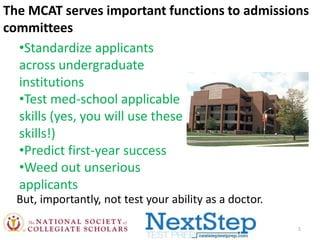
The MCAT serves important functions to admissions
committees
•Standardize applicants
across undergraduate
institutions
•Test med-school applicable
skills (yes, you will use these
skills!)
•Predict first-year success
•Weed out unserious
applicants
But, importantly, not test your ability as a doctor.
5
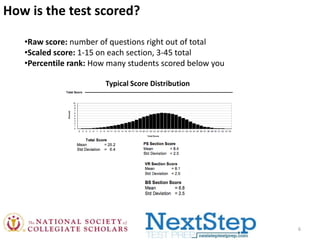
How is the test scored?
•Raw score: number of questions right out of total
•Scaled score: 1-15 on each section, 3-45 total
•Percentile rank: How many students scored below you
Typical Score Distribution

6
•The MCAT in Admissions
•What’s On the Exam?
•How Should You Prepare?

7
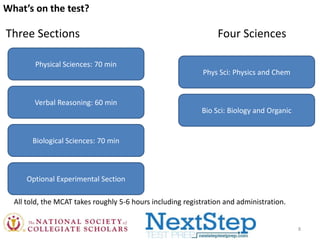
What’s on the test?

Three Sections
Physical Sciences: 70 min

Verbal Reasoning: 60 min

Four Sciences
Phys Sci: Physics and Chem

Bio Sci: Biology and Organic

Biological Sciences: 70 min

Optional Experimental Section
All told, the MCAT takes roughly 5-6 hours including registration and administration.

8
Physical and Biological Sciences
•70 minutes, 52 Q's, 7 Passages
•It's NOT a science test, actually tests:
•Critical reading
•Time / Anxiety management
•Problem-solving skills
•Some pure recall

•Requires only basic science: one year of
freshman chem, physics, bio, organic

9
Verbal Reasoning
Like the ACT/SAT, except much MUCH harder.

•7 passages covering hard and soft sciences as well
as the arts
•40 total questions
•The challenge: answer choices are cleverly
designed for you to get them wrong
•Significantly harder than the prior version

10
•The MCAT in Admissions
•What’s On the Exam?
•How Should You Prepare?

11
Step 1: Take a free practice MCAT. How does your score
compare to your goal?

http://e-mcat.com
Step 2: Get the free science outlines from the AAMC:
https://www.aamc.org/students/applying/mcat/preparing/
Step 3: Register for the test and make a plan!

12
Applying early can have big benefits

Almost all med schools practice “rolling admissions.” There are
more seats available in

August

than there are in January.

13
What skills do I need to build?

Critical Reading.
Ok, and science content, and time management, and
tolerance for pressure.

14
What materials should I use?

Good question.
•Start with getting ALL official AAMC
materials: practice tests and selfassessment packages
•Next Step has discounts with the
AAMC for our students
•Any prep company will supply you
with great books
•Lots of free stuff out there!

15
How many tests should I take?
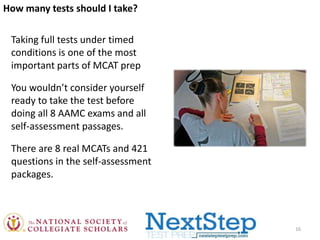
Taking full tests under timed
conditions is one of the most
important parts of MCAT prep
You wouldn’t consider yourself
ready to take the test before
doing all 8 AAMC exams and all
self-assessment passages.
There are 8 real MCATs and 421
questions in the self-assessment
packages.

16
How many times should you take the MCAT?

Once.
You should absolutely not take the MCAT unprepared to “see how you do.” That’s the
function of free diagnostic exams taken at home.
Med schools get to see ALL of your scores. So if you take it unprepared, you will have to
work very VERY hard to overcome that low score. Med schools may:
• Take the most recent score
• Take the highest score
• Take the highest of each section score
• Average your scores (most common)
Further, students are permitted to take the exam only three times with the current
version of the MCAT.

17
Will you improve on a retake?
Be careful! As many as 30% of test-takers see a DROP in their second MCAT score, and
another 10-20% see NO CHANGE in their retake.

You should consider retaking the exam if:
•Your score is so low you won't even bother applying with it
•Something disastrous happened on the day of the exam (left half a section blank, had
the flu, etc)
•You scored lower than your lowest practice test
•You can point to a specific deficiency in your MCAT prep (only studied with bargain
MCAT prep books, did not yet take physics, etc.)

18
Ideal Prep Calendars

Most students take 3 months of full time work to prepare for the exam.

•If you can't do MCATs FT (you have work, school, etc) then you will need 5-6 months of
PT work.
•Less than a month is not enough time to reach your top score
As of today, there is still ample time to prepare for the March MCAT, or any other 2014
dates.
If you're applying in 2014, take the MCAT between March and June of 2014.

19
A basic 3-month study plan
If you are working with a tutor or taking a course, a professional will recommend a study
plan for you.
If you are studying on your own, consider the following outline:

Month 1:
•Take a diagnostic exam; purchase prep books and AAMC materials
•Do 2-3 chapters a day from your prep books to review all content
•Start doing verbal every day to build up your verbal skills
Month 2:
•Finish content review, and go back to your books as needed
•Start taking a full AAMC test once a week
•Analyze every AAMC test carefully! LESSONS LEARNED
Month 3:
•Complete remaining AAMC exams, re-take your diagnostic
•Complete all self-assessment package questions

20
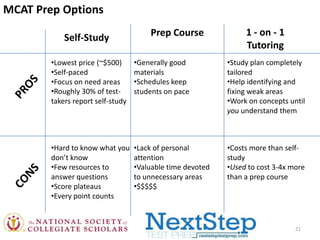
MCAT Prep Options
Self-Study

Prep Course

1 - on - 1
Tutoring

•Lowest price (~$500)
•Self-paced
•Focus on need areas
•Roughly 30% of testtakers report self-study

•Generally good
materials
•Schedules keep
students on pace

•Study plan completely
tailored
•Help identifying and
fixing weak areas
•Work on concepts until
you understand them

•Hard to know what you
don’t know
•Few resources to
answer questions
•Score plateaus
•Every point counts

•Lack of personal
attention
•Valuable time devoted
to unnecessary areas
•$$$$$

•Costs more than selfstudy
•Used to cost 3-4x more
than a prep course

21
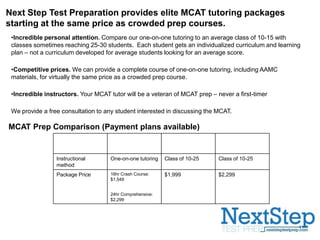
Next Step Test Preparation provides elite MCAT tutoring packages
starting at the same price as crowded prep courses.
•Incredible personal attention. Compare our one-on-one tutoring to an average class of 10-15 with
classes sometimes reaching 25-30 students. Each student gets an individualized curriculum and learning
plan – not a curriculum developed for average students looking for an average score.
•Competitive prices. We can provide a complete course of one-on-one tutoring, including AAMC
materials, for virtually the same price as a crowded prep course.
•Incredible instructors. Your MCAT tutor will be a veteran of MCAT prep – never a first-timer
We provide a free consultation to any student interested in discussing the MCAT.

MCAT Prep Comparison (Payment plans available)
Next Step

Kaplan

Princeton
Review

Instructional
method

One-on-one tutoring

Class of 10-25

Class of 10-25

Package Price

16hr Crash Course:
$1,549

$1,999

$2,299

24hr Comprehensive:
$2,299
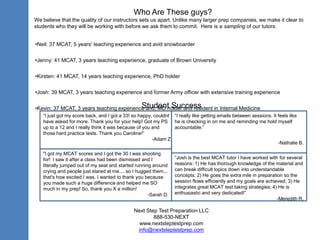
Who Are These guys?
We believe that the quality of our instructors sets us apart. Unlike many larger prep companies, we make it clear to
students who they will be working with before we ask them to commit. Here is a sampling of our tutors:
•Neil: 37 MCAT, 5 years' teaching experience and avid snowboarder
•Jenny: 41 MCAT, 3 years teaching experience, graduate of Brown University
•Kirsten: 41 MCAT, 14 years teaching experience, PhD holder
•Josh: 39 MCAT, 3 years teaching experience and former Army officer with extensive training experience

Student Success
•Kevin: 37 MCAT, 3 years teaching experience and, MD holder and resident in Internal Medicine
“I just got my score back, and I got a 33! so happy, couldnt “I really like getting emails between sessions. It feels like
have asked for more. Thank you for your help! Got my PS he is checking in on me and reminding me hold myself
up to a 12 and I really think it was because of you and
accountable.”
those hard practice tests. Thank you Caroline!”
-Adam Z.
-Nathalie B.
"I got my MCAT scores and I got the 30 I was shooting
for! I saw it after a class had been dismissed and I
literally jumped out of my seat and started running around
crying and people just stared at me.... so I hugged them...
that's how excited I was. I wanted to thank you because
you made such a huge difference and helped me SO
much in my prep! So, thank you X a million!
-Sarah D.

“Josh is the best MCAT tutor I have worked with for several
reasons: 1) He has thorough knowledge of the material and
can break difficult topics down into understandable
concepts; 2) He goes the extra mile in preparation so the
session flows efficiently and my goals are achieved; 3) He
integrates great MCAT test taking strategies; 4) He is
enthusiastic and very dedicated!”
-Meredith R.

Next Step Test Preparation LLC
888-530-NEXT
www.nextsteptestprep.com
info@nextsteptestprep.com
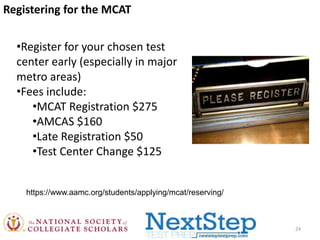
Registering for the MCAT
•Register for your chosen test
center early (especially in major
metro areas)
•Fees include:
•MCAT Registration $275
•AMCAS $160
•Late Registration $50
•Test Center Change $125
https://www.aamc.org/students/applying/mcat/reserving/

24
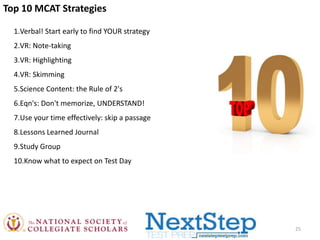
Top 10 MCAT Strategies
1.Verbal! Start early to find YOUR strategy
2.VR: Note-taking
3.VR: Highlighting

4.VR: Skimming
5.Science Content: the Rule of 2's
6.Eqn's: Don't memorize, UNDERSTAND!
7.Use your time effectively: skip a passage
8.Lessons Learned Journal
9.Study Group
10.Know what to expect on Test Day

25
Thank you for listening!
Contact me if you've any questions about the
MCAT or med school admissions.
Bryan Schnedeker
Bryan@NextStepTestPrep.com
973-866-0149
www.nextsteptestprep.com

26

Next Step Test Prep MCAT Webinar

  • 1.
    Introduction to theMCAT NSCS Webinar Series Bryan Schnedeker MCAT Director, Next Step Test Prep 1
  • 2.
    Introductions •Bryan Schnedeker •MCAT Directorof Next Step Test Preparation •Worked with thousands of MCAT students over the last 12 years •Personally achieved a 41 MCAT, including perfect 15 in Bio Sci 2
  • 3.
    •The MCAT inAdmissions •What’s On the Exam? •How Should You Prepare? 3
  • 4.
    What is theMCAT? Who takes it? The MCAT is required by students applying to all AAMC med schools. While the importance of the MCAT varies by admissions department, generally the MCAT and GPA are by far the largest factors in admissions decisions. Put another way – the MCAT is more important in med school admissions than SAT and ACT are in college admissions. 4
  • 5.
    The MCAT servesimportant functions to admissions committees •Standardize applicants across undergraduate institutions •Test med-school applicable skills (yes, you will use these skills!) •Predict first-year success •Weed out unserious applicants But, importantly, not test your ability as a doctor. 5
  • 6.
    How is thetest scored? •Raw score: number of questions right out of total •Scaled score: 1-15 on each section, 3-45 total •Percentile rank: How many students scored below you Typical Score Distribution 6
  • 7.
    •The MCAT inAdmissions •What’s On the Exam? •How Should You Prepare? 7
  • 8.
    What’s on thetest? Three Sections Physical Sciences: 70 min Verbal Reasoning: 60 min Four Sciences Phys Sci: Physics and Chem Bio Sci: Biology and Organic Biological Sciences: 70 min Optional Experimental Section All told, the MCAT takes roughly 5-6 hours including registration and administration. 8
  • 9.
    Physical and BiologicalSciences •70 minutes, 52 Q's, 7 Passages •It's NOT a science test, actually tests: •Critical reading •Time / Anxiety management •Problem-solving skills •Some pure recall •Requires only basic science: one year of freshman chem, physics, bio, organic 9
  • 10.
    Verbal Reasoning Like theACT/SAT, except much MUCH harder. •7 passages covering hard and soft sciences as well as the arts •40 total questions •The challenge: answer choices are cleverly designed for you to get them wrong •Significantly harder than the prior version 10
  • 11.
    •The MCAT inAdmissions •What’s On the Exam? •How Should You Prepare? 11
  • 12.
    Step 1: Takea free practice MCAT. How does your score compare to your goal? http://e-mcat.com Step 2: Get the free science outlines from the AAMC: https://www.aamc.org/students/applying/mcat/preparing/ Step 3: Register for the test and make a plan! 12
  • 13.
    Applying early canhave big benefits Almost all med schools practice “rolling admissions.” There are more seats available in August than there are in January. 13
  • 14.
    What skills doI need to build? Critical Reading. Ok, and science content, and time management, and tolerance for pressure. 14
  • 15.
    What materials shouldI use? Good question. •Start with getting ALL official AAMC materials: practice tests and selfassessment packages •Next Step has discounts with the AAMC for our students •Any prep company will supply you with great books •Lots of free stuff out there! 15
  • 16.
    How many testsshould I take? Taking full tests under timed conditions is one of the most important parts of MCAT prep You wouldn’t consider yourself ready to take the test before doing all 8 AAMC exams and all self-assessment passages. There are 8 real MCATs and 421 questions in the self-assessment packages. 16
  • 17.
    How many timesshould you take the MCAT? Once. You should absolutely not take the MCAT unprepared to “see how you do.” That’s the function of free diagnostic exams taken at home. Med schools get to see ALL of your scores. So if you take it unprepared, you will have to work very VERY hard to overcome that low score. Med schools may: • Take the most recent score • Take the highest score • Take the highest of each section score • Average your scores (most common) Further, students are permitted to take the exam only three times with the current version of the MCAT. 17
  • 18.
    Will you improveon a retake? Be careful! As many as 30% of test-takers see a DROP in their second MCAT score, and another 10-20% see NO CHANGE in their retake. You should consider retaking the exam if: •Your score is so low you won't even bother applying with it •Something disastrous happened on the day of the exam (left half a section blank, had the flu, etc) •You scored lower than your lowest practice test •You can point to a specific deficiency in your MCAT prep (only studied with bargain MCAT prep books, did not yet take physics, etc.) 18
  • 19.
    Ideal Prep Calendars Moststudents take 3 months of full time work to prepare for the exam. •If you can't do MCATs FT (you have work, school, etc) then you will need 5-6 months of PT work. •Less than a month is not enough time to reach your top score As of today, there is still ample time to prepare for the March MCAT, or any other 2014 dates. If you're applying in 2014, take the MCAT between March and June of 2014. 19
  • 20.
    A basic 3-monthstudy plan If you are working with a tutor or taking a course, a professional will recommend a study plan for you. If you are studying on your own, consider the following outline: Month 1: •Take a diagnostic exam; purchase prep books and AAMC materials •Do 2-3 chapters a day from your prep books to review all content •Start doing verbal every day to build up your verbal skills Month 2: •Finish content review, and go back to your books as needed •Start taking a full AAMC test once a week •Analyze every AAMC test carefully! LESSONS LEARNED Month 3: •Complete remaining AAMC exams, re-take your diagnostic •Complete all self-assessment package questions 20
  • 21.
    MCAT Prep Options Self-Study PrepCourse 1 - on - 1 Tutoring •Lowest price (~$500) •Self-paced •Focus on need areas •Roughly 30% of testtakers report self-study •Generally good materials •Schedules keep students on pace •Study plan completely tailored •Help identifying and fixing weak areas •Work on concepts until you understand them •Hard to know what you don’t know •Few resources to answer questions •Score plateaus •Every point counts •Lack of personal attention •Valuable time devoted to unnecessary areas •$$$$$ •Costs more than selfstudy •Used to cost 3-4x more than a prep course 21
  • 22.
    Next Step TestPreparation provides elite MCAT tutoring packages starting at the same price as crowded prep courses. •Incredible personal attention. Compare our one-on-one tutoring to an average class of 10-15 with classes sometimes reaching 25-30 students. Each student gets an individualized curriculum and learning plan – not a curriculum developed for average students looking for an average score. •Competitive prices. We can provide a complete course of one-on-one tutoring, including AAMC materials, for virtually the same price as a crowded prep course. •Incredible instructors. Your MCAT tutor will be a veteran of MCAT prep – never a first-timer We provide a free consultation to any student interested in discussing the MCAT. MCAT Prep Comparison (Payment plans available) Next Step Kaplan Princeton Review Instructional method One-on-one tutoring Class of 10-25 Class of 10-25 Package Price 16hr Crash Course: $1,549 $1,999 $2,299 24hr Comprehensive: $2,299
  • 23.
    Who Are Theseguys? We believe that the quality of our instructors sets us apart. Unlike many larger prep companies, we make it clear to students who they will be working with before we ask them to commit. Here is a sampling of our tutors: •Neil: 37 MCAT, 5 years' teaching experience and avid snowboarder •Jenny: 41 MCAT, 3 years teaching experience, graduate of Brown University •Kirsten: 41 MCAT, 14 years teaching experience, PhD holder •Josh: 39 MCAT, 3 years teaching experience and former Army officer with extensive training experience Student Success •Kevin: 37 MCAT, 3 years teaching experience and, MD holder and resident in Internal Medicine “I just got my score back, and I got a 33! so happy, couldnt “I really like getting emails between sessions. It feels like have asked for more. Thank you for your help! Got my PS he is checking in on me and reminding me hold myself up to a 12 and I really think it was because of you and accountable.” those hard practice tests. Thank you Caroline!” -Adam Z. -Nathalie B. "I got my MCAT scores and I got the 30 I was shooting for! I saw it after a class had been dismissed and I literally jumped out of my seat and started running around crying and people just stared at me.... so I hugged them... that's how excited I was. I wanted to thank you because you made such a huge difference and helped me SO much in my prep! So, thank you X a million! -Sarah D. “Josh is the best MCAT tutor I have worked with for several reasons: 1) He has thorough knowledge of the material and can break difficult topics down into understandable concepts; 2) He goes the extra mile in preparation so the session flows efficiently and my goals are achieved; 3) He integrates great MCAT test taking strategies; 4) He is enthusiastic and very dedicated!” -Meredith R. Next Step Test Preparation LLC 888-530-NEXT www.nextsteptestprep.com info@nextsteptestprep.com
  • 24.
    Registering for theMCAT •Register for your chosen test center early (especially in major metro areas) •Fees include: •MCAT Registration $275 •AMCAS $160 •Late Registration $50 •Test Center Change $125 https://www.aamc.org/students/applying/mcat/reserving/ 24
  • 25.
    Top 10 MCATStrategies 1.Verbal! Start early to find YOUR strategy 2.VR: Note-taking 3.VR: Highlighting 4.VR: Skimming 5.Science Content: the Rule of 2's 6.Eqn's: Don't memorize, UNDERSTAND! 7.Use your time effectively: skip a passage 8.Lessons Learned Journal 9.Study Group 10.Know what to expect on Test Day 25
  • 26.
    Thank you forlistening! Contact me if you've any questions about the MCAT or med school admissions. Bryan Schnedeker Bryan@NextStepTestPrep.com 973-866-0149 www.nextsteptestprep.com 26