TEST ANXIETY: SCIENCE AND
SOLUTIONS
Dr. Frank O’Neill
Frank@OnlineTeacherYOUniversity.com
GrowGrayMatter on Twitter and Linkedin
OnlineTeacherYOUniversity on Facebook and YouTube
www.OnlineTeacherYOUniversity.com
All images in the presentation are from Pixabay. No attribution is required
www.pixabay.com
HOW SHOULD WE VIEW TEST ANXIETY?
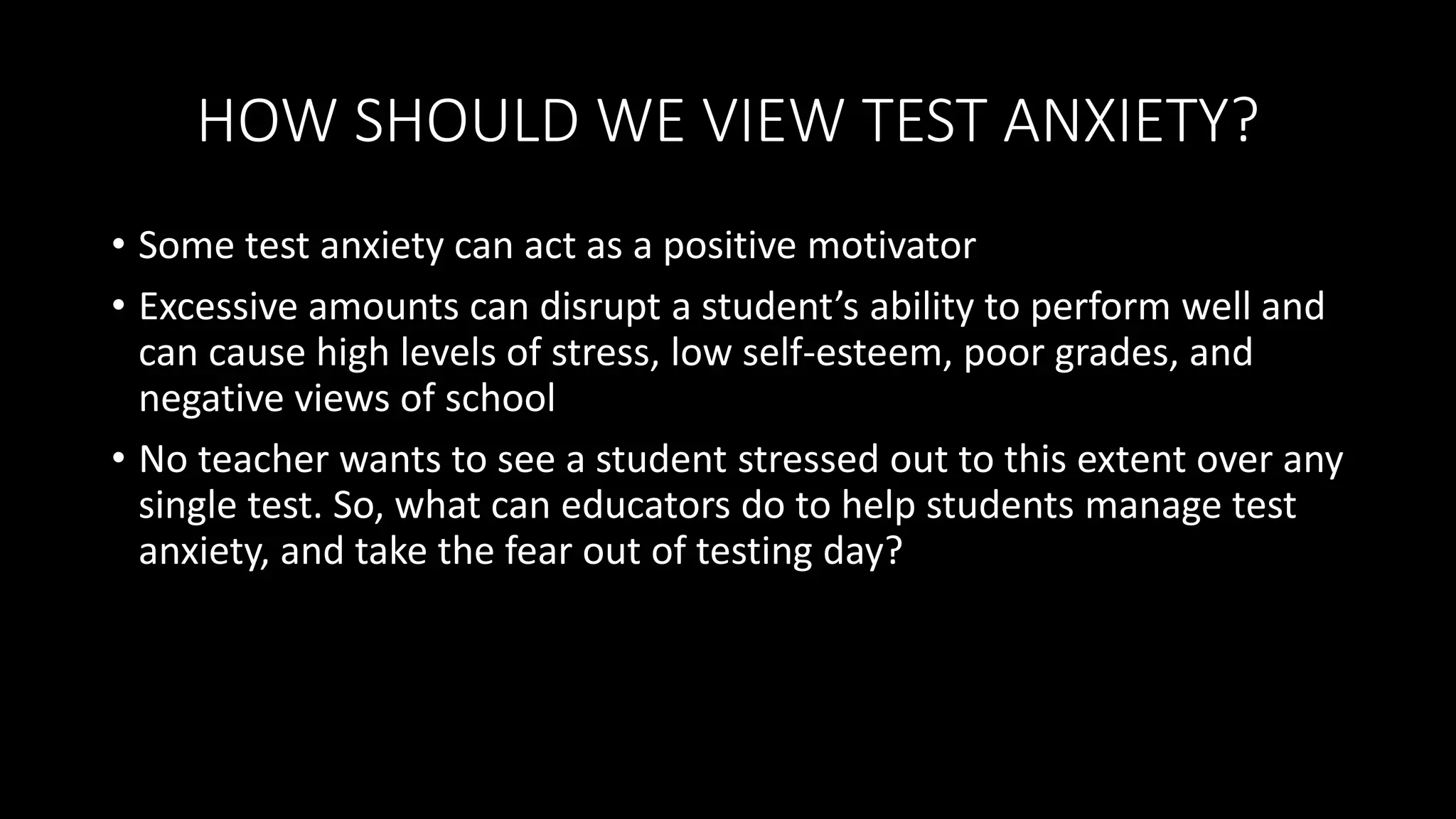
• As any teacher knows, tests can
create crippling anxiety in
students
• Anxious students can perform
below their true abilities
• I want to know what my
students actually know, not what
they can recall while they are
freaking out
HOW SHOULD WE VIEW TEST ANXIETY?
• Some test anxiety can act as a positive motivator
• Excessive amounts can disrupt a student’s ability to perform well and
can cause high levels of stress, low self-esteem, poor grades, and
negative views of school
• No teacher wants to see a student stressed out to this extent over any
single test. So, what can educators do to help students manage test
anxiety, and take the fear out of testing day?
WHAT IS TEST ANXIETY?
• Ask former Supreme Court Justice Potter Stewart 
• Most students experience some level of anxiety during an exam
• 2012 British Psychological Society study found that test anxiety is more
detrimental to performance for some people than others. Students with
good working memories actually achieved higher test results when they
had test anxiety. However, students with poor working memory had poor
test results associated with test anxiety
• When anxiety affects exam performance it has become a problem
• The Anxiety and Depression Association of America officially recognizes
test anxiety as a type of performance anxiety, characterized by extreme
nervousness about taking a test
WHAT IS TEST ANXIETY?
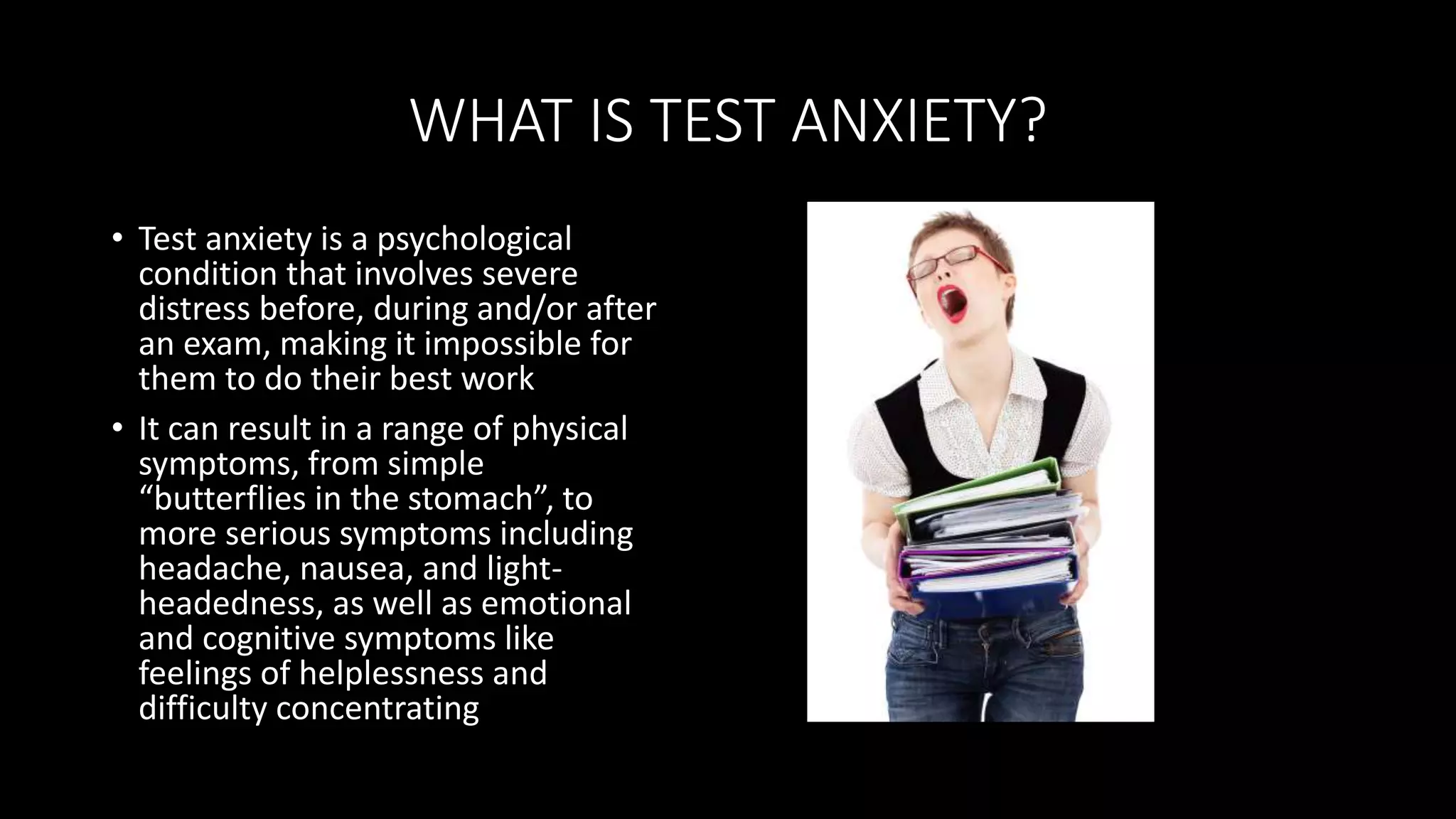
• Test anxiety is a psychological
condition that involves severe
distress before, during and/or after
an exam, making it impossible for
them to do their best work
• It can result in a range of physical
symptoms, from simple
“butterflies in the stomach”, to
more serious symptoms including
headache, nausea, and light-
headedness, as well as emotional
and cognitive symptoms like
feelings of helplessness and
difficulty concentrating
WHAT IS TEST ANXIETY?
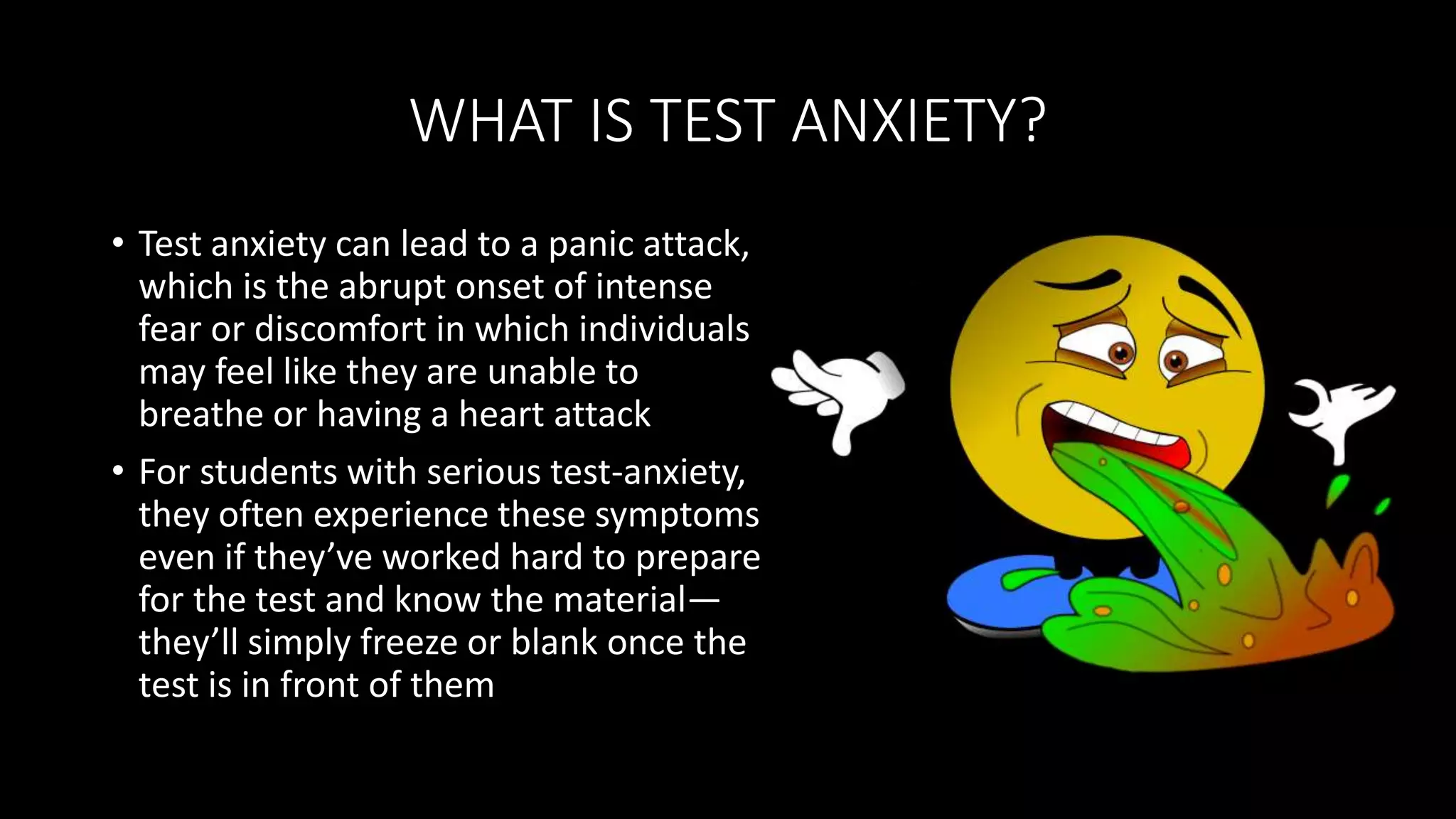
• Test anxiety can lead to a panic attack,
which is the abrupt onset of intense
fear or discomfort in which individuals
may feel like they are unable to
breathe or having a heart attack
• For students with serious test-anxiety,
they often experience these symptoms
even if they’ve worked hard to prepare
for the test and know the material—
they’ll simply freeze or blank once the
test is in front of them
HOW COMMON IS TEST ANXIETY?
• According to a 2010 study in Educational Psychology, text anxiety can
affect anywhere between 10 to 40 percent of all students. That
percentage has seemed to increase alongside the increase in
standardized testing
• It’s not clear exactly how many students have it but severe test
anxiety could afflict as much as 20 percent of the school-going
population, according to the American Test Anxiety Association, and
another 18 percent may have a moderate form of the condition
WHAT CAUSES TEST ANXIETY?
• All anxiety is a reaction to anticipating something stressful. Like other
anxiety reactions, test anxiety affects the body and the mind
• According to the Anxiety and Depression Association of America,
causes of test anxiety may include a fear of failure, lack of adequate
prep time, or bad experiences taking tests in the past
WHAT CAUSES TEST ANXIETY?
• Lack of preparation: Waiting until the last minute or not studying at
all can leave individuals feeling anxious and overwhelmed
• I don’t waste my limited time and energy trying to help students that don’t
help themselves. Having test anxiety because you haven’t prepared or put in
the effort is not real test anxiety (It’s a no-brainer)
• Fear of failure: While the pressure to perform can act as a motivator,
it can also be devastating to individuals who tie their self-worth to the
outcome of a test
• Poor test history: Previous problems or bad experiences with test-
taking can lead to a negative mindset and influence performance on
future tests
WHERE DO WE BEGIN?
• Your students should never
feel like you are the one
trying to hold them back.
• They should feel like you are
the one helping to propel
them forward
• Be a part of their team
BUILD A RESILIENT STUDENT
• Many students find that their test anxiety eases when they start to
study better or more regularly
• It makes sense — the more you know the material, the more
confident you'll feel. Having confidence going into a test means you
expect to do well. When you expect to do well, you'll be able to relax
into a test after the normal first-moment jitters pass
• What can we do to increase the odds that this will happen?
BUILD A RESILIENT STUDENT
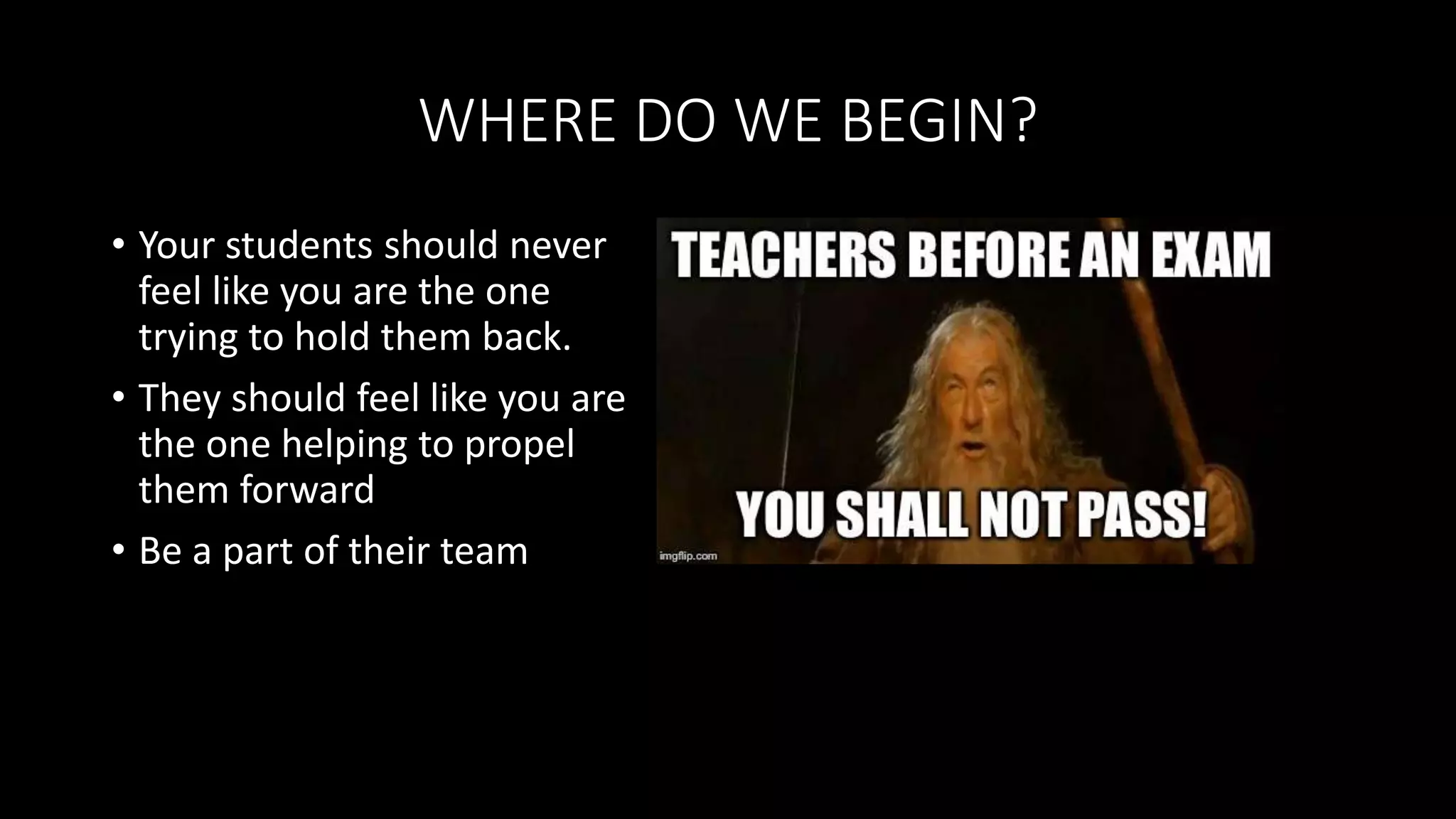
Help (or force) students to develop a good study
schedule:
• Teach like a coach
• Remind students where they should be at in their
learning each week
• Provide ample review each week
• Give students an estimate of how much time they
should be spending in your course each week
• Weekly quizzes or other strategies to keep students
from waiting until the end of the unit to start their
learning
BUILD A RESILIENT STUDENT
Help them to help themselves:
• Some students think that doing the bare
minimum in their classes is all it should
take to learn and do well on tests
• Teach your students to be very
intentional about how they prepare for
your course
• Make sure that students know that
reading isn’t enough. They need to be
able to concentrate, focus, synthesize,
and learn the material well enough to
recall it
BUILD A RESILIENT STUDENT
Help them to help themselves:
• Scheduling study time at their best time for
learning
• Study in an environment that is similar to the
testing environment
• Teach them about spaced repetition
• Develop good test-taking skills. Read the
directions carefully, answer questions you know
first and then return to the more difficult ones.
Outline essays before you begin to write
BUILD A RESILIENT STUDENT
Help them to help each other:
• Recommend that students get to know students in their area in case they
want to form study groups
• Assign a “Study Buddy”
• Facilitate peer study groups by allowing a place for it in your course shells
• Host a peer discussion group online where students can pose questions for
their peers to answer
• This could be asynchronous or live via Zoom, etc
• By monitoring these discussions you can see where students need
clarification before the test
BE A GOOD GUIDE
Teaching and Course Management Methods:
• Model low levels of anxiety in your interactions with your students.
Research shows a correlation between degrees of tension and
uneasiness displayed by teachers and levels of anxiety experienced by
students
• Positive “parenting” in your courses
• Examine the results of tests beyond recording grades. Use tests as
tools to focus on areas in which weaker students are less confident
and focus on these areas with the students. Increased confidence is
the key to lessened anxiety
BE A GOOD GUIDE
• Aim to have graded work back to
students with sufficient time for the
students to review their grade and
feedback and ask follow-up
questions
• Attempt to stagger testing schedules
as much as possible when students
attend classes taught by multiple
teachers so that students may focus
on fewer subjects at once
BE A GOOD GUIDE
• Outside of the “classroom”:
• Consider offering extra review opportunities outside of class as well.
Online office hours are a low-pressure way that anxious students
looking for some additional practice will appreciate
• Have a place that you check regularly where students can ask
questions
• Consider requiring students to complete study logs
• Encourage students to seek clarification or additional help, when
needed, from you or others
Prepare the Student for the Exam Part 1
(Content prep)
• Make sure you have a well-thought-out review plan to give your
students plenty of chances to brush up on knowledge and skills they’ll
be assessed on
• Create a study guide of what will likely be on the test. Don't leave
students guessing
• Don’t teach TO the test, but teach the students the material that is
important enough to be on an exam
• Create short audio and video resources for students to review course
content. This is especially important for reviewing the trickier
concepts of the course
Prepare the Student for the Exam Part 2
(Exam prep)
• Make sure your students are comfortable with the type of test
environment they’ll experience. If tests will be taken online, make
sure your students are familiar with the kind of devices they’ll use
and any technology they will encounter
• Give students lots of notice about your exams: Due dates, proctor
requirements, test format
• Make sure your test instructions are clear. Ambiguity will lead to
increased anxiety
Prepare the Student for the Exam Part 2
(Exam prep)
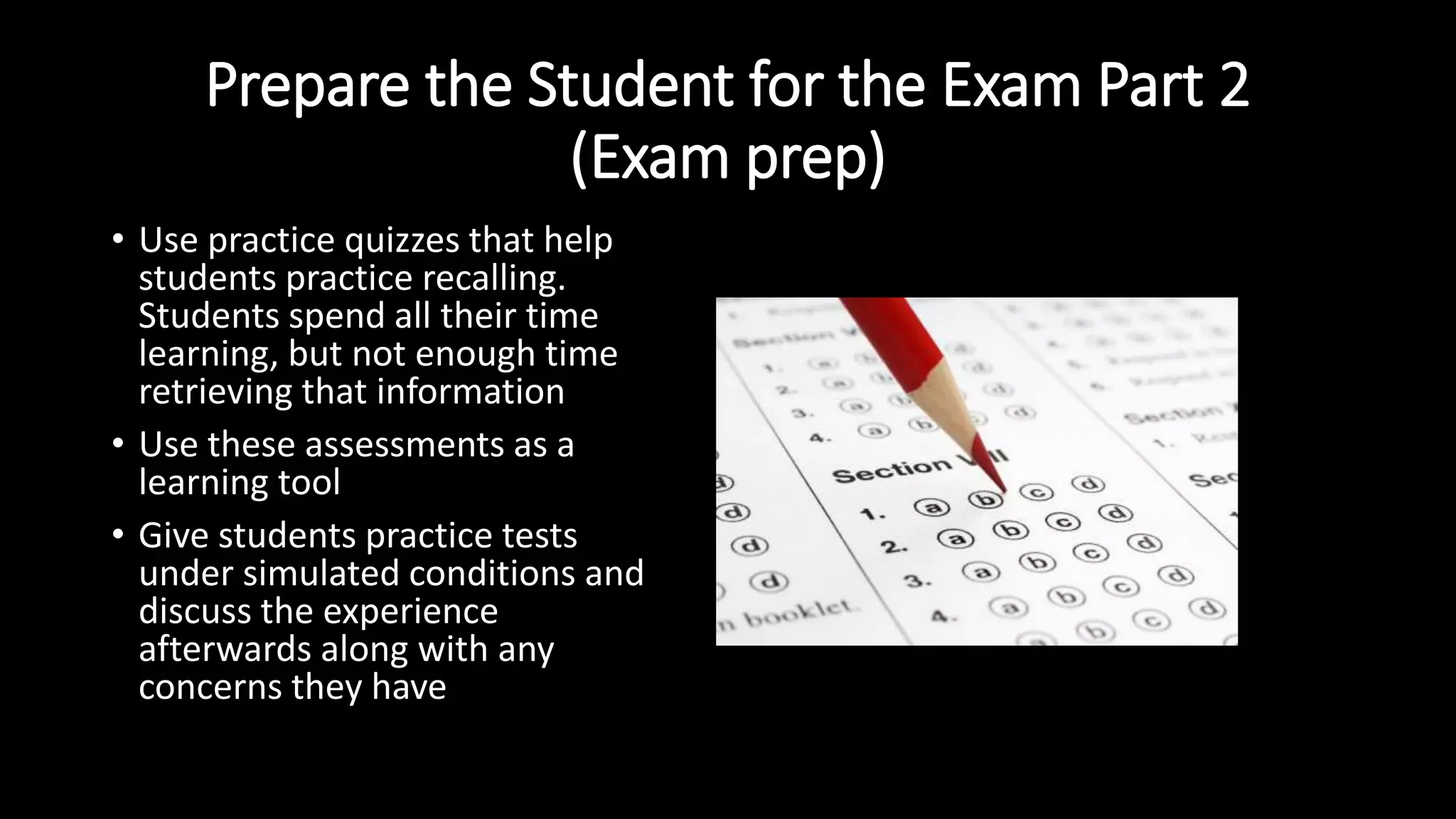
• Use practice quizzes that help
students practice recalling.
Students spend all their time
learning, but not enough time
retrieving that information
• Use these assessments as a
learning tool
• Give students practice tests
under simulated conditions and
discuss the experience
afterwards along with any
concerns they have
Prepare the Student for the Exam Part 2
(Exam prep)
• Have these practice exams due several days or more before the exam
date to “force” students to study ahead of time instead of cramming
or pulling an “all-nighter.”
• I like to use the publisher test banks for these since I make all of my
own test questions
• Alternatives could include showing students older tests or providing a
few sample questions
ANXIETY PROOF YOUR TESTS
• Design your tests to cover topics that you
emphasize in your course
• If it is valuable enough to test on, it is valuable
enough to teach on
• Avoid adding questions on a concept test
about a fact that was only briefly mentioned
in class or that was covered in one bullet point
on a PowerPoint slide
• Expecting recall of an esoteric fact promotes
anxiety in some people
ANXIETY PROOF YOUR TESTS
• If your school offers professional development on effective question
writing, make sure you attend a workshop. Writing good test
questions is not easy
• If your tests include a lot of multiple-choice questions, make sure
your questions are well written and are clearly matched to a learning
outcome
• Make questions that they will be able to answer if they UNDERSTAND
the review materials rather than memorize the review materials
BE A RESOURCE FOR YOUR STUDENTS
• Make sure your students know that you are a
resource, but you are not a mind reader
• Students need to know that they can come to
you if they have issues with test anxiety, but
not an hour before the test
• Teach or review effective study and
organizational skills (what to study and how
to study)
• Teach students successful test-taking
strategies
• Teach students how to learn from their
mistakes on previous exams
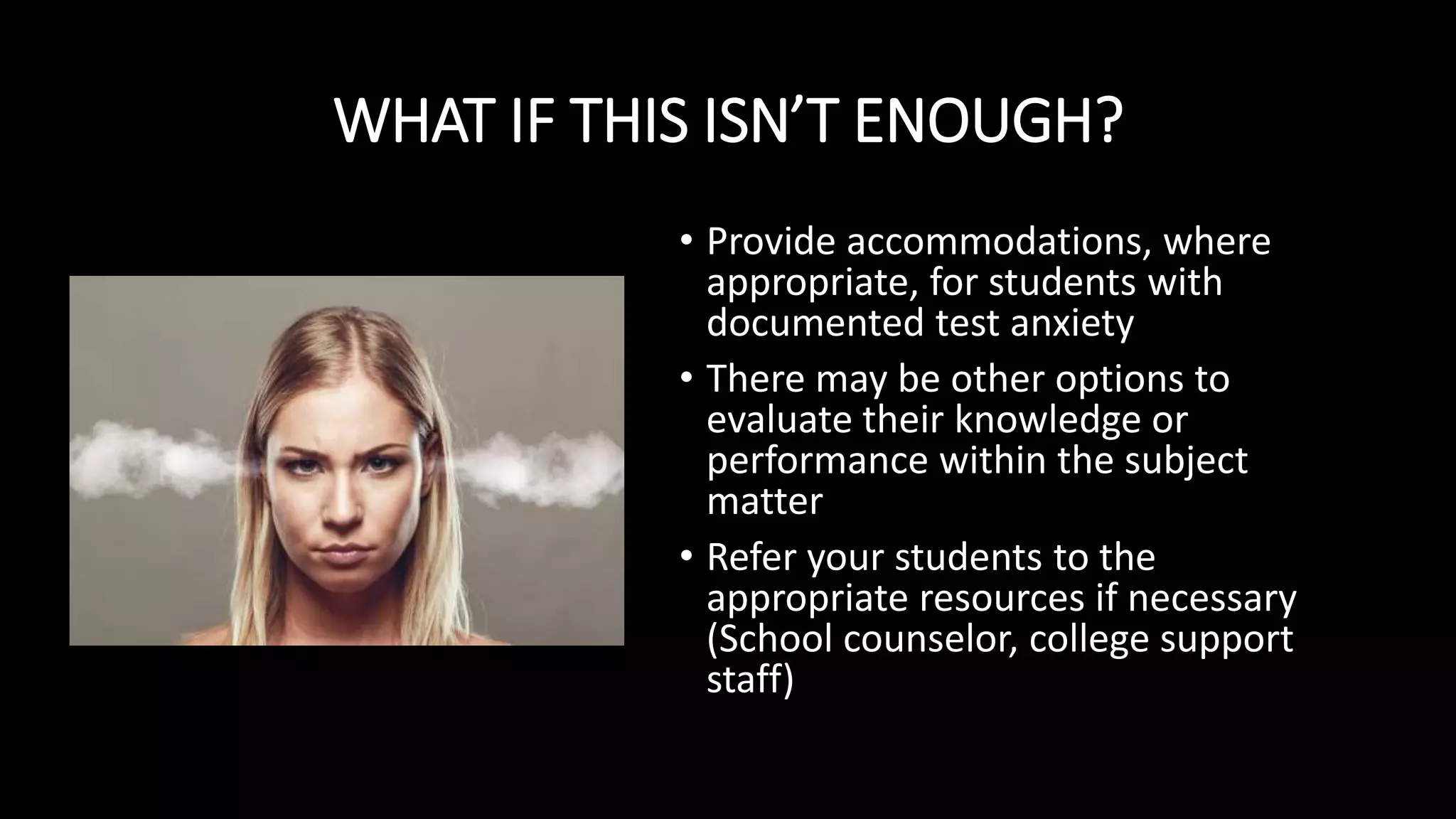
WHAT IF THIS ISN’T ENOUGH?
• Provide accommodations, where
appropriate, for students with
documented test anxiety
• There may be other options to
evaluate their knowledge or
performance within the subject
matter
• Refer your students to the
appropriate resources if necessary
(School counselor, college support
staff)
WHERE CAN YOU START?
• What are 5 things that you can do to help your students deal with test
anxiety?
• BONUS: These same 5 things will help your students that don’t
struggle with test anxiety 
HELPING STUDENTS COPE
• Use it!
• Encourage students to view some anxiety as healthy and helpful. Moderate
amounts of anxiety can actually facilitate performance
• Sometimes just remembering that some test-taking anxiety is a normal part of
school can help make it easier to handle
• Use a little stress to your advantage. Stress is your body's warning mechanism —
it's a signal that helps you prepare for something important that's about to
happen. So use it to your advantage
• Instead of reacting to the stress by dreading, complaining, or fretting about the
test with friends, take an active approach
• Let stress remind you to study well in advance of a test. Chances are, you'll keep
your stress from spinning out of control. After all, nobody ever feels stressed out
by thoughts that they might do well on a test
PHYSICAL PREPERATION TIPS
• Stay healthy:
Get enough sleep, eat healthfully, exercise and allow for personal time. If you
are exhausted—physically or emotionally—it will be more difficult for you to
handle stress and anxiety
• Get a good night’s sleep:
Cramming is never the answer, and pulling an all-nighter can exacerbate your
nerves. Having adequate rest (9–10 hours per night) is likely to be more
beneficial than rereading a text until dawn
• Fuel up:
Eat a nutritious breakfast before the test and pack smart snacks for ongoing
energy. Look for foods that offer a steady stream of nutrients, rather than a
sugar high followed by a crash
POST-TEST TIPS I SHARE WITH MY STUDENTS
• Reviewing your past performance on tests to improve and learn from
experience
• After the test, review how you did
• List what worked, and hold onto these strategies
• It does not matter how small the items are: they are building blocks
to success
• List what did not work for improvement
• Celebrate that you are on the road to overcoming this obstacle
SHARE RESOURCES WITH YOUR STUDENTS
• Website with practice quizzes for students:
www.koofers.com
SHARE RESOURCES WITH YOUR STUDENTS
Test Anxiety: How to Take On Your Exams Without Stress - College Info Geek
https://youtu.be/fHfHSq7PVDU
Test Anxiety: Crash Course Study Skills #8 (similar to first one)
https://youtu.be/t-9cqaRJMP4
A Brain Hack (of sorts) for Exams and Tests - College Info Geek
https://youtu.be/USkDbcGPKP0
10 Study Tips for Earning an A on Your Next Exam - College Info Geek
https://youtu.be/jYWfiP7w5w0
SHARE RESOURCES WITH YOUR STUDENTS
5 Rules (and One Secret Weapon) for Acing Multiple Choice Tests
https://youtu.be/Q1y8c_MZYvE
Exam Tips: How to Study for Finals - College Info Geek
https://youtu.be/qWUUP5p0Auo
10 Ways to Avoid Making Stupid Mistakes on Exams - College Info Geek
https://youtu.be/OY6Z8gNKp-w

Creating Online Courses that Minimize Test Anxiety

  • 1.
    TEST ANXIETY: SCIENCEAND SOLUTIONS Dr. Frank O’Neill Frank@OnlineTeacherYOUniversity.com GrowGrayMatter on Twitter and Linkedin OnlineTeacherYOUniversity on Facebook and YouTube www.OnlineTeacherYOUniversity.com
  • 2.
    All images inthe presentation are from Pixabay. No attribution is required www.pixabay.com
  • 3.
    HOW SHOULD WEVIEW TEST ANXIETY? • As any teacher knows, tests can create crippling anxiety in students • Anxious students can perform below their true abilities • I want to know what my students actually know, not what they can recall while they are freaking out
  • 4.
    HOW SHOULD WEVIEW TEST ANXIETY? • Some test anxiety can act as a positive motivator • Excessive amounts can disrupt a student’s ability to perform well and can cause high levels of stress, low self-esteem, poor grades, and negative views of school • No teacher wants to see a student stressed out to this extent over any single test. So, what can educators do to help students manage test anxiety, and take the fear out of testing day?
  • 5.
    WHAT IS TESTANXIETY? • Ask former Supreme Court Justice Potter Stewart  • Most students experience some level of anxiety during an exam • 2012 British Psychological Society study found that test anxiety is more detrimental to performance for some people than others. Students with good working memories actually achieved higher test results when they had test anxiety. However, students with poor working memory had poor test results associated with test anxiety • When anxiety affects exam performance it has become a problem • The Anxiety and Depression Association of America officially recognizes test anxiety as a type of performance anxiety, characterized by extreme nervousness about taking a test
  • 6.
    WHAT IS TESTANXIETY? • Test anxiety is a psychological condition that involves severe distress before, during and/or after an exam, making it impossible for them to do their best work • It can result in a range of physical symptoms, from simple “butterflies in the stomach”, to more serious symptoms including headache, nausea, and light- headedness, as well as emotional and cognitive symptoms like feelings of helplessness and difficulty concentrating
  • 7.
    WHAT IS TESTANXIETY? • Test anxiety can lead to a panic attack, which is the abrupt onset of intense fear or discomfort in which individuals may feel like they are unable to breathe or having a heart attack • For students with serious test-anxiety, they often experience these symptoms even if they’ve worked hard to prepare for the test and know the material— they’ll simply freeze or blank once the test is in front of them
  • 8.
    HOW COMMON ISTEST ANXIETY? • According to a 2010 study in Educational Psychology, text anxiety can affect anywhere between 10 to 40 percent of all students. That percentage has seemed to increase alongside the increase in standardized testing • It’s not clear exactly how many students have it but severe test anxiety could afflict as much as 20 percent of the school-going population, according to the American Test Anxiety Association, and another 18 percent may have a moderate form of the condition
  • 9.
    WHAT CAUSES TESTANXIETY? • All anxiety is a reaction to anticipating something stressful. Like other anxiety reactions, test anxiety affects the body and the mind • According to the Anxiety and Depression Association of America, causes of test anxiety may include a fear of failure, lack of adequate prep time, or bad experiences taking tests in the past
  • 10.
    WHAT CAUSES TESTANXIETY? • Lack of preparation: Waiting until the last minute or not studying at all can leave individuals feeling anxious and overwhelmed • I don’t waste my limited time and energy trying to help students that don’t help themselves. Having test anxiety because you haven’t prepared or put in the effort is not real test anxiety (It’s a no-brainer) • Fear of failure: While the pressure to perform can act as a motivator, it can also be devastating to individuals who tie their self-worth to the outcome of a test • Poor test history: Previous problems or bad experiences with test- taking can lead to a negative mindset and influence performance on future tests
  • 11.
    WHERE DO WEBEGIN? • Your students should never feel like you are the one trying to hold them back. • They should feel like you are the one helping to propel them forward • Be a part of their team
  • 12.
    BUILD A RESILIENTSTUDENT • Many students find that their test anxiety eases when they start to study better or more regularly • It makes sense — the more you know the material, the more confident you'll feel. Having confidence going into a test means you expect to do well. When you expect to do well, you'll be able to relax into a test after the normal first-moment jitters pass • What can we do to increase the odds that this will happen?
  • 13.
    BUILD A RESILIENTSTUDENT Help (or force) students to develop a good study schedule: • Teach like a coach • Remind students where they should be at in their learning each week • Provide ample review each week • Give students an estimate of how much time they should be spending in your course each week • Weekly quizzes or other strategies to keep students from waiting until the end of the unit to start their learning
  • 14.
    BUILD A RESILIENTSTUDENT Help them to help themselves: • Some students think that doing the bare minimum in their classes is all it should take to learn and do well on tests • Teach your students to be very intentional about how they prepare for your course • Make sure that students know that reading isn’t enough. They need to be able to concentrate, focus, synthesize, and learn the material well enough to recall it
  • 15.
    BUILD A RESILIENTSTUDENT Help them to help themselves: • Scheduling study time at their best time for learning • Study in an environment that is similar to the testing environment • Teach them about spaced repetition • Develop good test-taking skills. Read the directions carefully, answer questions you know first and then return to the more difficult ones. Outline essays before you begin to write
  • 16.
    BUILD A RESILIENTSTUDENT Help them to help each other: • Recommend that students get to know students in their area in case they want to form study groups • Assign a “Study Buddy” • Facilitate peer study groups by allowing a place for it in your course shells • Host a peer discussion group online where students can pose questions for their peers to answer • This could be asynchronous or live via Zoom, etc • By monitoring these discussions you can see where students need clarification before the test
  • 17.
    BE A GOODGUIDE Teaching and Course Management Methods: • Model low levels of anxiety in your interactions with your students. Research shows a correlation between degrees of tension and uneasiness displayed by teachers and levels of anxiety experienced by students • Positive “parenting” in your courses • Examine the results of tests beyond recording grades. Use tests as tools to focus on areas in which weaker students are less confident and focus on these areas with the students. Increased confidence is the key to lessened anxiety
  • 18.
    BE A GOODGUIDE • Aim to have graded work back to students with sufficient time for the students to review their grade and feedback and ask follow-up questions • Attempt to stagger testing schedules as much as possible when students attend classes taught by multiple teachers so that students may focus on fewer subjects at once
  • 19.
    BE A GOODGUIDE • Outside of the “classroom”: • Consider offering extra review opportunities outside of class as well. Online office hours are a low-pressure way that anxious students looking for some additional practice will appreciate • Have a place that you check regularly where students can ask questions • Consider requiring students to complete study logs • Encourage students to seek clarification or additional help, when needed, from you or others
  • 20.
    Prepare the Studentfor the Exam Part 1 (Content prep) • Make sure you have a well-thought-out review plan to give your students plenty of chances to brush up on knowledge and skills they’ll be assessed on • Create a study guide of what will likely be on the test. Don't leave students guessing • Don’t teach TO the test, but teach the students the material that is important enough to be on an exam • Create short audio and video resources for students to review course content. This is especially important for reviewing the trickier concepts of the course
  • 21.
    Prepare the Studentfor the Exam Part 2 (Exam prep) • Make sure your students are comfortable with the type of test environment they’ll experience. If tests will be taken online, make sure your students are familiar with the kind of devices they’ll use and any technology they will encounter • Give students lots of notice about your exams: Due dates, proctor requirements, test format • Make sure your test instructions are clear. Ambiguity will lead to increased anxiety
  • 22.
    Prepare the Studentfor the Exam Part 2 (Exam prep) • Use practice quizzes that help students practice recalling. Students spend all their time learning, but not enough time retrieving that information • Use these assessments as a learning tool • Give students practice tests under simulated conditions and discuss the experience afterwards along with any concerns they have
  • 23.
    Prepare the Studentfor the Exam Part 2 (Exam prep) • Have these practice exams due several days or more before the exam date to “force” students to study ahead of time instead of cramming or pulling an “all-nighter.” • I like to use the publisher test banks for these since I make all of my own test questions • Alternatives could include showing students older tests or providing a few sample questions
  • 24.
    ANXIETY PROOF YOURTESTS • Design your tests to cover topics that you emphasize in your course • If it is valuable enough to test on, it is valuable enough to teach on • Avoid adding questions on a concept test about a fact that was only briefly mentioned in class or that was covered in one bullet point on a PowerPoint slide • Expecting recall of an esoteric fact promotes anxiety in some people
  • 25.
    ANXIETY PROOF YOURTESTS • If your school offers professional development on effective question writing, make sure you attend a workshop. Writing good test questions is not easy • If your tests include a lot of multiple-choice questions, make sure your questions are well written and are clearly matched to a learning outcome • Make questions that they will be able to answer if they UNDERSTAND the review materials rather than memorize the review materials
  • 26.
    BE A RESOURCEFOR YOUR STUDENTS • Make sure your students know that you are a resource, but you are not a mind reader • Students need to know that they can come to you if they have issues with test anxiety, but not an hour before the test • Teach or review effective study and organizational skills (what to study and how to study) • Teach students successful test-taking strategies • Teach students how to learn from their mistakes on previous exams
  • 27.
    WHAT IF THISISN’T ENOUGH? • Provide accommodations, where appropriate, for students with documented test anxiety • There may be other options to evaluate their knowledge or performance within the subject matter • Refer your students to the appropriate resources if necessary (School counselor, college support staff)
  • 28.
    WHERE CAN YOUSTART? • What are 5 things that you can do to help your students deal with test anxiety? • BONUS: These same 5 things will help your students that don’t struggle with test anxiety 
  • 29.
    HELPING STUDENTS COPE •Use it! • Encourage students to view some anxiety as healthy and helpful. Moderate amounts of anxiety can actually facilitate performance • Sometimes just remembering that some test-taking anxiety is a normal part of school can help make it easier to handle • Use a little stress to your advantage. Stress is your body's warning mechanism — it's a signal that helps you prepare for something important that's about to happen. So use it to your advantage • Instead of reacting to the stress by dreading, complaining, or fretting about the test with friends, take an active approach • Let stress remind you to study well in advance of a test. Chances are, you'll keep your stress from spinning out of control. After all, nobody ever feels stressed out by thoughts that they might do well on a test
  • 30.
    PHYSICAL PREPERATION TIPS •Stay healthy: Get enough sleep, eat healthfully, exercise and allow for personal time. If you are exhausted—physically or emotionally—it will be more difficult for you to handle stress and anxiety • Get a good night’s sleep: Cramming is never the answer, and pulling an all-nighter can exacerbate your nerves. Having adequate rest (9–10 hours per night) is likely to be more beneficial than rereading a text until dawn • Fuel up: Eat a nutritious breakfast before the test and pack smart snacks for ongoing energy. Look for foods that offer a steady stream of nutrients, rather than a sugar high followed by a crash
  • 31.
    POST-TEST TIPS ISHARE WITH MY STUDENTS • Reviewing your past performance on tests to improve and learn from experience • After the test, review how you did • List what worked, and hold onto these strategies • It does not matter how small the items are: they are building blocks to success • List what did not work for improvement • Celebrate that you are on the road to overcoming this obstacle
  • 32.
    SHARE RESOURCES WITHYOUR STUDENTS • Website with practice quizzes for students: www.koofers.com
  • 33.
    SHARE RESOURCES WITHYOUR STUDENTS Test Anxiety: How to Take On Your Exams Without Stress - College Info Geek https://youtu.be/fHfHSq7PVDU Test Anxiety: Crash Course Study Skills #8 (similar to first one) https://youtu.be/t-9cqaRJMP4 A Brain Hack (of sorts) for Exams and Tests - College Info Geek https://youtu.be/USkDbcGPKP0 10 Study Tips for Earning an A on Your Next Exam - College Info Geek https://youtu.be/jYWfiP7w5w0
  • 34.
    SHARE RESOURCES WITHYOUR STUDENTS 5 Rules (and One Secret Weapon) for Acing Multiple Choice Tests https://youtu.be/Q1y8c_MZYvE Exam Tips: How to Study for Finals - College Info Geek https://youtu.be/qWUUP5p0Auo 10 Ways to Avoid Making Stupid Mistakes on Exams - College Info Geek https://youtu.be/OY6Z8gNKp-w