
Preparing for the Health Professions Emil T. Chuck, Ph.D. Health Professions Advisor & Term Assistant Professor of Biology George Mason University
Agenda I want to get into medical, dental, optometry, veterinary, etc. schools. I was told you were offering food. Why are you here?
Agenda Introduce myself. Grades and scores are necessary but not sufficient. Timeline for freshmen/sophomores Process and timeline for juniors (EY 2008). Why am I here?
Mission Statement To educate, support, and prepare George Mason students and alumni for careers in the health professions through effective advising, research, recruitment, and collaboration. What Health Professions Advising Should Be
Advising Vision Website (prehealth.gmu.edu) General information for all prospective students, current students, faculty, and administration. Links, documents, and data. Listserver (PREHEALTH-L) Bulletins and “newsletters” Includes any “advertising” for programs Surveys@Mason (still experimental) Part 1 of pre-application Supplemental evaluation online forms WebCT Separate discussion board, calendar, and assignments to prepare for health professions application process. Effective advising using electronic resources
The Glorified Life Do you want to be any of these doctors?
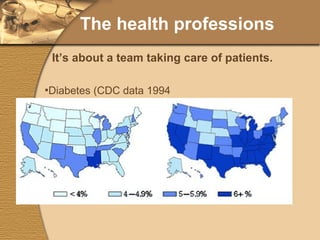
The health professions Diabetes (CDC data 1994 vs. 2000) It’s about a team taking care of patients.
The health professions Diabetes (a subset of professionals) Internal Medicine/Endocrinologist Nutritionist Pharmacist Nurse Optometrist Podiatrist Physical and Occupational Therapist Acupuncture and oriental medical specialist Public health It’s about a team taking care of patients.
Question Your favorite health care professional. Your least favorite health care professional. You. Think of five adjectives or phrases that describe...
Are you ready? Intellectual ability Aptitude in synthesizing, evaluating, and applying new and complex information (scientific or non-scientific) Ability to understand and assess problems as well as employing imaginative and innovative solutions. Interpersonal skills Capacity to work with others from diverse backgrounds and cultures, to collaborate and cooperate as a team member, and to act with sensitivity or empathy towards others. Project and time management Ability to complete assignments and tasks in a reliable, professional manner with available resources. Ability to act autonomously and independently, capacity to analyze situations and make decisions. The seven criteria of a great health care professional.
Are you ready? Written and oral communications skills Ability to explain complex concepts to diverse audiences. Self-management and self-awareness Personal development, maturity, and emotional stability in coping with a variety of life situations. Capacity for personal integrity, professionalism, and honesty. Awareness of personal strengths and weaknesses, with ability to address both areas with confidence. Ability to adapt to stressful or unfamiliar situations. The seven criteria of a great health care professional.
Are you ready? Observational or aesthetic appreciation Cultivated creativity or observational skills in appreciating visual, auditory, or literary works. Laboratory, manual, or tactile skills Aptitude in performing manual or delicate tasks, such as those in a laboratory, on a sports field, or other areas involving instruments or devices. The seven criteria of a great health care professional.
Preparation for a Career Science coursework (grades and test scores) To show you can handle a rigorous scientific curriculum. To demonstrate your competency with the fundamental science requirements. Get to know your professors (science and non-science) for reference letters. Your pre-application years
Preparation for a Career Significant experience in the profession Begin early (even summer after freshman year). Work with and serve others. Can you enjoy working in a clinical environment? Can you work in a  different  clinical environment? Shadowing (sophomore/junior year).  Participate in summer programs (freshmen or sophomores only). Your pre-application years
Preparation for a Career Gain knowledge of challenges facing the profession Read about health- or science-related issues. Listen to podcasts. Participate in research programs. Participate in general education, public policy, or health advocacy programs. Your pre-application (and beyond) years
The Application Timeline Complete all science prerequisites. Register for the MCAT ( six months ahead ), DAT, OAT, GRE. Identify target programs. Pre-application, personal statement, and solicit evaluation letters (by fall semester) MSAC interview (spring semester). Your application year (mostly juniors or seniors).
The Application Timeline Complete all science prerequisites. Take the MCAT, DAT, OAT, GRE. Submit central application essays and forms. Your application summer.
MSAC evaluation letters MSAC schedules interviews during spring and early summer. MSAC writes composite evaluations for all applicants by August 1 (hopefully July 1). NOT an option for medical and dental applicants!
MSAC evaluation letters To schedule an interview: Complete a pre-application form (online). Submit a first draft of your personal statement (WebCT). Submit a passport-photo-like image (online). Identify evaluators (online). Return original forms needing signatures (mail). Declare special programs to which you are applying. NOT an option for medical and dental applicants!
MSAC evaluation letters MSAC Pre-applications will be available around October 1. Deadlines: December 1: pre-apps, PS, prelim evaluators January 1: photo, signed forms Intend to notify by mid-December. Interviews start by mid-January. NOT an option for medical and dental applicants!
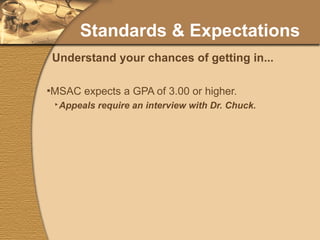
Standards & Expectations MSAC expects a GPA of 3.00 or higher. Appeals require an interview with Dr. Chuck. MSAC will no longer require scores at the time of interview. MSAC expects students to have above average test scores and have a realistic understanding of one’s chances for admission. Understand your chances of getting in...
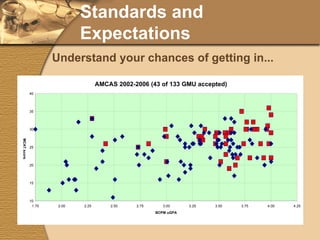
Standards and Expectations Understand your chances of getting in... AMCAS 2002-2006 (43 of 133 GMU accepted) 10 15 20 25 30 35 40 1.75 2.00 2.25 2.50 2.75 3.00 3.25 3.50 3.75 4.00 4.25 BCPM uGPA MCAT score
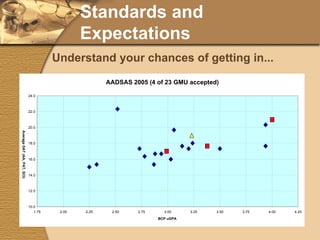
Standards and Expectations Understand your chances of getting in... AADSAS 2005 (4 of 23 GMU accepted) 10.0 12.0 14.0 16.0 18.0 20.0 22.0 24.0 1.75 2.00 2.25 2.50 2.75 3.00 3.25 3.50 3.75 4.00 4.25 BCP uGPA Average DAT (AA, PAT, SCI)
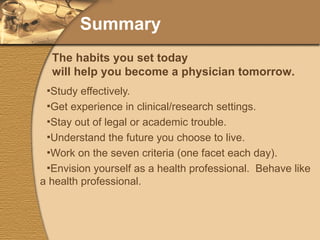
Summary Study effectively. Get experience in clinical/research settings. Stay out of legal or academic trouble. Understand the future you choose to live. Work on the seven criteria (one facet each day). Envision yourself as a health professional.  Behave like a health professional. The habits you set today will help you become a physician tomorrow.
Summary Refer to the health professions advising websites. Prehealth.gmu.edu Premed.gmu.edu Predental.gmu.edu Subscribe to the PREHEALTH-L listserv. Attend programs organized by pre-health organizations. The habits you set today will help you become a physician tomorrow.
Summary Meet with prehealth advisor... One or two appointments a year Freshmen and Sophomores One appointment each semester: applicants Freshmen or sophomores applying for competitive summer or early enrollment programs Juniors and seniors The habits you set today will help you become a physician tomorrow.
Ask for Any Further Questions
Thank You for Coming! Close with encouragement and thanks to the audience.

Health Professions Advising Foundation Talk

  • 1.
    Preparing for theHealth Professions Emil T. Chuck, Ph.D. Health Professions Advisor & Term Assistant Professor of Biology George Mason University
  • 2.
    Agenda I wantto get into medical, dental, optometry, veterinary, etc. schools. I was told you were offering food. Why are you here?
  • 3.
    Agenda Introduce myself.Grades and scores are necessary but not sufficient. Timeline for freshmen/sophomores Process and timeline for juniors (EY 2008). Why am I here?
  • 4.
    Mission Statement Toeducate, support, and prepare George Mason students and alumni for careers in the health professions through effective advising, research, recruitment, and collaboration. What Health Professions Advising Should Be
  • 5.
    Advising Vision Website(prehealth.gmu.edu) General information for all prospective students, current students, faculty, and administration. Links, documents, and data. Listserver (PREHEALTH-L) Bulletins and “newsletters” Includes any “advertising” for programs Surveys@Mason (still experimental) Part 1 of pre-application Supplemental evaluation online forms WebCT Separate discussion board, calendar, and assignments to prepare for health professions application process. Effective advising using electronic resources
  • 6.
    The Glorified LifeDo you want to be any of these doctors?
  • 7.
    The health professionsDiabetes (CDC data 1994 vs. 2000) It’s about a team taking care of patients.
  • 8.
    The health professionsDiabetes (a subset of professionals) Internal Medicine/Endocrinologist Nutritionist Pharmacist Nurse Optometrist Podiatrist Physical and Occupational Therapist Acupuncture and oriental medical specialist Public health It’s about a team taking care of patients.
  • 9.
    Question Your favoritehealth care professional. Your least favorite health care professional. You. Think of five adjectives or phrases that describe...
  • 10.
    Are you ready?Intellectual ability Aptitude in synthesizing, evaluating, and applying new and complex information (scientific or non-scientific) Ability to understand and assess problems as well as employing imaginative and innovative solutions. Interpersonal skills Capacity to work with others from diverse backgrounds and cultures, to collaborate and cooperate as a team member, and to act with sensitivity or empathy towards others. Project and time management Ability to complete assignments and tasks in a reliable, professional manner with available resources. Ability to act autonomously and independently, capacity to analyze situations and make decisions. The seven criteria of a great health care professional.
  • 11.
    Are you ready?Written and oral communications skills Ability to explain complex concepts to diverse audiences. Self-management and self-awareness Personal development, maturity, and emotional stability in coping with a variety of life situations. Capacity for personal integrity, professionalism, and honesty. Awareness of personal strengths and weaknesses, with ability to address both areas with confidence. Ability to adapt to stressful or unfamiliar situations. The seven criteria of a great health care professional.
  • 12.
    Are you ready?Observational or aesthetic appreciation Cultivated creativity or observational skills in appreciating visual, auditory, or literary works. Laboratory, manual, or tactile skills Aptitude in performing manual or delicate tasks, such as those in a laboratory, on a sports field, or other areas involving instruments or devices. The seven criteria of a great health care professional.
  • 13.
    Preparation for aCareer Science coursework (grades and test scores) To show you can handle a rigorous scientific curriculum. To demonstrate your competency with the fundamental science requirements. Get to know your professors (science and non-science) for reference letters. Your pre-application years
  • 14.
    Preparation for aCareer Significant experience in the profession Begin early (even summer after freshman year). Work with and serve others. Can you enjoy working in a clinical environment? Can you work in a different clinical environment? Shadowing (sophomore/junior year). Participate in summer programs (freshmen or sophomores only). Your pre-application years
  • 15.
    Preparation for aCareer Gain knowledge of challenges facing the profession Read about health- or science-related issues. Listen to podcasts. Participate in research programs. Participate in general education, public policy, or health advocacy programs. Your pre-application (and beyond) years
  • 16.
    The Application TimelineComplete all science prerequisites. Register for the MCAT ( six months ahead ), DAT, OAT, GRE. Identify target programs. Pre-application, personal statement, and solicit evaluation letters (by fall semester) MSAC interview (spring semester). Your application year (mostly juniors or seniors).
  • 17.
    The Application TimelineComplete all science prerequisites. Take the MCAT, DAT, OAT, GRE. Submit central application essays and forms. Your application summer.
  • 18.
    MSAC evaluation lettersMSAC schedules interviews during spring and early summer. MSAC writes composite evaluations for all applicants by August 1 (hopefully July 1). NOT an option for medical and dental applicants!
  • 19.
    MSAC evaluation lettersTo schedule an interview: Complete a pre-application form (online). Submit a first draft of your personal statement (WebCT). Submit a passport-photo-like image (online). Identify evaluators (online). Return original forms needing signatures (mail). Declare special programs to which you are applying. NOT an option for medical and dental applicants!
  • 20.
    MSAC evaluation lettersMSAC Pre-applications will be available around October 1. Deadlines: December 1: pre-apps, PS, prelim evaluators January 1: photo, signed forms Intend to notify by mid-December. Interviews start by mid-January. NOT an option for medical and dental applicants!
  • 21.
    Standards & ExpectationsMSAC expects a GPA of 3.00 or higher. Appeals require an interview with Dr. Chuck. MSAC will no longer require scores at the time of interview. MSAC expects students to have above average test scores and have a realistic understanding of one’s chances for admission. Understand your chances of getting in...
  • 22.
    Standards and ExpectationsUnderstand your chances of getting in... AMCAS 2002-2006 (43 of 133 GMU accepted) 10 15 20 25 30 35 40 1.75 2.00 2.25 2.50 2.75 3.00 3.25 3.50 3.75 4.00 4.25 BCPM uGPA MCAT score
  • 23.
    Standards and ExpectationsUnderstand your chances of getting in... AADSAS 2005 (4 of 23 GMU accepted) 10.0 12.0 14.0 16.0 18.0 20.0 22.0 24.0 1.75 2.00 2.25 2.50 2.75 3.00 3.25 3.50 3.75 4.00 4.25 BCP uGPA Average DAT (AA, PAT, SCI)
  • 24.
    Summary Study effectively.Get experience in clinical/research settings. Stay out of legal or academic trouble. Understand the future you choose to live. Work on the seven criteria (one facet each day). Envision yourself as a health professional. Behave like a health professional. The habits you set today will help you become a physician tomorrow.
  • 25.
    Summary Refer tothe health professions advising websites. Prehealth.gmu.edu Premed.gmu.edu Predental.gmu.edu Subscribe to the PREHEALTH-L listserv. Attend programs organized by pre-health organizations. The habits you set today will help you become a physician tomorrow.
  • 26.
    Summary Meet withprehealth advisor... One or two appointments a year Freshmen and Sophomores One appointment each semester: applicants Freshmen or sophomores applying for competitive summer or early enrollment programs Juniors and seniors The habits you set today will help you become a physician tomorrow.
  • 27.
    Ask for AnyFurther Questions
  • 28.
    Thank You forComing! Close with encouragement and thanks to the audience.