



AXELOS.com
12th March 2015
Webinar: Newcastle
University Case Study
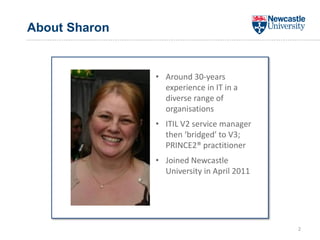
About Sharon
2
• Around 30-years
experience in IT in a
diverse range of
organisations
• ITIL V2 service manager
then ‘bridged’ to V3;
PRINCE2® practitioner
• Joined Newcastle
University in April 2011
Our ITIL Journey (So Far…)
Sharon Mossman
March 2015
3
4
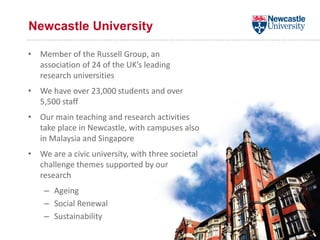
• Member of the Russell Group, an
association of 24 of the UK’s leading
research universities
• We have over 23,000 students and over
5,500 staff
• Our main teaching and research activities
take place in Newcastle, with campuses also
in Malaysia and Singapore
• We are a civic university, with three societal
challenge themes supported by our
research
– Ageing
– Social Renewal
– Sustainability
5
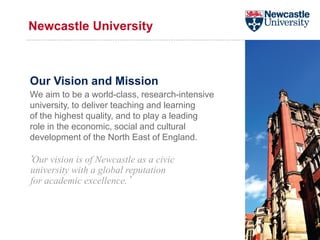
Newcastle University
Our Vision and Mission
We aim to be a world-class, research-intensive
university, to deliver teaching and learning
of the highest quality, and to play a leading
role in the economic, social and cultural
development of the North East of England.
‘Our vision is of Newcastle as a civic
university with a global reputation
for academic excellence.’
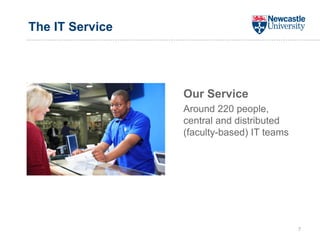
The IT Service
Our Service
Around 220 people,
central and distributed
(faculty-based) IT teams
7
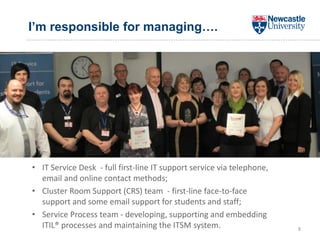
I’m responsible for managing….
8
• IT Service Desk - full first-line IT support service via telephone,
email and online contact methods;
• Cluster Room Support (CRS) team - first-line face-to-face
support and some email support for students and staff;
• Service Process team - developing, supporting and embedding
ITIL® processes and maintaining the ITSM system.
Why ITIL?
9
ITIL’s ‘common-sense’ framework addresses
what to do, but most appealing is its
adaptability to suit the organisation
‘Adopt and Adapt’
Our challenges
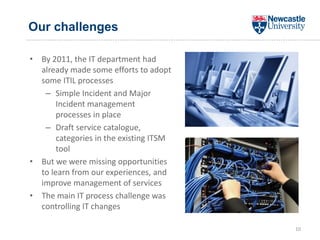
• By 2011, the IT department had
already made some efforts to adopt
some ITIL processes
– Simple Incident and Major
Incident management
processes in place
– Draft service catalogue,
categories in the existing ITSM
tool
• But we were missing opportunities
to learn from our experiences, and
improve management of services
• The main IT process challenge was
controlling IT changes
10
Where to start?
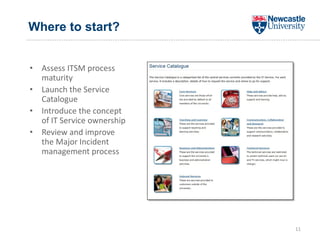
• Assess ITSM process
maturity
• Launch the Service
Catalogue
• Introduce the concept
of IT Service ownership
• Review and improve
the Major Incident
management process
11
And then…
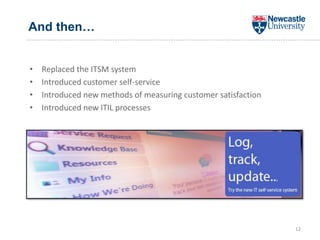
• Replaced the ITSM system
• Introduced customer self-service
• Introduced new methods of measuring customer satisfaction
• Introduced new ITIL processes
12
Some benefits
• The new Major Incident process
– Getting people together to talk
about service-related issues,
improving communication and
instilling a service-oriented culture
• More transparency around service
provision
– Change planning and visibility
– Metrics and reporting
• Common terminology really helps in a
support context
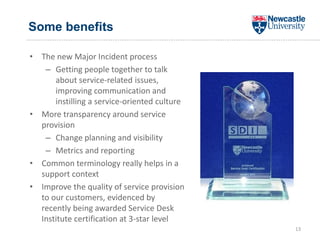
• Improve the quality of service provision
to our customers, evidenced by
recently being awarded Service Desk
Institute certification at 3-star level
13
Are we done, then?
In a word…
NO!
14
What next?
15
The sky’s the limit!
…or is it?
Potential pitfalls to avoid or mitigate
1. Resistance to change
2. Lack of leadership
support
3. Trying to do too
much, too soon
16
I’d recommend…
DO:
• Engage early with the people who will be
working with and within the processes;
consult and include them in process
development decision-making wherever
possible
• Communicate (use a RACI model)
• Set out the planned benefits (ROI) for each
stage and ensure you review to show how
well they’ve been achieved; use this
information to inform next stage planning
and to celebrate success
• Work with the culture of the organisation
(not against it)
• Review and improve – it’s never finished.
17
I’d recommend…
DON’T:
• Don’t do it all at once – find the biggest
pain points and try to address those first
• Don’t aim for perfection – do the best
possible within a defined timescale, then
improve
• Don’t be afraid to ask for help – there are
so many resources and forums, lots of help
and support available
• Don’t be daunted if something doesn’t
work – there’s usually another way
• Don’t be a slave to the book – take
advantage of ‘adopt and adapt’ and make
it work for your organisation.
18
Thank You
Any Questions?
Sharon.Mossman@newcastle.ac.uk
19
Next Webinar:
ITIL and the Cloud with Mark O’Loughlin
16th April 2015, 2pm GMT

Newcastle University ITIL® Case Study - AXELOS Webinar

  • 1.
    AXELOS.com 12th March 2015 Webinar:Newcastle University Case Study
  • 2.
    About Sharon 2 • Around30-years experience in IT in a diverse range of organisations • ITIL V2 service manager then ‘bridged’ to V3; PRINCE2® practitioner • Joined Newcastle University in April 2011
  • 3.
    Our ITIL Journey(So Far…) Sharon Mossman March 2015 3
  • 4.
  • 5.
    • Member ofthe Russell Group, an association of 24 of the UK’s leading research universities • We have over 23,000 students and over 5,500 staff • Our main teaching and research activities take place in Newcastle, with campuses also in Malaysia and Singapore • We are a civic university, with three societal challenge themes supported by our research – Ageing – Social Renewal – Sustainability 5 Newcastle University
  • 6.
    Newcastle University Our Visionand Mission We aim to be a world-class, research-intensive university, to deliver teaching and learning of the highest quality, and to play a leading role in the economic, social and cultural development of the North East of England. ‘Our vision is of Newcastle as a civic university with a global reputation for academic excellence.’
  • 7.
    The IT Service OurService Around 220 people, central and distributed (faculty-based) IT teams 7
  • 8.
    I’m responsible formanaging…. 8 • IT Service Desk - full first-line IT support service via telephone, email and online contact methods; • Cluster Room Support (CRS) team - first-line face-to-face support and some email support for students and staff; • Service Process team - developing, supporting and embedding ITIL® processes and maintaining the ITSM system.
  • 9.
    Why ITIL? 9 ITIL’s ‘common-sense’framework addresses what to do, but most appealing is its adaptability to suit the organisation ‘Adopt and Adapt’
  • 10.
    Our challenges • By2011, the IT department had already made some efforts to adopt some ITIL processes – Simple Incident and Major Incident management processes in place – Draft service catalogue, categories in the existing ITSM tool • But we were missing opportunities to learn from our experiences, and improve management of services • The main IT process challenge was controlling IT changes 10
  • 11.
    Where to start? •Assess ITSM process maturity • Launch the Service Catalogue • Introduce the concept of IT Service ownership • Review and improve the Major Incident management process 11
  • 12.
    And then… • Replacedthe ITSM system • Introduced customer self-service • Introduced new methods of measuring customer satisfaction • Introduced new ITIL processes 12
  • 13.
    Some benefits • Thenew Major Incident process – Getting people together to talk about service-related issues, improving communication and instilling a service-oriented culture • More transparency around service provision – Change planning and visibility – Metrics and reporting • Common terminology really helps in a support context • Improve the quality of service provision to our customers, evidenced by recently being awarded Service Desk Institute certification at 3-star level 13
  • 14.
    Are we done,then? In a word… NO! 14
  • 15.
    What next? 15 The sky’sthe limit! …or is it?
  • 16.
    Potential pitfalls toavoid or mitigate 1. Resistance to change 2. Lack of leadership support 3. Trying to do too much, too soon 16
  • 17.
    I’d recommend… DO: • Engageearly with the people who will be working with and within the processes; consult and include them in process development decision-making wherever possible • Communicate (use a RACI model) • Set out the planned benefits (ROI) for each stage and ensure you review to show how well they’ve been achieved; use this information to inform next stage planning and to celebrate success • Work with the culture of the organisation (not against it) • Review and improve – it’s never finished. 17
  • 18.
    I’d recommend… DON’T: • Don’tdo it all at once – find the biggest pain points and try to address those first • Don’t aim for perfection – do the best possible within a defined timescale, then improve • Don’t be afraid to ask for help – there are so many resources and forums, lots of help and support available • Don’t be daunted if something doesn’t work – there’s usually another way • Don’t be a slave to the book – take advantage of ‘adopt and adapt’ and make it work for your organisation. 18
  • 19.
  • 20.
    Next Webinar: ITIL andthe Cloud with Mark O’Loughlin 16th April 2015, 2pm GMT