EMS
Resuscitation of the
Newborn
Jim Morgan , D.O. FAAEM
Emergency Medicine
EMS Medical Director
Joplin, MO
Epidemiology


10% of newborns will require “assistance”
when they’re born



Incidence of complications increase as






Birth weight decreases
Prenatal problems increase
Prenatal age decreases

Look for antepartum & intrapartum issues
Physiology


Prior to delivery, newborn lungs filled with
fluid



Capillaries & arterioles of lungs are
closed



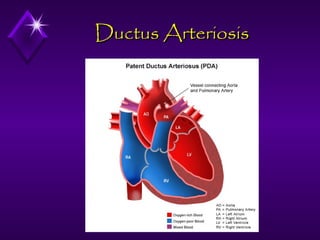
Blood pumped by heart bypasses lungs
thru ductus arteriosis
Ductus Arteriosis
Physiology


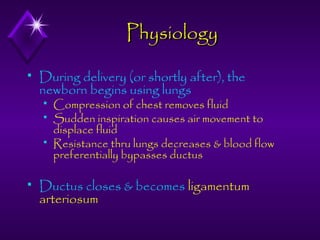
During delivery (or shortly after), the
newborn begins using lungs






Compression of chest removes fluid
Sudden inspiration causes air movement to
displace fluid
Resistance thru lungs decreases & blood flow
preferentially bypasses ductus

Ductus closes & becomes ligamentum
arteriosum
Initial Care


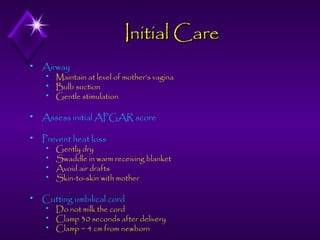
Airway




Maintain at level of mother’s vagina
Bulb suction
Gentle stimulation



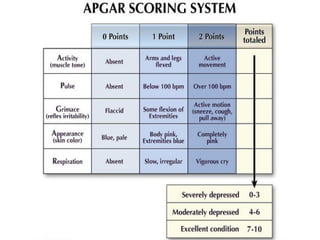
Assess initial APGAR score



Prevent heat loss







Gently dry
Swaddle in warm receiving blanket
Avoid air drafts
Skin-to-skin with mother

Cutting umbilical cord




Do not milk the cord
Clamp 30 seconds after delivery
Clamp ~ 4 cm from newborn
At Birth


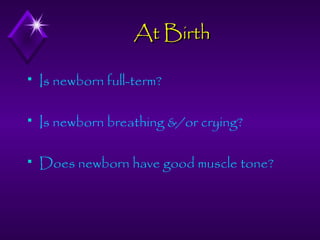
Is newborn full-term?



Is newborn breathing &/or crying?



Does newborn have good muscle tone?
At Birth


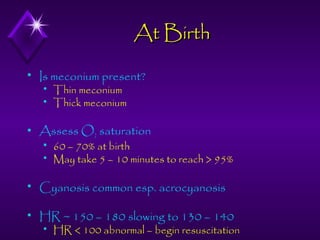
Is meconium present?





Thin meconium
Thick meconium

Assess O2 saturation



60 – 70% at birth
May take 5 – 10 minutes to reach > 95%



Cyanosis common esp. acrocyanosis



HR ~ 150 – 180 slowing to 130 – 140


HR < 100 abnormal – begin resuscitation
The Distressed Newborn
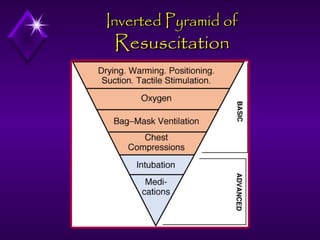
Inverted Pyramid of

Resuscitation
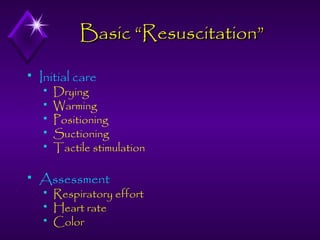
Basic “Resuscitation”


Initial care








Drying
Warming
Positioning
Suctioning
Tactile stimulation

Assessment




Respiratory effort
Heart rate
Color
Airway


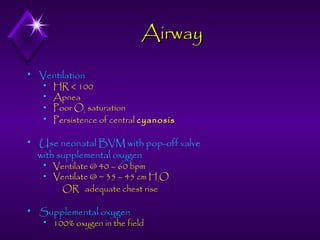
Ventilation







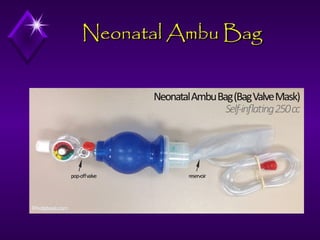
Use neonatal BVM with pop-off valve
with supplemental oxygen





HR < 100
Apnea
Poor O2 saturation
Persistence of central cyanosis

Ventilate @ 40 – 60 bpm
Ventilate @ ~ 35 – 45 cm H2O
OR adequate chest rise

Supplemental oxygen


100% oxygen in the field
Neonatal Ambu Bag
Airway


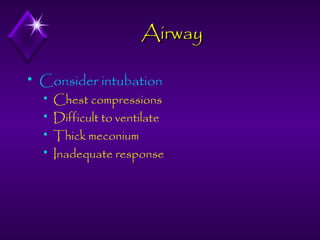
Consider intubation





Chest compressions
Difficult to ventilate
Thick meconium
Inadequate response
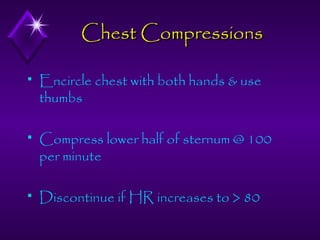
Chest Compressions


Encircle chest with both hands & use
thumbs



Compress lower half of sternum @ 100
per minute



Discontinue if HR increases to > 80
Vascular Access


MOST distressed newborns respond to
initial care, ventilation, & chest
compressions



If vascular access needed, can use
umbilical catheter



Umbilical cord with 2 arteries & 1 vein
Insert catheter into vein & secure with
umbilical tape
Medications


Naloxone




Glucose





Do not use in newborn resuscitation
No specific glucose level at birth can be agreed upon
Prehospital glucose administration difficult

Epinephrine


0.05 - 0.1 mg/kg


(0.3 to 1 mL/kg of a 1:10,000 solution)
Specific Neonatal
Situations















Meconium-stained amniotic fluid
Apnea
Diaphragmatic hernia
Bradycardia
Prematurity
Respiratory distress/cyanosis
Hypovolemia
Seizures
Fever
Hypothermia
Hypoglycemia
Vomiting
Diarrhea
Common birth injuries
Congenital heart conditions








Atrial septal defect (ASD)
Ventricular septal defect (VSD)
Tetralogy of Fallot
Transposition of the great vessels
Coarctation of the aorta
Pulmonary stenosis
Aortic stenosis
Failure to respond


Mechanical blockage




Impaired lung function






Pneumothorax
Diaphragmatic hernia
Pulmonary atresia

Central cyanosis




Meconium

Congenital heart disease

Apnea



Brain injury
Neuromuscular disease
Enroute to the call


Review how you will handle



Normal birth & newborn
Newborn in distress



Warm patient compartment



Consider possibility of needing back-up
personnel
Remember….


Most newborns will respond to minimal intervention



If meconium is present AND…





Child is vigorous, light suctioning
Child is flaccid, may need ETT + suction

If HR




> 100, supplemental oxygen
Between 60 – 100, positive pressure ventilation
< 60, chest compressions



Rarely…..epinephrine thru umbilical vein



Reassess every 30 seconds
Questions?

Newborn Emergencies