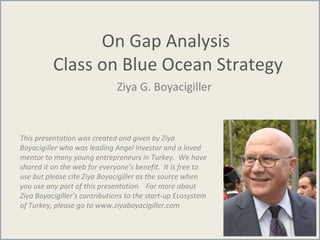
On Gap Analysis
Class on Blue Ocean Strategy
Ziya G. Boyacigiller
This presentation was created and given by Ziya
Boyacigiller who was leading Angel Investor and a loved
mentor to many young entrepreneurs in Turkey. We have
shared it on the web for everyone’s benefit. It is free to
use but please cite Ziya Boyacigiller as the source when
you use any part of this presentation. For more about
Ziya Boyacigiller’s contributions to the start-up Ecosystem
of Turkey, please go to www.ziyaboyacigiller.com
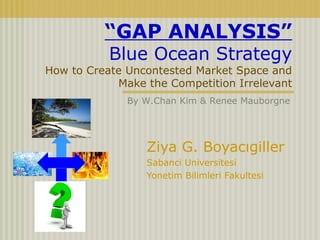
“GAP ANALYSIS”
Blue Ocean Strategy
How to Create Uncontested Market Space and
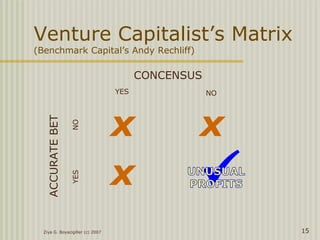
Make the Competition Irrelevant
Ziya G. Boyacıgiller
Sabanci Universitesi
Yonetim Bilimleri Fakultesi
By W.Chan Kim & Renee Mauborgne
Ziya G. Boyacigiller (c) 2007 3
Why do some
companies achieve
sustained
high-growth
in revenues and profits?
Ziya G. Boyacigiller (c) 2007 4
How Can We
Explain
Sustained
Growth & Profits?
Ziya G. Boyacigiller (c) 2007 5
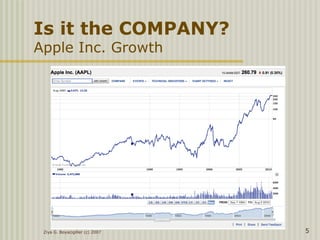
Is it the COMPANY?
Apple Inc. Growth
Ziya G. Boyacigiller (c) 2007 6
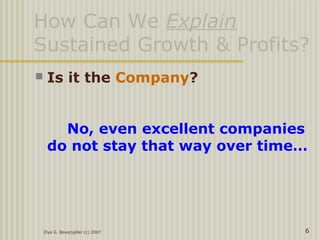
How Can We Explain
Sustained Growth & Profits?
 Is it the Company?
No, even excellent companies
do not stay that way over time…
Ziya G. Boyacigiller (c) 2007 7
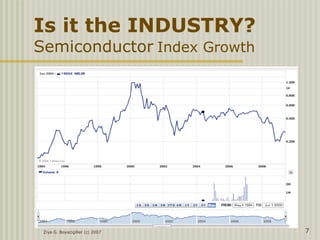
Is it the INDUSTRY?
Semiconductor Index Growth
Ziya G. Boyacigiller (c) 2007 8
How Can We Explain
Sustained Growth & Profits?
 Is it the Industry?
No, even the most favored
industries don’t stay attractive
over time…
Ziya G. Boyacigiller (c) 2007 9
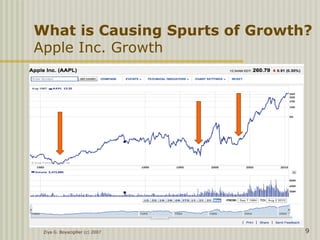
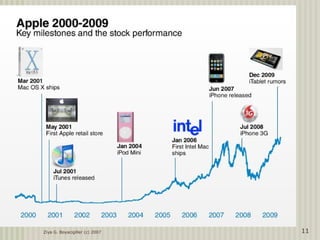
What is Causing Spurts of Growth?
Apple Inc. Growth
It is the
Strategic Moves !
Ziya G. Boyacigiller (c) 2007 10
Ziya G. Boyacigiller (c) 2007 11
Ziya G. Boyacigiller (c) 2007 12
Strategic Moves are the set of
managerial actions and decisions
that have delivered products and
services that
opened and captured
new market space,
with a significant leap in demand.
Ziya G. Boyacigiller (c) 2007 13
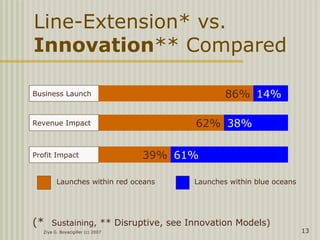
Line-Extension* vs.
Innovation** Compared
Business Launch 86% 14%
62% 38%
39% 61%
Revenue Impact
Profit Impact
Launches within red oceans Launches within blue oceans
(* Sustaining, ** Disruptive, see Innovation Models)
Ziya G. Boyacigiller (c) 2007 14
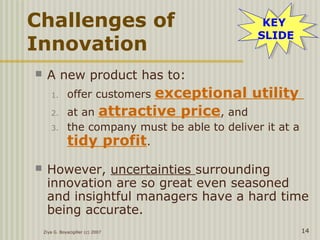
Challenges of
Innovation
 A new product has to:
1. offer customers exceptional utility
2. at an attractive price, and
3. the company must be able to deliver it at a
tidy profit.
 However, uncertainties surrounding
innovation are so great even seasoned
and insightful managers have a hard time
being accurate.
KEY
SLIDE
KEY
SLIDE
x x
x 
Ziya G. Boyacigiller (c) 2007 15
Venture Capitalist’s Matrix
(Benchmark Capital’s Andy Rechliff)ACCURATEBET
CONCENSUS
YES NO
YESNO
Ziya G. Boyacigiller (c) 2007 16
How can we reduce the
risk of innovation?
Ziya G. Boyacigiller (c) 2007 17
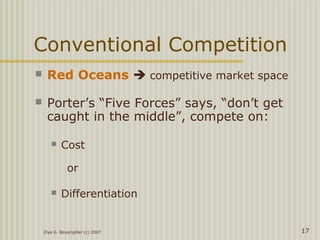
Conventional Competition
 Red Oceans  competitive market space
 Porter’s “Five Forces” says, “don’t get
caught in the middle”, compete on:
 Cost
or
 Differentiation
Ziya G. Boyacigiller (c) 2007 18
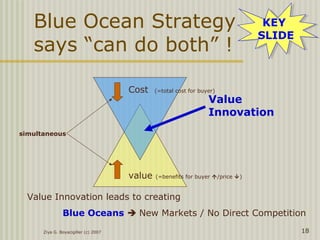
Blue Ocean Strategy
says “can do both” !
value (=benefits for buyer /price )
Value
Innovation
simultaneous
Value Innovation leads to creating
Blue Oceans  New Markets / No Direct Competition
KEY
SLIDE
KEY
SLIDE
Cost (=total cost for buyer)
Ziya G. Boyacigiller (c) 2007 19
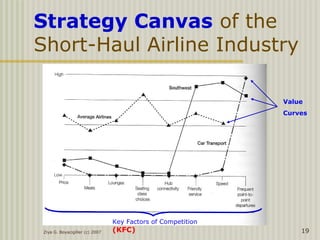
Strategy Canvas of the
Short-Haul Airline Industry
Value
Curves
Key Factors of Competition
(KFC)
Key-Factors-of-Competition
KFCs
Ziya G. Boyacigiller (c) 2007 20
These are for a given industry, what they compete on
and what they invest in (use RPV model).
Example: The wine industry key-factors KFCs are:
• Price per bottle
• Refined packaging/bottle image
• Above the line-marketing directed to consumers and
distributors/retailers
• Aging quality of wines
• Prestige of the wine’s vineyard and legacy (brand image)
• Taste of wine
• Diverse range of wine selection
In Class Exercise:
You Start Work in a
Design House…
Your 1st
assignment is:
Define KFCs for wallet.
Ziya G. Boyacigiller (c) 2007 21
Ziya G. Boyacigiller (c) 2007 22
“Blue Ocean” shifts the
Strategy Canvas of an Industry
To fundamentally shift the strategy canvas of an
industry, you must begin by reorienting your
strategic focus from
competitors  alternatives,
and from
customers  noncustomers,
of the industry.
KEY
SLIDE
KEY
SLIDE
Ziya G. Boyacigiller (c) 2007 23
Substitutes vs. Alternatives
 Substitutes to “eating at an Italian Restaurant”:
 All Italian restaurants,
 Alternatives* to “eating at an Italian Restaurant”:
 (job: satisfy hunger)
Kebapci, Burger King, balik-ekmek, even “simit”/bagel
and,
 (job: entertainment)
Movies, theater, concert, cruzing along the Bosporus,
watching TV
(* ALTERNATIVES ARE MEANINGFUL WHEN LINKED TO A “JOB”)
Ziya G. Boyacigiller (c) 2007 24
Listen to
“noncustomers”?
Look for “common pain”
for “noncustomers” to
identify your Blue Ocean
opportunities (market gaps)
KEY
SLIDE
KEY
SLIDE
Ziya G. Boyacigiller (c) 2007 25
Look for
“common pain”…
Potential / Existing customers
are not happy with the existing
alternatives, yet no other choice
exists…
KEY
SLIDE
KEY
SLIDE
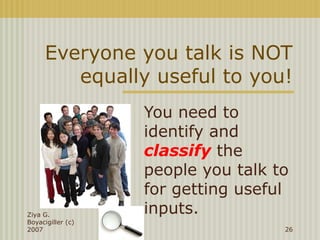
Everyone you talk is NOT
equally useful to you!
You need to
identify and
classify the
people you talk to
for getting useful
inputs.Ziya G.
Boyacigiller (c)
2007 26
Ziya G. Boyacigiller (c) 2007 27
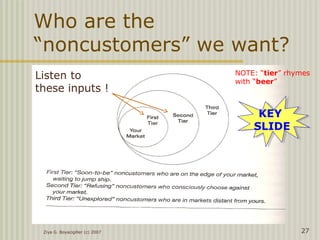
Who are the
“noncustomers” we want?
KEY
SLIDE
KEY
SLIDE
NOTE: “tier” rhymes
with “beer”
Listen to
these inputs !
Defining Tiers Again…
 Tier 1:
• Their need for the product/service is so
important that they can’t wait, they want it
now. So, they already bought an
alternative and are using.
They will know best, what they like and
don’t like about the alternative they are
using now, and possibly about other
alternatives they have looked at.
Ziya G. Boyacigiller (c) 2007 28
Defining Tiers Again…
 Tier 2:
• Their need for the product/service is NOT
as important, compared to Tier 1
customers, that although they looked for an
alternative to buy, decided to wait, until an
acceptable alternative comes to market.
They will know what they like and don’t like
about the alternatives they looked at.
Ziya G. Boyacigiller (c) 2007 29
Defining Tiers Again…
 Tier 3:
• They have not recognized a need for the
product/service yet. They have not even
looked for alternatives.
They will NOT know what they like and
don’t like about the alternatives on the
market currently – they can only guess…
➜DO NOT WASTE TIME WITH THEM!
Ziya G. Boyacigiller (c) 2007 30
Your 2nd
assignment is:
Define a new wallet.
Identify common pains.
Ziya G. Boyacigiller (c) 2007 31
In Class Exercise:
You Start Work in a
Design House…
Ziya G. Boyacigiller (c) 2007 32
Casella Wines (Australian)
 Looking at alternatives to wine:
 Beer, Spirits, Ready-to-Drink Cocktails (which
capture 3 times sales compared to US wine sales)
 Mass of US adults (non-consumers) saw wine as
a turn-off:
 Intimidating, pretentious, flavor challenging
 These non-consumers are drinking the
alternatives  big potential market!
Ziya G. Boyacigiller (c) 2007 33
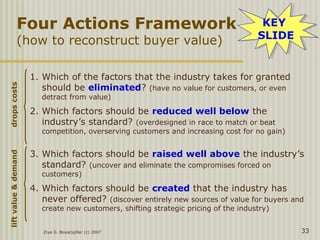
Four Actions Framework
(how to reconstruct buyer value)
1. Which of the factors that the industry takes for granted
should be eliminated? (have no value for customers, or even
detract from value)
2. Which factors should be reduced well below the
industry’s standard? (overdesigned in race to match or beat
competition, overserving customers and increasing cost for no gain)
3. Which factors should be raised well above the industry’s
standard? (uncover and eliminate the compromises forced on
customers)
4. Which factors should be created that the industry has
never offered? (discover entirely new sources of value for buyers and
create new customers, shifting strategic pricing of the industry)
dropscostsliftvalue&demand
KEY
SLIDE
KEY
SLIDE
Your 3rd
assignment is:
Create Product Strategy using Four
Actions Framework for the wallet.
What is your “tag line”?
What is your mission?
Ziya G. Boyacigiller (c) 2007 34
In Class Exercise:
You Start Work in a
Design House…
Ziya G. Boyacigiller (c) 2007 35
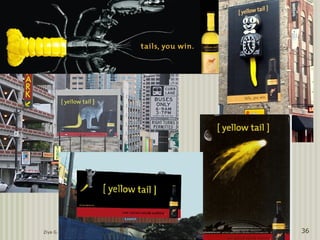
[yellow tail]
•Fun, social drink accessible to nonwine
drinkers
•Fastest growing brand in the histories of
both Australian and US wine industries
•#1 imported wine into USA, surpassing
wines of France, Italy
•#1 red wine in 750ml bottle in USA,
surpassing California labels
•Sales in about 2 years hit over 4.5million
cases
•While competing with 1,600 wineries in the
USA !
Ziya G. Boyacigiller (c) 2007 36
Ziya G. Boyacigiller (c) 2007 37
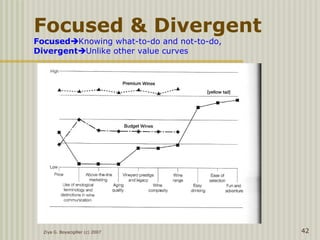
Strategy Canvas of
[yellow tail]
Ziya G. Boyacigiller (c) 2007 38
Focus on
alternatives & noncustomers
others [yellow tail]
Easy
drinking
Wine’s complicated taste
is difficult to appreciate
compared to alternatives
[yellow tail] is soft in taste,
with pronounced fruit flavors
(easy drinking wine that
doesn’t need developed
appreciation over time)
Ease of
selection
Isles of wine in markets
overwhelmed and
intimidated customers
Only 2 to choose from (one
white/one red (used same
bottle design for both to
reduce cost)
Fun and
adventure
Elite image did not
resonate with general
public
Australian theme, unusual
label, no mention of vineyard
or other intimidating wine
vocabulary
Ziya G. Boyacigiller (c) 2007 39
Eliminate-Reduce-Raise-Create
Grid for [yellow tail]
Eliminate
Enological terminology and
distinctions
Aging qualities
Above-the-line marketing
Raise
Price compared to budget
wines
Retail store support and
involvement
Reduce
Wine complexity
Wine range (variety)
Vineyard prestige
Create
Easy drinking
Ease of selection
Fun and adventure (new
delightful experience)
KEY
SLIDE
KEY
SLIDE
Ziya G. Boyacigiller (c) 2007 40
I have to apologize, that I just tried a different boxed
California cabernet, which tasted like a bad children's
fruit drink. I have learned my lesson and will stick to
yellow tail merlot! And I must say that I love yellow
tail, because my wife loves yellow tail.
I was never a wine drinker until I was introduced to
Yellow Tail Chardonnay 3 years ago at a dinner party. I
was immediately hooked! Now, there's nothing I look
forward to more than coming home from work on a
Friday night and pouring myself a glass of Yellow Tail
to unwind. It's a standard at parties that I attend and it's
always a welcome gift. Thanks for a wonderful product
and keep up the good work! Is it Friday yet?
What customers are saying…
[yellow tales] from Casella web site
Ziya G. Boyacigiller (c) 2007 41
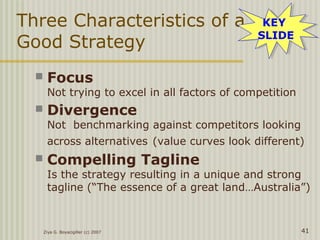
Three Characteristics of a
Good Strategy
 Focus
Not trying to excel in all factors of competition
 Divergence
Not benchmarking against competitors looking
across alternatives (value curves look different)
 Compelling Tagline
Is the strategy resulting in a unique and strong
tagline (“The essence of a great land…Australia”)
KEY
SLIDE
KEY
SLIDE
Ziya G. Boyacigiller (c) 2007 42
Focused & Divergent
FocusedKnowing what-to-do and not-to-do,
DivergentUnlike other value curves
Ziya G. Boyacigiller (c) 2007 43
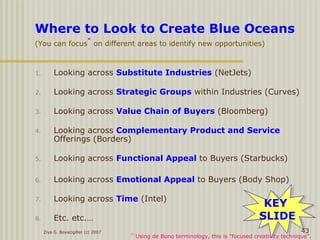
Where to Look to Create Blue Oceans
(You can focus
*
on different areas to identify new opportunities)
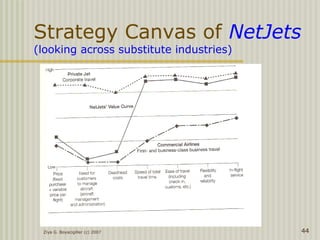
1. Looking across Substitute Industries (NetJets)
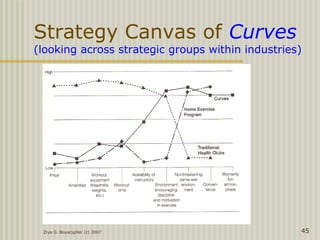
2. Looking across Strategic Groups within Industries (Curves)
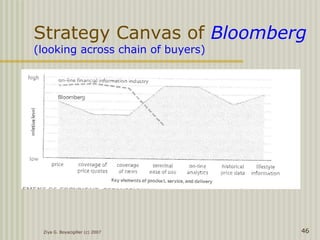
3. Looking across Value Chain of Buyers (Bloomberg)
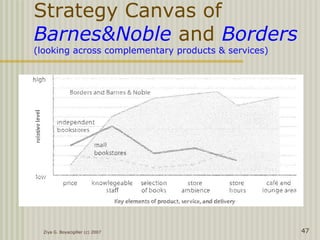
4. Looking across Complementary Product and Service
Offerings (Borders)
5. Looking across Functional Appeal to Buyers (Starbucks)
6. Looking across Emotional Appeal to Buyers (Body Shop)
7. Looking across Time (Intel)
8. Etc. etc.…
(*)
Using de Bono terminology, this is “focused creativity technique”.
KEY
SLIDE
KEY
SLIDE
Ziya G. Boyacigiller (c) 2007 44
Strategy Canvas of NetJets
(looking across substitute industries)
Ziya G. Boyacigiller (c) 2007 45
Strategy Canvas of Curves
(looking across strategic groups within industries)
Ziya G. Boyacigiller (c) 2007 46
Strategy Canvas of Bloomberg
(looking across chain of buyers)
Ziya G. Boyacigiller (c) 2007 47
Strategy Canvas of
Barnes&Noble and Borders
(looking across complementary products & services)
Ziya G. Boyacigiller (c) 2007 48
Strategy Canvas of Body Shop
(looking across functional or emotional appeal to buyers)
Ziya G. Boyacigiller (c) 2007 49
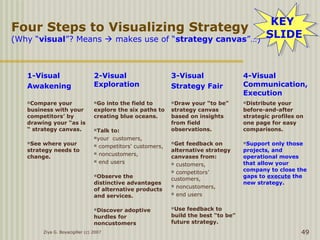
Four Steps to Visualizing Strategy
(Why “visual”? Means  makes use of “strategy canvas”…)
1-Visual
Awakening
2-Visual
Exploration
3-Visual
Strategy Fair
4-Visual
Communication,
Execution
Compare your
business with your
competitors’ by
drawing your “as is
“ strategy canvas.
See where your
strategy needs to
change.
Go into the field to
explore the six paths to
creating blue oceans.
Talk to:
your customers,
 competitors’ customers,
 noncustomers,
 end users
Observe the
distinctive advantages
of alternative products
and services.
Discover adoptive
hurdles for
noncustomers
Draw your “to be”
strategy canvas
based on insights
from field
observations.
Get feedback on
alternative strategy
canvases from:
 customers,
 competitors’
customers,
 noncustomers,
 end users
Use feedback to
build the best “to be”
future strategy.
Distribute your
before-and-after
strategic profiles on
one page for easy
comparisons.
Support only those
projects, and
operational moves
that allow your
company to close the
gaps to execute the
new strategy.
KEY
SLIDE
KEY
SLIDE
Ziya G. Boyacigiller (c) 2007 50
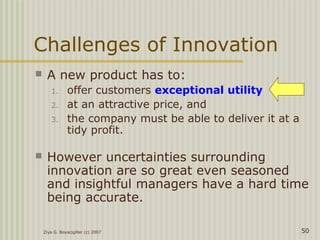
Challenges of Innovation
 A new product has to:
1. offer customers exceptional utility
2. at an attractive price, and
3. the company must be able to deliver it at a
tidy profit.
 However uncertainties surrounding
innovation are so great even seasoned
and insightful managers have a hard time
being accurate.
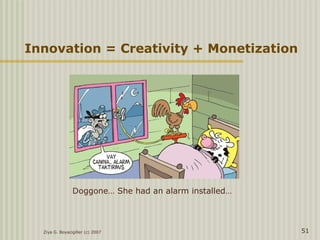
Innovation = Creativity + Monetization
Ziya G. Boyacigiller (c) 2007 51
Doggone… She had an alarm installed…
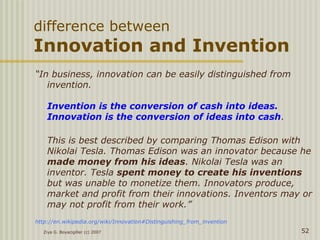
difference between
Innovation and Invention
“In business, innovation can be easily distinguished from
invention.
Invention is the conversion of cash into ideas.
Innovation is the conversion of ideas into cash.
This is best described by comparing Thomas Edison with
Nikolai Tesla. Thomas Edison was an innovator because he
made money from his ideas. Nikolai Tesla was an
inventor. Tesla spent money to create his inventions
but was unable to monetize them. Innovators produce,
market and profit from their innovations. Inventors may or
may not profit from their work.”
http://en.wikipedia.org/wiki/Innovation#Distinguishing_from_invention
Ziya G. Boyacigiller (c) 2007 52
It takes creative focus to “find a
way” to monetize a creative idea.
Entrepreneurs not only need to create a
differentiated product or service, but they
may also need to create a new business
model.
Examples:
Apple iTunes  99 cents songs,
iPhone  Apps
Ziya G. Boyacigiller (c) 2007 53
Ziya G. Boyacigiller (c) 2007 54
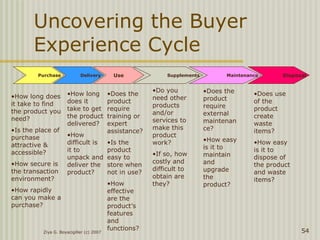
Uncovering the Buyer
Experience Cycle
DisposalMaintenanceSupplementsUseDeliveryPurchase
•How long does
it take to find
the product you
need?
•Is the place of
purchase
attractive &
accessible?
•How secure is
the transaction
environment?
•How rapidly
can you make a
purchase?
•How long
does it
take to get
the product
delivered?
•How
difficult is
it to
unpack and
deliver the
product?
•Does the
product
require
training or
expert
assistance?
•Is the
product
easy to
store when
not in use?
•How
effective
are the
product’s
features
and
functions?
•Do you
need other
products
and/or
services to
make this
product
work?
•If so, how
costly and
difficult to
obtain are
they?
•Does the
product
require
external
maintenan
ce?
•How easy
is it to
maintain
and
upgrade
the
product?
•Does use
of the
product
create
waste
items?
•How easy
is it to
dispose of
the product
and waste
items?
page 55 02/06/15
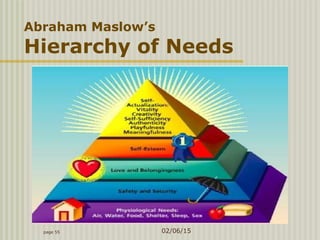
Abraham Maslow’s
Hierarchy of Needs
Ziya G. Boyacigiller (c) 2007 56
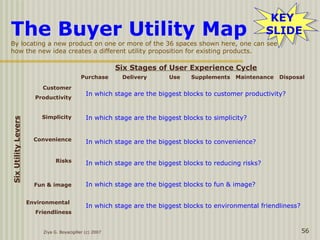
The Buyer Utility Map
By locating a new product on one or more of the 36 spaces shown here, one can see
how the new idea creates a different utility proposition for existing products.
Six Stages of User Experience Cycle
Purchase Delivery Use Supplements Maintenance Disposal
SixUtilityLevers
Environmental
Friendliness
Fun & image
Risks
Convenience
Simplicity
Customer
Productivity
In which stage are the biggest blocks to customer productivity?
In which stage are the biggest blocks to simplicity?
In which stage are the biggest blocks to convenience?
In which stage are the biggest blocks to reducing risks?
In which stage are the biggest blocks to fun & image?
In which stage are the biggest blocks to environmental friendliness?
KEY
SLIDE
KEY
SLIDE
page 57 02/06/15
Thanks to Sahin Tulga / HP Turkiye for sharing this slide... I
h
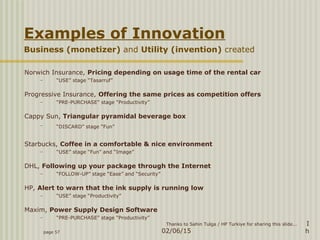
Examples of Innovation
Business (monetizer) and Utility (invention) created
Norwich Insurance, Pricing depending on usage time of the rental car
– “USE” stage “Tasarruf”
Progressive Insurance, Offering the same prices as competition offers
– “PRE-PURCHASE” stage “Productivity”
Cappy Sun, Triangular pyramidal beverage box
– “DISCARD” stage “Fun”
Starbucks, Coffee in a comfortable & nice environment
– “USE” stage “Fun” and “Image”
DHL, Following up your package through the Internet
– “FOLLOW-UP” stage “Ease” and “Security”
HP, Alert to warn that the ink supply is running low
– “USE” stage “Productivity”
Maxim, Power Supply Design Software
– “PRE-PURCHASE” stage “Productivity”
Ziya G. Boyacigiller (c) 2007 58
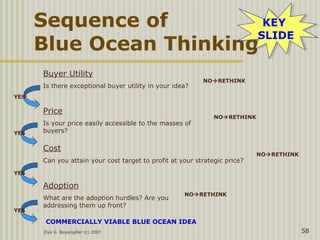
Sequence of
Blue Ocean Thinking
Buyer Utility
Is there exceptional buyer utility in your idea?
Price
Is your price easily accessible to the masses of
buyers?
Cost
Can you attain your cost target to profit at your strategic price?
Adoption
What are the adoption hurdles? Are you
addressing them up front?
YES
YES
YES
YES
NORETHINK
COMMERCIALLY VIABLE BLUE OCEAN IDEA
NORETHINK
NORETHINK
NORETHINK
KEY
SLIDE
KEY
SLIDE
Your 4th
assignment is:
Improve your utility for the wallet
(create new KFCs) by using Utility Matrix.
Ziya G. Boyacigiller (c) 2007 59
In Class Exercise:
You Start Work in a
Design House…
Ziya G. Boyacigiller (c) 2007 60
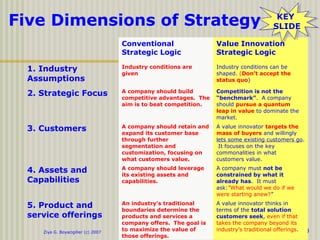
Conventional
Strategic Logic
Value Innovation
Strategic Logic
1. Industry
Assumptions
Industry conditions are
given
Industry conditions can be
shaped. (Don’t accept the
status quo)
2. Strategic Focus A company should build
competitive advantages. The
aim is to beat competition.
Competition is not the
“benchmark”. A company
should pursue a quantum
leap in value to dominate the
market.
3. Customers A company should retain and
expand its customer base
through further
segmentation and
customization, focusing on
what customers value.
A value innovator targets the
mass of buyers and willingly
lets some existing customers go.
It focuses on the key
commonalities in what
customers value.
4. Assets and
Capabilities
A company should leverage
its existing assets and
capabilities.
A company must not be
constrained by what it
already has. It must
ask:”What would we do if we
were starting anew?”
5. Product and
service offerings
An industry’s traditional
boundaries determine the
products and services a
company offers. The goal is
to maximize the value of
those offerings.
A value innovator thinks in
terms of the total solution
customers seek, even if that
takes the company beyond its
industry’s traditional offerings.
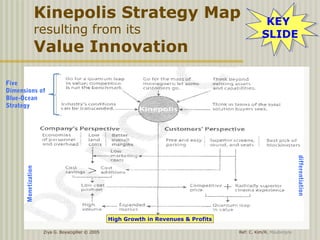
Five Dimensions of Strategy KEY
SLIDE
KEY
SLIDE
Ziya G. Boyacigiller © 2005
High Growth in Revenues & Profits
Ref: C. Kim/R. Mauborgne
Five
Dimensions of
Blue-Ocean
Strategy
KEY
SLIDE
KEY
SLIDE
Kinepolis Strategy Map
resulting from its
Value Innovation
Monetization
differentiation
Ziya G. Boyacigiller (c) 2007 62
Over time, competition
forces the value curves in
an industry to converge.
Success is a voyage,
not a destination…
Ziya G. Boyacigiller (c) 2007 63
Remember:
Ziya G. Boyacigiller (c) 2007 64
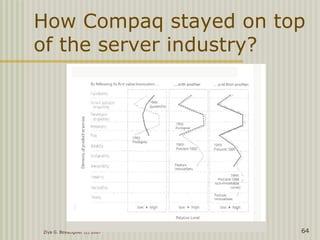
How Compaq stayed on top
of the server industry?
“We will have to
create faster than
they can copy us!”
Ziya G. Boyacigiller (c)
2007 65
Walt Disney, when his people rush to him in
panic when they find out that others are
copying Disney Studios’ film animation
innovations…
Summarize…
Q&A
Ziya G. Boyacigiller (c)
2007 66

New4 bos blue ocean strategy

  • 1.
    On Gap Analysis Classon Blue Ocean Strategy Ziya G. Boyacigiller This presentation was created and given by Ziya Boyacigiller who was leading Angel Investor and a loved mentor to many young entrepreneurs in Turkey. We have shared it on the web for everyone’s benefit. It is free to use but please cite Ziya Boyacigiller as the source when you use any part of this presentation. For more about Ziya Boyacigiller’s contributions to the start-up Ecosystem of Turkey, please go to www.ziyaboyacigiller.com
  • 2.
    “GAP ANALYSIS” Blue OceanStrategy How to Create Uncontested Market Space and Make the Competition Irrelevant Ziya G. Boyacıgiller Sabanci Universitesi Yonetim Bilimleri Fakultesi By W.Chan Kim & Renee Mauborgne
  • 3.
    Ziya G. Boyacigiller(c) 2007 3 Why do some companies achieve sustained high-growth in revenues and profits?
  • 4.
    Ziya G. Boyacigiller(c) 2007 4 How Can We Explain Sustained Growth & Profits?
  • 5.
    Ziya G. Boyacigiller(c) 2007 5 Is it the COMPANY? Apple Inc. Growth
  • 6.
    Ziya G. Boyacigiller(c) 2007 6 How Can We Explain Sustained Growth & Profits?  Is it the Company? No, even excellent companies do not stay that way over time…
  • 7.
    Ziya G. Boyacigiller(c) 2007 7 Is it the INDUSTRY? Semiconductor Index Growth
  • 8.
    Ziya G. Boyacigiller(c) 2007 8 How Can We Explain Sustained Growth & Profits?  Is it the Industry? No, even the most favored industries don’t stay attractive over time…
  • 9.
    Ziya G. Boyacigiller(c) 2007 9 What is Causing Spurts of Growth? Apple Inc. Growth
  • 10.
    It is the StrategicMoves ! Ziya G. Boyacigiller (c) 2007 10
  • 11.
  • 12.
    Ziya G. Boyacigiller(c) 2007 12 Strategic Moves are the set of managerial actions and decisions that have delivered products and services that opened and captured new market space, with a significant leap in demand.
  • 13.
    Ziya G. Boyacigiller(c) 2007 13 Line-Extension* vs. Innovation** Compared Business Launch 86% 14% 62% 38% 39% 61% Revenue Impact Profit Impact Launches within red oceans Launches within blue oceans (* Sustaining, ** Disruptive, see Innovation Models)
  • 14.
    Ziya G. Boyacigiller(c) 2007 14 Challenges of Innovation  A new product has to: 1. offer customers exceptional utility 2. at an attractive price, and 3. the company must be able to deliver it at a tidy profit.  However, uncertainties surrounding innovation are so great even seasoned and insightful managers have a hard time being accurate. KEY SLIDE KEY SLIDE
  • 15.
    x x x  ZiyaG. Boyacigiller (c) 2007 15 Venture Capitalist’s Matrix (Benchmark Capital’s Andy Rechliff)ACCURATEBET CONCENSUS YES NO YESNO
  • 16.
    Ziya G. Boyacigiller(c) 2007 16 How can we reduce the risk of innovation?
  • 17.
    Ziya G. Boyacigiller(c) 2007 17 Conventional Competition  Red Oceans  competitive market space  Porter’s “Five Forces” says, “don’t get caught in the middle”, compete on:  Cost or  Differentiation
  • 18.
    Ziya G. Boyacigiller(c) 2007 18 Blue Ocean Strategy says “can do both” ! value (=benefits for buyer /price ) Value Innovation simultaneous Value Innovation leads to creating Blue Oceans  New Markets / No Direct Competition KEY SLIDE KEY SLIDE Cost (=total cost for buyer)
  • 19.
    Ziya G. Boyacigiller(c) 2007 19 Strategy Canvas of the Short-Haul Airline Industry Value Curves Key Factors of Competition (KFC)
  • 20.
    Key-Factors-of-Competition KFCs Ziya G. Boyacigiller(c) 2007 20 These are for a given industry, what they compete on and what they invest in (use RPV model). Example: The wine industry key-factors KFCs are: • Price per bottle • Refined packaging/bottle image • Above the line-marketing directed to consumers and distributors/retailers • Aging quality of wines • Prestige of the wine’s vineyard and legacy (brand image) • Taste of wine • Diverse range of wine selection
  • 21.
    In Class Exercise: YouStart Work in a Design House… Your 1st assignment is: Define KFCs for wallet. Ziya G. Boyacigiller (c) 2007 21
  • 22.
    Ziya G. Boyacigiller(c) 2007 22 “Blue Ocean” shifts the Strategy Canvas of an Industry To fundamentally shift the strategy canvas of an industry, you must begin by reorienting your strategic focus from competitors  alternatives, and from customers  noncustomers, of the industry. KEY SLIDE KEY SLIDE
  • 23.
    Ziya G. Boyacigiller(c) 2007 23 Substitutes vs. Alternatives  Substitutes to “eating at an Italian Restaurant”:  All Italian restaurants,  Alternatives* to “eating at an Italian Restaurant”:  (job: satisfy hunger) Kebapci, Burger King, balik-ekmek, even “simit”/bagel and,  (job: entertainment) Movies, theater, concert, cruzing along the Bosporus, watching TV (* ALTERNATIVES ARE MEANINGFUL WHEN LINKED TO A “JOB”)
  • 24.
    Ziya G. Boyacigiller(c) 2007 24 Listen to “noncustomers”? Look for “common pain” for “noncustomers” to identify your Blue Ocean opportunities (market gaps) KEY SLIDE KEY SLIDE
  • 25.
    Ziya G. Boyacigiller(c) 2007 25 Look for “common pain”… Potential / Existing customers are not happy with the existing alternatives, yet no other choice exists… KEY SLIDE KEY SLIDE
  • 26.
    Everyone you talkis NOT equally useful to you! You need to identify and classify the people you talk to for getting useful inputs.Ziya G. Boyacigiller (c) 2007 26
  • 27.
    Ziya G. Boyacigiller(c) 2007 27 Who are the “noncustomers” we want? KEY SLIDE KEY SLIDE NOTE: “tier” rhymes with “beer” Listen to these inputs !
  • 28.
    Defining Tiers Again… Tier 1: • Their need for the product/service is so important that they can’t wait, they want it now. So, they already bought an alternative and are using. They will know best, what they like and don’t like about the alternative they are using now, and possibly about other alternatives they have looked at. Ziya G. Boyacigiller (c) 2007 28
  • 29.
    Defining Tiers Again… Tier 2: • Their need for the product/service is NOT as important, compared to Tier 1 customers, that although they looked for an alternative to buy, decided to wait, until an acceptable alternative comes to market. They will know what they like and don’t like about the alternatives they looked at. Ziya G. Boyacigiller (c) 2007 29
  • 30.
    Defining Tiers Again… Tier 3: • They have not recognized a need for the product/service yet. They have not even looked for alternatives. They will NOT know what they like and don’t like about the alternatives on the market currently – they can only guess… ➜DO NOT WASTE TIME WITH THEM! Ziya G. Boyacigiller (c) 2007 30
  • 31.
    Your 2nd assignment is: Definea new wallet. Identify common pains. Ziya G. Boyacigiller (c) 2007 31 In Class Exercise: You Start Work in a Design House…
  • 32.
    Ziya G. Boyacigiller(c) 2007 32 Casella Wines (Australian)  Looking at alternatives to wine:  Beer, Spirits, Ready-to-Drink Cocktails (which capture 3 times sales compared to US wine sales)  Mass of US adults (non-consumers) saw wine as a turn-off:  Intimidating, pretentious, flavor challenging  These non-consumers are drinking the alternatives  big potential market!
  • 33.
    Ziya G. Boyacigiller(c) 2007 33 Four Actions Framework (how to reconstruct buyer value) 1. Which of the factors that the industry takes for granted should be eliminated? (have no value for customers, or even detract from value) 2. Which factors should be reduced well below the industry’s standard? (overdesigned in race to match or beat competition, overserving customers and increasing cost for no gain) 3. Which factors should be raised well above the industry’s standard? (uncover and eliminate the compromises forced on customers) 4. Which factors should be created that the industry has never offered? (discover entirely new sources of value for buyers and create new customers, shifting strategic pricing of the industry) dropscostsliftvalue&demand KEY SLIDE KEY SLIDE
  • 34.
    Your 3rd assignment is: CreateProduct Strategy using Four Actions Framework for the wallet. What is your “tag line”? What is your mission? Ziya G. Boyacigiller (c) 2007 34 In Class Exercise: You Start Work in a Design House…
  • 35.
    Ziya G. Boyacigiller(c) 2007 35 [yellow tail] •Fun, social drink accessible to nonwine drinkers •Fastest growing brand in the histories of both Australian and US wine industries •#1 imported wine into USA, surpassing wines of France, Italy •#1 red wine in 750ml bottle in USA, surpassing California labels •Sales in about 2 years hit over 4.5million cases •While competing with 1,600 wineries in the USA !
  • 36.
  • 37.
    Ziya G. Boyacigiller(c) 2007 37 Strategy Canvas of [yellow tail]
  • 38.
    Ziya G. Boyacigiller(c) 2007 38 Focus on alternatives & noncustomers others [yellow tail] Easy drinking Wine’s complicated taste is difficult to appreciate compared to alternatives [yellow tail] is soft in taste, with pronounced fruit flavors (easy drinking wine that doesn’t need developed appreciation over time) Ease of selection Isles of wine in markets overwhelmed and intimidated customers Only 2 to choose from (one white/one red (used same bottle design for both to reduce cost) Fun and adventure Elite image did not resonate with general public Australian theme, unusual label, no mention of vineyard or other intimidating wine vocabulary
  • 39.
    Ziya G. Boyacigiller(c) 2007 39 Eliminate-Reduce-Raise-Create Grid for [yellow tail] Eliminate Enological terminology and distinctions Aging qualities Above-the-line marketing Raise Price compared to budget wines Retail store support and involvement Reduce Wine complexity Wine range (variety) Vineyard prestige Create Easy drinking Ease of selection Fun and adventure (new delightful experience) KEY SLIDE KEY SLIDE
  • 40.
    Ziya G. Boyacigiller(c) 2007 40 I have to apologize, that I just tried a different boxed California cabernet, which tasted like a bad children's fruit drink. I have learned my lesson and will stick to yellow tail merlot! And I must say that I love yellow tail, because my wife loves yellow tail. I was never a wine drinker until I was introduced to Yellow Tail Chardonnay 3 years ago at a dinner party. I was immediately hooked! Now, there's nothing I look forward to more than coming home from work on a Friday night and pouring myself a glass of Yellow Tail to unwind. It's a standard at parties that I attend and it's always a welcome gift. Thanks for a wonderful product and keep up the good work! Is it Friday yet? What customers are saying… [yellow tales] from Casella web site
  • 41.
    Ziya G. Boyacigiller(c) 2007 41 Three Characteristics of a Good Strategy  Focus Not trying to excel in all factors of competition  Divergence Not benchmarking against competitors looking across alternatives (value curves look different)  Compelling Tagline Is the strategy resulting in a unique and strong tagline (“The essence of a great land…Australia”) KEY SLIDE KEY SLIDE
  • 42.
    Ziya G. Boyacigiller(c) 2007 42 Focused & Divergent FocusedKnowing what-to-do and not-to-do, DivergentUnlike other value curves
  • 43.
    Ziya G. Boyacigiller(c) 2007 43 Where to Look to Create Blue Oceans (You can focus * on different areas to identify new opportunities) 1. Looking across Substitute Industries (NetJets) 2. Looking across Strategic Groups within Industries (Curves) 3. Looking across Value Chain of Buyers (Bloomberg) 4. Looking across Complementary Product and Service Offerings (Borders) 5. Looking across Functional Appeal to Buyers (Starbucks) 6. Looking across Emotional Appeal to Buyers (Body Shop) 7. Looking across Time (Intel) 8. Etc. etc.… (*) Using de Bono terminology, this is “focused creativity technique”. KEY SLIDE KEY SLIDE
  • 44.
    Ziya G. Boyacigiller(c) 2007 44 Strategy Canvas of NetJets (looking across substitute industries)
  • 45.
    Ziya G. Boyacigiller(c) 2007 45 Strategy Canvas of Curves (looking across strategic groups within industries)
  • 46.
    Ziya G. Boyacigiller(c) 2007 46 Strategy Canvas of Bloomberg (looking across chain of buyers)
  • 47.
    Ziya G. Boyacigiller(c) 2007 47 Strategy Canvas of Barnes&Noble and Borders (looking across complementary products & services)
  • 48.
    Ziya G. Boyacigiller(c) 2007 48 Strategy Canvas of Body Shop (looking across functional or emotional appeal to buyers)
  • 49.
    Ziya G. Boyacigiller(c) 2007 49 Four Steps to Visualizing Strategy (Why “visual”? Means  makes use of “strategy canvas”…) 1-Visual Awakening 2-Visual Exploration 3-Visual Strategy Fair 4-Visual Communication, Execution Compare your business with your competitors’ by drawing your “as is “ strategy canvas. See where your strategy needs to change. Go into the field to explore the six paths to creating blue oceans. Talk to: your customers,  competitors’ customers,  noncustomers,  end users Observe the distinctive advantages of alternative products and services. Discover adoptive hurdles for noncustomers Draw your “to be” strategy canvas based on insights from field observations. Get feedback on alternative strategy canvases from:  customers,  competitors’ customers,  noncustomers,  end users Use feedback to build the best “to be” future strategy. Distribute your before-and-after strategic profiles on one page for easy comparisons. Support only those projects, and operational moves that allow your company to close the gaps to execute the new strategy. KEY SLIDE KEY SLIDE
  • 50.
    Ziya G. Boyacigiller(c) 2007 50 Challenges of Innovation  A new product has to: 1. offer customers exceptional utility 2. at an attractive price, and 3. the company must be able to deliver it at a tidy profit.  However uncertainties surrounding innovation are so great even seasoned and insightful managers have a hard time being accurate.
  • 51.
    Innovation = Creativity+ Monetization Ziya G. Boyacigiller (c) 2007 51 Doggone… She had an alarm installed…
  • 52.
    difference between Innovation andInvention “In business, innovation can be easily distinguished from invention. Invention is the conversion of cash into ideas. Innovation is the conversion of ideas into cash. This is best described by comparing Thomas Edison with Nikolai Tesla. Thomas Edison was an innovator because he made money from his ideas. Nikolai Tesla was an inventor. Tesla spent money to create his inventions but was unable to monetize them. Innovators produce, market and profit from their innovations. Inventors may or may not profit from their work.” http://en.wikipedia.org/wiki/Innovation#Distinguishing_from_invention Ziya G. Boyacigiller (c) 2007 52
  • 53.
    It takes creativefocus to “find a way” to monetize a creative idea. Entrepreneurs not only need to create a differentiated product or service, but they may also need to create a new business model. Examples: Apple iTunes  99 cents songs, iPhone  Apps Ziya G. Boyacigiller (c) 2007 53
  • 54.
    Ziya G. Boyacigiller(c) 2007 54 Uncovering the Buyer Experience Cycle DisposalMaintenanceSupplementsUseDeliveryPurchase •How long does it take to find the product you need? •Is the place of purchase attractive & accessible? •How secure is the transaction environment? •How rapidly can you make a purchase? •How long does it take to get the product delivered? •How difficult is it to unpack and deliver the product? •Does the product require training or expert assistance? •Is the product easy to store when not in use? •How effective are the product’s features and functions? •Do you need other products and/or services to make this product work? •If so, how costly and difficult to obtain are they? •Does the product require external maintenan ce? •How easy is it to maintain and upgrade the product? •Does use of the product create waste items? •How easy is it to dispose of the product and waste items?
  • 55.
    page 55 02/06/15 AbrahamMaslow’s Hierarchy of Needs
  • 56.
    Ziya G. Boyacigiller(c) 2007 56 The Buyer Utility Map By locating a new product on one or more of the 36 spaces shown here, one can see how the new idea creates a different utility proposition for existing products. Six Stages of User Experience Cycle Purchase Delivery Use Supplements Maintenance Disposal SixUtilityLevers Environmental Friendliness Fun & image Risks Convenience Simplicity Customer Productivity In which stage are the biggest blocks to customer productivity? In which stage are the biggest blocks to simplicity? In which stage are the biggest blocks to convenience? In which stage are the biggest blocks to reducing risks? In which stage are the biggest blocks to fun & image? In which stage are the biggest blocks to environmental friendliness? KEY SLIDE KEY SLIDE
  • 57.
    page 57 02/06/15 Thanksto Sahin Tulga / HP Turkiye for sharing this slide... I h Examples of Innovation Business (monetizer) and Utility (invention) created Norwich Insurance, Pricing depending on usage time of the rental car – “USE” stage “Tasarruf” Progressive Insurance, Offering the same prices as competition offers – “PRE-PURCHASE” stage “Productivity” Cappy Sun, Triangular pyramidal beverage box – “DISCARD” stage “Fun” Starbucks, Coffee in a comfortable & nice environment – “USE” stage “Fun” and “Image” DHL, Following up your package through the Internet – “FOLLOW-UP” stage “Ease” and “Security” HP, Alert to warn that the ink supply is running low – “USE” stage “Productivity” Maxim, Power Supply Design Software – “PRE-PURCHASE” stage “Productivity”
  • 58.
    Ziya G. Boyacigiller(c) 2007 58 Sequence of Blue Ocean Thinking Buyer Utility Is there exceptional buyer utility in your idea? Price Is your price easily accessible to the masses of buyers? Cost Can you attain your cost target to profit at your strategic price? Adoption What are the adoption hurdles? Are you addressing them up front? YES YES YES YES NORETHINK COMMERCIALLY VIABLE BLUE OCEAN IDEA NORETHINK NORETHINK NORETHINK KEY SLIDE KEY SLIDE
  • 59.
    Your 4th assignment is: Improveyour utility for the wallet (create new KFCs) by using Utility Matrix. Ziya G. Boyacigiller (c) 2007 59 In Class Exercise: You Start Work in a Design House…
  • 60.
    Ziya G. Boyacigiller(c) 2007 60 Conventional Strategic Logic Value Innovation Strategic Logic 1. Industry Assumptions Industry conditions are given Industry conditions can be shaped. (Don’t accept the status quo) 2. Strategic Focus A company should build competitive advantages. The aim is to beat competition. Competition is not the “benchmark”. A company should pursue a quantum leap in value to dominate the market. 3. Customers A company should retain and expand its customer base through further segmentation and customization, focusing on what customers value. A value innovator targets the mass of buyers and willingly lets some existing customers go. It focuses on the key commonalities in what customers value. 4. Assets and Capabilities A company should leverage its existing assets and capabilities. A company must not be constrained by what it already has. It must ask:”What would we do if we were starting anew?” 5. Product and service offerings An industry’s traditional boundaries determine the products and services a company offers. The goal is to maximize the value of those offerings. A value innovator thinks in terms of the total solution customers seek, even if that takes the company beyond its industry’s traditional offerings. Five Dimensions of Strategy KEY SLIDE KEY SLIDE
  • 61.
    Ziya G. Boyacigiller© 2005 High Growth in Revenues & Profits Ref: C. Kim/R. Mauborgne Five Dimensions of Blue-Ocean Strategy KEY SLIDE KEY SLIDE Kinepolis Strategy Map resulting from its Value Innovation Monetization differentiation
  • 62.
    Ziya G. Boyacigiller(c) 2007 62 Over time, competition forces the value curves in an industry to converge.
  • 63.
    Success is avoyage, not a destination… Ziya G. Boyacigiller (c) 2007 63 Remember:
  • 64.
    Ziya G. Boyacigiller(c) 2007 64 How Compaq stayed on top of the server industry?
  • 65.
    “We will haveto create faster than they can copy us!” Ziya G. Boyacigiller (c) 2007 65 Walt Disney, when his people rush to him in panic when they find out that others are copying Disney Studios’ film animation innovations…
  • 66.