On Paper Tigers
Ziya G. Boyacigiller
This presentation was created and given by Ziya
Boyacigiller who was leading Angel Investor and a loved
mentor to many young entrepreneurs in Turkey. We have
shared it on the web for everyone’s benefit. It is free to
use but please cite Ziya Boyacigiller as the source when
you use any part of this presentation. For more about
Ziya Boyacigiller’s contributions to the start-up Ecosystem
of Turkey, please go to www.ziyaboyacigiller.com
Copyright © Ziya G. Boyacigiller 2003,2004
Paper Tigers
紙老虎
Copyright © Ziya G. Boyacigiller 2003,2004
Paper Tiger
From Wikipedia, the free encyclopedia
Paper tiger is a literal English translation
of the Chinese phrase zhǐ lǎohǔ
(Chinese: 紙老虎), meaning something
which seems as threatening as a tiger,
but is really harmless.
Copyright © Ziya G. Boyacigiller 2003,2004
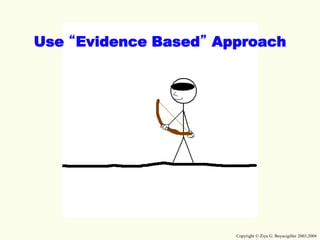
Use “Evidence Based” Approach
Copyright © Ziya G. Boyacigiller 2003,2004
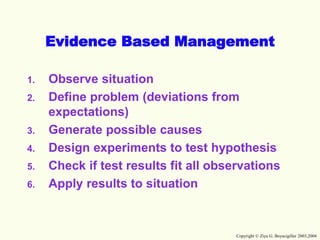
Evidence Based Management
1. Observe situation
2. Define problem (deviations from
expectations)
3. Generate possible causes
4. Design experiments to test hypothesis
5. Check if test results fit all observations
6. Apply results to situation
Copyright © Ziya G. Boyacigiller 2003,2004
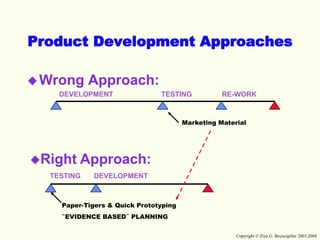
Product Development Approaches
Wrong Approach:
DEVELOPMENT TESTING RE-WORK
Right Approach:
TESTING DEVELOPMENT
Paper-Tigers & Quick Prototyping
“EVIDENCE BASED” PLANNING
Marketing Material
Copyright © Ziya G. Boyacigiller 2003,2004
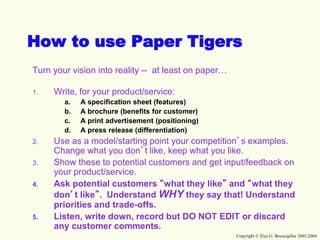
How to use Paper Tigers
Turn your vision into reality -- at least on paper…
1. Write, for your product/service:
a. A specification sheet (features)
b. A brochure (benefits for customer)
c. A print advertisement (positioning)
d. A press release (differentiation)
2. Use as a model/starting point your competition’s examples.
Change what you don’t like, keep what you like.
3. Show these to potential customers and get input/feedback on
your product/service.
4. Ask potential customers “what they like” and “what they
don’t like”. Understand WHY they say that! Understand
priorities and trade-offs.
5. Listen, write down, record but DO NOT EDIT or discard
any customer comments.

Paper tigers

  • 1.
    On Paper Tigers ZiyaG. Boyacigiller This presentation was created and given by Ziya Boyacigiller who was leading Angel Investor and a loved mentor to many young entrepreneurs in Turkey. We have shared it on the web for everyone’s benefit. It is free to use but please cite Ziya Boyacigiller as the source when you use any part of this presentation. For more about Ziya Boyacigiller’s contributions to the start-up Ecosystem of Turkey, please go to www.ziyaboyacigiller.com
  • 2.
    Copyright © ZiyaG. Boyacigiller 2003,2004 Paper Tigers 紙老虎
  • 3.
    Copyright © ZiyaG. Boyacigiller 2003,2004 Paper Tiger From Wikipedia, the free encyclopedia Paper tiger is a literal English translation of the Chinese phrase zhǐ lǎohǔ (Chinese: 紙老虎), meaning something which seems as threatening as a tiger, but is really harmless.
  • 4.
    Copyright © ZiyaG. Boyacigiller 2003,2004 Use “Evidence Based” Approach
  • 5.
    Copyright © ZiyaG. Boyacigiller 2003,2004 Evidence Based Management 1. Observe situation 2. Define problem (deviations from expectations) 3. Generate possible causes 4. Design experiments to test hypothesis 5. Check if test results fit all observations 6. Apply results to situation
  • 6.
    Copyright © ZiyaG. Boyacigiller 2003,2004 Product Development Approaches Wrong Approach: DEVELOPMENT TESTING RE-WORK Right Approach: TESTING DEVELOPMENT Paper-Tigers & Quick Prototyping “EVIDENCE BASED” PLANNING Marketing Material
  • 7.
    Copyright © ZiyaG. Boyacigiller 2003,2004 How to use Paper Tigers Turn your vision into reality -- at least on paper… 1. Write, for your product/service: a. A specification sheet (features) b. A brochure (benefits for customer) c. A print advertisement (positioning) d. A press release (differentiation) 2. Use as a model/starting point your competition’s examples. Change what you don’t like, keep what you like. 3. Show these to potential customers and get input/feedback on your product/service. 4. Ask potential customers “what they like” and “what they don’t like”. Understand WHY they say that! Understand priorities and trade-offs. 5. Listen, write down, record but DO NOT EDIT or discard any customer comments.