New Product Process

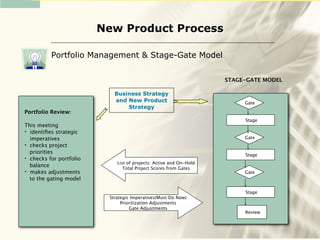
          Portfolio Management & Stage-Gate Model


                                                                    STAGE-GATE MODEL

                            Business Strategy
                            and New Product                              Gate
                                Strategy
Portfolio Review:
                                                                         Stage
This meeting
• identifies strategic
  imperatives                                                            Gate
• checks project
  priorities                                                             Stage
• checks for portfolio
                             List of projects: Active and On-Hold
  balance                       Total Project Scores from Gates
• makes adjustments                                                      Gate
  to the gating model

                                                                         Stage
                          Strategic Imperatives(Must Do Now)
                               Prioritization Adjustments
                                   Gate Adjustments
                                                                         Review
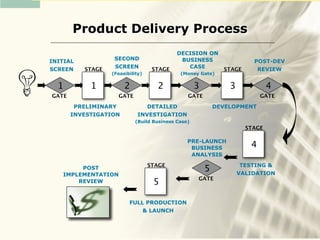
Product Delivery Process
                                            DECISION ON
                   SECOND                    BUSINESS
INITIAL                                                                 POST-DEV
                   SCREEN                      CASE
SCREEN    STAGE                    STAGE                      STAGE      REVIEW
                  (Feasibility)              (Money Gate)


  1         1          2            2               3           3             4
GATE                GATE                        GATE                       GATE

        PRELIMINARY             DETAILED                    DEVELOPMENT
       INVESTIGATION         INVESTIGATION
                            (Build Business Case)
                                                                      STAGE

                                                PRE-LAUNCH
                                                 BUSINESS              4
                                                 ANALYSIS

                                  STAGE                              TESTING &
        POST                                            5           VALIDATION
   IMPLEMENTATION
                                                    GATE
       REVIEW                      5

                         FULL PRODUCTION
                             & LAUNCH
Goals
#1 Quality of Execution

      focus on completeness: key activities central to
       success are carried out
      focus on quality: execution of activities is
       proficient
      focus on the important: devote attention &
       resources to pivotal and potentially weak steps
       (up-front and market-oriented activities)
Goals
#2 Sharper Focus, Project Prioritization

      focus on funnels, not tunnels: strong gates weed
       out weak projects
      focus on using resources efficiently: resources are
       directed toward the truly meritorious projects
Goals
#3 A Strong Market Orientation
Key marketing activities:
      Preliminary market assessment
      Market research to determine user needs and
       wants
      Competitive analysis
      Value-in-use analysis
      Concept testing
      Customer reaction & feedback
      User tests & field trials
      Test market or trial sell
      Market Launch based on marketing plan
Goals
#4 Fact-Based Product Definition

      up-front homework: defines the product and builds
       the business case for Development
      fully defined products: lead to strong first steps
       into becoming full-fledged development projects
      strategic product platforms: creates
       comprehensive product links to insure long-term
       idea pipelines
Goals
#5 Fast-Paced Parallel Processing

      relay race approach ends: the series approach
       moves to the rugby match style of concurrently
       occurring activities
      benefits of team work:
        • more work gets done in an elapsed time period
        • less chance of an activity being overlooked
        • activities are designed to feed each other
        • process becomes cross-functional and
          multidisciplinary
Goals
#6 True Cross-Functional Team Approach


Key ingredients:
      Committed team players
      Team leader accountable for the project
      Leader w/formal authority
      Fluid team structure, w/new members added or
       dropped as work requirements demand-some may
       not be involved in all
      Small, core group of responsible and accountable
       team players from beginning to end
Goals
#7 Products with Competitive Advantage


Defined as:
      Differentiated products
      Unique benefits
      Superior value for the customer

      Product superiority should be built in at
       every opportunity, questioned at every Gate,
       and a key deliverable for Go/Kill reviews
Goals
#8 A Fast-Paced and Flexible Process

      elimination of time wasters: work that adds no
       value to the new product process only slows it
       down
      different projects have different needs: the risks
       and nature of different projects should be
       considered - some will move faster than others
Definitions
Stage
       consists of a set of parallel activities by people
        from different functional groups
       designed to gather information needed to advance
        project to next gate
       each is cross-functional and owned by no single
        functional group
       designed to help manage risk by driving
        uncertainties down at each successive stage
       in general, each stage costs more than the
        preceding one due to successive commitment to
        launch
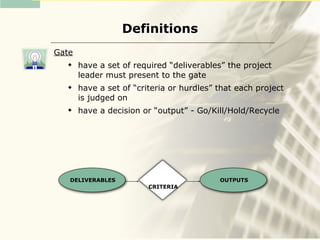
Definitions
Gate
      have a set of required “deliverables” the project
       leader must present to the gate
      have a set of “criteria or hurdles” that each project
       is judged on
      have a decision or “output” - Go/Kill/Hold/Recycle


   DELIVERABLES                            OUTPUTS
                         CRITERIA
Definitions
Gatekeepers
      management team of decision makers and
       resource owners responsible for facilitating the
       rapid commercialization of selected projects
      TI - Managers; Newspaper - Directors after Gate 2
       or 3 forward


 Deliverables
      a prescribed list of items - results of completed
       actions - the Project leader must present to the gate
      based on a standard menu for each gate & are
       decided at the output of the previous gate
Definitions
Criteria/Hurdles
      a predetermined set of hurdles or questions that
       the project is judged on to make Go/Kill and
       prioritization decisions
      can include a list of must-meet or knockout
       questions to weed out misfit projects quickly
      e.g., Does the project fit the corporate strategy?
       Is there consumer appeal - that is, clear consumer
       need and expectation of consumer benefit? Is
       manufacturing or procurement feasible?
Definitions
Outputs
      a decision (Go/Kill/Hold/Recycle)
      an approved action plan for the next stage
      a list of deliverables
      date for the next gate


 Action plan
      estimate of people required
      estimated money and person-days
      budget
      time schedule
Idea Generation

Keys to success
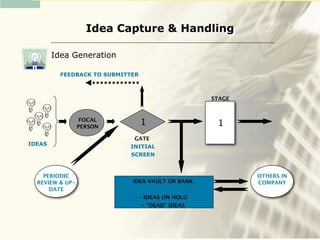
     focal point for new ideas: assign the responsibility
      of generating and handling ideas to a single person
     identify the sources: where do good ideas come
      from - make a list of possible sources and follow
      up
     grease the path: create events or opportunities for
      idea generation - kits, contests, conversations
     capture & handling system: allow for easy
      submission points and forms, with a repository for
      ideas not accepted
Idea Capture & Handling

        Idea Generation

          FEEDBACK TO SUBMITTER


                                                  STAGE


                  FOCAL
                 PERSON
                                  1                1
                             GATE
IDEAS                       INITIAL
                            SCREEN


    PERIODIC                                              OTHERS IN
  REVIEW & UP-               IDEA VAULT OR BANK           COMPANY
      DATE
                              - IDEAS ON HOLD
                               - “DEAD” IDEAS
Idea Capture & Handling

Idea Generation


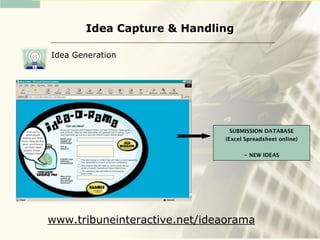
                                SUBMISSION DATABASE
                              (Excel Spreadsheet online)


                                    - NEW IDEAS


www.tribuneinteractive.net/ideaorama
Gate 1
                  Initial Screen
Characteristics
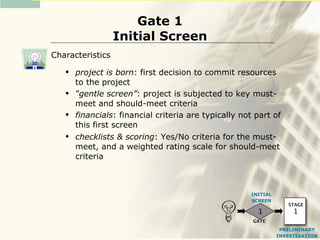
      project is born: first decision to commit resources
       to the project
      “gentle screen”: project is subjected to key must-
       meet and should-meet criteria
      financials: financial criteria are typically not part of
       this first screen
      checklists & scoring: Yes/No criteria for the must-
       meet, and a weighted rating scale for should-meet
       criteria


                                                      INITIAL
                                                      SCREEN
                                                                   STAGE
                                                        1            1
                                                       GATE
                                                                 PRELIMINARY
                                                                INVESTIGATION
Gate 1
                 Initial Screen
Criteria/Hurdles
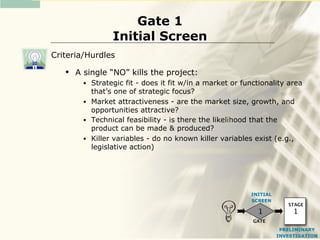
      A single “NO” kills the project:
         • Strategic fit - does it fit w/in a market or functionality area
           that’s one of strategic focus?
         • Market attractiveness - are the market size, growth, and
           opportunities attractive?
         • Technical feasibility - is there the likelihood that the
           product can be made & produced?
         • Killer variables - do no known killer variables exist (e.g.,
           legislative action)


                                                          INITIAL
                                                          SCREEN
                                                                       STAGE
                                                            1            1
                                                           GATE
                                                                     PRELIMINARY
                                                                    INVESTIGATION
Stage 1
       Preliminary Investigation
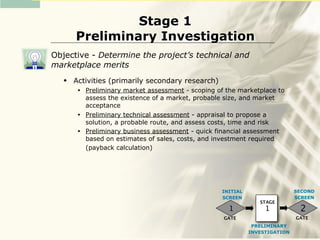
Objective - Determine the project’s technical and
marketplace merits
      Activities (primarily secondary research)
        •   Preliminary market assessment - scoping of the marketplace to
            assess the existence of a market, probable size, and market
            acceptance
        •   Preliminary technical assessment - appraisal to propose a
            solution, a probable route, and assess costs, time and risk
        •   Preliminary business assessment - quick financial assessment
            based on estimates of sales, costs, and investment required
            (payback calculation)


                                                     INITIAL                   SECOND
                                                     SCREEN                    SCREEN
                                                                  STAGE
                                                       1            1           2
                                                      GATE                     GATE
                                                                PRELIMINARY
                                                               INVESTIGATION
Gate 2
                  “Feasibility”
Characteristics
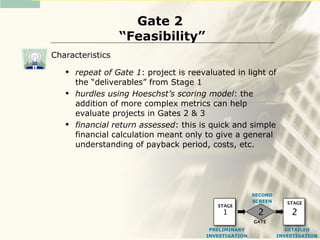
      repeat of Gate 1: project is reevaluated in light of
       the “deliverables” from Stage 1
      hurdles using Hoeschst’s scoring model: the
       addition of more complex metrics can help
       evaluate projects in Gates 2 & 3
      financial return assessed: this is quick and simple
       financial calculation meant only to give a general
       understanding of payback period, costs, etc.


                                                        SECOND
                                                        SCREEN      STAGE
                                           STAGE
                                             1           2           2
                                                        GATE
                                         PRELIMINARY                DETAILED
                                        INVESTIGATION            INVESTIGATION
Gate 2
                       “Feasibility”
Criteria/Hurdles
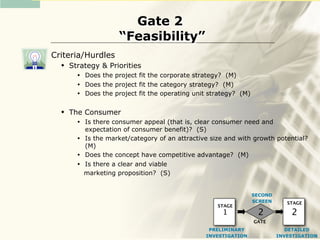
     Strategy & Priorities
        •   Does the project fit the corporate strategy? (M)
        •   Does the project fit the category strategy? (M)
        •   Does the project fit the operating unit strategy? (M)

     The Consumer
        •   Is there consumer appeal (that is, clear consumer need and
            expectation of consumer benefit)? (S)
        •   Is the market/category of an attractive size and with growth potential?
            (M)
        •   Does the concept have competitive advantage? (M)
        •   Is there a clear and viable
            marketing proposition? (S)


                                                                    SECOND
                                                                    SCREEN      STAGE
                                                      STAGE
                                                        1            2           2
                                                                    GATE
                                                   PRELIMINARY                  DETAILED
                                                  INVESTIGATION              INVESTIGATION
Gate 2
                      “Feasibility”
Criteria/Hurdles (cont’d)
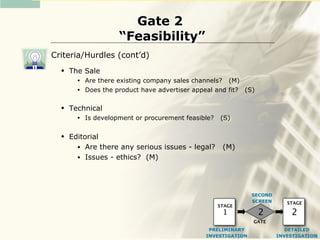
     The Sale
        •   Are there existing company sales channels? (M)
        •   Does the product have advertiser appeal and fit? (S)

     Technical
        •   Is development or procurement feasible?   (S)

     Editorial
        • Are there any serious issues - legal?        (M)
        • Issues - ethics? (M)


                                                                 SECOND
                                                                 SCREEN      STAGE
                                                      STAGE
                                                       1           2          2
                                                                 GATE
                                                  PRELIMINARY                DETAILED
                                                 INVESTIGATION            INVESTIGATION
Gate 2
                     “Feasibility”
Criteria/Hurdles (cont’d)
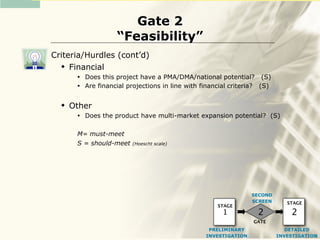
   Financial

       •   Does this project have a PMA/DMA/national potential? (S)
       •   Are financial projections in line with financial criteria? (S)

     Other
       •   Does the product have multi-market expansion potential? (S)

       M= must-meet
       S = should-meet    (Hoescht scale)


                                                                   SECOND
                                                                   SCREEN      STAGE
                                                       STAGE
                                                        1           2           2
                                                                   GATE
                                                    PRELIMINARY                DETAILED
                                                   INVESTIGATION            INVESTIGATION
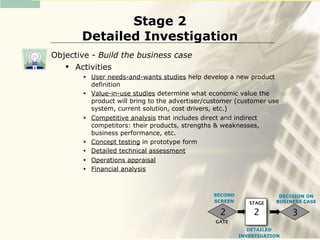
Stage 2
       Detailed Investigation
Objective - Build the business case
    Activities
       •   User needs-and-wants studies help develop a new product
           definition
       •   Value-in-use studies determine what economic value the
           product will bring to the advertiser/customer (customer use
           system, current solution, cost drivers, etc.)
       •   Competitive analysis that includes direct and indirect
           competitors: their products, strengths & weaknesses,
           business performance, etc.
       •   Concept testing in prototype form
       •   Detailed technical assessment
       •   Operations appraisal
       •   Financial analysis


                                                 SECOND               DECISION ON
                                                 SCREEN      STAGE   BUSINESS CASE

                                                   2          2           3
                                                  GATE
                                                             DETAILED
                                                          INVESTIGATION
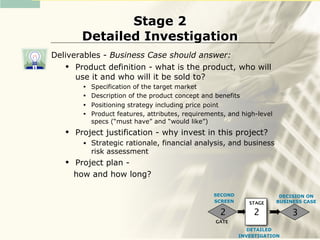
Stage 2
        Detailed Investigation
Deliverables - Business Case should answer:
     Product definition - what is the product, who will
      use it and who will it be sold to?
         •   Specification of the target market
         •   Description of the product concept and benefits
         •   Positioning strategy including price point
         •   Product features, attributes, requirements, and high-level
             specs (“must have” and “would like”)
      Project justification - why invest in this project?
         •   Strategic rationale, financial analysis, and business
             risk assessment
      Project plan -
       how and how long?

                                                    SECOND                 DECISION ON
                                                    SCREEN      STAGE     BUSINESS CASE

                                                      2          2             3
                                                    GATE
                                                                DETAILED
                                                             INVESTIGATION
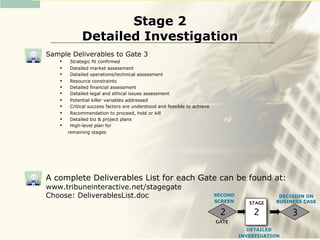
Stage 2
             Detailed Investigation
Sample Deliverables to Gate 3
       Strategic fit confirmed
       Detailed market assessment
       Detailed operations/technical assessment
       Resource constraints
       Detailed financial assessment
       Detailed legal and ethical issues assessment
       Potential killer variables addressed
       Critical success factors are understood and feasible to achieve
       Recommendation to proceed, hold or kill
       Detailed biz & project plans
       High-level plan for
       remaining stages


A complete Deliverables List for each Gate can be found at:
www.tribuneinteractive.net/stagegate
Choose: DeliverablesList.doc                                              SECOND               DECISION ON
                                                                          SCREEN      STAGE   BUSINESS CASE

                                                                           2           2           3
                                                                          GATE
                                                                                      DETAILED
                                                                                   INVESTIGATION
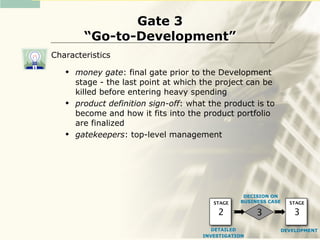
Gate 3
         “Go-to-Development”
Characteristics
      money gate: final gate prior to the Development
       stage - the last point at which the project can be
       killed before entering heavy spending
      product definition sign-off: what the product is to
       become and how it fits into the product portfolio
       are finalized
      gatekeepers: top-level management


                                                   DECISION ON
                                          STAGE   BUSINESS CASE   STAGE

                                           2           3           3
                                          DETAILED            DEVELOPMENT
                                       INVESTIGATION
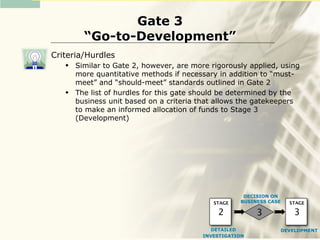
Gate 3
         “Go-to-Development”
Criteria/Hurdles
      Similar to Gate 2, however, are more rigorously applied, using
       more quantitative methods if necessary in addition to “must-
       meet” and “should-meet” standards outlined in Gate 2
      The list of hurdles for this gate should be determined by the
       business unit based on a criteria that allows the gatekeepers
       to make an informed allocation of funds to Stage 3
       (Development)


                                                      DECISION ON
                                             STAGE   BUSINESS CASE   STAGE

                                              2           3           3
                                             DETAILED            DEVELOPMENT
                                          INVESTIGATION
Stage 3
                  Development
Characteristics
      Deliverable is a “lab-tested” product, w/full
       production & marketing plans being developed
       here
      Development plan includes
        • chronological list of activities, actions, and tasks
          (project management)
        • a timeline or schedule showing beginning & end
          points, and milestones
        • resources required for each task and assigned
          responsibility


                                                                        POST
                                           DECISION ON              DEVELOPMENT
                                          BUSINESS CASE   STAGE       REVIEW

                                               3           3            4
                                                      DEVELOPMENT
Gate 4
    Post Development Review
Characteristics
     A check on the progress and continued
      attractiveness of the product and project
     Question switches from “Should we invest in the
      project?” to “How well is the project unfolding - is
      it on track?”
     Go/Kill criteria/hurdles in both Gates 4 & 5 should
      reflect this shift
     Test or validation plans and capital expenditures
      should be approved here
     Marketing and operations
     plans are reviewed for
     future execution                              POST
                                                 DEVELOPMENT
                                         STAGE     REVIEW       STAGE

                                          3          4            4
                                       DEVELOPMENT              TESTING &
                                                               VALIDATION
Stage 4
       Testing and Validation
Characteristics
    Tests and validates the entire commercial viability
     of the project: the product itself, the production
     process, customer acceptance, and the economics
       •   in-house prototype testing
       •   user tests or field trials
       •   limited pilot production
       •   financial revisions
       •   mini-launch


                                                                    PRE-
                                            POST               COMMERCIALIZAT
                                        DEVELOPMENT             ION BUSINESS
                                          REVIEW       STAGE      ANALYSIS

                                            4            4          5
                                                      TESTING &
                                                      VALIDATION
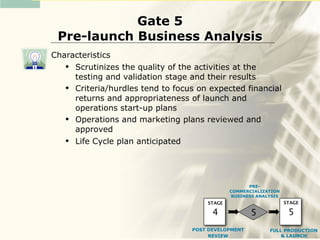
Gate 5
 Pre-launch Business Analysis
Characteristics
    Scrutinizes the quality of the activities at the
     testing and validation stage and their results
    Criteria/hurdles tend to focus on expected financial
     returns and appropriateness of launch and
     operations start-up plans
    Operations and marketing plans reviewed and
     approved
    Life Cycle plan anticipated


                                                    PRE-
                                              COMMERCIALIZATION
                                              BUSINESS ANALYSIS
                                      STAGE                       STAGE

                                        4            5             5
                                  POST DEVELOPMENT         FULL PRODUCTION
                                       REVIEW                  & LAUNCH
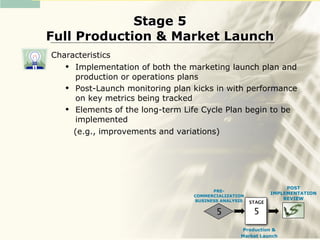
Stage 5
Full Production & Market Launch
Characteristics
    Implementation of both the marketing launch plan and
     production or operations plans
    Post-Launch monitoring plan kicks in with performance
     on key metrics being tracked
    Elements of the long-term Life Cycle Plan begin to be
     implemented
     (e.g., improvements and variations)


                                                                  POST
                                       PRE-
                                                             IMPLEMENTATION
                                 COMMERCIALIZATION
                                 BUSINESS ANALYSIS
                                                                 REVIEW
                                                     STAGE

                                        5             5
                                                 Production &
                                                Market Launch
Post Implementation Review

Characteristics
    After about 6 to 18 months the product project must
     be terminated - product becomes part of the
     company’s portfolio
    Product’s performance is tracked, analyzed, and
     assessed - in terms of costs, revenue against
     projections, profits, timing against other products,
     etc.
    Project team and the leader remain accountable for
     the success of the project through this post-Launch
     period


                                                            POST
                                                       IMPLEMENTATION
                                                           REVIEW
                                               STAGE

                                                 5
                                              TESTING &
                                              VALIDATION

PDMA Process StageGate

  • 2.
    New Product Process Portfolio Management & Stage-Gate Model STAGE-GATE MODEL Business Strategy and New Product Gate Strategy Portfolio Review: Stage This meeting • identifies strategic imperatives Gate • checks project priorities Stage • checks for portfolio List of projects: Active and On-Hold balance Total Project Scores from Gates • makes adjustments Gate to the gating model Stage Strategic Imperatives(Must Do Now) Prioritization Adjustments Gate Adjustments Review
  • 4.
    Product Delivery Process DECISION ON SECOND BUSINESS INITIAL POST-DEV SCREEN CASE SCREEN STAGE STAGE STAGE REVIEW (Feasibility) (Money Gate) 1 1 2 2 3 3 4 GATE GATE GATE GATE PRELIMINARY DETAILED DEVELOPMENT INVESTIGATION INVESTIGATION (Build Business Case) STAGE PRE-LAUNCH BUSINESS 4 ANALYSIS STAGE TESTING & POST 5 VALIDATION IMPLEMENTATION GATE REVIEW 5 FULL PRODUCTION & LAUNCH
  • 6.
    Goals #1 Quality ofExecution  focus on completeness: key activities central to success are carried out  focus on quality: execution of activities is proficient  focus on the important: devote attention & resources to pivotal and potentially weak steps (up-front and market-oriented activities)
  • 7.
    Goals #2 Sharper Focus,Project Prioritization  focus on funnels, not tunnels: strong gates weed out weak projects  focus on using resources efficiently: resources are directed toward the truly meritorious projects
  • 8.
    Goals #3 A StrongMarket Orientation Key marketing activities:  Preliminary market assessment  Market research to determine user needs and wants  Competitive analysis  Value-in-use analysis  Concept testing  Customer reaction & feedback  User tests & field trials  Test market or trial sell  Market Launch based on marketing plan
  • 9.
    Goals #4 Fact-Based ProductDefinition  up-front homework: defines the product and builds the business case for Development  fully defined products: lead to strong first steps into becoming full-fledged development projects  strategic product platforms: creates comprehensive product links to insure long-term idea pipelines
  • 10.
    Goals #5 Fast-Paced ParallelProcessing  relay race approach ends: the series approach moves to the rugby match style of concurrently occurring activities  benefits of team work: • more work gets done in an elapsed time period • less chance of an activity being overlooked • activities are designed to feed each other • process becomes cross-functional and multidisciplinary
  • 11.
    Goals #6 True Cross-FunctionalTeam Approach Key ingredients:  Committed team players  Team leader accountable for the project  Leader w/formal authority  Fluid team structure, w/new members added or dropped as work requirements demand-some may not be involved in all  Small, core group of responsible and accountable team players from beginning to end
  • 12.
    Goals #7 Products withCompetitive Advantage Defined as:  Differentiated products  Unique benefits  Superior value for the customer  Product superiority should be built in at every opportunity, questioned at every Gate, and a key deliverable for Go/Kill reviews
  • 13.
    Goals #8 A Fast-Pacedand Flexible Process  elimination of time wasters: work that adds no value to the new product process only slows it down  different projects have different needs: the risks and nature of different projects should be considered - some will move faster than others
  • 15.
    Definitions Stage  consists of a set of parallel activities by people from different functional groups  designed to gather information needed to advance project to next gate  each is cross-functional and owned by no single functional group  designed to help manage risk by driving uncertainties down at each successive stage  in general, each stage costs more than the preceding one due to successive commitment to launch
  • 16.
    Definitions Gate  have a set of required “deliverables” the project leader must present to the gate  have a set of “criteria or hurdles” that each project is judged on  have a decision or “output” - Go/Kill/Hold/Recycle DELIVERABLES OUTPUTS CRITERIA
  • 17.
    Definitions Gatekeepers  management team of decision makers and resource owners responsible for facilitating the rapid commercialization of selected projects  TI - Managers; Newspaper - Directors after Gate 2 or 3 forward Deliverables  a prescribed list of items - results of completed actions - the Project leader must present to the gate  based on a standard menu for each gate & are decided at the output of the previous gate
  • 18.
    Definitions Criteria/Hurdles  a predetermined set of hurdles or questions that the project is judged on to make Go/Kill and prioritization decisions  can include a list of must-meet or knockout questions to weed out misfit projects quickly  e.g., Does the project fit the corporate strategy? Is there consumer appeal - that is, clear consumer need and expectation of consumer benefit? Is manufacturing or procurement feasible?
  • 19.
    Definitions Outputs  a decision (Go/Kill/Hold/Recycle)  an approved action plan for the next stage  a list of deliverables  date for the next gate Action plan  estimate of people required  estimated money and person-days  budget  time schedule
  • 21.
    Idea Generation Keys tosuccess  focal point for new ideas: assign the responsibility of generating and handling ideas to a single person  identify the sources: where do good ideas come from - make a list of possible sources and follow up  grease the path: create events or opportunities for idea generation - kits, contests, conversations  capture & handling system: allow for easy submission points and forms, with a repository for ideas not accepted
  • 22.
    Idea Capture &Handling Idea Generation FEEDBACK TO SUBMITTER STAGE FOCAL PERSON 1 1 GATE IDEAS INITIAL SCREEN PERIODIC OTHERS IN REVIEW & UP- IDEA VAULT OR BANK COMPANY DATE - IDEAS ON HOLD - “DEAD” IDEAS
  • 23.
    Idea Capture &Handling Idea Generation SUBMISSION DATABASE (Excel Spreadsheet online) - NEW IDEAS www.tribuneinteractive.net/ideaorama
  • 24.
    Gate 1 Initial Screen Characteristics  project is born: first decision to commit resources to the project  “gentle screen”: project is subjected to key must- meet and should-meet criteria  financials: financial criteria are typically not part of this first screen  checklists & scoring: Yes/No criteria for the must- meet, and a weighted rating scale for should-meet criteria INITIAL SCREEN STAGE 1 1 GATE PRELIMINARY INVESTIGATION
  • 25.
    Gate 1 Initial Screen Criteria/Hurdles  A single “NO” kills the project: • Strategic fit - does it fit w/in a market or functionality area that’s one of strategic focus? • Market attractiveness - are the market size, growth, and opportunities attractive? • Technical feasibility - is there the likelihood that the product can be made & produced? • Killer variables - do no known killer variables exist (e.g., legislative action) INITIAL SCREEN STAGE 1 1 GATE PRELIMINARY INVESTIGATION
  • 26.
    Stage 1 Preliminary Investigation Objective - Determine the project’s technical and marketplace merits  Activities (primarily secondary research) • Preliminary market assessment - scoping of the marketplace to assess the existence of a market, probable size, and market acceptance • Preliminary technical assessment - appraisal to propose a solution, a probable route, and assess costs, time and risk • Preliminary business assessment - quick financial assessment based on estimates of sales, costs, and investment required (payback calculation) INITIAL SECOND SCREEN SCREEN STAGE 1 1 2 GATE GATE PRELIMINARY INVESTIGATION
  • 27.
    Gate 2 “Feasibility” Characteristics  repeat of Gate 1: project is reevaluated in light of the “deliverables” from Stage 1  hurdles using Hoeschst’s scoring model: the addition of more complex metrics can help evaluate projects in Gates 2 & 3  financial return assessed: this is quick and simple financial calculation meant only to give a general understanding of payback period, costs, etc. SECOND SCREEN STAGE STAGE 1 2 2 GATE PRELIMINARY DETAILED INVESTIGATION INVESTIGATION
  • 28.
    Gate 2 “Feasibility” Criteria/Hurdles  Strategy & Priorities • Does the project fit the corporate strategy? (M) • Does the project fit the category strategy? (M) • Does the project fit the operating unit strategy? (M)  The Consumer • Is there consumer appeal (that is, clear consumer need and expectation of consumer benefit)? (S) • Is the market/category of an attractive size and with growth potential? (M) • Does the concept have competitive advantage? (M) • Is there a clear and viable marketing proposition? (S) SECOND SCREEN STAGE STAGE 1 2 2 GATE PRELIMINARY DETAILED INVESTIGATION INVESTIGATION
  • 29.
    Gate 2 “Feasibility” Criteria/Hurdles (cont’d)  The Sale • Are there existing company sales channels? (M) • Does the product have advertiser appeal and fit? (S)  Technical • Is development or procurement feasible? (S)  Editorial • Are there any serious issues - legal? (M) • Issues - ethics? (M) SECOND SCREEN STAGE STAGE 1 2 2 GATE PRELIMINARY DETAILED INVESTIGATION INVESTIGATION
  • 30.
    Gate 2 “Feasibility” Criteria/Hurdles (cont’d)  Financial • Does this project have a PMA/DMA/national potential? (S) • Are financial projections in line with financial criteria? (S)  Other • Does the product have multi-market expansion potential? (S) M= must-meet S = should-meet (Hoescht scale) SECOND SCREEN STAGE STAGE 1 2 2 GATE PRELIMINARY DETAILED INVESTIGATION INVESTIGATION
  • 31.
    Stage 2 Detailed Investigation Objective - Build the business case  Activities • User needs-and-wants studies help develop a new product definition • Value-in-use studies determine what economic value the product will bring to the advertiser/customer (customer use system, current solution, cost drivers, etc.) • Competitive analysis that includes direct and indirect competitors: their products, strengths & weaknesses, business performance, etc. • Concept testing in prototype form • Detailed technical assessment • Operations appraisal • Financial analysis SECOND DECISION ON SCREEN STAGE BUSINESS CASE 2 2 3 GATE DETAILED INVESTIGATION
  • 32.
    Stage 2 Detailed Investigation Deliverables - Business Case should answer:  Product definition - what is the product, who will use it and who will it be sold to? • Specification of the target market • Description of the product concept and benefits • Positioning strategy including price point • Product features, attributes, requirements, and high-level specs (“must have” and “would like”)  Project justification - why invest in this project? • Strategic rationale, financial analysis, and business risk assessment  Project plan - how and how long? SECOND DECISION ON SCREEN STAGE BUSINESS CASE 2 2 3 GATE DETAILED INVESTIGATION
  • 33.
    Stage 2 Detailed Investigation Sample Deliverables to Gate 3  Strategic fit confirmed  Detailed market assessment  Detailed operations/technical assessment  Resource constraints  Detailed financial assessment  Detailed legal and ethical issues assessment  Potential killer variables addressed  Critical success factors are understood and feasible to achieve  Recommendation to proceed, hold or kill  Detailed biz & project plans  High-level plan for remaining stages A complete Deliverables List for each Gate can be found at: www.tribuneinteractive.net/stagegate Choose: DeliverablesList.doc SECOND DECISION ON SCREEN STAGE BUSINESS CASE 2 2 3 GATE DETAILED INVESTIGATION
  • 34.
    Gate 3 “Go-to-Development” Characteristics  money gate: final gate prior to the Development stage - the last point at which the project can be killed before entering heavy spending  product definition sign-off: what the product is to become and how it fits into the product portfolio are finalized  gatekeepers: top-level management DECISION ON STAGE BUSINESS CASE STAGE 2 3 3 DETAILED DEVELOPMENT INVESTIGATION
  • 35.
    Gate 3 “Go-to-Development” Criteria/Hurdles  Similar to Gate 2, however, are more rigorously applied, using more quantitative methods if necessary in addition to “must- meet” and “should-meet” standards outlined in Gate 2  The list of hurdles for this gate should be determined by the business unit based on a criteria that allows the gatekeepers to make an informed allocation of funds to Stage 3 (Development) DECISION ON STAGE BUSINESS CASE STAGE 2 3 3 DETAILED DEVELOPMENT INVESTIGATION
  • 36.
    Stage 3 Development Characteristics  Deliverable is a “lab-tested” product, w/full production & marketing plans being developed here  Development plan includes • chronological list of activities, actions, and tasks (project management) • a timeline or schedule showing beginning & end points, and milestones • resources required for each task and assigned responsibility POST DECISION ON DEVELOPMENT BUSINESS CASE STAGE REVIEW 3 3 4 DEVELOPMENT
  • 37.
    Gate 4 Post Development Review Characteristics  A check on the progress and continued attractiveness of the product and project  Question switches from “Should we invest in the project?” to “How well is the project unfolding - is it on track?”  Go/Kill criteria/hurdles in both Gates 4 & 5 should reflect this shift  Test or validation plans and capital expenditures should be approved here  Marketing and operations plans are reviewed for future execution POST DEVELOPMENT STAGE REVIEW STAGE 3 4 4 DEVELOPMENT TESTING & VALIDATION
  • 38.
    Stage 4 Testing and Validation Characteristics  Tests and validates the entire commercial viability of the project: the product itself, the production process, customer acceptance, and the economics • in-house prototype testing • user tests or field trials • limited pilot production • financial revisions • mini-launch PRE- POST COMMERCIALIZAT DEVELOPMENT ION BUSINESS REVIEW STAGE ANALYSIS 4 4 5 TESTING & VALIDATION
  • 39.
    Gate 5 Pre-launchBusiness Analysis Characteristics  Scrutinizes the quality of the activities at the testing and validation stage and their results  Criteria/hurdles tend to focus on expected financial returns and appropriateness of launch and operations start-up plans  Operations and marketing plans reviewed and approved  Life Cycle plan anticipated PRE- COMMERCIALIZATION BUSINESS ANALYSIS STAGE STAGE 4 5 5 POST DEVELOPMENT FULL PRODUCTION REVIEW & LAUNCH
  • 40.
    Stage 5 Full Production& Market Launch Characteristics  Implementation of both the marketing launch plan and production or operations plans  Post-Launch monitoring plan kicks in with performance on key metrics being tracked  Elements of the long-term Life Cycle Plan begin to be implemented (e.g., improvements and variations) POST PRE- IMPLEMENTATION COMMERCIALIZATION BUSINESS ANALYSIS REVIEW STAGE 5 5 Production & Market Launch
  • 41.
    Post Implementation Review Characteristics  After about 6 to 18 months the product project must be terminated - product becomes part of the company’s portfolio  Product’s performance is tracked, analyzed, and assessed - in terms of costs, revenue against projections, profits, timing against other products, etc.  Project team and the leader remain accountable for the success of the project through this post-Launch period POST IMPLEMENTATION REVIEW STAGE 5 TESTING & VALIDATION