Amy Vecchione May 7, 2009 Boise State University Strategies for connecting to & supporting faculty, graduate students, and undergraduates
“ the continued progress of the library facilitates progress in the scholarly community” Drummond, Rebecca C. (May 1991). A Joint Venture:  Collaboration in Collection Building.  Collection  Management .  14 , 59-72.
Current Trends in the Academic Library  Less visits to the reference desk More online searching  Increase in cloud computing Sharp increase in distance education Publishing model is shifting Constant change in technology Shrinking budgets
Connecting in a Changing World Low cost innovations Embracing the constant change Continuous learning Reaching out to where the students and faculty are Be receptive to new ideas Learn evolving and current technologies Admit when tools are no longer working and move on Learn and evaluate the needs of your user groups
“… the Millennial Generation’s identified traits of self-assuredness,  technological savvy, and impatience…” Duke, Lynda M. (March 2009).Collaboration between Marketing Students and  the Library : An Experiential Learning Project to Promote Reference  Services.  College & Research Libraries .  70 , 109-121.
 
Strategies For All Users Relationship building Communication Inform of library services Be an advocate Engage in continual learning Keep an open mind Listen carefully & show empathy Reach out Be relevant Make use of current web tools Customize
Strategies for Faculty Introduce yourself  Ask a lot of Questions Promote publishing with open access journals Collection Development Collaboration Super Supporters Communication methods E-mail newsletters Attend departmental meetings Learn the departmental culture Level of formality Be invested, embedded and caring Take courses, Attend classes, Read Published Articles Be there face to face or online Congratulate Successes Technical help & Information Literacy Instruction
Questions to Ask Are faculty aware of present library services? What methods does faculty use to communicate? What are their preferred methods of communication? What are their research subjects? How many members are there? Who has been published recently and what awards have any won? Does the academic department have a liaison for the library? What do other library liaisons do?  How do other librarians connect to their community? Do I have a mentor? What are the existing marketing plans?
Strategies for Graduate and Undergraduate Students Listen and show empathy on the reference desk Be there Cater to their individual needs They can find us when they need us Be embedded Partnerships with popular organizations Showing up to help Service oriented experiences Journals projects Workshops Embrace non-traditional students Be ready to learn  Research consultations
 
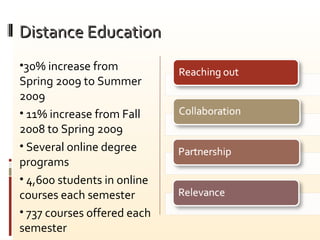
Distance Education 30% increase from Spring 2009 to Summer 2009 11% increase from Fall 2008 to Spring 2009 Several online degree programs 4,600 students in online courses each semester 737 courses offered each semester
Responsibilities as Virtual Learners Use the tools that suit your users learning styles  Stop using tools when they are no longer useful Evaluate tools before you use them Become familiar with tools before sharing them Learn new things Provide feedback for new technology Show respect Consider all points of view Interact and respond Be genuine
 
 
Bibliography Anderson, Jan R. (March 1999) Collection Development in the Electronic Environment: Shifting  Priorities: A Conference Report.  Library Collections, Acquisitions & Technical Services.  v. 23 n.  4 p. 443-449.  Drummond, Rebecca C. (May 1991). A Joint Venture: Collaboration in Collection Building.  Collection  Management . v. 14 , p. 59-72. Duderstadt, James J. (April 2009). Possible Futures for the Research Library in the 21 st  Century.  Journal of  Library Administration.  v. 49 n. 3 p. 217-225. Duke, Lynda M. (March 2009).Collaboration between Marketing Students and the Library: An Experiential  Learning Project to Promote Reference Services.  College & Research Libraries .  70 , 109-121. Hunter, Karen, et. al., (April 2009) Panel 3: Into the Glass Darkly: Future Directions in the 21 st  Century.  Journal of Library Administration.  v. 49 n.3 p. 281-301 Kozel-Gains, Melissa A., et. al. (April 2009) Experiments and Experiences in Liaison Activities: Lessons  from New Librarians in Integrating Technology, Face-to-Face, and Follow Up.  Collection  Management.  v. 32 n. 2 p. 130-142. Liu, Shu. (January 2008) Engaging Users: The Future of Academic Library Web Sites.  College & Research  Libraries.  v. 69 no. 1 p. 6-27. Stoddard, Richard A., et. al., (July 2006) Going Boldly Beyond the Reference Desk: Practical  Advice and  Learning Plans for New Reference Librarians Performing Liaison Work.  The Journal of  Academic Librarianship. v. 32 n. 4 p. 419-427. Tucker, James C., et. al., (2003) Collaborate or Die! Collection Development in Today’s Academic Library. The Reference Librarian. v.  83/84, 2003, p. 219-236. Veal, Robin, et. al., The Virtual Library Liaison: A Case Study at an Online University.  Journal of Library  Administration.  V. 49 n. 1 p. 161-170. York, Amy C., et. al., (January 2009) Taking Library Instruction into the Online Classroom: Best Practices  for Embedded Librarians.  Journal of Library Administration.  v. 49 n. 1 p. 197-209.

Reaching Out To Work Together

  • 1.
    Amy Vecchione May7, 2009 Boise State University Strategies for connecting to & supporting faculty, graduate students, and undergraduates
  • 2.
    “ the continuedprogress of the library facilitates progress in the scholarly community” Drummond, Rebecca C. (May 1991). A Joint Venture: Collaboration in Collection Building. Collection Management . 14 , 59-72.
  • 3.
    Current Trends inthe Academic Library Less visits to the reference desk More online searching Increase in cloud computing Sharp increase in distance education Publishing model is shifting Constant change in technology Shrinking budgets
  • 4.
    Connecting in aChanging World Low cost innovations Embracing the constant change Continuous learning Reaching out to where the students and faculty are Be receptive to new ideas Learn evolving and current technologies Admit when tools are no longer working and move on Learn and evaluate the needs of your user groups
  • 5.
    “… the MillennialGeneration’s identified traits of self-assuredness, technological savvy, and impatience…” Duke, Lynda M. (March 2009).Collaboration between Marketing Students and the Library : An Experiential Learning Project to Promote Reference Services. College & Research Libraries . 70 , 109-121.
  • 6.
  • 7.
    Strategies For AllUsers Relationship building Communication Inform of library services Be an advocate Engage in continual learning Keep an open mind Listen carefully & show empathy Reach out Be relevant Make use of current web tools Customize
  • 8.
    Strategies for FacultyIntroduce yourself Ask a lot of Questions Promote publishing with open access journals Collection Development Collaboration Super Supporters Communication methods E-mail newsletters Attend departmental meetings Learn the departmental culture Level of formality Be invested, embedded and caring Take courses, Attend classes, Read Published Articles Be there face to face or online Congratulate Successes Technical help & Information Literacy Instruction
  • 9.
    Questions to AskAre faculty aware of present library services? What methods does faculty use to communicate? What are their preferred methods of communication? What are their research subjects? How many members are there? Who has been published recently and what awards have any won? Does the academic department have a liaison for the library? What do other library liaisons do? How do other librarians connect to their community? Do I have a mentor? What are the existing marketing plans?
  • 10.
    Strategies for Graduateand Undergraduate Students Listen and show empathy on the reference desk Be there Cater to their individual needs They can find us when they need us Be embedded Partnerships with popular organizations Showing up to help Service oriented experiences Journals projects Workshops Embrace non-traditional students Be ready to learn Research consultations
  • 11.
  • 12.
    Distance Education 30%increase from Spring 2009 to Summer 2009 11% increase from Fall 2008 to Spring 2009 Several online degree programs 4,600 students in online courses each semester 737 courses offered each semester
  • 13.
    Responsibilities as VirtualLearners Use the tools that suit your users learning styles Stop using tools when they are no longer useful Evaluate tools before you use them Become familiar with tools before sharing them Learn new things Provide feedback for new technology Show respect Consider all points of view Interact and respond Be genuine
  • 14.
  • 15.
  • 16.
    Bibliography Anderson, JanR. (March 1999) Collection Development in the Electronic Environment: Shifting Priorities: A Conference Report. Library Collections, Acquisitions & Technical Services. v. 23 n. 4 p. 443-449. Drummond, Rebecca C. (May 1991). A Joint Venture: Collaboration in Collection Building. Collection Management . v. 14 , p. 59-72. Duderstadt, James J. (April 2009). Possible Futures for the Research Library in the 21 st Century. Journal of Library Administration. v. 49 n. 3 p. 217-225. Duke, Lynda M. (March 2009).Collaboration between Marketing Students and the Library: An Experiential Learning Project to Promote Reference Services. College & Research Libraries . 70 , 109-121. Hunter, Karen, et. al., (April 2009) Panel 3: Into the Glass Darkly: Future Directions in the 21 st Century. Journal of Library Administration. v. 49 n.3 p. 281-301 Kozel-Gains, Melissa A., et. al. (April 2009) Experiments and Experiences in Liaison Activities: Lessons from New Librarians in Integrating Technology, Face-to-Face, and Follow Up. Collection Management. v. 32 n. 2 p. 130-142. Liu, Shu. (January 2008) Engaging Users: The Future of Academic Library Web Sites. College & Research Libraries. v. 69 no. 1 p. 6-27. Stoddard, Richard A., et. al., (July 2006) Going Boldly Beyond the Reference Desk: Practical Advice and Learning Plans for New Reference Librarians Performing Liaison Work. The Journal of Academic Librarianship. v. 32 n. 4 p. 419-427. Tucker, James C., et. al., (2003) Collaborate or Die! Collection Development in Today’s Academic Library. The Reference Librarian. v. 83/84, 2003, p. 219-236. Veal, Robin, et. al., The Virtual Library Liaison: A Case Study at an Online University. Journal of Library Administration. V. 49 n. 1 p. 161-170. York, Amy C., et. al., (January 2009) Taking Library Instruction into the Online Classroom: Best Practices for Embedded Librarians. Journal of Library Administration. v. 49 n. 1 p. 197-209.