
OPIOIDS
PRESENTOR :-AKHILENDRA
CHOPRA
MODERATOR:-DR VIRENDRA
KUMAR
INTRODUCTION
 The term “opioid” is used to denote all exogenous substances natural
and synthetic, that bind to opioid receptors and produce at least some
agonist effects.
 Opioids have remain mainstay of modern perioprative pain
management.
 The word opium is derived from the Greek word opion (“poppy juice”).
 Opium is a dark brown, resinous material obtained from the capsule of
the poppy plant (Papaver somniferum).
 There are 20 natural alkaloids derived from the juice of poppy plant.
 Opiate is the term used for drugs derived from opium
HISTORY
 Opioids are world's oldest known drugs.
 1805- German chemist Friedrich Serturner isolated the pure active
ingredient in opium. He named this chemical “morphine”.
 1874: German chemists invented heroin by adding two acetyl
groups to morphine .
 1939: Meperidine the first opiate with a structure altogether different
from morphine.
 1942: Weijlard and Erikson produced nalorphine, the first opiate
antagonist.
HISTORY CONT…
 1959:Fentanyl was first synthesized by Paul Janssen.
 1973: Candace Pert and Solomon Snyder discovered that opioids
act by attaching to specific receptors within the brain. These
receptors were called the opioid receptors.
 1975: Scottish neuroscientists John Hughes and Hans Kosterlitz
discovered neurotransmitter that activate the opiate receptors.-
“endorphins”.
 1974 to 1976: Other fentanyl congeners like alfentanyl, sufentanyl
were synthesized.
CLASSIFICATION
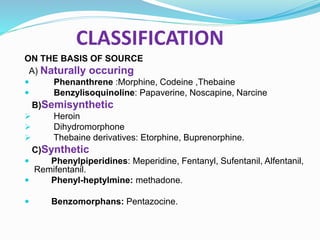
ON THE BASIS OF SOURCE
A) Naturally occuring
 Phenanthrene :Morphine, Codeine ,Thebaine
 Benzylisoquinoline: Papaverine, Noscapine, Narcine
B)Semisynthetic
 Heroin
 Dihydromorphone
 Thebaine derivatives: Etorphine, Buprenorphine.
C)Synthetic
 Phenylpiperidines: Meperidine, Fentanyl, Sufentanil, Alfentanil,
Remifentanil.
 Phenyl-heptylmine: methadone.
 Benzomorphans: Pentazocine.
CLASSIFICATION CONT…
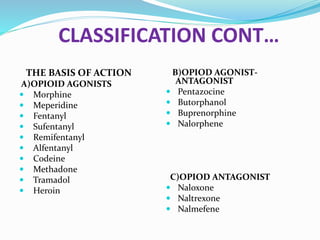
THE BASIS OF ACTION
A)OPIOID AGONISTS
 Morphine
 Meperidine
 Fentanyl
 Sufentanyl
 Remifentanyl
 Alfentanyl
 Codeine
 Methadone
 Tramadol
 Heroin
B)OPIOD AGONIST-
ANTAGONIST
 Pentazocine
 Butorphanol
 Buprenorphine
 Nalorphene
C)OPIOD ANTAGONIST
 Naloxone
 Naltrexone
 Nalmefene
ENDOGENOUS OPIOID PEPTIDES
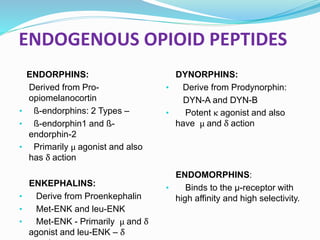
ENDORPHINS:
Derived from Pro-
opiomelanocortin
• ß-endorphins: 2 Types –
• ß-endorphin1 and ß-
endorphin-2
• Primarily μ agonist and also
has δ action
ENKEPHALINS:
• Derive from Proenkephalin
• Met-ENK and leu-ENK
• Met-ENK - Primarily μ and δ
agonist and leu-ENK – δ
DYNORPHINS:
• Derive from Prodynorphin:
DYN-A and DYN-B
• Potent κ agonist and also
have μ and δ action
ENDOMORPHINS:
• Binds to the µ-receptor with
high affinity and high selectivity.
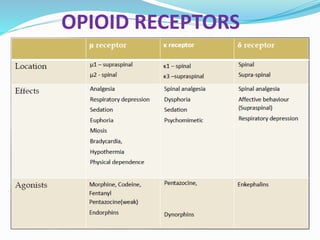
OPIOID RECEPTORS
LOCATION OF OPIOID RECEPTORS
1.Brainstem: respiration, cough, nausea & vomiting, BP, pupill and GI
secretion.
• 2. Thalamus: poorly localized deep pain
• 3. Spinal cord: substantia gelatinosa ,involved painful afferent
stimuli
• 4. Hypothalamus: mediating neuroendocrine secretion.
• 5. Limbic system: major role in emotional behavior & little
analgesic effect.
• 6. Peripheral nerve fibers
MORPHINE-PROTOTYPE OPIOID
PHARMACOLOGICAL ACTIONS
• A)Analgesia
 Produces strong analgesia without loss of consciousness.
 Other sensory modalities are not affected.
 Increases the threshold of pain.
 Nociceptive pain is better relieved than neuritic pain.
 Visceral pain is relieved better than somatic pain.
• B) Sedation:
 Drowsiness.
 Colorful day dream.
 Larger doses produce sleep.
MORPHINE-PROTOTYPE OPIOID
CONT…
C)Mood effects:
 Opioids produce euphoria.
D) Depression
 Pontine and medullary ventilatory centre – for both rate
and depth of respiration is diminished.
 Medullary cough centre .
 Temperature regulating centre.
 Vasomotor centre – High doses cause fall in BP.
MORPHINE-PROTOTYPE OPIOID
CONT…
E)Stimulation
 CTZ – sensitize CTZ.
 Edinger Westphal Nucleus – miosis .
 Vagal centre – Bradycardia .
 Hippocampal cells – convulsions (inhibition of GABA release).
 Increases ADH release – oliguria..
F)CVS:
 No direct action on the myocardium.
 Histamine release.
 Depression of vasomotor centre
 Vasodilatation leading to hypotension.
PHARMACOKINETICS OF MORPHINE
ABSORPTION AND DISTRIBUTION:
 Variable absorption orally.
 Well absorbed after IM administration with onset of action in 15 -
30min.
 Duration of action is about 4 hrs.
 Widely distributed,IV administration,However CNS penetration is
poor.
 Crosses placental barrier – hypoxia and apnoea fetus.
PHARMACOKINETICS OF MORPHINE
F) Metabolism:
 Conjugation with glucuronic acid in hepatic and extra hepatic sites.
 Produce water soluble metabolites.
 Morphine-3-glucuronide (70-80%): Pharmacologically inactive.
 Morphine-6-glucuronide (5-10%): Agonist action at μ–receptors
G)Excretion:
 Via Urine, Plasma t1/2 = 2-3 hrs
 Completely eliminated in 24 hrs.
 Elimination of morphine glucuronides may be impaired in renal
failure.
ADVERSE EFFECT-VENTILATORY DEPRESION
All μ-receptor agonists- dose dependent depression of respiration:
 Decrease brainstem sensitivity to CO2
 Increase Apnoeic threshold
 Decrease Hypoxic drive to respiration
 Pontine & medullary centres involved in rhythmic respiration
 Periodic breathing resembling Cheyne- Stokes breathing.
Effect increased :
 CNS depressants like
 Inhalational anesthetics ,
 BZDs and most of the sedative
 Standard therapy is Naloxone
 Dose 0.5 mcg-1mcg I every 2-3 minute.
ADVERSE EFFECT CONT….
 CVS:
 Orthostatic hypotension.
 Bradycardia may be due to direct or idirect.
 CNS:
 Sedation.
 Mental clouding – sometimes dysphoria.
 Skeletal muscle rigidity.
 Raised ICT.
 Smooth Muscle contraction:
 Biliary colic.
 Urinary retention.
 Bronchospasm.
ADVERSE EFFECT CONT….
Tolerance and dependence:
 Most common problem.
 Exhibited in most actions except constipation and miosis.
 Psychological and physical dependence.
MORPHINE WITHDRAWAL SYNDROME:
 Anxiety, fear, restlesness, diarrhoea, abdominal colic, delirium and
convulsion.
 Treatment is methadone
ADVERSE EFFECT CONT….
Acute Morphine Poisoning:
 Occurs if >50 mg (Lethal dose – 250 mg) is administered.
 Depression of ventilation may progress to apnoea.
Triad:
 Miosis,
 Hypoventilation and
 Coma
Treatment:
 Gastric lavage with KMnO4.
 Specific antidote: Naloxone: 0.4 to 0.8mg IV repeatedly in 2-3
minutes till respiration picks up.
THERAPEUTIC USES OF MORPHINE
 Analgesic: Dose- 0.1-0.15mg/kg iv bolus F/B 0.01mg/kg/hr
maintenance.
 Surgical and post operative analgesia
 Long bone fracture,
 Burns.
 Myocardial infarction.
 Palliative therapy in cancer.
 Visceral pains – pleurisy, acute pericarditis.
 Other Uses
 Pre-anaesthetic medication
 Acute left ventricular failure – Cardiac asthma
 Congeners eg. loperamide and diphenoxylate :severe intractable
diarrhoea.
MEPERIDINE (PETHIDINE)
 Phenylepiperidine derivative having structural similarities with
atropine.
 Pharmacokinetics:
 Better oral absorption.
 1/10th as potent as morphine, but efficacy is similar.
 Rapid but short acting (2-3 Hrs).
 It produces as much sedation, euphoria and respiratory depression
as morphine.
 Producess Less spasmodic action.
 Less miosis,constipation and urinary retention.
 Less histamine release – safer in asthmatics.
MEPERIDINE (PETHIDINE) CONT…
 Clinical Uses:
 Labour and post operative analgesia.
 Post operative shivering.
 Adverse Effects:
 Similar to morphine.
 Dry mouth, blurred vision,tachycardia (not use in borderline
cardiac function)
 Overdose :
 Tremors, mydriasis, delirium and convulsion due to norpethidine
accumulation
FENTANYL
 Phenylpiperidine derivative ,structurally related to meperidine
 Pharmacokinetics:
 75 to 125 times as potent as morphine.
 Rapid onset and shorter duration.
 Rapidly redistributed to fat and skeletal muscles.
 75% of the initial dose undergoes first-pass pulmonary uptake.
CLINICAL USE OF FENTANYL
 Analgesia: Low IV dose 1-2 μg/kg.
 Adjuvant to anaesthetics (2-20 μg/kg) to blunt circulatory response
for Intubation and to decrease requirement of inhalational agents.
 TIVA – Dose 50-150 μg/kg.
 Intrathecal: labour analgesia and anaesthesia ,DOSE-5-25μg.
 Oral transmucosal :fentanyl 5- 20 μg/kg for decrease pre-operative
anxiety and smooth induction.
 Transdermal fentanyl patch: delivering 75 - 100 μg/hr for treatment of
chronic pain in cancer and also for post op pain.
ADVERSE EFFECT OF
FENTANYL
 Similar to morphine.
 Persistent/ recurrent respiratory depression.
 Carotid sinus baroreceptor reflex control is markedly depressed-
caution in neonates.
 Bradycardia is more prominent.
 Myoclonus: may produce clinical picture of seizure activity in the
absence of EEG changes.
 Modest increases in ICP in head injury patients inspite of an
unchanged PaCO2.
FENTANYL AS A SOLE ANAESHETIC AGENT
 Advantages:
 Lack of direct myocardial depressant effects.
 Absence of histamine release.
 Suppression of stress respone to surgery.
 Disadvantages:
 Failure to prevent sympathetic response to surgical stimulation.
 Possible patient awareness.
 Postoperative ventilatory depression.
SUFENTANIL
 Thienyl analogue of fentanyl.
 Pharmacokinetics:
 Potency is 5 to 10 times that of fentanyl.
 Lipophilic nature permits rapid penetration into the BBB and onset of
CNS effects.
 Approx. 60% of the drug undergoes first pass pulmonary uptake.
 Extensive protein binding - mainly glycoprotein.
 Enhanced effect in neonates probably due to α1 acid glycoprotein.
SUFENTANIL
 Metabolism :
 N-dealkylation→ inactive metabolite
 O-demethylation→ desmethyl sufentanyl has10% activity of
sufentanyl.
 Extensively metabolised by hepatic microsomal enzymes.
 Hepatic clearance sensitive to hepatic blood flow.
Sufentanyl Vs Fentanyl:
 Faster analgesia and less ventilatory depression.
 More rapid induction.
 Earlier emergence and earlier tracheal extubation
ALFENTANIL
 Fentanyl analogue with lesser potency and shorter duration ofaction.
 Despite its lower lipid solubilty it has a more rapid onset of action
due to the higher degree of non-ionisation.
 It is used to provide analgesia when the noxious stimulation is acute
but transient as in laryngoscopy, tracheal intubation and performance
of a retrobulbar block.
 Associated with a lower incidence of PONV.
REMIFENTANIL
 Selective μ agonist with potency similar to fentanyl.
 Predictable onset and termination of effect because of
Rapid clearance
No significant redistribution to inactive storage sites
 Unique ester-linkage ,metabolised by non-specific plasma and
tissue esterases, Safe in hepatic and renal failure.
 Blood-brain equilibration time similar to alfentanil.
REMIFENTANIL CONT….
 Clinical Uses
 Short intense analgesia.
 Suppressing transient sympathetic response to laryngoscopy of at
risk patients.
 Intermittent administration as PCA during labour and delivery.
 Sedation and analgesia.
 To attenuate haemodynamic response to electroconvulsive therapy.
 Side effects:.
 Termination of analgesic effect on accidental stoppage of infusion.
 Induce seizure like activity
 Decrease in B.P and H.R.
TRAMADOL
 Centrally acting opioid.
 Moderate affinity for μ receptors and weak κ and δ activity.
 Dual mechanism of action
 Opioid agonist effect.
 5-HT and NA uptake inhibition enhancing function of spinal inhibitory
pathways.
 Effective both orally and IV (100mg = 10 mg Morphine).
 Dose-50-100 mg IV, repeat 6 hr ,and maximum dose upto 400 mg/day
TRAMADOL CONT…
 Uses
 Effective for the treatment of chronic pain.
 Can be used where NSAIDS are contraindicated.
 Post-operative shivering.
DOSE-2 mg/kg
 Disadvantages
 Seizures have been demonstrated.
 High incidence of nausea and vomiting.
OPIOID AGONIST-ANTAGONIST
 PENTAZOCINE:
 Benzomorphan derivative.
 Weak μ-receptor antagonist and agonist of κ and δ receptor.
 Given orally( dose -50-100 mg)
 Parenterl (dose-30-60 mg)
 both analgesia and respiratory depression occur after 30 to 70 mg
of pentazocine.
 Low abuse liability. However can precipitate withdrawal symptoms
OPIOID AGONIST-ANTAGONIST
PENTAZOCINE CONT..
USES:
Moderately severe pain in injury, burns, trauma and orthopaedic
manuevers
DISADVANTAGES
 Depresses myocardial contractility.
 Inhibits gastric emptying and GIT transit.
 High incidence of PONV.
 Limited analgesia.
 Partially antagonizes other opioids.
BUTORPHANOL
 Agonist- antagonist opioid that resembles Pentazocine.
 Compared to Pentazocine, its agonist action is 20 times greater and
antagonist activity is 15- 30 times greater.
 Rapidly and almost completely absorbed after I.M administration.
 Respiratory depression is similar to morphine
 Less abuse and has less addictive potential than morphine or
fentanyl.
 Transnasal butorphanol is effective in relieving migraine and
postoperative pain.
BUPRENORPHINE
 Buprenorphine is a thebaine derivative.
 Approximately 33 times more potent than morphine Has 50 times
higher affinity for μ- receptor than morphine.
 Given Sublingually or parenterally but not orally – high 1st pass
metabolism
 The onset of action of is slow, peak effect takes 3 hours, and its
duration of effect is prolonged (>10 hours).
BUPRENORPHINE
USES
 Analgesic component in balanced anesthesia.
 Excellent analgesic for relieving pain in the post operative period,
cancer, renal colic.
 Adjuvant for spinal and epidural analgesia. High lipid solubility limits
ADVERSE EFFECTS:
 Hypotension,drowsiness, nausea, vomiting and Pulmonary oedema
has been observed in some patients
 Respiratory depression (fatal in neonates) and cannot be reversed
by Naloxone
OPIOID ANTAGONIST
 Naloxone , naltrexone, nalmefene
 Higher affinity for μ-receptors results in displacement of the opioid agonists
from thereceptor sites.
 NALOXONE
Non-selective antagonist of all types of opioid receptors
Uses
 Treat opioid induced depression of ventilation in postoperative peiod and in
neonates due to maternal opioid administration.
 Opioid overdose.
 In hypovolaemic and septic shock, naloxone is useful to promote myocardial
contractility and inproves patient outcome.
NALOXONE CONT…
 Adverse Effects
 Antagonizes analgesic actions of opioids.
 Nausea/ vomiting .
 Increased sympathetic nervous system activity- tachycardia,
hypertension, pulmonary oedema and cardiac dysrhythmias.
 Administration of naloxone to an opioid dependent parturient may
produce acute withdrawal in the neonate.
 Antagonizes the depressant effect of inhaled anaesthetics.
OPIOID ANTAGONIST CONT…
NALTREXONE
Highly effective orally and duration of action is as long as 24 hrs.
Nalmefene
 6-methylene analogue of naltrexone.
 Equipotent to naloxone.
 Primary advantage is its longer duration of action as compared to
naloxone – as long as 24hrs.
 Prophylactic administration decreases the need for anti-emetics and
anti-pruritic medications in patients receiving opioid analgesics.
ANAESTHETIC USE OF OPIOIDS
 1.ANALGESIA
 2.SEDATION
 3.BALANCED ANAESTHESIA
 Reduce post-operative pain and anxiety.
 Decrease the somatic and autonomic responses to airway
stimulation.
 Improve haemodynamic stability.
 Reduce the dose of sedative agents.
 Reduce the requirement of inhalational agents.
ANAESTHETIC USE OF OPIOIDS
4.NEUROLEPTANALGESIA- ANAESTHESIA
 Neuroleptanalgesia is characterized by
 analgesia,
 absence of motor activity.
 suppression of autonomic reflexes.
 maintenance of cardiovascular stability.
 amnesia in most patients.
 Neuroleptanalgesia is achieved by:
 Potent opioid analgesic (fentanyl)
 The addition of an inhaled agent, usually N2O, improves amnesia
and has been called Neuroleptanaesthesia.
ANAESTHETIC USE OF OPIOIDS
5.Total Intravenous Anaesthesia (TIVA)
 Useful when delivery of inhalational agents are compromised or
contraindicated.
 Most commonly an opioid is combined with another drug which
provide hypnosis and amnesia.
 Combination of alfentanil and propofol produces excellent TIVA.
 Alfentanil: analgesia, haemodynamic stability and blunting of
responses to noxious stimuli.
 Propofol: hypnosis and amnesia and is anti-emetic.
ANAESTHETIC USE OF OPIOIDS
6.HIGH-DOSE OPIOID ANESTHESIA FOR CARDIACSURGERY
 stress-free anesthetic method for cardiac surgery.
performed with morphine later fentanyl and sufentanilwere
recommended
 Advantage of providing stable haemodynamics due to.
 Lack of myocardial depressant effect.
 Absence of histamine release (fentanyl congeners).
 Supression of stress response to surgery.
 Postoperative depression of ventilation and Possible awareness
have diminished the popularity
ANAESTHETIC USE OF OPIOIDS
 7)INTRATHECAL INFUSION
 Direct access to the substantia gelatinosa of dorsal horn of
the spinal cord.
 Lowered dose required than oral or parenteral administration.
 Intrathecal opioids combined with local anesthetics permits
the use of lower concentrations of both agents.
dose-dependent side effects
 Itching, nausea,vomiting,
 Respiratory depression,
 Urinary retention.
Use of lipophilic opioids reduces delayed respiratory
depression .
TAKE HOME MASSAGE
 Opioids are widely used in the practice of anaesthesia for pre-
anaesthetic medication, systemic and spinal analgesia and
supplementation of general anaesthetic agents.
 A proper understanding of the pharmacokinetic and
pharmacodynamic properties of opioids, is essential for their
judicious use.
 New opioid delivery systems are continually being developed.
Such systems allow more flexibility in providing analgesia, both
inside and outside the operating room.
 THANK YOU

New microsoft office power point presentation

  • 1.
  • 2.
    INTRODUCTION  The term“opioid” is used to denote all exogenous substances natural and synthetic, that bind to opioid receptors and produce at least some agonist effects.  Opioids have remain mainstay of modern perioprative pain management.  The word opium is derived from the Greek word opion (“poppy juice”).  Opium is a dark brown, resinous material obtained from the capsule of the poppy plant (Papaver somniferum).  There are 20 natural alkaloids derived from the juice of poppy plant.  Opiate is the term used for drugs derived from opium
  • 3.
    HISTORY  Opioids areworld's oldest known drugs.  1805- German chemist Friedrich Serturner isolated the pure active ingredient in opium. He named this chemical “morphine”.  1874: German chemists invented heroin by adding two acetyl groups to morphine .  1939: Meperidine the first opiate with a structure altogether different from morphine.  1942: Weijlard and Erikson produced nalorphine, the first opiate antagonist.
  • 4.
    HISTORY CONT…  1959:Fentanylwas first synthesized by Paul Janssen.  1973: Candace Pert and Solomon Snyder discovered that opioids act by attaching to specific receptors within the brain. These receptors were called the opioid receptors.  1975: Scottish neuroscientists John Hughes and Hans Kosterlitz discovered neurotransmitter that activate the opiate receptors.- “endorphins”.  1974 to 1976: Other fentanyl congeners like alfentanyl, sufentanyl were synthesized.
  • 5.
    CLASSIFICATION ON THE BASISOF SOURCE A) Naturally occuring  Phenanthrene :Morphine, Codeine ,Thebaine  Benzylisoquinoline: Papaverine, Noscapine, Narcine B)Semisynthetic  Heroin  Dihydromorphone  Thebaine derivatives: Etorphine, Buprenorphine. C)Synthetic  Phenylpiperidines: Meperidine, Fentanyl, Sufentanil, Alfentanil, Remifentanil.  Phenyl-heptylmine: methadone.  Benzomorphans: Pentazocine.
  • 6.
    CLASSIFICATION CONT… THE BASISOF ACTION A)OPIOID AGONISTS  Morphine  Meperidine  Fentanyl  Sufentanyl  Remifentanyl  Alfentanyl  Codeine  Methadone  Tramadol  Heroin B)OPIOD AGONIST- ANTAGONIST  Pentazocine  Butorphanol  Buprenorphine  Nalorphene C)OPIOD ANTAGONIST  Naloxone  Naltrexone  Nalmefene
  • 7.
    ENDOGENOUS OPIOID PEPTIDES ENDORPHINS: Derivedfrom Pro- opiomelanocortin • ß-endorphins: 2 Types – • ß-endorphin1 and ß- endorphin-2 • Primarily μ agonist and also has δ action ENKEPHALINS: • Derive from Proenkephalin • Met-ENK and leu-ENK • Met-ENK - Primarily μ and δ agonist and leu-ENK – δ DYNORPHINS: • Derive from Prodynorphin: DYN-A and DYN-B • Potent κ agonist and also have μ and δ action ENDOMORPHINS: • Binds to the µ-receptor with high affinity and high selectivity.
  • 8.
  • 9.
    LOCATION OF OPIOIDRECEPTORS 1.Brainstem: respiration, cough, nausea & vomiting, BP, pupill and GI secretion. • 2. Thalamus: poorly localized deep pain • 3. Spinal cord: substantia gelatinosa ,involved painful afferent stimuli • 4. Hypothalamus: mediating neuroendocrine secretion. • 5. Limbic system: major role in emotional behavior & little analgesic effect. • 6. Peripheral nerve fibers
  • 10.
    MORPHINE-PROTOTYPE OPIOID PHARMACOLOGICAL ACTIONS •A)Analgesia  Produces strong analgesia without loss of consciousness.  Other sensory modalities are not affected.  Increases the threshold of pain.  Nociceptive pain is better relieved than neuritic pain.  Visceral pain is relieved better than somatic pain. • B) Sedation:  Drowsiness.  Colorful day dream.  Larger doses produce sleep.
  • 11.
    MORPHINE-PROTOTYPE OPIOID CONT… C)Mood effects: Opioids produce euphoria. D) Depression  Pontine and medullary ventilatory centre – for both rate and depth of respiration is diminished.  Medullary cough centre .  Temperature regulating centre.  Vasomotor centre – High doses cause fall in BP.
  • 12.
    MORPHINE-PROTOTYPE OPIOID CONT… E)Stimulation  CTZ– sensitize CTZ.  Edinger Westphal Nucleus – miosis .  Vagal centre – Bradycardia .  Hippocampal cells – convulsions (inhibition of GABA release).  Increases ADH release – oliguria.. F)CVS:  No direct action on the myocardium.  Histamine release.  Depression of vasomotor centre  Vasodilatation leading to hypotension.
  • 13.
    PHARMACOKINETICS OF MORPHINE ABSORPTIONAND DISTRIBUTION:  Variable absorption orally.  Well absorbed after IM administration with onset of action in 15 - 30min.  Duration of action is about 4 hrs.  Widely distributed,IV administration,However CNS penetration is poor.  Crosses placental barrier – hypoxia and apnoea fetus.
  • 14.
    PHARMACOKINETICS OF MORPHINE F)Metabolism:  Conjugation with glucuronic acid in hepatic and extra hepatic sites.  Produce water soluble metabolites.  Morphine-3-glucuronide (70-80%): Pharmacologically inactive.  Morphine-6-glucuronide (5-10%): Agonist action at μ–receptors G)Excretion:  Via Urine, Plasma t1/2 = 2-3 hrs  Completely eliminated in 24 hrs.  Elimination of morphine glucuronides may be impaired in renal failure.
  • 15.
    ADVERSE EFFECT-VENTILATORY DEPRESION Allμ-receptor agonists- dose dependent depression of respiration:  Decrease brainstem sensitivity to CO2  Increase Apnoeic threshold  Decrease Hypoxic drive to respiration  Pontine & medullary centres involved in rhythmic respiration  Periodic breathing resembling Cheyne- Stokes breathing. Effect increased :  CNS depressants like  Inhalational anesthetics ,  BZDs and most of the sedative  Standard therapy is Naloxone  Dose 0.5 mcg-1mcg I every 2-3 minute.
  • 16.
    ADVERSE EFFECT CONT…. CVS:  Orthostatic hypotension.  Bradycardia may be due to direct or idirect.  CNS:  Sedation.  Mental clouding – sometimes dysphoria.  Skeletal muscle rigidity.  Raised ICT.  Smooth Muscle contraction:  Biliary colic.  Urinary retention.  Bronchospasm.
  • 17.
    ADVERSE EFFECT CONT…. Toleranceand dependence:  Most common problem.  Exhibited in most actions except constipation and miosis.  Psychological and physical dependence. MORPHINE WITHDRAWAL SYNDROME:  Anxiety, fear, restlesness, diarrhoea, abdominal colic, delirium and convulsion.  Treatment is methadone
  • 18.
    ADVERSE EFFECT CONT…. AcuteMorphine Poisoning:  Occurs if >50 mg (Lethal dose – 250 mg) is administered.  Depression of ventilation may progress to apnoea. Triad:  Miosis,  Hypoventilation and  Coma Treatment:  Gastric lavage with KMnO4.  Specific antidote: Naloxone: 0.4 to 0.8mg IV repeatedly in 2-3 minutes till respiration picks up.
  • 19.
    THERAPEUTIC USES OFMORPHINE  Analgesic: Dose- 0.1-0.15mg/kg iv bolus F/B 0.01mg/kg/hr maintenance.  Surgical and post operative analgesia  Long bone fracture,  Burns.  Myocardial infarction.  Palliative therapy in cancer.  Visceral pains – pleurisy, acute pericarditis.  Other Uses  Pre-anaesthetic medication  Acute left ventricular failure – Cardiac asthma  Congeners eg. loperamide and diphenoxylate :severe intractable diarrhoea.
  • 20.
    MEPERIDINE (PETHIDINE)  Phenylepiperidinederivative having structural similarities with atropine.  Pharmacokinetics:  Better oral absorption.  1/10th as potent as morphine, but efficacy is similar.  Rapid but short acting (2-3 Hrs).  It produces as much sedation, euphoria and respiratory depression as morphine.  Producess Less spasmodic action.  Less miosis,constipation and urinary retention.  Less histamine release – safer in asthmatics.
  • 21.
    MEPERIDINE (PETHIDINE) CONT… Clinical Uses:  Labour and post operative analgesia.  Post operative shivering.  Adverse Effects:  Similar to morphine.  Dry mouth, blurred vision,tachycardia (not use in borderline cardiac function)  Overdose :  Tremors, mydriasis, delirium and convulsion due to norpethidine accumulation
  • 22.
    FENTANYL  Phenylpiperidine derivative,structurally related to meperidine  Pharmacokinetics:  75 to 125 times as potent as morphine.  Rapid onset and shorter duration.  Rapidly redistributed to fat and skeletal muscles.  75% of the initial dose undergoes first-pass pulmonary uptake.
  • 23.
    CLINICAL USE OFFENTANYL  Analgesia: Low IV dose 1-2 μg/kg.  Adjuvant to anaesthetics (2-20 μg/kg) to blunt circulatory response for Intubation and to decrease requirement of inhalational agents.  TIVA – Dose 50-150 μg/kg.  Intrathecal: labour analgesia and anaesthesia ,DOSE-5-25μg.  Oral transmucosal :fentanyl 5- 20 μg/kg for decrease pre-operative anxiety and smooth induction.  Transdermal fentanyl patch: delivering 75 - 100 μg/hr for treatment of chronic pain in cancer and also for post op pain.
  • 24.
    ADVERSE EFFECT OF FENTANYL Similar to morphine.  Persistent/ recurrent respiratory depression.  Carotid sinus baroreceptor reflex control is markedly depressed- caution in neonates.  Bradycardia is more prominent.  Myoclonus: may produce clinical picture of seizure activity in the absence of EEG changes.  Modest increases in ICP in head injury patients inspite of an unchanged PaCO2.
  • 25.
    FENTANYL AS ASOLE ANAESHETIC AGENT  Advantages:  Lack of direct myocardial depressant effects.  Absence of histamine release.  Suppression of stress respone to surgery.  Disadvantages:  Failure to prevent sympathetic response to surgical stimulation.  Possible patient awareness.  Postoperative ventilatory depression.
  • 26.
    SUFENTANIL  Thienyl analogueof fentanyl.  Pharmacokinetics:  Potency is 5 to 10 times that of fentanyl.  Lipophilic nature permits rapid penetration into the BBB and onset of CNS effects.  Approx. 60% of the drug undergoes first pass pulmonary uptake.  Extensive protein binding - mainly glycoprotein.  Enhanced effect in neonates probably due to α1 acid glycoprotein.
  • 27.
    SUFENTANIL  Metabolism : N-dealkylation→ inactive metabolite  O-demethylation→ desmethyl sufentanyl has10% activity of sufentanyl.  Extensively metabolised by hepatic microsomal enzymes.  Hepatic clearance sensitive to hepatic blood flow. Sufentanyl Vs Fentanyl:  Faster analgesia and less ventilatory depression.  More rapid induction.  Earlier emergence and earlier tracheal extubation
  • 28.
    ALFENTANIL  Fentanyl analoguewith lesser potency and shorter duration ofaction.  Despite its lower lipid solubilty it has a more rapid onset of action due to the higher degree of non-ionisation.  It is used to provide analgesia when the noxious stimulation is acute but transient as in laryngoscopy, tracheal intubation and performance of a retrobulbar block.  Associated with a lower incidence of PONV.
  • 29.
    REMIFENTANIL  Selective μagonist with potency similar to fentanyl.  Predictable onset and termination of effect because of Rapid clearance No significant redistribution to inactive storage sites  Unique ester-linkage ,metabolised by non-specific plasma and tissue esterases, Safe in hepatic and renal failure.  Blood-brain equilibration time similar to alfentanil.
  • 30.
    REMIFENTANIL CONT….  ClinicalUses  Short intense analgesia.  Suppressing transient sympathetic response to laryngoscopy of at risk patients.  Intermittent administration as PCA during labour and delivery.  Sedation and analgesia.  To attenuate haemodynamic response to electroconvulsive therapy.  Side effects:.  Termination of analgesic effect on accidental stoppage of infusion.  Induce seizure like activity  Decrease in B.P and H.R.
  • 31.
    TRAMADOL  Centrally actingopioid.  Moderate affinity for μ receptors and weak κ and δ activity.  Dual mechanism of action  Opioid agonist effect.  5-HT and NA uptake inhibition enhancing function of spinal inhibitory pathways.  Effective both orally and IV (100mg = 10 mg Morphine).  Dose-50-100 mg IV, repeat 6 hr ,and maximum dose upto 400 mg/day
  • 32.
    TRAMADOL CONT…  Uses Effective for the treatment of chronic pain.  Can be used where NSAIDS are contraindicated.  Post-operative shivering. DOSE-2 mg/kg  Disadvantages  Seizures have been demonstrated.  High incidence of nausea and vomiting.
  • 33.
    OPIOID AGONIST-ANTAGONIST  PENTAZOCINE: Benzomorphan derivative.  Weak μ-receptor antagonist and agonist of κ and δ receptor.  Given orally( dose -50-100 mg)  Parenterl (dose-30-60 mg)  both analgesia and respiratory depression occur after 30 to 70 mg of pentazocine.  Low abuse liability. However can precipitate withdrawal symptoms
  • 34.
    OPIOID AGONIST-ANTAGONIST PENTAZOCINE CONT.. USES: Moderatelysevere pain in injury, burns, trauma and orthopaedic manuevers DISADVANTAGES  Depresses myocardial contractility.  Inhibits gastric emptying and GIT transit.  High incidence of PONV.  Limited analgesia.  Partially antagonizes other opioids.
  • 35.
    BUTORPHANOL  Agonist- antagonistopioid that resembles Pentazocine.  Compared to Pentazocine, its agonist action is 20 times greater and antagonist activity is 15- 30 times greater.  Rapidly and almost completely absorbed after I.M administration.  Respiratory depression is similar to morphine  Less abuse and has less addictive potential than morphine or fentanyl.  Transnasal butorphanol is effective in relieving migraine and postoperative pain.
  • 36.
    BUPRENORPHINE  Buprenorphine isa thebaine derivative.  Approximately 33 times more potent than morphine Has 50 times higher affinity for μ- receptor than morphine.  Given Sublingually or parenterally but not orally – high 1st pass metabolism  The onset of action of is slow, peak effect takes 3 hours, and its duration of effect is prolonged (>10 hours).
  • 37.
    BUPRENORPHINE USES  Analgesic componentin balanced anesthesia.  Excellent analgesic for relieving pain in the post operative period, cancer, renal colic.  Adjuvant for spinal and epidural analgesia. High lipid solubility limits ADVERSE EFFECTS:  Hypotension,drowsiness, nausea, vomiting and Pulmonary oedema has been observed in some patients  Respiratory depression (fatal in neonates) and cannot be reversed by Naloxone
  • 38.
    OPIOID ANTAGONIST  Naloxone, naltrexone, nalmefene  Higher affinity for μ-receptors results in displacement of the opioid agonists from thereceptor sites.  NALOXONE Non-selective antagonist of all types of opioid receptors Uses  Treat opioid induced depression of ventilation in postoperative peiod and in neonates due to maternal opioid administration.  Opioid overdose.  In hypovolaemic and septic shock, naloxone is useful to promote myocardial contractility and inproves patient outcome.
  • 39.
    NALOXONE CONT…  AdverseEffects  Antagonizes analgesic actions of opioids.  Nausea/ vomiting .  Increased sympathetic nervous system activity- tachycardia, hypertension, pulmonary oedema and cardiac dysrhythmias.  Administration of naloxone to an opioid dependent parturient may produce acute withdrawal in the neonate.  Antagonizes the depressant effect of inhaled anaesthetics.
  • 40.
    OPIOID ANTAGONIST CONT… NALTREXONE Highlyeffective orally and duration of action is as long as 24 hrs. Nalmefene  6-methylene analogue of naltrexone.  Equipotent to naloxone.  Primary advantage is its longer duration of action as compared to naloxone – as long as 24hrs.  Prophylactic administration decreases the need for anti-emetics and anti-pruritic medications in patients receiving opioid analgesics.
  • 41.
    ANAESTHETIC USE OFOPIOIDS  1.ANALGESIA  2.SEDATION  3.BALANCED ANAESTHESIA  Reduce post-operative pain and anxiety.  Decrease the somatic and autonomic responses to airway stimulation.  Improve haemodynamic stability.  Reduce the dose of sedative agents.  Reduce the requirement of inhalational agents.
  • 42.
    ANAESTHETIC USE OFOPIOIDS 4.NEUROLEPTANALGESIA- ANAESTHESIA  Neuroleptanalgesia is characterized by  analgesia,  absence of motor activity.  suppression of autonomic reflexes.  maintenance of cardiovascular stability.  amnesia in most patients.  Neuroleptanalgesia is achieved by:  Potent opioid analgesic (fentanyl)  The addition of an inhaled agent, usually N2O, improves amnesia and has been called Neuroleptanaesthesia.
  • 43.
    ANAESTHETIC USE OFOPIOIDS 5.Total Intravenous Anaesthesia (TIVA)  Useful when delivery of inhalational agents are compromised or contraindicated.  Most commonly an opioid is combined with another drug which provide hypnosis and amnesia.  Combination of alfentanil and propofol produces excellent TIVA.  Alfentanil: analgesia, haemodynamic stability and blunting of responses to noxious stimuli.  Propofol: hypnosis and amnesia and is anti-emetic.
  • 44.
    ANAESTHETIC USE OFOPIOIDS 6.HIGH-DOSE OPIOID ANESTHESIA FOR CARDIACSURGERY  stress-free anesthetic method for cardiac surgery. performed with morphine later fentanyl and sufentanilwere recommended  Advantage of providing stable haemodynamics due to.  Lack of myocardial depressant effect.  Absence of histamine release (fentanyl congeners).  Supression of stress response to surgery.  Postoperative depression of ventilation and Possible awareness have diminished the popularity
  • 45.
    ANAESTHETIC USE OFOPIOIDS  7)INTRATHECAL INFUSION  Direct access to the substantia gelatinosa of dorsal horn of the spinal cord.  Lowered dose required than oral or parenteral administration.  Intrathecal opioids combined with local anesthetics permits the use of lower concentrations of both agents. dose-dependent side effects  Itching, nausea,vomiting,  Respiratory depression,  Urinary retention. Use of lipophilic opioids reduces delayed respiratory depression .
  • 46.
    TAKE HOME MASSAGE Opioids are widely used in the practice of anaesthesia for pre- anaesthetic medication, systemic and spinal analgesia and supplementation of general anaesthetic agents.  A proper understanding of the pharmacokinetic and pharmacodynamic properties of opioids, is essential for their judicious use.  New opioid delivery systems are continually being developed. Such systems allow more flexibility in providing analgesia, both inside and outside the operating room.
  • 47.