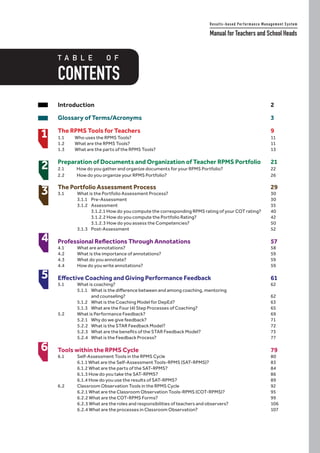
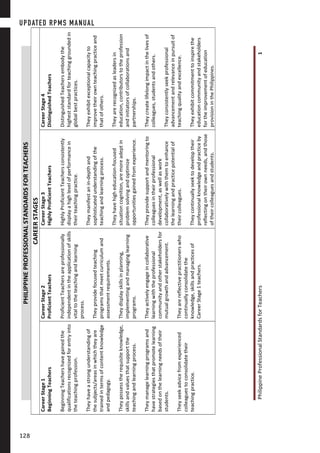
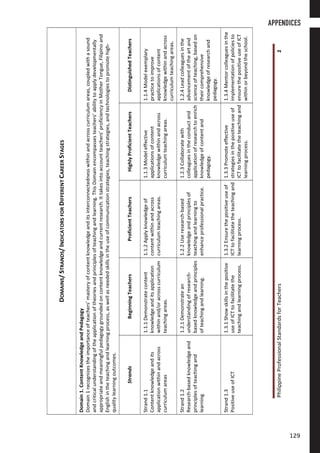
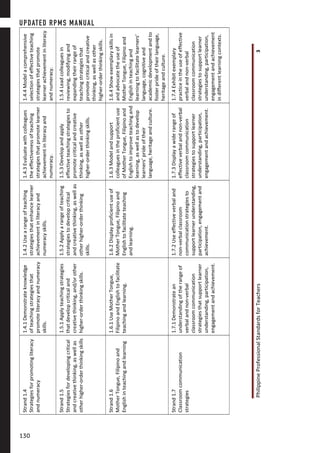
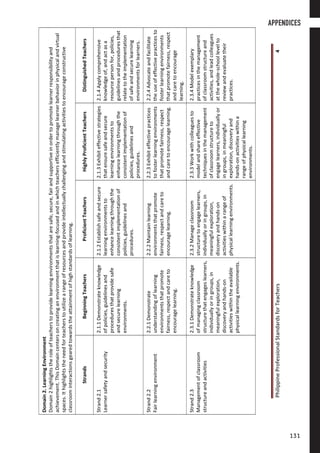
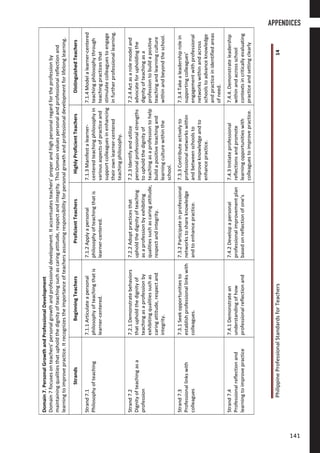
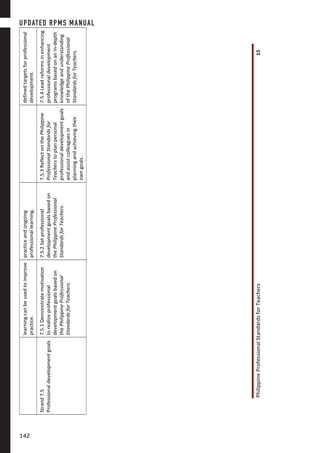
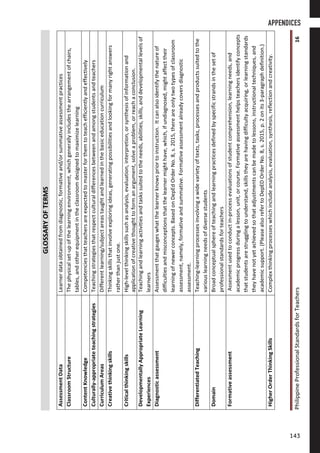
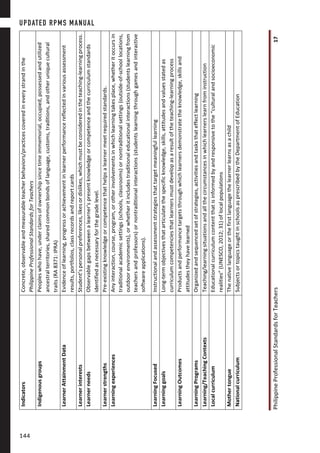
Philippine National
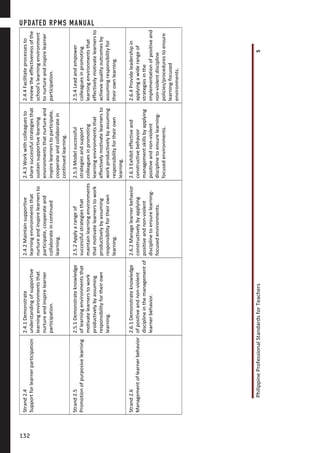
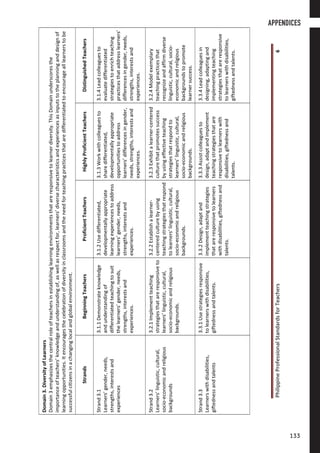
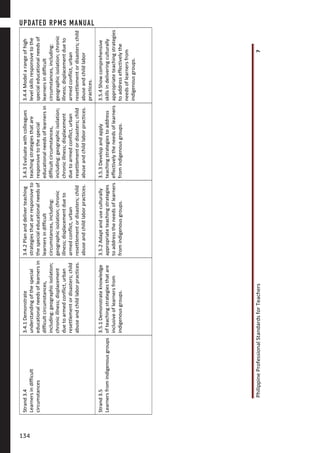
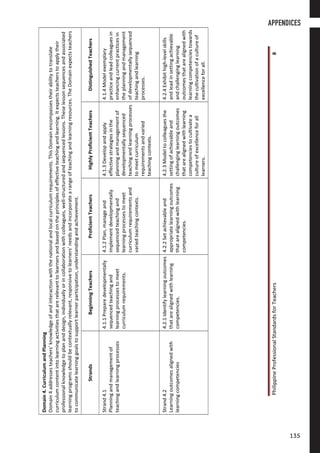
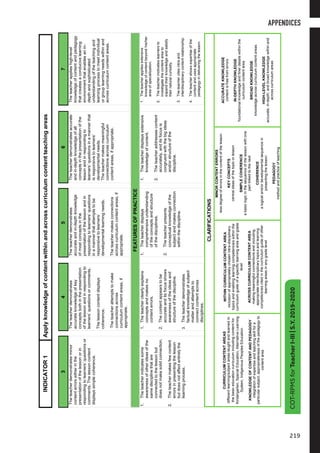
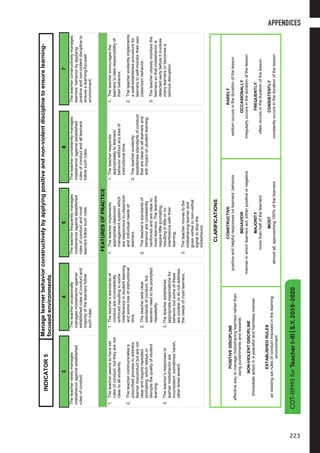
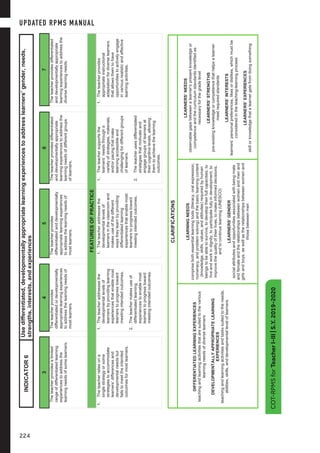
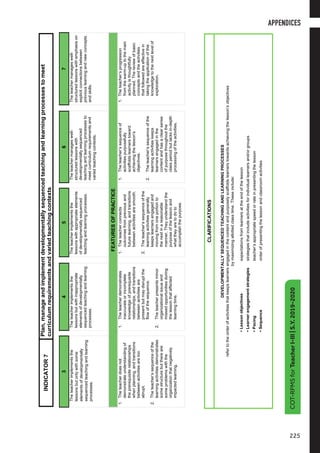
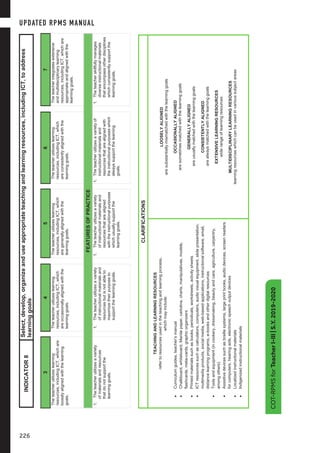
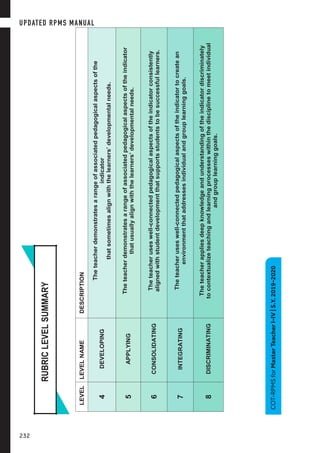
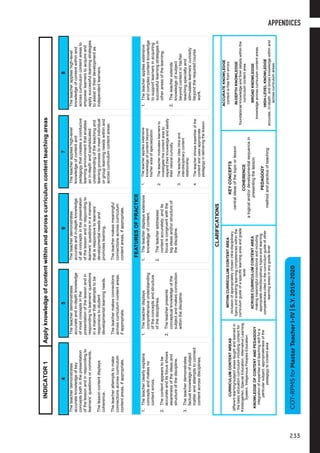
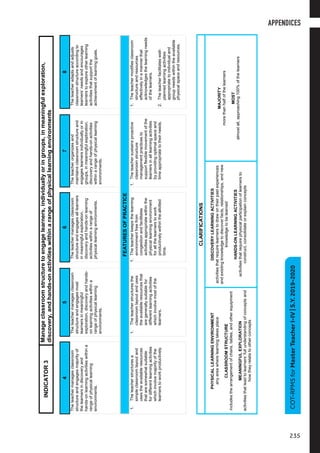
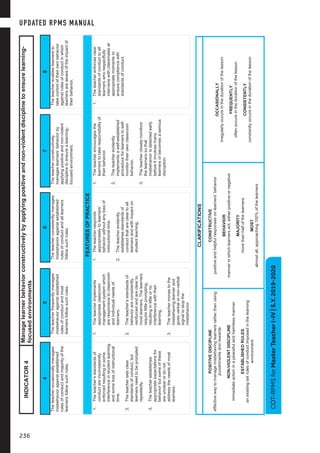
RESEARCH CENTER
FOR TEACHER QUALITY
The Results-based Performance Management System (RPMS) Manual for Teachers and School Heads was developed through the Philippine National Research
Center for Teacher Quality (RCTQ) with support from the Australian Government through the Basic Education Sector Transformation (BEST) Program.
© Department of Education - Bureau of Human Resource and Organizational Development
Results-based Performance
Management System (RPMS)
UPDATED
for Teachers and School Heads
MANUAL
Your guide to using RPMS Tools for Teachers
from Portfolio preparation to assessment
CONTENTS
T A B L E O F
Results-based Performance Management System
Manual for Teachers and School Heads
	 Introduction										2
	 Glossary of Terms/Acronyms							3
	 The RPMS Tools for Teachers							9
	 1.1	Who uses the RPMS Tools?								11
	1.2	What are the RPMS Tools?								11
	 1.3	 What are the parts of the RPMS Tools?						 13
	 Preparation of Documents and Organization of Teacher RPMS Portfolio	 21
	 2.1 How do you gather and organize documents for your RPMS Portfolio?			 22
	 2.2 How do you organize your RPMS Portfolio?						 26
									
3	 The Portfolio Assessment Process						29
3.1	 What is the Portfolio Assessment Process?						 30
	3.1.1	Pre-Assessment								30
	3.1.2	Assessment								35
		 3.1.2.1 How do you compute the corresponding RPMS rating of your COT rating? 	 40
		 3.1.2.2 How do you compute the Portfolio Rating?				 42
		 3.1.2.3 How do you assess the Competencies?					 50
	3.1.3	Post-Assessment 								52
4	 Professional Reflections Through Annotations					 57
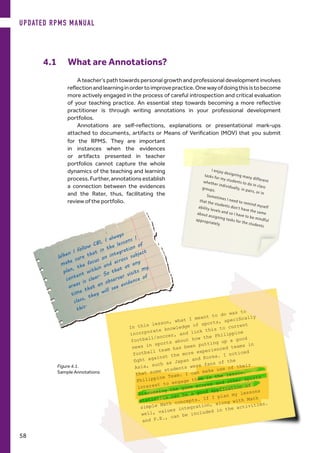
4.1	What are annotations? 								58
4.2	 What is the importance of annotations?						 59
4.3	What do you annotate?								59
4.4	How do you write annotations?							59
5	 Effective Coaching and Giving Performance Feedback				 61
5.1	What is coaching?									62
	 5.1.1	 What is the difference between and among coaching, mentoring
		and counseling?								62
	 5.1.2	 What is the Coaching Model for DepEd? 					 63
	 5.1.3	 What are the Four (4) Step Processes of Coaching?				 65
5.2	What is Performance Feedback?							69
	5.2.1	Why do we give feedback?							71
	5.2.2	What is the STAR Feedback Model?						72
	 5.2.3	 What are the benefits of the STAR Feedback Model? 	 	 	 	 73
	5.2.4	What is the Feedback Process? 						77
	 Tools within the RPMS Cycle							 79
6.1	 Self-Assessment Tools in the RPMS Cycle						 80
	 6.1.1 What are the Self-Assessment Tools-RPMS (SAT-RPMS)?				 83
	 6.1.2 What are the parts of the SAT-RPMS?						 84
	 6.1.3 How do you take the SAT-RPMS?						 86
	 6.1.4 How do you use the results of SAT-RPMS?					 89
6.2	 Classroom Observation Tools in the RPMS Cycle					 92
	 6.2.1 What are the Classroom Observation Tools-RPMS (COT-RPMS)?			 95
	6.2.2 What are the COT-RPMS Forms?						99
	 6.2.3 What are the roles and responsibilities of teachers and observers?			 106
	 6.2.4 What are the processes in Classroom Observation? 				 107
							
1
2
3
4
5
6
8	 Resource Library								111
	
	
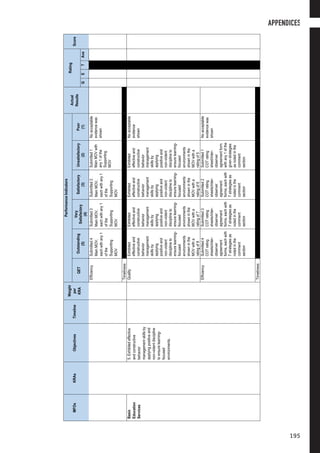
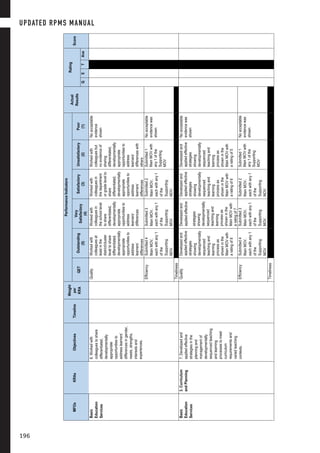
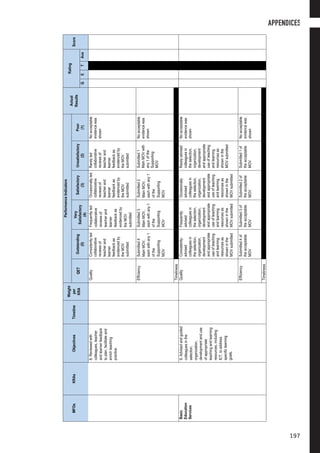
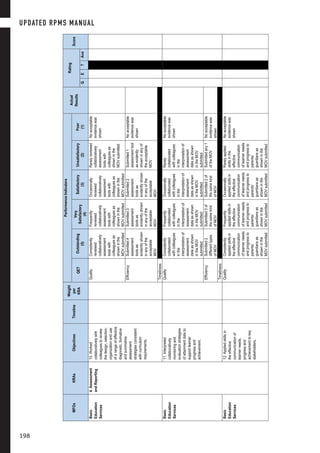
	Appendices									119
Appendix A: 	 Professional Standards for Teachers in the Philippines			 120
Appendix B: 	 RPMS Tool for Teacher I-III (Proficient Teachers)		 	 	 151	
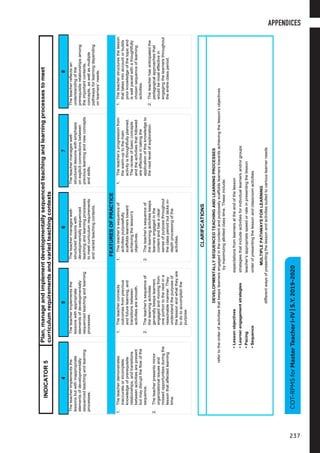
Appendix C: 	 RPMS Tool for Master Teacher I-IV (Highly Proficient Teachers)	 	 167
Appendix D.1: 	 Individual Performance Commitment and 	
		 Review Form (IPCRF) for Teacher I-III					 185
Appendix D.2:	 Individual Performance Commitment and
		 Review Form (IPCRF) for Master Teacher I-IV				 193
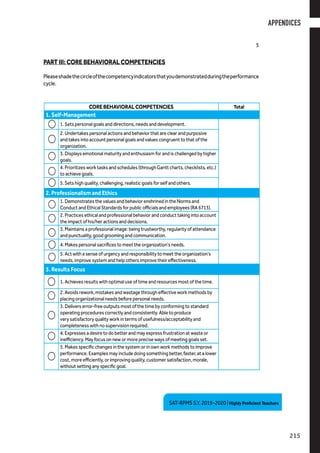
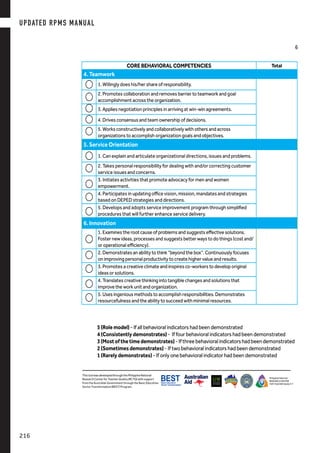
Appendix D.3:	IPCRF-Part II: Competencies						200
Appendix D.4	 IPCRF-Part III: Summary of Ratings for Discussion			 201
Appendix D.5: 	 Part IV of the IPCRF: Development Plans				 202
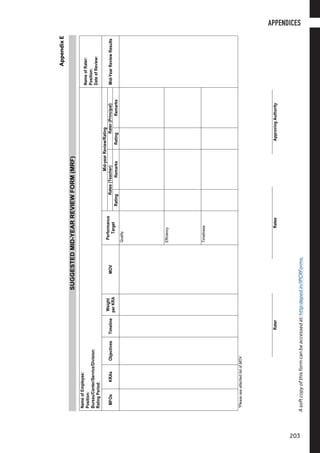
Appendix E: 	Mid-year Review Form						203
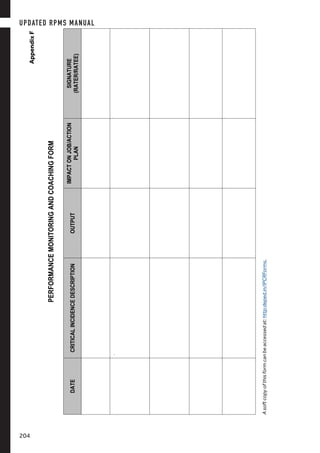
Appendix F: 	 Performance Monitoring and Coaching Form (PMCF)			 204
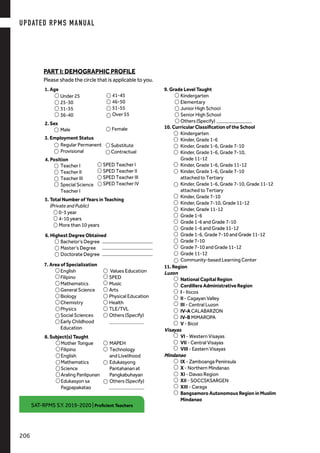
Appendix G:	 Self-Assessment Tool for Teacher I-III (Proficient Teachers)	 	 205
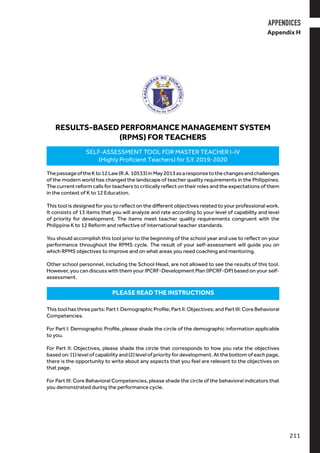
Appendix H:	 Self-Assessment Tool for Master
	 	 Teacher I-IV (Highly Proficient Teachers)	 	 	 	 211
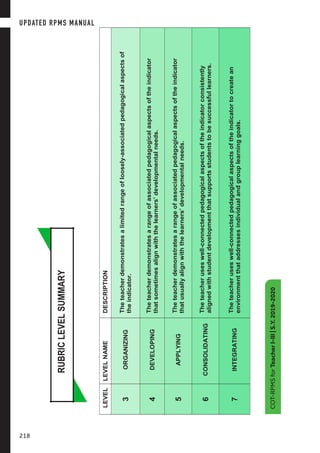
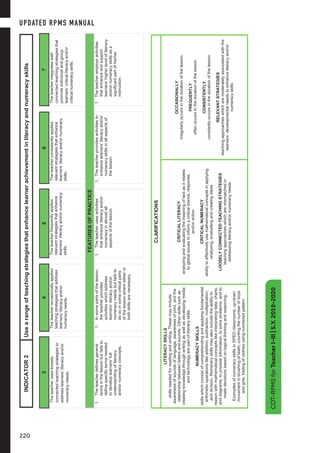
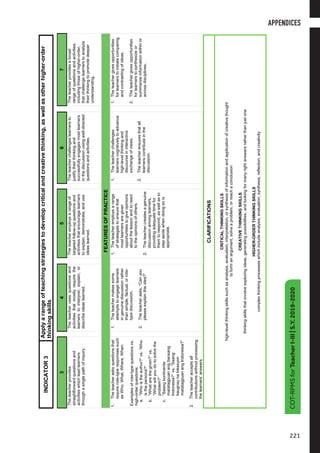
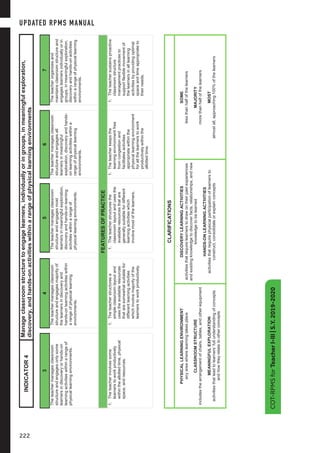
Appendix I.1: 	 COT-RPMS for Teacher I-III (Proficient Teachers)	 	 	 217
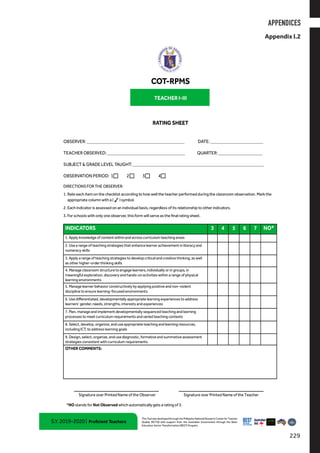
Appendix I.2: 	 COT-RPMS Rating Sheet (Teacher I-III)					 229
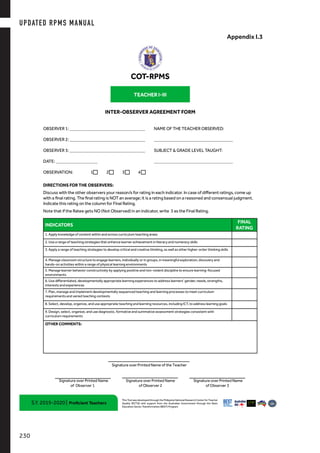
Appendix I.3: 	 Inter-Observer Agreement Form (Teacher I-III)				 230
Appendix J.1: 	 COT-RPMS for Master Teacher I-IV (Highly Proficient Teachers)	 	 231
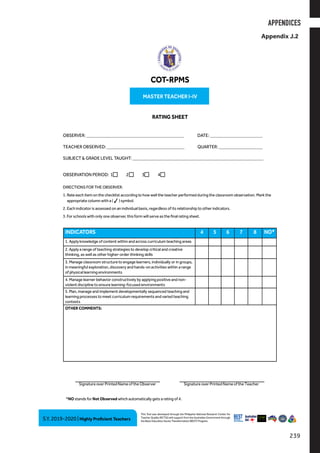
Appendix J.2: 	 COT-RPMS Rating Sheet (Master Teacher I-IV)				 239
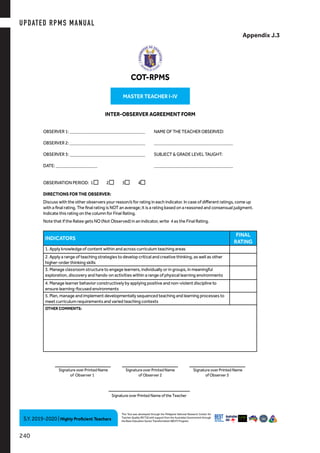
Appendix J.3: 	 Inter-Observer Agreement Form (Master Teacher I-IV)			 240
Appendix K: 	 COT-RPMS Observation Notes Form					 241
Appendix L: 	Annotation Template						242
7
8	 Acknowledgements								 243
8
INTRODUCTION
Results-based Performance Management System
Manual for Teachers and School Heads
The Results-based Performance Management System (RPMS) Manual for Teachers and School Heads was developed through the Philippine National
Research Center for Teacher Quality (RCTQ) with support from the Australian Government through the Basic Education Sector Transformation (BEST) Program.
© Department of Education - Bureau of Human Resource and Organizational Development
Philippine National
RESEARCH CENTER
FOR TEACHER QUALITY
RPMS Toolfor Teacher I-III
(Proficient Teachers)
T
EACHERS play a crucial role in improving the quality of the
teaching and learning process. Good teachers are vital to
raising student achievement. Hence, enhancing teacher
quality ranks foremost in the many educational reform
efforts toward quality education.
To complement reform initiatives on teacher quality, the Philippine
Professional Standards for Teachers (PPST) has been developed and nationally
validated. This was signed into policy by Department of Education (DepEd)
Secretary Leonor Magtolis Briones through DepEd Order No. 42, s. 2017.
The PPST articulates what constitutes teacher quality through well-defined
domains, strands and indicators that provide measures of professional learning,
competent practice and effective engagement across teachers’ career stages.
This document serves as a public statement of professional accountability that
can help teachers reflect on and assess their own practices as they aspire for
personal growth and professional development.
In 2015, the DepEd issued Order No. 2, s. 2015 — “Guidelines on the
Establishment and Implementation of the Results-based Performance
Management System (RPMS) in the Department of Education” following Civil
Service Commission Memorandum Circular No. 06, s. 2012 or the Strategic
Performance Management System (SPMS) to ensure efficient, timely and
quality performance among personnel.
The guidelines explain mechanisms, criteria and processes for performance
target setting, monitoring, evaluation and development planning. Through
the RPMS, the DepEd ensures that work efforts focus towards achieving its
vision, mission, values and strategic priorities toward the delivery of quality
educational services to Filipino learners.
The alignment of the RPMS with the Philippine Professional Standards for
Teachers has led to the development of new results-based assessment tools,
hence, this Manual on RPMS Tools for Teachers.
This Manual provides information and guidance to Teachers and School
Heads in the performance assessment process. For Teachers, the Manual
guides them through the basics in preparing and completing RPMS documents.
It describes the appropriate tools to assess performance and explains the
different assessment phases for teachers. It also introduces the concept of
annotations to guide teachers through critical reflection of their practices for
their continuous improvement.
For School Heads and other Raters, this Manual contains all the information
needed to assess teacher performance. It provides a detailed reference to help
in the understanding of the tools and the different phases of assessment within
the various cycles of RPMS, ensuring that mechanisms are in place to support
teacher performance.
UPDATED RPMS MANUAL
GLOSSARY OF TERMS
/ ACRONYMS
Results-based Performance Management System
Manual for Teachers and School Heads
The Results-based Performance Management System (RPMS) Manual for Teachers and School Heads was developed through the Philippine National
Research Center for Teacher Quality (RCTQ) with support from the Australian Government through the Basic Education Sector Transformation (BEST) Program.
© Department of Education - Bureau of Human Resource and Organizational Development
Philippine National
RESEARCH CENTER
FOR TEACHER QUALITY
GLOSSARY OF TERMS
/ ACRONYMS
Results-based Performance Management System
Manual for Teachers and School Heads
The Results-based Performance Management System (RPMS) Manual for Teachers and School Heads was developed through the Philippine National
Research Center for Teacher Quality (RCTQ) with support from the Australian Government through the Basic Education Sector Transformation (BEST) Program.
© Department of Education - Bureau of Human Resource and Organizational Development
Philippine National
RESEARCH CENTER
FOR TEACHER QUALITY
Annotations Self-reflection, explanation, or presentational mark-up attached to/
written on a document, artifact, or Means of Verification (MOV); see
reflection notes.
Artifacts All documents that provide evidence of quality instruction (e.g.
lesson plan, instructional materials, etc.) which may be used as
means of verifying attainment of Key Result Areas (KRAs).
Assessment The process of gathering, documenting and organizing in
measurable terms, knowledge, skills, attitudes and values to
determine how much they attain the KRAs. The process of
determining the relevance, worth or value of documents and
evidences.
Assessment Phase Any of the stages in the portfolio assessment process: pre-
assessment, assessment and post-assessment.
Assessment Process A set of procedures or stages in evaluating a portfolio to determine
the merits of its contents.
Authenticate Rater and Ratee affix their signatures to verify, prove or confirm that
the contents/documents of an RPMS Portfolio are valid and genuine
copies of the original.
Career Growth Developmental progression as teachers develop, refine their
practice, and respond to the complexities of educational reforms.
Career Stages The different phases in one’s teaching career which starts from
being a Beginning, to Proficient, to Highly Proficient and to
Distinguished teacher.
Clarifications Definitions or explanations of some terms included in the level
descriptions of the Classroom Observation Tool (COT) Rubric.
Classroom Context The setting or environment where the teaching-learning process
takes place. It also points to all the factors which may affect the
teaching-learning process in the classroom.
Classroom Observation
Tool – Results-
based Performance
Management System
(COT-RPMS)
A subset of the full Classroom Observation Tool used for RPMS for
Teachers.
Content Knowledge Competencies that teachers are expected to master for them to
teach efficiently and effectively.
Competencies Knowledge, skills and behavior that individuals demonstrate in
achieving results. Competencies shall uphold the DepEd’s core
values. They represent the way individuals define and live the
values. (DepEd Order No. 2, s. 2015, p. 6) .
Demonstration Teaching Showcasing the Master Teachers’ teaching-learning practice either
in their own classrooms which may be attended by their colleagues
or in a formal demonstration festival in school, district or division.
Features of Practice Specific classroom practices, which may characterize a particular
level in the COT Rubric.
Inter-Observer
Agreement Exercise
A discussion among observers to arrive at a final rating. This occurs
during the post-observation process and involves the use of the
Inter-Observer Agreement Form.
UPDATED RPMS MANUAL
4
Learning Context The teaching/learning situation, environment and all the factors in
which learners learn from instruction.
Lesson Plan The teacher’s detailed description of the steps a teacher will take to
teach a particular topic. This includes the following: Detailed Lesson
Plan (DLP), Weeky Lesson Log (for Alternative Learning System
classes) and Indigenized Lesson Plan (for Indigenous Peoples
Education classes).
Level Description Description of practice for each level. The description explains the
features of practice expected of teachers in the classroom.
Mid-year Review The Portfolio assessment process usually conducted in November
to identify the areas that a teacher needs to improve in preparation
for the year-end evaluation.
Objectives The specific tasks that an office and/or individual employee needs
to do to achieve the major final outputs under the key result areas.
(DepEd Order No. 2, s. 2015, p. 2). They also refer to a specific result
that a teacher aims to achieve within a time frame and with available
resources.
Outcomes The results achieved and/or the products developed as a result
of the instructional process. In the RPMS, outcomes refer to
the results of the teacher performance of their duties and
responsibilities.
Observation A classroom observation, usually for 50-60 minutes.
Observation Notes Form A form used by the observer(s) during the classroom
observation.
Observers School Heads, Assistant Principals, Head Teachers, Master
Teachers who conduct the classroom observation for RPMS.
This is provided in DO 2,s 2015.
Performance The action or process of carrying out or accomplishing tasks, duties
and responsibilities.
Performance Data The rating that a teacher garnered from the portfolio assessment.
Performance Indicators An exact quantification of objectives, which shall serve as an
assessment tool that gauges whether a performance is positive or
negative (DepEd Order No. 2, s. 2015).
Portfolio Assessment
Process
A process of gauging teacher performance based on verifiable
evidence organized in a portfolio. It follows three phases: pre-
assessment, assessment and post-assessment.
Philippine Professional
Standards for Teachers
(PPST)
A set of professional standards for teachers
that operationalizes teacher quality aspects of the K to 12
reform and elaborates teacher lifelong learning. It contains 37
performance indicators per career stage. It provides an acceptable
common language for professional discussions among teachers
and other concerned stakeholders.
Portfolio Organization It is a systematic arrangement and presentation of documents done
to facilitate the rater’s assessment process.
Post-Assessment Phase Portfolio assessment conducted at the end of the school year.
Post-Observation The concluding phase of the classroom observation process
during which observers assign individual ratings, undertake the
inter-observer agreement exercise and make recommendations to
improve a teacher’s performance.
GLOSSARY OF TERMS/ACRONYMS
5
Pre-Observation The preliminary phase of the observation process in which
teachers and observers prepare for the observation.
Professional
Development
The continuous process of acquiring new knowledge and skills
that relate to teacher’s personal development, profession, job
responsibilities, or work environment.
Ratee The individual teacher who is rated. They are the teachers from
all career stages who submit their Portfolios as evidence of their
teaching performance. (DepEd Order No. 2, s. 2015, p. 2).
Rater May be the school head, assistant principal, head teacher, master
teacher who evaluates the Portfolio presented by the Ratee.
Reflection Notes The insights or realizations that teachers write as a result of careful
introspection on events, discussions, decisions and/or actions they
make. Reflections notes may be attached to an MOV, written as
marginal notes or appended in the form of journal entries.
Reflective Thinking Critical self-reflection on one’s own teaching-learning process. It
helps develop higher-order thinking skills. For teachers, reflective
thinking aids them in improving their teaching practice because
it allows them to note classroom experiences, critically evaluate
them, relate new knowledge and insights to prior understandings
and apply their insights to improve their teaching practice.
Results-based
Performance
Management System
(RPMS)
DepEd-contextualized SPMS. It is an organization-wide
process of ensuring that employees focus work efforts towards
achieving DepEd vision, mission, values, and strategic priorities.
It is also a mechanism to manage, monitor and measure
performance, and identify human resource and organizational
development needs (DepEd Order No. 2, s. 2015, p. 3).
RPMS Tools Assessment instruments used to ensure quality teacher
performance at different career stages.
Teacher Portfolio Purposeful compilation of documents that display teacher’s
achievements, classroom performance, teaching practices,
students evaluation, actions that are used as evidences for mid-
year and year-end assessment.
Teaching Practice A teacher’s manner or habit on the delivery of instruction.
This includes everything that a teacher does to achieve learning. It
reflects the teachers’ knowledge, skills, values and attitudes as they
perform their duties and responsibilities in teaching.
Teaching Competencies Competencies intended for teachers (DepEd Order No. 2, s. 2015,
p. 6). They pertain to the knowledge, skills and behavior expected
of teachers for them to realize their duties and responsibilities
efficiently and effectively.
Year-End Evaluation Assessment of Teacher Portfolio conducted during Phase 3 of the
RPMS Cycle to rate the performance of Ratees.
UPDATED RPMS MANUAL
6
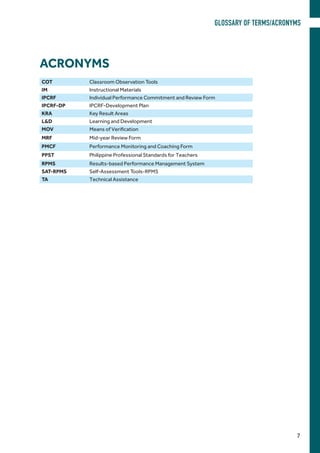
ACRONYMS
COT Classroom Observation Tools
IM Instructional Materials
IPCRF Individual Performance Commitment and Review Form
IPCRF-DP IPCRF-Development Plan
KRA Key Result Areas
L&D		 Learning and Development
MOV Means of Verification
MRF Mid-year Review Form
PMCF Performance Monitoring and Coaching Form
PPST Philippine Professional Standards for Teachers
RPMS Results-based Performance Management System
SAT-RPMS Self-Assessment Tools-RPMS
TA Technical Assistance
GLOSSARY OF TERMS/ACRONYMS
7
UPDATED RPMS MANUAL
8
M
RPMS Tool
for Master Teacher I-IV
T1-3
RPMS Tool
for Teacher I-III
(Proficient Teachers)
THE RPMS TOOLS
FOR TEACHERS
1
Results-based Performance Management System
Manual for Teachers and School Heads
The Results-based Performance Management System (RPMS) Manual for Teachers and School Heads was developed through the Philippine National
Research Center for Teacher Quality (RCTQ) with support from the Australian Government through the Basic Education Sector Transformation (BEST) Program.
© Department of Education - Bureau of Human Resource and Organizational Development
Philippine National
RESEARCH CENTER
FOR TEACHER QUALITY
TA
L&D
TA
L&D
TA
L&D
TA
L&DPhilippinePro
fessional Standard
sforTeachers
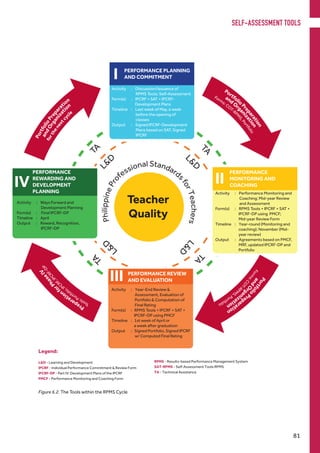
PERFORMANCE PLANNING
AND COMMITMENT
Activity	 : Discussion /Issuance of
	 RPMS Tools; Self-Assessment
Form(s)	 : IPCRF + SAT + IPCRF-
	 Development Plans
Timeline 	 : Last week of May, a week
	 before the opening of
	 classes
Output 	 : Signed IPCRF-Development
	 Plans based on SAT, Signed
	 IPCRF
I
Activity	 : Performance Monitoring and 	
	 Coaching; Mid-year Review
	 and Assessment
Form(s)	 : RPMS Tools + IPCRF + SAT +
	 IPCRF-DP using PMCF; 	
	 Mid-year Review Form
Timeline 	 : Year-round (Monitoring and
	 coaching); November (Mid-
	 year review)
Output 	 : Agreements based on PMCF,
	 MRF, updated IPCRF-DP and
	 Portfolio
PERFORMANCE
MONITORING AND
COACHING
II
Activity	 : Year-End Review &
	 Assessment, Evaluation of
	 Portfolio & Computation of
	 Final Rating
Form(s)	 : RPMS Tools + IPCRF + SAT +
	 IPCRF-DP using PMCF
Timeline 	 : 1st week of April or
	 a week after graduation
Output 	 : Signed Portfolio, Signed IPCRF
	 w/ Computed Final Rating
PERFORMANCE REVIEW
AND EVALUATIONIII
Activity	 : Ways Forward and
	 Development Planning
Form(s)	 : Final IPCRF-DP
Timeline 	 : April
Output 	 : Reward, Recognition,
	 IPCRF-DP
PERFORMANCE
REWARDING AND
DEVELOPMENT
PLANNING
IV
Teacher
Quality
(Tools:Portfolio,
IPCRF,IPCRF-DP)
forthenextcycl
e
Portfolio
P
reparation
andO
rga
nization
Forms:COT-RP
M
S,Portfolio
Portfolio
Preparation
andO
r
ganization
Form
s:COT
-RPM
S,Portfolio
Preparationfor
PhaseIV
Tools:Portfolio,IPCR
F,IPCRF-DP
PortfolioPrepar
ation
andOrganiza
tion
forthenextcy
cle
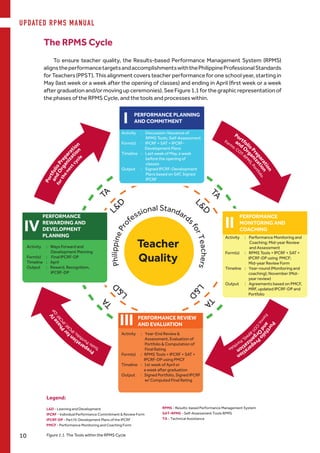
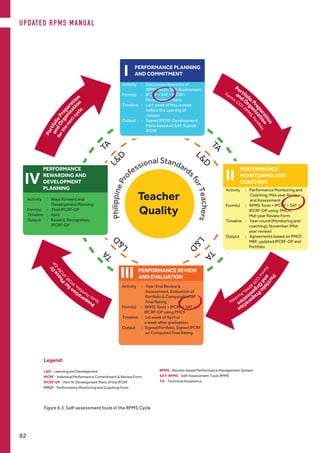
Figure 1.1. The Tools within the RPMS Cycle
Legend:
L&D - Learning and Development
IPCRF - Individual Performance Commitment & Review Form
IPCRF-DP - Part IV: Development Plans of the IPCRF
PMCF - Performance Monitoring and Coaching Form
RPMS - Results-based Performance Management System
SAT-RPMS - Self-Assessment Tools RPMS
TA - Technical Assistance
The RPMS Cycle
To ensure teacher quality, the Results-based Performance Management System (RPMS)
alignstheperformancetargetsandaccomplishmentswiththePhilippineProfessionalStandards
for Teachers (PPST). This alignment covers teacher performance for one school year, starting in
May (last week or a week after the opening of classes) and ending in April (first week or a week
aftergraduationand/ormovingupceremonies).SeeFigure1.1forthegraphicrepresentationof
the phases of the RPMS Cycle, and the tools and processes within.
UPDATED RPMS MANUAL
10
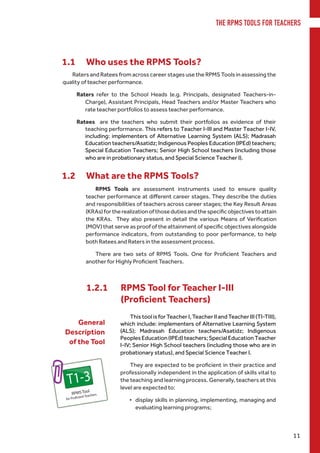
Raters and Ratees from across career stages use the RPMS Tools in assessing the
quality of teacher performance.
Raters refer to the School Heads (e.g. Principals, designated Teachers-in-
Charge), Assistant Principals, Head Teachers and/or Master Teachers who
rate teacher portfolios to assess teacher performance.
Ratees are the teachers who submit their portfolios as evidence of their
teaching performance. This refers to Teacher I-III and Master Teacher I-IV,
including: implementers of Alternative Learning System (ALS); Madrasah
Education teachers/Asatidz; Indigenous Peoples Education (IPEd) teachers;
Special Education Teachers; Senior High School teachers (including those
who are in probationary status, and Special Science Teacher I).
RPMS Tools are assessment instruments used to ensure quality
teacher performance at different career stages. They describe the duties
and responsibilities of teachers across career stages; the Key Result Areas
(KRAs)fortherealizationofthosedutiesandthespecificobjectivestoattain
the KRAs. They also present in detail the various Means of Verification
(MOV) that serve as proof of the attainment of specific objectives alongside
performance indicators, from outstanding to poor performance, to help
both Ratees and Raters in the assessment process.
There are two sets of RPMS Tools. One for Proficient Teachers and
another for Highly Proficient Teachers.
ThistoolisforTeacherI,TeacherIIandTeacherIII(TI-TIII),
which include: implementers of Alternative Learning System
(ALS); Madrasah Education teachers/Asatidz; Indigenous
PeoplesEducation(IPEd)teachers;SpecialEducationTeacher
I-IV; Senior High School teachers (including those who are in
probationary status), and Special Science Teacher I.
They are expected to be proficient in their practice and
professionally independent in the application of skills vital to
the teaching and learning process. Generally, teachers at this
level are expected to:
•	 display skills in planning, implementing, managing and
evaluating learning programs;
1.1 	 Who uses the RPMS Tools?
General
Description
of the Tool
T1-3
RPMS Tool
for Proficient Teachers
11
THE RPMS TOOLS FOR TEACHERS
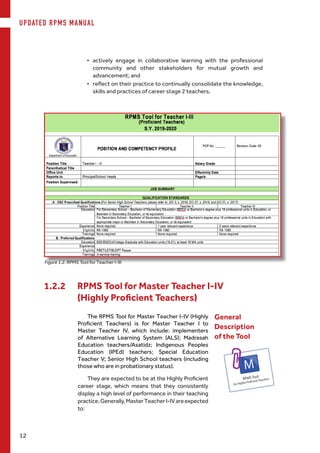
1.2.1 	 RPMS Tool for Teacher I-III
	 (Proficient Teachers)	
1.2	 What are the RPMS Tools?
The RPMS Tool for Master Teacher I-IV (Highly
Proficient Teachers) is for Master Teacher I to
Master Teacher IV, which include: implementers
of Alternative Learning System (ALS); Madrasah
Education teachers/Asatidz; Indigenous Peoples
Education (IPEd) teachers; Special Education
Teacher V; Senior High School teachers (including
those who are in probationary status).
They are expected to be at the Highly Proficient
career stage, which means that they consistently
display a high level of performance in their teaching
practice.Generally,MasterTeacherI-IVareexpected
to:
Figure 1.2. RPMS Tool for Teacher I-III
•	 actively engage in collaborative learning with the professional
community and other stakeholders for mutual growth and
advancement; and
•	 reflect on their practice to continually consolidate the knowledge,
skills and practices of career stage 2 teachers.
General
Description
of the Tool
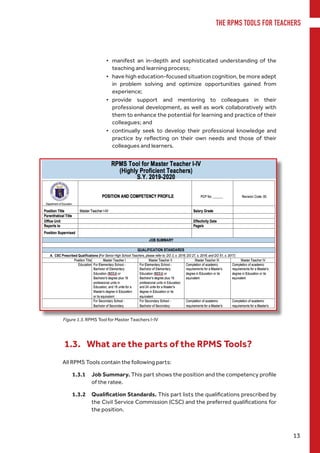
1.2.2 	 RPMS Tool for Master Teacher I-IV
	 (Highly Proficient Teachers)
M
RPMS Tool
for Highly Proficient Teachers
UPDATED RPMS MANUAL
12
Figure 1.3. RPMS Tool for Master Teachers I-IV
All RPMS Tools contain the following parts:
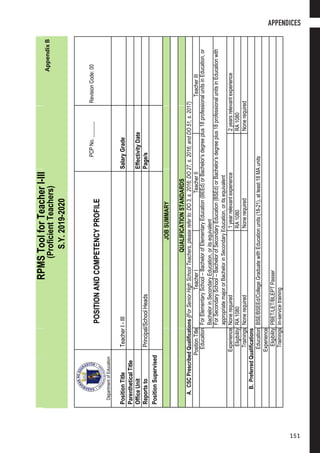
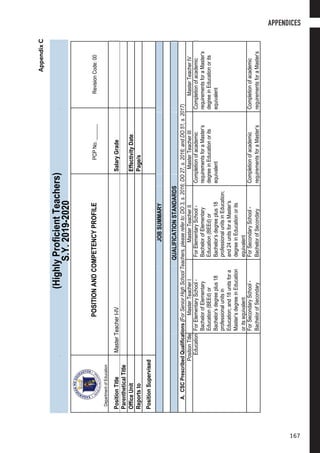
1.3.1	 Job Summary. This part shows the position and the competency profile
of the ratee.
1.3.2	 Qualification Standards. This part lists the qualifications prescribed by
the Civil Service Commission (CSC) and the preferred qualifications for
the position.
•	 manifest an in-depth and sophisticated understanding of the
teaching and learning process;
•	 have high education-focused situation cognition, be more adept
in problem solving and optimize opportunities gained from
experience;
•	 provide support and mentoring to colleagues in their
professional development, as well as work collaboratively with
them to enhance the potential for learning and practice of their
colleagues; and
•	 continually seek to develop their professional knowledge and
practice by reflecting on their own needs and those of their
colleagues and learners.
1.3. 	 What are the parts of the RPMS Tools?
13
THE RPMS TOOLS FOR TEACHERS
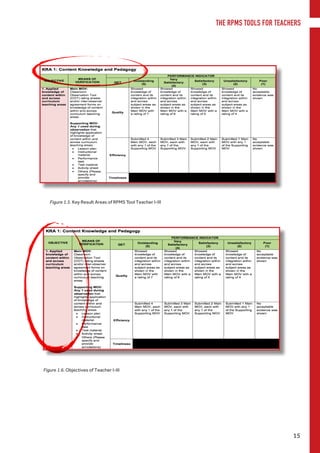
1.3.4 	 Key Result Areas (KRAs). The KRAs refer to the general
outputs or outcomes. They are the mandate or the functions of
the office and/or the individual employee (D.O. No. 2, s. 2015). In
the context of the RPMS Tools, the KRAs capture the Domains
of the Philippine Professional Standards for Teachers, which
articulates what constitutes teacher quality. The KRAs are:
(1) Content Knowledge and Pedagogy;
(2) Learning Environment and Diversity of Learners;
(3) Curriculum and Planning;
(4) Assessment and Reporting; and
(5) Plus Factor.
1.3.5 	 Objectives. They are specific tasks that an office and/or
individual employee needs to do to achieve the KRAs.
	 In the RPMS Tools, teachers target thirteen (13) objectives to
realize the five (5) KRAs. These objectives are aligned with the
indicators of the Philippine Professional Standards for Teachers
(PPST).
Duties and Responsibilities
1. Applies mastery of content knowledge and its application across
learning areas
2. Facilitates learning using appropriate and innovative teaching
strategies and classroom management practices
3. Manages an environment conducive to learning
4. Addresses learner diversity
5. Implements and supervises curricular and co-curricular programs to
support learning
6. Monitors and evaluates learners’ progress and undertakes activities
to improve performance
7. Maintains updated records of learners’ progress
8. Counsels and guides learners
9. Works with relevant stakeholders, both internal and external, to
promote learning and improve school performance
10. Undertakes activities towards personal and professional growth
11. Does related work
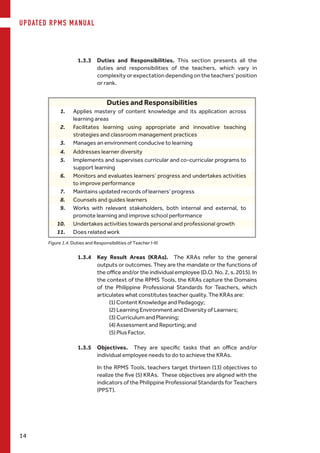
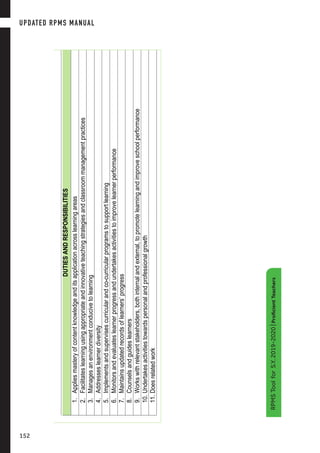
Figure 1.4. Duties and Responsibilities of Teacher I-III
1.3.3	 Duties and Responsibilities. This section presents all the
duties and responsibilities of the teachers, which vary in
complexity or expectation depending on the teachers’ position
or rank.
UPDATED RPMS MANUAL
14
Figure 1.6. Objectives of Teacher I-III
Figure 1.5. Key Result Areas of RPMS Tool Teacher I-III
15
THE RPMS TOOLS FOR TEACHERS
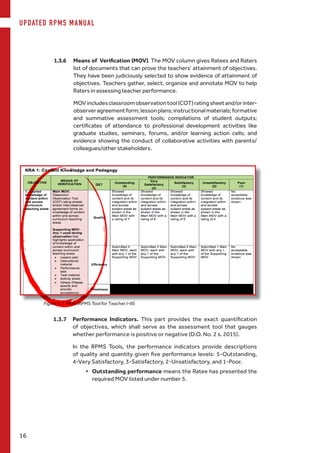
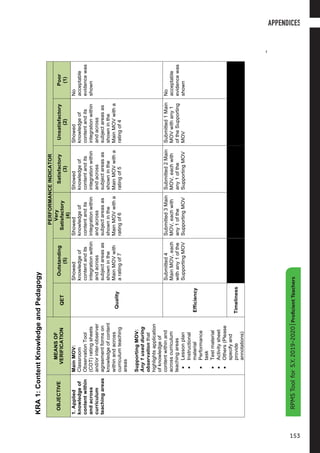
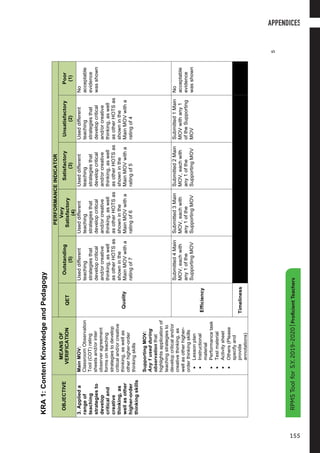
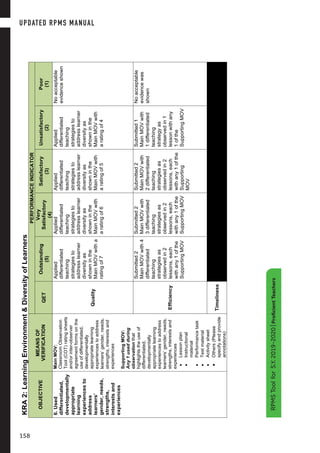
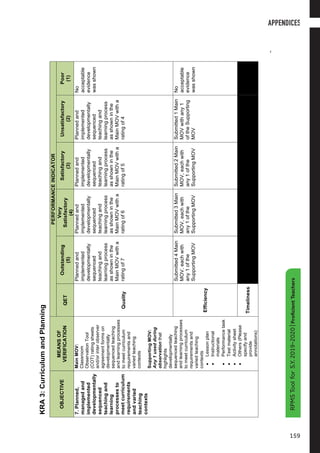
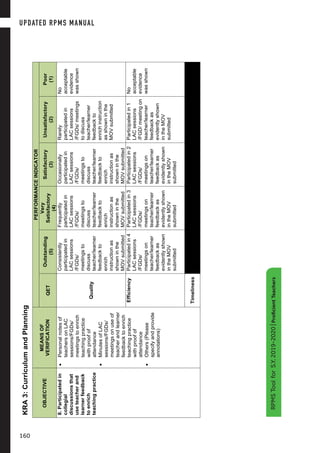
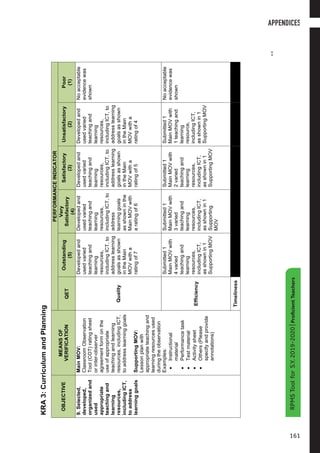
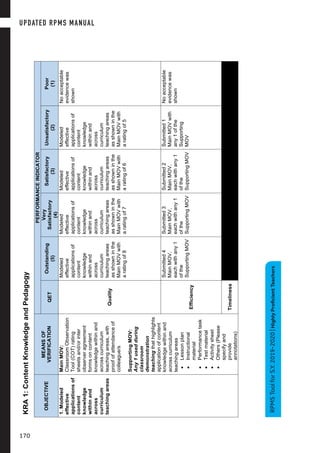
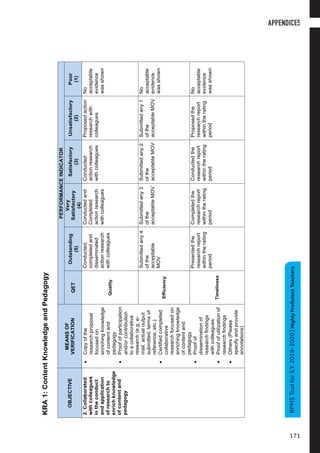
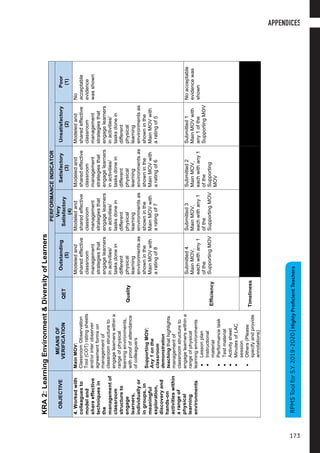
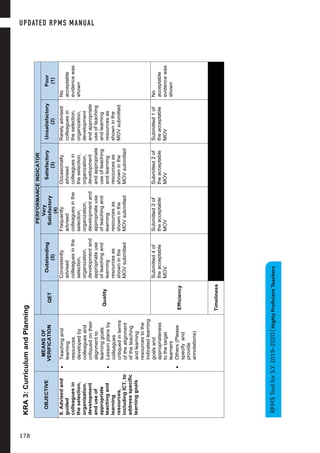
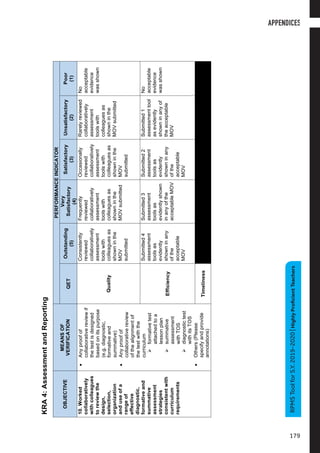
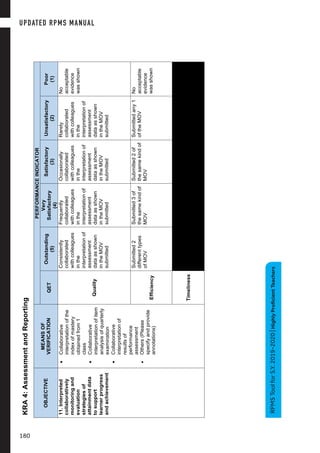
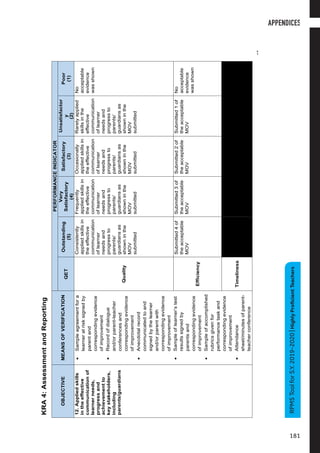
1.3.6	 Means of  Verification (MOV). The MOV column gives Ratees and Raters
list of documents that can prove the teachers’ attainment of objectives.
They have been judiciously selected to show evidence of attainment of
objectives. Teachers gather, select, organize and annotate MOV to help
Raters in assessing teacher performance.
	 MOVincludesclassroomobservationtool(COT)ratingsheetand/orinter-
observeragreementform;lessonplans;instructionalmaterials;formative
and summative assessment tools; compilations of student outputs;
certificates of attendance to professional development activities like
graduate studies, seminars, forums, and/or learning action cells; and
evidence showing the conduct of collaborative activities with parents/
colleagues/other stakeholders.
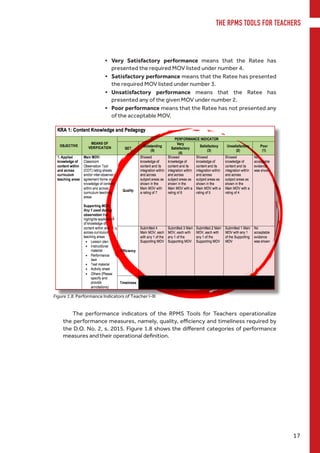
1.3.7 	 Performance Indicators. This part provides the exact quantification
of objectives, which shall serve as the assessment tool that gauges
whether performance is positive or negative (D.O. No. 2 s. 2015).
	 In the RPMS Tools, the performance indicators provide descriptions
of quality and quantity given five performance levels: 5-Outstanding,
4-Very Satisfactory, 3-Satisfactory, 2-Unsatisfactory, and 1-Poor.
•	 Outstanding performance means the Ratee has presented the
required MOV listed under number 5.
Figure 1.7. MOV (RPMS Tool for Teacher I-III)
UPDATED RPMS MANUAL
16
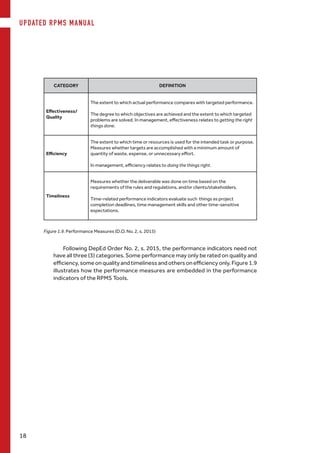
The performance indicators of the RPMS Tools for Teachers operationalize
the performance measures, namely, quality, efficiency and timeliness required by
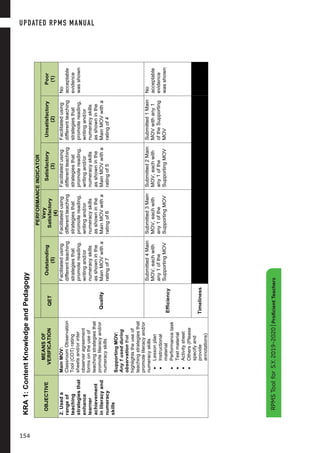
the D.O. No. 2, s. 2015. Figure 1.8 shows the different categories of performance
measures and their operational definition.
•	 Very Satisfactory performance means that the Ratee has
presented the required MOV listed under number 4.
•	 Satisfactory performance means that the Ratee has presented
the required MOV listed under number 3.
•	 Unsatisfactory performance means that the Ratee has
presented any of the given MOV under number 2.
•	 Poor performance means that the Ratee has not presented any
of the acceptable MOV.
Figure 1.8. Performance Indicators of Teacher I-III
17
THE RPMS TOOLS FOR TEACHERS
CATEGORY DEFINITION
Effectiveness/
Quality
The extent to which actual performance compares with targeted performance.
The degree to which objectives are achieved and the extent to which targeted
problems are solved. In management, effectiveness relates to getting the right
things done.
Efficiency
The extent to which time or resources is used for the intended task or purpose.
Measures whether targets are accomplished with a minimum amount of
quantity of waste, expense, or unnecessary effort.
In management, efficiency relates to doing the things right.
Timeliness
Measures whether the deliverable was done on time based on the
requirements of the rules and regulations, and/or clients/stakeholders.
Time-related performance indicators evaluate such things as project
completion deadlines, time management skills and other time-sensitive
expectations.
Figure 1.9. Performance Measures (D.O. No. 2, s. 2015)
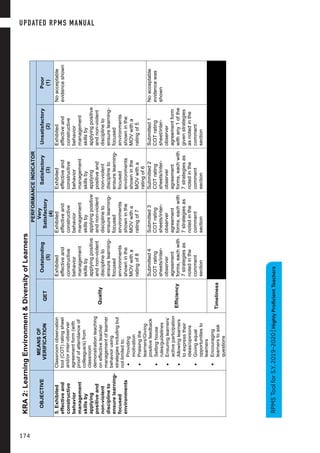
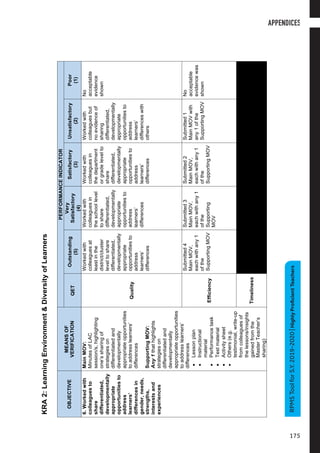
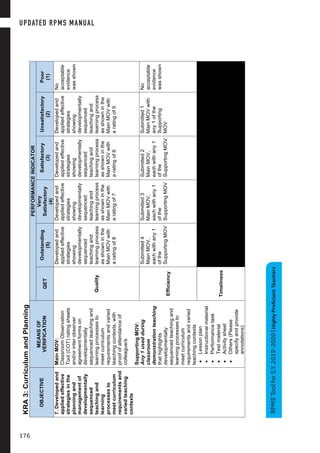
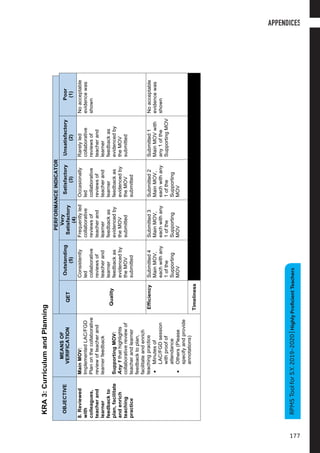
Following DepEd Order No. 2, s. 2015, the performance indicators need not
have all three (3) categories. Some performance may only be rated on quality and
efficiency,someonqualityandtimelinessandothersonefficiencyonly.Figure 1.9
illustrates how the performance measures are embedded in the performance
indicators of the RPMS Tools.
UPDATED RPMS MANUAL
18
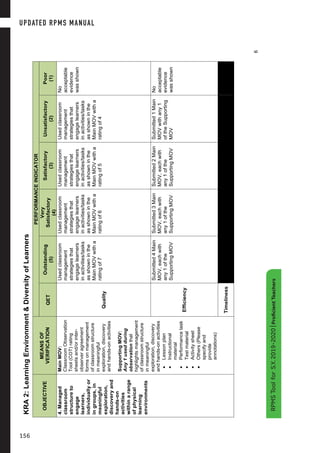
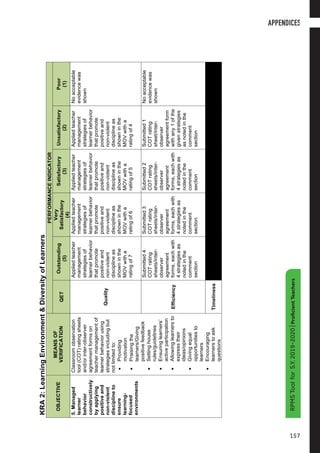
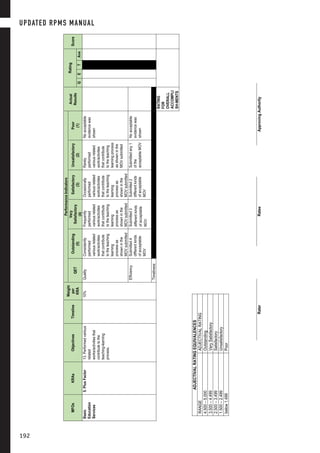
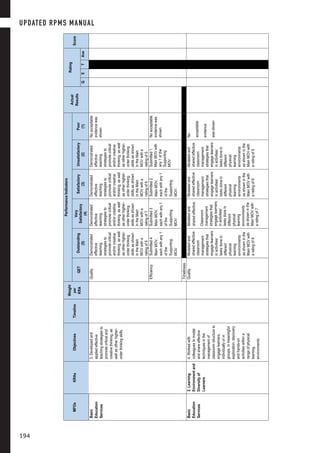
Figure1.10.PerformanceIndicatorsofRPMSToolforMasterTeacherI-IVwithQET
19
THE RPMS TOOLS FOR TEACHERS
UPDATED RPMS MANUAL
20
PREPARATION OFDOCUMENTS AND ORGANIZATION OF TEACHER
2
Results-based Performance Management System
Manual for Teachers and School Heads
RPMS PORTFOLIO
The Results-based Performance Management System (RPMS) Manual for Teachers and School Heads was developed through the Philippine National
Research Center for Teacher Quality (RCTQ) with support from the Australian Government through the Basic Education Sector Transformation (BEST) Program.
© Department of Education - Bureau of Human Resource and Organizational Development
Philippine National
RESEARCH CENTER
FOR TEACHER QUALITY
As Ratee, at the beginning of the school year, you start
working towards the achievement of your objectives as
required by RPMS. In the process, documents are needed
as proof to show that you have done so. This section
provides the steps that will guide you in gathering
documents and organizing your RPMS Portfolio.
1.	 Review the Results-based Performance
Management System (RPMS) Tool appropriate to
your level.
The RPMS Tool for Teacher I-III (Proficient
Teachers) shall be used by Teacher I, Teacher II and
Teacher III (TI-TIII), which include: implementers
of Alternative Learning System (ALS); Madrasah
Education teachers/Asatidz; Indigenous Peoples
Education (IPEd) teachers; Special Education Teacher
I-IV; Senior High School teachers (including those
who are in probationary status), and Special Science
Teacher I.
The RPMS Tool for Master Teacher I-IV (Highly
Proficient Teachers) is for Master Teacher I to
Master Teacher IV, which include: implementers
of Alternative Learning System (ALS); Madrasah
Education teachers/Asatidz; Indigenous Peoples
Education (IPEd) teachers; Special Education Teacher
V; Senior High School teachers (including those who
are in probationary status).
2.1	How do you gather and organize documents
for your RPMS Portfolio?
Things you need:
•	 Copy of RPMS
Tool appropriate
to your level
•	 Five (5) long
folders or a
clear book for
five KRAs
•	 Binder clips/
fastener
•	 Original
documents
•	 Photocopy of
the documents
•	 Tabs
•	 Highlighter/
marker
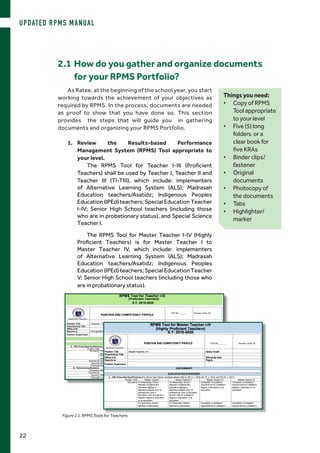
Figure 2.1. RPMS Tools for Teachers
UPDATED RPMS MANUAL
22
Position Forms/Tools to be Used
Teacher I-III
RPMS Tool/IPCRF for Proficient
Teachers
Special Education Teacher I-IV
ALS Implementers
Madrasah Education Teachers
(Teacher I-III)
Indigenous Peoples Education (IPEd)
Teachers (Teacher I-III)
Special Science Teacher I (SHS)
Master Teacher I-IV
RPMS Tool/IPCRF for Highly
Proficient Teachers
Special Education Teacher V
Madrasah Education Teachers
(Master Teacher I-IV)
Indigenous Peoples Education (IPEd)
Teachers (Master Teacher I-IV)
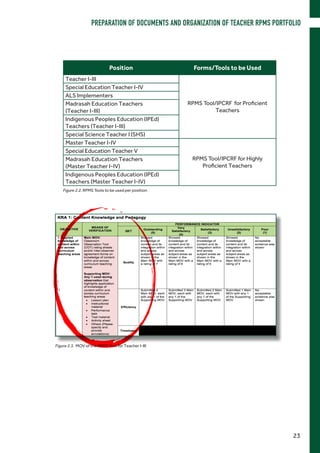
Figure 2.2. RPMS Tools to be used per position
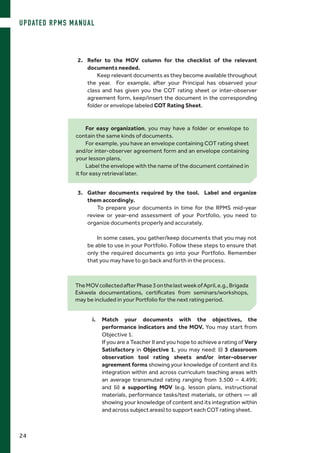
Figure 2.3. MOV of the RPMS Tool for Teacher I-III
23
PREPARATION OF DOCUMENTS AND ORGANIZATION OF TEACHER RPMS PORTFOLIO
i.	Match your documents with the objectives, the
performance indicators and the MOV. You may start from
Objective 1.
	 If you are a Teacher II and you hope to achieve a rating of Very
Satisfactory in Objective 1, you may need: (i) 3 classroom
observation tool rating sheets and/or inter-observer
agreement forms showing your knowledge of content and its
integration within and across curriculum teaching areas with
an average transmuted rating ranging from 3.500 – 4.499;
and (ii) a supporting MOV (e.g. lesson plans, instructional
materials, performance tasks/test materials, or others — all
showing your knowledge of content and its integration within
and across subject areas) to support each COT rating sheet.
2.	 Refer to the MOV column for the checklist of the relevant
documents needed.
Keep relevant documents as they become available throughout
the year. For example, after your Principal has observed your
class and has given you the COT rating sheet or inter-observer
agreement form, keep/insert the document in the corresponding
folder or envelope labeled COT Rating Sheet.
For easy organization, you may have a folder or envelope to
contain the same kinds of documents.
For example, you have an envelope containing COT rating sheet
and/or inter-observer agreement form and an envelope containing
your lesson plans.
Label the envelope with the name of the document contained in
it for easy retrieval later.
TheMOVcollectedafterPhase3onthelastweekofApril,e.g.,Brigada
Eskwela documentations, certificates from seminars/workshops,
may be included in your Portfolio for the next rating period.
3.	 Gather documents required by the tool. Label and organize
them accordingly.
To prepare your documents in time for the RPMS mid-year
review or year-end assessment of your Portfolio, you need to
organize documents properly and accurately.
In some cases, you gather/keep documents that you may not
be able to use in your Portfolio. Follow these steps to ensure that
only the required documents go into your Portfolio. Remember
that you may have to go back and forth in the process.
UPDATED RPMS MANUAL
24
Remember that one document may be used as MOV or evidence
of performance for other objectives. For example, if you are a
Teacher II, your COT rating sheet may contain rating or feedback
about: (i) knowledge of content (Objective 1); (ii) teaching strategies
that develop critical and creative thinking (Objective 3); and (iii)
differentiated, developmentally appropriate learning experiences
(Objective 6).
ii.	 Mark your document(s) with the objective(s) where the
document(s) may be used as MOV. You may use a pencil for
this. This helps you organize your MOV later on based on
objectives.
iii.	 Use markers to highlight the parts of your MOV that satisfy
the requirement of the objectives and the performance
indicators. This facilitates the Rater’s evaluation of your
documents.
iv.	 Reproduce the document(s) that may be used as MOV in
other objectives, whenever necessary. Ensure that the
copies are clear.
v.	 Puttogetherdocumentsthatbelongtothesameobjective.
You may bind them together or place them in a folder marked
according to objective.
vi.	Insert documents in relevant folders as they become
available.
Include only the acceptable documents as specified in the
Quality, Efficiency and Timeliness of the RPMS tool. You do not
need to submit all the listed MOV.
4.	 Put annotation template/document after the annotated MOV
Annotations establish a connection between the evidences
and the indicators. This helps the Rater facilitate the review of the
RPMS Portfolio.
25
PREPARATION OF DOCUMENTS AND ORGANIZATION OF TEACHER RPMS PORTFOLIO
Now that you have prepared your documents, you are ready to organize your
Portfolio for submission for mid-year review and year-end evaluation. Follow
these steps:
1.	 Put together MOV of objectives that are under the
same Key Result Area (KRA). Ensure that the MOV are
arranged according to the list specified in the tool. MOV
1 should go first followed by other supporting MOV. You
may also arrange the MOV based on dates, e.g. from
the most recent to the oldest COT rating sheet and/
or inter-observer agreement form. Note that an MOV
(e.g., COT rating sheet, lesson plan) can also be used
for other objectives.
2.	 Use tabs labeled Objective 1, 2, 3 and so on to separate
MOV under every objective. Arrange objectives in order
(Objective 1, 2, 3 and so on).
3.	 Use tabs labeled KRA 1, KRA 2, KRA 3 and so on to
separate objectives under each KRA. Arrange KRAs in
order (KRA 1, KRA 2, KRA 3 and so on).
4.	 Put together all the MOV. They could be either in soft
bound, ring bound or fastened to a folder following this
sequence: KRA 1, Objective 1 and its MOV; Objective 2
and its MOV; Objective 3 and its MOV. Do the same thing
for KRA 2 through KRA 5.
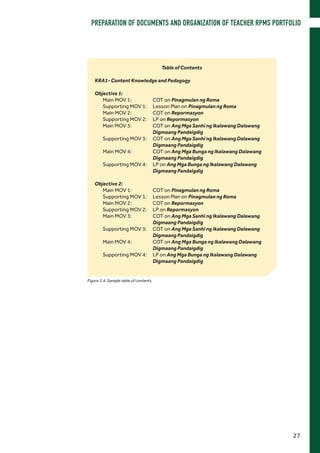
5.	 Prepare a “Table of Contents” in your Portfolio for easy
reference. See Figure 2.4.
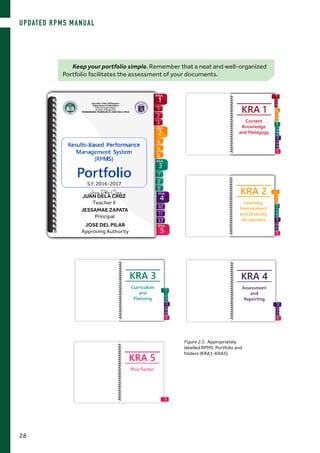
6.	 Provide a cover page in your Portfolio indicating the
following: name of your school, name of your Rater,
name of your Approving Authority and current school
year. See Figure 2.5 on page 28.
7.	 Prepare a second copy of your Portfolio for submission
to your Rater/Approving Authority. Affix your signature
on top of your name on the cover page of your
Portfolio. The Rater will need the original documents to
authenticate the photocopied documents.
Note the following tips to
help you produce a well-
prepared document and
well-organized Portfolio:
A.	 Start gathering
documents at the
beginning of the
school year.
B.	 Follow the steps
in preparing your
documents and
organizing your
Portfolio.
C.	 Check for the
completeness of the
documents needed by
preparing a checklist.
D.	 Reproduce the
documents in clear
copies.
E.	 Have the photocopied
documents in A4,
long bond paper
or whatever size
available.
F.	 Label properly all the
documents for easy
reference.
G.	 Submit complete
documents and keep
them intact.
H.	 Keep your Portfolio
simple yet
presentable.
2.2	How do you organize your RPMS Portfolio?
With an agreement with your approving authority, you may
digitize your physical documents and submit an electronic
copy of your Portfolio to minimize printing costs.
UPDATED RPMS MANUAL
26
Table of Contents
KRA1- Content Knowledge and Pedagogy
Objective 1:							
Main MOV 1: 		 COT on Pinagmulan ng Roma
Supporting MOV 1: 	 Lesson Plan on Pinagmulan ng Roma
Main MOV 2: 		 COT on Repormasyon
Supporting MOV 2: 	 LP on Repormasyon
Main MOV 3: 		 COT on Ang Mga Sanhi ng Ikalawang Dalawang 		
			 Digmaang Pandaigdig
Supporting MOV 3: 	 COT on Ang Mga Sanhi ng Ikalawang Dalawang 	
					 Digmaang Pandaigdig
Main MOV 4: 		 COT on Ang Mga Bunga ng Ikalawang Dalawang 		
			 Digmaang Pandaigdig
Supporting MOV 4: 	 LP on Ang Mga Bunga ng Ikalawang Dalawang 		
			 Digmaang Pandaigdig
Objective 2:							
Main MOV 1: 		 COT on Pinagmulan ng Roma
Supporting MOV 1: 	 Lesson Plan on Pinagmulan ng Roma
Main MOV 2: 		 COT on Repormasyon
Supporting MOV 2: 	 LP on Repormasyon
Main MOV 3: 		 COT on Ang Mga Sanhi ng Ikalawang Dalawang 		
			 Digmaang Pandaigdig
Supporting MOV 3: 	 COT on Ang Mga Sanhi ng Ikalawang Dalawang 	
					 Digmaang Pandaigdig
Main MOV 4: 		 COT on Ang Mga Bunga ng Ikalawang Dalawang 		
			 Digmaang Pandaigdig
Supporting MOV 4: 	 LP on Ang Mga Bunga ng Ikalawang Dalawang 		
			 Digmaang Pandaigdig
Figure 2.4. Sample table of contents
27
PREPARATION OF DOCUMENTS AND ORGANIZATION OF TEACHER RPMS PORTFOLIO
Figure 2.5. Appropriately
labelled RPMS Portfolio and
folders (KRA1-KRA5)
Keep your portfolio simple. Remember that a neat and well-organized
Portfolio facilitates the assessment of your documents.
JUAN DELA CRUZ
Teacher II
JESSAMAE ZAPATA
Principal
S.Y. 2016-2017
JOSE DEL PILAR
Approving Authority
UPDATED RPMS MANUAL
28
3
Results-based Performance Management System
Manual for Teachers and School Heads
THE PORTFOLIO
ASSESSMENT
PROCESS
The Results-based Performance Management System (RPMS) Manual for Teachers and School Heads was developed through the Philippine National
Research Center for Teacher Quality (RCTQ) with support from the Australian Government through the Basic Education Sector Transformation (BEST) Program.
© Department of Education - Bureau of Human Resource and Organizational Development
Philippine National
RESEARCH CENTER
FOR TEACHER QUALITY
RPMS Toolfor Teacher I-III
(Proficient Teachers)
Assessing the Teacher Portfolio is one of the most crucial processes in ensuring teacher
quality. The Portfolio assessment process is done across all phases of RPMS.

The Portfolio pre-assessment process, which focuses on Portfolio preparation, happens
in Phase I of the RPMS Process: Performance Planning and Commitment. It ensures that
teachers understand the Key Result Areas (KRAs), the objectives, the performance indicators
in the RPMS tool and the means of verification (MOV) to improve performance. It allows
teachers to select and prepare appropriate documents and attest to their authenticity.
Meanwhile, the Portfolio assessment process is covered in RPMS Phase II (Performance
Monitoring and Coaching) and Phase III (Performance Review and Evaluation). It involves
teacher self-assessment and Rater’s assessment of the Portfolio.
Finally,thePortfoliopost-assessmentprocessthatoccursinRPMSPhaseIII(Performance
Review and Evaluation) and Phase IV (Performance Rewarding and Development Planning),
aims to help teachers improve their performance. It focuses on the conduct of teacher and
rater conference on the results of the portfolio assessment process.
See Figure 3.2 on Page 33
Step1: ReviewthePhilippine
Professional Standards for
Teachers.
As Ratee, you should be familiar
with the new set of professional
standards for teachers since it has
been integrated in the RPMS tools.
The set of standards describes
seven Domains of teacher
quality: Content Knowledge and
Pedagogy; Learning Environment;
Diversity of Learners; Curriculum
and Planning; Assessment and
Reporting; Community Linkages
and Professional Engagement; and
Personal Growth and Professional
Development. These Domains are
presented as five KRAs in the RPMS
Tools for Teachers.
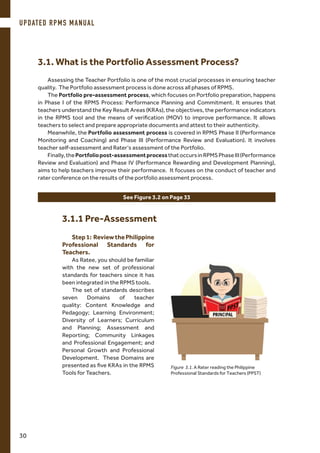
Figure 3.1. A Rater reading the Philippine
Professional Standards for Teachers (PPST)
3.1. What is the Portfolio Assessment Process?
3.1.1 Pre-Assessment
UPDATED RPMS MANUAL
30
Pre-AssessmentPhase
(Document/Forms:PPST,
RPMSTools,IPCRF,Teacher
RPMSPortfolio)
1.	ReviewthePhilippine
ProfessionalStandardsfor
Teachers.
2.	Determinethe
correspondingtoolforthe
teacher/Ratee.
•	RPMSToolfor
TeacherI-III
(ProficientTeachers)
•	RPMSToolforMaster
TeacherI-IV(Highly
ProficientTeachers)
3.	Guidetheteacher/Ratee
inunderstandingthe
appropriateRPMSTooland
theIndividualPerformance
CommitmentandReview
Form(IPCRF).
4.	Guidetheteacersin
preparingdocumentsand
organizingPortfolio.
5.	Uponsubmissionof
Portfolio,authenticate
documents.
AssessmentPhase
(Document/Forms:Teacher
RPMSPortfolio,appropriate
RPMSToolandIPCRF)
1.	RatethePortfoliobased
ontheMOVpresented.
Ratetheteacher’slevel
ofperformanceusingthe
5-pointscale:
5-Outstanding
4-VerySatisfactory
3-Satisfactory
2-Unsatisfactory
1-Poor
2.	ExplainyourRating,if
needed.
Post-AssessmentPhase
(Document/Forms:IPCRFand
IPCRF-DP)
1.	Discusswiththeteacher
hisorherperformance
dataandagreeonthe
ratings.
2.	Assisttheteacher
inpreparingthe
DevelopmentPlans.
Mid-yearReview
(Documents/
Forms:Teacher
RPMSPortfolio,
RPMSTools,IPCRF
andPMCF)
Year-end
Evaluation
(Documents/
Forms:IPCRFand
IPCRF-DP
PortfolioAssessmentProcess
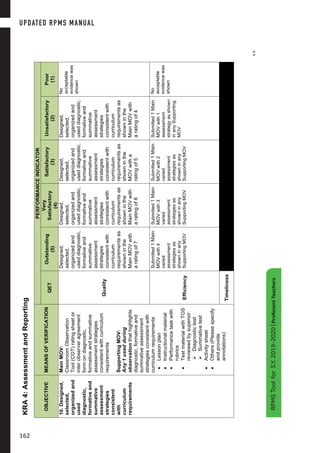
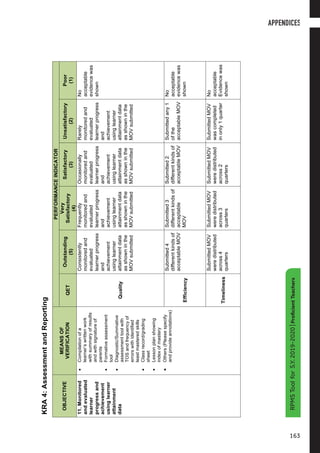
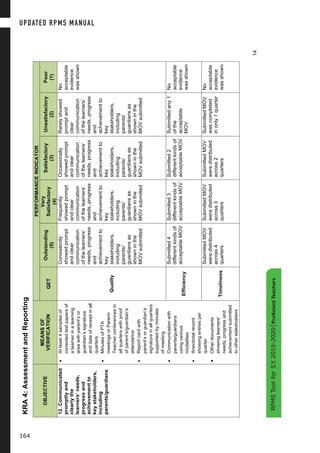
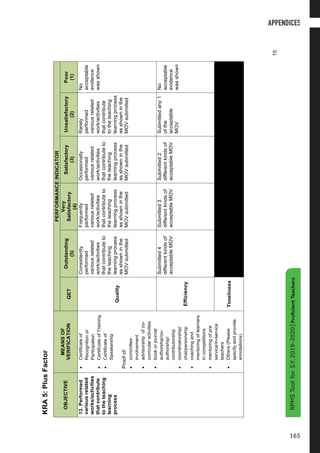
Figure3.2.ThePortfolioAssessmentProcess
THE PORTFOLIO ASSESSMENT PROCESS
31
Step 2: Determine the corresponding RPMS Tool for the Teacher/Ratee.
At the start of the Portfolio preparation, teachers should identify their RPMS
Tool considering their current position and the general description of their practice
based on the PPST.
The RPMS Tool for Teacher I-III (Proficient Teachers) shall be used by Teacher I,
TeacherIIandTeacherIII(TI-TIII),whichinclude:implementersofAlternativeLearning
System (ALS); Madrasah Education teachers/Asatidz; Indigenous Peoples Education
(IPEd) teachers; Special Education Teacher I-IV; Senior High School teachers
(including those who are in probationary status), and Special Science Teacher I.
The RPMS Tool for Master Teacher I-IV (Highly Proficient Teachers) is for Master
Teacher I to Master Teacher IV, which include: implementers of Alternative Learning
System (ALS); Madrasah Education teachers/Asatidz; Indigenous Peoples Education
(IPEd) teachers; Special Education Teacher V; Senior High School teachers (including
those who are in probationary status).
Step 3: Guide the Ratee in understanding the appropriate RPMS Tool
and the Individual Performance Commitment Review Form (IPCRF). The
various elements and the language of the tool must be clear to the Teacher so you
can guide them in understanding the following:
•	 objectives to be met per KRA;
•	 specific performance rating from Outstanding to Poor performance;
•	 performance indicators per level; and
•	 MOV to prove the level of performance
Figure 3.4 provides the summary of forms/tools used per position.
Step 4: Advise the Teacher/Ratee to accomplish the IPCRF.
Discuss the performance indicators to be achieved as identified for
each of the individual objectives in the appropriate RPMS tool. See
the IPCRF Template on page 34 and the sample accomplished IPCRF
on page 37. Excel-based IPCRF are provided for Teachers and Master Teachers.
Step 5: Guide the Teachers in preparing documents and organizing
Portfolio. Refer to Chapter 2 of this Manual.
Figure 3.3. A Rater determines the corresponding RPMS tool for the Teacher/Ratee
What is
your current
position?
I am
a Teacher 1.
UPDATED RPMS MANUAL
32
Figure 3.4. Matrix of Forms/Tools used by Position
Below is the summary table of RPMS forms/tools for Teachers and
Master Teachers.
The Office Performance Commitment Review Form (OPCRF)
shall be accomplished by the head of school, e.g. School Head, Head
Teachers, including designated Teacher-in-Charge, to reflect the office
KRAs, objectives and performance indicators. Other personnel with
administrative functions, but are not head of office, must craft their own
IPCRF. See Figure 3.5 for the forms/tools to be used.
Position Forms/Tools to be Used
Head Teacher
(designated as School Head)
Office Performance Commitment and
Review Form (OPCRF)
Head Teacher with teaching load
Individual Performance Commitment
and Review Form (IPCRF), capturing
the expected administrative tasks and
objectives in the Highly Proficient Tools for
Master Teacher I-IV
Head Teacher
without teaching load IPCRF anchored on the OPCRF of the School
Head
Assistant Principal
School Head/designated Teacher-
in-Charge
Office Performance Commitment and
Review Form (OPCRF)
Figure 3.5. Matrix of Forms/Tools used by personnel with administrative functions
Position Forms/Tools to be Used
Teacher I-III
RPMS Tool/IPCRF for Proficient
Teachers
Special Education Teacher I-IV
ALS Implementers
Madrasah Education Teachers
(Teacher I-III)
Indigenous Peoples Education (IPEd)
Teachers (Teacher I-III)
Special Science Teacher I (SHS)
Master Teacher I-IV
RPMS Tool/IPCRF for Highly
Proficient Teachers
Special Education Teacher V
Madrasah Education Teachers
(Master Teacher I-IV)
Indigenous Peoples Education (IPEd)
Teachers (Master Teacher I-IV)
THE PORTFOLIO ASSESSMENT PROCESS
33
Figure3.6.IPCRFTemplate
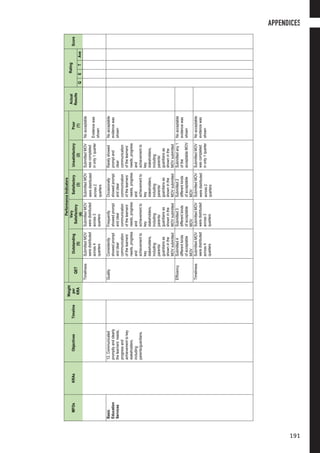
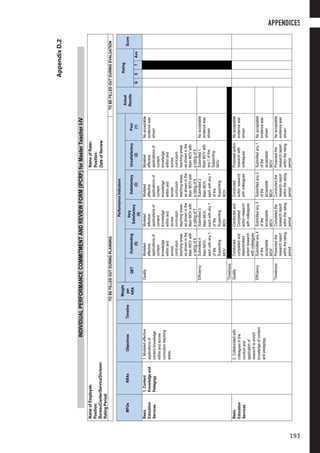
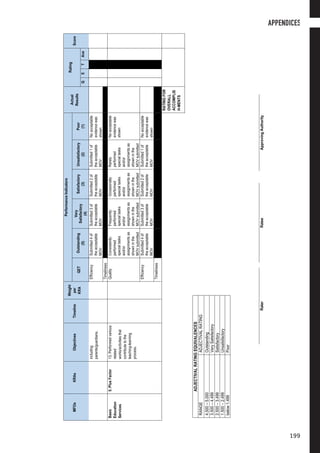
INDIVIDUALPERFORMANCECOMMITMENTANDREVIEWFORM(IPCRF)–TeacherI-III(ProficientTeachers)
NameofEmployee:
Position:
Bureau/Center/Service/Division:
RatingPeriod:
NameofRater:
Position:
DateofReview:
TOBEFILLEDINDURINGPLANNINGTOBEFILLEDDURINGEVALUATION
MFOsKRAsObjectivesTimeline
Weight
per
KRA
PerformanceIndicators
Actual
Results
RatingScore
QET
Outstanding
(5)
Very
Satisfactory
(4)
Satisfactory
(3)
Unsatisfactory
(2)
Poor(1)QETAve
Basic
Education
Services
Content
Knowledge
and
Pedagogy
1.Applied
knowledge
ofcontent
withinand
across
curriculum
teaching
areas.
June
2016–
March
2017
22.5%
Quality
Efficiency
Timeliness
OVERALL
RATINGFOR
ACCOMPLISH-
MENTS
JOSEMARIAGUERREROSANTIAGOMARTINJESSAMAEZAPATA
RaterRateeApprovingAuthority
UPDATED RPMS MANUAL
34
This phase focuses on the actual assessment of the Teacher Portfolio.
At this stage, you will examine the Portfolio against the corresponding
RPMS Tool and the IPCRF.
You will assess the Portfolio twice — first during the mid-year review
and second during the year-end evaluation. In the year-end review, fill out
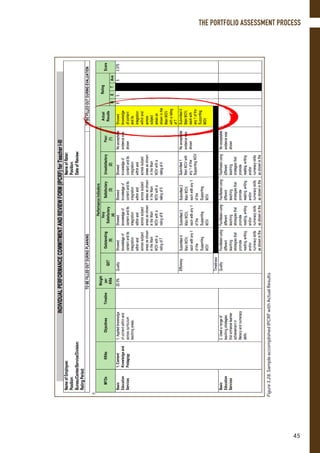
the column that says “Actual Results” in the IPCRF. See Figure 3.28 on page
45.
Step 1: Rate the Portfolio based on the MOV presented.
ExaminetheMOVpresentedbytheteacherandratetheteacher’slevel
of performance using the 5-point scale:
Numerical
Rating
Adjectival
Rating
Description of Meaning of Rating
5 Outstanding
Performance represents an extraordinary
level of achievement and commitment in
terms of quality and time, technical skills
and knowledge, ingenuity, creativity and
initiative. Employees at this performance level
should have demonstrated exceptional job
mastery in all major areas of responsibility.
Employee achievement and contribution to the
organization are of marked excellence
4
Very
Satisfactory
Performance exceeded expectations. All goals,
objectives and targets were achieved above the
established standards.
3 Satisfactory
Performance met expectations in terms of
quality of work, efficiency and timeliness. The
most critical annual goals were met.
2 Unsatisfactory
Performance failed to meet expectations, and/
or one or more of the most critical goals were
not met.
1 Poor
Perforrmance was consistanetly below
expectations, and/or reasonable progress
toward critical goals was not made. Significant
improvement is needed in one or more
important areas.
Figure 3.8. The RPMS Rating Scale
Step 6: Upon submission of the Teacher
Portfolio, authenticate documents.
As Rater, check the photocopies/electronic copy against
the original documents. Raters do not need to affix his/her
signature in each document/evidence to prove valid and genuine
copies of the original. Instead, Raters may just affix his or her
signature on a sheet of paper to attest that all documents in the
RPMS Portfolio are valid.
Figure 3.7. A Rater compares
the original documents with the
duplicates.
3.1.2 Assessment
THE PORTFOLIO ASSESSMENT PROCESS
35
Ensure that the quantitative and the qualitative feedback
in the Classroom Observation Tool (COT) are consistent. If
inconsistent,requesttheRateetoconferwiththeobserveragain.
Embedded in the performance indicators of the RPMS Tools for Teachers are
relevant dimensions of performance measures required by the RPMS Guidelines.
Figure 3.9 shows the definition of these performance measures, namely, quality/
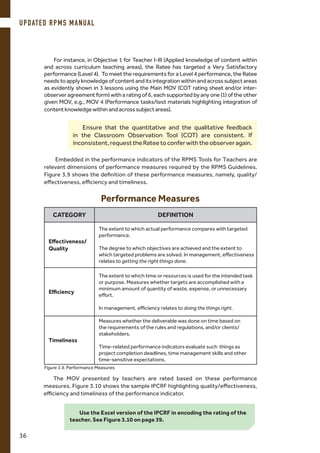
effectiveness, efficiency and timeliness.
CATEGORY DEFINITION
Effectiveness/
Quality
The extent to which actual performance compares with targeted
performance.
The degree to which objectives are achieved and the extent to
which targeted problems are solved. In management, effectiveness
relates to getting the right things done.
Efficiency
The extent to which time or resources is used for the intended task
or purpose. Measures whether targets are accomplished with a
minimum amount of quantity of waste, expense, or unnecessary
effort.
In management, efficiency relates to doing the things right.
Timeliness
Measures whether the deliverable was done on time based on
the requirements of the rules and regulations, and/or clients/
stakeholders.
Time-related performance indicators evaluate such things as
project completion deadlines, time management skills and other
time-sensitive expectations.
Figure 3.9. Performance Measures
The MOV presented by teachers are rated based on these performance
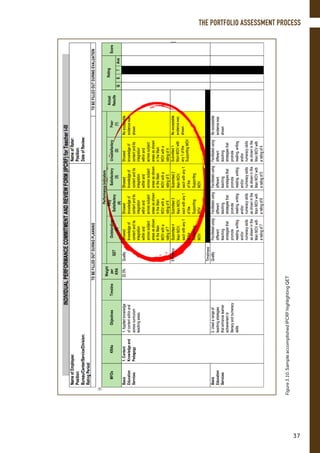
measures. Figure 3.10 shows the sample IPCRF highlighting quality/effectiveness,
efficiency and timeliness of the performance indicator.
Performance Measures
For instance, in Objective 1 for Teacher I-III (Applied knowledge of content within
and across curriculum teaching areas), the Ratee has targeted a Very Satisfactory
performance (Level 4). To meet the requirements for a Level 4 performance, the Ratee
needstoapplyknowledgeofcontentanditsintegrationwithinandacrosssubjectareas
as evidently shown in 3 lessons using the Main MOV (COT rating sheet and/or inter-
observer agreement form) with a rating of 6, each supported by any one (1) of the other
given MOV, e.g., MOV 4 (Performance tasks/test materials highlighting integration of
contentknowledgewithinandacrosssubjectareas).
Use the Excel version of the IPCRF in encoding the rating of the
teacher. See Figure 3.10 on page 39.
UPDATED RPMS MANUAL
36
Figure3.10.SampleaccomplishedIPCRFhighlightingQET
THE PORTFOLIO ASSESSMENT PROCESS
37
Teacher Grace, a Master Teacher II of Calauag East Central School, submits her
Portfolio for rating. She includes the following MOV under KRA 1 Objective 1:
•	 Four COT Rating Sheets with a rating of level 7 on effective applications of
content knowledge within and across curriculum teaching areas for 4 lessons.
- COT 1 is supported by 1 lesson plan used in demonstration teaching
highlighting integration of content knowledge within and across subject areas;
- COT 2 is supported by 1 set of instructional materials developed highlighting
effective application of content knowledge within and across subject areas;
- COT 3 is supported by 1 performance task/test material used in
demonstration teaching across subject areas; and
- COT 4 is supported by results of assessment used in demonstration
teaching highlighting mastery of lessons learned
Teacher Grace receives an average rating of 4.500 (Outstanding) for KRA 1
Objective 1. Why?
Teacher Grace models effective applications of content knowledge within and
across curriculum teaching areas as evidenced by the following:
Therefore, Teacher Grace got a corresponding rating of 4 in the RPMS 5-point scale for
Quality for each submitted COT rating sheet with a rating of 7. Each COT is supported by a
lesson plan, a set of instructional material used, performance tasks/test materials and results
of assessment. She also got a rating of 5 for Efficiency having submitted the required number
of MOV. The computation is shown below:
Sample School Scenario for Master Teachers
Figure 3.11. A table of sample submitted MOV for Master Teacher I-IV
Acceptable MOV Submitted MOV Remarks
1.	 Classroom observation tool (COT)
rating sheet and/or inter-observer
agreement form about effective
applications of content knowledge
within and across curriculum teaching
areas
2.	 Lesson plans used in demonstration
teaching highlighting integration of
content knowledge within and across
subject areas
3.	 Instructional materials developed
highlighting effective application of
content knowledge within and across
subject areas
4.	 Performance tasks/test material(s)
used in demonstration teaching
highlighting integration of content
knowledge within and across subject
areas
5.	 Results of assessment used in
demonstration teaching highlighting
mastery of lessons learned
6.	 Others (Please specify and provide
annotations)
4 COT rating sheets with a rating of
level 7.
•	 COT 1 is supported by 1 lesson
plan used in demonstration
teaching highlighting integration
of knowledge of content within and
across subject areas
•	 COT 2 is supported by 1 set of
instructional materials developed
highlighting effective application
of content knowledge within and
across subject areas
•	 COT 3 is supported by 1
performance task/test material
used in demonstration teaching
highlighting integration of content
knowledge within and across
subject areas
•	 COT 4 is supported by results of
assessment used in demonstration
teaching highlighting mastery of
lessons learned
Valid
Valid
Valid
Valid
Valid
Q E T Total Average Weight per Objective Score
4 5 - 9 4.500 7.5% 0.337
Figure 3.12. Sample computation of Teacher Grace’s rating based on the submitted MOV
UPDATED RPMS MANUAL
38
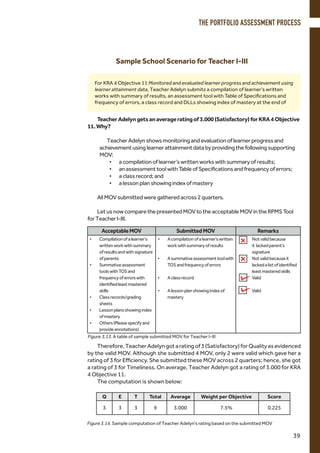
Sample School Scenario for Teacher I-III
For KRA 4 Objective 11 Monitored and evaluated learner progress and achievement using
learner attainment data, Teacher Adelyn submits a compilation of learner’s written
works with summary of results, an assessment tool with Table of Specifications and
frequency of errors, a class record and DLLs showing index of mastery at the end of
TeacherAdelyngetsanaverageratingof3.000(Satisfactory)forKRA4Objective
11.Why?
	 TeacherAdelynshowsmonitoringandevaluationoflearnerprogressand
achievementusinglearnerattainmentdatabyprovidingthefollowingsupporting
MOV:
•	 acompilationoflearner’swrittenworkswithsummaryofresults;
•	 anassessmenttoolwithTableofSpecificationsandfrequencyoferrors;
•	 aclassrecord;and
•	 alessonplanshowingindexofmastery
AllMOVsubmittedweregatheredacross2quarters.
LetusnowcomparethepresentedMOVtotheacceptableMOVintheRPMSTool
forTeacherI-III.
Therefore,TeacherAdelyngotaratingof3(Satisfactory)forQualityasevidenced
by the valid MOV. Although she submitted 4 MOV, only 2 were valid which gave her a
rating of 3 for Efficiency. She submitted these MOV across 2 quarters; hence, she got
a rating of 3 for Timeliness. On average, Teacher Adelyn got a rating of 3.000 for KRA
4 Objective 11.
The computation is shown below:
Figure 3.13. A table of sample submitted MOV for Teacher I-III
AcceptableMOV SubmittedMOV Remarks
•	 Compilationofalearner’s
writtenworkwithsummary
ofresultsandwithsignature
ofparents
•	 Summativeassessment
toolswithTOSand
frequencyoferrorswith
identifiedleastmastered
skills
•	 Classrecords/grading
sheets
•	 Lessonplansshowingindex
ofmastery
•	 Others(Pleasespecifyand
provideannotations)
•	 Acompilationofalearner’swritten
workwithsummaryofresults
•	 Asummativeassessmenttoolwith
TOSandfrequencyoferrors
•	 Aclassrecord
•	 Alessonplanshowingindexof
mastery
Notvalidbecause
it lackedparent’s
signature
Notvalidbecauseit
lackedalistofidentified
leastmasteredskills
Valid
Valid
Q E T Total Average Weight per Objective Score
3 3 3 9 3.000 7.5% 0.225
Figure 3.14. Sample computation of Teacher Adelyn’s rating based on the submitted MOV
THE PORTFOLIO ASSESSMENT PROCESS
39
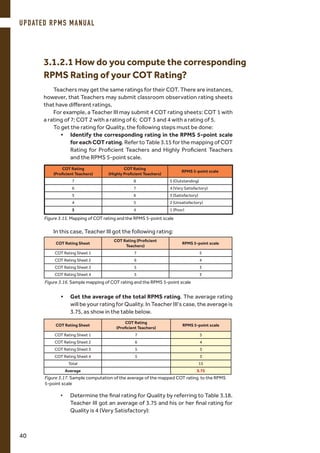
Teachers may get the same ratings for their COT. There are instances,
however, that Teachers may submit classroom observation rating sheets
that have different ratings.
For example, a Teacher III may submit 4 COT rating sheets: COT 1 with
a rating of 7; COT 2 with a rating of 6; COT 3 and 4 with a rating of 5.
To get the rating for Quality, the following steps must be done:
•	 Identify the corresponding rating in the RPMS 5-point scale
for each COT rating. Refer to Table 3.15 for the mapping of COT
Rating for Proficient Teachers and Highly Proficient Teachers
and the RPMS 5-point scale.
COT Rating
(Proficient Teachers)
COT Rating
(Highly Proficient Teachers)
RPMS 5-point scale
7 8 5 (Outstanding)
6 7 4 (Very Satisfactory)
5 6 3 (Satisfactory)
4 5 2 (Unsatisfactory)
3 4 1 (Poor)
COT Rating Sheet
COT Rating (Proficient
Teachers)
RPMS 5-point scale
COT Rating Sheet 1 7 5
COT Rating Sheet 2 6 4
COT Rating Sheet 3 5 3
COT Rating Sheet 4 5 3
COT Rating Sheet
COT Rating
(Proficient Teachers)
RPMS 5-point scale
COT Rating Sheet 1 7 5
COT Rating Sheet 2 6 4
COT Rating Sheet 3 5 3
COT Rating Sheet 4 5 3
Total 15
Average 3.75
In this case, Teacher III got the following rating:
•	 Get the average of the total RPMS rating. The average rating
will be your rating for Quality. In Teacher III’s case, the average is
3.75, as show in the table below.
•	 Determine the final rating for Quality by referring to Table 3.18.
Teacher III got an average of 3.75 and his or her final rating for
Quality is 4 (Very Satisfactory):
Figure 3.15. Mapping of COT rating and the RPMS 5-point scale
Figure 3.16. Sample mapping of COT rating and the RPMS 5-point scale
Figure 3.17. Sample computation of the average of the mapped COT rating to the RPMS
5-point scale
3.1.2.1 How do you compute the corresponding
RPMS Rating of your COT Rating?
UPDATED RPMS MANUAL
40
Step 2: Explain your Rating, if needed.
To help the Ratees enrich their Portfo in improving the quality of the Portfolios.
A sample feedback on a Teacher Portfolio appears below.
Sample Feedback of a Principal
Good! Lessons presented in Araling Panlipunan, Edukasyon sa Pagpapakatao
and MTB emphasized the integration of other subjects and content areas.
The attached COT further proves the integration. The modified DLL also
shows the teacher’s creativity in designing tasks and visual aids.
However, integration becomes more effective if the students are able to apply
the concepts to their real life experiences, so you can add other activities where
they will use the concepts in their everyday experiences.
In so doing, you can actually meet the requirements for the higher performance
level.
Keep up the good work!
Figure 3.19. Sample feedback of a Rater
Figure 3.20. A rater provides feedback on the Teacher’s Portfolio.
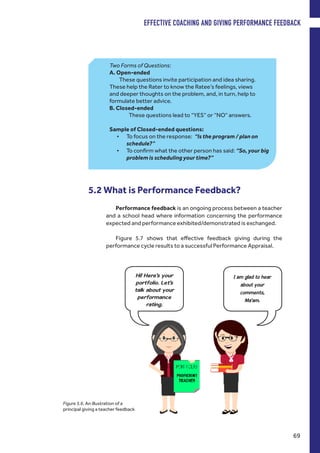
Hi! Here’s your
portfolio. Let’s
talk about your
performance
rating.
I am glad to
hear about
your
comments,
Ma’am.
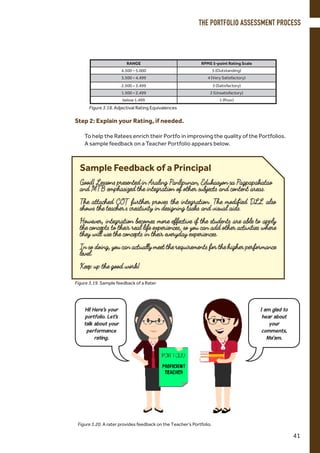
RANGE RPMS 5-point Rating Scale
4.500 – 5.000 5 (Outstanding)
3.500 – 4.499 4 (Very Satisfactory)
2.500 – 3.499 3 (Satisfactory)
1.500 – 2.499 2 (Unsatisfactory)
below 1.499 1 (Poor)
Figure 3.18. Adjectival Rating Equivalences
THE PORTFOLIO ASSESSMENT PROCESS
41
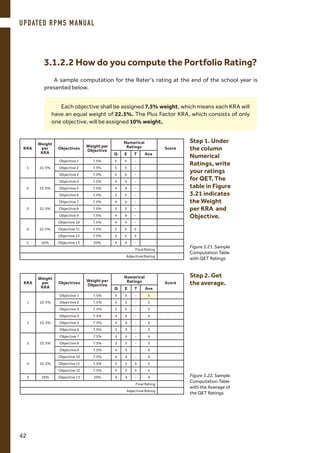
Step 1. Under
the column
Numerical
Ratings, write
your ratings
for QET. The
table in Figure
3.21 indicates
the Weight
per KRA and
Objective.
KRA
Weight
per
KRA
Objectives
Weight per
Objective
Numerical
Ratings Score
Q E T Ave
1 22.5%
Objective 1 7.5% 5 5 -
Objective 2 7.5% 5 5 -
Objective 3 7.5% 5 5 -
2 22.5%
Objective 4 7.5% 4 4 -
Objective 5 7.5% 4 4 -
Objective 6 7.5% 3 3 -
3 22.5%
Objective 7 7.5% 4 4 -
Objective 8 7.5% 3 3 -
Objective 9 7.5% 4 4 -
4 22.5%
Objective 10 7.5% 4 4 -
Objective 11 7.5% 5 5 5
Objective 12 7.5% 5 5 5
5 10% Objective 13 10% 4 4 -
Final Rating
Adjectival Rating
A sample computation for the Rater’s rating at the end of the school year is
presented below.
Figure 3.21. Sample
Computation Table
with QET Ratings
3.1.2.2 How do you compute the Portfolio Rating?
Each objective shall be assigned 7.5% weight, which means each KRA will
have an equal weight of 22.5%. The Plus Factor KRA, which consists of only
one objective, will be assigned 10% weight.
Step 2. Get
the average.KRA
Weight
per
KRA
Objectives
Weight per
Objective
Numerical
Ratings Score
Q E T Ave
1 22.5%
Objective 1 7.5% 5 5 - 5
Objective 2 7.5% 5 5 - 5
Objective 3 7.5% 5 5 - 5
2 22.5%
Objective 4 7.5% 4 4 - 4
Objective 5 7.5% 4 4 - 4
Objective 6 7.5% 3 3 - 3
3 22.5%
Objective 7 7.5% 4 4 - 4
Objective 8 7.5% 3 3 - 3
Objective 9 7.5% 4 4 - 4
4 22.5%
Objective 10 7.5% 4 4 - 4
Objective 11 7.5% 5 5 5 5
Objective 12 7.5% 5 5 5 5
5 10% Objective 13 10% 4 4 - 4
Final Rating
Adjectival Rating
Figure 3.22. Sample
Computation Table
with the Average of
the QET Ratings
UPDATED RPMS MANUAL
42
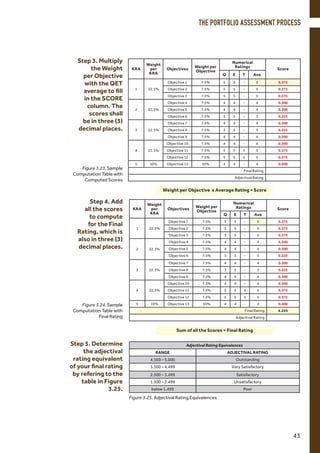
Step 4. Add
all the scores
to compute
for the Final
Rating, which is
also in three (3)
decimal places.
Adjectival Rating Equivalences
RANGE ADJECTIVAL RATING
4.500 – 5.000 Outstanding
3.500 – 4.499 Very Satisfactory
2.500 – 3.499 Satisfactory
1.500 – 2.499 Unsatisfactory
below 1.499 Poor
Step 5. Determine
the adjectival
rating equivalent
of your final rating
by refering to the
table in Figure
3.25.
Figure 3.24. Sample
Computation Table with
Final Rating
Figure 3.25. Adjectival Rating Equivalences
KRA
Weight
per
KRA
Objectives
Weight per
Objective
Numerical
Ratings Score
Q E T Ave
1 22.5%
Objective 1 7.5% 5 5 - 5 0.375
Objective 2 7.5% 5 5 - 5 0.375
Objective 3 7.5% 5 5 - 5 0.375
2 22.5%
Objective 4 7.5% 4 4 - 4 0.300
Objective 5 7.5% 4 4 - 4 0.300
Objective 6 7.5% 3 3 - 3 0.225
3 22.5%
Objective 7 7.5% 4 4 - 4 0.300
Objective 8 7.5% 3 3 - 3 0.225
Objective 9 7.5% 4 4 - 4 0.300
4 22.5%
Objective 10 7.5% 4 4 - 4 0.300
Objective 11 7.5% 5 5 5 5 0.375
Objective 12 7.5% 5 5 5 5 0.375
5 10% Objective 13 10% 4 4 - 4 0.400
Final Rating 4.225
Adjectival Rating
Figure 3.23. Sample
Computation Table with
Computed Scores
Step 3. Multiply
the Weight
per Objective
with the QET
average to fill
in the SCORE
column. The
scores shall
be in three (3)
decimal places.
Weight per Objective x Average Rating = Score
KRA
Weight
per
KRA
Objectives
Weight per
Objective
Numerical
Ratings
Score
Q E T Ave
1 22.5%
Objective 1 7.5% 5 5 - 5 0.375
Objective 2 7.5% 5 5 - 5 0.375
Objective 3 7.5% 5 5 - 5 0.375
2 22.5%
Objective 4 7.5% 4 4 - 4 0.300
Objective 5 7.5% 4 4 - 4 0.300
Objective 6 7.5% 3 3 - 3 0.225
3 22.5%
Objective 7 7.5% 4 4 - 4 0.300
Objective 8 7.5% 3 3 - 3 0.225
Objective 9 7.5% 4 4 - 4 0.300
4 22.5%
Objective 10 7.5% 4 4 - 4 0.300
Objective 11 7.5% 5 5 5 5 0.375
Objective 12 7.5% 5 5 5 5 0.375
5 10% Objective 13 10% 4 4 - 4 0.400
Final Rating
Adjectival Rating
Sum of all the Scores = Final Rating
THE PORTFOLIO ASSESSMENT PROCESS
43
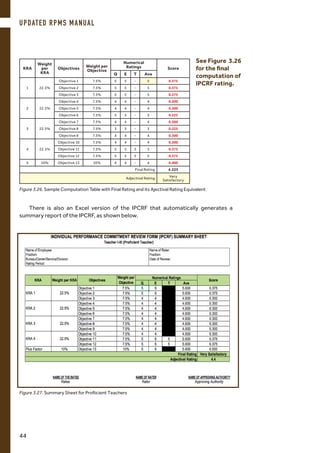
See Figure 3.26
for the final
computation of
IPCRF rating.
Figure 3.26. Sample Computation Table with Final Rating and its Ajectival Rating Equivalent
KRA
Weight
per
KRA
Objectives
Weight per
Objective
Numerical
Ratings Score
Q E T Ave
1 22.5%
Objective 1 7.5% 5 5 - 5 0.375
Objective 2 7.5% 5 5 - 5 0.375
Objective 3 7.5% 5 5 - 5 0.375
2 22.5%
Objective 4 7.5% 4 4 - 4 0.300
Objective 5 7.5% 4 4 - 4 0.300
Objective 6 7.5% 3 3 - 3 0.225
3 22.5%
Objective 7 7.5% 4 4 - 4 0.300
Objective 8 7.5% 3 3 - 3 0.225
Objective 9 7.5% 4 4 - 4 0.300
4 22.5%
Objective 10 7.5% 4 4 - 4 0.300
Objective 11 7.5% 5 5 5 5 0.375
Objective 12 7.5% 5 5 5 5 0.375
5 10% Objective 13 10% 4 4 - 4 0.400
Final Rating 4.225
Adjectival Rating
Very
Satisfactory
There is also an Excel version of the IPCRF that automatically generates a
summary report of the IPCRF, as shown below.
Figure 3.27. Summary Sheet for Profiicient Teachers
UPDATED RPMS MANUAL
44
Figure3.28.SampleaccomplishedIPCRFwithActualResults
THE PORTFOLIO ASSESSMENT PROCESS
45
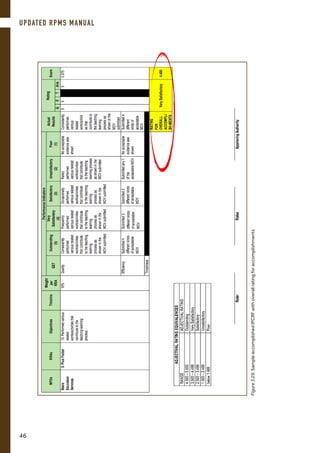
Figure3.29.SampleaccomplishedIPCRFwithoverallratingforaccomplishments
UPDATED RPMS MANUAL
46
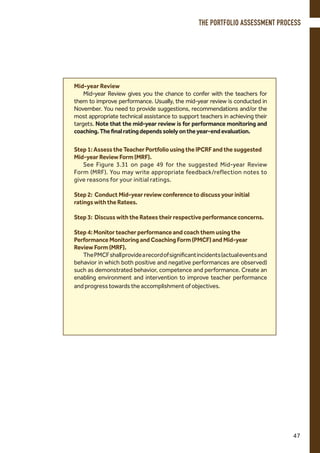
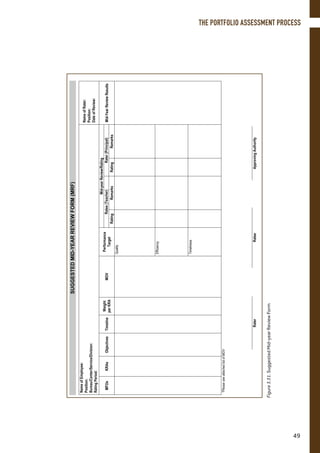
Mid-year Review
Mid-year Review gives you the chance to confer with the teachers for
them to improve performance. Usually, the mid-year review is conducted in
November. You need to provide suggestions, recommendations and/or the
most appropriate technical assistance to support teachers in achieving their
targets. Note that the mid-year review is for performance monitoring and
coaching.Thefinalratingdependssolelyontheyear-endevaluation.
Step 1: Assess the Teacher Portfolio using the IPCRF and the suggested
Mid-year Review Form (MRF).
See Figure 3.31 on page 49 for the suggested Mid-year Review
Form (MRF). You may write appropriate feedback/reflection notes to
give reasons for your initial ratings.
Step 2: Conduct Mid-year review conference to discuss your initial
ratings with the Ratees.
Step 3: Discuss with the Ratees their respective performance concerns.
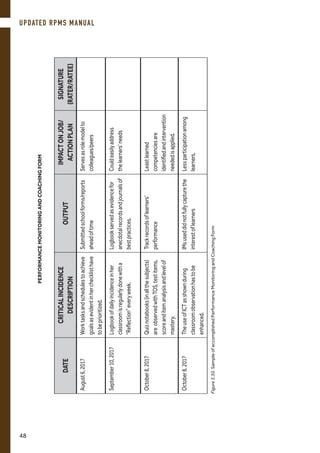
Step 4: Monitor teacher performance and coach them using the
Performance Monitoring and Coaching Form (PMCF) and Mid-year
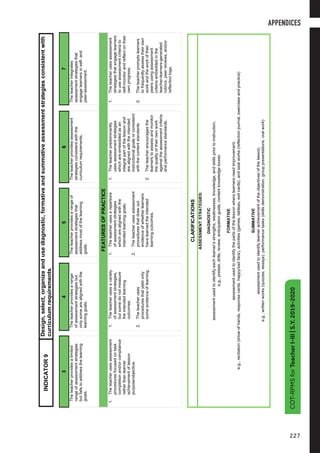
Review Form (MRF).
ThePMCFshallprovidearecordofsignificantincidents(actualeventsand
behavior in which both positive and negative performances are observed)
such as demonstrated behavior, competence and performance. Create an
enabling environment and intervention to improve teacher performance
and progress towards the accomplishment of objectives.
THE PORTFOLIO ASSESSMENT PROCESS
47
DATE
CRITICALINCIDENCE
DESCRIPTION
OUTPUT
IMPACTONJOB/
ACTIONPLAN
SIGNATURE
(RATER/RATEE)
August6,2017Worktasksandschedulestoachieve
goalsasevidentinherchecklisthave
tobeprioritized.
Submittedschoolforms/reports
aheadoftime
Servesasrolemodelto
colleagues/peers
September10,2017Logbookofdailyincidenceinher
classroomisregularlydonewitha
“Reflection”everyweek.
Logbookservedasevidencefor
anecdotalrecordsandjournalsof
bestpractices.
Couldeasilyaddress
thelearners’needs
October8,2017Quiznotebooks(inallthesubjects)
areobservedwithTOS,testitems,
scoreanditemanalysisandlevelof
mastery.
Trackrecordsoflearners’
performance
Leastlearned
competenciesare
identifiedandintervention
neededisapplied.
October8,2017TheuseofICTasshownduring
classroomobservationhastobe
enhanced.
IMsuseddidnotfullycapturethe
interestoflearners
Lessparticipationamong
learners.
Figure3.30.SampleofaccomplishedPerformanceMonitoringandCoachingForm
PERFORMANCEMONITORINGANDCOACHINGFORM
UPDATED RPMS MANUAL
48
Figure3.31.SuggestedMid-yearReviewForm	174	
AppendixE
SUGGESTEDMID-YEARREVIEWFORM(MRF)
NameofEmployee:
Position:
Bureau/Center/Service/Division:
RatingPeriod:
NameofRater:
Position:
DateofReview:
MFOsKRAsObjectivesTimeline
Weight
perKRA
MOV
Performance
Target
Mid-yearReview/Rating
Mid-YearReviewResultsRatee(Teacher)Rater(Principal)
RatingRemarksRatingRemarks
Quality
Efficiency
Timeliness
*PleaseseeattachedlistofMOV
RaterRateeApprovingAuthority
THE PORTFOLIO ASSESSMENT PROCESS
49
Step 1: Discuss with the Ratee the set of competencies.
Discuss with the teacher the set of core behavioral competencies
demonstrated during the performance cycle. See Figure 3.33 on page 51.
Step 2: Assess the demonstration of competencies.
In the form provided in the Annex F, IPCRF, write the appropriate rating
inside the box for each competency using the 5-point scale shown below: a
3.1.2.3 How do you assess the Competencies?
Scale Definition
5 Role Model
4 Consistently demonstrates
3 Most of the time demonstrates
2 Sometimes demonstrates
1 Rarely demonstrates
5 - If all behavioral indicators had been demonstrated
4 - If four behavioral indicators had been demonstrated
3 - If three behavioral indicators had been demonstrated
2 - If two behavioral indicators had been demonstrated
1 - If only one behavioral indicator had been demonstrated
Figure 3.32. The DepEd Competencies Scale
During the RPMS Phase 1, the Rater shall discuss with the Ratee
the competencies required of him or her. The demonstration of these
competencies shall be monitored to effectively plan the interventions
needed for development plans and shall be assessed at the end of the year.
After rating the Portfolio, determine the overall rating of the actual
accomplishments and results. The Rater and the Ratee should reach an
agreement by signing the IPCRF.
The assessment in the demonstration of competencies shall not be
reflected in the final rating. These competencies are monitored to inform
professional development plans.
UPDATED RPMS MANUAL
50
PARTII:COMPETENCIES
COREBEHAVIORALCOMPETENCIES
Self-Management
1.Setspersonalgoalsanddirections,needsanddevelopment.
2.Undertakespersonalactionsandbehaviorthatareclearand
purposiveandtakesintoaccountpersonalgoalsandvalues
congruenttothatoftheorganization.
3.Displaysemotionalmaturityandenthusiasmforandischallenged
byhighergoals.
4.Prioritizeworktasksandschedules(throughGanttcharts,
checklists,etc.)toachievegoals.
5.Setshighquality,challenging,realisticgoalsforselfandothers.
Teamwork
1.Willinglydoeshis/hershareofresponsibility.
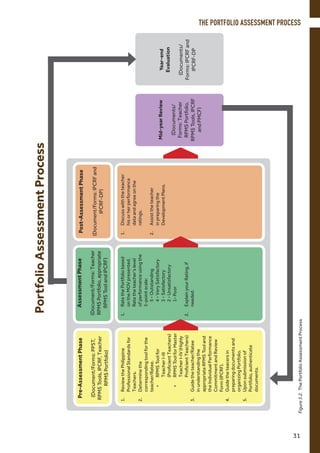
2.Promotescollaborationandremovesbarriertoteamworkandgoal
accomplishmentacrosstheorganization.
3.Appliesnegotiationprinciplesinarrivingatwin-winagreements.
4.Drivesconsensusandteamownershipofdecisions.
5.Worksconstructivelyandcollaborativelywithothersandacross
organizationstoaccomplishorganizationgoalsandobjectives.
ProfessionalismandEthics
1.DemonstratesthevaluesandbehaviorenshrinedintheNormsand
ConductandEthicalStandardsforpublicofficialsandemployess(RA
6713).
2.Practicesethicalandprofessionalbehaviorandconducttakinginto
accounttheimpactofhis/heractionsanddecisions.
3.Maintainsaprofessionalimage:beingtrustworthy,regularityof
attendanceandpunctuality,goodgroomingandcommunication.
4.Makespersonalsacrificestomeettheorganization’sneeds.
5.Actswithasenseofurgencyandresponsibilitytomeetthe
organization’sneeds,improvesystemandhelpothersimprovetheir
effectiveness.
ServiceOrientation
1.Canexplainandarticulateorganizationaldirections,issuesand
problems.
2.Takespersonalresponsibilityfordealingwithand/orcorrecting
customerserviceissuesandconcerns.
3.Initiatesactivitiesthatpromoteadvocacyformenandwomen
empowerment.
4.Participatesinupdatingofficevision,mission,mandatesand
strategiesbasedonDepEdstrategiesanddirections.
5.Developsandadoptsserviceimprovementprogramthrough
simplifiedproceduresthatwillfurtherenhanceservicedelivery.
ResultsFocus
1.Achievesresultswithoptimaluseoftimeandresourcesmostof
thetime.
2.Avoidsrework,mistakesandwastagethrougheffectivework
methodsbyplacingorganizationalneedsbeforepersonalneeds.
3.Deliverserror-freeoutputsmostofthetimebyconformingto
standardoperatingprocedurescorrectlyandconsistently.Able
toproduceverysatisfactoryqualityworkintermsofusefulness/
acceptabilityandcompletenesswithnosupervisionrequired.
4.Expressesadesiretodobetterandmayexpressfrustrationat
wasteorinefficiency.Mayfocusonnewormoreprecisewaysof
meetinggoalsset.
5.Makesspecificchangesinthesystemorinownworkmethodsto
improveperformance.Examplesmayincludedoingsomethingbetter,
faster,atalowercost,moreefficiently,orimprovingquality,customer
satisfaction,morale,withoutsettinganyspecificgoal.
Innovation
1.Examinestherootcauseofproblemsandsuggestseffective
solutions.Fosternewideas,processesandsuggestsbetterwaysto
dothings(costand/oroperational
efficiency).
2.Demonstratesanabilitytothink“beyondthebox”.Continuously
focusesonimprovingpersonalproductivitytocreatehighervalueand
results.
3.Promotesacreativeclimateandinspiresco-workerstodevelop
originalideasorsolutions.
4.Translatescreativethinkingintotangiblechangesandsolutions
thatimprovetheworkunitandorganization.
5.Usesingeniousmethodstoaccomplishresponsibilities.
Demonstratesresourcefulnessandtheabilitytosucceedwith
minimalresources.
Figure3.33.SampleAssessmentoftheCoreBehavioralCompetencies
THE PORTFOLIO ASSESSMENT PROCESS
51
ThePartIV:DevelopmentPlansoftheIPCRF(IPCRF-DP)shallbeinformed
by the results of the self-assessment during Phase 1: Performance Planning
and Commitment. The Rater and the Ratee shall identify and agree on the
strengths and development needs and reflect them in Part IV: Development
Plans of the IPCRF.
The IPCRF-DP shall be updated during Phase 4: Performance Rewarding
and Development Planning and shall be informed by the actual ratings of the
IPCRF in Phase 3: Performance Review and Evaluation.
After rating the Portfolio, explain accomplishments, corresponding
rewards or possible incentives. Finally, assist Ratees in preparing their Part
IV: Development Plans of the IPCRF for the following year.
The following steps shall be applied in preparing Development Plans:
1.	 Identify the development needs.
2.	 Set goals for meeting the development needs.
3.	 Prepare action plans for meeting the development needs, such
as list of learning activities, resources and supports, measure of
successes, among other needs.
4.	 Implement action plans.
5.	Evaluate.
3.1.3 Post-Assessment
Ratee Rater Approving Authority
Principal/School Head
Assistant
Superintendent
Schools Division Superintendent
Head Teacher/Master
Teacher
Principal/School Head
Superintendent
(Small and Medium Divisions)
Assistant Superintendent
(Large and Very Large Divisions)
Asssistant Principal
Teacher
Principal/School Head
Superintendent
(Small and Medium Divisions)
Assistant Superintendent
(Large and Very Large Divisions)
Master Teacher/Head
Teacher/Assistant
Principal
Principal/School Head
ALS Implementers
(school-based)
Master Teacher/Head
Teacher/Assistant
Principal
Principal/ School Head
ALS Implementers
(Community learning
centers-based)
Education Program
Supervisors for ALS
Chief of Curriculum Implementation
Division (CID)
Figure 3.34. Matrix of Rater-Ratee-Approving Authority.
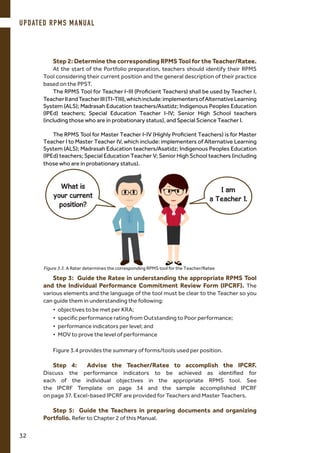
Below is the summary of ratee, rater and approving authority in
the RPMS.
UPDATED RPMS MANUAL
52
Figure 3.35. Sample of accomplished Part IV of the IPCRF: Development Plans
PART	IV:	DEVELOPMENT	PLANS	
Strengths	
	
Development	
Needs	
Action	Plan	
(Recommended	
Developmental	Intervention)	 Timeline	
Resources	
Needed	
Learning	
Objectives	
Intervention	
A.	Functional	Competencies	
Objective	3,	KRA	1	
To	apply	a	range	of	
teaching	strategies	to	
develop	critical	and	
creative	thinking,	as	well	
as	other	higher-order	
thinking	skills.	
	
Objective	3,	KRA	
1	
To	apply	a	range	
of	teaching	
strategies	to	
develop	critical	
and	creative	
thinking,	as	well	
as	other	higher-
order	thinking	
skills;	
particularly,	to	
improve	on	my	
art	of	
questioning	so	
that	I	will	be	able	
to	make	my	
students	use	and	
develop	their	
critical	thinking	
skills	
		
	
Acquire	
techniques	
and	
strategies	on	
the	art	of	
questioning	
that	will	
enable	to	
develop	
HOTS	among	
the	students.	
Applying	new	
learning	from	
attending	
courses/seminars/	
workshops/	
Learning	Action	
Cells	(LAC)/	E-
learning	
	
Using	feedback	to	
try	a	new	approach	
to	an	old	practice	
	
Coaching	and	
mentoring	
Year-
round	
Learning	and	
Development	
Team	
	
Supervisors	/	
School	Heads	
/	
	Master	
Teachers	
	
Local	Funds	
Enrich	skills	
in	developing	
various	
activities	that	
will	promote	
critical	and	
creative	
thinking	
among	my	
students	
Equipping	myself	
with	pedagogical	
skills	to	develop	
activities	that	will	
promote	critical	
and	creative	
thinking	skills	of	
my	students	
	
B.	Core	Behavioral	Competencies		
• Professionalism	
and	Ethics	
• Teamwork	
• Service	
Orientation	
• Results	Focus	
Innovation;	
particularly	on	
conceptualizing	
“Out	of	the	Box”	
ideas/approach	
Focus	on	
personal	
productivity	
to	create	
higher	value	
and	results	
	
Coaching	
	
Incorporating	in	
the	next	in-service	
training	(INSET)	the	
training	on	
conceptualization	
of	innovative	and	
ingenious	methods	
and	solutions	


Regular	
coaching			
In-service	
training	in	
April	and	
May		
	
HRTD	Funds	
Feedback:		


	 RATEE	 	 	 RATER	 	 APPROVING	
AUTHORITY	
	
Your Development Plans may have the following components: A)
Teaching Competencies, based on the PPST; and B) Core Behavioral
Competencies, as shown in Figure 3.35.
THE PORTFOLIO ASSESSMENT PROCESS
53
Figure 3.37. Principle of the 70-20-10 Learning Model
The Rater and the Ratee also ensure that the action plans and
interventions are appropriate for the development needs of the Ratee.
Below are examples of developmental activities:
Geographical
cross posting
Seminars/
workshops
Coaching/
Counseling
Formal
education/
classes
Developmental/
lateral career move
Assignment to task
forces/committees/
special projects
Benchmarking
Functional
cross posting
Job enhancement/
redesign
Figure 3.36. Examples of developmental activities for teachers
Other
developmental
options
Remember:
Use appropriate
interventions or activities
that have high impact
and results in employee’s
development.
For this purpose, it
is suggested that the
Principle of the 70-20-10
Learning Model shown
in Figure 3.37 and Figure
3.38 be used as a guide.
70 - 20 - 10
Learning Model
70%
Learn and develop
through Experience
20%
Learn and
develop
through Others
10%
Learn and develop
through Structured
courses and programs
(Formal education)
90% Experiential learning
and development
UPDATED RPMS MANUAL
54
At the end of the RPMS performance cycle, the Ratee must submit the
accomplished and duly signed IPCRF to the School Head. The IPCRF includes
the following parts:
•	 Part I: Individual Performance Commitment and Review Form with
computed final rating
•	 Part II: Core Behavioral Competencies
•	 Part III: Summary of Ratings for Discussion
•	 Part IV: Development Plans
70 - Learn and
Develop through
Experience
•	 Applying new
learning in real
situations
•	 Using feedback to
try a new approach
to an old problem
•	 Trying new work
and solving
problems within
role
•	 Having increased
span of control
•	 Having increased
decision-making
•	 Becoming
champion and/or
managing changes
20 - Learn and
Develop through
Others
•	 Seeking informal
feedback and work
debriefs
•	 Seeking advice,
asking opinions,
sounding out ideas
•	 Requesting
coaching from
manager/others
•	 Getting 360°
feedback
•	 Undergoing
structured
mentoring and
coaching
•	 Participating in
Learning Action
Cells (LAC)
10 - Learn and
Develop through
Structured Courses
and Programs
(Formal Education)
•	 Learning through: 	
	 - courses
	 - workshops
	 - seminars
	 - e-learning
•	 Applying for
professional
qualifications/
accreditation
70-20-10 Learning Model Examples
Figure 3.38. Examples of the 70-20-10 Learning Model Principle
THE PORTFOLIO ASSESSMENT PROCESS
55
UPDATED RPMS MANUAL
56
PROFESSIONALREFLECTIONS THROUGH
4
Results-based Performance Management System
Manual for Teachers and School Heads
ANNOTATIONS
The Results-based Performance Management System (RPMS) Manual for Teachers and School Heads was developed through the Research Center
for Teacher Quality (RCTQ) with support from the Australian Government through the Basic Education Sector Transformation (BEST) Program.
© Department of Education - Bureau of Human Resource and Organizational Development
Philippine National
RESEARCH CENTER
FOR TEACHER QUALITY
PROFESSIONALREFLECTIONS THROUGH
4
Results-Based Performance Management System
Manual for Teachers and School Heads
ANNOTATIONS
The Results-based Performance Management System (RPMS) Manual for Teachers and School Heads was developed through the Research Center
for Teacher Quality (RCTQ) with support from the Australian Government through the Basic Education Sector Transformation (BEST) Program.
© Department of Education - Bureau of Human Resource and Organizational Development
Philippine National
RESEARCH CENTER
FOR TEACHER QUALITY
In this lesson, what I meant to do was to
incorporate knowledge of sports, specifically
football/soccer, and link this to current
news in sports about how the Philippine
football team has been putting up a good
fight against the more experienced teams in
Asia, such as Japan and Korea. I noticed
that some students were fans of the
Philippine Team. I can make use of their
interest to engage them in the lesson.
Discussing the game scores and other sports
statistics can be a good application of
simple Math concepts. If I plan my lessons
well, values integration, along with Math
and P.E., can be included in the activities.
When I follow CBI, I always
make sure that in the lessons I
plan, the focus on integration of
content within and across subject
areas is clear. So that at any
time that an observer visits my
class, they will see evidence of
this.
A teacher’s path towards personal growth and professional development involves
reflectionandlearninginordertoimprovepractice.Onewayofdoingthisistobecome
more actively engaged in the process of careful introspection and critical evaluation
of your teaching practice. An essential step towards becoming a more reflective
practitioner is through writing annotations in your professional development
portfolios.	
Annotations are self-reflections, explanations or presentational mark-ups
attached to documents, artifacts or Means of Verification (MOV) that you submit
4.1 	 What are Annotations?
I enjoy designing many different
tasks for my students to do in class
whether individually, in pairs, or in
groups.
Sometimes I need to remind myself
that the students don’t have the same
ability levels and so I have to be mindful
about assigning tasks for the students
appropriately.
for the RPMS. They are important
in instances when the evidences
or artifacts presented in teacher
portfolios cannot capture the whole
dynamics of the teaching and learning
process.Further,annotationsestablish
a connection between the evidences
and the Rater, thus, facilitating the
review of the portfolio.
Figure 4.1.
Sample Annotations
UPDATED RPMS MANUAL
58
4.2	 What is the Importance of Annotations?
Annotations allow you to exercise reflective thinking. They help you
describe your teaching experiences and explain instructional decisions.
Annotations are important because they:
•	 make your evidence speak on your behalf;
•	 highlight your professional strengths in teaching;
•	 help you reflect on your teaching practices that pave the way for
professional advancement;
•	 describe your intentions, goals and purposes towards career growth;
•	 present and explain credentials required by the Rater for ranking and
promotion; and
•	 make it easier for the Rater to rate your performance.
4.3 	 What do you Annotate?
When writing annotations, you need to present evidences of your best
practices in the various Key Result Areas. The following are possibilities
for annotations:
•	 documents/artifacts that show your creativity and
resourcefulness in teaching;
•	 evidence that may fully satisfy the requirements of the
performance indicators but do not clearly demonstrate their link
to the indicators themselves; and
•	 classroom context that explains your teaching practice and the
realities you face in the classroom/school/community context.
4.4 	 How do you write Annotations?
Annotations help your Rater understand the story behind the MOV
and be familiar with the documents being reviewed. The following may
help you write annotations for a particular MOV in your RPMS Portfolio:
Step 1. 	Describe the Means of Verification (MOV)
that you 	want to annotate.
The following questions may help you describe
the MOV that you want to annotate:
a.	 What is your MOV about?
b.	 How does your MOV meet the KRA’s objectives?
Step 2. 	Reflect on your MOV.
These questions may guide your reflection:
a.	 How does your MOV meet the objective?
b.	 What do you wish to highlight in your MOV in relation to
the objective?
c.	 What classroom contexts explain your practices as
reflected in your MOV?
PROFESSIONAL REFLECTIONS THROUGH ANNOTATIONS
59
Figure4.2.SampleAnnotationTemplateforTeacherI-III(ProficientTeachers)
ObjectivesMeansofVerification
DescriptionoftheMOV
Presented
Annotations
1.Applied
knowledge
ofcontent
withinand
across
curriculum
teaching
areas
Classroomobservationtool(COT)
ratingsheetand/orinter-observer
agreementformaboutknowledgeof
contentwithinandacrosscurriculum
teachingareas
Lessonplansdevelopedhighlighting
integrationofcontentknowledge
withinandacrosssubjectareas
Instructionalmaterialshighlighting
masteryofcontentanditsintegration
inothersubjectareas
Performancetasks/testmaterial(s)
highlightingintegrationofcontent
knowledgewithinandacrosssubject
areas
Others(Pleasespecifyandprovide
annnotations)
TheMOVpresented
wasalessonplanthat
showedintegrationof
knowledgeandcontent
inPhysicalEducation.
Inthislesson,Iincorporated
knowledgeofsports,
specificallyfootball/soccer,
tomyMathlesson.Toget
studentsinterested,Idrew
attentiontothesportsnews
abouthowthePhilippineteam
hadbeenputtingupagood
fightagainstmoreexperienced
teamsinAsia,suchasJapan
andKorea.ToapplyMath
concepts,Iledtheclassin
discussingthegamescores
andothersportsstatistics.My
studentswereengaged.Iwas
abletodelivermylessonin
Mathwithaninterestingfocus
onsports.
SampleAnnotationTemplateforTeacherI-III(ProficientTeachers)
UPDATED RPMS MANUAL
60
EFFECTIVE COACHING
5
Results-based Performance Management System
Manual for Teachers and School Heads
& PERFORMANCE FEEDBACK
The Results-based Performance Management System (RPMS) Manual for Teachers and School Heads was developed through the Philippine National
Research Center for Teacher Quality (RCTQ) with support from the Australian Government through the Basic Education Sector Transformation (BEST) Program.
© Department of Education - Bureau of Human Resource and Organizational Development
Philippine National
RESEARCH CENTER
FOR TEACHER QUALITY
5.1 	 What is Coaching?
Coaching is an interactive process where Raters and Ratees aim to
close performance gaps, teach skills, impart knowledge and inculcate
values and desirable work behaviors.
Coachingisaprocessthatenableslearninganddevelopment
to occur, and thus, improve performance.
Mentoring is a support by one person to another in making
significant transitions in knowledge, work or thinking.
Counseling is a principled relationship characterized by
the application of one or more psychological theories and a
recognized set of communication skills, modified by experience,
intuition and other interpersonal factors, to clients’ intimate
concerns, problems or aspirations.
5.1.1 	What is the difference between and
among coaching, mentoring and
counseling?
Competencies of an effective Rater
The following are necessary competencies of an effective
Rater:
•	Self-clarity
•	 Clear communication
•	 Critical thinking
•	 Ability to build relationships and inspire
Figure 5.1. The Rater and the teacher discuss on issues and how they can be addressed.
I feel that
I need to
improve
on...
How do
you feel
about your
progress
so far?
UPDATED RPMS MANUAL
62
5.1.2 	What is the Coaching Model for DepEd?
In DepEd, there are three (3) opportunities to apply coaching.
Below is the coaching model.
Coach
for Work
Improvement
Coach
for Maximum
Performance
Coach
to Strengthen
Skills,
Competencies
and BehaviorApplication
Opportunities
5.1.2.1 Coach for Improvement
Coach for work improvement is applied when performance
gaps are observed and identified.
Performancegapsrefertothedifferencebetweenateacher’s
current performance and what is required or expected. These
can either be gaps concerning work behavior or skills. They could
be both.
Figure 5.2. Coaching Model for DepEd
Coach
EFFECTIVE COACHING AND GIVING PERFORMANCE FEEDBACK
63
Tips in Identifying Performance Gaps
1.	 Routinely monitor/check teacher performance against
stated performance metrics or agreed upon monthly or
quarterly milestones vs. subordinates’ annual goals.
2.	 Analyze the tasks that the teacher is not doing well.
3.	 Identify the causes, behaviors that interfere with
goal accomplishment in controllable/uncontrollable
situations.
4.	 Try to draw facts from other sources when possible.
5.	 Avoid premature judgments.
Catch a problem early!
Causes Description
Inefficient processes
Check work process before looking
into faults of the people who run
them.
Personal Problems
Off-the-job concerns that affect
performance at work
Work Overload
Demand is too much or too fast-
paced
Relationships Conflict at Work
Jealousy, competition for attention
or for promotion
Figure 5.3. Possible causes of poor performance
5.1.2.2 Coach for Maximum Performance
Coach for maximum performance is applied to sustain teacher’s high
performance and to continuously improve performance.
It is also an opportunity to develop succession plans and career
development of high-performing and high-potential teacher for
promotion.
UPDATED RPMS MANUAL
64
5.1.2.3	 Coach to Strengthen Skills,
	 Competencies and Behavior
This model is applied to strengthen and/or develop new
competencies, skills, and behaviors.
Itisalsoanopportunitytoboostmoraleandconfidenceof
teachers, as well as cultivate/raise the level of performance.
5.1.3 What are the Four (4) Step Processes
of Coaching?
There are four (4) step processes that the Coach/Rater and the Ratee/
Ratee must undertake to provide effective coaching.
Figure 5.4. Four Step Processes of Coaching
Observation
The rater identifies
a performance gap
or an opportunity
to improve.
Active Coaching
Rater and Ratee create
and agree on the action
plan to address the gap.
Discussion &
Agreement
Rater and Ratee agree on:
(1) problems to be fixed;
and (2) an opportunity to
move job performance
two notches higher.
Follow up
Setting follow-up
sessions to check on
the status of the agreed
upon action plan.
EFFECTIVE COACHING AND GIVING PERFORMANCE FEEDBACK
65
Steps in conducting discussion and agreement sessions
Step 1: Opening /Climate Setting/ Establishing Rapport
(achieving a comfort level that encourages openness)
•	 Thank teacher for making time for the meeting.
•	 Express your hope that you will find the meeting useful.
Step 2: Objective Setting
•	 Tell teacher things he or she is doing right; express sincere
appreciation.
•	 Tell your reason for calling the meeting with him or her.
•	 Give feedback on performance deficiency you have observed.
•	 Listen with empathy, i.e. give an empathic response, paraphrase
what he or she had said, and reflect on his or her feelings.
Step 3: Discussion and Agreement Proper
•	 Tell what you want him or her to do, how you want it done, and why
(standards of performance).
•	 If possible, show (model) how it is done.
•	 Then ask him or her to do it while you observe.
•	 Give positive feedback and/or correction; offer suggestions.
•	 Let him or her know you respect his or her ability.
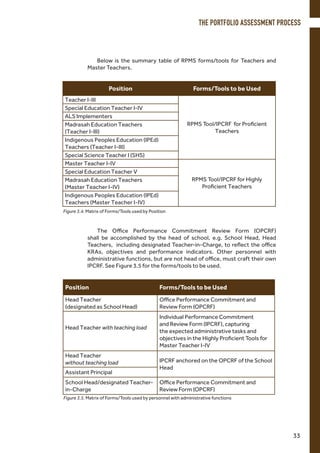
•	 Agree upon appropriate actions - teacher’s and yours.
•	 Let him or her know you will closely monitor his or her performance.
Step 4: Closing
•	 Share how you feel about the meeting.
•	 Ask him or her how he or she feels about the meeting.
•	 Schedule a follow-up meeting on a specific date.
•	 Thank him or her and express confidence that he or she can do it.
Assure him or her of your support.
•	 Shake hands and smile, while maintaining eye contact.
UPDATED RPMS MANUAL
66
Performance monitoring shall be the responsibility of both the Rater
and the Ratee who agree to track and record significant incidents through
the use of the Performance Monitoring and Coaching Form (PMCF) shown
in Figure 3.30 on page 50 of this Manual.
Managing focuses on... Coaching focuses on...
Telling Exploring
Directing Facilitating
Authority Partnership
Immediate Needs Long-term Improvement
A Specific Outcome Many possible outcomes
Is there a difference between Managing and Coaching?
Performance Coaching is not…
•	 a one-time process
•	 fault-finding and does not put the teacher down
•	 giving advice and does not involve the Rater sharing
his or her personal experience or opinions/beliefs
Figure 5.5. Difference between managing and coaching
Why follow-up?
•	 It provides opportunities to remind teachers about goals and the
importance of these goals.
•	 Periodic checks give you a chance to offer positive feedback
about the good things that teachers do.
•	 These checks can help spot small problems before they become
large ones.
EFFECTIVE COACHING AND GIVING PERFORMANCE FEEDBACK
67
Performance Coaching is...
•	 Creating the right atmosphere
Mutual Trust
•	 Develop mutual trust by demonstrating concern for the Ratee’s
well-being and success. Showing empathy, genuine interest,
consultation, providing opportunities for the Ratee to move
ahead are demonstrations of concern.
•	 Experience in the matter at hand. Trust can be gained when the
Rater has a reputation of success in the area.
•	 Being as good as your word. Trust is built through repeated
demonstration. Do what you say everytime.
•	 Not disclosing information held in Ratee’s desire for
confidentiality
Accountability for Results
•	 A person who is held accountable for results will take coaching
seriously.
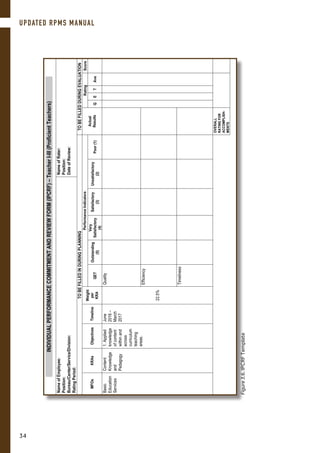
•	 A formal coaching plan makes accountability explicit.
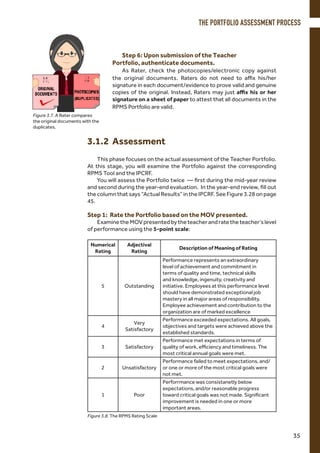
Motivation to Learn and Improve
(workplace motivations that encourage people)
•	 Mastering an important skill will open the door to advancement.
•	 An teacher sees that improved productivity is reflected in his or
her paycheck.
•	 A person knows that his or her job is in danger unless he or she
learns to do a particular task better.
•	 An teacher has reached the point where he or she is eager to
learn something new or move on to a more challenging job.
•	 Practice active listening
Active listening encourages communication and puts other
people at ease. An Active Listener pays attention to the speaker and
practices the following good listening skills:
•	 Maintaining eye contact
•	 Smiling at appropriate moments
•	 Being sensitive to body language
•	 Listening first and evaluate later
•	 Never interrupting except to ask for clarification
•	 Indicating that you are listening by repeating what was said about
critical points
•	 Asking the right questions
Asking the right questions will help the Rater to understand the
Ratee and get to the bottom of performance problems.
UPDATED RPMS MANUAL
68
5.2 What is Performance Feedback?
Performance feedback is an ongoing process between a teacher
and a school head where information concerning the performance
expected and performance exhibited/demonstrated is exchanged.
Figure 5.7 shows that effective feedback giving during the
performance cycle results to a successful Performance Appraisal.
Figure 5.6. An illustration of a
principal giving a teacher feedback
Hi! Here’s your
portfolio. Let’s
talk about your
performance
rating.
I am glad to hear
about your
comments,
Ma’am.
Two Forms of Questions:
	 A. Open-ended
These questions invite participation and idea sharing.
These help the Rater to know the Ratee’s feelings, views
and deeper thoughts on the problem, and, in turn, help to
formulate better advice.
	 B. Closed-ended
	 These questions lead to “YES” or “NO” answers.
Sample of Closed-ended questions:
•	 To focus on the response: “Is the program / plan on
schedule?”
•	 To confirm what the other person has said: “So, your big
problem is scheduling your time?”
EFFECTIVE COACHING AND GIVING PERFORMANCE FEEDBACK
69
Infographics taken from https://www.cognology.com.au/
(No copyright infringement intended. Strictly for Academic Purposes only)
Figure 5.7. Successful Performance Appraisal resulting from Effective Feedback
UPDATED RPMS MANUAL
70
There are two types of feedback:
Type 1: Reinforce
This type of feedback identifies job-related behavior and performance
that contribute to individual, group and organizational goals. This
encourages the teacher to repeat and develop them.
Type 2: Redirect
This type of feedback identifies job related behavior and performance
that do not contribute to individual, group and organizational goals and
helps the teacher develop alternative strategies.
5.2.1 Why do we give feedback?
Feedback benefits the school head, the teachers and the school. It can:
•	 build teacher competence and confidence to achieve high performance;
•	 benefit the school head in his or her managerial and leadership functions;
and create a culture of performance excellence.
When is feedback effective?
Effective feedback should be specific; it tells your teachers what they
did or did not accomplish, how they completed their tasks and how
effective their actions are.
Effective feedback is also timely, in order to reinforce positive actions
or provide alternative suggestions early enough that your teacher can
adjust and enhance his or her performance.
•	 You give it early enough to create impact (adjust or enhance
performance)
•	 It is also important to know when to postpone the giving of
feedback.
Finally, feedback should be balanced, highlighting both the teacher’s
strengths and areas for improvement.
EFFECTIVE COACHING AND GIVING PERFORMANCE FEEDBACK
71
Figure 5.8. The STAR Feedback Model
For effective feedback-giving performance, the STAR Model is applied.
5.2.2 What is the STAR Feedback Model?
S/T – Situation or Task
•	 Provides context for teacher’s action(s)
•	 Describes specific event, job, or assignment that
triggered or warranted a response
A – Action
•	 Specific response of teacher to the situation or task
•	 What teacher said or did
•	 Can be multiple actions
•	 Can also be non-action
R – Result
•	 What happened due to the teacher’s action
•	 Can be effective or ineffective
•	 Can be concrete (e.g., report, written feedback from
colleagues, etc.)
•	 Can be less tangible (e.g., low morale,
misunderstanding, etc.)
UPDATED RPMS MANUAL
72
5.2.3 What are the benefits of the STAR
Feedback Model?
The STAR Feedback Model:
•	 helps you focus teacher’s attention on behaviors that got them
to their current level of performance;
•	 can be used to reinforce teacher’s good performance, as well as
to facilitate improvement in teacher’s performance; and
•	 can be used to give feedback verbally or in writing.
See Figure 5.9 for a sample Reinforce STAR Feedback of a Principal
to a Teacher that demonstrates a contributing behavior or performance.
For a sample of Redirect STAR Feedback of a Principal to a Teacher that
demonstrates a non-contributing behavior or performance, see Figure
5.10.
The STAR-AR Feedback Model is used for developmental or
performance improvement, where alternative action and result are
described.
STAR - AR
Alternative Action
What could be done better or differently next time?
Alternative Result
What could be the probable result or impact of the
alternative action?
EFFECTIVE COACHING AND GIVING PERFORMANCE FEEDBACK
73
Figure 5.9.
Sample of Reinforce
STAR Feedback
of a Principal to
a Teacher that
demonstrates
a contributing
behavior or
performance
Today, you took
the challenge
and successfully
presented the
subject matter so
that the student
accepted his skill
level and worked to
learn what he needed
to know.
Yesterday morning,
I observed that you had
a student that had seemed to
refuse to acknowledge that
he lacked the knowledge
and the skills.
In the past,
his former teachers
did not challenge his
composition skills but always
gave him high marks.
Encourage the student
to accept that
“There is always
more to learn” and
“I can listen and explore
what this teacher
has to offer.”
When I asked the student
this afternoon about
his experience in your class,
he told me that you are
his first teacher who could
show him what he needed
to know and help him understand
the significance
of good writing skills.
Good job! You were able to handle
the situation successfully.
UPDATED RPMS MANUAL
74
A - While you provided
all of the data I asked for,
I received it two days
after I requested,
because other
priorities had come up.
R - Because the report
was late, I had to delay
our LAC meeting
with the division supervisor.
“Last week, I asked
you to complete
a documentation
of the LAC session.”
A -“The next time you’re faced
with competing priorities,
feel free to come to me
for further directions.”
R - “That way, I’ll know if you’re
having challenges completing
a request, so I can help you
prioritize your assignments.”
Figure 5.10. Sample of
Redirect STAR Feedback
of a Principal to a Teacher
that demonstrates a non-
contributing performance
EFFECTIVE COACHING AND GIVING PERFORMANCE FEEDBACK
75
Tips in providing redirect
or developmental feedback
Focus on facts, not the person.
•	 Choose positively-phrased statements, such as
“Forgetting to do that caused a delay,” rather than saying
“You’re completely disorganized.“
Share your thoughts on alternative approaches while
remembering to seek the other person’s ideas.
•	 “What do you think would be the best approach next
time?”
•	 “If you do that, what results could we expect?”
Provide your teacher with the necessary support in
terms of time, resources or coaching to act on your
feedback.
•	 “What resources or support would you need to carry this
out?”
UPDATED RPMS MANUAL
76
The following are the processes for providing effective feedback:
5.2.4 What is the Feedback Process?
Step 1: Preparation
•	 Self-Assessment. The teacher accomplishes a self-assessment
form and sends a copy to his or her immediate superior.
•	 Agreeing on the Schedule of the Meeting. The teacher and the
immediate superior agree on the meeting schedule.
•	 Gathering Data and Preparing Discussion Notes. The teacher
and the immediate superior gather data and note down discussion
points for the meeting. The discussion points can be:
•	 Performance Objectives
•	 Critical Incidents/STARs
•	 Progress or Final Results
•	 Development Plans
Step 2: Conducting the Meeting
•	 Opening the Meeting. Greet the teacher and make him or her feel
comfortable. Thank him or her for his or her time. You may engage
in quick, light, small talk.
•	 Clarifying the Meeting. The immediate supervisor should signal
start of discussion and state the purpose of the meeting.
•	 Discussion.Gothrougheachoftheobjectivesanddiscusswiththe
teacher the extent of accomplishment versus targets. Be prepared
to discuss specific examples of behaviors and performance
outcomes. Listen actively and openly. Take down notes.
•	 Giving Feedback. Prepare your notes. Be specific and own the
feedback. Engage the teacher in the discussion.
Step 3: Closing the Meeting
•	 Ask the teacher to share his/her take-aways.
•	 What were my major achievements?
•	 What have I done well or am doing well?
•	 In what key areas could I have done or should I do better?
•	 How is my overall performance?
•	 What are my next steps?
•	 Affirm your trust in the teacher. Thank him or her for his or
her time.
EFFECTIVE COACHING AND GIVING PERFORMANCE FEEDBACK
77
Tips in Receiving Feedback (for
Teachers)
•	 Welcome constructive feedback (withhold judgment).
•	 Clarify and seek understanding (i.e. paraphrase, probe).
•	 Evaluate based on critical incidents, observations.
•	 Decide what to do with the feedback.
Key Principles for Interactions
•	 Maintain or enhance self-esteem.
•	 Listen and respond with empathy.
•	 Ask for help and encourage involvement.
•	 Share thoughts, feelings, and rationale (to build trust).
•	 Provide support without removing responsibility (to
build ownership).
UPDATED RPMS MANUAL
78
6
TOOLS WITHIN
THE RPMS CYCLE
M
RPMS Toolfor Master Teacher I-IV
T1-3
RPMS Tool
for Teacher I-III
(Proficient Teachers)
sat - cot
RPMS
TOOLS
Results-based Performance Management System
Manual for Teachers and School Heads
Philippine National
RESEARCH CENTER
FOR TEACHER QUALITY
The Results-based Performance Management System (RPMS) Manual for Teachers and School Heads was developed through the Philippine National
Research Center for Teacher Quality (RCTQ) with support from the Australian Government through the Basic Education Sector Transformation (BEST) Program.
© Department of Education - Bureau of Human Resource and Organizational Development
The Self-Assessment Tool is a common tool for assessing teacher
performance. It can be used as a starting point for informal purposes of
self-reflection to clarify performance expectations and determine which
competencies to focus on. It can also be used to monitor the progression or
improvement of teacher competencies and validate whether the interventions
provided are effective. It can guide discussions about goal-setting and
professional development needs.
6.1 Self-Assessment Tools in the RPMS Cycle
Figure 6.1. Self-assessment as a crucial step towards development planning
Performance Monitoring and Coaching
Self-
Reflection
Actual
Performance
Development
Planning
The RPMS Cycle
To ensure teacher quality, the Results-based Performance Management System (RPMS)
alignstheperformancetargetsandaccomplishmentswiththePhilippineProfessionalStandards
for Teachers (PPST). This alignment covers teacher performance for one school year, starting in
May (last week or a week after the opening of classes) and ending in April (first week or a week
after graduation and/or moving up ceremonies).
The RPMS Manual for Teachers and School Heads provides information and guidance to
TeachersandSchoolsintheuseofdifferenttoolsandformstoassessperformance,thedifferent
assessment processes and different developmental activities for teachers as they undergo the
four-stage performance RPMS cycle, namely, Performance Planning and Commitment (Phase
1);PerformanceMonitoringandCoaching(Phase2);PerformanceReviewandEvaluation(Phase
3); and Performance Rewarding and Development Planning (Phase 4).
See Figure 6.2 on page 82 for the graphic representation of the phases of the RPMS Cycle,
and the tools and processes within.
UPDATED RPMS MANUAL
80
Figure 6.2. The Tools within the RPMS Cycle
Legend:
L&D - Learning and Development
IPCRF - Individual Performance Commitment & Review Form
IPCRF-DP - Part IV: Development Plans of the IPCRF
PMCF - Performance Monitoring and Coaching Form
RPMS - Results-based Performance Management System
SAT-RPMS - Self-Assessment Tools RPMS
TA - Technical Assistance
TA
L&D
TA
L&D
TA
L&D
TA
L&DPhilippinePro
fessional StandardsforTeachers
PERFORMANCE PLANNING
AND COMMITMENT
Activity	 : Discussion/Issuance of
	 RPMS Tools; Self-Assessment
Form(s)	 : IPCRF + SAT + IPCRF-
	 Development Plans
Timeline 	 : Last week of May, a week
	 before the opening of
	 classes
Output 	 : Signed IPCRF-Development
	 Plans based on SAT, Signed
	 IPCRF
I
Activity	 : Performance Monitoring and 	
	 Coaching; Mid-year Review
	 and Assessment
Form(s)	 : RPMS Tools + IPCRF + SAT +
	 IPCRF-DP using PMCF; 	
	 Mid-year Review Form
Timeline 	 : Year-round (Monitoring and
	 coaching); November (Mid-
	 year review)
Output 	 : Agreements based on PMCF,
	 MRF, updated IPCRF-DP and
	 Portfolio
PERFORMANCE
MONITORING AND
COACHING
II
Activity	 : Year-End Review &
	 Assessment, Evaluation of
	 Portfolio & Computation of
	 Final Rating
Form(s)	 : RPMS Tools + IPCRF + SAT +
	 IPCRF-DP using PMCF
Timeline 	 : 1st week of April or
	 a week after graduation
Output 	 : Signed Portfolio, Signed IPCRF
	 w/ Computed Final Rating
PERFORMANCE REVIEW
AND EVALUATIONIII
Activity	 : Ways Forward and
	 Development Planning
Form(s)	 : Final IPCRF-DP
Timeline 	 : April
Output 	 : Reward, Recognition,
	 IPCRF-DP
PERFORMANCE
REWARDING AND
DEVELOPMENT
PLANNING
IV
Teacher
Quality
(Tools:Portfolio,
IPCRF,IPCRF-DP)
forthenextcycl
e
Portfolio
P
reparation
andO
rga
nization
Forms:COT-RP
M
S,Portfolio
Portfolio
Preparation
andO
r
ganization
Form
s:COT
-RPM
S,Portfolio
Preparationfor
PhaseIV
Tools:Portfolio,IPCR
F,IPCRF-DP
PortfolioPrepar
ation
andOrganiza
tion
forthenextcy
cle
SELF-ASSESSMENT TOOLS
81
Legend:
L&D - Learning and Development
IPCRF - Individual Performance Commitment & Review Form
IPCRF-DP - Part IV: Development Plans of the IPCRF
PMCF - Performance Monitoring and Coaching Form
RPMS - Results-based Performance Management System
SAT-RPMS - Self-Assessment Tools RPMS
TA - Technical Assistance
TA
L&D
TA
L&D
TA
L&D
TA
L&DPhilippinePro
fessional Standard
sforTeachers
PERFORMANCE PLANNING
AND COMMITMENT
Activity	 : Discussion/Issuance of
	 RPMS Tools; Self-Assessment
Form(s)	 : IPCRF + SAT + IPCRF-
	 Development Plans
Timeline 	 : Last week of May, a week
	 before the opening of
	 classes
Output 	 : Signed IPCRF-Development
	 Plans based on SAT, Signed
	 IPCRF
I
Activity	 : Performance Monitoring and 	
	 Coaching; Mid-year Review
	 and Assessment
Form(s)	 : RPMS Tools + IPCRF + SAT +
	 IPCRF-DP using PMCF; 	
	 Mid-year Review Form
Timeline 	 : Year-round (Monitoring and
	 coaching); November (Mid-
	 year review)
Output 	 : Agreements based on PMCF,
	 MRF, updated IPCRF-DP and
	 Portfolio
PERFORMANCE
MONITORING AND
COACHING
II
Activity	 : Year-End Review &
	 Assessment, Evaluation of
	 Portfolio & Computation of
	 Final Rating
Form(s)	 : RPMS Tools + IPCRF + SAT +
	 IPCRF-DP using PMCF
Timeline 	 : 1st week of April or
	 a week after graduation
Output 	 : Signed Portfolio, Signed IPCRF
	 w/ Computed Final Rating
PERFORMANCE REVIEW
AND EVALUATIONIII
Activity	 : Ways Forward and
	 Development Planning
Form(s)	 : Final IPCRF-DP
Timeline 	 : April
Output 	 : Reward, Recognition,
	 IPCRF-DP
PERFORMANCE
REWARDING AND
DEVELOPMENT
PLANNING
IV
Teacher
Quality
(Tools:Portfolio,
IPCRF,IPCRF-DP)
forthenextcycl
e
Portfolio
P
reparation
andO
rga
nization
Forms:COT-RP
M
S,Portfolio
Portfolio
Preparation
andO
r
ganization
Form
s:COT
-RPM
S,Portfolio
Preparationfor
PhaseIV
Tools:Portfolio,IPCR
F,IPCRF-DP
PortfolioPrepar
ation
andOrganiza
tion
forthenextcy
cle
Figure 6.3. Self-assessment tools in the RPMS Cycle
UPDATED RPMS MANUAL
82
The Self-Assessment Tools-RPMS (SAT-RPMS) comprise two
different self-assessment questionnaires within the RPMS designed
for Teacher I-III and Master Teacher I-IV to reflect on the different
performance indicators that relate to their professional work. It is
meant to support teacher performance and professional development.
The SAT-RPMS for Teacher I-III (Proficient Teachers) shall be used by
TeacherI,TeacherIIandTeacherIII(TI-TIII), whichinclude:implementersof
Alternative Learning System (ALS); Madrasah Education teachers/Asatidz;
Indigenous Peoples Education (IPEd) teachers; Special Education Teacher
I-IV; Senior High School teachers (including those who are in probationary
status), and Special Science Teacher I.
The SAT-RPMS for Master Teacher I-IV (Highly Proficient Teachers) is
for Master Teacher I to Master Teacher IV, which include: implementers of
Alternative Learning System (ALS); Madrasah Education teachers/Asatidz;
Indigenous Peoples Education (IPEd) teachers; Special Education Teacher
V; Senior High School teachers (including those who are in probationary
status).
6.1.1 What are the Self-Assessment
	 Tools-RPMS (SAT-RPMS)?
Figure 6.4. Self-Assessment Tools-RPMS
The teachers should assess their own performance prior to the beginning
of the year (Performance Planning and Commitment) and reflect on their
performance throughout the RPMS Cycle. The results of this self-assessment
will guide the teachers and the principal on which RPMS indicators the teachers
must improve and on what areas they need coaching and mentoring.
SELF-ASSESSMENT TOOLS
83
6.1.2. What are the parts of the SAT-RPMS?
The SAT-RPMS has the following parts:
1.	 Cover Page. This page introduces the SAT-RPMS, its
purposes and parts. It also provides instructions on how to
accomplish the SAT-RPMS.
2.	 Demographic Profile. This part collects the teacher’s
demographic information, such as age, sex, position, highest
degree obtained, among others. See Figure 6.5.
Figure 6.5. Part I: Demographic Profile of SAT-RPMS for Teacher I-III
UPDATED RPMS MANUAL
84
3.	Objectives.Thispagecontainsthe13objectivesoftheSAT-RPMS.
Using a four-point Likert scale, the teachers will rate themselves in terms
of how capable they are in performing each objective and what level of
development priority they give to each objective. See Figure 6.6.
Figure 6.6. Part II: Performance Indicators of SAT-RPMS for Teacher I-III
SELF-ASSESSMENT TOOLS
85
6.1.3. How do you take the SAT-RPMS?
Step 1: Determine your corresponding SAT-RPMS.
Identify your SAT-RPMS by considering your current
position and general description of your practice based on
the Philippine Professional Standards for Teachers.
If you are a Teacher I, Teacher II or Teacher III, use the tool
for SAT-RPMS for Teacher I-III. This includes: implementers
of Alternative Learning System (ALS); Madrasah Education
teachers/Asatidz; Indigenous Peoples Education (IPEd) teachers;
Special Education Teacher I-IV; Senior High School teachers
(including those who are in probationary status), and Special
Science Teacher I.
Ifyouare aMasterTeacherI,MasterTeacherII,MasterTeacher
III and Master Teacher IV, use the SAT-RPMS for Master Teacher
I-IV. This includes: implementers of Alternative Learning System
(ALS); Madrasah Education teachers/Asatidz; Indigenous Peoples
Education (IPEd) teachers; Special Education Teacher V; Senior
High School teachers (including those who are in probationary
status).
Figure 6.7 A graphical representation of a teacher looking at SAT-RPMS
UPDATED RPMS MANUAL
86
Figure 6.8. Screenshot of the box on the bottom of the SAT-RPMS Page
Step 2: Take the SAT-RPMS appropriate to your position.
Accomplish Part I: Demographic Profile by shading the item
that describes you.
Accomplish Part II: Objectives by shading the circle that
corresponds to the rating you give yourself for each indicator
according to the level of your capability and development priority.
You may also write your comments about the indicators in the box
provided at the end of SAT-RPMS page. See Figure 6.8.
Accomplish Part III: Core Behavioral Competencies by shading
the behavioral indicators that you demonstrated during the
performance cycle. See Figure 6.9.
Figure 6.9. Part III of the Self-Assessment Tool for Teacher I-III
SELF-ASSESSMENT TOOLS
87
Step 3: Discuss with your School Head your IPCRF-
Development Plan based on the results of your SAT-RPMS.
AftertakingtheSAT-RPMS,discusswithyourSchoolHeadthe
Development Plan based on the results of your self-assessment.
Figure 6.10. A graphical representation of a teacher (Ratee) and a principal (Rater)
discussing the Development Plan based on the teachers’ SAT-RPMS results
UPDATED RPMS MANUAL
88
The IPCRF-DP shall be updated during Phase 4: Performance
Rewarding and Development Planning and shall be informed by
the actual ratings of the IPCRF in Phase 3: Performance Review
and Evaluation.
The results can inform various development interventions in
preparation for the next school year, such as In-Service Training
(INSET) Orientation/Teacher Induction Program (TIP).
Both the teacher and the School Head may also refer to
the Development Plans in the monitoring and coaching of
the teacher’s performance and in providing the necessary
interventions.
6.1.4. How do you use the results of
		 SAT-RPMS?
Step 1: The teacher prepares the Development Plan based
on the results of SAT-RPMS.
The teacher can reflect in the plan as development needs the
objectives that rated “Low” in terms of level of capability, or “High”
or “Very High” in terms of priority for development.
The objectives rated “High” or “Very High” in terms of level of
capability can be reflected as strengths in the Development Plan.
See Figure 6.11 for the sample accomplished Part IV:
Development Plans (IPCRF-DP) based on the SAT-RPMS results.
Follow the steps in Chapter 3, page 52, in preparing for the Part IV:
DP.
Step 2: The teacher discusses the Development Plan with
the Principal.
Step 3: The teacher and the School Head come to an
agreement about the final Development Plan.
SELF-ASSESSMENT TOOLS
89
Figure 6.11. Sample of accomplished Part IV of the IPCRF: Development Plans
PART	IV:	DEVELOPMENT	PLANS	
Strengths	
	
Development	
Needs	
Action	Plan	
(Recommended	
Developmental	Intervention)	 Timeline	
Resources	
Needed	
Learning	
Objectives	
Intervention	
A.	Functional	Competencies	
Objective	3,	KRA	1	
To	apply	a	range	of	
teaching	strategies	to	
develop	critical	and	
creative	thinking,	as	well	
as	other	higher-order	
thinking	skills.	
	
Objective	3,	KRA	
1	
To	apply	a	range	
of	teaching	
strategies	to	
develop	critical	
and	creative	
thinking,	as	well	
as	other	higher-
order	thinking	
skills;	
particularly,	to	
improve	on	my	
art	of	
questioning	so	
that	I	will	be	able	
to	make	my	
students	use	and	
develop	their	
critical	thinking	
skills	
		
	
Acquire	
techniques	
and	
strategies	on	
the	art	of	
questioning	
that	will	
enable	to	
develop	
HOTS	among	
the	students.	
Applying	new	
learning	from	
attending	
courses/seminars/	
workshops/	
Learning	Action	
Cells	(LAC)/	E-
learning	
	
Using	feedback	to	
try	a	new	approach	
to	an	old	practice	
	
Coaching	and	
mentoring	
Year-
round	
Learning	and	
Development	
Team	
	
Supervisors	/	
School	Heads	
/	
	Master	
Teachers	
	
Local	Funds	
Enrich	skills	
in	developing	
various	
activities	that	
will	promote	
critical	and	
creative	
thinking	
among	my	
students	
Equipping	myself	
with	pedagogical	
skills	to	develop	
activities	that	will	
promote	critical	
and	creative	
thinking	skills	of	
my	students	
	
B.	Core	Behavioral	Competencies		
• Professionalism	
and	Ethics	
• Teamwork	
• Service	
Orientation	
• Results	Focus	
Innovation;	
particularly	on	
conceptualizing	
“Out	of	the	Box”	
ideas/approach	
Focus	on	
personal	
productivity	
to	create	
higher	value	
and	results	
	
Coaching	
	
Incorporating	in	
the	next	in-service	
training	(INSET)	the	
training	on	
conceptualization	
of	innovative	and	
ingenious	methods	
and	solutions	


Regular	
coaching			
In-service	
training	in	
April	and	
May		
	
HRTD	Funds	
Feedback:		


	 RATEE	 	 	 RATER	 	 APPROVING	
AUTHORITY	
	
UPDATED RPMS MANUAL
90
Results-based Performance Management System
Manual for Teachers and School Heads
Philippine National
RESEARCH CENTER
FOR TEACHER QUALITY
The Results-based Performance Management System (RPMS) Manual for Teachers and School Heads was developed through the Philippine National
Research Center for Teacher Quality (RCTQ) with support from the Australian Government through the Basic Education Sector Transformation (BEST) Program.
© Department of Education - Bureau of Human Resource and Organizational Development
ELECTRONIC
SELF-ASSESSMENT TOOL
(E-SAT)
Guide for Teachers and Master Teachers 2019
Figure 6.12. Electronic Self-Assessment Tool (e-SAT) and
Guide for Teachers and Master Teachers
An electronic version of the SAT is provided through http://
deped.in/eSATPackage. The system supports schools in analyzing
school-wide SAT data of teachers to help plan for teachers’
professional development. The e-SAT has accompanying guides
for School Heads, Teachers and School ICT Coordinators.
SELF-ASSESSMENT TOOLS
91
Figure 6.13. Classroom Observation Tools and Forms in the RPMS Cycle
Classroomobservationisaprocessofprovidingfeedbacktoateacher’sclassroom
practice. Feedback given provides quality input for the continuous improvement of
teacher practice and provides opportunities to share ideas and expertise, as well as
promote mentoring and coaching among colleagues. It also encourages teachers
to reflect and develop awareness about their own practice as it provides evidence of
actualteacherperformance,theirstrengthsandareasfordevelopmentandtheimpact
of their practice. Finally, classroom observation aims to visualize classroom practices.
To be more effective, classroom observation must be based on a set of standards,
which can assess teaching quality across a continuum of development (Darling-
Hammond, 2012). The link between what the teachers can do as evidenced by their
classroom performance and the standards against which this performance can be
rated or evaluated is crucial in classroom observation.
6.2 Classroom Observation Tools in the RPMS Cycle
S.Y. 2019-2020
UPDATED RPMS MANUAL
92
Figure 6.14. Classroom Observation Tools and Forms in the RPMS Cycle
In the RPMS Cycle, a teacher’s classroom performance is assessed
against the indicators of the Philippine Professional Standards for Teachers
(PPST).Theresultsofclassroomobservationarenon-negotiableevidenceof
teacher performance that can prove the teacher’s attainment of classroom
observableobjectivesintheRPMSTools.ItistheMainMOVfortheclassroom
observable objectives in the RPMS.
CLASSROOM OBSERVATION TOOLS
93
TA
L&D
TA
L&D
TA
L&D
TA
L&DPhilippinePro
fessional Standard
sforTeachers
PERFORMANCE PLANNING
AND COMMITMENT
Activity	 : Discussion/Issuance of
	 RPMS Tools; Self-Assessment
Form(s)	 : IPCRF + SAT + IPCRF-
	 Development Plans
Timeline 	 : Last week of May, a week
	 before the opening of
	 classes
Output 	 : Signed IPCRF-Development
	 Plans based on SAT, Signed
	 IPCRF
I
Activity	 : Performance Monitoring and 	
	 Coaching; Mid-year Review
	 and Assessment
Form(s)	 : RPMS Tools + IPCRF + SAT +
	 IPCRF-DP using PMCF; 	
	 Mid-year Review Form
Timeline 	 : Year-round (Monitoring and
	 coaching); November (Mid-
	 year review)
Output 	 : Agreements based on PMCF,
	 MRF, updated IPCRF-DP and
	 Portfolio
PERFORMANCE
MONITORING AND
COACHING
II
Activity	 : Year-End Review &
	 Assessment, Evaluation of
	 Portfolio & Computation of
	 Final Rating
Form(s)	 : RPMS Tools + IPCRF + SAT +
	 IPCRF-DP using PMCF
Timeline 	 : 1st week of April or
	 a week after graduation
Output 	 : Signed Portfolio, Signed IPCRF
	 w/ Computed Final Rating
PERFORMANCE REVIEW
AND EVALUATIONIII
Activity	 : Ways Forward and
	 Development Planning
Form(s)	 : Final IPCRF-DP
Timeline 	 : April
Output 	 : Reward, Recognition,
	 IPCRF-DP
PERFORMANCE
REWARDING AND
DEVELOPMENT
PLANNING
IV
Teacher
Quality
(Tools:Portfolio,
IPCRF,IPCRF-DP)
forthenextcycl
e
Portfolio
P
reparation
andO
rga
nization
Forms:COT-RP
M
S,Portfolio
Portfolio
Preparation
andO
r
ganization
Form
s:COT
-RPM
S,Portfolio
Preparationfor
PhaseIV
Tools:Portfolio,IPCR
F,IPCRF-DP
PortfolioPrepar
ation
andOrganiza
tion
forthenextcy
cle
Figure 6.15. Classroom Observation Tools in the RPMS Cycle
Legend:
L&D - Learning and Development
IPCRF - Individual Performance Commitment & Review Form
IPCRF-DP - Part IV: Development Plans of the IPCRF
PMCF - Performance Monitoring and Coaching Form
RPMS - Results-based Performance Management System
SAT-RPMS - Self-Assessment Tools RPMS
TA - Technical Assistance
UPDATED RPMS MANUAL
94
There are two (2) Classroom Observation Tools for RPMS (COT-
RPMS), one for Teachers I-III (Proficient) and one for Master Teachers
I-IV (Highly Proficient). The indicators in the tools are the observable
classroom objectives listed in the RPMS tools. The language of
the indicators is from the Proficient career stage in the Philippine
Professional Standards for Teachers (PPST).
COT-RPMS for Teachers I-III has nine (9) indicators, while the COT-
RPMS for Master Teacher I-IV has five (5) indicators.
6.2.1 	What are the Classroom Observation
Tools-RPMS (COT-RPMS)?
Figure 6.16. COT-RPMS Rubric Front Page
6.2.1.1 Mapped RPMS Objectives
	 and COT Indicators
Not all objectives in the RPMS tools are classroom observable. The
tables below show the congruence between the RPMS objectives and COT
indicators.
See Figures 6.17 and 6.18 for the mapped RPMS objectives and the
COT indicators.
S.Y. 2019-2020
S.Y. 2019-2020
CLASSROOM OBSERVATION TOOLS
95
Figure6.17.MappedRPMSObjectivesandCOTIndicatorforTeacherI-III
RPMS
Objective
Number
Objectives
COT
Indicator
Number
Indicators
1
Appliedknowledgeofcontentwithinandacross
curriculumteachingareas.1
Applyknowledgeofcontentwithinandacross
curriculumteachingareas
2
Usedarangeofteachingstrategiesthatenhance
learnerachievementinliteracyandnumeracyskills.2
Usearangeofteachingstrategiesthatenhance
learnerachievementinliteracyandnumeracyskills
3
Appliedarangeofteachingstrategiestodevelop
criticalandcreativethinking,aswellasother
higher-orderthinkingskills.
3
Applyarangeofteachingstrategiestodevelop
criticalandcreativethinking,aswellasother
higher-orderthinkingskills
4
Managedclassroomstructuretoengagelearners,
individuallyoringroups,inmeaningfulexploration,
discoveryandhands-onactivitieswithinarangeof
physicallearningenvironments.
4
Manageclassroomstructuretoengagelearners,
individuallyoringroups,inmeaningfulexploration,
discoveryandhands-onactivitieswithinarangeof
physicallearningenvironments
5
Managedlearnerbehaviorconstructivelyby
applyingpositiveandnon-violentdisciplineto
ensurelearning-ocusedenvironments.
5
Managelearnerbehaviorconstructivelyby
applyingpositiveandnon-violentdisciplineto
ensurelearning-focusedenvironments
6
Useddifferentiated,developmentallyappropriate
learningexperiencestoaddresslearners’gender,
needs,strengths,interestsandexperiences.
6
Usedifferentiated,developmentallyappropriate
learningexperiencestoaddresslearners'gender,
needs,strengths,interestsandexperiences
7
Planned,managedandimplemented
developmentallysequencedteachingandlearning
processestomeetcurriculumrequirementsand
variedteachingcontexts.
7
Plan,manageandimplementdevelopmentally
sequencedteachingandlearningprocessesto
meetcurriculumrequirementsandvariedteaching
contexts
9
Selected,developed,organizedandused
appropriateteachingandlearningresources,
includingICT,toaddresslearninggoals.
8
Select,develop,organize,anduseappropriate
teachingandlearningresources,includingICT,to
addresslearninggoals
10
Designed,selected,organizedanduseddiagnostic,
formativeandsummativeassessmentstrategies
consistentwithcurriculumrequirements.
9
Design,select,organize,andusediagnostic,
formativeandsummativeassessmentstrategies
consistentwithcurriculumrequirements
UPDATED RPMS MANUAL
96
RPMS
Objective
Number
Objectives
COT
Indicator
Number
Indicators
1
Modeledeffectiveapplicationsofcontent
knowledgewithinandacrosscurriculumteaching
areas.
1
Applyknowledgeofcontentwithinandacross
curriculumteachingareas
3
Developedandappliedeffectiveteaching
strategiestopromotecriticalandcreativethinking,
aswellasotherhigher-orderthinkingskills.
2
Applyarangeofteachingstrategiestodevelop
criticalandcreativethinking,aswellasother
higher-orderthinkingskills
4
Workedwithcolleaguestomodelandshare
effectivetechniquesinthemanagementof
classroomstructuretoengagelearners,individually
oringroups,inmeaningfulexploration,discovery
andhands-onactivitieswithinarangeofphysical
learningenvironments.
3
Manageclassroomstructuretoengagelearners,
individuallyoringroups,inmeaningfulexploration,
discoveryandhands-onactivitieswithinarangeof
physicallearningenvironments
5
Exhibitedeffectiveandconstructivebehavior
managementskillsbyapplyingpositiveandnon-
violentdisciplinetoensurelearning-focused
environments.
4
Managelearnerbehaviorconstructivelyby
applyingpositiveandnon-violentdisciplineto
ensurelearning-focusedenvironments
7
Developedandappliedeffectivestrategiesinthe
planningandmanagementofdevelopmentally
sequencedteachingandlearningprocessesto
meetcurriculumrequirementsandvariedteaching
contexts.
5
Plan,manageandimplementdevelopmentally
sequencedteachingandlearningprocessesto
meetcurriculumrequirementsandvariedteaching
contexts
Figure6.18.MappedRPMSObjectivesandCOTIndicatorforMasterTeacherI-IV
CLASSROOM OBSERVATION TOOLS
97
6.2.1.2 Indicator List
Classroom observation in the RPMS cycle is distributed within the academic year.
The prescribed indicators per observation period are shown in Figures 6.19 and 6.20.
The check mark in the table below signifies that the indicator has to be shown
in the observation period. The cells in black signify that the indicator should not be
observed in the observation period.
COT
Indicator
No.
INDICATORS
Observation Period
1 2 3 4
1
Apply knowledge of content within and
across curriculum teaching areas
/ / / /
2
Use a range of teaching strategies that
enhance learner achievement in literacy and
numeracy skills
/ / / /
3
Apply a range of teaching strategies to
develop critical and creative thinking, as well
as other higher-order thinking skills
/ / / /
4
Manage classroom structure to engage
learners, individually or in groups, in
meaningful exploration, discovery and
hands-on activities within a range of physical
learning environments
/ / / /
5
Manage learner behavior constructively by
applying positive and non-violent discipline
to ensure learning-focused environments
/ / / /
6
Use differentiated, developmentally
appropriate learning experiences to address
learners’ gender, needs, strengths, interests
and experiences
/ x / x
7
Plan, manage and implement
developmentally sequenced teaching and
learning processes to meet curriculum
requirements and varied teaching contexts
/ / / /
8
Select, develop, organize, and use
appropriate teaching and learning resources,
including ICT, to address learning goals
x / x x
9
Design, select, organize, and use diagnostic,
formative and summative assessment
strategies consistent with curriculum
requirements
x x x /
Figure 6.19. Indicator List for Proficient Teachers
UPDATED RPMS MANUAL
98
COT
Indicator
No.
INDICATORS
Observation Period
1 2 3 4
1
Apply knowledge of content within and
across curriculum teaching areas
/ / / /
2
Apply a range of teaching strategies to
develop critical and creative thinking, as well
as other higher-order thinking skills
/ / / /
3
Manage classroom structure to engage
learners, individually or in groups, in
meaningful exploration, discovery and
hands-on activities within a range of physical
learning environments
/ / / /
4
Manage learner behavior constructively by
applying positive and non-violent discipline
to ensure learning-focused environments
/ / / /
5
Plan, manage and implement
developmentally sequenced teaching and
learning processes to meet curriculum
requirements and varied teaching contexts
/ / / /
Figure 6.20. Indicator List for Highly Proficient Teachers
For Highly Proficient level, all indicators are expected to be
observed per observation period.
The COT-RPMS is composed of four forms:
•	Rubric
•	 Observation Notes Form
•	 Rating Sheet
•	 Inter-Observer Agreement Form
Each form is used at a specific stage in the observation process.
6.2.2 	What are the COT-RPMS Forms?
CLASSROOM OBSERVATION TOOLS
99
Figure 6.21. Rubric Level Summary for Teacher I-III
The rubric has the following parts:
1.	Rubric Level Summary. This refers to both the name and
description of each level, described according to performance of
teachers in the classroom.
Figure 6.22. Rubric Level Summary for Master Teacher I-IV
6.2.2.1 Rubric
The rubric contains a performance continuum for each career
stage. For Teacher I-III (with Levels 3-7), the expected attained
level is at least Level 6, Consolidating. For Master Teacher I-IV
(with Levels 4-8), the expected attained level is at least Level 7,
Integrating.
UPDATED RPMS MANUAL
100
3.	 Level Description. This refers to the description of practice for each
level. The description explains the practice expected of teachers in the
classroom.
As teachers progress in their careers, different levels of performance are
expected of them. The development in levels refers to the expectations of
teachers in different career stages: Levels 3-7 for Teacher I-III while Levels
4-8 for Master Teacher I-IV.
COT-RPMS for Teacher I-III | S.Y. 2019-2020
3
INDICATOR 1 Apply knowledge of content within and across curriculum content teaching areas
3 4 5 6 7
The teacher demonstrates minor
content errors either in the
presentation of the lesson or in
responding to learners’ questions or
comments. The lesson content
displays simple coherence.
The teacher demonstrates
accurate knowledge of key
concepts both in the presentation
of the lesson and in responding to
learners’ questions or comments.
The lesson content displays
coherence.
The teacher attempts to make
connections across
curriculum content areas, if
appropriate.
The teacher demonstrates
accurate and in-depth knowledge
of most concepts in the
presentation of the lesson and in
responding to learners’ questions
in a manner that attempts to be
responsive to learners’
developmental learning needs.
The teacher makes connections
across curriculum content areas, if
appropriate.
The teacher demonstrates accurate
and in-depth knowledge of all
concepts in the presentation of the
lesson and in responding to
learners’ questions in a manner that
is responsive to learners’
developmental needs.
The teacher makes meaningful
connections across curriculum
content areas, if appropriate.
The teacher applies high-level
knowledge of content and pedagogy
that creates a conducive learning
environment that enables an in-
depth and sophisticated
understanding of the teaching and
learning process to meet individual
or group learning needs within and
across curriculum content areas.
FEATURES OF PRACTICE
1. The teacher indicates some
awareness of other ideas of the
same discipline that are
connected to the lesson but
does not make solid connection.
2. The teacher makes few content
errors in presenting the lesson
but does not affect entirely the
learning process.
1. The teacher clearly explains
concepts and makes no
content errors.
2. The content appears to be
accurate and its focus shows
awareness of the ideas and
structure of the discipline.
3. The teacher demonstrates
factual knowledge of subject
matter and attempts to
connect content across
disciplines.
1. The teacher displays
comprehensive understanding
of the concepts and structure
of the disciplines.
2. The teacher presents
conceptual knowledge of the
subject and makes connection
within the discipline.
1. The teacher displays extensive
knowledge of content.
2. The teacher addresses content
accurately, and its focus is
congruent with the big ideas
and/or structure of the
discipline.
1. The teacher applies extensive
knowledge of content beyond his/her
area of specialization.
2. The teacher motivates learners to
investigate the content area to
expand their knowledge and satisfy
their natural curiosity.
3. The teacher cites intra and
interdisciplinary content relationship.
4. The teacher shows expertise of the
content and uses appropriate
pedagogy in delivering the lesson.
CLARIFICATIONS
CURRICULUM CONTENT AREAS
different learning/subject areas taught and learned in
the basic education curriculum including content for
Kindergarten, Special Education, Alternative Learning
System, Indigenous Peoples Education
KNOWLEDGE OF CONTENT AND PEDAGOGY
integration of expertise and teaching skill for a
particular subject; appropriateness of the pedagogy to
content area
WITHIN CURRICULUM CONTENT AREA
inclusion of appropriately chosen intra-disciplinary
topics and enabling learning competencies within the
curriculum guide of a specific learning area and grade
level
ACROSS CURRICULUM CONTENT AREA
making meaningful connections and including
appropriate interdisciplinary topics and learning
competencies cited in the curriculum guide of other
learning areas in any grade level
MINOR CONTENT ERRORS
less degree of errors in the content of the lesson
KEY CONCEPTS
central ideas of the topic or lesson
SIMPLE COHERENCE
a basic logic in the sequence of the lesson with one
part linked to the next
COHERENCE
a logical and/or developmental sequence in
presenting the lesson
PEDAGOGY
method and practice of teaching
ACCURATE KNOWLEDGE
content is free from errors
IN-DEPTH KNOWLEDGE
foundational knowledge and finer details within the
curriculum content area
BROAD KNOWLEDGE
knowledge across curriculum content areas
HIGH-LEVEL KNOWLEDGE
accurate, in-depth, and broad knowledge within and
across curriculum areas
Figure 6.23. The Indicators of COT-RPMS
2.	Indicators. This refers to the specific classroom observable practice
of teachers.
COT-RPMS for Teacher I-III | S.Y. 2019-2020
3
INDICATOR 1 Apply knowledge of content within and across curriculum content teaching areas
3 4 5 6 7
The teacher demonstrates minor
content errors either in the
presentation of the lesson or in
responding to learners’ questions or
comments. The lesson content
displays simple coherence.
The teacher demonstrates
accurate knowledge of key
concepts both in the presentation
of the lesson and in responding to
learners’ questions or comments.
The lesson content displays
coherence.
The teacher attempts to make
connections across
curriculum content areas, if
appropriate.
The teacher demonstrates
accurate and in-depth knowledge
of most concepts in the
presentation of the lesson and in
responding to learners’ questions
in a manner that attempts to be
responsive to learners’
developmental learning needs.
The teacher makes connections
across curriculum content areas, if
appropriate.
The teacher demonstrates accurate
and in-depth knowledge of all
concepts in the presentation of the
lesson and in responding to
learners’ questions in a manner that
is responsive to learners’
developmental needs.
The teacher makes meaningful
connections across curriculum
content areas, if appropriate.
The teacher applies high-level
knowledge of content and pedagogy
that creates a conducive learning
environment that enables an in-
depth and sophisticated
understanding of the teaching and
learning process to meet individual
or group learning needs within and
across curriculum content areas.
FEATURES OF PRACTICE
1. The teacher indicates some
awareness of other ideas of the
same discipline that are
connected to the lesson but
does not make solid connection.
2. The teacher makes few content
errors in presenting the lesson
but does not affect entirely the
learning process.
1. The teacher clearly explains
concepts and makes no
content errors.
2. The content appears to be
accurate and its focus shows
awareness of the ideas and
structure of the discipline.
3. The teacher demonstrates
factual knowledge of subject
matter and attempts to
connect content across
disciplines.
1. The teacher displays
comprehensive understanding
of the concepts and structure
of the disciplines.
2. The teacher presents
conceptual knowledge of the
subject and makes connection
within the discipline.
1. The teacher displays extensive
knowledge of content.
2. The teacher addresses content
accurately, and its focus is
congruent with the big ideas
and/or structure of the
discipline.
1. The teacher applies extensive
knowledge of content beyond his/her
area of specialization.
2. The teacher motivates learners to
investigate the content area to
expand their knowledge and satisfy
their natural curiosity.
3. The teacher cites intra and
interdisciplinary content relationship.
4. The teacher shows expertise of the
content and uses appropriate
pedagogy in delivering the lesson.
CLARIFICATIONS
CURRICULUM CONTENT AREAS
different learning/subject areas taught and learned in
the basic education curriculum including content for
Kindergarten, Special Education, Alternative Learning
System, Indigenous Peoples Education
KNOWLEDGE OF CONTENT AND PEDAGOGY
integration of expertise and teaching skill for a
particular subject; appropriateness of the pedagogy to
content area
WITHIN CURRICULUM CONTENT AREA
inclusion of appropriately chosen intra-disciplinary
topics and enabling learning competencies within the
curriculum guide of a specific learning area and grade
level
ACROSS CURRICULUM CONTENT AREA
making meaningful connections and including
appropriate interdisciplinary topics and learning
competencies cited in the curriculum guide of other
learning areas in any grade level
MINOR CONTENT ERRORS
less degree of errors in the content of the lesson
KEY CONCEPTS
central ideas of the topic or lesson
SIMPLE COHERENCE
a basic logic in the sequence of the lesson with one
part linked to the next
COHERENCE
a logical and/or developmental sequence in
presenting the lesson
PEDAGOGY
method and practice of teaching
ACCURATE KNOWLEDGE
content is free from errors
IN-DEPTH KNOWLEDGE
foundational knowledge and finer details within the
curriculum content area
BROAD KNOWLEDGE
knowledge across curriculum content areas
HIGH-LEVEL KNOWLEDGE
accurate, in-depth, and broad knowledge within and
across curriculum areas
COT-RPMS for Master Teacher I-IV | S.Y. 2019-2020 3
4 5 6 7 8
The teacher demonstrates
accurate knowledge of key
concepts both in the presentation
of the lesson and in responding to
learners’ questions or comments.
The lesson content displays
coherence.
The teacher attempts to make
connections across curriculum
content areas, if appropriate.
The teacher demonstrates
accurate and in-depth knowledge
of most concepts in the
presentation of the lesson and in
responding to learners’ questions
in a manner that attempts to be
responsive to student
developmental learning needs.
The teacher makes connections
across curriculum content areas,
if appropriate.
The teacher demonstrates
accurate and in-depth knowledge
of all concepts in the presentation
of the lesson and in responding to
learners’ questions in a manner
that is responsive to learners’
developmental needs and
promotes learning.
The teacher makes meaningful
connections across curriculum
content areas, if appropriate.
The teacher applies high-level
knowledge of content and
pedagogy that creates a conducive
learning environment that enables
an in-depth and sophisticated
understanding of the teaching and
learning process to meet individual
or group learning needs within and
across curriculum content areas.
The teacher applies high-level
knowledge of content within and
across curriculum content areas to
empower learners to acquire and
apply successful learning strategies
to assist in their development as
independent learners.
FEATURES OF PRACTICE
1. The teacher clearly explains
concepts and makes no
content errors.
2. The content appears to be
accurate and its focus shows
awareness of the ideas and
structure of the discipline.
3. The teacher demonstrates
factual knowledge of subject
matter and attempts to connect
content across disciplines.
1. The teacher displays
comprehensive understanding
of the concepts and structure
of the disciplines.
2. The teacher presents
conceptual knowledge of the
subject and makes connection
within the discipline.
1. The teacher displays extensive
knowledge of content.
2. The teacher addresses
content accurately, and its
focus is congruent with the
big ideas and/or structure of
the discipline.
1. The teacher applies extensive
knowledge of content beyond
his/her area of specialization.
2. The teacher motivates learners to
investigate the content area to
expand their knowledge and satisfy
their natural curiosity.
3. The teacher cites intra and
interdisciplinary content
relationship.
4. The teacher shows expertise of the
content and uses appropriate
pedagogy in delivering the lesson.
1. The teacher applies extensive
and complex content knowledge
to support learners in acquiring
successful learning strategies in
other areas of the learning.
2. The teacher extends
knowledge of subject
beyond content in his/her
teaching specialty and
stimulates learners’ curiosity
beyond the required course
work.
INDICATOR 1 Apply knowledge of content within and across curriculum content teaching areas
CLARIFICATIONS
CURRICULUM CONTENT AREAS
different learning/subject areas taught and learned in
the basic education curriculum including content for
Kindergarten, Special Education, Alternative Learning
System, Indigenous Peoples Education
KNOWLEDGE OF CONTENT AND PEDAGOGY
integration of expertise and teaching skill for a
particular subject; appropriateness of the
pedagogy to content area
WITHIN CURRICULUM CONTENT AREA
inclusion of appropriately chosen intra-disciplinary
topics and enabling learning competencies within the
curriculum guide of a specific learning area and grade
level
ACROSS CURRICULUM CONTENT AREA
making meaningful connections and including
appropriate interdisciplinary topics and learning
competencies cited in the curriculum guide of other
learning areas in any grade level
KEY CONCEPTS
central ideas of the topic or lesson
COHERENCE
a logical and/or developmental sequence in
presenting the lesson
PEDAGOGY
method and practice of teaching
ACCURATE KNOWLEDGE
content is free from errors
IN-DEPTH KNOWLEDGE
foundational knowledge and finer details within the
curriculum content area
BROAD KNOWLEDGE
knowledge across curriculum content areas
HIGH-LEVEL KNOWLEDGE
accurate, in-depth, and broad knowledge within and
across curriculum areas
Figure 6.24. Level Description for Master Teacher I-IV
4 5 6 7 8
The teacher demonstrates
accurate knowledge of key
concepts both in the presentation
of the lesson and in responding to
learners’ questions or comments.
The lesson content displays
coherence.
The teacher attempts to make
connections across curriculum
content areas, if appropriate.
The teacher demonstrates
accurate and in-depth knowledge
of most concepts in the
presentation of the lesson and in
responding to learners’ questions
in a manner that attempts to be
responsive to student
developmental learning needs.
The teacher makes connections
across curriculum content areas,
if appropriate.
The teacher demonstrates
accurate and in-depth knowledge
of all concepts in the presentation
of the lesson and in responding to
learners’ questions in a manner
that is responsive to learners’
developmental needs and
promotes learning.
The teacher makes meaningful
connections across curriculum
content areas, if appropriate.
The teacher applies high-level
knowledge of content and
pedagogy that creates a conducive
learning environment that enables
an in-depth and sophisticated
understanding of the teaching and
learning process to meet individual
or group learning needs within and
across curriculum content areas.
The teacher applies high-level
knowledge of content within and
across curriculum content areas to
empower learners to acquire and
apply successful learning strategies
to assist in their development as
independent learners.
FEATURES OF PRACTICE
1. The teacher clearly explains
concepts and makes no
content errors.
2. The content appears to be
accurate and its focus shows
awareness of the ideas and
structure of the discipline.
3. The teacher demonstrates
factual knowledge of subject
matter and attempts to connect
content across disciplines.
1. The teacher displays
comprehensive understanding
of the concepts and structure
of the disciplines.
2. The teacher presents
conceptual knowledge of the
subject and makes connection
within the discipline.
1. The teacher displays extensive
knowledge of content.
2. The teacher addresses
content accurately, and its
focus is congruent with the
big ideas and/or structure of
the discipline.
1. The teacher applies extensive
knowledge of content beyond
his/her area of specialization.
2. The teacher motivates learners to
investigate the content area to
expand their knowledge and satisfy
their natural curiosity.
3. The teacher cites intra and
interdisciplinary content
relationship.
4. The teacher shows expertise of the
content and uses appropriate
pedagogy in delivering the lesson.
1. The teacher applies extensive
and complex content knowledge
to support learners in acquiring
successful learning strategies in
other areas of the learning.
2. The teacher extends
knowledge of subject
beyond content in his/her
teaching specialty and
stimulates learners’ curiosity
beyond the required course
work.
INDICATOR 1 Apply knowledge of content within and across curriculum content teaching areas
CLARIFICATIONS
CURRICULUM CONTENT AREAS
different learning/subject areas taught and learned in
the basic education curriculum including content for
Kindergarten, Special Education, Alternative Learning
System, Indigenous Peoples Education
WITHIN CURRICULUM CONTENT AREA
inclusion of appropriately chosen intra-disciplinary
topics and enabling learning competencies within the
curriculum guide of a specific learning area and grade
level
KEY CONCEPTS
central ideas of the topic or lesson
COHERENCE
ACCURATE KNOWLEDGE
content is free from errors
IN-DEPTH KNOWLEDGE
foundational knowledge and finer details within the
curriculum content area
CLASSROOM OBSERVATION TOOLS
101
COT-RPMS for Teacher I-III | S.Y. 2019-2020
3
INDICATOR 1 Apply knowledge of content within and across curriculum content teaching areas
3 4 5 6 7
The teacher demonstrates minor
content errors either in the
presentation of the lesson or in
responding to learners’ questions or
comments. The lesson content
displays simple coherence.
The teacher demonstrates
accurate knowledge of key
concepts both in the presentation
of the lesson and in responding to
learners’ questions or comments.
The lesson content displays
coherence.
The teacher attempts to make
connections across
curriculum content areas, if
appropriate.
The teacher demonstrates
accurate and in-depth knowledge
of most concepts in the
presentation of the lesson and in
responding to learners’ questions
in a manner that attempts to be
responsive to learners’
developmental learning needs.
The teacher makes connections
across curriculum content areas, if
appropriate.
The teacher demonstrates accurate
and in-depth knowledge of all
concepts in the presentation of the
lesson and in responding to
learners’ questions in a manner that
is responsive to learners’
developmental needs.
The teacher makes meaningful
connections across curriculum
content areas, if appropriate.
The teacher applies high-level
knowledge of content and pedagogy
that creates a conducive learning
environment that enables an in-
depth and sophisticated
understanding of the teaching and
learning process to meet individual
or group learning needs within and
across curriculum content areas.
FEATURES OF PRACTICE
1. The teacher indicates some
awareness of other ideas of the
same discipline that are
connected to the lesson but
does not make solid connection.
2. The teacher makes few content
errors in presenting the lesson
but does not affect entirely the
learning process.
1. The teacher clearly explains
concepts and makes no
content errors.
2. The content appears to be
accurate and its focus shows
awareness of the ideas and
structure of the discipline.
3. The teacher demonstrates
factual knowledge of subject
matter and attempts to
connect content across
disciplines.
1. The teacher displays
comprehensive understanding
of the concepts and structure
of the disciplines.
2. The teacher presents
conceptual knowledge of the
subject and makes connection
within the discipline.
1. The teacher displays extensive
knowledge of content.
2. The teacher addresses content
accurately, and its focus is
congruent with the big ideas
and/or structure of the
discipline.
1. The teacher applies extensive
knowledge of content beyond his/her
area of specialization.
2. The teacher motivates learners to
investigate the content area to
expand their knowledge and satisfy
their natural curiosity.
3. The teacher cites intra and
interdisciplinary content relationship.
4. The teacher shows expertise of the
content and uses appropriate
pedagogy in delivering the lesson.
CLARIFICATIONS
CURRICULUM CONTENT AREAS
different learning/subject areas taught and learned in
the basic education curriculum including content for
Kindergarten, Special Education, Alternative Learning
System, Indigenous Peoples Education
KNOWLEDGE OF CONTENT AND PEDAGOGY
integration of expertise and teaching skill for a
particular subject; appropriateness of the pedagogy to
content area
WITHIN CURRICULUM CONTENT AREA
inclusion of appropriately chosen intra-disciplinary
topics and enabling learning competencies within the
curriculum guide of a specific learning area and grade
level
ACROSS CURRICULUM CONTENT AREA
making meaningful connections and including
appropriate interdisciplinary topics and learning
competencies cited in the curriculum guide of other
learning areas in any grade level
MINOR CONTENT ERRORS
less degree of errors in the content of the lesson
KEY CONCEPTS
central ideas of the topic or lesson
SIMPLE COHERENCE
a basic logic in the sequence of the lesson with one
part linked to the next
COHERENCE
a logical and/or developmental sequence in
presenting the lesson
PEDAGOGY
method and practice of teaching
ACCURATE KNOWLEDGE
content is free from errors
IN-DEPTH KNOWLEDGE
foundational knowledge and finer details within the
curriculum content area
BROAD KNOWLEDGE
knowledge across curriculum content areas
HIGH-LEVEL KNOWLEDGE
accurate, in-depth, and broad knowledge within and
across curriculum areas
4.	 Clarifications. This refers to definitions or elaborations of some
terms included in the level descriptions.
5.	 Features of Practice. This refers to specific classroom practices,
which help describe a particular level.
Figure 6.25. Clarifications and Features of Practice for Teacher I-III
COT-RPMS for Teacher I-III | S.Y. 2019-2020
3
INDICATOR 1 Apply knowledge of content within and across curriculum content teaching areas
3 4 5 6 7
The teacher demonstrates minor
content errors either in the
presentation of the lesson or in
responding to learners’ questions or
comments. The lesson content
displays simple coherence.
The teacher demonstrates
accurate knowledge of key
concepts both in the presentation
of the lesson and in responding to
learners’ questions or comments.
The lesson content displays
coherence.
The teacher attempts to make
connections across
curriculum content areas, if
appropriate.
The teacher demonstrates
accurate and in-depth knowledge
of most concepts in the
presentation of the lesson and in
responding to learners’ questions
in a manner that attempts to be
responsive to learners’
developmental learning needs.
The teacher makes connections
across curriculum content areas, if
appropriate.
The teacher demonstrates accurate
and in-depth knowledge of all
concepts in the presentation of the
lesson and in responding to
learners’ questions in a manner that
is responsive to learners’
developmental needs.
The teacher makes meaningful
connections across curriculum
content areas, if appropriate.
The teacher applies high-level
knowledge of content and pedagogy
that creates a conducive learning
environment that enables an in-
depth and sophisticated
understanding of the teaching and
learning process to meet individual
or group learning needs within and
across curriculum content areas.
FEATURES OF PRACTICE
1. The teacher indicates some
awareness of other ideas of the
same discipline that are
connected to the lesson but
does not make solid connection.
2. The teacher makes few content
errors in presenting the lesson
but does not affect entirely the
learning process.
1. The teacher clearly explains
concepts and makes no
content errors.
2. The content appears to be
accurate and its focus shows
awareness of the ideas and
structure of the discipline.
3. The teacher demonstrates
factual knowledge of subject
matter and attempts to
connect content across
disciplines.
1. The teacher displays
comprehensive understanding
of the concepts and structure
of the disciplines.
2. The teacher presents
conceptual knowledge of the
subject and makes connection
within the discipline.
1. The teacher displays extensive
knowledge of content.
2. The teacher addresses content
accurately, and its focus is
congruent with the big ideas
and/or structure of the
discipline.
1. The teacher applies extensive
knowledge of content beyond his/her
area of specialization.
2. The teacher motivates learners to
investigate the content area to
expand their knowledge and satisfy
their natural curiosity.
3. The teacher cites intra and
interdisciplinary content relationship.
4. The teacher shows expertise of the
content and uses appropriate
pedagogy in delivering the lesson.
CLARIFICATIONS
CURRICULUM CONTENT AREAS
different learning/subject areas taught and learned in
the basic education curriculum including content for
Kindergarten, Special Education, Alternative Learning
System, Indigenous Peoples Education
KNOWLEDGE OF CONTENT AND PEDAGOGY
integration of expertise and teaching skill for a
particular subject; appropriateness of the pedagogy to
content area
WITHIN CURRICULUM CONTENT AREA
inclusion of appropriately chosen intra-disciplinary
topics and enabling learning competencies within the
curriculum guide of a specific learning area and grade
level
ACROSS CURRICULUM CONTENT AREA
making meaningful connections and including
appropriate interdisciplinary topics and learning
competencies cited in the curriculum guide of other
learning areas in any grade level
MINOR CONTENT ERRORS
less degree of errors in the content of the lesson
KEY CONCEPTS
central ideas of the topic or lesson
SIMPLE COHERENCE
a basic logic in the sequence of the lesson with one
part linked to the next
COHERENCE
a logical and/or developmental sequence in
presenting the lesson
PEDAGOGY
method and practice of teaching
ACCURATE KNOWLEDGE
content is free from errors
IN-DEPTH KNOWLEDGE
foundational knowledge and finer details within the
curriculum content area
BROAD KNOWLEDGE
knowledge across curriculum content areas
HIGH-LEVEL KNOWLEDGE
accurate, in-depth, and broad knowledge within and
across curriculum areas
COT-RPMS for Teacher I-III | S.Y. 2019-2020
3
INDICATOR 1 Apply knowledge of content within and across curriculum content teaching areas
3 4 5 6 7
The teacher demonstrates minor
content errors either in the
presentation of the lesson or in
responding to learners’ questions or
comments. The lesson content
displays simple coherence.
The teacher demonstrates
accurate knowledge of key
concepts both in the presentation
of the lesson and in responding to
learners’ questions or comments.
The lesson content displays
coherence.
The teacher attempts to make
connections across
curriculum content areas, if
appropriate.
The teacher demonstrates
accurate and in-depth knowledge
of most concepts in the
presentation of the lesson and in
responding to learners’ questions
in a manner that attempts to be
responsive to learners’
developmental learning needs.
The teacher makes connections
across curriculum content areas, if
appropriate.
The teacher demonstrates accurate
and in-depth knowledge of all
concepts in the presentation of the
lesson and in responding to
learners’ questions in a manner that
is responsive to learners’
developmental needs.
The teacher makes meaningful
connections across curriculum
content areas, if appropriate.
The teacher applies high-level
knowledge of content and pedagogy
that creates a conducive learning
environment that enables an in-
depth and sophisticated
understanding of the teaching and
learning process to meet individual
or group learning needs within and
across curriculum content areas.
FEATURES OF PRACTICE
1. The teacher indicates some
awareness of other ideas of the
same discipline that are
connected to the lesson but
does not make solid connection.
2. The teacher makes few content
errors in presenting the lesson
but does not affect entirely the
learning process.
1. The teacher clearly explains
concepts and makes no
content errors.
2. The content appears to be
accurate and its focus shows
awareness of the ideas and
structure of the discipline.
3. The teacher demonstrates
factual knowledge of subject
matter and attempts to
connect content across
disciplines.
1. The teacher displays
comprehensive understanding
of the concepts and structure
of the disciplines.
2. The teacher presents
conceptual knowledge of the
subject and makes connection
within the discipline.
1. The teacher displays extensive
knowledge of content.
2. The teacher addresses content
accurately, and its focus is
congruent with the big ideas
and/or structure of the
discipline.
1. The teacher applies extensive
knowledge of content beyond his/her
area of specialization.
2. The teacher motivates learners to
investigate the content area to
expand their knowledge and satisfy
their natural curiosity.
3. The teacher cites intra and
interdisciplinary content relationship.
4. The teacher shows expertise of the
content and uses appropriate
pedagogy in delivering the lesson.
CLARIFICATIONS
CURRICULUM CONTENT AREAS
different learning/subject areas taught and learned in
the basic education curriculum including content for
Kindergarten, Special Education, Alternative Learning
System, Indigenous Peoples Education
KNOWLEDGE OF CONTENT AND PEDAGOGY
integration of expertise and teaching skill for a
particular subject; appropriateness of the pedagogy to
content area
WITHIN CURRICULUM CONTENT AREA
inclusion of appropriately chosen intra-disciplinary
topics and enabling learning competencies within the
curriculum guide of a specific learning area and grade
level
ACROSS CURRICULUM CONTENT AREA
making meaningful connections and including
appropriate interdisciplinary topics and learning
competencies cited in the curriculum guide of other
learning areas in any grade level
MINOR CONTENT ERRORS
less degree of errors in the content of the lesson
KEY CONCEPTS
central ideas of the topic or lesson
SIMPLE COHERENCE
a basic logic in the sequence of the lesson with one
part linked to the next
COHERENCE
a logical and/or developmental sequence in
presenting the lesson
PEDAGOGY
method and practice of teaching
ACCURATE KNOWLEDGE
content is free from errors
IN-DEPTH KNOWLEDGE
foundational knowledge and finer details within the
curriculum content area
BROAD KNOWLEDGE
knowledge across curriculum content areas
HIGH-LEVEL KNOWLEDGE
accurate, in-depth, and broad knowledge within and
across curriculum areas
UPDATED RPMS MANUAL
102
6.2.2.2 Observation Notes Form
The observer(s) use(s) this form to take note of his or her specific
observations and comments during the classroom observation.
This is the only form the observer(s) will bring and complete during
the observation.
Figure 6.26. Observation Notes Form
Observation Notes Forms should not be submitted with the
COT Rating Sheet or the Inter-Observer Agreement Form as
part of the Main MOV.
CLASSROOM OBSERVATION TOOLS
103
6.2.2.3 Rating Sheet
This form lists the indicators in the COT-RPMS tool. The
observer(s) use(s) this form to indicate the rating/level attained
in each indicator by the observed teacher.
This form is completed after the observation. Refer to the
Indicator List to check which indicators are expected to be
observed within the observation period.
Figure 6.27. Rating Sheet of the COT-RPMS
•	 If possible, a subject expert is expected to rate Indicator 1 (Apply knowledge of content within and across
curriculum content areas).
•	 Elementary teachers are “generalists”, any observer may rate Indicator 1.
•	 It is highly recommended that 2-3 observers sit for an observation. However, if challenges like schedules
and availabilty of observers hinder a school to follow this recommendation, one (1) observer will be
enough.
UPDATED RPMS MANUAL
104
6.2.2.4 Inter-Observer Agreement Form
Observer(s) use(s) this form. It serves as the final rating form used during the
Inter-Observer Agreement Exercise.
To arrive at a final rating, each observer discusses and justifies the rating(s)
given to the observed teacher. The final rating is not the average of the ratings
given but the rating agreed upon by all the observers.
In case there is only one observer, i.e. the School Head, his or her rating is
the final rating.
Figure 6.28. Inter-Observer Agreement Form
•	 This form is used when there are 2-3 observers.
•	 The observers meet with the teacher to discuss the results of the observation. This aims to help the
teacher improve his or her performance through constructive feedback.
•	 When this form is used as Main MOV, the individual COT rating sheets should no longer be
submitted.
CLASSROOM OBSERVATION TOOLS
105
6.2.3 What are the roles and responsibilities of
Teachers and Observers?
6.2.3.1 Teachers are Teacher I-III or Master
Teacher I-IV who will be observed
Teachers are expected to:
1.	 review the Classroom Observation Rubric appropriate to their
career stage.
2.	 understand the observation process.
3.	 prepare for and participate in each step of the observation
process.
4.	 prepare and provide the lesson plan for the observation.
6.2.3.2 Observers are Principals/School
Heads, Assistant Principals, Head
Teachers, and Master Teachers
Observers are expected to:
1.	 reviewtheobservationprocessandensurethatallstepsarecorrectly
followed.
2.	 reviewandunderstandtheClassroomObservationRubricandthe
differentformstobeusedatdifferentstagesintheobservation:
ObservationNotesForm,RatingSheet,andInter-Observer
AgreementForm(tobeusediftherearemorethanoneobservers).
3.	 ratetheteacherusingtheRatingSheet.Identifytheteacher’s
strengthsandareasforimprovementthenmakerecommendations
forimprovingperformance,asguidedbytheCOT-RPMSrubric.
4.	 ensurethattheClassroomObservationForms(ObservationNotes
Form, RatingSheet,andInter-ObserverAgreementForm)contain
accurateinformationabouttheteacherandtheclassobserved.
5.	 meetwiththeteacheraftertheobservationtodiscusstheresultsof
theobservation.
It is highly encouraged that 2-3 observers participate
in the observation.However, if challenges like schedules
and availability of observers hinder a school to follow this
recommendation, one (1) observer will be enough.
UPDATED RPMS MANUAL
106
6.2.4 What are the processes in Classroom
Observation?
6.2.4.1 Pre-Observation
Observer Teacher
1. Reviews the COT-RPMS Rubric
appropriate to the level of the
teacher he or she will observe.
•	 It is highly recommended that
2-3 observers participate in
the observation, whenever
possible.
However, if challenges like
schedules and availability of
observers hinder a school to
follow this recommendation,
one (1) observer will be
enough.
2. Refers to the list of indicators
expected to be observed in each
observation period.
Note:
If there are multiple observations
within a day, it is recommended that
an observer undertakes no more than
three (3) observations per day.
1.	Reviews the COT-RPMS
Rubric appropriate to his or
her position.
2.	Refers to the Indicator List
expected to be observed in
each quarter/observation
period in order to plan well for
the observation.
3.	Plans his or her lesson
according to the indicators
expected for the particular
observation period.
4.	Provides the observers with
the lesson plan.
Observer Teacher
1.	Sits at available chairs. Multiple
observers are expected to sit
apart.
2.	Uses the Observation Notes
Form to record comments and
observations on the teacher’s
performance.
3.	If there are multiple observers,
avoid engaging in any
discussion with one another.
Showing any feedback on
the teacher’s performance
using facial expression is also
discouraged.
4.	Observes the entire class
period.
1. Delivers the lesson.
6.2.4.2 Actual Observation
Figure 6.29. Protocols in Pre-observation process
Figure 6.30. Processes and protocols in the Actual Observation process
At the beginning of the RPMS cycle, the Rater and the Ratee must
plan and agree on the schedule of classroom observations for the whole
rating period. In the event that the agreed observation did not push
through due to unforeseen circumstance, they must reschedule the
soonest possible time.
CLASSROOM OBSERVATION TOOLS
107
Observer Teacher
1.	Thanks the teacher and leaves
the room immediately after
observation.
2.	Individual rating
Rates the teacher using the
COT-RPMS Rubric appropriate
to the teacher’s level. Only
those indicators expected to
be observed in an observation
period, as specified in the table of
list of indicators, must be given
rating.
•	 If there are multiple
observers, only the subject
specialist is expected to rate
Indicator 1.
•	 If there is only one observer,
he or she rates Indicator 1.
•	 Elementary teachers are
generalists; all observers are
expected to rate Indicator 1.
3.	Inter-Observer Agreement
Exercise (in case of multiple
observers)
Meets all other observers to
discuss the individual ratings
given. In case of different ratings,
come up with a final rating. The
final rating is not an average; it is
a final rating based on reasoned
and consensual judgment.
4. Meets with the teacher to discuss
the results of the observation.
6.3.4.3 Post-Observation
Figure 6.31. Processes and protocols in Post-observation process
UPDATED RPMS MANUAL
108
OBSERVERS TOOL NEEDED TEACHER
PRE-OBSERVATION
•	 Review the COT-
RPMS Rubric
appropriate for
the rank of the
teacher to be
observed.
•	 Refer to the
indicator list for
the prescribed
indicator to be
rated
RUBRIC
INDICATOR LIST
•	 Reviews the
COT-RPMS Rubric
appropriate to his
or her rank
•	 Plans the lesson
•	 Refers to the
indicator list for
the prescribed
indicator to plan
the lesson
•	 Arrive at the
designated
classroom a few
minutes before
the observation
OBSERVATION
•	 Sit at any available
seats in the
classroom
•	 Multiple observers
are to sit apart
•	 Record all
comments on
the Observation
Notes Form
OBSERVATION
NOTES FORM
•	 Delivers the
lesson
POST-OBSERVATION
•	 Rate the teacher RATING SHEET
In case of multiple
observers:
•	 Discuss the rating
with the fellow
observers
•	 Decide on the final
rating
INTER-OBSERVER
AGREEMENT
FORM
The observers and the teacher meet to discuss
the results of the observation. The teacher and observer(s)
affix their signature on the COT rating sheet/inter-
observer agreement form.
Figure 6.32. Graphical representation of the Classroom Observation Process
CLASSROOM OBSERVATION TOOLS
109
Figure6.33.GraphicalrepresentationoftheClassroomObservationProcess
UPDATED RPMS MANUAL
110
RESOURCE LIBRARY
111
Philippine National
RESEARCH CENTER
FOR TEACHER QUALITY
RESOURCE
7
Results-based Performance Management System
Manual for Teachers and School Heads
LIBRARY
The Results-based Performance Management System (RPMS) Manual for Teachers and School Heads was developed through the Research Center
for Teacher Quality (RCTQ) with support from the Australian Government through the Basic Education Sector Transformation (BEST) Program.
© Department of Education - Bureau of Human Resource and Organizational Development
ELECTRONIC
SELF-ASSESSMENTTOOL
(E-SAT)
GuideforSchoolICTCoordinators 2019
Results-based Performance Management System
Manual for Teachers and School Heads
Philip
pine
Natio
nal
RESEAR
CH CEN
TER
FOR
TEACHER QUA
LITY
The Results-based Performance Management System (RPMS) Manual for Teach
ers
and School Heads was developed through the
Philippine National
Research
Center for Teach
er Quality (RC
TQ) with sup
port from the
Australian Government through the
Basic Education Sector Transform
ation (BEST) Program.
© Departm
ent of Education - Bureau of Human Resou
rce
and
Organ
izational Development
This section provides you a list of support materials that can further help you in
understanding the RPMS, its tools and processes.
7 RESOURCE LIBRARY
7.1 PPST Resource Package
This resource package:
•	 serves as your guidebook towards
becoming better acquainted with
the PPST;
•	 comprises 12 modules
corresponding to the 12 indicators
that are aligned with the Results-
based Performance Management
System (RPMS); and
•	 contains illustrative and instructive
information that you will find
realistic, sensible and workable
and can help you achieve the
target indicators across curriculum
teaching areas and key stages of
learners’ education.
7.2 RPMS Facilitator’s Guide
This RPMS Facilitators’ Guide aims
to assist RPMS regional, division, and
school facilitators in conducting RPMS
orientation for School Year 2019-
2020. It provides detailed instructions,
presentations with presenter notes,
and other relevant documents and
support materials.
These materials can be accessed through:
http://deped.in/PPSTResourcePackages
UPDATED RPMS MANUAL
112
7.3 Illustrated FAQs
This comic strip provides answers to the most frequently asked questions
(FAQs) on the Results-based Performance Management System (RPMS).
Information, Education and Communication (IEC) materials are also regularly
releasedthroughofficialFacebookpagesandwebsiteoftheDepartmentofEducation
(e.g., DepEd-BHROD, DepEd Tayo, Department of Education - Philippines).
RESOURCE LIBRARY
113
7.4 RPMS SY 2019-2020 Google Drive
This Google Drive contains all the
materials related to the RPMS for S.Y.
2019-2020. This includes:
•	 RPMS Manual and Facilitator’s
Guide
•	 PPST Resource Package
•	 Module Slides for S.Y. 2019-2020
•	 RPMS Forms (word file and Excel
file versions)
•	 Electronic Self-Assessment Tool
(e-SAT) Package
•	 Materials related to D.O. 42, s.
2017
•	 Classroom Observation
Simulation Materials
The file can be accessed through:
http://deped.in/RPMSPPSTSY20192020
7.5 Supplementary Guides
Supplementary guides were also developed to assist teachers, school heads
and other users of Excel-based forms/tools within the RPMS.
ELECTRONIC
SELF-ASSESSMENT TOOL
(E-SAT)
Guide for School ICT Coordinators 2019
Results-based Per formance Management System
Manual for Teachers and School Heads
Philippine National
RESEARCH CENTER
FOR TEACHER QUALITY
The Results-based Performance Management System (RPMS) Manual for Teachers and School Heads was developed through the Philippine National
Research Center for Teacher Quality (RCTQ) with support from the Australian Government through the Basic Education Sector Transformation (BEST) Program.
© Department of Education - Bureau of Human Resource and Organizational Development
Results-based Per formance Management System
Manual for Teachers and School Heads
Philippine National
RESEARCH CENTER
FOR TEACHER QUALITY
The Results-based Performance Management System (RPMS) Manual for Teachers and School Heads was developed through the Philippine National
Research Center for Teacher Quality (RCTQ) with support from the Australian Government through the Basic Education Sector Transformation (BEST) Program.
© Department of Education - Bureau of Human Resource and Organizational Development
ELECTRONIC
SELF-ASSESSMENT TOOL
(E-SAT)
Guide for Teachers and Master Teachers 2019
7.5.1 Electronic Self-Assessment Tool (e-SAT) Guide
Th e-SAT Guides assist the teachers, school head and school ICT coordinator in
the administration and accomplishment of the Excel-based Self-Assessment Tool.
The guides can be accessed through: http://deped.in/eSATPackage.
Results-based Performance Management System
Manual for Teachers and School Heads
Philippine National
RESEARCH CENTER
FOR TEACHER QUALITY
The Results-based Performance Management System (RPMS) Manual for Teachers and School Heads was developed through the Philippine National
Research Center for Teacher Quality (RCTQ) with support from the Australian Government through the Basic Education Sector Transformation (BEST) Program.
© Department of Education - Bureau of Human Resource and Organizational Development
ELECTRONIC
SELF-ASSESSMENT TOOL
(E-SAT)
Guide for School Heads 2019
UPDATED RPMS MANUAL
114
Results-based Performance Management System
Manual for Teachers and School Heads
Philippine National
RESEARCH CENTER
FOR TEACHER QUALITY
The Results-based Performance Management System (RPMS) Manual for Teachers and School Heads was developed through the Philippine National
Research Center for Teacher Quality (RCTQ) with support from the Australian Government through the Basic Education Sector Transformation (BEST) Program.
© Department of Education - Bureau of Human Resource and Organizational Development
Individual Performance Commitment
and Review Form (IPCRF)
DATA COLLECTION
Guide for School Heads and Other
Human Resource Personnel
2019
AND CONSOLIDATION
This Manual contains screenshots of
Excel-based data gathering forms to
guide you on how to use them.
It also provides step-by-step process
on: i) setting up and opening the
IPCRF data gathering forms; ii)
collection of teacher’s IPCRF ratings;
iii) consolidation and submission of
IPCRF data at different governance
levels; and iv) use and analysis of the
consolidated data.
The guides can be accessed
through: http://deped.in/
IPCRFDataForms.
7.5.2 IPCRF Data Collection and
Consolidation Guide for School
Head and Human Resource
Personnel
7.6 Excel-based RPMS Tools and Forms
7.6.1 Electronic Self-Assessment Tool
The DepEd also developed Excel-based version of the RPMS Tools, e.g., the
electronic Self-Assessment Tool and the Individual Performance Commitment and
Review Form for Teachers and Master Teachers. Excel-based IPCRF data gathering
Anelectronicversionofthe
SATisprovidedthroughhttp://
deped.in/eSATPackage. The
system supports schools in
analyzing school-wide SAT
data of teachers to help plan
for teachers’ professional
development.
RESOURCE LIBRARY
115
7.6.2 Excel-based IPCRF Data Gathering Forms
To facilitate the collection and consolidation of IPCRF data of teachers across
governance levels, Excel-based data gathering forms were developed.
There are two types of Excel-based data gathering forms:
1.	 IPCRF Rating Collection Form, which is used to collect individual IPCRF
ratings of teachers. The form changes accordingly based on the position of
the teacher whose data is being encoded.
2.	 IPCRF Data Consolidation Forms, which is used to consolidate
data submitted at school, division and regional levels. There are two
consolidation forms: one for elementary schools; and one for secondary
schools.
The forms can be accessed at http://deped.in/IPCRFDataForms.
UPDATED RPMS MANUAL
116
RESOURCE LIBRARY
117
UPDATED RPMS MANUAL
118
APPENDICES
8
Results-based Performance Management System
Manual for Teachers and School Heads
The Results-based Performance Management System (RPMS) Manual for Teachers and School Heads was developed through the Philippine National
Research Center for Teacher Quality (RCTQ) with support from the Australian Government through the Basic Education Sector Transformation (BEST) Program.
© Department of Education - Bureau of Human Resource and Organizational Development
Philippine National
RESEARCH CENTER
FOR TEACHER QUALITY
APPENDICES
8
Results-Based Performance Management System
Manual for Teachers and School Heads
The Results-based Performance Management System (RPMS) Manual for Teachers and School Heads was developed through the Philippine National
Research Center for Teacher Quality (RCTQ) with support from the Australian Government through the Basic Education Sector Transformation (BEST) Program.
© Department of Education - Bureau of Human Resource and Organizational Development
Philippine National
RESEARCH CENTER
FOR TEACHER QUALITY
PhilippineProfessionalStandardsforTeachers1
UPDATED RPMS MANUAL
120120
PhilippineProfessionalStandardsforTeachersi
CONTENTS
TableofContentsi
Introductionii
Roleofteachersii
Professionalstandardsforteachersii
TeacherqualityinthePhilippinesiii
CareerStagesvi
PhilippineProfessionalStandardsforTeachers1
GlossaryofTerms16
References19
Acknowledgements20
ThePhilippineProfessionalStandardsforTeachers(2017)was
developedthroughtheResearchCenterforTeacherQuality
(RCTQ)withsupportfromtheAustralianGovernment.
©2017.DepartmentofEducation-TeacherEducationCouncil.
APPENDICES
121121
PhilippineProfessionalStandardsforTeachersii
INTRODUCTION
Roleofteachers
Teachersplayacrucialroleinnationbuilding.Throughqualityteachers,thePhilippinescandevelopholisticlearnerswhoaresteepedinvalues,
equippedwith21st
centuryskills,andabletopropelthecountrytodevelopmentandprogress.ThisisinconsonancewiththeDepartmentofEducationvision
ofproducing:“Filipinoswhopassionatelylovetheircountryandwhosevaluesandcompetenciesenablethemtorealizetheirfullpotentialandcontribute
meaningfullytobuildingthenation”(DepEDOrderNo.36,s.2013).
Evidencesshowunequivocallythatgoodteachersarevitaltoraisingstudentachievement,i.e.,qualitylearningiscontingentuponqualityteaching.
Hence,enhancingteacherqualitybecomesofutmostimportanceforlong-termandsustainablenationbuilding.
Thechangesbroughtaboutbyvariousnationalandglobalframeworks,suchastheKto12ReformandtheASEANintegration,globalization,andthe
changingcharacterofthe21st
centurylearners,necessitatetheimprovementandadaptabilityofeducation,andacallforrethinkingofthecurrentteacher
standards.
Professionalstandardsforteachers
ThePhilippineGovernmenthasconsistentlypursuedteacherqualityreformsthroughanumberofinitiatives.Asaframeworkofteacherquality,the
NationalCompetency-BasedTeacherStandards(NCBTS)wasinstitutionalizedthroughCHEDMemorandumOrderNo.52,s.2007andDepEDOrderNo.32,s.
2009.ItemergedaspartoftheimplementationoftheBasicEducationSectorReformAgenda(BESRA),andwasfacilitatedbydrawingonthelearning
considerationsofprograms,suchastheBasicEducationAssistanceforMindanao(BEAM),theStrengtheningImplementationofVisayasEducation(STRIVE)
projectandtheThirdElementaryEducationProject(TEEP).
TheKto12Reform(R.A.10533)in2013haschangedthelandscapeofteacherqualityrequirementsinthePhilippines.Thereformprocesswarrants
anequivalentsupportivefocusonteacherquality–highqualityteacherswhoareproperlyequippedandpreparedtoassumetherolesandfunctionsofaK
to12teacher.
UPDATED RPMS MANUAL
122122
PhilippineProfessionalStandardsforTeachersiii
ThePhilippineProfessionalStandardsforTeachers,whichisbuiltonNCBTS,complementsthereforminitiativesonteacherqualityfrompre-service
educationtoin-servicetraining.ItarticulateswhatconstitutesteacherqualityintheKto12Reformthroughwell-definedDomains,Strands,andIndicators
thatprovidemeasuresofprofessionallearning,competentpractice,andeffectiveengagement.Thissetofstandardsmakesexplicitwhatteachersshould
know,beabletodoandvaluetoachievecompetence,improvedstudentlearningoutcomes,andeventuallyqualityeducation.Itisfoundedonteaching
philosophiesoflearner-centeredness,lifelonglearning,andinclusivity/inclusiveness,amongothers.ThePhilippineProfessionalStandardsforTeachers,
therefore,becomesapublicstatementofprofessionalaccountabilitythatcanhelpteachersreflectonandassesstheirownpracticesastheyaspirefor
personalgrowthandprofessionaldevelopment.
TeacherqualityinthePhilippines
ThePhilippineProfessionalStandardsforTeachersdefinesteacherqualityinthePhilippines.Thestandardsdescribetheexpectationsofteachers’
increasinglevelsofknowledge,practiceandprofessionalengagement.Atthesametime,thestandardsallowforteachers’growingunderstanding,applied
withincreasingsophisticationacrossabroaderandmorecomplexrangeofteaching/learningsituations.
Thefollowingdescribesthebreadthof7Domainsthatarerequiredbyteacherstobeeffectiveinthe21st
centuryinthePhilippines.Qualityteachers
inthePhilippines:
recognizetheimportanceofmasteryofcontentknowledgeanditsinterconnectednesswithinandacrosscurriculumareas,coupledwithasoundand
criticalunderstandingoftheapplicationoftheoriesandprinciplesofteachingandlearning.Theyapplydevelopmentallyappropriateandmeaningful
pedagogygroundedoncontentknowledgeandcurrentresearch.TheydisplayproficiencyinMotherTongue,FilipinoandEnglishtofacilitatethe
teachingandlearningprocess,aswellasexhibittheneededskillsintheuseofcommunicationstrategies,teachingstrategiesandtechnologiesto
promotehigh-qualitylearningoutcomes.
providelearningenvironmentsthataresafe,secure,fairandsupportiveinordertopromotelearnerresponsibilityandachievement.Theycreatean
environmentthatislearning-focusedandtheyefficientlymanagelearnerbehaviorinphysicalandvirtualspaces.Theyutilizearangeofresources
andprovideintellectuallychallengingandstimulatingactivitiestoencourageconstructiveclassroominteractionsgearedtowardstheattainmentof
highstandardsoflearning.
establishlearningenvironmentsthatareresponsivetolearnerdiversity.Theyrespectlearners’diversecharacteristicsandexperiencesasinputsto
theplanninganddesignoflearningopportunities.Theyencouragethecelebrationofdiversityintheclassroomandtheneedforteachingpractices
thataredifferentiatedtoencouragealllearnerstobesuccessfulcitizensinachanginglocalandglobalenvironment.
APPENDICES
123123
PhilippineProfessionalStandardsforTeachersiv
interactwiththenationalandlocalcurriculumrequirements.Theytranslatecurriculumcontentintolearningactivitiesthatarerelevanttolearners
andbasedontheprinciplesofeffectiveteachingandlearning.Theyapplytheirprofessionalknowledgetoplananddesign,individuallyorin
collaborationwithcolleagues,well-structuredandsequencedlessonsthatarecontextuallyrelevant,responsivetolearners’needsandincorporatea
rangeofteachingandlearningresources.Theycommunicatelearninggoalstosupportlearnerparticipation,understandingandachievement.
applyavarietyofassessmenttoolsandstrategiesinmonitoring,evaluating,documentingandreportinglearners’needs,progressandachievement.
Theyuseassessmentdatainavarietyofwaystoinformandenhancetheteachingandlearningprocessandprograms.Theyprovidelearnerswith
thenecessaryfeedbackaboutlearningoutcomesthatinformsthereportingcycleandenablesteacherstoselect,organizeandusesoundassessment
processes.
establishschool-communitypartnershipsaimedatenrichingthelearningenvironment,aswellasthecommunity’sengagementintheeducative
process.Theyidentifyandrespondtoopportunitiesthatlinkteachingandlearningintheclassroomtotheexperiences,interestsandaspirationsof
thewiderschoolcommunityandotherkeystakeholders.Theyunderstandandfulfilltheirobligationsinupholdingprofessionalethics,accountability
andtransparencytopromoteprofessionalandharmoniousrelationshipswithlearners,parents,schoolsandthewidercommunity.
valuepersonalgrowthandprofessionaldevelopmentandexhibithighpersonalregardfortheprofessionbymaintainingqualitiesthatupholdthe
dignityofteaching,suchascaringattitude,respectandintegrity.Theyvaluepersonalandprofessionalreflectionandlearningtoimprovetheir
practice.Theyassumeresponsibilityforpersonalgrowthandprofessionaldevelopmentforlifelonglearning.
The7Domainscollectivelycomprise37strandsthatrefertomorespecificdimensionsofteacherpractices.
Domain1,ContentKnowledgeandPedagogy,iscomposedofsevenstrands:
1.Contentknowledgeanditsapplicationwithinandacrosscurriculumareas
2.Research-basedknowledgeandprinciplesofteachingandlearning
3.PositiveuseofICT
4.Strategiesforpromotingliteracyandnumeracy
5.Strategiesfordevelopingcriticalandcreativethinking,aswellasotherhigher-orderthinkingskills
6.MotherTongue,FilipinoandEnglishinteachingandlearning
7.Classroomcommunicationstrategies
Domain2,LearningEnvironment,consistsofsixstrands:
1.Learnersafetyandsecurity
UPDATED RPMS MANUAL
124124
PhilippineProfessionalStandardsforTeachersv
2.Fairlearningenvironment
3.Managementofclassroomstructureandactivities
4.Supportforlearnerparticipation
5.Promotionofpurposivelearning
6.Managementoflearnerbehavior
Domain3,DiversityofLearners,consistsoffivestrands:
1.Learners’gender,needs,strengths,interestsandexperiences
2.Learners’linguistic,cultural,socio-economicandreligiousbackgrounds
3.Learnerswithdisabilities,giftednessandtalents
4.Learnersindifficultcircumstances
5.Learnersfromindigenousgroups
Domain4,CurriculumandPlanning,includesfivestrands:
1.Planningandmanagementofteachingandlearningprocesses
2.Learningoutcomesalignedwithlearningcompetencies
3.Relevanceandresponsivenessoflearningprograms
4.Professionalcollaborationtoenrichteachingpractice
5.TeachingandlearningresourcesincludingICT
Domain5,AssessmentandReporting,iscomposedoffivestrands:
1.Design,selection,organizationandutilizationofassessmentstrategies
2.Monitoringandevaluationoflearnerprogressandachievement
3.Feedbacktoimprovelearning
4.Communicationoflearnerneeds,progressandachievementtokeystakeholders
5.Useofassessmentdatatoenhanceteachingandlearningpracticesandprograms
Domain6,CommunityLinkagesandProfessionalEngagement,consistsoffourstrands:
1.Establishmentoflearningenvironmentsthatareresponsivetocommunitycontexts
APPENDICES
125125
PhilippineProfessionalStandardsforTeachersvi
2.Engagementofparentsandthewiderschoolcommunityintheeducativeprocess
3.Professionalethics
4.Schoolpoliciesandprocedures
Domain7,PersonalGrowthandProfessionalDevelopment,containsfivestrands:
1.Philosophyofteaching
2.Dignityofteachingasaprofession
3.Professionallinkswithcolleagues
4.Professionalreflectionandlearningtoimprovepractice
5.Professionaldevelopmentgoals
Careerstages
Teacherprofessionaldevelopmenttakesplaceinacontinuumfrombeginningtoexemplarypractice.Anchoredontheprincipleoflifelonglearning,
thePhilippineProfessionalStandardsforTeachersrecognizesthesignificanceofastandardsframeworkthatarticulatesdevelopmentalprogressionas
teachersdevelop,refinetheirpracticeandrespondtothecomplexitiesofeducationalreforms.
Thefollowingstatements,whichdefinetheworkofteachersatdifferentcareerstages,makeexplicittheelementsofhigh-qualityteachingforthe
21st
century.Theycomprisedescriptorsthathavebeeninformedbyteachers’understandingsofwhatisrequiredateachofthefourCareerStages.The
descriptorsrepresentacontinuumofdevelopmentwithintheprofessionbyprovidingabasisforattracting,preparing,developingandsupportingteachers.
CareerStage1orBeginningTeachershavegainedthequalificationsrecognizedforentryintotheteachingprofession.Theyhaveastrong
understandingofthesubjects/areasinwhichtheyaretrainedintermsofcontentknowledgeandpedagogy.Theypossesstherequisiteknowledge,skillsand
valuesthatsupporttheteachingandlearningprocess.Theymanagelearningprogramsandhavestrategiesthatpromotelearningbasedonthelearning
needsoftheirstudents.Theyseekadvicefromexperiencedcolleaguestoconsolidatetheirteachingpractice.
CareerStage2orProficientTeachersareprofessionallyindependentintheapplicationofskillsvitaltotheteachingandlearningprocess.They
providefocusedteachingprogramsthatmeetcurriculumandassessmentrequirements.Theydisplayskillsinplanning,implementing,andmanaginglearning
UPDATED RPMS MANUAL
126126
PhilippineProfessionalStandardsforTeachersvii
programs.Theyactivelyengageincollaborativelearningwiththeprofessionalcommunityandotherstakeholdersformutualgrowthandadvancement.They
arereflectivepractitionerswhocontinuallyconsolidatetheknowledge,skillsandpracticesofCareerStage1teachers.
CareerStage3orHighlyProficientTeachersconsistentlydisplayahighlevelofperformanceintheirteachingpractice.Theymanifestanin-depth
andsophisticatedunderstandingoftheteachingandlearningprocess.Theyhavehigheducation-focusedsituationcognition,aremoreadeptinproblem
solvingandoptimizeopportunitiesgainedfromexperience.CareerStage3Teachersworkcollaborativelywithcolleaguesandprovidethemsupportand
mentoringtoenhancetheirlearningandpractice.Theycontinuallyseektodeveloptheirprofessionalknowledgeandpracticebyreflectingontheirown
needs,andthoseoftheircolleaguesandstudents.
CareerStage4orDistinguishedTeachersembodythehigheststandardforteachinggroundedinglobalbestpractices.Theyexhibitexceptional
capacitytoimprovetheirownteachingpracticeandthatofothers.Theyarerecognizedasleadersineducation,contributorstotheprofession,andinitiators
ofcollaborationsandpartnerships.Theycreatelifelongimpactinthelivesofcolleagues,studentsandothers.Theyconsistentlyseekprofessional
advancementandrelevanceinpursuitofteachingqualityandexcellence.Theyexhibitcommitmenttoinspiretheeducationcommunityandstakeholdersfor
theimprovementofeducationprovisioninthePhilippines.
APPENDICES
127127
PhilippineProfessionalStandardsforTeachers1
PHILIPPINEPROFESSIONALSTANDARDSFORTEACHERS
CAREERSTAGES
CareerStage1
BeginningTeachers
BeginningTeachershavegainedthe
qualificationsrecognizedforentryinto
theteachingprofession.
Theyhaveastrongunderstandingof
thesubjects/areasinwhichtheyare
trainedintermsofcontentknowledge
andpedagogy.
Theypossesstherequisiteknowledge,
skillsandvaluesthatsupportthe
teachingandlearningprocess.
Theymanagelearningprogramsand
havestrategiesthatpromotelearning
basedonthelearningneedsoftheir
students.
Theyseekadvicefromexperienced
colleaguestoconsolidatetheir
teachingpractice.
CareerStage2
ProficientTeachers
ProficientTeachersareprofessionally
independentintheapplicationofskills
vitaltotheteachingandlearning
process.
Theyprovidefocusedteaching
programsthatmeetcurriculumand
assessmentrequirements.
Theydisplayskillsinplanning,
implementingandmanaginglearning
programs.
Theyactivelyengageincollaborative
learningwiththeprofessional
communityandotherstakeholdersfor
mutualgrowthandadvancement.
Theyarereflectivepractitionerswho
continuallyconsolidatethe
knowledge,skillsandpracticesof
CareerStage1teachers.
CareerStage3
HighlyProficientTeachers
HighlyProficientTeachersconsistently
displayahighlevelofperformancein
theirteachingpractice.
Theymanifestanin-depthand
sophisticatedunderstandingofthe
teachingandlearningprocess.
Theyhavehigheducation-focused
situationcognition,aremoreadeptin
problemsolvingandoptimize
opportunitiesgainedfromexperience.
Theyprovidesupportandmentoringto
colleaguesintheirprofessional
development,aswellaswork
collaborativelywiththemtoenhance
thelearningandpracticepotentialof
theircolleagues.
Theycontinuallyseektodeveloptheir
professionalknowledgeandpracticeby
reflectingontheirownneeds,andthose
oftheircolleaguesandstudents.
CareerStage4
DistinguishedTeachers
DistinguishedTeachersembodythe
higheststandardforteachinggroundedin
globalbestpractices.
Theyexhibitexceptionalcapacityto
improvetheirownteachingpracticeand
thatofothers.
Theyarerecognizedasleadersin
education,contributorstotheprofession
andinitiatorsofcollaborationsand
partnerships.
Theycreatelifelongimpactinthelivesof
colleagues,studentsandothers.
Theyconsistentlyseekprofessional
advancementandrelevanceinpursuitof
teachingqualityandexcellence.
Theyexhibitcommitmenttoinspirethe
educationcommunityandstakeholders
fortheimprovementofeducation
provisioninthePhilippines.
UPDATED RPMS MANUAL
128128
PhilippineProfessionalStandardsforTeachers2
DOMAINS/STRANDS/INDICATORSFORDIFFERENTCAREERSTAGES
Domain1.ContentKnowledgeandPedagogy
Domain1recognizestheimportanceofteachers’masteryofcontentknowledgeanditsinterconnectednesswithinandacrosscurriculumareas,coupledwithasound
andcriticalunderstandingoftheapplicationoftheoriesandprinciplesofteachingandlearning.ThisDomainencompassesteachers’abilitytoapplydevelopmentally
appropriateandmeaningfulpedagogygroundedoncontentknowledgeandcurrentresearch.Ittakesintoaccountteachers’proficiencyinMotherTongue,Filipinoand
Englishintheteachingandlearningprocess,aswellasneededskillsintheuseofcommunicationstrategies,teachingstrategies,andtechnologiestopromotehigh-
qualitylearningoutcomes.
StrandsBeginningTeachersProficientTeachersHighlyProficientTeachersDistinguishedTeachers
Strand1.1
Contentknowledgeandits
applicationwithinandacross
curriculumareas
1.1.1Demonstratecontent
knowledgeanditsapplication
withinand/oracrosscurriculum
teachingareas.
1.1.2Applyknowledgeof
contentwithinandacross
curriculumteachingareas.
1.1.3Modeleffective
applicationsofcontent
knowledgewithinandacross
curriculumteachingareas.
1.1.4Modelexemplary
practicetoimprove
applicationsofcontent
knowledgewithinandacross
curriculumteachingareas.
Strand1.2
Research-basedknowledgeand
principlesofteachingand
learning
1.2.1Demonstratean
understandingofresearch-
basedknowledgeandprinciples
ofteachingandlearning.
1.2.2Useresearch-based
knowledgeandprinciplesof
teachingandlearningto
enhanceprofessionalpractice.
1.2.3Collaboratewith
colleaguesintheconductand
applicationofresearchtoenrich
knowledgeofcontentand
pedagogy.
1.2.4Leadcolleaguesinthe
advancementoftheartand
scienceofteaching,basedon
theircomprehensive
knowledgeofresearchand
pedagogy.
Strand1.3
PositiveuseofICT
1.3.1Showskillsinthepositive
useofICTtofacilitatethe
teachingandlearningprocess.
1.3.2Ensurethepositiveuseof
ICTtofacilitatetheteachingand
learningprocess.
1.3.3Promoteeffective
strategiesinthepositiveuseof
ICTtofacilitatetheteachingand
learningprocess.
1.3.4Mentorcolleaguesinthe
implementationofpoliciesto
ensurethepositiveuseofICT
withinorbeyondtheschool.
APPENDICES
129129
PhilippineProfessionalStandardsforTeachers3
Strand1.4
Strategiesforpromotingliteracy
andnumeracy
1.4.1Demonstrateknowledge
ofteachingstrategiesthat
promoteliteracyandnumeracy
skills.
1.4.2Usearangeofteaching
strategiesthatenhancelearner
achievementinliteracyand
numeracyskills.
1.4.3Evaluatewithcolleagues
theeffectivenessofteaching
strategiesthatpromotelearner
achievementinliteracyand
numeracy.
1.4.4Modelacomprehensive
selectionofeffectiveteaching
strategiesthatpromote
learnerachievementinliteracy
andnumeracy.
Strand1.5
Strategiesfordevelopingcritical
andcreativethinking,aswellas
otherhigher-orderthinkingskills
1.5.1Applyteachingstrategies
thatdevelopcriticaland
creativethinking,and/orother
higher-orderthinkingskills.
1.5.2Applyarangeofteaching
strategiestodevelopcritical
andcreativethinking,aswellas
otherhigher-orderthinking
skills.
1.5.3Developandapply
effectiveteachingstrategiesto
promotecriticalandcreative
thinking,aswellasother
higher-orderthinkingskills.
1.5.4Leadcolleaguesin
reviewing,modifyingand
expandingtheirrangeof
teachingstrategiesthat
promotecriticalandcreative
thinking,aswellasother
higher-orderthinkingskills.
Strand1.6
MotherTongue,Filipinoand
Englishinteachingandlearning
1.6.1UseMotherTongue,
FilipinoandEnglishtofacilitate
teachingandlearning.
1.6.2Displayproficientuseof
MotherTongue,Filipinoand
Englishtofacilitateteaching
andlearning.
1.6.3Modelandsupport
colleaguesintheproficientuse
ofMotherTongue,Filipinoand
Englishtoimproveteachingand
learning,aswellastodevelop
learners’prideoftheir
language,heritageandculture.
1.6.4Showexemplaryskillsin
andadvocatetheuseof
MotherTongue,Filipinoand
Englishinteachingand
learningtofacilitatelearners’
language,cognitiveand
academicdevelopmentandto
fosterprideoftheirlanguage,
heritageandculture.
Strand1.7
Classroomcommunication
strategies
1.7.1Demonstratean
understandingoftherangeof
verbalandnon-verbal
classroomcommunication
strategiesthatsupportlearner
understanding,participation,
engagementandachievement.
1.7.2Useeffectiveverbaland
non-verbalclassroom
communicationstrategiesto
supportlearnerunderstanding,
participation,engagementand
achievement.
1.7.3Displayawiderangeof
effectiveverbalandnon-verbal
classroomcommunication
strategiestosupportlearner
understanding,participation,
engagementandachievement.
1.7.4Exhibitexemplary
practiceintheuseofeffective
verbalandnon-verbal
classroomcommunication
strategiestosupportlearner
understanding,participation,
engagementandachievement
indifferentlearningcontexts.
UPDATED RPMS MANUAL
130130
PhilippineProfessionalStandardsforTeachers4
Domain2.LearningEnvironment
Domain2highlightstheroleofteacherstoprovidelearningenvironmentsthataresafe,secure,fairandsupportiveinordertopromotelearnerresponsibilityand
achievement.ThisDomaincentersoncreatinganenvironmentthatislearning-focusedandinwhichteachersefficientlymanagelearnerbehaviorinphysicalandvirtual
spaces.Ithighlightstheneedforteacherstoutilizearangeofresourcesandprovideintellectuallychallengingandstimulatingactivitiestoencourageconstructive
classroominteractionsgearedtowardstheattainmentofhighstandardsoflearning.
StrandsBeginningTeachersProficientTeachersHighlyProficientTeachersDistinguishedTeachers
Strand2.1
Learnersafetyandsecurity
2.1.1Demonstrateknowledge
ofpolicies,guidelinesand
proceduresthatprovidesafe
andsecurelearning
environments.
2.1.2Establishsafeandsecure
learningenvironmentsto
enhancelearningthroughthe
consistentimplementationof
policies,guidelinesand
procedures.
2.1.3Exhibiteffectivestrategies
thatensuresafeandsecure
learningenvironmentsto
enhancelearningthroughthe
consistentimplementationof
policies,guidelinesand
procedures.
2.1.4Applycomprehensive
knowledgeof,andactasa
resourcepersonfor,policies,
guidelinesandproceduresthat
relatetotheimplementation
ofsafeandsecurelearning
environmentsforlearners.
Strand2.2
Fairlearningenvironment
2.2.1Demonstrate
understandingoflearning
environmentsthatpromote
fairness,respectandcareto
encouragelearning.
2.2.2Maintainlearning
environmentsthatpromote
fairness,respectandcareto
encouragelearning.
2.2.3Exhibiteffectivepractices
tofosterlearningenvironments
thatpromotefairness,respect
andcaretoencouragelearning.
2.2.4Advocateandfacilitate
theuseofeffectivepracticesto
fosterlearningenvironments
thatpromotefairness,respect
andcaretoencourage
learning.
Strand2.3
Managementofclassroom
structureandactivities
2.3.1Demonstrateknowledge
ofmanagingclassroom
structurethatengageslearners,
individuallyoringroups,in
meaningfulexploration,
discoveryandhands-on
activitieswithintheavailable
physicallearningenvironments.
2.3.2Manageclassroom
structuretoengagelearners,
individuallyoringroups,in
meaningfulexploration,
discoveryandhands-on
activitieswithinarangeof
physicallearningenvironments.
2.3.3Workwithcolleaguesto
modelandshareeffective
techniquesinthemanagement
ofclassroomstructureto
engagelearners,individuallyor
ingroups,inmeaningful
exploration,discoveryand
hands-onactivitieswithina
rangeofphysicallearning
environments.
2.3.4Modelexemplary
practicesinthemanagement
ofclassroomstructureand
activities,andleadcolleagues
atthewhole-schoollevelto
reviewandevaluatetheir
practices.
APPENDICES
131131
PhilippineProfessionalStandardsforTeachers5
Strand2.4
Supportforlearnerparticipation
2.4.1Demonstrate
understandingofsupportive
learningenvironmentsthat
nurtureandinspirelearner
participation.
2.4.2Maintainsupportive
learningenvironmentsthat
nurtureandinspirelearnersto
participate,cooperateand
collaborateincontinued
learning.
2.4.3Workwithcolleaguesto
sharesuccessfulstrategiesthat
sustainsupportivelearning
environmentsthatnurtureand
inspirelearnerstoparticipate,
cooperateandcollaboratein
continuedlearning.
2.4.4Facilitateprocessesto
reviewtheeffectivenessofthe
school’slearningenvironment
tonurtureandinspirelearner
participation.
Strand2.5
Promotionofpurposivelearning
2.5.1Demonstrateknowledge
oflearningenvironmentsthat
motivatelearnerstowork
productivelybyassuming
responsibilityfortheirown
learning.
2.5.2Applyarangeof
successfulstrategiesthat
maintainlearningenvironments
thatmotivatelearnerstowork
productivelybyassuming
responsibilityfortheirown
learning.
2.5.3Modelsuccessful
strategiesandsupport
colleaguesinpromoting
learningenvironmentsthat
effectivelymotivatelearnersto
workproductivelybyassuming
responsibilityfortheirown
learning.
2.5.4Leadandempower
colleaguesinpromoting
learningenvironmentsthat
effectivelymotivatelearnersto
achievequalityoutcomesby
assumingresponsibilityfor
theirownlearning.
Strand2.6
Managementoflearnerbehavior
2.6.1Demonstrateknowledge
ofpositiveandnon-violent
disciplineinthemanagementof
learnerbehavior.
2.6.2Managelearnerbehavior
constructivelybyapplying
positiveandnon-violent
disciplinetoensurelearning-
focusedenvironments.
2.6.3Exhibiteffectiveand
constructivebehavior
managementskillsbyapplying
positiveandnon-violent
disciplinetoensurelearning-
focusedenvironments.
2.6.4Provideleadershipin
applyingawiderangeof
strategiesinthe
implementationofpositiveand
non-violentdiscipline
policies/procedurestoensure
learning-focused
environments.
UPDATED RPMS MANUAL
132132
PhilippineProfessionalStandardsforTeachers6
Domain3.DiversityofLearners
Domain3emphasizesthecentralroleofteachersinestablishinglearningenvironmentsthatareresponsivetolearnerdiversity.ThisDomainunderscoresthe
importanceofteachers’knowledgeandunderstandingof,aswellasrespectfor,learners’diversecharacteristicsandexperiencesasinputstotheplanninganddesignof
learningopportunities.Itencouragesthecelebrationofdiversityinclassroomsandtheneedforteachingpracticesthataredifferentiatedtoencouragealllearnerstobe
successfulcitizensinachanginglocalandglobalenvironment.
StrandsBeginningTeachersProficientTeachersHighlyProficientTeachersDistinguishedTeachers
Strand3.1
Learners’gender,needs,
strengths,interestsand
experiences
3.1.1Demonstrateknowledge
andunderstandingof
differentiatedteachingtosuit
thelearners’gender,needs,
strengths,interestsand
experiences.
3.1.2Usedifferentiated,
developmentallyappropriate
learningexperiencestoaddress
learners’gender,needs,
strengths,interestsand
experiences.
3.1.3Workwithcolleaguesto
sharedifferentiated,
developmentallyappropriate
opportunitiestoaddress
learners’differencesingender,
needs,strengths,interestsand
experiences.
3.1.4Leadcolleaguesto
evaluatedifferentiated
strategiestoenrichteaching
practicesthataddresslearners’
differencesingender,needs,
strengths,interestsand
experiences.
Strand3.2
Learners’linguistic,cultural,
socio-economicandreligious
backgrounds
3.2.1Implementteaching
strategiesthatareresponsiveto
learners’linguistic,cultural,
socio-economicandreligious
backgrounds.
3.2.2Establishalearner-
centeredculturebyusing
teachingstrategiesthatrespond
tolearners’linguistic,cultural,
socio-economicandreligious
backgrounds.
3.2.3Exhibitalearner-centered
culturethatpromotessuccess
byusingeffectiveteaching
strategiesthatrespondto
learners’linguistic,cultural,
socio-economicandreligious
backgrounds.
3.2.4Modelexemplary
teachingpracticesthat
recognizeandaffirmdiverse
linguistic,cultural,socio-
economicandreligious
backgroundstopromote
learnersuccess.
Strand3.3
Learnerswithdisabilities,
giftednessandtalents
3.3.1Usestrategiesresponsive
tolearnerswithdisabilities,
giftednessandtalents.
3.3.2Design,adaptand
implementteachingstrategies
thatareresponsivetolearners
withdisabilities,giftednessand
talents.
3.3.3Assistcolleaguesto
design,adaptandimplement
teachingstrategiesthatare
responsivetolearnerswith
disabilities,giftednessand
talents.
3.3.4Leadcolleaguesin
designing,adaptingand
implementingteaching
strategiesthatareresponsive
tolearnerswithdisabilities,
giftednessandtalents.
APPENDICES
133133
PhilippineProfessionalStandardsforTeachers7
Strand3.4
Learnersindifficult
circumstances
3.4.1Demonstrate
understandingofthespecial
educationalneedsoflearnersin
difficultcircumstances,
including:geographicisolation;
chronicillness;displacement
duetoarmedconflict,urban
resettlementordisasters;child
abuseandchildlaborpractices.
3.4.2Plananddeliverteaching
strategiesthatareresponsiveto
thespecialeducationalneedsof
learnersindifficult
circumstances,including:
geographicisolation;chronic
illness;displacementdueto
armedconflict,urban
resettlementordisasters;child
abuseandchildlaborpractices.
3.4.3Evaluatewithcolleagues
teachingstrategiesthatare
responsivetothespecial
educationalneedsoflearnersin
difficultcircumstances,
including:geographicisolation;
chronicillness;displacement
duetoarmedconflict,urban
resettlementordisasters;child
abuseandchildlaborpractices.
3.4.4Modelarangeofhigh
levelskillsresponsivetothe
specialeducationalneedsof
learnersindifficult
circumstances,including:
geographicisolation;chronic
illness;displacementdueto
armedconflict,urban
resettlementordisasters;child
abuseandchildlabor
practices.
Strand3.5
Learnersfromindigenousgroups
3.5.1Demonstrateknowledge
ofteachingstrategiesthatare
inclusiveoflearnersfrom
indigenousgroups.
3.5.2Adaptanduseculturally
appropriateteachingstrategies
toaddresstheneedsoflearners
fromindigenousgroups.
3.5.3Developandapply
teachingstrategiestoaddress
effectivelytheneedsoflearners
fromindigenousgroups.
3.5.4Showcomprehensive
skillsindeliveringculturally
appropriateteachingstrategies
toaddresseffectivelythe
needsoflearnersfrom
indigenousgroups.
UPDATED RPMS MANUAL
134134
PhilippineProfessionalStandardsforTeachers8
Domain4.CurriculumandPlanning
Domain4addressesteachers’knowledgeofandinteractionwiththenationalandlocalcurriculumrequirements.ThisDomainencompassestheirabilitytotranslate
curriculumcontentintolearningactivitiesthatarerelevanttolearnersandbasedontheprinciplesofeffectiveteachingandlearning.Itexpectsteacherstoapplytheir
professionalknowledgetoplananddesign,individuallyorincollaborationwithcolleagues,well-structuredandsequencedlessons.Theselessonsequencesandassociated
learningprogramsshouldbecontextuallyrelevant,responsivetolearners’needsandincorporatearangeofteachingandlearningresources.TheDomainexpectsteachers
tocommunicatelearninggoalstosupportlearnerparticipation,understandingandachievement.
StrandsBeginningTeachersProficientTeachersHighlyProficientTeachersDistinguishedTeachers
Strand4.1
Planningandmanagementof
teachingandlearningprocesses
4.1.1Preparedevelopmentally
sequencedteachingand
learningprocessestomeet
curriculumrequirements.
4.1.2Plan,manageand
implementdevelopmentally
sequencedteachingand
learningprocessestomeet
curriculumrequirementsand
variedteachingcontexts.
4.1.3Developandapply
effectivestrategiesinthe
planningandmanagementof
developmentallysequenced
teachingandlearningprocesses
tomeetcurriculum
requirementsandvaried
teachingcontexts.
4.1.4Modelexemplary
practiceandleadcolleaguesin
enhancingcurrentpracticesin
theplanningandmanagement
ofdevelopmentallysequenced
teachingandlearning
processes.
Strand4.2
Learningoutcomesalignedwith
learningcompetencies
4.2.1Identifylearningoutcomes
thatarealignedwithlearning
competencies.
4.2.2Setachievableand
appropriatelearningoutcomes
thatarealignedwithlearning
competencies.
4.2.3Modeltocolleaguesthe
settingofachievableand
challenginglearningoutcomes
thatarealignedwithlearning
competenciestocultivatea
cultureofexcellenceforall
learners.
4.2.4Exhibithigh-levelskills
andleadinsettingachievable
andchallenginglearning
outcomesthatarealignedwith
learningcompetenciestowards
thecultivationofacultureof
excellenceforall.
APPENDICES
135135
PhilippineProfessionalStandardsforTeachers9
Strand4.3
Relevanceandresponsivenessof
learningprograms
4.3.1Demonstrateknowledge
oftheimplementationof
relevantandresponsive
learningprograms.
4.3.2Adaptandimplement
learningprogramsthatensure
relevanceandresponsiveness
totheneedsofalllearners.
4.3.3Workcollaborativelywith
colleaguestoevaluatethe
designoflearningprograms
thatdeveloptheknowledgeand
skillsoflearnersatdifferent
abilitylevels.
4.3.4Provideadviceonthe
designandimplementationof
relevantandresponsive
learningprogramsthat
developtheknowledgeand
skillsoflearnersatdifferent
abilitylevels.
Strand4.4
Professionalcollaborationtoenrich
teachingpractice
4.4.1Seekadviceconcerning
strategiesthatcanenrich
teachingpractice.
4.4.2Participateincollegial
discussionsthatuseteacherand
learnerfeedbacktoenrich
teachingpractice.
4.4.3Reviewwithcolleagues,
teacherandlearnerfeedbackto
plan,facilitate,andenrich
teachingpractice.
4.4.4Leadcolleaguesin
professionaldiscussionsto
planandimplementstrategies
thatenrichteachingpractice.
Strand4.5
Teachingandlearningresources
includingICT
4.5.1Showskillsinthe
selection,developmentanduse
ofavarietyofteachingand
learningresources,including
ICT,toaddresslearninggoals.
4.5.2Select,develop,organize
anduseappropriateteaching
andlearningresources,
includingICT,toaddress
learninggoals.
4.5.3Adviseandguide
colleaguesintheselection,
organization,developmentand
useofappropriateteachingand
learningresources,including
ICT,toaddressspecificlearning
goals.
4.5.4Modelexemplaryskills
andleadcolleaguesinthe
developmentandevaluationof
teachingandlearning
resources,includingICT,for
usewithinandbeyondthe
school.
UPDATED RPMS MANUAL
136136
PhilippineProfessionalStandardsforTeachers10
Domain5.AssessmentandReporting
Domain5relatestoprocessesassociatedwithavarietyofassessmenttoolsandstrategiesusedbyteachersinmonitoring,evaluating,documentingandreporting
learners’needs,progressandachievement.ThisDomainconcernstheuseofassessmentdatainavarietyofwaystoinformandenhancetheteachingandlearning
processandprograms.Itconcernsteachersprovidinglearnerswiththenecessaryfeedbackaboutlearningoutcomes.Thisfeedbackinformsthereportingcycleand
enablesteacherstoselect,organizeandusesoundassessmentprocesses.
StrandsBeginningTeachersProficientTeachersHighlyProficientTeachersDistinguishedTeachers
Strand5.1
Design,selection,organization
andutilizationofassessment
strategies
5.1.1Demonstrateknowledge
ofthedesign,selection,
organizationanduseof
diagnostic,formativeand
summativeassessment
strategiesconsistentwith
curriculumrequirements.
5.1.2Design,select,organize
andusediagnostic,formative
andsummativeassessment
strategiesconsistentwith
curriculumrequirements.
5.1.3Workcollaborativelywith
colleaguestoreviewthedesign,
selection,organizationanduse
ofarangeofeffective
diagnostic,formativeand
summativeassessment
strategiesconsistentwith
curriculumrequirements.
5.1.4Leadinitiativesinthe
evaluationofassessment
policiesandguidelinesthat
relatetothedesign,selection,
organizationanduseof
effectivediagnostic,formative
andsummativeassessment
strategiesconsistentwith
curriculumrequirements.
Strand5.2
Monitoringandevaluationof
learnerprogressand
achievement
5.2.1Demonstrateknowledge
ofmonitoringandevaluationof
learnerprogressand
achievementusinglearner
attainmentdata.
5.2.2Monitorandevaluate
learnerprogressand
achievementusinglearner
attainmentdata.
5.2.3Interpretcollaboratively
monitoringandevaluation
strategiesofattainmentdatato
supportlearnerprogressand
achievement.
5.2.4Provideadviceonand
mentorcolleaguesinthe
effectiveanalysisanduseof
learnerattainmentdata.
APPENDICES
137137
PhilippineProfessionalStandardsforTeachers11
Strand5.3
Feedbacktoimprovelearning
5.3.1Demonstrateknowledge
ofprovidingtimely,accurate
andconstructivefeedbackto
improvelearnerperformance.
5.3.2Usestrategiesfor
providingtimely,accurateand
constructivefeedbackto
improvelearnerperformance.
5.3.3Useeffectivestrategiesfor
providingtimely,accurateand
constructivefeedbackto
encouragelearnerstoreflecton
andimprovetheirownlearning.
5.3.4Exhibitexemplaryskills
andleadinitiativestosupport
colleaguesinapplying
strategiesthateffectively
providetimely,accurateand
constructivefeedbackto
learnerstoimprovelearning
achievement.
Strand5.4
Communicationoflearner
needs,progressand
achievementtokeystakeholders
5.4.1Demonstratefamiliarity
witharangeofstrategiesfor
communicatinglearnerneeds,
progressandachievement.
5.4.2Communicatepromptly
andclearlythelearners’needs,
progressandachievementto
keystakeholders,including
parents/guardians.
5.4.3Applyskillsintheeffective
communicationoflearner
needs,progressand
achievementtokey
stakeholders,including
parents/guardians.
5.4.4Sharewithcolleaguesa
widerangeofstrategiesthat
ensureeffective
communicationoflearner
needs,progressand
achievementtokey
stakeholders,including
parents/guardians.
Strand5.5
Useofassessmentdatato
enhanceteachingandlearning
practicesandprograms
5.5.1Demonstratean
understandingoftheroleof
assessmentdataasfeedbackin
teachingandlearningpractices
andprograms.
5.5.2Utilizeassessmentdatato
informthemodificationof
teachingandlearningpractices
andprograms.
5.5.3Workcollaborativelywith
colleaguestoanalyzeandutilize
assessmentdatatomodify
practicesandprogramsto
furthersupportlearnerprogress
andachievement.
5.5.4Leadcolleaguesto
explore,designandimplement
effectivepracticesand
programsusinginformation
derivedfromassessmentdata.
UPDATED RPMS MANUAL
138138
PhilippineProfessionalStandardsforTeachers12
Domain6.CommunityLinkagesandProfessionalEngagement
Domain6affirmstheroleofteachersinestablishingschool-communitypartnershipsaimedatenrichingthelearningenvironment,aswellasthecommunity’s
engagementintheeducativeprocess.ThisDomainexpectsteacherstoidentifyandrespondtoopportunitiesthatlinkteachingandlearningintheclassroomtothe
experiences,interestsandaspirationsofthewiderschoolcommunityandotherkeystakeholders.Itconcernstheimportanceofteachers’understandingandfulfilling
theirobligationsinupholdingprofessionalethics,accountabilityandtransparencytopromoteprofessionalandharmoniousrelationshipswithlearners,parents,schools
andthewidercommunity.
StrandsBeginningTeachersProficientTeachersHighlyProficientTeachersDistinguishedTeachers
Strand6.1
Establishmentoflearning
environmentsthatare
responsivetocommunity
contexts
6.1.1Demonstratean
understandingofknowledgeof
learningenvironmentsthatare
responsivetocommunity
contexts.
6.1.2Maintainlearning
environmentsthatare
responsivetocommunity
contexts.
6.1.3Reflectonandevaluate
learningenvironmentsthatare
responsivetocommunity
contexts.
6.1.4Modelexemplarypractice
andempowercolleaguesto
establishandmaintaineffective
learningenvironmentsthatare
responsivetocommunity
contexts.
Strand6.2
Engagementofparentsandthe
widerschoolcommunityinthe
educativeprocess
6.2.1Seekadviceconcerning
strategiesthatbuild
relationshipswith
parents/guardiansandthe
widercommunity.
6.2.2Buildrelationshipswith
parents/guardiansandthe
widerschoolcommunityto
facilitateinvolvementinthe
educativeprocess.
6.2.3Guidecolleaguesto
strengthenrelationshipswith
parents/guardiansandthe
widerschoolcommunityto
maximizetheirinvolvementin
theeducativeprocess.
6.2.4Leadinconsolidating
networksthatstrengthen
relationshipswith
parents/guardiansandthe
widerschoolcommunityto
maximizetheirinvolvementin
theeducativeprocess.
Strand6.3
Professionalethics
6.3.1Demonstrateawareness
ofexistinglawsandregulations
thatapplytotheteaching
profession,andbecomefamiliar
withtheresponsibilities
specifiedintheCodeofEthics
forProfessionalTeachers.
6.3.2Reviewregularlypersonal
teachingpracticeusingexisting
lawsandregulationsthatapply
totheteachingprofessionand
theresponsibilitiesspecifiedin
theCodeofEthicsfor
ProfessionalTeachers.
6.3.3Discusswithcolleagues
teachingandlearningpractices
thatapplyexistingcodes,laws
andregulationsapplicableto
theteachingprofession,andthe
responsibilitiesspecifiedinthe
CodeofEthicsforProfessional
Teachers.
6.3.4Leadcolleaguesinthe
regularreviewofexistingcodes,
lawsandregulationsthatapply
totheteachingprofession,and
theresponsibilitiesasspecified
intheCodeofEthicsfor
ProfessionalTeachers.
APPENDICES
139139
PhilippineProfessionalStandardsforTeachers13
Strand6.4
Schoolpoliciesandprocedures
6.4.1Demonstrateknowledge
andunderstandingofschool
policiesandproceduresto
fosterharmoniousrelationships
withthewiderschool
community.
6.4.2Complywithand
implementschoolpoliciesand
proceduresconsistentlyto
fosterharmoniousrelationships
withlearners,parents,and
otherstakeholders.
6.4.3Exhibitcommitmentto
andsupportteachersinthe
implementationofschool
policiesandproceduresto
fosterharmoniousrelationships
withlearners,parentsandother
stakeholders.
6.4.4Evaluateexistingschool
policiesandproceduresto
makethemmoreresponsiveto
theneedsofthelearners,
parentsandotherstakeholders.
UPDATED RPMS MANUAL
140140
PhilippineProfessionalStandardsforTeachers14
Domain7.PersonalGrowthandProfessionalDevelopment
Domain7focusesonteachers’personalgrowthandprofessionaldevelopment.Itaccentuatesteachers’properandhighpersonalregardfortheprofessionby
maintainingqualitiesthatupholdthedignityofteachingsuchascaringattitude,respectandintegrity.ThisDomainvaluespersonalandprofessionalreflectionand
learningtoimprovepractice.Itrecognizestheimportanceofteachersassumingresponsibilityforpersonalgrowthandprofessionaldevelopmentforlifelonglearning.
StrandsBeginningTeachersProficientTeachersHighlyProficientTeachersDistinguishedTeachers
Strand7.1
Philosophyofteaching
7.1.1Articulateapersonal
philosophyofteachingthatis
learner-centered.
7.1.2Applyapersonal
philosophyofteachingthatis
learner-centered.
7.1.3Manifestalearner-
centeredteachingphilosophyin
variousaspectsofpracticeand
supportcolleaguesinenhancing
theirownlearner-centered
teachingphilosophy.
7.1.4Modelalearner-centered
teachingphilosophythrough
teachingpracticesthat
stimulatecolleaguestoengage
infurtherprofessionallearning.
Strand7.2
Dignityofteachingasa
profession
7.2.1Demonstratebehaviors
thatupholdthedignityof
teachingasaprofessionby
exhibitingqualitiessuchas
caringattitude,respectand
integrity.
7.2.2Adoptpracticesthat
upholdthedignityofteaching
asaprofessionbyexhibiting
qualitiessuchascaringattitude,
respectandintegrity.
7.2.3Identifyandutilize
personalprofessionalstrengths
toupholdthedignityof
teachingasaprofessiontohelp
buildapositiveteachingand
learningculturewithinthe
school.
7.2.4Actasarolemodeland
advocateforupholdingthe
dignityofteachingasa
professiontobuildapositive
teachingandlearningculture
withinandbeyondtheschool.
Strand7.3
Professionallinkswith
colleagues
7.3.1Seekopportunitiesto
establishprofessionallinkswith
colleagues.
7.3.2Participateinprofessional
networkstoshareknowledge
andtoenhancepractice.
7.3.3Contributeactivelyto
professionalnetworkswithin
andbetweenschoolsto
improveknowledgeandto
enhancepractice.
7.3.4Takealeadershiprolein
supportingcolleagues’
engagementwithprofessional
networkswithinandacross
schoolstoadvanceknowledge
andpracticeinidentifiedareas
ofneed.
Strand7.4
Professionalreflectionand
learningtoimprovepractice
7.4.1Demonstratean
understandingofhow
professionalreflectionand
7.4.2Developapersonal
professionalimprovementplan
basedonreflectionofone’s
7.4.3Initiateprofessional
reflectionsandpromote
learningopportunitieswith
colleaguestoimprovepractice.
7.4.4.Demonstrateleadership
withinandacrossschool
contextsincriticallyevaluating
practiceandsettingclearly
APPENDICES
141141
PhilippineProfessionalStandardsforTeachers15
learningcanbeusedtoimprove
practice.
practiceandongoing
professionallearning.
definedtargetsforprofessional
development.
Strand7.5
Professionaldevelopmentgoals
7.5.1Demonstratemotivation
torealizeprofessional
developmentgoalsbasedon
thePhilippineProfessional
StandardsforTeachers.
7.5.2Setprofessional
developmentgoalsbasedon
thePhilippineProfessional
StandardsforTeachers.
7.5.3ReflectonthePhilippine
ProfessionalStandardsfor
Teacherstoplanpersonal
professionaldevelopmentgoals
andassistcolleaguesin
planningandachievingtheir
owngoals.
7.5.4Leadreformsinenhancing
professionaldevelopment
programsbasedonanin-depth
knowledgeandunderstanding
ofthePhilippineProfessional
StandardsforTeachers.
UPDATED RPMS MANUAL
142142
PhilippineProfessionalStandardsforTeachers16
GLOSSARYOFTERMS
AssessmentDataLearnerdataobtainedfromdiagnostic,formativeand/orsummativeassessmentpractices
ClassroomStructureThephysicalset-upofthelearningenvironment,whichgenerallyincludesthearrangementofchairs,
tables,andotherequipmentintheclassroomdesignedtomaximizelearning
ContentKnowledgeCompetenciesthatteachersareexpectedtomasterforthemtoteachefficientlyandeffectively
Culturally-appropriateteachingstrategiesTeachingstrategiesthatrespectculturaldifferencesbetweenandamongstudentsandteachers
CurriculumAreasDifferentlearning/subjectareastaughtandlearnedinthebasiceducationcurriculum
CreativethinkingskillsThinkingskillsthatinvolveexploringideas,generatingpossibilitiesandlookingformanyrightanswers
ratherthanjustone.
CriticalthinkingskillsHigh-levelthinkingskillssuchasanalysis,evaluation,interpretion,orsynthesisofinformationand
applicationofcreativethoughttoformanargument,solveaproblem,orreachaconclusion.
DevelopmentallyAppropriateLearning
Experiences
Teachingandlearningactivitiesandtaskssuitedtotheneeds,abilities,skills,anddevelopmentallevelsof
learners
DiagnosticassessmentAssessmentthatgaugeswhatthelearnerknowspriortoinstruction.Itcanalsoidentifythenatureof
difficultiesandmisconceptionsthatthelearnermighthave,which,ifundiagnosed,mightaffecttheir
learningofnewerconcepts.BasedonDepEdOrderNo.8,s.2015,thereareonlytwotypesofclassroom
assessment,namely,formativeandsummative.Formativeassessmentalreadycoversdiagnostic
assessment.
DifferentiatedTeachingTeaching-learningprocessesinvolvingawidevarietyoftexts,tasks,processesandproductssuitedtothe
variouslearningneedsofdiversestudents
DomainBroadconceptualsphereofteachingandlearningpracticesdefinedbyspecificstrandsinthesetof
professionalstandardsforteachers
FormativeassessmentAssesmentusedtoconductin-processevaluationsofstudentcomprehension,learningneeds,and
academicprogressduringalesson,unit,orcourse.Formativeassessmenthelpsteachersidentifyconcepts
thatstudentsarestrugglingtounderstand,skillstheyarehavingdifficultyacquiring,orlearningstandards
theyhavenotyetachievedsothatadjustmentscanbemadetolessons,instructionaltechniques,and
academicsupport.(PleasealsorefertoDepEDOrderNo.8,s.2015,p.2onits3-paragraphdefinition.)
HigherOrderThinkingSkillsComplexthinkingprocesseswhichincludeanalysis,evaluation,synthesis,reflectionandcreativity.
APPENDICES
143143
PhilippineProfessionalStandardsforTeachers17
IndicatorsConcrete,observableandmeasurableteacherbehaviors/practicescoveredineverystrandinthe
PhilippineProfessionalStandardsforTeachers
IndigenousgroupsPeopleswhohave,underclaimsofownershipsincetimeimmemorial,occupied,possessedandutilized
ancestralterritories,sharedcommonbondsoflanguage,customs,traditions,andotheruniquecultural
traits(RA8371:IPRA)
LearnerAttainmentDataEvidenceoflearning,progressorachievementinlearnerperformancereflectedinvariousassessment
results,portfolios,classrecordsandreportcards
LearnerinterestsStudent’spersonalpreferences,likesordislikes,whichmustbeconsideredintheteaching-learningprocess.
LearnerneedsObservablegapsbetweenalearner'spresentknowledgeorcompetenceandthecurriculumstandards
identifiedasnecessaryforthegradelevel.
LearnerstrengthsPre-existingknowledgeorcompetencethathelpsalearnermeetrequiredstandards.
LearningexperiencesAnyinteraction,course,program,orotherinvolvementsinwhichlearningtakesplace,whetheritoccursin
traditionalacademicsettings(schools,classrooms)ornontraditionalsettings(outside-of-schoollocations,
outdoorenvironments),orwhetheritincludestraditionaleducationalinteractions(studentslearningfrom
teachersandprofessors)ornontraditionalinteractions(studentslearningthroughgamesandinteractive
softwareapplications).
LearningFocusedInstructionalandassessmentstrategiesthattargetmeaningfullearning
LearninggoalsLong-termobjectivesthatarticulatethespecificknowledge,skills,attitudesandvaluesstatedas
curriculumcompetenciesthatlearnersmustdevelopasaresultoftheteaching-learningprocess
LearningOutcomesProductsandperformancetargetsthroughwhichlearnersdemonstratetheknowledge,skillsand
attitudestheyhavelearned
LearningProgramsOrganizedandsequencedsetofstrategies,activitiesandtasksthateffectlearning
Learning/TeachingContextsTeaching/learningsituationsandallthecircumstancesinwhichlearnerslearnfrominstruction
LocalcurriculumEducationalcurriculumcontentthatisinformedbyandresponsivetothe“culturalandsocioeconomic
realities”(UNESCO,2012;31)oflocalpopulations
MothertongueThenativelanguageorthefirstlanguagethelearnerlearnsasachild
NationalcurriculumSubjectsortopicstaughtinschoolsasprescribedbytheDepartmentofEducation
UPDATED RPMS MANUAL
144144
PhilippineProfessionalStandardsforTeachers18
Non-verbalcommunicationCommunicationthatdoesnotinvolvetheuseofwords,e.g.,facialexpressions,gestures,andtoneof
voice
Non-violentdisciplineDisciplinethatavoidstheuseofpunishmentsuchasspanking,verbalabuseandhumiliation(seePositive
discipline)
NumeracyandliteracyskillsReading,writing,andmathematicalskillsneededtocopeineverydaylife
PhilosophyofteachingAteacher’sviews,understandingsandconceptualizationofteachingandlearning
Physicalspace/physicallearning
environment
Anyareaconducivetolearningwhichusuallyincludesasafeclassroomwithappropriatedevicesfor
teachingandlearning
PositivedisciplineNon-violent,respectfulanddiplomaticmeansofdiscipliningalearnerormanaginglearnerbehavior
throughdialogueandcounselinginsteadofpunishment(seeNon-violentdiscipline)
PositiveuseofICTResponsible,ethicalorappropriateuseofICTtoachieveandreinforcelearning
ProfessionalcollaborationTeachersworkingtogetherwithcolleaguesandotherstakeholderstoenrichtheteaching-learning
practice
ProfessionallearningLearningthatdevelopsprofessionalknowledgeand/orpractice.
ProfessionalnetworkAconnectedcommunityofeducators.Thecommunitymayexistonlinee.g.LinkedIn.
ProfessionalreflectionThoughtfulconsiderationinaction(whileteaching)andonaction(afterteaching)
PhilippineProfessionalStandardsfor
Teachers
PublicdocumentthatdefinesteacherqualityinthePhilippinesthroughwell-definedDomains,Strands,
andIndicatorsthatprovidemeasuresofprofessionallearning,competentpractice,andeffective
engagement
PurposivelearningKnowledgeandskillsacquisitiondesignedwithaclearpurpose,goalorobjectiveinmind
Research-basedknowledgeInformation,knowledgeordataacquiredthroughsystematicinvestigationandlogicalstudy
School/learning/communitycontextSeelearningcontext
StrandSpecificdimensionsofteacherpracticeundereverydomaininthePhilippineProfessionalStandardsfor
Teachers
SummativeassessmentAssessmentofstudentlearning,skillacquisition,andacademicachievementattheconclusionofadefined
instructionalperiod—typicallyattheendofaproject,unit,quarter,semester,program,orschoolyear.
(SeeDepEdOrderNo.8,s.2015,pp.2-3foradditionaldescriptionofsummativeassessment.)
APPENDICES
145145
PhilippineProfessionalStandardsforTeachers19
TeachingandlearningresourcesTeachingaidsandothermaterialsthatteachersusetoenhanceteachingandlearning,andtoassistlearners
tomeettheexpectationsforlearningasdefinedbythecurriculum.
VerbalcommunicationstrategiesOralorspokenmeansoftransmittinginformationandmeaning
VirtualspaceAnonlineenvironmentinwhichpeoplecaninteract
WiderschoolcommunityInternalandexternalstakeholders,includingteachers,schooladministrators,parents,guardians,
communitymembers,localbusinessleaders,localauthoritiesandelectedofficials,amongothers.
REFERENCES
CommissiononHigherEducation.(2007).AddendumtoCMO30,Seriesof2004Entitled“RevisedPoliciesandStandardsforUndergraduateTeacher
EducationCurriculum.”CHEDMemorandumNo.52,s.2007.
DepartmentofEducation.(2015).PolicyGuidelinesonClassroomAssessmentfortheKto12BasicEducationProgram.DepartmentOrderNo.8,s.2015
DepartmentofEducation.(2009).NationalAdoptionandImplementationofNCBTS-TSNAandIPPDforTeachers,andIntegrationofitsSystemOperationsin
theOverallProgramforContinuingTeacherCapacityBuilding.DepartmentOrderNo.32,s.2009.
DepartmentofEducation.(2013).OurDepartmentofEducationVision,MissionandCoreValues(DepEdVMV).DepartmentOrderNo.36,s.2013.
RepublicofthePhilippines.Congress.Senate.(2013).RA10533.AnActEnhancingthePhilippineBasicEducationSystembyStrengtheningItsCurriculumand
IncreasingtheNumberofYearsforBasicEducation,AppropriatingFundsThereforandforOtherPurposes.Philippines.
RepublicofthePhilippines.Congress.Senate.(1997).RA8371.AnActtoRecognize,ProtectandPromotetheRightsofIndigenousCultural
Communities/IndigenousPeoples,CreatingaNationalCommissiononIndigenousPeoples,EstablishingImplementingMechanisms,Appropriating
FundsTherefor,andforOtherPurposes.Philippines.
UPDATED RPMS MANUAL
146146
PhilippineProfessionalStandardsforTeachers20
ACKNOWLEDGEMENTS
THEPROJECTTEAM
ResearchCenterforTeacher
Quality(RCTQ)
GinaO.Gonong,Ph.D.
DirectorandProjectLeader
JennieV.Jocson,Ph.D.
SeniorProgramManager
MarilynU.Balagtas,Ph.D.
FormerDirector
TeresitaT.Rungduin,Ph.D.
SeniorProgramManager
SiMERRNationalResearch
Centre
JohnPegg,Ph.D.
Director
JoyHardy,Ph.D.
DeputyDirector
KenVine,Ph.D.
PrincipalResearchAdviser
GregMcPhan,Ph.D.
PrincipalResearchManager
TECHNICALWORKINGGROUP
AllenU.Bautista,Ed.D.
JenniferE.Lopez
LeanaD.S.Patungan
ChinitaA.Tolentino
RESEARCHOFFICERS
VictoriaJ.DelosSantos
DonnaMarieB.DeMesa
MariaArseniaC.Gomez
Ma.ConcepcionB.Montenegro
FavianL.Noche
MarlaC.Papango
MichaelWilsonI.Rosero
MalvinR.Tabajen
SUPPORTSTAFF
MichaelJoveB.Ablaza
RoaimaLynnB.Antonio
RichardJayJ.Arias
RanieB.Catimbang
ZhaninaU.Custodio
EzraB.deJesus
JonathanB.Erfe
BeverlyE.Estocapio
ShielaMarieV.Gimeno
Dr.RachelleB.Lintao
CherylC.Lualhati
IanKennethD.Magabilin
RossannaA.Mendiogarin
RyanAnthonyA.Olalia
Ma.LuzV.Rantael
JessaP.Reynoso
JerreldM.Romulo
REFERENCEPANEL
Ms.HazelD.Aniceto(Chair)
PortfolioManager,Australian
Embassy
AmeliaA.Biglete,Ph.D.
DirectorIV,OfficeforProgram
andStandardsDevelopment
CommissiononHigher
Education
PuritaB.Bilbao,Ed.D.
Chairperson,CHEDTechnical
PanelforTeacherEducation
AzucenaP.Esleta
(representedbyMs.Ma.Paz
FelynCruz-Tayag)
DirectorIV,CivilService
CommissionHumanResource
PoliciesandStandardsOffice
FeA.Hidalgo,Ph.D.
President,Foundationfor
UpgradingtheStandardof
Education
Atty.TeresitaR.Manzala
(representedbyDr.Paraluman
R.Giron)
Chairperson,Professional
RegulationCommission
*AbelardoB.Medes
ChiefEducationProgram
Specialist,EducationAssessment
Division,Departmentof
Education
*ClodualdoV.Paiton
TechnicalSpecialist,Bureauof
CurriculumDevelopment,
DepartmentofEducation
*FernandoM.Pantino
SeniorEducationProgram
Specialist,BureauofSecondary
Education,Departmentof
Education
MariaLourdesD.Pantoja
DirectorIV,BureauofHuman
ResourceandOrganization
Development
YolandaB.Quijano,Ph.D.
FormerUndersecretary,
DepartmentofEducation
ChitoB.Salazar,Ph.D.
President,PhilippineBusiness
forEducation
EthelAgnesP.Valenzuela,Ed.D.
DeputyDirectorforProgramme
andDevelopment,SEAMEO
Secretariat
*RepresentingtheDirectorsof
DepEDBureaus
APPENDICES
147147
PhilippineProfessionalStandardsforTeachers21
Specialthanksto:
AUSTRALIANEMBASSY–
Manila
RobynBiti,MinisterCounselor,
AustralianAgencyfor
InternationalDevelopment
FelicityLee,FirstSecretary
(Development)
QuintinG.AtienzaII
RomeliaI.Neri
BASICEDUCATIONSECTOR
TRANSFORMATIONPROGRAM
(BEST)
Dr.Greg-RyanGadsden,Team
Leader
Dr.PeterGrimes,Senior
SpecialistforTeacher
Development
KrupskayaM.Añonuevo
Dr.NemahN.Hermosa
SoledadT.Lecaroz
Dr.TwilaG.Punsalan
COMMISSIONONHIGHER
EDUCATION(CHED)
Dr.MinellaC.Alarcon
Commissioner
Dr.MariaCynthiaRoseB.
Bautista,Commissioner
PHILIPPINENORMAL
UNIVERSITY
Dr.EsterB.Ogena,President
Dr.WilmaS.Reyes,Vice
PresidentforResearch,Planning
andQualityAssurance
MarivillaLydiaB.Aggarao
EmilioF.Aguinaldo
GerryC.Areta
GregorioB.Borines
JosephineM.Calamlam
ErwinR.Callo
VicMarieI.Camacho
ShirleyN.Cerbo
MaribelC.Gerundio
GlinoreS.Morales
MaryLeighAnnC.Perez
MariaRuthM.Regalado
Dr.RitaB.Ruscoe
JoemarD.Sajona
MylaZenaidaC.Torio
MarilouM.Ubiña
LordinioA.Vergara
UNIVERSITYOFNEWENGLAND
-AUSTRALIA
Dr.RebeccaSpence
DEPARTMENTOFEDUCATION
(DepEd)
TEACHEREDUCATIONCOUNCIL
(TEC)
LeonorM.Briones
Secretary,Departmentof
Education
Ex-officioChair,TEC
RunviV.Manguerra,Ph.D.
ExecutiveDirectorII
JaysonA.Peñafiel
EducationProgramSupervisor
DEPARTMENTOFEDUCATION–
CENTRALOFFICE
Br.ArminA.Luistro,FSC,
FormerSecretary
Atty.NepomucenoA.Malaluan,
AssistantSecretaryandChiefof
Staff
JesusLorenzoR.Mateo,
UndersecretaryforPlanningand
FieldOperations
Dr.DinaJoanaS.Ocampo,
FormerUndersecretaryfor
CurriculumandInstruction
RizalinoD.Rivera,Former
UndersecretaryforRegional
Operations
JohnArnoldS.Siena,Director
IV,NationalEducatorsAcademy
ofthePhilippines
DEPARTMENTOFEDUCATION-
ARMM
Atty.JamarM.Kulayan,Former
RegionalSecretary
UPDATED RPMS MANUAL
148148
PhilippineProfessionalStandardsforTeachers22
DEPARTMENTOFEDUCATION-
REGIONALOFFICES
RegionalDirectors/Assistant
RegionalDirectors
LuzS.Almeda,Ph.D.
RamonFielG.Abcede
ArturoB.Bayocot,Ph.D.
IsabelitaM.Borres,Ph.D.
EstelaL.Cariño,Ed.D.
Atty.ShirleyO.Chatto
RebeccaV.Delapuz,Ph.D.
LornaD.Dino,Ph.D.
EllenB.Donato,Ed.D.
MayB.Eclar,Ph.D.
Atty.AlbertoT.Escobarte
AllanG.Farnazo,Ph.D.
MalcolmS.Garma,CESOV
JulietA.Jeruta,Ph.D.
GemmaM.Ledesma,CESOV
PoncianoA.Menguito.Ed.D.
RizalinoJoseT.Rosales
GilbertT.Sadsad,Ph.D.
DiosdadoM.SanAntonio,Ph.D.
RubyAlmaC.Torio,Ed.D.
BeatrizG.Torno,Ph.D.
TeresitaM.Velasco,Ph.D.
LuisaB.Yu,Ph.D.
SENIOROFFICIALS
Dr.FlordelizaA.Alquiza,EPS,
Officer-in-Charge,Quality
AssuranceDivision,NCR(retired)
Dr.BernadetteJ.Atienza,EPS,
RegionIIIQualityAssurance
Division
Dr.ErlindaA.Atienza,Chief
EducationProgramSupervisor,
RegionXIIIHumanResource
DevelopmentDivision
ArielM.Azuelo,Administrative
OfficerV,RegionIV-
CALABARZONPublicAffairsUnit
Dr.LeonardoC.Canlas,Chief
EducationProgramSupervisor,
RegionIIIPolicy,Planningand
ResearchDivision
AngelinaB.Castillo,EPS,Region
IV-CALABARZON
Dr.JeromeA.Chavez,EPS,
RegionIV-CALABARZON
ReganB.Dagadas,EPSII,Region
XII
Dr.HjaJalihaDiwallay,Region
IX
BervyC.Domingo,EPS,RegionII
QualityAssuranceDivision
Dr.EmilianoB.Elnar,Jr.,Chief
EducationProgramSupervisor,
RegionVIICurriculumand
LearningManagementDivision
Dr.CynthiaD.Jacob,Chief,
RegionVHumanResource
DevelopmentDivision
SammyC.Legaspi,Information
TechnologyOfficerI,RegionI
Dr.LeoncioP.Lumaban,Chief
EducationSupervisor,RegionII
QualityAssuranceDivision
GertrudesL.Malabanan,EPS,
RegionIV-CALABARZON
Dr.JoyC.Mangubat,EPS,
RegionX
LornaF.Mapinogos,Chief
EducationProgramSupervisor,
RegionXIHumanResource
DevelopmentDivision
Dr.LuzE.Osmeña,Chief,Region
IV-CALABARZONHuman
ResourceDevelopmentDivision
JoseSarioE.Poblete,EPS,
RegionIILearningResource
ManagementandDevelopment
Section
MacrinoA.Raymundo,EPS,
RegionII
Dr.JudithV.Romaguera,Chief
EducationProgramSupervisor,
RegionIXHumanResource
DevelopmentDivision
LaurenteA.Samala,EPS,Region
IV-MIMAROPAQuality
AssuranceDivision
JerryB.Sario,Officer-in-Charge,
RegionIIHumanResource
DevelopmentDivision
Dr.SusanD.Severino,EPS,
RegionVIHumanResource
DevelopmentDivision
Allteachers,principals/school
heads,supervisors,
superintendents,pre-service
teachers,andeducatorswho
tookpartinthedevelopment
work
APPENDICES
149149
PhilippineProfessionalStandardsforTeachers24
DEPARTMENTOFEDUCATION
DepEdComplex
MeralcoAve.,PasigCity
TEACHEREDUCATIONCOUNCIL
Rooms228-229MabiniBldg.,
DepEdComplex,MeralcoAve.,PasigCity
(T)638-61-70
(F)638-61-72
UPDATED RPMS MANUAL
150150
1
S.Y.2019-2020|ProficientTeachers
RPMSToolforTeacherI-III
(ProficientTeachers)
POSITIONANDCOMPETENCYPROFILE
PCPNo.______RevisionCode:00
DepartmentofEducation
PositionTitleTeacherI-IIISalaryGrade
ParentheticalTitle
OfficeUnitEffectivityDate
ReportstoPrincipal/SchoolHeadsPage/s
PositionSupervised
JOBSUMMARY
QUALIFICATIONSTANDARDS
A.CSCPrescribedQualifications(ForSeniorHighSchoolTeachers,pleasereferto:DO3,s.2016;DO27,s.2016;andDO51,s.2017)
PositionTitleTeacherITeacherIITeacherIII
EducationForElementarySchool–BachelorofElementaryEducation(BEEd)orBachelor’sdegreeplus18professionalunitsinEducation,or
BachelorinSecondaryEducation,oritsequivalent
ForSecondarySchool–BachelorofSecondaryEducation(BSEd)orBachelor’sdegreeplus18professionalunitsinEducationwith
appropriatemajororBachelorinSecondaryEducation,oritsequivalent
ExperienceNonerequired1yearrelevantexperience2yearsrelevantexperience
EligibilityRA1080RA1080RA1080
TrainingsNonerequiredNonerequiredNonerequired
B.PreferredQualifications
EducationBSE/BSEEd/CollegeGraduatewithEducationunits(18-21),atleast18MAunits
Experience
EligibilityPBET/LET/BLEPTPasser
TrainingsIn-servicetraining
S.Y.2019-2020
AppendixB
APPENDICES
151151
2
	S.Y.2019-2020|ProficientTeachers
DUTIESANDRESPONSIBILITIES
1.Appliesmasteryofcontentknowledgeanditsapplicationacrosslearningareas
2.Facilitateslearningusingappropriateandinnovativeteachingstrategiesandclassroommanagementpractices
3.Managesanenvironmentconducivetolearning
4.Addresseslearnerdiversity
5.Implementsandsupervisescurricularandco-curricularprogramstosupportlearning
6.Monitorsandevaluateslearnerprogressandundertakesactivitiestoimprovelearnerperformance
7.Maintainsupdatedrecordsoflearners’progress
8.Counselsandguideslearners
9.Workswithrelevantstakeholders,bothinternalandexternal,topromotelearningandimproveschoolperformance
10.Undertakesactivitiestowardspersonalandprofessionalgrowth
11.Doesrelatedwork
RPMSToolforS.Y.2019-2020|ProficientTeachers
UPDATED RPMS MANUAL
152152
3
S.Y.2019-2020|ProficientTeachers
KRA1:ContentKnowledgeandPedagogy
OBJECTIVE
MEANSOF
VERIFICATION
PERFORMANCEINDICATOR
QET
Outstanding
(5)
Very
Satisfactory
(4)
Satisfactory
(3)
Unsatisfactory
(2)
Poor
(1)
1.Applied
knowledgeof
contentwithin
andacross
curriculum
teachingareas
MainMOV:
Classroom
ObservationTool
(COT)ratingsheets
and/orinter-observer
agreementformson
knowledgeofcontent
withinandacross
curriculumteaching
areas
SupportingMOV:
Any1usedduring
observationthat
highlightsapplication
ofknowledgeof
contentwithinand
acrosscurriculum
teachingareas
•Lessonplan
•Instructional
material
•Performance
task
•Testmaterial
•Activitysheet
•Others(Please
specifyand
provide
annotations)
Quality
Showed
knowledgeof
contentandits
integrationwithin
andacross
subjectareasas
showninthe
MainMOVwith
aratingof7
Showed
knowledgeof
contentandits
integrationwithin
andacross
subjectareasas
showninthe
MainMOVwitha
ratingof6
Showed
knowledgeof
contentandits
integrationwithin
andacross
subjectareasas
showninthe
MainMOVwitha
ratingof5
Showed
knowledgeof
contentandits
integrationwithin
andacross
subjectareasas
showninthe
MainMOVwitha
ratingof4
No
acceptable
evidencewas
shown
Efficiency
Submitted4
MainMOV,each
withany1ofthe
SupportingMOV
Submitted3Main
MOV,eachwith
any1ofthe
SupportingMOV
Submitted2Main
MOV,eachwith
any1ofthe
SupportingMOV
Submitted1Main
MOVwithany1
oftheSupporting
MOV
No
acceptable
evidencewas
shown
Timeliness
RPMSToolforS.Y.2019-2020|ProficientTeachers
APPENDICES
153
4
S.Y.2019-2020|ProficientTeachers
KRA1:ContentKnowledgeandPedagogy
OBJECTIVE
MEANSOF
VERIFICATION
PERFORMANCEINDICATOR
QET
Outstanding
(5)
Very
Satisfactory
(4)
Satisfactory
(3)
Unsatisfactory
(2)
Poor
(1)
2.Useda
rangeof
teaching
strategiesthat
enhance
learner
achievement
inliteracyand
numeracy
skills
MainMOV:
ClassroomObservation
Tool(COT)rating
sheetsand/orinter
observeragreement
formsontheuseof
teachingstrategiesthat
promoteliteracyand/or
numeracyskills
SupportingMOV:
Any1usedduring
observationthat
highlightstheuseof
teachingstrategiesthat
promoteliteracyand/or
numeracyskills
•Lessonplan
•Instructional
material
•Performancetask
•Testmaterial
•Activitysheet
•Others(Please
specifyand
provide
annotations)
Quality
Facilitatedusing
differentteaching
strategiesthat
promotereading,
writingand/or
numeracyskills
asshowninthe
MainMOVwitha
ratingof7
Facilitatedusing
differentteaching
strategiesthat
promotereading,
writingand/or
numeracyskills
asshowninthe
MainMOVwitha
ratingof6
Facilitatedusing
differentteaching
strategiesthat
promotereading,
writingand/or
numeracyskills
asshowninthe
MainMOVwitha
ratingof5
Facilitatedusing
differentteaching
strategiesthat
promotereading,
writingand/or
numeracyskills
asshowninthe
MainMOVwitha
ratingof4
No
acceptable
evidence
wasshown
Efficiency
Submitted4Main
MOV,eachwith
any1ofthe
SupportingMOV
Submitted3Main
MOV,eachwith
any1ofthe
SupportingMOV
Submitted2Main
MOV,eachwith
any1ofthe
SupportingMOV
Submitted1Main
MOVwithany1
oftheSupporting
MOV
No
acceptable
evidence
wasshown
Timeliness
RPMSToolforS.Y.2019-2020|ProficientTeachers
UPDATED RPMS MANUAL
154
5
S.Y.2019-2020|ProficientTeachers
KRA1:ContentKnowledgeandPedagogy
OBJECTIVE
MEANSOF
VERIFICATION
PERFORMANCEINDICATOR
QET
Outstanding
(5)
Very
Satisfactory
(4)
Satisfactory
(3)
Unsatisfactory
(2)
Poor
(1)
3.Applieda
rangeof
teaching
strategiesto
develop
criticaland
creative
thinking,as
wellasother
higher-order
thinkingskills
MainMOV:
ClassroomObservation
Tool(COT)rating
sheetsand/orinter
observeragreement
formsonteaching
strategiestodevelop
criticaland/orcreative
thinking,aswellas
otherhigher-order
thinkingskills
SupportingMOV:
Any1usedduring
observationthat
highlightsapplicationof
teachingstrategiesto
developcriticaland/or
creativethinking,as
wellasotherhigher-
orderthinkingskills
•Lessonplan
•Instructional
material
•Performancetask
•Testmaterial
•Activitysheet
•Others(Please
specifyand
provide
annotations)
Quality
Useddifferent
teaching
strategiesthat
developcritical
and/orcreative
thinking,aswell
asotherHOTSas
showninthe
MainMOVwitha
ratingof7
Useddifferent
teaching
strategiesthat
developcritical
and/orcreative
thinking,aswell
asotherHOTSas
showninthe
MainMOVwitha
ratingof6
Useddifferent
teaching
strategiesthat
developcritical
and/orcreative
thinking,aswell
asotherHOTSas
showninthe
MainMOVwitha
ratingof5
Useddifferent
teaching
strategiesthat
developcritical
and/orcreative
thinking,aswell
asotherHOTSas
showninthe
MainMOVwitha
ratingof4
No
acceptable
evidence
wasshown
Efficiency
Submitted4Main
MOV,eachwith
any1ofthe
SupportingMOV
Submitted3Main
MOV,eachwith
any1ofthe
SupportingMOV
Submitted2Main
MOV,eachwith
any1ofthe
SupportingMOV
Submitted1Main
MOVwithany1
oftheSupporting
MOV
No
acceptable
evidence
wasshown
Timeliness
APPENDICES
155
RPMSToolforS.Y.2019-2020|ProficientTeachers
6
S.Y.2019-2020|ProficientTeachers
KRA2:LearningEnvironment&DiversityofLearners
OBJECTIVE
MEANSOF
VERIFICATION
PERFORMANCEINDICATOR
QET
Outstanding
(5)
Very
Satisfactory
(4)
Satisfactory
(3)
Unsatisfactory
(2)
Poor
(1)
4.Managed
classroom
structureto
engage
learners,
individuallyor
ingroups,in
meaningful
exploration,
discoveryand
hands-on
activities
withinarange
ofphysical
learning
environments
MainMOV:
ClassroomObservation
Tool(COT)rating
sheetsand/orinter-
observeragreement
formsonmanagement
ofclassroomstructure
inmeaningful
exploration,discovery
andhands-onactivities
SupportingMOV:
Any1usedduring
observationthat
highlightsmanagement
ofclassroomstructure
inmeaningful
exploration,discovery
andhands-onactivities
•Lessonplan
•Instructional
material
•Performancetask
•Testmaterial
•Activitysheet
•Others(Please
specifyand
provide
annotations)
Quality
Usedclassroom
management
strategiesthat
engagelearners
inactivities/tasks
asshowninthe
MainMOVwitha
ratingof7
Usedclassroom
management
strategiesthat
engagelearners
inactivities/tasks
asshowninthe
MainMOVwitha
ratingof6
Usedclassroom
management
strategiesthat
engagelearners
inactivities/tasks
asshowninthe
MainMOVwitha
ratingof5
Usedclassroom
management
strategiesthat
engagelearners
inactivities/tasks
asshowninthe
MainMOVwitha
ratingof4
No
acceptable
evidence
wasshown
Efficiency
Submitted4Main
MOV,eachwith
any1ofthe
SupportingMOV
Submitted3Main
MOV,eachwith
any1ofthe
SupportingMOV
Submitted2Main
MOV,eachwith
any1ofthe
SupportingMOV
Submitted1Main
MOVwithany1
oftheSupporting
MOV
No
acceptable
evidence
wasshown
Timeliness
UPDATED RPMS MANUAL
156
RPMSToolforS.Y.2019-2020|ProficientTeachers
7
S.Y.2019-2020|ProficientTeachers
KRA2:LearningEnvironment&DiversityofLearners
OBJECTIVE
MEANSOF
VERIFICATION
PERFORMANCEINDICATOR
QET
Outstanding
(5)
Very
Satisfactory
(4)
Satisfactory
(3)
Unsatisfactory
(2)
Poor
(1)
5.Managed
learner
behavior
constructively
byapplying
positiveand
non-violent
disciplineto
ensure
learning-
focused
environments
Classroomobservation
tool(COT)ratingsheets
and/orinter-observer
agreementformson
teachermanagementof
learnerbehaviorusing
strategiesincludingbut
notlimitedto:
•Providing
motivation
•Praisingthe
learners/Giving
positivefeedback
•Settinghouse
rules/guidelines
•Ensuringlearners’
activeparticipation
•Allowinglearnersto
expresstheir
ideas/opinions
•Givingequal
opportunitiesto
learners
•Encouraging
learnerstoask
questions
Quality
Appliedteacher
management
strategiesof
learnerbehavior
thatpromote
positiveand
non-violent
disciplineas
showninthe
MOVwitha
ratingof7
Appliedteacher
management
strategiesof
learnerbehavior
thatpromote
positiveand
non-violent
disciplineas
showninthe
MOVwitha
ratingof6
Appliedteacher
management
strategiesof
learnerbehavior
thatpromote
positiveand
non-violent
disciplineas
showninthe
MOVwitha
ratingof5
Appliedteacher
management
strategiesof
learnerbehavior
thatpromote
positiveand
non-violent
disciplineas
showninthe
MOVwitha
ratingof4
Noacceptable
evidencewas
shown
Efficiency
Submitted4
COTrating
sheets/inter-
observer
agreement
forms,eachwith
4strategiesas
notedinthe
comment
section
Submitted3
COTrating
sheets/inter-
observer
agreement
forms,eachwith
4strategiesas
notedinthe
comment
section
Submitted2
COTrating
sheets/inter-
observer
agreement
forms,eachwith
4strategiesas
notedinthe
comment
section
Submitted1
COTrating
sheet/inter-
observer
agreementform
withany1ofthe
givenstrategies
asnotedinthe
comment
section
Noacceptable
evidencewas
shown
Timeliness
APPENDICES
157
RPMSToolforS.Y.2019-2020|ProficientTeachers
8
S.Y.2019-2020|ProficientTeachers
KRA2:LearningEnvironment&DiversityofLearners
OBJECTIVE
MEANSOF
VERIFICATION
PERFORMANCEINDICATOR
QET
Outstanding
(5)
Very
Satisfactory
(4)
Satisfactory
(3)
Unsatisfactory
(2)
Poor
(1)
6.Used
differentiated,
developmentally
appropriate
learning
experiencesto
address
learners’
gender,needs,
strengths,
interestsand
experiences
MainMOV:
ClassroomObservation
Tool(COT)ratingsheets
and/orinter-observer
agreementformsonthe
useofdifferentiated,
developmentally
appropriatelearning
experiencestoaddress
learners’gender,needs,
strengths,interestsand
experiences
SupportingMOV:
Any1usedduring
observationthat
highlightstheuseof
differentiated,
developmentally
appropriatelearning
experiencestoaddress
learners’gender,needs,
strengths,interestsand
experiences
•Lessonplan
•Instructional
material
•Performancetask
•Testmaterial
•Activitysheet
•Others(Please
specifyandprovide
annotations)
Quality
Applied
differentiated
teaching
strategiesto
addresslearner
diversityas
showninthe
MainMOVwitha
ratingof7
Applied
differentiated
teaching
strategiesto
addresslearner
diversityas
showninthe
MainMOVwith
aratingof6
Applied
differentiated
teaching
strategiesto
addresslearner
diversityas
showninthe
MainMOVwith
aratingof5
Applied
differentiated
teaching
strategiesto
addresslearner
diversityas
showninthe
MainMOVwith
aratingof4
Noacceptable
evidenceshown
Efficiency
Submitted2
MainMOVwith4
differentiated
teaching
strategiesas
observedin2
lessons,each
withany1ofthe
SupportingMOV
Submitted2
MainMOVwith
3differentiated
teaching
strategiesas
observedin2
lessons,each
withany1ofthe
SupportingMOV
Submitted2
MainMOVwith
2differentiated
teaching
strategiesas
observedin2
lessons,each
withany1ofthe
Supporting
MOV
Submitted1
MainMOVwith
1differentiated
teaching
strategyas
observedin1
lessonwithany
1ofthe
SupportingMOV
Noacceptable
evidencewas
shown
Timeliness
UPDATED RPMS MANUAL
158
RPMSToolforS.Y.2019-2020|ProficientTeachers
9
S.Y.2019-2020|ProficientTeachers
KRA3:CurriculumandPlanning
OBJECTIVE
MEANSOF
VERIFICATION
PERFORMANCEINDICATOR
QET
Outstanding
(5)
Very
Satisfactory
(4)
Satisfactory
(3)
Unsatisfactory
(2)
Poor
(1)
7.Planned,
managedand
implemented
developmentally
sequenced
teachingand
learning
processesto
meetcurriculum
requirements
andvaried
teaching
contexts
MainMOV:
Classroom
ObservationTool
(COT)ratingsheets
and/orinterobserver
agreementformson
developmentally
sequencedteaching
andlearningprocesses
tomeetcurriculum
requirementsand
variedteaching
contexts
SupportingMOV:
Any1usedduring
observationthat
highlights
developmentally
sequencedteaching
andlearningprocesses
tomeetcurriculum
requirementsand
variedteaching
contexts
•Lessonplan
•Instructional
materials
•Performancetask
•Testmaterial
•Activitysheet
•Others(Please
specifyand
provide
annotations)
Quality
Plannedand
implemented
developmentally
sequenced
teachingand
learningprocess
asshowninthe
MainMOVwitha
ratingof7
Plannedand
implemented
developmentally
sequenced
teachingand
learningprocess
asshowninthe
MainMOVwitha
ratingof6
Plannedand
implemented
developmentally
sequenced
teachingand
learningprocess
asshowninthe
MainMOVwitha
ratingof5
Plannedand
implemented
developmentally
sequenced
teachingand
learningprocess
asshowninthe
MainMOVwitha
ratingof4
No
acceptable
evidence
wasshown
Efficiency
Submitted4Main
MOV,eachwith
any1ofthe
SupportingMOV
Submitted3Main
MOV,eachwith
any1ofthe
SupportingMOV
Submitted2Main
MOV,eachwith
any1ofthe
SupportingMOV
Submitted1Main
MOVwithany1
oftheSupporting
MOV
No
acceptable
evidence
wasshown
Timeliness
APPENDICES
159
RPMSToolforS.Y.2019-2020|ProficientTeachers
10
S.Y.2019-2020|ProficientTeachers
KRA3:CurriculumandPlanning
OBJECTIVE
MEANSOF
VERIFICATION
PERFORMANCEINDICATOR
QET
Outstanding
(5)
Very
Satisfactory
(4)
Satisfactory
(3)
Unsatisfactory
(2)
Poor
(1)
8.Participatedin
collegial
discussionsthat
useteacherand
learnerfeedback
toenrich
teachingpractice
•Personalnotesof
teachersonLAC
sessions/FGDs/
meetingstoenrich
teachingpractice
withproofof
attendance
•MinutesofLAC
sessions/FGDs/
meetingsonuseof
teacherandlearner
feedbacktoenrich
teachingpractice
withproofof
attendance
•Others(Please
specifyandprovide
annotations)
Quality
Consistently
participatedin
LACsessions
/FGDs/
meetingsto
discuss
teacher/learner
feedbackto
enrich
instructionas
showninthe
MOVsubmitted
Frequently
participatedin
LACsessions
/FGDs/
meetingsto
discuss
teacher/learner
feedbackto
enrich
instructionas
showninthe
MOVsubmitted
Occasionally
participatedin
LACsessions
/FGDs/
meetingsto
discuss
teacher/learner
feedbackto
enrich
instructionas
showninthe
MOVsubmitted
Rarely
participatedin
LACsessions
/FGDs/meetings
todiscuss
teacher/learner
feedbackto
enrichinstruction
asshowninthe
MOVsubmitted
No
acceptable
evidence
wasshown
EfficiencyParticipatedin4
LACsessions
/FGDs/
meetingson
teacher/learner
feedbackas
evidentlyshown
intheMOV
submitted
Participatedin3
LACsessions
/FGDs/
meetingson
teacher/learner
feedbackas
evidentlyshown
intheMOV
submitted
Participatedin2
LACsessions
/FGDs/
meetingson
teacher/learner
feedbackas
evidentlyshown
intheMOV
submitted
Participatedin1
LACsessions
/FGD/meetingon
teacher/learner
feedbackas
evidentlyshown
intheMOV
submitted
No
acceptable
evidence
wasshown
Timeliness
UPDATED RPMS MANUAL
160
RPMSToolforS.Y.2019-2020|ProficientTeachers
11
S.Y.2019-2020|ProficientTeachers
KRA3:CurriculumandPlanning
OBJECTIVE
MEANSOF
VERIFICATION
PERFORMANCEINDICATOR
QET
Outstanding
(5)
Very
Satisfactory
(4)
Satisfactory
(3)
Unsatisfactory
(2)
Poor
(1)
9.Selected,
developed,
organizedand
used
appropriate
teachingand
learning
resources,
includingICT,
toaddress
learninggoals
MainMOV:
ClassroomObservation
Tool(COT)ratingsheet
orinter-observer
agreementformonthe
useofappropriate
teachingandlearning
resources,includingICT,
toaddresslearninggoals
SupportingMOV:
Lessonplanwith
appropriateteachingand
learningresourcesused
duringtheobservation
Examples:
•Instructional
material
•Performancetask
•Testmaterial
•Activitysheet
•Others(Please
specifyandprovide
annotations)
Quality
Developedand
usedvaried
teachingand
learning
resources,
includingICT,to
addresslearning
goalsasshown
intheMain
MOVwitha
ratingof7
Developedand
usedvaried
teachingand
learning
resources,
includingICT,to
address
learninggoals
asshowninthe
MainMOVwith
aratingof6
Developedand
usedvaried
teachingand
learning
resources,
includingICT,to
addresslearning
goalsasshown
intheMain
MOVwitha
ratingof5
Developedand
usedvaried
teachingand
learning
resources,
includingICT,to
addresslearning
goalsasshown
intheMain
MOVwitha
ratingof4
Noacceptable
evidencewas
shown
Efficiency
Submitted1
MainMOVwith
4varied
teachingand
learning
resources,
includingICT,
asshownin1
SupportingMOV
Submitted1
MainMOVwith
3varied
teachingand
learning
resources,
includingICT,
asshownin1
Supporting
MOV	
Submitted1
MainMOVwith
2varied
teachingand
learning
resources,
includingICT,
asshownin1
SupportingMOV	
Submitted1
MainMOVwith
1teachingand
learning
resource,
includingICT,
asshownin1
SupportingMOV
Noacceptable
evidencewas
shown
Timeliness
APPENDICES
161
RPMSToolforS.Y.2019-2020|ProficientTeachers
12
S.Y.2019-2020|ProficientTeachers
KRA4:AssessmentandReporting
OBJECTIVEMEANSOFVERIFICATION
PERFORMANCEINDICATOR
QET
Outstanding
(5)
Very
Satisfactory
(4)
Satisfactory
(3)
Unsatisfactory
(2)
Poor
(1)
10.Designed,
selected,
organizedand
used
diagnostic,
formativeand
summative
assessment
strategies
consistent
with
curriculum
requirements
MainMOV:
ClassroomObservation
Tool(COT)ratingsheetor
interobserveragreement
formondiagnostic,
formativeandsummative
assessmentstrategies
consistentwithcurriculum
requirements
SupportingMOV:
Any1usedduring
observationthathighlights
diagnostic,formativeand
summativeassessment
strategiesconsistentwith
curriculumrequirements
•Lessonplan
•Instructionalmaterial
•Performancetaskwith
rubrics
•TestmaterialwithTOS
reviewedbysuperior:
ØDiagnostictest
ØSummativetest
•Activitysheet
•Others(Pleasespecify
andprovide
annotations)
Quality
Designed,
selected,
organizedand
useddiagnostic,
formativeand
summative
assessment
strategies
consistentwith
curriculum
requirementsas
showninthe
MainMOVwith
aratingof7
Designed,
selected,
organizedand
useddiagnostic,
formativeand
summative
assessment
strategies
consistentwith
curriculum
requirementsas
showninthe
MainMOVwith
aratingof6
Designed,
selected,
organizedand
useddiagnostic,
formativeand
summative
assessment
strategies
consistentwith
curriculum
requirementsas
showninthe
MOVwitha
ratingof5
Designed,
selected,
organizedand
useddiagnostic,
formativeand
summative
assessment
strategies
consistentwith
curriculum
requirementsas
showninthe
MainMOVwith
aratingof4
No
acceptable
evidencewas
shown
Efficiency
Submitted1Main
MOVwith4
varied
assessment
strategiesas
showninany
SupportingMOV
Submitted1Main
MOVwith3
varied
assessment
strategiesas
showninany
SupportingMOV	
Submitted1Main
MOVwith2
varied
assessment
strategiesas
showninany
SupportingMOV	
Submitted1Main
MOVwith1
assessment
strategyasshown
inanySupporting
MOV
No
acceptable
evidencewas
shown
Timeliness
UPDATED RPMS MANUAL
162
RPMSToolforS.Y.2019-2020|ProficientTeachers
13
S.Y.2019-2020|ProficientTeachers
KRA4:AssessmentandReporting
OBJECTIVE
MEANSOF
VERIFICATION
PERFORMANCEINDICATOR
QET
Outstanding
(5)
Very
Satisfactory
(4)
Satisfactory
(3)
Unsatisfactory
(2)
Poor
(1)
11.Monitored
andevaluated
learner
progressand
achievement
usinglearner
attainment
data
•Compilationofa
learner’swrittenwork
withsummaryofresults
andwithsignatureof
parents
•Formativeassessment
tool
•Diagnostic/Summative
assessmenttoolwith
TOSandfrequencyof
errorswithidentified
leastmasteredskills
•Classrecord/grading
sheet
•Lessonplanshowing
indexofmastery
•Others(Pleasespecify
andprovideannotations)
Quality
Consistently
monitoredand
evaluated
learnerprogress
and
achievement
usinglearner
attainmentdata
asshowninthe
MOVsubmitted
Frequently
monitoredand
evaluated
learnerprogress
and
achievement
usinglearner
attainmentdata
asshowninthe
MOVsubmitted
Occasionally
monitoredand
evaluated
learnerprogress
and
achievement
usinglearner
attainmentdata
asshowninthe
MOVsubmitted
Rarely
monitoredand
evaluated
learnerprogress
and
achievement
usinglearner
attainmentdata
asshowninthe
MOVsubmitted
No
acceptable
evidencewas
shown
Efficiency
Submitted4
differentkindsof
acceptableMOV
Submitted3
differentkindsof
acceptable
MOV
Submitted2
differentkindsof
acceptableMOV
Submittedany1
ofthe
acceptableMOV
No
acceptable
evidencewas
shown
Timeliness
SubmittedMOV
weredistributed
across4
quarters
SubmittedMOV
weredistributed
across3
quarters
SubmittedMOV
weredistributed
across2
quarters
SubmittedMOV
wascompleted
inonly1quarter
No
acceptable
Evidencewas
shown
APPENDICES
163
RPMSToolforS.Y.2019-2020|ProficientTeachers
14
S.Y.2019-2020|ProficientTeachers
KRA4:AssessmentandReporting
OBJECTIVE
MEANSOF
VERIFICATION
PERFORMANCEINDICATOR
QET
Outstanding
(5)
Very
Satisfactory
(4)
Satisfactory
(3)
Unsatisfactory
(2)
Poor
(1)
12.Communicated
promptlyand
clearlythe
learners’needs,
progressand
achievementto
keystakeholders,
including
parents/guardians
•Atleast4samplesof
correctedtestpapersof
alearnerinalearning
areawithparent’sor
guardian’ssignature
anddateofreceiptinall
quarters
•MinutesofPTA
meetingsorParent-
Teacherconferencesin
allquarterswithproof
ofparent’s/guardian’s
attendance
•Reportcardwith
parent’sorguardian’s
signatureinallquarters
supportedbyminutes
ofmeeting
•Communicationwith
parents/guardians
usingvarious
modalities
•Anecdotalrecord
showingentriesper
quarter
•Otherdocuments
showinglearners’
needs,progressand
achievementsubmitted
tootherstakeholders
Quality
Consistently
showedprompt
andclear
communication
ofthelearners’
needs,progress
and
achievementto
key
stakeholders,
including
parents/
guardiansas
showninthe
MOVsubmitted
Frequently
showedprompt
andclear
communication
ofthelearners’
needs,progress
and
achievementto
key
stakeholders,
including
parents/
guardiansas
showninthe
MOVsubmitted
Occasionally
showedprompt
andclear
communication
ofthelearners’
needs,progress
and
achievementto
key
stakeholders,
including
parents/
guardiansas
showninthe
MOVsubmitted
Rarelyshowed
promptand
clear
communication
ofthelearners’
needs,progress
and
achievementto
key
stakeholders,
including
parents/
guardiansas
showninthe
MOVsubmitted
No
acceptable
evidence
wasshown
Efficiency
Submitted4
differentkindsof
acceptableMOV
Submitted3
differentkindsof
acceptableMOV
Submitted2
differentkindsof
acceptableMOV
Submittedany1
ofthe
acceptable
MOV
No
acceptable
evidence
wasshown
Timeliness
SubmittedMOV
weredistributed
across4
quarters
SubmittedMOV
weredistributed
across3
quarters
SubmittedMOV
weredistributed
across2
quarters
SubmittedMOV
wascompleted
inonly1quarter
No
acceptable
evidence
wasshown
UPDATED RPMS MANUAL
164
RPMSToolforS.Y.2019-2020|ProficientTeachers
15
S.Y.2019-2020|ProficientTeachers
KRA5:PlusFactor
OBJECTIVE
MEANSOF
VERIFICATION
PERFORMANCEINDICATOR
QET
Outstanding
(5)
Very
Satisfactory
(4)
Satisfactory
(3)
Unsatisfactory
(2)
Poor
(1)
13.Performed
variousrelated
works/activities
thatcontribute
totheteaching
learning
process
•Certificateof
Recognitionor
Participation
•CertificateofTraining
•Certificateof
Speakership
Proofof:
•committee
involvement
•advisorshipofco-
curricularactivities
•bookorjournal
authorship/co-
authorship/
contributorship
•coordinatorship/
chairpersonship
•coachingand
mentoringoflearners
incompetitions
•mentoringofpre
service/in-service
teachers
•Others(Please
specifyandprovide
annotations)
Quality
Consistently
performed
variousrelated
work/activities
thatcontributeto
theteaching
learningprocess
asshowninthe
MOVsubmitted
Frequently
performed
variousrelated
work/activities
thatcontributeto
theteaching
learningprocess
asshowninthe
MOVsubmitted
Occasionally
performed
variousrelated
work/activities
thatcontributeto
theteaching
learningprocess
asshowninthe
MOVsubmitted
Rarely
performed
variousrelated
work/activities
thatcontribute
totheteaching
learningprocess
asshowninthe
MOVsubmitted
No
acceptable
evidence
wasshown
Efficiency
Submitted4
differentkindsof
acceptableMOV
Submitted3
differentkindsof
acceptableMOV
Submitted2
differentkindsof
acceptableMOV
Submittedany1
ofthe
acceptable
MOV
No
acceptable
evidence
wasshown
Timeliness
APPENDICES
165
RPMSToolforS.Y.2019-2020|ProficientTeachers
23	


ThisToolwasdevelopedthroughthePhilippineNationalResearchCenterforTeacherQuality(RCTQ)withsupportfromtheAustralian
GovernmentthroughtheBasicEducationSectorTransformation(BEST)Program.	
PhilippineNational
RESEARCHCENTER
FORTEACHERQUALITY
UPDATED RPMS MANUAL
166
RPMSToolforMasterTeacherI-IV	
	
(HighlyProficientTeachers)
S.Y.2019-2020
			POSITIONANDCOMPETENCYPROFILE		PCPNo.______		RevisionCode:00		
DepartmentofEducation											
PositionTitle		MasterTeacherI-IV				SalaryGrade				
ParentheticalTitle											
OfficeUnit							EffectivityDate				
Reportsto							Page/s				
PositionSupervised											
											
					JOBSUMMARY						
											
				QUALIFICATIONSTANDARDS						
A.CSCPrescribedQualifications(ForSeniorHighSchoolTeachers,pleasereferto:DO3,s.2016;DO27,s.2016;andDO51,s.2017)		
PositionTitle	MasterTeacherI		MasterTeacherII		MasterTeacherIII		MasterTeacherIV		
	Education	ForElementarySchool-		ForElementarySchool-	Completionofacademic	Completionofacademic		
			BachelorofElementary		BachelorofElementary	requirementsforaMaster’s	requirementsforaMaster’s		
			Education(BEEd)or		Education(BEEd)or	degreeinEducationorits	degreeinEducationorits		
			Bachelor’sdegreeplus18		Bachelor’sdegreeplus18	equivalent	equivalent		
			professionalunitsin		professionalunitsinEducation;						
			Education;and18unitsfora		and24unitsforaMaster’s						
			Master’sdegreeinEducation		degreeinEducationorits						
			oritsequivalent		equivalent						
			ForSecondarySchool-		ForSecondarySchool-	Completionofacademic	Completionofacademic		
			BachelorofSecondary		BachelorofSecondary	requirementsforaMaster’s	requirementsforaMaster’s		
S.Y.2019-2020|HighlyProficientTeachers
1
AppendixC
APPENDICES
167
Education(BSEd)or	Education(BSEd)or	degreeinEducationorits	degreeinEducationorits	
	Bachelor’sdegreeplus18	Bachelor’sdegreeplus18	equivalent	equivalent	
	professionalunitsinEducation	professionalunitsinEducation;			
	withappropriatemajor;and18	and24unitsforaMaster’s			
	unitsforaMaster’sdegreein	degreeinEducationorits			
	Educationoritsequivalent	equivalent			
Experience	3yearsrelevantexperience	1yearasMasterTeacherIor	1yearasMasterTeacherIIor	1yearasMasterTeacherIIIor	
		4yearsasTeacherIII	5yearsasTeacherIII	5yearsasTeacherIII	
Eligibility	RA1080	RA1080	RA1080	RA1080	
Trainings	Nonerequired	4hoursrelevanttraining	8hoursofrelevanttraining	16hoursofrelevanttraining	
B.PreferredQualifications					
Education	Master’sDegreeGraduate				
Experience	3yearsinserviceasTeacherIII				
Eligibility	PBET/LET/BLEPTPasser			
Trainings	Relevanttrainings				
2
S.Y.2019-2020|HighlyProficientTeachers
UPDATED RPMS MANUAL
168
RPMSToolforS.Y.2019-2020|HighlyProficientTeachers
DUTIESANDRESPONSIBILITIES			
1.Modelsexemplarypracticeintheapplicationofcontentknowledgeandpedagogyshowingitsintegrationwithinandacross
learningareas
2.Conductsin-depthstudiesoractionresearchesonteaching-learninginnovations
3.Workswithcolleaguestocreatelearning-focusedenvironmentsthatpromotelearnerresponsibilityandachievement
4.Assistscolleaguestoimplementdifferentiatedteachingstrategiesthatareresponsivetolearnerdiversity
5.Leadsinthepreparationandenrichmentofcurriculum
6.Initiatesprogramsandprojectsthatcanenhancethecurriculumanditsimplementation
7.Leadscolleaguesinthedesign,evaluation,interpretationandutilizationofdifferenttypesofassessmenttoolsfortheimprovement
oftheteachingandlearningprocess
8.Updatesparents/guardiansonlearnerneeds,progressandachievement
9.Strengthensschool-communitypartnershipstoenrichengagementofinternalandexternalstakeholdersintheeducativeprocess
10.Establisheslinkswithcolleaguesthroughattendanceandmembershipinprofessionalorganizationsforself-growthandadvancement
11.Providestechnicalassistancethroughdemonstrationteaching,mentoring,coaching,classmonitoringand
observation,organizing/leading/servingastrainers/facilitatorsinteacherqualitycircles/learningactioncells
12.Doesrelatedwork	
3
APPENDICES
169
RPMSToolforS.Y.2019-2020|HighlyProficientTeachers
4
S.Y.2019-2020|HighlyProficientTeachers
KRA1:ContentKnowledgeandPedagogy
OBJECTIVE
MEANSOF
VERIFICATION
PERFORMANCEINDICATOR
QET
Outstanding
(5)
Very
Satisfactory
(4)
Satisfactory
(3)
Unsatisfactory
(2)
Poor
(1)
1.Modeled
effective
applicationsof
content
knowledge
withinand
across
curriculum
teachingareas
MainMOV:
ClassroomObservation
Tool(COT)rating
sheetsand/orinter
observeragreement
formsoncontent
knowledgewithinand
acrosscurriculum
teachingareas,with
proofofattendanceof
colleague/s
SupportingMOV:
Any1usedduring
classroom
demonstration
teachingthathighlights
applicationofcontent
knowledgewithinand
acrosscurriculum
teachingareas
•Lessonplan
•Instructional
material
•Performancetask
•Testmaterial
•Activitysheet
•Others(Please
specifyand
provide
annotations)
Quality
Modeled
effective
applicationsof
content
knowledge
withinand
across
curriculum
teachingareas
asshowninthe
MainMOVwith
aratingof8
Modeled
effective
applicationsof
content
knowledge
withinand
across
curriculum
teachingareas
asshowninthe
MainMOVwith
aratingof7
Modeled
effective
applicationsof
content
knowledge
withinand
across
curriculum
teachingareas
asshowninthe
MainMOVwith
aratingof6
Modeled
effective
applicationsof
content
knowledge
withinand
across
curriculum
teachingareas
asshowninthe
MainMOVwith
aratingof5
Noacceptable
evidencewas
shown
Efficiency
Submitted4
MainMOV,
eachwithany1
ofthe
SupportingMOV
Submitted3
MainMOV,
eachwithany1
ofthe
SupportingMOV
Submitted2
MainMOV,
eachwithany1
ofthe
SupportingMOV
Submitted1
MainMOVwith
any1ofthe
Supporting
MOV
Noacceptable
evidencewas
shown
Timeliness
	
UPDATED RPMS MANUAL
170
RPMSToolforS.Y.2019-2020|HighlyProficientTeachers
5
S.Y.2019-2020|HighlyProficientTeachers
KRA1:ContentKnowledgeandPedagogy
OBJECTIVE
MEANSOF
VERIFICATION
PERFORMANCEINDICATOR
QET
Outstanding
(5)
Very
Satisfactory
(4)
Satisfactory
(3)
Unsatisfactory
(2)
Poor
(1)
2.Collaborated
withcolleagues
intheconduct
andapplication
ofresearchto
enrichknowledge
ofcontentand
pedagogy
•Copyofthe
researchproposal
focusedon
enrichingknowledge
ofcontentand
pedagogy
•Proofofparticipation
and/orcontribution
toacollaborative
research(e.g.e-
mail,actualoutput
submitted,termsof
reference,etc.)
•Certifiedcompleted
collaborative
researchfocusedon
enrichingknowledge
ofcontentand
pedagogy
•Proofof
disseminationof
researchfindings
withcolleagues
•Proofofutilizationof
researchfindings
•Others(Please
specifyandprovide
annotations)
Quality
Conducted,
completedand
disseminated
actionresearch
withcolleagues
Conductedand
Completed
actionresearch
withcolleagues
Conducted
actionresearch
withcolleagues
Proposedaction
researchwith
colleagues
No
acceptable
evidence
wasshown
Efficiency
Submittedany4
ofthe
acceptable
MOV
Submittedany3
ofthe
acceptableMOV
Submittedany2
ofthe
acceptableMOV
Submittedany1
ofthe
acceptableMOV
No
acceptable
evidence
wasshown
Timeliness
Presentedthe
researchreport
withintherating
period
Completedthe
researchreport
withintherating
period
Conductedthe
researchreport
withintherating
period
Proposedthe
researchreport
withintherating
period
No
acceptable
evidence
wasshown
	
	
APPENDICES
171
RPMSToolforS.Y.2019-2020|HighlyProficientTeachers
6
S.Y.2019-2020|HighlyProficientTeachers
KRA1:ContentKnowledgeandPedagogy
OBJECTIVE
MEANSOF
VERIFICATION
PERFORMANCEINDICATOR
QET
Outstanding
(5)
Very
Satisfactory
(4)
Satisfactory
(3)
Unsatisfactory
(2)
Poor
(1)
3.Developed
andapplied
effective
teaching
strategiesto
promote
criticaland
creative
thinking,as
wellasother
higher-order
thinkingskills
MainMOV:
ClassroomObservation
Tool(COT)ratingsheets
and/orinterobserver
agreementformson
teachingstrategiesto
promotecriticaland/or
creativethinking,aswell
asotherhigher-order
thinkingskills,withproof
ofattendanceof
colleague/s
SupportingMOV:
Any1usedduring
classroom
demonstration
teachingthathighlights
teachingstrategiesto
promotecriticaland/or
creativethinking,aswell
asotherhigher-order
thinkingskills
•Lessonplan
•Instructional
material
•Performancetask
•Testmaterial
•Activitysheet
•Others(Please
specifyandprovide
annotations)
Quality
Demonstrated
effective
teaching
strategiesto
promotecritical
and/orcreative
thinking,aswell
asotherhigher-
orderthinking
skillsasshown
intheMain
MOVwitha
ratingof8
Demonstrated
effective
teaching
strategiesto
promotecritical
and/orcreative
thinking,aswell
asotherhigher-
orderthinking
skillsasshown
intheMain
MOVwitha
ratingof7
Demonstrated
effective
teaching
strategiesto
promotecritical
and/orcreative
thinking,aswell
asotherhigher-
orderthinking
skillsasshown
intheMain
MOVwitha
ratingof6
Demonstrated
effective
teaching
strategiesto
promotecritical
and/orcreative
thinking,aswell
asotherhigher-
orderthinking
skillsasshown
intheMain
MOVwitha
ratingof5
Noacceptable
evidencewas
shown
Efficiency
Submitted4
MainMOV,
eachwithany1
ofthe
SupportingMOV
Submitted3
MainMOV,
eachwithany1
ofthe
SupportingMOV
Submitted2
MainMOV,
eachwithany1
ofthe
SupportingMOV
Submitted1
MainMOVwith
any1ofthe
Supporting
MOV
Noacceptable
evidencewas
shown
Timeliness
RPMSToolforS.Y.2019-2020|HighlyProficientTeachers
UPDATED RPMS MANUAL
172
7
S.Y.2019-2020|HighlyProficientTeachers
KRA2:LearningEnvironment&DiversityofLearners
OBJECTIVE
MEANSOF
VERIFICATION
PERFORMANCEINDICATOR
QET
Outstanding
(5)
Very
Satisfactory
(4)
Satisfactory
(3)
Unsatisfactory
(2)
Poor
(1)
4.Workedwith
colleaguesto
modeland
shareeffective
techniquesin
the
managementof
classroom
structureto
engage
learners,
individuallyor
ingroups,in
meaningful
exploration,
discoveryand
hands-on
activitieswithin
arangeof
physical
learning
environments
MainMOV:
ClassroomObservation
Tool(COT)ratingsheets
and/orinterobserver
agreementformson
managementof
classroomstructureto
engagelearnerswithina
rangeofphysical
learningenvironments,
withproofofattendance
ofcolleague/s
SupportingMOV:
Any1onthe
classroom
demonstration
teachingthathighlights
managementof
classroomstructureto
engagelearnerswithina
rangeofphysical
learningenvironments
•Lessonplan
•Instructional
material
•Performancetask
•Testmaterial
•Activitysheet
•MinutesofLAC
session
•Others(Please
specifyandprovide
annotations)
Quality
Modeledand
sharedeffective
classroom
management
strategiesthat
engagelearners
inactivities/
tasksdonein
different
physical
learning
environmentsas
showninthe
MainMOVwith
aratingof8
Modeledand
sharedeffective
classroom
management
strategiesthat
engagelearners
inactivities/
tasksdonein
different
physical
learning
environmentsas
showninthe
MainMOVwith
aratingof7
Modeledand
sharedeffective
classroom
management
strategiesthat
engagelearners
inactivities/
tasksdonein
different
physical
learning
environmentsas
showninthe
MainMOVwith
aratingof6
Modeledand
sharedeffective
classroom
management
strategiesthat
engagelearners
inactivities/
tasksdonein
different
physical
learning
environmentsas
showninthe
MainMOVwith
aratingof5
No
acceptable
evidence
wasshown
Efficiency
Submitted4
MainMOV,
eachwithany1
ofthe
SupportingMOV
Submitted3
MainMOV,
eachwithany1
ofthe
SupportingMOV
Submitted2
MainMOV,
eachwithany1
ofthe
Supporting
MOV
Submitted1
MainMOVwith
any1ofthe
SupportingMOV
Noacceptable
evidencewas
shown
Timeliness
RPMSToolforS.Y.2019-2020|HighlyProficientTeachers
APPENDICES
173
8
S.Y.2019-2020|HighlyProficientTeachers
KRA2:LearningEnvironment&DiversityofLearners	
OBJECTIVE
MEANSOF
VERIFICATION
PERFORMANCEINDICATOR
QET
Outstanding
(5)
Very
Satisfactory
(4)
Satisfactory
(3)
Unsatisfactory
(2)
Poor
(1)
5.Exhibited
effectiveand
constructive
behavior
management
skillsby
applying
positiveand
non-violent
disciplineto
ensurelearning-
focused
environments
Classroomobservation
tool(COT)ratingsheet
and/orinter-observer
agreementform(with
proofofattendanceof
colleague/s)from
classroom
demonstrationteaching
oneffectiveteacher
managementoflearner
behaviorusing
strategiesincludingbut
notlimitedto:
•Providing
motivation
•Praisingthe
learners/Giving
positivefeedback
•Settinghouse
rules/guidelines
•Ensuringlearners’
activeparticipation
•Allowinglearners
toexpresstheir
ideas/opinions
•Givingequal
opportunitiesto
learners
•Encouraging
learnerstoask
questions
Quality
Exhibited
effectiveand
constructive
behavior
management
skillsby
applyingpositive
andnon-violent
disciplineto
ensurelearning-
focused
environments
showninthe
MOVwitha
ratingof8
Exhibited
effectiveand
constructive
behavior
management
skillsby
applyingpositive
andnon-violent
disciplineto
ensurelearning-
focused
environments
showninthe
MOVwitha
ratingof7
Exhibited
effectiveand
constructive
behavior
management
skillsby
applying
positiveand
non-violent
disciplineto
ensurelearning-
focused
environments
showninthe
MOVwitha
ratingof6
Exhibited
effectiveand
constructive
behavior
management
skillsby
applyingpositive
andnon-violent
disciplineto
ensurelearning-
focused
environments
showninthe
MOVwitha
ratingof5
Noacceptable
evidenceshown
Efficiency
Submitted4
COTrating
sheets/inter-
observer
agreement
forms,eachwith
7strategiesas
notedinthe
comment
section
Submitted3
COTrating
sheets/inter-
observer
agreement
forms,eachwith
7strategiesas
notedinthe
comment
section
Submitted2
COTrating
sheets/inter-
observer
agreement
forms,eachwith
7strategiesas
notedinthe
comment
section
Submitted1
COTrating
sheet/inter-
observer
agreementform
withany1ofthe
givenstrategies
asnotedinthe
comment
section
Noacceptable
evidencewas
shown
Timeliness
RPMSToolforS.Y.2019-2020|HighlyProficientTeachers
UPDATED RPMS MANUAL
174
9
S.Y.2019-2020|HighlyProficientTeachers
KRA2:LearningEnvironment&DiversityofLearners
OBJECTIVE
MEANSOF
VERIFICATION
PERFORMANCEINDICATOR
QET
Outstanding
(5)
Very
Satisfactory
(4)
Satisfactory
(3)
Unsatisfactory
(2)
Poor
(1)
6.Workedwith
colleaguesto
share
differentiated,
developmentally
appropriate
opportunitiesto
address
learners’
differencesin
gender,needs,
strengths,
interestsand
experiences
MainMOV:
MinutesofLAC
session/s,highlighting
one’ssharingof
strategieson
differentiatedand
developmentally
appropriateopportunities
toaddresslearners’
differences
SupportingMOV:
Any1thathighlights
strategieson
differentiatedand
developmentally
appropriateopportunities
toaddresslearners’
differences
•Lessonplan
•Instructional
material
•Performancetask
•Testmaterial
•Activitysheet
•Others(e.g.
testimonial,write-up
fromcolleaguesof
thelessons/insights
gainedfromthe
MasterTeacher’s
sharing)
Quality
Workedwith
colleaguesat
leastinthe
district/cluster
leveltoshare
differentiated,
developmentally
appropriate
opportunitiesto
address
learners’
differences
Workedwith
colleaguesin
theschoollevel
toshare
differentiated,
developmentally
appropriate
opportunitiesto
address
learners’
differences
Workedwith
colleaguesin
thedepartment
orgradelevelto
share
differentiated,
developmentally
appropriate
opportunitiesto
address
learners’
differences
Workedwith
colleaguesbut
noevidenceof
sharing
differentiated,
developmentally
appropriate
opportunitiesto
address
learners’
differenceswith
others
No
acceptable
evidence
shown
Efficiency
Submitted4
MainMOV,
eachwithany1
ofthe
SupportingMOV
Submitted3
MainMOV,
eachwithany1
ofthe
Supporting
MOV
Submitted2
MainMOV,
eachwithany1
ofthe
SupportingMOV
Submitted1
MainMOVwith
any1ofthe
SupportingMOV
No
acceptable
evidencewas
shown
Timeliness
RPMSToolforS.Y.2019-2020|HighlyProficientTeachers
APPENDICES
175
10
S.Y.2019-2020|HighlyProficientTeachers
KRA3:CurriculumandPlanning
OBJECTIVE
MEANSOF
VERIFICATION
PERFORMANCEINDICATOR
QET
Outstanding
(5)
Very
Satisfactory
(4)
Satisfactory
(3)
Unsatisfactory
(2)
Poor
(1)
7.Developedand
appliedeffective
strategiesinthe
planningand
managementof
developmentally
sequenced
teachingand
learning
processesto
meetcurriculum
requirementsand
variedteaching
contexts
MainMOV:
ClassroomObservation
Tool(COT)ratingsheets
and/orinterobserver
agreementformson
developmentally
sequencedteachingand
learningprocessesto
meetcurriculum
requirementsandvaried
teachingcontexts,with
proofofattendanceof
colleague/s
SupportingMOV:
Any1usedduring
classroom
demonstrationteaching
thathighlights
developmentally
sequencedteachingand
learningprocessesto
meetcurriculum
requirementsandvaried
teachingcontexts
•Lessonplan
•Instructionalmaterial
•Performancetask
•Testmaterial
•Activitysheet
•Others(Please
specifyandprovide
annotations)
Quality
Developedand
appliedeffective
strategies
showing
developmentally
sequenced
teachingand
learningprocess
asshowninthe
MainMOVwith
aratingof8
Developedand
appliedeffective
strategies
showing
developmentally
sequenced
teachingand
learningprocess
asshowninthe
MainMOVwith
aratingof7
Developedand
appliedeffective
strategies
showing
developmentally
sequenced
teachingand
learningprocess
asshowninthe
MainMOVwith
aratingof6
Developedand
appliedeffective
strategies
showing
developmentally
sequenced
teachingand
learningprocess
asshowninthe
MainMOVwith
aratingof5
No
acceptable
evidence
wasshown
Efficiency
Submitted4
MainMOV,
eachwithany1
ofthe
SupportingMOV
Submitted3
MainMOV,
eachwithany1
ofthe
SupportingMOV
Submitted2
MainMOV,
eachwithany1
ofthe
SupportingMOV
Submitted1
MainMOVwith
any1ofthe
Supporting
MOV
No
acceptable
evidence
wasshown
Timeliness
RPMSToolforS.Y.2019-2020|HighlyProficientTeachers
UPDATED RPMS MANUAL
176
11
S.Y.2019-2020|HighlyProficientTeachers
KRA3:CurriculumandPlanning
OBJECTIVE
MEANSOF
VERIFICATION
PERFORMANCEINDICATOR
QET
Outstanding
(5)
Very
Satisfactory
(4)
Satisfactory
(3)
Unsatisfactory
(2)
Poor
(1)
8.Reviewed
with
colleagues,
teacherand
learner
feedbackto
plan,facilitate
andenrich
teaching
practice
MainMOV:
ImplementedLAC/FGD
Planonthecollaborative
reviewofteacherand
learnerfeedback
SupportingMOV:
Any1thathighlights
collaborativereviewof
teacherandlearner
feedbacktoplan,
facilitateandenrich
teachingpractice
•Minutesof
LAC/FGDsession
withproofof
attendance
•Others(Please
specifyandprovide
annotations)
Quality
Consistently
led
collaborative
reviewsof
teacherand
learner
feedbackas
evidencedby
theMOV
submitted
Frequentlyled
collaborative
reviewsof
teacherand
learner
feedbackas
evidencedby
theMOV
submitted
Occasionally
led
collaborative
reviewsof
teacherand
learner
feedbackas
evidencedby
theMOV
submitted
Rarelyled
collaborative
reviewsof
teacherand
learner
feedbackas
evidencedby
theMOV
submitted
Noacceptable
evidencewas
shown
EfficiencySubmitted4
MainMOV,
eachwithany
1ofthe
Supporting
MOV
Submitted3
MainMOV,
eachwithany
1ofthe
Supporting
MOV
Submitted2
MainMOV,
eachwithany
1ofthe
Supporting
MOV
Submitted1
MainMOVwith
any1ofthe
SupportingMOV
Noacceptable
evidencewas
shown
Timeliness
RPMSToolforS.Y.2019-2020|HighlyProficientTeachers
APPENDICES
177
12
S.Y.2019-2020|HighlyProficientTeachers
KRA3:CurriculumandPlanning
OBJECTIVE
MEANSOF
VERIFICATION
PERFORMANCEINDICATOR
QET
Outstanding
(5)
Very
Satisfactory
(4)
Satisfactory
(3)
Unsatisfactory
(2)
Poor
(1)
9.Advisedand
guided
colleaguesin
theselection,
organization,
development
anduseof
appropriate
teachingand
learning
resources,
includingICT,to
addressspecific
learninggoals
•Teachingand
learning
resources
developedby
colleaguesand
critiquedontheir
alignmentto
learninggoals
•Lessonplansby
colleagues
critiquedinterms
ofthealignment
oftheteaching
andlearning
resourcestothe
indicatedlearning
goalsand
appropriateness
tothetarget
learners
•Others(Please
specifyand
provide
annotations)
Quality
Consistently
advised
colleaguesinthe
selection,
organization,
developmentand
appropriateuse
ofteachingand
learning
resourcesas
showninthe
MOVsubmitted
Frequently
advised
colleaguesinthe
selection,
organization,
developmentand
appropriateuse
ofteachingand
learning
resourcesas
showninthe
MOVsubmitted
Occasionally
advised
colleaguesin
theselection,
organization,
development
andappropriate
useofteaching
andlearning
resourcesas
showninthe
MOVsubmitted
Rarelyadvised
colleaguesin
theselection,
organization,
development
andappropriate
useofteaching
andlearning
resourcesas
showninthe
MOVsubmitted
No
acceptable
evidencewas
shown
Efficiency
Submitted4of
theacceptable
MOV
Submitted3of
theacceptable
MOV
Submitted2of
theacceptable
MOV
Submitted1of
theacceptable
MOV
No
acceptable
evidencewas
shown
Timeliness
	
	
RPMSToolforS.Y.2019-2020|HighlyProficientTeachers
UPDATED RPMS MANUAL
178
13
S.Y.2019-2020|HighlyProficientTeachers
KRA4:AssessmentandReporting
OBJECTIVE
MEANSOF
VERIFICATION
PERFORMANCEINDICATOR
QET
Outstanding
(5)
Very
Satisfactory
(4)
Satisfactory
(3)
Unsatisfactory
(2)
Poor
(1)
10.Worked
collaboratively
withcolleagues
toreviewthe
design,
selection,
organization
anduseofa
rangeof
effective
diagnostic,
formativeand
summative
assessment
strategies
consistentwith
curriculum
requirements
•Anyproofof
collaborativereviewif
thetestisdesigned
basedonitspurpose
(e.g.diagnostic,
formativeand
summative)
•Anyproofof
collaborativereview
ofthealignmentof
thetestwiththe
curriculum
Øformativetest
attachedtoa
lessonplan
Øsummative
assessment
withTOS
Ødiagnostictest
withitsTOS
•Others(Please
specifyandprovide
annotations)
Quality
Consistently
reviewed
collaboratively
assessment
toolswith
colleaguesas
showninthe
MOV
submitted
Frequently
reviewed
collaboratively
assessment
toolswith
colleaguesas
showninthe
MOVsubmitted
Occasionally
reviewed
collaboratively
assessment
toolswith
colleaguesas
showninthe
MOV
submitted
Rarelyreviewed
collaboratively
assessment
toolswith
colleaguesas
showninthe
MOVsubmitted
No
acceptable
evidence
wasshown
Efficiency
Submitted4
assessment
toolsas
evidently
showninany
ofthe
acceptable
MOV
Submitted3
assessment
toolsas
evidentlyshown
inanyofthe
acceptableMOV
Submitted2
assessment
toolsas
evidently
showninany
ofthe
acceptable
MOV
Submitted1
assessmenttool
asevidently
showninanyof
theacceptable
MOV
No
acceptable
evidence
wasshown
Timeliness
	
RPMSToolforS.Y.2019-2020|HighlyProficientTeachers
APPENDICES
179
14
S.Y.2019-2020|HighlyProficientTeachers
KRA4:AssessmentandReporting
OBJECTIVE
MEANSOF
VERIFICATION
PERFORMANCEINDICATOR
QET
Outstanding
(5)
Very
Satisfactory
(4)
Satisfactory
(3)
Unsatisfactory
(2)
Poor
(1)
11.Interpreted
collaboratively
monitoringand
evaluation
strategiesof
attainmentdata
tosupport
learnerprogress
andachievement
•Collaborative
interpretationofthe
indexofmastery
obtainedfrom1
class
•Collaborative
interpretationofitem
analysisofquarterly
examination
•Collaborative
interpretationof
resultsof
performance
assessment
•Others(Please
specifyandprovide
annotations)
Quality
Consistently
collaborated
withcolleagues
inthe
interpretationof
assessment
dataasshown
intheMOV
submitted
Frequently
collaborated
withcolleagues
inthe
interpretationof
assessment
dataasshown
intheMOV
submitted
Occasionally
collaborated
withcolleagues
inthe
interpretationof
assessment
dataasshown
intheMOV
submitted
Rarely
collaborated
withcolleagues
inthe
interpretationof
assessment
dataasshown
intheMOV
submitted
No
acceptable
evidence
wasshown
Efficiency
Submitted2
differenttypes
ofMOV
Submitted3of
thesamekindof
MOV
Submitted2of
thesamekindof
MOV
Submittedany1
oftheMOV
No
acceptable
evidence
wasshown
Timeliness
RPMSToolforS.Y.2019-2020|HighlyProficientTeachers
UPDATED RPMS MANUAL
180
15
S.Y.2019-2020|HighlyProficientTeachers
KRA4:AssessmentandReporting
OBJECTIVEMEANSOFVERIFICATION
PERFORMANCEINDICATOR
QET
Outstanding
(5)
Very
Satisfactory
(4)
Satisfactory
(3)
Unsatisfactor
y
(2)
Poor
(1)
12.Appliedskills
intheeffective
communicationof
learnerneeds,
progressand
achievementto
keystakeholders,
including
parents/guardians
•Sampleagreementfora
learneratrisksignedby
parentand
correspondingevidence
ofimprovement
•Recordofdialogue
and/orparent-teacher
conferencesand
correspondingevidence
ofimprovement
•Anecdotalrecord
communicatedtoand
signedbythelearner
and/orparentwith
correspondingevidence
ofimprovement
•Sampleoflearner’stest
resultssignedby
parentsand
correspondingevidence
ofimprovement
•Sampleofaccomplished
rubricsgivenfor
performancetaskand
correspondingevidence
ofimprovement
•Attendance
sheet/minutesofparent-
teacherconference
Quality
Consistently
appliedskillsin
theeffective
communication
oflearner
needsand
progressto
parents/
guardiansas
showninthe
MOV
submitted
Frequently
appliedskillsin
theeffective
communication
oflearner
needsand
progressto
parents/
guardiansas
showninthe
MOV
submitted
Occasionally
appliedskillsin
theeffective
communication
oflearner
needsand
progressto
parents/
guardiansas
showninthe
MOV
submitted
Rarelyapplied
skillsinthe
effective
communication
oflearner
needsand
progressto
parents/
guardiansas
showninthe
MOV
submitted
No
acceptable
evidence
wasshown
Efficiency
Submitted4of
theacceptable
MOV
Submitted3of
theacceptable
MOV
Submitted2of
theacceptable
MOV
Submitted1of
theacceptable
MOV
No
acceptable
evidence
wasshown
Timeliness
RPMSToolforS.Y.2019-2020|HighlyProficientTeachers
APPENDICES
181
16
S.Y.2019-2020|HighlyProficientTeachers
•Signedreportcardsofa
learneratriskwith
correspondingevidence
ofimprovement
•Correspondence
notebook/letters/proofof
communicationusing
othermodalities(e.g.e-
mail,SMS,etc.)and
correspondingevidence
ofimprovement
•Learner’sperformance
record
•Others(Pleasespecify
andprovideannotations)
	
RPMSToolforS.Y.2019-2020|HighlyProficientTeachers
UPDATED RPMS MANUAL
182
17
S.Y.2019-2020|HighlyProficientTeachers
KRA5:PlusFactor
OBJECTIVEMEANSOFVERIFICATION
PERFORMANCEINDICATOR
QET
Outstanding
(5)
Very
Satisfactory
(4)
Satisfactory
(3)
Unsatisfactory
(2)
Poor
(1)
13.Performed
variousrelated
works/activities
thatcontribute
totheteaching
learning
process
•Certificateofrecognition
orparticipationin
trainings,seminarsor
workshops
•Certificateofspeakership
Proofof:
•serviceasrelieverof
classesintheabsenceof
teachers
•serviceasOICinthe
absenceoftheprincipal
•representationin
meetingsandconferences
intheabsenceofthe
principal
•observationofclassesof
TeacherI-III
•assistanceintheschool
selectioncommitteeinthe
evaluationofcredentials
whenhiringorpromoting
teachers
•committeeinvolvement
•advisorshipofco-
curricularactivities
•bookorjournal
authorship/co-authorship/
contributorship
Quality
Consistently
performed
specialtasks
and/or
assignments
asshownin
theMOV
submitted
Frequently
performed
specialtasks
and/or
assignments
asshownin
theMOV
submitted
Occasionally
performed
specialtasks
and/or
assignments
asshownin
theMOV
submitted
Rarely
performed
specialtasks
and/or
assignmentsas
showninthe
MOVsubmitted
No
acceptable
evidence
wasshown
Efficiency
Submitted4of
theacceptable
MOV
Submitted3of
theacceptable
MOV
Submitted2of
theacceptable
MOV
Submitted1of
theacceptable
MOV
No
acceptable
evidence
wasshown
Timeliness
RPMSToolforS.Y.2019-2020|HighlyProficientTeachers
APPENDICES
183
AppendixD.1
	23	


ThisToolwasdevelopedthroughthePhilippineNationalResearchCenterforTeacherQuality(RCTQ)withsupportfromtheAustralian
GovernmentthroughtheBasicEducationSectorTransformation(BEST)Program.	
PhilippineNational
RESEARCHCENTER
FORTEACHERQUALITY
UPDATED RPMS MANUAL
184
INDIVIDUALPERFORMANCECOMMITMENTANDREVIEWFORM(IPCRF)forTeacherI-III
NameofEmployee:
Position:
Bureau/Center/Service/Division:
RatingPeriod:
NameofRater:
Position:
DateofReview:
TOBEFILLEDOUTDURINGPLANNINGTOBEFILLEDOUTDURINGEVALUATION
	
MFOsKRAsObjectivesTimeline
Weight
per
KRA
PerformanceIndicators
Actual
Results
Rating
Score
QET
Outstanding
(5)
Very
Satisfactory
(4)
Satisfactory
(3)
Unsatisfactory
(2)
Poor
(1)QETAve
Basic
Education
Services
1.Content
Knowledgeand
Pedagogy
1.Appliedknowledge
ofcontentwithinand
acrosscurriculum
teachingareas.
22.5%QualityShowed
knowledgeof
contentandits
integration
withinand
acrosssubject
areasasshown
intheMain
MOVwitha
ratingof7
Showed
knowledgeof
contentandits
integration
withinand
acrosssubject
areasasshown
intheMain
MOVwitha
ratingof6
Showed
knowledgeof
contentandits
integration
withinand
acrosssubject
areasasshown
intheMain
MOVwitha
ratingof5
Showed
knowledgeof
contentandits
integration
withinand
acrosssubject
areasasshown
intheMain
MOVwitha
ratingof4
Noacceptable
evidencewas
shown
EfficiencySubmitted4
MainMOV,
eachwithany1
ofthe
Supporting
MOV
Submitted3
MainMOV,
eachwithany1
ofthe
Supporting
MOV
Submitted2
MainMOV,
eachwithany1
ofthe
Supporting
MOV
Submitted1
MainMOVwith
any1ofthe
SupportingMOV
Noacceptable
evidencewas
shown
Timeliness
Basic
Education
Services
2.Usedarangeof
teachingstrategies
thatenhancelearner
achievementin
literacyandnumeracy
skills.
QualityFacilitatedusing
different
teaching
strategiesthat
promote
reading,writing
and/or
numeracyskills
asshowninthe
MainMOVwith
aratingof7
Facilitatedusing
different
teaching
strategiesthat
promote
reading,writing
and/or
numeracyskills
asshowninthe
MainMOVwith
aratingof6
Facilitatedusing
different
teaching
strategiesthat
promote
reading,writing
and/or
numeracyskills
asshowninthe
MainMOVwith
aratingof5
Facilitatedusing
different
teaching
strategiesthat
promote
reading,writing
and/or
numeracyskills
asshowninthe
MainMOVwith
aratingof4
Noacceptable
evidencewas
shown
AppendixD.1
APPENDICES
185
MFOsKRAsObjectivesTimeline
Weight
per
KRA
PerformanceIndicators
Actual
Results
Rating
Score
QET
Outstanding
(5)
Very
Satisfactory
(4)
Satisfactory
(3)
Unsatisfactory
(2)
Poor
(1)QETAve
EfficiencySubmitted4
MainMOV,
eachwithany1
ofthe
Supporting
MOV
Submitted3
MainMOV,
eachwithany1
ofthe
Supporting
MOV
Submitted2
MainMOV,
eachwithany1
ofthe
Supporting
MOV
Submitted1
MainMOVwith
any1ofthe
SupportingMOV
Noacceptable
evidencewas
shown
Timeliness
Basic
Education
Services
3.Appliedarangeof
teachingstrategiesto
developcriticaland
creativethinking,as
wellasotherhigher-
orderthinkingskills.
QualityUseddifferent
teaching
strategiesthat
developcritical
and/orcreative
thinking,aswell
asotherHOTS
asshowninthe
MainMOVwith
aratingof7
Useddifferent
teaching
strategiesthat
developcritical
and/orcreative
thinking,aswell
asotherHOTS
asshowninthe
MainMOVwith
aratingof6
Useddifferent
teaching
strategiesthat
developcritical
and/orcreative
thinking,aswell
asotherHOTS
asshowninthe
MainMOVwith
aratingof5
Useddifferent
teaching
strategiesthat
developcritical
and/orcreative
thinking,aswell
asotherHOTS
asshowninthe
MainMOVwith
aratingof4
Noacceptable
evidencewas
shown
EfficiencySubmitted4
MainMOV,
eachwithany1
ofthe
Supporting
MOV
Submitted3
MainMOV,
eachwithany1
ofthe
Supporting
MOV
Submitted2
MainMOV,
eachwithany1
ofthe
Supporting
MOV
Submitted1
MainMOVwith
any1ofthe
SupportingMOV
Noacceptable
evidencewas
shown
Timeliness
Basic
Education
Services
2.Learning
Environmentand
Diversityof
Learners
4.Managed
classroomstructureto
engagelearners,
individuallyorin
groups,inmeaningful
exploration,discovery
andhands-on
activitieswithina
rangeofphysical
22.5%QualityUsedclassroom
management
strategiesthat
engagelearners
in
activities/tasks
asshowninthe
MainMOVwith
aratingof7
Usedclassroom
management
strategiesthat
engagelearners
in
activities/tasks
asshowninthe
MainMOVwith
aratingof6
Usedclassroom
management
strategiesthat
engagelearners
in
activities/tasks
asshowninthe
MainMOVwith
aratingof5
Usedclassroom
management
strategiesthat
engagelearners
in
activities/tasks
asshowninthe
MainMOVwith
aratingof4
Noacceptable
evidencewas
shown
UPDATED RPMS MANUAL
186
MFOsKRAsObjectivesTimeline
Weight
per
KRA
PerformanceIndicators
Actual
Results
Rating
Score
QET
Outstanding
(5)
Very
Satisfactory
(4)
Satisfactory
(3)
Unsatisfactory
(2)
Poor
(1)QETAve
learning
environments.
EfficiencySubmitted4
MainMOV,
eachwithany1
ofthe
Supporting
MOV
Submitted3
MainMOV,
eachwithany1
ofthe
Supporting
MOV
Submitted2
MainMOV,
eachwithany1
ofthe
Supporting
MOV
Submitted1
MainMOVwith
any1ofthe
SupportingMOV
Noacceptable
evidencewas
shown
Timeliness
Basic
Education
Services
5.Managedlearner
behavior
constructivelyby
applyingpositiveand
non-violentdiscipline
toensurelearning-
focused
environments.
QualityAppliedteacher
management
strategiesof
learnerbehavior
thatpromote
positiveand
non-violent
disciplineas
showninthe
MOVwitha
ratingof7
Appliedteacher
management
strategiesof
learnerbehavior
thatpromote
positiveand
non-violent
disciplineas
showninthe
MOVwitha
ratingof6
Appliedteacher
management
strategiesof
learnerbehavior
thatpromote
positiveand
non-violent
disciplineas
showninthe
MOVwitha
ratingof5
Appliedteacher
management
strategiesof
learnerbehavior
thatpromote
positiveand
non-violent
disciplineas
showninthe
MOVwitha
ratingof4
Noacceptable
evidencewas
shown
EfficiencySubmitted4
COTrating
sheets/inter-
observer
agreement
forms,eachwith
4strategiesas
notedinthe
comment
section
Submitted3
COTrating
sheets/inter-
observer
agreement
forms,eachwith
4strategiesas
notedinthe
comment
section
Submitted2
COTrating
sheets/inter-
observer
agreement
forms,each
with4strategies
asnotedinthe
comment
section
Submitted1
COTrating
sheet/inter-
observer
agreementform
withany1ofthe
givenstrategies
asnotedinthe
comment
section
Noacceptable
evidencewas
shown
Timeliness
Basic
Education
Services
6.Useddifferentiated,
developmentally
appropriatelearning
experiencesto
addresslearners’
gender,needs,
strengths,interests
andexperiences.
QualityApplied
differentiated
teaching
strategiesto
addresslearner
diversityas
showninthe
MainMOVwith
aratingof7
Applied
differentiated
teaching
strategiesto
addresslearner
diversityas
showninthe
MainMOVwith
aratingof6
Applied
differentiated
teaching
strategiesto
addresslearner
diversityas
showninthe
MainMOVwith
aratingof5
Applied
differentiated
teaching
strategiesto
addresslearner
diversityas
showninthe
MainMOVwith
aratingof4
Noacceptable
evidencewas
shown
APPENDICES
187
MFOsKRAsObjectivesTimeline
Weight
per
KRA
PerformanceIndicators
Actual
Results
Rating
Score
QET
Outstanding
(5)
Very
Satisfactory
(4)
Satisfactory
(3)
Unsatisfactory
(2)
Poor
(1)QETAve
EfficiencySubmitted2
MainMOVwith
4differentiated
teaching
strategiesas
observedin2
lessons,each
withany1ofthe
Supporting
MOV
Submitted2
MainMOVwith
3differentiated
teaching
strategiesas
observedin2
lessons,each
withany1ofthe
Supporting
MOV
Submitted2
MainMOVwith
2differentiated
teaching
strategiesas
observedin2
lessons,each
withany1of
theSupporting
MOV
Submitted1
MainMOVwith
1differentiated
teaching
strategyas
observedin1
lessonwithany
1ofthe
SupportingMOV
Noacceptable
evidencewas
shown
Timeliness
Basic
Education
Services
3.Curriculum
andPlanning
7.Planned,managed
andimplemented
developmentally
sequencedteaching
andlearning
processestomeet
curriculum
requirementsand
variedteaching
contexts.
22.5%QualityPlannedand
implemented
developmentally
sequenced
teachingand
learning
processas
showninthe
MainMOVwith
aratingof7
Plannedand
implemented
developmentally
sequenced
teachingand
learning
processas
showninthe
MainMOVwith
aratingof6
Plannedand
implemented
developmentally
sequenced
teachingand
learning
processas
showninthe
MainMOVwith
aratingof5
Plannedand
implemented
developmentally
sequenced
teachingand
learningprocess
asshowninthe
MainMOVwith
aratingof4
Noacceptable
evidencewas
shown
EfficiencySubmitted4
MainMOV,
eachwithany1
ofthe
Supporting
MOV
Submitted3
MainMOV,
eachwithany1
ofthe
Supporting
MOV
Submitted2
MainMOV,
eachwithany1
ofthe
Supporting
MOV
Submitted1
MainMOVwith
any1ofthe
SupportingMOV
Noacceptable
evidencewas
shown
Timeliness
8.Participatedin
collegialdiscussions
thatuseteacherand
learnerfeedbackto
enrichteaching
practice.
QualityConsistently
participatedin
LACsessions
/FGDs/
meetingsto
discuss
teacher/learner
feedbackto
enrich
Frequently
participatedin
LACsessions
/FGDs/
meetingsto
discuss
teacher/learner
feedbackto
enrich
Occasionally
participatedin
LACsessions
/FGDs/
meetingsto
discuss
teacher/learner
feedbackto
enrich
Rarely
participatedin
LACsessions
/FGDs/
meetingsto
discuss
teacher/learner
feedbackto
enrich
Noacceptable
evidencewas
shown
UPDATED RPMS MANUAL
188
MFOsKRAsObjectivesTimeline
Weight
per
KRA
PerformanceIndicators
Actual
Results
Rating
Score
QET
Outstanding
(5)
Very
Satisfactory
(4)
Satisfactory
(3)
Unsatisfactory
(2)
Poor
(1)QETAve
instructionas
showninthe
MOVsubmitted
instructionas
showninthe
MOVsubmitted
instructionas
showninthe
MOVsubmitted
instructionas
showninthe
MOVsubmitted
EfficiencyParticipatedin4
LACsessions/
FGDs/meetings
onteacher/
learner
feedbackas
evidentlyshown
intheMOV
submitted
Participatedin3
LACsessions/
FGDs/meetings
onteacher/
learner
feedbackas
evidentlyshown
intheMOV
submitted
Participatedin2
LACsessions/
FGDs/meetings
onteacher/
learner
feedbackas
evidentlyshown
intheMOV
submitted
Participatedin1
LACsession/
FGD/meetingon
teacher/learner
feedbackas
evidentlyshown
intheMOV
submitted
Noacceptable
evidencewas
shown
Timeliness
Basic
Education
Services
9.Selected,
developed,organized
andusedappropriate
teachingandlearning
resources,including
ICT,toaddress
learninggoals.
QualityDevelopedand
usedvaried
teachingand
learning
resources,
includingICT,to
address
learninggoals
asshowninthe
MainMOVwith
aratingof7
Developedand
usedvaried
teachingand
learning
resources,
includingICT,to
address
learninggoals
asshowninthe
MainMOVwith
aratingof6
Developedand
usedvaried
teachingand
learning
resources,
includingICT,to
address
learninggoals
asshowninthe
MainMOVwith
aratingof5
Developedand
usedvaried
teachingand
learning
resources,
includingICT,to
addresslearning
goalsasshown
intheMain
MOVwitha
ratingof4
Noacceptable
evidencewas
shown
EfficiencySubmitted1
MainMOVwith
4varied
teachingand
learning
resources,
includingICT,
asshownin1
Supporting
MOV
Submitted1
MainMOVwith
3varied
teachingand
learning
resources,
includingICT,
asshownin1
Supporting
MOV
Submitted1
MainMOVwith
2varied
teachingand
learning
resources,
includingICT,
asshownin1
Supporting
MOV
Submitted1
MainMOVwith
1teachingand
learning
resource,
includingICT,
asshownin1
SupportingMOV
Noacceptable
evidencewas
shown
Timeliness
APPENDICES
189
MFOsKRAsObjectivesTimeline
Weight
per
KRA
PerformanceIndicators
Actual
Results
Rating
Score
QET
Outstanding
(5)
Very
Satisfactory
(4)
Satisfactory
(3)
Unsatisfactory
(2)
Poor
(1)QETAve
Basic
Education
Services
4.Assessment
andReporting
10.Designed,
selected,organized
anduseddiagnostic,
formativeand
summative
assessment
strategiesconsistent
withcurriculum
requirements.
22.5%QualityDesigned,
selected,
organizedand
useddiagnostic,
formativeand
summative
assessment
strategies
consistentwith
curriculum
requirementsas
showninthe
MainMOVwith
aratingof7
Designed,
selected,
organizedand
useddiagnostic,
formativeand
summative
assessment
strategies
consistentwith
curriculum
requirementsas
showninthe
MainMOVwith
aratingof6
Designed,
selected,
organizedand
useddiagnostic,
formativeand
summative
assessment
strategies
consistentwith
curriculum
requirementsas
showninthe
MOVwitha
ratingof5
Designed,
selected,
organizedand
useddiagnostic,
formativeand
summative
assessment
strategies
consistentwith
curriculum
requirementsas
showninthe
MainMOVwith
aratingof4
Noacceptable
evidencewas
shown
EfficiencySubmitted1
MainMOVwith
4varied
assessment
strategiesas
showninany
Supporting
MOV
Submitted1
MainMOVwith
3varied
assessment
strategiesas
showninany
Supporting
MOV
Submitted1
MainMOVwith
2varied
assessment
strategiesas
showninany
Supporting
MOV
Submitted1
MainMOVwith
1assessment
strategyas
showninany
SupportingMOV
Noacceptable
evidencewas
shown
Timeliness
Basic
Education
Services
11.Monitoredand
evaluatedlearner
progressand
achievementusing
learnerattainment
data.
QualityConsistently
monitoredand
evaluated
learnerprogress
and
achievement
usinglearner
attainmentdata
asshowninthe
MOVsubmitted
Frequently
monitoredand
evaluated
learnerprogress
and
achievement
usinglearner
attainmentdata
asshowninthe
MOVsubmitted
Occasionally
monitoredand
evaluated
learner
progressand
achievement
usinglearner
attainmentdata
asshowninthe
MOVsubmitted
Rarely
monitoredand
evaluated
learnerprogress
and
achievement
usinglearner
attainmentdata
asshowninthe
MOVsubmitted
Noacceptable
evidencewas
shown
EfficiencySubmitted4
differentkinds
ofacceptable
MOV
Submitted3
differentkinds
ofacceptable
MOV
Submitted2
differentkinds
ofacceptable
MOV
Submittedany1
ofthe
acceptableMOV
Noacceptable
evidencewas
shown
UPDATED RPMS MANUAL
190
MFOsKRAsObjectivesTimeline
Weight
per
KRA
PerformanceIndicators
Actual
Results
Rating
Score
QET
Outstanding
(5)
Very
Satisfactory
(4)
Satisfactory
(3)
Unsatisfactory
(2)
Poor
(1)QETAve
TimelinessSubmittedMOV
weredistributed
across4
quarters
SubmittedMOV
weredistributed
across3
quarters
SubmittedMOV
weredistributed
across2
quarters
SubmittedMOV
wascompleted
inonly1quarter
Noacceptable
Evidencewas
shown
Basic
Education
Services
12.Communicated
promptlyandclearly
thelearners’needs,
progressand
achievementtokey
stakeholders,
including
parents/guardians.
QualityConsistently
showedprompt
andclear
communication
ofthelearners’
needs,progress
and
achievementto
key
stakeholders,
including
parents/
guardiansas
showninthe
MOVsubmitted
Frequently
showedprompt
andclear
communication
ofthelearners’
needs,progress
and
achievementto
key
stakeholders,
including
parents/
guardiansas
showninthe
MOVsubmitted
Occasionally
showedprompt
andclear
communication
ofthelearners’
needs,progress
and
achievementto
key
stakeholders,
including
parents/
guardiansas
showninthe
MOVsubmitted
Rarelyshowed
promptand
clear
communication
ofthelearners’
needs,progress
and
achievementto
key
stakeholders,
including
parents/
guardiansas
showninthe
MOVsubmitted
Noacceptable
evidencewas
shown
EfficiencySubmitted4
differentkinds
ofacceptable
MOV
Submitted3
differentkinds
ofacceptable
MOV
Submitted2
differentkinds
ofacceptable
MOV
Submittedany1
ofthe
acceptableMOV
Noacceptable
evidencewas
shown
TimelinessSubmittedMOV
weredistributed
across4
quarters
SubmittedMOV
weredistributed
across3
quarters
SubmittedMOV
weredistributed
across2
quarters
SubmittedMOV
wascompleted
inonly1quarter
Noacceptable
evidencewas
shown
APPENDICES
191
MFOsKRAsObjectivesTimeline
Weight
per
KRA
PerformanceIndicators
Actual
Results
Rating
Score
QET
Outstanding
(5)
Very
Satisfactory
(4)
Satisfactory
(3)
Unsatisfactory
(2)
Poor
(1)QETAve
Basic
Education
Services
5.PlusFactor13.Performedvarious
related
works/activitiesthat
contributetothe
teaching-learning
process.
10%QualityConsistently
performed
variousrelated
work/activities
thatcontribute
totheteaching
learning
processas
showninthe
MOVsubmitted
Frequently
performed
variousrelated
work/activities
thatcontribute
totheteaching
learning
processas
showninthe
MOVsubmitted
Occasionally
performed
variousrelated
work/activities
thatcontribute
totheteaching
learning
processas
showninthe
MOVsubmitted
Rarely
performed
variousrelated
work/activities
thatcontribute
totheteaching
learningprocess
asshowninthe
MOVsubmitted
Noacceptable
evidencewas
shown
EfficiencySubmitted4
differentkinds
ofacceptable
MOV
Submitted3
differentkinds
ofacceptable
MOV
Submitted2
differentkinds
ofacceptable
MOV
Submittedany1
ofthe
acceptableMOV
Noacceptable
evidencewas
shown
Timeliness
RATING
FOR
OVERALL
ACCOMPLI
SH-MENTS


ADJECTIVALRATINGEQUIVALENCES
RANGEADJECTIVALRATING
4.500–5.000Outstanding
3.500–4.499VerySatisfactory
2.500–3.499Satisfactory
1.500–2.499Unsatisfactory
below1.499Poor
RaterRateeApprovingAuthority
UPDATED RPMS MANUAL
192
INDIVIDUALPERFORMANCECOMMITMENTANDREVIEWFORM(IPCRF)forMasterTeacherI-IV
NameofEmployee:
Position:
Bureau/Center/Service/Division:
RatingPeriod:
NameofRater:
Position:
DateofReview:
TOBEFILLEDOUTDURINGPLANNINGTOBEFILLEDOUTDURINGEVALUATION
	
MFOsKRAsObjectivesTimeline
Weight
per
KRA
PerformanceIndicators
Actual
Results
Rating
Score
QETOutstanding
(5)
Very
Satisfactory
(4)
Satisfactory
(3)
Unsatisfactory
(2)
Poor
(1)QETAve
Basic
Education
Services
1.Content
Knowledgeand
Pedagogy
1.Modeledeffective
applicationsof
contentknowledge
withinandacross
curriculumteaching
areas.
QualityModeled
effective
applicationsof
content
knowledge
withinand
across
curriculum
teachingareas
asshowninthe
MainMOVwith
aratingof8
Modeled
effective
applicationsof
content
knowledge
withinand
across
curriculum
teachingareas
asshowninthe
MainMOVwith
aratingof7
Modeled
effective
applicationsof
content
knowledge
withinand
across
curriculum
teachingareas
asshowninthe
MainMOVwith
aratingof6
Modeled
effective
applicationsof
content
knowledge
withinand
across
curriculum
teachingareas
asshowninthe
MainMOVwith
aratingof5
Noacceptable
evidencewas
shown
EfficiencySubmitted4
MainMOV,
eachwithany1
ofthe
Supporting
MOV
Submitted3
MainMOV,
eachwithany1
ofthe
Supporting
MOV
Submitted2
MainMOV,
eachwithany1
ofthe
Supporting
MOV
Submitted1
MainMOVwith
any1ofthe
Supporting
MOV
Noacceptable
evidencewas
shown
Timeliness
Basic
Education
Services
2.Collaboratedwith
colleaguesinthe
conductand
applicationof
researchtoenrich
knowledgeofcontent
andpedagogy.
QualityConducted,
completedand
disseminated
actionresearch
withcolleagues
Conductedand
Completed
actionresearch
withcolleagues
Conducted
actionresearch
withcolleagues
Proposedaction
researchwith
colleagues
Noacceptable
evidencewas
shown
EfficiencySubmittedany4
ofthe
acceptable
MOV
Submittedany3
ofthe
acceptable
MOV
Submittedany2
ofthe
acceptable
MOV
Submittedany1
ofthe
acceptable
MOV
Noacceptable
evidencewas
shown
TimelinessPresentedthe
researchreport
withintherating
period
Completedthe
researchreport
withintherating
period
Conductedthe
researchreport
withintherating
period
Proposedthe
researchreport
withintherating
period
Noacceptable
evidencewas
shown
AppendixD.2
APPENDICES
193
MFOsKRAsObjectivesTimeline
Weight
per
KRA
PerformanceIndicators
Actual
Results
Rating
Score
QETOutstanding
(5)
Very
Satisfactory
(4)
Satisfactory
(3)
Unsatisfactory
(2)
Poor
(1)QETAve
Basic
Education
Services
3.Developedand
appliedeffective
teachingstrategiesto
promotecriticaland
creativethinking,as
wellasotherhigher-
orderthinkingskills.
QualityDemonstrated
effective
teaching
strategiesto
promotecritical
and/orcreative
thinking,aswell
asotherhigher-
orderthinking
skillsasshown
intheMain
MOVwitha
ratingof8
Demonstrated
effective
teaching
strategiesto
promotecritical
and/orcreative
thinking,aswell
asotherhigher-
orderthinking
skillsasshown
intheMain
MOVwitha
ratingof7
Demonstrated
effective
teaching
strategiesto
promotecritical
and/orcreative
thinking,aswell
asotherhigher-
orderthinking
skillsasshown
intheMain
MOVwitha
ratingof6
Demonstrated
effective
teaching
strategiesto
promotecritical
and/orcreative
thinking,aswell
asotherhigher-
orderthinking
skillsasshown
intheMain
MOVwitha
ratingof5
Noacceptable
evidencewas
shown
EfficiencySubmitted4
MainMOV,
eachwithany1
ofthe
Supporting
MOV
Submitted3
MainMOV,
eachwithany1
ofthe
Supporting
MOV
Submitted2
MainMOV,
eachwithany1
ofthe
Supporting
MOV
Submitted1
MainMOVwith
any1ofthe
Supporting
MOV
Noacceptable
evidencewas
shown
Timeliness
Basic
Education
Services
2.Learning
Environmentand
Diversityof
Learners
4.Workedwith
colleaguestomodel
andshareeffective
techniquesinthe
managementof
classroomstructureto
engagelearners,
individuallyorin
groups,inmeaningful
exploration,discovery
andhands-on
activitieswithina
rangeofphysical
learning
environments.
QualityModeledand
sharedeffective
classroom
management
strategiesthat
engagelearners
inactivities/
tasksdonein
different
physical
learning
environments
asshowninthe
MainMOVwith
aratingof8
Modeledand
sharedeffective
Classroom
management
strategiesthat
engagelearners
inactivities/
tasksdonein
different
physical
learning
environments
asshowninthe
MainMOVwith
aratingof7
Modeledand
sharedeffective
classroom
management
strategiesthat
engagelearners
inactivities/
tasksdonein
different
physical
learning
environments
asshowninthe
MainMOVwith
aratingof6
Modeledand
sharedeffective
classroom
management
strategiesthat
engagelearners
inactivities/
tasksdonein
different
physical
learning
environments
asshowninthe
MainMOVwith
aratingof5
No
acceptable
evidence
wasshown
UPDATED RPMS MANUAL
194
MFOsKRAsObjectivesTimeline
Weight
per
KRA
PerformanceIndicators
Actual
Results
Rating
Score
QETOutstanding
(5)
Very
Satisfactory
(4)
Satisfactory
(3)
Unsatisfactory
(2)
Poor
(1)QETAve
EfficiencySubmitted4
MainMOV,
eachwithany1
ofthe
Supporting
MOV
Submitted3
MainMOV,
eachwithany1
ofthe
Supporting
MOV
Submitted2
MainMOV,
eachwithany1
ofthe
Supporting
MOV
Submitted1
MainMOVwith
any1ofthe
Supporting
MOV
Noacceptable
evidencewas
shown
Timeliness
Basic
Education
Services
5.Exhibitedeffective
andconstructive
behavior
managementskillsby
applyingpositiveand
non-violentdiscipline
toensurelearning-
focused
environments.
QualityExhibited
effectiveand
constructive
behavior
management
skillsby
applying
positiveand
non-violent
disciplineto
ensurelearning-
focused
environments
showninthe
MOVwitha
ratingof8
Exhibited
effectiveand
constructive
behavior
management
skillsby
applying
positiveand
non-violent
disciplineto
ensurelearning-
focused
environments
showninthe
MOVwitha
ratingof7
Exhibited
effectiveand
constructive
behavior
management
skillsby
applying
positiveand
non-violent
disciplineto
ensurelearning-
focused
environments
showninthe
MOVwitha
ratingof6
Exhibited
effectiveand
constructive
behavior
management
skillsby
applying
positiveand
non-violent
disciplineto
ensurelearning-
focused
environments
showninthe
MOVwitha
ratingof5
Noacceptable
evidence
shown
EfficiencySubmitted4
COTrating
sheets/inter-
observer
agreement
forms,eachwith
7strategiesas
notedinthe
comment
section
Submitted3
COTrating
sheets/inter-
observer
agreement
forms,eachwith
7strategiesas
notedinthe
comment
section
Submitted2
COTrating
sheets/inter-
observer
agreement
forms,eachwith
7strategiesas
notedinthe
comment
section
Submitted1
COTrating
sheet/inter-
observer
agreementform
withany1ofthe
givenstrategies
asnotedinthe
comment
section
Noacceptable
evidencewas
shown
Timeliness
APPENDICES
195
MFOsKRAsObjectivesTimeline
Weight
per
KRA
PerformanceIndicators
Actual
Results
Rating
Score
QETOutstanding
(5)
Very
Satisfactory
(4)
Satisfactory
(3)
Unsatisfactory
(2)
Poor
(1)QETAve
Basic
Education
Services
6.Workedwith
colleaguestoshare
differentiated,
developmentally
appropriate
opportunitiesto
addresslearners’
differencesingender,
needs,strengths,
interestsand
experiences.
QualityWorkedwith
colleaguesat
leastinthe
district/cluster
leveltoshare
differentiated,
developmentally
appropriate
opportunitiesto
address
learners’
differences
Workedwith
colleaguesin
theschoollevel
toshare
differentiated,
developmentally
appropriate
opportunitiesto
address
learners’
differences
Workedwith
colleaguesin
thedepartment
orgradelevelto
share
differentiated,
developmentally
appropriate
opportunitiesto
address
learners’
differences
Workedwith
colleaguesbut
noevidenceof
sharing
differentiated,
developmentally
appropriate
opportunitiesto
address
learners’
differenceswith
others
Noacceptable
evidence
shown
EfficiencySubmitted4
MainMOV,
eachwithany1
ofthe
Supporting
MOV
Submitted3
MainMOV,
eachwithany1
ofthe
Supporting
MOV
Submitted2
MainMOV,
eachwithany1
ofthe
Supporting
MOV
Submitted1
MainMOVwith
any1ofthe
Supporting
MOV
Noacceptable
evidencewas
shown
Timeliness
Basic
Education
Services
3.Curriculum
andPlanning
7.Developedand
appliedeffective
strategiesinthe
planningand
managementof
developmentally
sequencedteaching
andlearning
processestomeet
curriculum
requirementsand
variedteaching
contexts.
QualityDevelopedand
appliedeffective
strategies
showing
developmentally
sequenced
teachingand
learning
processas
showninthe
MainMOVwith
aratingof8
Developedand
appliedeffective
strategies
showing
developmentally
sequenced
teachingand
learning
processas
showninthe
MainMOVwith
aratingof7
Developedand
appliedeffective
strategies
showing
developmentally
sequenced
teachingand
learning
processas
showninthe
MainMOVwith
aratingof6
Developedand
appliedeffective
strategies
showing
developmentally
sequenced
teachingand
learning
processas
showninthe
MainMOVwith
aratingof5
Noacceptable
evidencewas
shown
EfficiencySubmitted4
MainMOV,
eachwithany1
ofthe
Supporting
MOV
Submitted3
MainMOV,
eachwithany1
ofthe
Supporting
MOV
Submitted2
MainMOV,
eachwithany1
ofthe
Supporting
MOV
Submitted1
MainMOVwith
any1ofthe
Supporting
MOV
Noacceptable
evidencewas
shown
Timeliness
UPDATED RPMS MANUAL
196
MFOsKRAsObjectivesTimeline
Weight
per
KRA
PerformanceIndicators
Actual
Results
Rating
Score
QETOutstanding
(5)
Very
Satisfactory
(4)
Satisfactory
(3)
Unsatisfactory
(2)
Poor
(1)QETAve
8.Reviewedwith
colleagues,teacher
andlearnerfeedback
toplan,facilitateand
enrichteaching
practice.
QualityConsistentlyled
collaborative
reviewsof
teacherand
learner
feedbackas
evidencedby
theMOV
submitted
Frequentlyled
collaborative
reviewsof
teacherand
learner
feedbackas
evidencedby
theMOV
submitted
Occasionallyled
collaborative
reviewsof
teacherand
learner
feedbackas
evidencedby
theMOV
submitted
Rarelyled
collaborative
reviewsof
teacherand
learner
feedbackas
evidencedby
theMOV
submitted
Noacceptable
evidencewas
shown
EfficiencySubmitted4
MainMOV,
eachwithany1
ofthe
Supporting
MOV
Submitted3
MainMOV,
eachwithany1
ofthe
Supporting
MOV
Submitted2
MainMOV,
eachwithany1
ofthe
Supporting
MOV
Submitted1
MainMOVwith
any1ofthe
Supporting
MOV
Noacceptable
evidencewas
shown
Timeliness
Basic
Education
Services
9.Advisedandguided
colleaguesinthe
selection,
organization,
developmentanduse
ofappropriate
teachingandlearning
resources,including
ICT,toaddress
specificlearning
goals.
QualityConsistently
advised
colleaguesin
theselection,
organization,
development
andappropriate
useofteaching
andlearning
resourcesas
showninthe
MOVsubmitted
Frequently
advised
colleaguesin
theselection,
organization,
development
andappropriate
useofteaching
andlearning
resourcesas
showninthe
MOVsubmitted
Occasionally
advised
colleaguesin
theselection,
organization,
development
andappropriate
useofteaching
andlearning
resourcesas
showninthe
MOVsubmitted
Rarelyadvised
colleaguesin
theselection,
organization,
development
andappropriate
useofteaching
andlearning
resourcesas
showninthe
MOVsubmitted
Noacceptable
evidencewas
shown
EfficiencySubmitted4of
theacceptable
MOV
Submitted3of
theacceptable
MOV
Submitted2of
theacceptable
MOV
Submitted1of
theacceptable
MOV
Noacceptable
evidencewas
shown
Timeliness
APPENDICES
197
MFOsKRAsObjectivesTimeline
Weight
per
KRA
PerformanceIndicators
Actual
Results
Rating
Score
QETOutstanding
(5)
Very
Satisfactory
(4)
Satisfactory
(3)
Unsatisfactory
(2)
Poor
(1)QETAve
Basic
Education
Services
4.Assessment
andReporting
10.Worked
collaborativelywith
colleaguestoreview
thedesign,selection,
organizationanduse
ofarangeofeffective
diagnostic,formative
andsummative
assessment
strategiesconsistent
withcurriculum
requirements.
QualityConsistently
reviewed
collaboratively
assessment
toolswith
colleaguesas
showninthe
MOVsubmitted
Frequently
reviewed
collaboratively
assessment
toolswith
colleaguesas
showninthe
MOVsubmitted
Occasionally
reviewed
collaboratively
assessment
toolswith
colleaguesas
showninthe
MOVsubmitted
Rarelyreviewed
collaboratively
assessment
toolswith
colleaguesas
showninthe
MOVsubmitted
Noacceptable
evidencewas
shown
EfficiencySubmitted4
assessment
toolsas
evidentlyshown
inanyofthe
acceptable
MOV
Submitted3
assessment
toolsas
evidentlyshown
inanyofthe
acceptable
MOV
Submitted2
assessment
toolsas
evidentlyshown
inanyofthe
acceptable
MOV
Submitted1
assessmenttool
asevidently
showninanyof
theacceptable
MOV
Noacceptable
evidencewas
shown
Timeliness
Basic
Education
Services
11.Interpreted
collaboratively
monitoringand
evaluationstrategies
ofattainmentdatato
supportlearner
progressand
achievement.
QualityConsistently
collaborated
withcolleagues
inthe
interpretationof
assessment
dataasshown
intheMOV
submitted
Frequently
collaborated
withcolleagues
inthe
interpretationof
assessment
dataasshown
intheMOV
submitted
Occasionally
collaborated
withcolleagues
inthe
interpretationof
assessment
dataasshown
intheMOV
submitted
Rarely
collaborated
withcolleagues
inthe
interpretationof
assessment
dataasshown
intheMOV
submitted
Noacceptable
evidencewas
shown
EfficiencySubmitted2
differenttypes
ofMOV
Submitted3of
thesamekind
ofMOV
Submitted2of
thesamekind
ofMOV
Submittedany1
oftheMOV
Noacceptable
evidencewas
shown
Timeliness
Basic
Education
Services
12.Appliedskillsin
theeffective
communicationof
learnerneeds,
progressand
achievementtokey
stakeholders,
QualityConsistently
appliedskillsin
theeffective
communication
oflearnerneeds
andprogressto
parents/
guardiansas
showninthe
MOVsubmitted
Frequently
appliedskillsin
theeffective
communication
oflearnerneeds
andprogressto
parents/
guardiansas
showninthe
MOVsubmitted
Occasionally
appliedskillsin
theeffective
communication
oflearnerneeds
andprogressto
parents/
guardiansas
showninthe
MOVsubmitted
Rarelyapplied
skillsinthe
effective
communication
oflearnerneeds
andprogressto
parents/
guardiansas
showninthe
MOVsubmitted
Noacceptable
evidencewas
shown
UPDATED RPMS MANUAL
198
MFOsKRAsObjectivesTimeline
Weight
per
KRA
PerformanceIndicators
Actual
Results
Rating
Score
QETOutstanding
(5)
Very
Satisfactory
(4)
Satisfactory
(3)
Unsatisfactory
(2)
Poor
(1)QETAve
including
parents/guardians.
EfficiencySubmitted4of
theacceptable
MOV
Submitted3of
theacceptable
MOV
Submitted2of
theacceptable
MOV
Submitted1of
theacceptable
MOV
Noacceptable
evidencewas
shown
Timeliness
Basic
Education
Services
5.PlusFactor13.Performedvarious
related
works/activitiesthat
contributetothe
teaching-learning
process.
QualityConsistently
performed
specialtasks
and/or
assignmentsas
showninthe
MOVsubmitted
Frequently
performed
specialtasks
and/or
assignmentsas
showninthe
MOVsubmitted
Occasionally
performed
specialtasks
and/or
assignmentsas
showninthe
MOVsubmitted
Rarely
performed
specialtasks
and/or
assignmentsas
showninthe
MOVsubmitted
Noacceptable
evidencewas
shown
EfficiencySubmitted4of
theacceptable
MOV
Submitted3of
theacceptable
MOV
Submitted2of
theacceptable
MOV
Submitted1of
theacceptable
MOV
Noacceptable
evidencewas
shown
Timeliness
RATINGFOR
OVERALL
ACCOMPLIS
H-MENTS
	
	ADJECTIVALRATINGEQUIVALENCES
RANGEADJECTIVALRATING
4.500–5.000Outstanding
3.500–4.499VerySatisfactory
2.500–3.499Satisfactory
1.500–2.499Unsatisfactory
below1.499Poor
RaterRateeApprovingAuthority
APPENDICES
199
PARTII:COMPETENCIES
COREBEHAVIORALCOMPETENCIES
Self-Management
1.Setspersonalgoalsanddirections,needsanddevelopment.
2.Undertakespersonalactionsandbehaviorthatareclearandpurposive
andtakesintoaccountpersonalgoalsandvaluescongruenttothatofthe
organization.
3.Displaysemotionalmaturityandenthusiasmforandischallengedbyhigher
goals.
4.Prioritizesworktasksandschedules(throughGanttchants,checklists,etc.)
toachievegoals.
5.Setshighquality,challenging,realisticgoalsforselfandothers.
Teamwork
1.Willinglydoeshis/hershareofresponsibility.
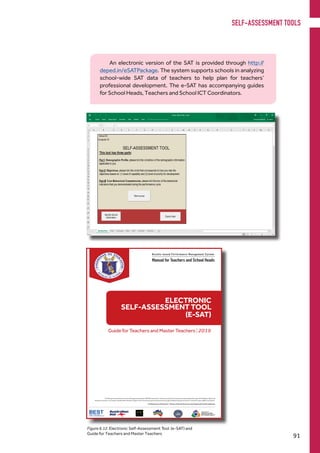
2.Promotescollaborationandremovesbarriertoteamworkandgoal
accomplishmentacrosstheorganization.
3.Appliesnegotiationprinciplesinarrivingatwin-winagreements.
4.Drivesconsensusandteamownershipofdecisions.
5.Worksconstructivelyandcollaborativelywithothersandacrossorganizationsto
accomplishorganizationgoalsandobjectives.
ProfessionalismandEthics
1.DemonstratesthevaluesandbehaviorenshrinedintheNormsandConduct
andEthicalStandardsforpublicofficialsandemployees(RA6713).
2.Practicesethicalandprofessionalbehaviorandconducttakingintoaccount
theimpactofhis/heractionsanddecisions.
3.Maintainsaprofessionalimage:beingtrustworthy,regularityofattendance
andpunctuality,goodgroomingandcommunication.
4.Makespersonalsacrificestomeettheorganization’sneeds.
5.Actswithasenseofurgencyandresponsibilitytomeettheorganization’s
needs,improvesystemandhelpothersimprovetheireffectiveness.
ServiceOrientation
1.Canexplainandarticulateorganizationaldirections,issuesandproblems.
2.Takespersonalresponsibilityfordealingwithand/orcorrectingcustomer
serviceissuesandconcerns.
3.Initiatesactivitiesthatpromoteadvocacyformenandwomenempowerment.
4.Participatesinupdatingofficevision,mission,mandatesandstrategiesbased
onDepEdstrategiesanddirections.
5.Developsandadoptsserviceimprovementprogramthroughsimplified
proceduresthatwillfurtherenhanceservicedelivery.
ResultsFocus
1.Achievesresultswithoptimaluseoftimeandresourcesmostofthetime.
2.Avoidsrework,mistakesandwastagethrougheffectiveworkmethodsby
placingorganizationalneedsbeforepersonalneeds.
3.Deliverserror-freeoutputsmostofthetimebyconformingtostandard
operatingprocedurescorrectlyandconsistently.Abletoproduce
verysatisfactoryqualityworkintermsofusefulness/acceptabilityand
completenesswithnosupervisionrequired.
4.Expressesadesiretodobetterandmayexpressfrustrationatwasteor
inefficiency.Mayfocusonnewormoreprecisewaysofmeetinggoalsset.
5.Makesspecificchangesinthesystemorinownworkmethodstoimprove
performance.Examplesmayincludedoingsomethingbetter,faster,atalower
cost,moreefficiently,orimprovingquality,customersatisfaction,morale,
withoutsettinganyspecificgoal.
Innovation
1.Examinestherootcauseofproblemsandsuggestseffectivesolutions.
Fosternewideas,processesandsuggestsbetterwaystodothings(costand/or
operational
efficiency).
2.Demonstratesanabilitytothink“beyondthebox”.Continuouslyfocuseson
improvingpersonalproductivitytocreatehighervalueandresults.
3.Promotesacreativeclimateandinspiresco-workerstodeveloporiginalideasor
solutions.
4.Translatescreativethinkingintotangiblechangesandsolutionsthatimprovethe
workunitandorganization.
5.Usesingeniousmethodstoaccomplishresponsibilities.Demonstrates
resourcefulnessandtheabilitytosucceedwithminimalresources.
Notethattheassessmentinthedemonstrationofcompetenciesshallnotbereflectedinthefinalrating.Thesecompetenciesaremonitoredtoinformprofessional
developmentplans(DepEdOrderNo.2,s.2015,p.9).
Asoftcopyofthisformcanbeaccessedat:http:deped.in/IPCRForms.
AppendixD.3UPDATED RPMS MANUAL
200
PARTIII:SUMMARYOFRATINGSFORDISCUSSION
FINALPERFORMANCERESULTSRATINGADJECTIVALRATING
AccomplishmentsofKRAsandObjectives
Asoftcopyofthisformcanbeaccessedat:http:deped.in/IPCRForms.
NameofEmployeeNameofSuperior
SignatureSignature
DateDate
RATER-RATEEAGREEMENT
Thesignaturesbelowconfirmthattheemployeeandhis/hersuperiorhaveagreedoncontentofthisappraisalform
andtheperformancerating.
AppendixD.4
APPENDICES
201
Asoftcopyofthisformcanbeaccessedat:http:deped.in/IPCRForms.
PART	IV:	DEVELOPMENT	PLANS	
Strengths	
	
Development	Needs	
Action	Plan	
(Recommended	Developmental	
Intervention)	Timeline	Resources	Needed	
Learning	
Objectives	
Intervention	
A.	Functional	Competencies	


B.	Core	Behavioral	Competencies		


Feedback:		


	RATEE			RATER		APPROVING	AUTHORITY	
	
AppendixD.4UPDATED RPMS MANUAL
202
Asoftcopyofthisformcanbeaccessedat:http:deped.in/IPCRForms.
	174	
AppendixE
SUGGESTEDMID-YEARREVIEWFORM(MRF)
NameofEmployee:
Position:
Bureau/Center/Service/Division:
RatingPeriod:
NameofRater:
Position:
DateofReview:
MFOsKRAsObjectivesTimeline
Weight
perKRA
MOV
Performance
Target
Mid-yearReview/Rating
Mid-YearReviewResultsRatee(Teacher)Rater(Principal)
RatingRemarksRatingRemarks
Quality
Efficiency
Timeliness
*PleaseseeattachedlistofMOV
RaterRateeApprovingAuthority
APPENDICES
203
175	
PERFORMANCEMONITORINGANDCOACHINGFORM
DATECRITICALINCIDENCEDESCRIPTIONOUTPUT
IMPACTONJOB/ACTION
PLAN
SIGNATURE
(RATER/RATEE)
.
	
AppendixF
Asoftcopyofthisformcanbeaccessedat:http:deped.in/IPCRForms.
UPDATED RPMS MANUAL
204
Appendix G
APPENDICES
205
UPDATED RPMS MANUAL
206
APPENDICES
207
UPDATED RPMS MANUAL
208
APPENDICES
209
UPDATED RPMS MANUAL
210210
Appendix H
APPENDICES
211
UPDATED RPMS MANUAL
212
APPENDICES
213
UPDATED RPMS MANUAL
214
APPENDICES
215
UPDATED RPMS MANUAL
216
AppendixJ.1AppendixI.1
S.Y.2019-2020
APPENDICES
217
LEVELLEVELNAMEDESCRIPTION
3ORGANIZING
Theteacherdemonstratesalimitedrangeofloosely-associatedpedagogicalaspectsof
theindicator.
4DEVELOPING
Theteacherdemonstratesarangeofassociatedpedagogicalaspectsoftheindicator
thatsometimesalignwiththelearners’developmentalneeds.
5APPLYING
Theteacherdemonstratesarangeofassociatedpedagogicalaspectsoftheindicator
thatusuallyalignwiththelearners’developmentalneeds.
6CONSOLIDATING
Theteacheruseswell-connectedpedagogicalaspectsoftheindicatorconsistently
alignedwithstudentdevelopmentthatsupportsstudentstobesuccessfullearners.
7INTEGRATING
Theteacheruseswell-connectedpedagogicalaspectsoftheindicatortocreatean
environmentthataddressesindividualandgrouplearninggoals.
RUBRICLEVELSUMMARY
COT-RPMSforTeacherI-III|S.Y.2019-2020
UPDATED RPMS MANUAL
218
COT-RPMSforTeacherI-III|S.Y.2019-2020
3
INDICATOR1Applyknowledgeofcontentwithinandacrosscurriculumcontentteachingareas
34567
Theteacherdemonstratesminor
contenterrorseitherinthe
presentationofthelessonorin
respondingtolearners’questionsor
comments.Thelessoncontent
displayssimplecoherence.
Theteacherdemonstrates
accurateknowledgeofkey
conceptsbothinthepresentation
ofthelessonandinrespondingto
learners’questionsorcomments.
Thelessoncontentdisplays
coherence.
Theteacherattemptstomake
connectionsacross
curriculumcontentareas,if
appropriate.
Theteacherdemonstrates
accurateandin-depthknowledge
ofmostconceptsinthe
presentationofthelessonandin
respondingtolearners’questions
inamannerthatattemptstobe
responsivetolearners’
developmentallearningneeds.
Theteachermakesconnections
acrosscurriculumcontentareas,if
appropriate.
Theteacherdemonstratesaccurate
andin-depthknowledgeofall
conceptsinthepresentationofthe
lessonandinrespondingto
learners’questionsinamannerthat
isresponsivetolearners’
developmentalneeds.
Theteachermakesmeaningful
connectionsacrosscurriculum
contentareas,ifappropriate.
Theteacherapplieshigh-level
knowledgeofcontentandpedagogy
thatcreatesaconducivelearning
environmentthatenablesanin-
depthandsophisticated
understandingoftheteachingand
learningprocesstomeetindividual
orgrouplearningneedswithinand
acrosscurriculumcontentareas.
FEATURESOFPRACTICE
1.Theteacherindicatessome
awarenessofotherideasofthe
samedisciplinethatare
connectedtothelessonbut
doesnotmakesolidconnection.
2.Theteachermakesfewcontent
errorsinpresentingthelesson
butdoesnotaffectentirelythe
learningprocess.
1.Theteacherclearlyexplains
conceptsandmakesno
contenterrors.
2.Thecontentappearstobe
accurateanditsfocusshows
awarenessoftheideasand
structureofthediscipline.
3.Theteacherdemonstrates
factualknowledgeofsubject
matterandattemptsto
connectcontentacross
disciplines.
1.Theteacherdisplays
comprehensiveunderstanding
oftheconceptsandstructure
ofthedisciplines.
2.Theteacherpresents
conceptualknowledgeofthe
subjectandmakesconnection
withinthediscipline.
1.Theteacherdisplaysextensive
knowledgeofcontent.
2.Theteacheraddressescontent
accurately,anditsfocusis
congruentwiththebigideas
and/orstructureofthe
discipline.
1.Theteacherappliesextensive
knowledgeofcontentbeyondhis/her
areaofspecialization.
2.Theteachermotivateslearnersto
investigatethecontentareato
expandtheirknowledgeandsatisfy
theirnaturalcuriosity.
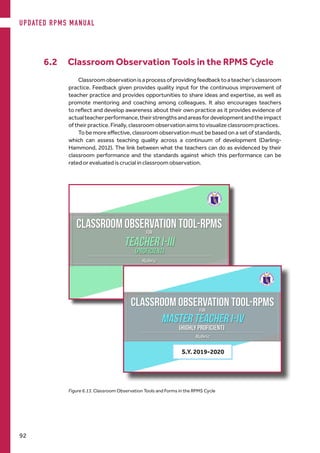
3.Theteachercitesintraand
interdisciplinarycontentrelationship.
4.Theteachershowsexpertiseofthe
contentandusesappropriate
pedagogyindeliveringthelesson.
CLARIFICATIONS
CURRICULUMCONTENTAREAS
differentlearning/subjectareastaughtandlearnedin
thebasiceducationcurriculumincludingcontentfor
Kindergarten,SpecialEducation,AlternativeLearning
System,IndigenousPeoplesEducation
KNOWLEDGEOFCONTENTANDPEDAGOGY
integrationofexpertiseandteachingskillfora
particularsubject;appropriatenessofthepedagogyto
contentarea
WITHINCURRICULUMCONTENTAREA
inclusionofappropriatelychosenintra-disciplinary
topicsandenablinglearningcompetencieswithinthe
curriculumguideofaspecificlearningareaandgrade
level
ACROSSCURRICULUMCONTENTAREA
makingmeaningfulconnectionsandincluding
appropriateinterdisciplinarytopicsandlearning
competenciescitedinthecurriculumguideofother
learningareasinanygradelevel
MINORCONTENTERRORS
lessdegreeoferrorsinthecontentofthelesson
KEYCONCEPTS
centralideasofthetopicorlesson
SIMPLECOHERENCE
abasiclogicinthesequenceofthelessonwithone
partlinkedtothenext
COHERENCE
alogicaland/ordevelopmentalsequencein
presentingthelesson
PEDAGOGY
methodandpracticeofteaching
ACCURATEKNOWLEDGE
contentisfreefromerrors
IN-DEPTHKNOWLEDGE
foundationalknowledgeandfinerdetailswithinthe
curriculumcontentarea
BROADKNOWLEDGE
knowledgeacrosscurriculumcontentareas
HIGH-LEVELKNOWLEDGE
accurate,in-depth,andbroadknowledgewithinand
acrosscurriculumareas
COT-RPMSforTeacherI-III|S.Y.2019-2020
APPENDICES
219
COT-RPMSforTeacherI-III|S.Y.2019-2020
4
34567
Theteacherusesloosely
connectedteachingstrategiesto
addresslearners’literacyand/or
numeracyneeds.
Theteacheroccasionallyapplies
teachingstrategiesthataddress
learners’literacyand/or
numeracyneeds.
Theteacherfrequentlyapplies
relevantstrategiesthatenhance
learners’literacyand/ornumeracy
skills.
Theteacherconsistentlyapplies
relevantstrategiesthatenhance
learners’literacyand/ornumeracy
skills.
Theteacherintegrateswell-
connectedteachingstrategiesthat
promoteindividualandgroup
learners’criticalliteracyand/or
criticalnumeracyskills.
FEATURESOFPRACTICE
1.Theteacherdefinesgeneral
termsinthelessonbutfailsto
definespecifictermsneeded
todeveloplearners’full
understandingofliteracy
and/ornumeracyconcepts.
1.Insomepartsofthelesson,
theteacherprovides
activitieswhichaddress
learners’literacyand/or
numeracyneedsbutfailsto
dosoinsomecriticalparts
ofthelessonwhereeitheror
bothskillsarenecessary.
1.Theteacherusesactivities
thatenhanceliteracyand/or
numeracyinalmostall
aspectsofthelesson.
1.Theteacherprovidesactivitiesto
enhancelearners’literacyand/or
numeracyskillsinallaspectsof
thelesson.
1.Theteacheremploysactivities
thatenhanceandsupport
learners’higherlevelofliteracy
and/ornumeracyskillsasa
significantpartofhis/her
instruction.
INDICATOR2Usearangeofteachingstrategiesthatenhancelearnerachievementinliteracyandnumeracyskills
CLARIFICATIONS
LITERACYSKILLS
skillsneededforreadingandwriting.Thesemayinclude
awarenessofsoundsoflanguage,awarenessofprint,andthe
relationshipbetweenlettersandsounds.Otherskillssuchas
creatingknowledgethroughwritingaswellasdevelopingmedia
andtechnologyarepartofliteracyskills.
NUMERACYSKILLS
skillswhichconsistofcomprehendingandapplyingfundamental
arithmeticoperationslikeaddition,subtraction,multiplication,
anddivision.Numeracyskillsmayalsoincludetheabilityto
reasonwithmathematicalconceptslikeinterpretingdata,charts,
anddiagrams;toprocessinformation;tosolveproblems;andto
makedecisionsbasedonlogicalthinkingandreasoning.
ExamplesofnumeracyskillsinSPEDclassrooms:up-down
movementinbrushingofteeth;countingthenumberofboys
andgirls;foldingofclothesusingnumberedpattern
CRITICALLITERACY
analyzingandevaluatingthemeaningoftextasitrelates
toglobalissuestoinformacriticalstance,response,
and/oraction
CRITICALNUMERACY
abilitytoeffectivelyusemathematicalconceptsinapplying,
analyzing,evaluatingandcreatingideas
LOOSELYCONNECTEDTEACHINGSTRATEGIES
teachingapproacheswhicharemismatchedin
addressingliteracyand/ornumeracyneeds
OCCASIONALLY
irregularlyoccursinthedurationofthelesson
FREQUENTLY
oftenoccursinthedurationofthelesson
CONSISTENTLY
constantlyoccursinthedurationofthelesson
RELEVANTSTRATEGIES
teachingapproacheswhicharemoderatelyassociatedwiththe
learners’developmentalneedstoenhanceliteracyand/or
numeracyskills
COT-RPMSforTeacherI-III|S.Y.2019-2020
UPDATED RPMS MANUAL
220
COT-RPMSforTeacherI-III|S.Y.2019-2020
5
CLARIFICATIONS
CRITICALTHINKINGSKILLS
high-levelthinkingskillssuchasanalysis,evaluation,interpretation,orsynthesisofinformationandapplicationofcreativethought
toformanargument,solveaproblem,orreachaconclusion
CREATIVETHINKINGSKILLS
thinkingskillsthatinvolveexploringideas,generatingpossibilities,andlookingformanyrightanswersratherthanjustone
HIGHER-ORDERTHINKINGSKILLS
complexthinkingprocesseswhichincludeanalysis,evaluation,synthesis,reflection,andcreativity
34567
Theteacherprovides
straightforwardquestionsand
activitieswhichleadlearners
throughasinglepathofinquiry.
Theteacherusesquestionsand
activitiesthatmostlyrequirethe
learnerstointerpret,explain,or
describeideaslearned.
Theteacheremploysarangeof
targetedfollow-upquestionsand
activitiesthatencouragelearners
toexplain,demonstrate,anduse
ideaslearned.
Theteacherchallengeslearnersto
justifytheirthinkingand
successfullyengagesmostlearners
inthediscussionusingwell-directed
questionsandactivities.
Theteacherprovidesabroad
rangeofquestionsandactivities,
includingthoseofhigher-order,
thatchallengelearnerstoanalyze
theirthinkingtopromotedeeper
understanding.
FEATURESOFPRACTICE
1.Theteacherasksquestionsthat
requirerote-typeresponsessuch
asWho,What,Where,When.
Examplesofrote-typequestionsvs.
high-orderquestions:
a.“Whoistheauthor?”vs.“Who
isthepersona?”
b.“Whatarethegiven?”vs.
“Whatwillyoudotosolvethe
problem?”
c.“Saangkontinente
matatagpuanangbansang
Indonesia?”vs.“Saang
kaugnaynalokasyon
matatagpuanangIndonesia?”
2.Theteacheracceptsall
contributionswithoutprocessing
thelearners’answers.
1.Theteachermakessome
attemptstoengagelearners
ingenuinediscussionrather
thansimple,factual,orrote-
typediscussion.
2.Theteacherasks,“Canyou
pleaseexplainthisidea?”
1.Theteacheremploysarange
ofstrategiestoensurethat
mostlearnersaregiven
opportunitiestogiveopinions
aboutthelessonandtoreact
totheopinionsofothers.
2.Theteachercreatesagenuine
discussionamonglearners,
providingadequatetimefor
themtorespond,aswellasto
stepasidewhendoingsois
appropriate.
1.Theteacherchallenges
learnerscognitivelytoadvance
high-levelthinkingand
discourseininteractive
exchangeofviews.
2.Theteacherensuresthatall
learnerscontributeinthe
discussion.
1.Theteachergivesopportunities
forlearnerstoinitiatecomparing
andcontrastingofideas.
2.Theteachergivesopportunities
forlearnerstosynthesizeor
summarizeinformationwithinor
acrossdisciplines.
INDICATOR3
Applyarangeofteachingstrategiestodevelopcriticalandcreativethinking,aswellasotherhigher-order
thinkingskills
COT-RPMSforTeacherI-III|S.Y.2019-2020
APPENDICES
221
APPENDICES
COT-RPMSforTeacherI-III|S.Y.2019-2020
6
CLARIFICATIONS
PHYSICALLEARNINGENVIRONMENT
anyareawherelearningtakesplace
CLASSROOMSTRUCTURE
includesthearrangementofchairs,tables,andotherequipment
MEANINGFULEXPLORATION
activitiesthatleadtolearners’fullunderstandingofconcepts
andhowtheyrelatetootherconcepts
DISCOVERYLEARNINGACTIVITIES
activitiesthatrequirelearnerstodrawontheirpastexperiences
andexistingknowledgetodiscoverfacts,relationships,andnew
knowledgetobelearned
HANDS-ONLEARNINGACTIVITIES
activitiesthatrequirephysicalparticipationoflearnersto
construct,consolidateorexplainconcepts
SOME
lessthanhalfofthelearners
MAJORITY
morethanhalfofthelearners
MOST
almostall,approaching100%ofthelearners
INDICATOR4
Manageclassroomstructuretoengagelearners,individuallyoringroups,inmeaningfulexploration,
discovery,andhands-onactivitieswithinarangeofphysicallearningenvironments
34567
Theteachermanagesclassroom
structureandengagesonlysome
learnersindiscoveryorhands-on
learningactivitieswithinarangeof
physicallearningenvironments.
Theteachermanagesclassroom
structureandengagesmajorityof
thelearnersindiscoveryand
hands-onlearningactivitieswithin
arangeofphysicallearning
environments.
Theteachermanagesclassroom
structureandengagesmost
learnersinmeaningfulexploration,
discoveryandhands-onlearning
activitieswithinarangeof
physicallearningenvironments.
Theteachermanagesclassroom
structureandengagesall
learnersinmeaningful
exploration,discoveryandhands-
onlearningactivitieswithina
rangeofphysicallearning
environments.
Theteacherorganizesand
maintainsclassroomstructureand
engageslearnersindividuallyorin
groups,inmeaningfulexploration,
discoveryandhands-onactivities
withinarangeofphysicallearning
environments.
FEATURESOFPRACTICE
1.Theteacherinvolvessome
learnerstoworkproductively
withintheallottedtime,physical
space,andresources.
1.Theteacherstructuresa
simpleclassroomlayoutand
usestheavailableresources
thataresomewhatsuitablefor
differentlearningactivities
whichinvolvemajorityofthe
learnerstoworkproductively.
1.Theteacherstructuresthe
classroomlayoutandusesthe
availableresourcesthatare
generallysuitablefordifferent
learningactivitieswhich
involvemostofthelearners.
1.Theteacherkeepsthe
learningenvironmentfree
fromcongestionand
facilitatesactivities
appropriatewithinthe
physicallearningenvironment
forallthelearnerstowork
productivelywithinthe
allottedtime.
1.Theteachersustainsproactive
classroomstructure
managementpracticesto
supportflexiblemovementof
thelearnersinalllearning
activitiesbyprovidingoptimal
spaceandtimeappropriateto
theirneeds.
COT-RPMSforTeacherI-III|S.Y.2019-2020
UPDATED RPMS MANUAL
222
COT-RPMSforTeacherI-III|S.Y.2019-2020
7
34567
Theteacherrarelymanages
misbehavioragainstestablished
rulesofconduct.
Theteacheroccasionally
managesmisbehavioragainst
establishedrulesofconductand
majorityofthelearnersfollow
suchrules.
Theteacherfrequentlymanages
misbehavioragainstestablished
rulesofconductandmost
learnersfollowsuchrules.
Theteacherconsistentlymanages
misbehavioragainstestablished
rulesofconductandalllearners
followsuchrules.
Theteacherconstructivelymanages
learners’behaviorbyapplying
positiveandnon-violentdisciplineto
ensurealearning-focused
environment.
FEATURESOFPRACTICE
1.Theteacherseemstohaveset
rulesofconduct,buttheyarenot
cleartoallstudents.
2.Theteachercommunicatesa
prescribedprocesstoaddress
learnermisconductbutarenot
clearandrequirerepeated
prompting,whichdelaysor
disruptsthequalityofstudent
learning.
3.Theteacher’sresponsesto
learnermisbehaviorare
inconsistent:sometimesharsh,
othertimeslenient.
1.Theteacher’sstandardsof
conductareinconsistently
enforcedresultinginsome
interferenceinstudentlearning
andsomelossofinstructional
time.
2.Theteachersetsclear
standardsofconduct,but
learnersneedtobeprompted
repeatedly.
3.Theteacherestablishes
appropriateexpectationsfor
behaviorbutsomeofthese
areunclearordonotaddress
theneedsofmostlearners.
1.Theteacherimplements
appropriateclassroom
managementsystemwhich
areresponsivetoclassroom
andindividualneedsof
learners.
2.Theteacher’sstandardsof
behaviorareconsistently
reinforcedandareclearto
mostlearners.Thelearners
requirelittleprompting,
resultinginlittleorno
interferencewiththeir
learning.
3.Theteachermovestothe
misbehavinglearnerand
givesverbalornon-verbal
signaltostopthe
misbehavior.
1.Theteacherresponds
appropriatelytolearners’
behaviorwithoutanylossof
instructionaltime.
2.Theteacherevidently
establishesstandardsofconduct
thatarecleartoalllearnersand
withimpactonstudentlearning.
1.Theteacherencouragesthe
learnerstotakeresponsibilityof
theirbehavior.
2.Theteacherevidentlyimplements
awell-establishedprocedurefor
learnerstoself-monitortheirown
classroombehavior.
3.Theteachercloselymonitorsthe
learnerssothatmisbehavioris
detectedearlybeforeitinvolves
manylearnersorbecomesa
seriousdisruption.
CLARIFICATIONS
POSITIVEDISCIPLINE
effectivewaytomanagemisbehavinglearnersratherthan
usingpunishmentsandrewards
NON-VIOLENTDISCIPLINE
Immediateactioninapeacefulandharmlessmanner
ESTABLISHEDRULES
anexistingsetrulesofconductimposedinthelearning
environment
CONSTRUCTIVE
positiveandhelpfulresponsesonlearners’behavior
BEHAVIOR
mannerinwhichlearnersact;eitherpositiveornegative
MAJORITY
morethanhalfofthelearners
MOST
almostall,approaching100%ofthelearners
RARELY
seldomoccursinthedurationofthelesson
OCCASIONALLY
irregularlyoccursinthedurationofthelesson
FREQUENTLY
oftenoccursinthedurationofthelesson
CONSISTENTLY
constantlyoccursinthedurationofthelesson
INDICATOR5
Managelearnerbehaviorconstructivelybyapplyingpositiveandnon-violentdisciplinetoensurelearning-
focusedenvironments
COT-RPMSforTeacherI-III|S.Y.2019-2020
APPENDICES
223
COT-RPMSforTeacherI-III|S.Y.2019-2020
8
34567
Theteacherprovidesalimited
rangeofdifferentiatedlearning
experiencestoaddressthe
learningneedsofsomelearners.
Theteacherprovides
differentiatedordevelopmentally
appropriatelearningexperiences
toaddressthelearningneedsof
mostlearners.
Theteacherprovides
differentiatedanddevelopmentally
appropriatelearningexperiences
toaddressthelearningneedsof
mostlearners.
Theteacherprovidesdifferentiated
anddevelopmentallyappropriate
learningexperiencestoaddressthe
learningneedsofdifferentgroups
oflearners.
Theteacherprovidesdifferentiated
anddevelopmentallyappropriate
learningexperiencestoaddressthe
diverselearningneeds.
FEATURESOFPRACTICE
1.Theteacherreliesona
singlestrategyorsome
strategiestoaccommodate
learners’differencesand
developmentalneedsbut
failstomeettheintended
outcomesformostlearners.
1.Theteacheraddressesthe
developmentallevelsof
learnersbyprovidinglearning
experiencesthatenablemost
learnerstoprogresstoward
meetingintendedoutcomes.
2.Theteachermakesuseof
differentiatedlearning
experiencestoenablemost
learnerstoprogresstoward
meetingintendedoutcomes.
1.Theteacheraddressesthe
developmentallevelsof
learnersintheclassroomand
makesuseofthedifferent
waystheylearnbyproviding
differentiatedlearning
experiencesthatenablemost
learnerstoprogresstoward
meetingintendedoutcomes.
1.Theteachersupportsthe
learners’needsthrougha
varietyofstrategies,materials,
and/orpacingthatmake
learningaccessibleand
challengingfordifferentgroups
oflearners.
2.Theteacherusesdifferentiated
strategiesthatmotivateand
engagegroupsoflearnersat
theircognitivelevels,allowing
themtoachievethelearning
outcomes.
1.Theteacherprovides
appropriateinstructional
adaptationfordiverselearners
thatallowsthemtohave
opportunitiestoactivelyengage
invariousrealisticandeffective
learningactivities.
CLARIFICATIONS
DIFFERENTIATEDLEARNINGEXPERIENCES
teachingandlearningactivitiesthataresuitedtothevarious
learningneedsofdiverselearners
DEVELOPMENTALLYAPPROPRIATELEARNING
EXPERIENCES
teachingandlearningactivitiesandtaskssuitedtotheneeds,
abilities,skills,anddevelopmentalleveloflearners
LEARNINGNEEDS
comprisebothessentiallearningtools(literacy,oralexpression,
numeracy,andproblemsolving)andthebasiclearningcontent
(knowledge,skills,values,andattitudes)requiredbyhuman
beingstobeabletosurvive,todeveloptheirfullcapacities,to
liveandworkindignity,toparticipatefullyindevelopment,to
improvethequalityoftheirlives,tomakeinformeddecisions,
andtocontinuelearning(UNESCO)
LEARNERS’GENDER
socialattributesandopportunitiesassociatedwithbeingmale
andfemaleandtherelationshipsbetweenwomenandmenand
girlsandboys,aswellastherelationshipsbetweenwomenand
thosebetweenmen
LEARNERS’NEEDS
observablegapsbetweenalearner’spresentknowledgeor
competenceandthecurriculumstandardsidentifiedas
necessaryforthegradelevel
LEARNERS’STRENGTHS
pre-existingknowledgeorcompetencethathelpsalearner
meetrequiredstandards
LEARNERS’INTERESTS
learners’personalpreferences,likesordislikes,whichmustbe
consideredintheteaching-learningprocess
LEARNERS’EXPERIENCES
skillorknowledgethatalearnergetsfromdoingsomething
INDICATOR6
Usedifferentiated,developmentallyappropriatelearningexperiencestoaddresslearners’gender,needs,
strengths,interests,andexperiences
COT-RPMSforTeacherI-III|S.Y.2019-2020
UPDATED RPMS MANUAL
224
COT-RPMSforTeacherI-III|S.Y.2019-2020
9
34567
Theteacherimplementsthe
lessonsbutonlywithsome
elementsofdevelopmentally
sequencedteachingandlearning
processes.
Theteacherimplementsthe
lessonsbutwithinappropriate
elementsofdevelopmentally
sequencedteachingandlearning
processes.
Theteacherimplementsthe
lessonswithappropriateelements
ofdevelopmentallysequenced
teachingandlearningprocesses.
Theteachermanageswell-
structuredlessonswith
developmentallysequenced
teachingandlearningprocessesto
meetcurriculumrequirementsand
variedteachingcontexts.
Theteachermanageswell-
structuredlessonswithemphasison
explicitconnectionsbetween
previouslearningandnewconcepts
andskills.
FEATURESOFPRACTICE
1.Theteacherdoesnot
demonstrateunderstandingof
theprerequisiterelationships
whenplanning,andtransitions
betweenactivitiesaretoo
abrupt.
2.Theteacher’ssequenceofthe
learningactivitiesdemonstrates
somestructurebutthereare
someproblemswiththe
organizationthatnegatively
impactedlearning.
1.Theteacherdemonstrates
inaccurateorincomplete
knowledgeofprerequisite
relationships,andtransitions
betweenactivitiesare
presentbutmaydisruptthe
flowofthesequence.
2.Theteacherpresentsminor
organizationalissueand
missedopportunitiesduring
thelessonthataffected
learningtime.
1.Theteacherconnects
outcomesfrompreviousand
futurelearning,andtransitions
betweenactivitiesaresmooth.
2.Theteacher’ssequenceofthe
learningactivitiesgenerally
keepslearnersengagedand
movingfromoneportionto
thenextinareasonable
manner.Theyunderstandthe
purposeofthelessonand
whattheyaretodoto
accomplishthepurpose.
1.Theteacher’ssequenceof
activitiespurposefully
scaffoldslearnerstoward
achievingthelesson’s
objectives.
2.Theteacher’ssequenceofthe
learningactivitieskeeps
learnersengagedinthe
contentandhasaclearsense
ofpurposethroughoutthe
classperiodbutlacksin-depth
processingoftheactivities.
1.Theteacher’sprogression
fromthewarm-uptothemain
activityisthoughtfully
planned.Thereviewofbasic
conceptsandtheactivities
thatfollowedareeffectivein
takingtheapplicationofthis
knowledgetothenextlevelof
exploration.
INDICATOR7
Plan,manageandimplementdevelopmentallysequencedteachingandlearningprocessestomeet
curriculumrequirementsandvariedteachingcontexts
CLARIFICATIONS
DEVELOPMENTALLYSEQUENCEDTEACHINGANDLEARNINGPROCESSES
refertotheorderofactivitiesthatkeepslearnersengagedinthecontentandpurposelyscaffoldslearnerstowardsachievingthelesson’sobjectives
bymaximizingallottedclasstime.Theseinclude:
•Lessonobjectivesexpectationsfromlearnersattheendofthelesson
•Learnerengagementstrategiesstrategiesthatincludeactivitiesforindividuallearnersand/orgroups
•Pacingteacher’sappropriatespeedorrateinpresentingthelesson
•Sequenceorderofpresentingthelessonandclassroomactivities
COT-RPMSforTeacherI-III|S.Y.2019-2020
APPENDICES
225
APPENDICES
COT-RPMSforTeacherI-III|S.Y.2019-2020
10
INDICATOR8
Select,develop,organizeanduseappropriateteachingandlearningresources,includingICT,toaddress
learninggoals
34567
Theteacherutilizeslearning
resources,includingICT,whichare
looselyalignedwiththelearning
goals.
Theteacherutilizeslearning
resources,includingICT,which
areoccasionallyalignedwiththe
learninggoals.
Theteacherutilizeslearning
resources,includingICT,which
aregenerallyalignedwiththe
learninggoals.
Theteacherutilizeslearning
resources,includingICT,which
areconsistentlyalignedwiththe
learninggoals.
Theteacherintegratesextensive
andmultidisciplinarylearning
resources,includingICT,whichare
appropriateandalignedwiththe
learninggoals.
FEATURESOFPRACTICE
1.Theteacherutilizesavariety
ofmaterialsandresources
thatdonotsupportthe
learninggoals.
1.Theteacherutilizesavariety
ofinstructionalmaterialsand
resourcesbutisnotableto
maximizetheirpurposeto
supportthelearninggoals.
1.Theteacherutilizesavariety
ofinstructionalmaterialsand
resourcesthatarealigned
withtheinstructionalpurposes
whichusuallysupportthe
learninggoals.
1.Theteacherutilizesavarietyof
instructionalmaterialsand
resourcesthatarealignedwith
theinstructionalpurposeswhich
alwayssupportthelearning
goals.
1.Theteacherskillfullymanages
diverseinstructionalmaterials
thatencompassotherdisciplines
whichconsistentlysupportthe
learninggoals.
CLARIFICATIONS
TEACHINGANDLEARNINGRESOURCES
refertoresourcesusedintheteachingandlearningprocess,
whichmayinclude:
Curriculumguides,teacher’smanual
Chalkboard,whiteboard,Manilapaper,cartolina,charts,manipulatives,models,
flashcards,meta-cards,graphicorganizers
Printedmaterialssuchasbooks,periodicals,worksheets,activitysheets
ICTresourcessuchascalculators,computers,audiovisualequipment,slidepresentation,
multimediaproducts,socialmedia,web-basedapplications,instructionalsoftware,email,
distancelearningprograms,e-booksandotherdigitalresources
Toolsandequipment(incookery,dressmaking,beautyandcare,agriculture,carpentry,
amongothers)
Assistivedevicessuchasbraillesystems,largeprintbooks,audiodevices,screenreaders
forcomputers,hearingaids,electronicspeechoutputdevices
Localizedinstructionalmaterials
Indigenizedinstructionalmaterials
LOOSELYALIGNED
aresubstantiallymismatchedwiththelearninggoals
OCCASIONALLYALIGNED
aresometimesmatchedwiththelearninggoals
GENERALLYALIGNED
areusuallymatchedwiththelearninggoals
CONSISTENTLYALIGNED
arealwaysmatchedwiththelearninggoals
EXTENSIVELEARNINGRESOURCES
widerangeoflearningresources
MULTIDISCIPLINARYLEARNINGRESOURCES
learningresourceswhichcanbeusedinvarioussubjectareas
COT-RPMSforTeacherI-III|S.Y.2019-2020
UPDATED RPMS MANUAL
226
COT-RPMSforTeacherI-III|S.Y.2019-2020
11
34567
Theteacherprovidesalimited
rangeofassessmentstrategies
butfailstoaddressthelearning
goals.
Theteacherprovidesarange
ofassessmentstrategiesbut
onlysomearealignedwiththe
learninggoals.
Theteacherprovidesarangeof
assessmentstrategiesthat
addressmostofthelearning
goals.
Theteacherprovidesassessment
strategiesconsistentwiththe
curriculumrequirements.
Theteacherintegrates
assessmentstrategiesthat
engagelearnersinself-and
peer-assessment.
FEATURESOFPRACTICE
1.Theteacherusesassessment
proceduresfocusedontask
completionand/orcompliance
ratherthanlearner
achievementoflesson
purpose/objective.
1.Theteacherusesavariety
ofassessmentstrategies,
butsomedonotmeasure
theintendedlearning
outcomes.
2.Theteacheruses
proceduresthatyieldonly
someevidenceoflearning.
1.Theteacherusesarepertoire
ofassessmentstrategies
whicharealignedwiththe
intendedlearninggoals.
2.Theteacherusesassessment
proceduresthatdrawout
evidenceofwhetherlearners
havelearnedtheintended
learningoutcomes.
1.Theteacherpredominantly
usesassessmentstrategies
whichareembeddedasan
integralpartofthelessonand
arealignedwiththeintended
instructionalgoalsorconsistent
withthecontentstandards.
2.Theteacherencouragesthe
learnerstoassessandmonitor
thequalityoftheirownwork
againsttheassessmentcriteria
andperformancestandards.
1.Theteacherusesassessment
strategiesthatengagelearners
touseassessmentcriteriato
self-monitorandreflectontheir
ownprogress.
2.Theteacherpromptslearners
tofrequentlyassesstheirown
workandtheworkoftheir
peersusingassessment
criteriaembeddedinthe
teacher-learners-generated
rubrics,peerreviews,and/or
reflectionlogs.
CLARIFICATIONS
ASSESSMENTSTRATEGIES:
DIAGNOSTIC
assessmentusedtoidentifyeachlearner’sstrengths,weaknesses,knowledge,andskillspriortoinstruction,
e.g.,pretest,drills,review,anticipationguide,contentknowledgeboxes
FORMATIVE
assessmentusedtoidentifythepartsofthelessonwherelearnersneedimprovement,
e.g.,recitation(showofhands,responsecards,happy/sadface),activities(games,tableau,exitcards),andseatworks(reflectionjournal,exercisesandpractice)
SUMMATIVE
assessmentusedtoidentifylearnerachievementoftheobjectivesofthelesson,
e.g.,writtenworks(quizzes,essays),performancetasks(skillsdemonstration,grouppresentations,oralwork)
INDICATOR9
Design,select,organizeandusediagnostic,formativeandsummativeassessmentstrategiesconsistentwith
curriculumrequirements
COT-RPMSforTeacherI-III|S.Y.2019-2020
APPENDICES
227
©DepartmentofEducation-BureauofHumanResourcesandOrganizationalDevelopment
TheClassroomObservationToolwasdevelopedthroughthePhilippineNationalResearchCenterforTeacherQuality(RCTQ)
withsupportfromtheAustralianGovernmentthroughtheBasicEducationSectorTransformation(BEST)Program
UPDATED RPMS MANUAL
228
Appendix I.2
APPENDICES
229
Appendix I.3
UPDATED RPMS MANUAL
230
AppendixK.1AppendixJ.1
S.Y.2019-2020
APPENDICES
231
LEVELLEVELNAMEDESCRIPTION
4DEVELOPING
Theteacherdemonstratesarangeofassociatedpedagogicalaspectsofthe
indicator
thatsometimesalignwiththelearners’developmentalneeds.
5APPLYING
Theteacherdemonstratesarangeofassociatedpedagogicalaspectsoftheindicator
thatusuallyalignwiththelearners’developmentalneeds.
6CONSOLIDATING
Theteacheruseswell-connectedpedagogicalaspectsoftheindicatorconsistently
alignedwithstudentdevelopmentthatsupportsstudentstobesuccessfullearners.
7INTEGRATING
Theteacheruseswell-connectedpedagogicalaspectsoftheindicatortocreatean
environmentthataddressesindividualandgrouplearninggoals.
8DISCRIMINATING
Theteacherappliesdeepknowledgeandunderstandingoftheindicatordiscriminately
tocontextualizeteachingandlearningprocesseswithinthedisciplinetomeetindividual
andgrouplearninggoals.
RUBRICLEVELSUMMARY
COT-RPMSforMasterTeacherI-IV|S.Y.2019-2020
UPDATED RPMS MANUAL
232
COT-RPMSforMasterTeacherI-IV|S.Y.2019-20203
45678
Theteacherdemonstrates
accurateknowledgeofkey
conceptsbothinthepresentation
ofthelessonandinrespondingto
learners’questionsorcomments.
Thelessoncontentdisplays
coherence.
Theteacherattemptstomake
connectionsacrosscurriculum
contentareas,ifappropriate.
Theteacherdemonstrates
accurateandin-depthknowledge
ofmostconceptsinthe
presentationofthelessonandin
respondingtolearners’questions
inamannerthatattemptstobe
responsivetostudent
developmentallearningneeds.
Theteachermakesconnections
acrosscurriculumcontentareas,
ifappropriate.
Theteacherdemonstrates
accurateandin-depthknowledge
ofallconceptsinthepresentation
ofthelessonandinrespondingto
learners’questionsinamanner
thatisresponsivetolearners’
developmentalneedsand
promoteslearning.
Theteachermakesmeaningful
connectionsacrosscurriculum
contentareas,ifappropriate.
Theteacherapplieshigh-level
knowledgeofcontentand
pedagogythatcreatesaconducive
learningenvironmentthatenables
anin-depthandsophisticated
understandingoftheteachingand
learningprocesstomeetindividual
orgrouplearningneedswithinand
acrosscurriculumcontentareas.
Theteacherapplieshigh-level
knowledgeofcontentwithinand
acrosscurriculumcontentareasto
empowerlearnerstoacquireand
applysuccessfullearningstrategies
toassistintheirdevelopmentas
independentlearners.
FEATURESOFPRACTICE
1.Theteacherclearlyexplains
conceptsandmakesno
contenterrors.
2.Thecontentappearstobe
accurateanditsfocusshows
awarenessoftheideasand
structureofthediscipline.
3.Theteacherdemonstrates
factualknowledgeofsubject
matterandattemptstoconnect
contentacrossdisciplines.
1.Theteacherdisplays
comprehensiveunderstanding
oftheconceptsandstructure
ofthedisciplines.
2.Theteacherpresents
conceptualknowledgeofthe
subjectandmakesconnection
withinthediscipline.
1.Theteacherdisplaysextensive
knowledgeofcontent.
2.Theteacheraddresses
contentaccurately,andits
focusiscongruentwiththe
bigideasand/orstructureof
thediscipline.
1.Theteacherappliesextensive
knowledgeofcontentbeyond
his/herareaofspecialization.
2.Theteachermotivateslearnersto
investigatethecontentareato
expandtheirknowledgeandsatisfy
theirnaturalcuriosity.
3.Theteachercitesintraand
interdisciplinarycontent
relationship.
4.Theteachershowsexpertiseofthe
contentandusesappropriate
pedagogyindeliveringthelesson.
1.Theteacherappliesextensive
andcomplexcontentknowledge
tosupportlearnersinacquiring
successfullearningstrategiesin
otherareasofthelearning.
2.Theteacherextends
knowledgeofsubject
beyondcontentinhis/her
teachingspecialtyand
stimulateslearners’curiosity
beyondtherequiredcourse
work.
INDICATOR1Applyknowledgeofcontentwithinandacrosscurriculumcontentteachingareas
CLARIFICATIONS
CURRICULUMCONTENTAREAS
differentlearning/subjectareastaughtandlearnedin
thebasiceducationcurriculumincludingcontentfor
Kindergarten,SpecialEducation,AlternativeLearning
System,IndigenousPeoplesEducation
KNOWLEDGEOFCONTENTANDPEDAGOGY
integrationofexpertiseandteachingskillfora
particularsubject;appropriatenessofthe
pedagogytocontentarea
WITHINCURRICULUMCONTENTAREA
inclusionofappropriatelychosenintra-disciplinary
topicsandenablinglearningcompetencieswithinthe
curriculumguideofaspecificlearningareaandgrade
level
ACROSSCURRICULUMCONTENTAREA
makingmeaningfulconnectionsandincluding
appropriateinterdisciplinarytopicsandlearning
competenciescitedinthecurriculumguideofother
learningareasinanygradelevel
KEYCONCEPTS
centralideasofthetopicorlesson
COHERENCE
alogicaland/ordevelopmentalsequencein
presentingthelesson
PEDAGOGY
methodandpracticeofteaching
ACCURATEKNOWLEDGE
contentisfreefromerrors
IN-DEPTHKNOWLEDGE
foundationalknowledgeandfinerdetailswithinthe
curriculumcontentarea
BROADKNOWLEDGE
knowledgeacrosscurriculumcontentareas
HIGH-LEVELKNOWLEDGE
accurate,in-depth,andbroadknowledgewithinand
acrosscurriculumareas
COT-RPMSforMasterTeacherI-IV|S.Y.2019-2020
APPENDICES
233
COT-RPMSforMasterTeacherI-IV|S.Y.2019-20204
45678
Theteacherusesquestionsand
activitiesthatmostlyrequirethe
learnerstointerpret,explain,or
describeideaslearned.
Theteacheremploysarangeof
targetedfollow-upquestionsand
activitiesthatencouragelearners
toexplain,demonstrate,anduse
ideaslearned.
Theteacherchallengeslearners
tojustifytheirthinkingand
successfullyengagesmost
learnersinthediscussionusing
well-directedquestionsand
activities.
Theteacherprovidesabroad
rangeofquestionsandactivities,
includingthoseofhigher-order,that
challengelearnerstoanalyzetheir
thinkingtopromotedeeper
understanding.
Theteacherprovides,atthe
appropriatetimes,alearning
environmentforhigher-order
thinkingskillsthatenablelearners
toevaluatetheirthinkingandto
seekconstructivefeedbackfrom
peersandtheteacher.
FEATURESOFPRACTICE
1.Theteachermakessome
attemptstoengagelearnersin
genuinediscussionratherthan
simple,factual,orrote-type
discussion.
2.Theteacherasks,“Canyou
pleaseexplainthisidea?”
1.Theteacheremploysarange
ofstrategiestoensurethat
mostlearnersaregiven
opportunitiestogiveopinions
aboutthelessonandtoreact
totheopinionsofothers.
2.Theteachercreatesa
genuinediscussionamong
learners,providing
adequatetimeforthemto
respond,aswellastostep
asidewhendoingsois
appropriate.
1.Theteacherchallenges
learnerscognitivelyto
advancehigh-levelthinking
anddiscourseininteractive
exchangeofviews.
2.Theteacherensuresthatall
learnerscontributeinthe
discussion.
1.Theteachergivesopportunities
forlearnerstoinitiate
comparingandcontrastingof
ideas.
2.Theteachergivesopportunities
forlearnerstosynthesizeor
summarizeinformationwithin
oracrossdisciplines.
1.Theteacherleadslearnersto
judgeorevaluatesituations,
problemsinresolving
issues/concernsthatmayarise
inthediscussion.
2.Theteacherextendsthe
discussionbyinvitinglearners
togivecommentstoother’s
answers/outputduringthe
discussion.
INDICATOR2
Applyarangeofteachingstrategiestodevelopcriticalandcreativethinking,aswellasotherhigher-order
thinkingskills
CLARIFICATIONS
CRITICALTHINKINGSKILLS
high-levelthinkingskillssuchasanalysis,evaluation,interpretation,orsynthesisofinformationandapplicationofcreativethought
toformanargument,solveaproblem,orreachaconclusion
CREATIVETHINKINGSKILLS
thinkingskillsthatinvolveexploringideas,generatingpossibilitiesandlookingformanyrightanswersratherthanjustone
HIGHER-ORDERTHINKINGSKILLS
complexthinkingprocesseswhichincludeanalysis,evaluation,synthesis,reflection,andcreativity
COT-RPMSforMasterTeacherI-IV|S.Y.2019-2020
UPDATED RPMS MANUAL
234
COT-RPMSforMasterTeacherI-IV|S.Y.2019-20205
45678
Theteachermanagesclassroom
structureandengagesmajorityof
thelearnersindiscoveryand
hands-onlearningactivitieswithina
rangeofphysicallearning
environments.
Theteachermanagesclassroom
structureandengagesmost
learnersinmeaningful
exploration,discoveryandhands-
onlearningactivitieswithina
rangeofphysicallearning
environments.
Theteachermanagesclassroom
structureandengagesalllearners
inmeaningfulexploration,
discoveryandhands-onlearning
activitieswithinarangeof
physicallearningenvironments.
Theteacherorganizesand
maintainsclassroomstructureand
engageslearnersindividuallyorin
groups,inmeaningfulexploration,
discoveryandhands-onactivities
withinarangeofphysicallearning
environments.
Theteacheradaptsandadjusts
classroomstructureaccordingto
learners’needsandencourages
learnerstoexploreotherlearning
activitiesthatsupportthe
achievementoflearninggoals.
FEATURESOFPRACTICE
1.Theteacherstructuresa
simpleclassroomlayoutand
usestheavailableresources
thataresomewhatsuitable
fordifferentlearningactivities
whichinvolvemajorityofthe
learnerstoworkproductively.
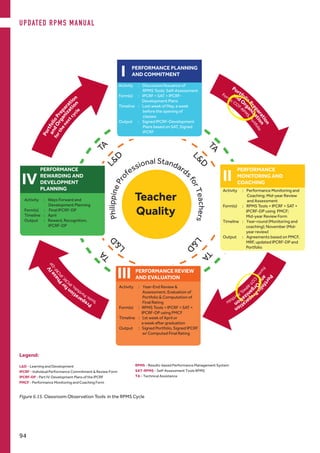
1.Theteacherstructuresthe
classroomlayoutanduses
theavailableresourcesthat
aregenerallysuitablefor
differentlearningactivities
whichinvolvemostofthe
learners.
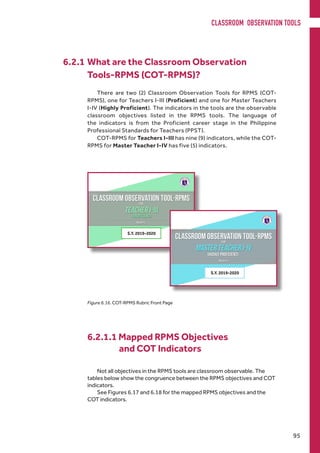
1.Theteacherkeepsthelearning
environmentfreefrom
congestionandfacilitates
activitiesappropriatewithinthe
physicallearningenvironment
forallthelearnerstowork
productivelywithintheallotted
time.
1.Theteachersustainsproactive
classroomstructure
managementpracticesto
supportflexiblemovementofthe
learnersinalllearningactivities
byprovidingoptimalspaceand
timeappropriatetotheirneeds.
1.Theteachermodifiesclassroom
structureandresources
effectivelyinamannerthat
acknowledgesthelearningneeds
ofthelearners.
2.Theteacherfacilitateswell-
plannedlearningactivities
appropriatetoindividualand
groupneedswithintheavailable
physicalspaceandresources.
INDICATOR3
Manageclassroomstructuretoengagelearners,individuallyoringroups,inmeaningfulexploration,
discovery,andhands-onactivitieswithinarangeofphysicallearningenvironments
CLARIFICATIONS
PHYSICALLEARNINGENVIRONMENT
anyareawherelearningtakesplace
CLASSROOMSTRUCTURE
includesthearrangementofchairs,tables,andotherequipment
MEANINGFULEXPLORATION
activitiesthatleadtolearners’fullunderstandingofconceptsand
howtheyrelatetootherconcepts
DISCOVERYLEARNINGACTIVITIES
activitiesthatrequirelearnerstodrawontheirpastexperiences
andexistingknowledgetodiscoverfacts,relationships,andnew
knowledgetobelearned
HANDS-ONLEARNINGACTIVITIES
activitiesthatrequirephysicalparticipationoflearnersto
construct,consolidateorexplainconcepts
MAJORITY
morethanhalfofthelearners
MOST
almostall,approaching100%ofthelearners
COT-RPMSforMasterTeacherI-IV|S.Y.2019-2020
APPENDICES
235
COT-RPMSforMasterTeacherI-IV|S.Y.2019-20206
45678
Theteacheroccasionallymanages
misbehavioragainstestablished
rulesofconductandmajorityofthe
learnersfollowsuchrules.
Theteacherfrequentlymanages
misbehavioragainstestablished
rulesofconductandmost
learnersfollowsuchrules.
Theteacherconsistentlymanages
misbehavioragainstestablished
rulesofconductandalllearners
followsuchrules.
Theteacherconstructively
manageslearners’behaviorby
applyingpositiveandnon-violent
disciplinetoensurealearning-
focusedenvironment.
Theteacherenableslearnersto
takecontroloftheirownbehavior
againstrulesofconductinwhich
learnersareawareoftheimpactof
theirbehavior.
FEATURESOFPRACTICE
1.Theteacher’sstandardsof
conductareinconsistently
enforcedresultinginsome
interferenceinstudentlearning
andsomelossofinstructional
time.
2.Theteachersetsclear
standardsofconduct,but
learnersneedtobeprompted
repeatedly.
3.Theteacherestablishes
appropriateexpectationsfor
behaviorbutsomeofthese
areunclearordonot
addresstheneedsofmost
learners.
1.Theteacherimplements
appropriateclassroom
managementsystemwhich
areresponsivetoclassroom
andindividualneedsof
learners.
2.Theteacher’sstandardsof
behaviorareconsistently
reinforcedandareclearto
mostlearners.Thelearners
requirelittleprompting,
resultinginlittleorno
interferencewiththeir
learning.
3.Theteachermovestothe
misbehavinglearnerand
givesverbalornon-verbal
signaltostopthe
misbehavior.
1.Theteacherresponds
appropriatelytolearners’
behaviorwithoutanylossof
instructionaltime.
2.Theteacherevidently
establishesstandardsof
conductthatarecleartoall
learnersandwithimpacton
studentlearning.
1.Theteacherencouragesthe
learnerstotakeresponsibilityof
theirbehavior.
2.Theteacherevidently
implementsawell-established
procedureforlearnerstoself-
monitortheirownclassroom
behavior.
3.Theteachercloselymonitors
thelearnerssothat
misbehaviorisdetectedearly
beforeitinvolvesmany
learnersorbecomesaserious
disruption.
1.Theteacherenforcesclear
standardsofconducttoall
learnerswhorespectfully
intervenewithclassmatesat
appropriatemomentsto
ensurecompliancewith
standardsofconduct.
CLARIFICATIONS
POSITIVEDISCIPLINE
effectivewaytomanagemisbehavinglearnersratherthanusing
punishmentsandrewards
NON-VIOLENTDISCIPLINE
immediateactioninapeacefulandharmlessmanner
ESTABLISHEDRULES
anexistingsetrulesofconductimposedinthelearning
environment
CONSTRUCTIVE
positiveandhelpfulresponsesonlearners’behavior
BEHAVIOR
mannerinwhichlearnersact;eitherpositiveornegative
MAJORITY
morethanhalfofthelearners
MOST
almostall,approaching100%ofthelearners
OCCASIONALLY
irregularlyoccursinthedurationofthelesson
FREQUENTLY
oftenoccursinthedurationofthelesson
CONSISTENTLY
constantlyoccursinthedurationofthelesson
INDICATOR4
Managelearnerbehaviorconstructivelybyapplyingpositiveandnon-violentdisciplinetoensurelearning-
focusedenvironments
COT-RPMSforMasterTeacherI-IV|S.Y.2019-2020
UPDATED RPMS MANUAL
236
COT-RPMSforMasterTeacherI-IV|S.Y.2019-20207
45678
Theteacherimplementsthe
lessonsbutwithinappropriate
elementsofdevelopmentally
sequencedteachingandlearning
processes.
Theteacherimplementsthe
lessonswithappropriate
elementsofdevelopmentally
sequencedteachingandlearning
processes.
Theteachermanageswell-
structuredlessonswith
developmentallysequenced
teachingandlearningprocesses
tomeetcurriculumrequirements
andvariedteachingcontexts.
Theteachermanageswell-
structuredlessonswithemphasis
onexplicitconnectionsbetween
previouslearningandnewconcepts
andskills.
Theteacherreflectsan
understandingofthe
prerequisiterelationshipsamong
theimportantcontents,
concepts,aswellasmultiple
pathwaysforlearningdepending
onlearners’needs.
FEATURESOFPRACTICE
1.Theteacherdemonstrates
inaccurateorincomplete
knowledgeofprerequisite
relationships,andtransitions
betweenactivitiesarepresent
butmaydisrupttheflowofthe
sequence.
2.Theteacherpresentsminor
organizationalissuesand
missedopportunitiesduringthe
lessonthataffectedlearning
time.
1.Theteacherconnects
outcomesfromprevious
andfuturelearning,and
transitionsbetween
activitiesaresmooth.
2.Theteacher’ssequenceof
thelearningactivities
generallykeepslearners
engagedandmovingfrom
oneportiontothenextina
reasonablemanner.They
understandthepurposeof
thelessonandwhattheyare
todotoaccomplishthe
purpose.
1.Theteacher’ssequenceof
activitiespurposefully
scaffoldslearnerstoward
achievingthelesson’s
objectives.
2.Theteacher’ssequenceof
thelearningactivitieskeeps
learnersengagedinthe
contentandhasaclear
senseofpurposethroughout
theclassperiodbutlacksin-
depthprocessingofthe
activities.
1.Theteacher’sprogressionfrom
thewarm-uptothemain
activityisthoughtfullyplanned.
Thereviewofbasicconcepts
andtheactivitiesthatfollowed
areeffectiveintakingthe
applicationofthisknowledgeto
thenextlevelofexploration.
1.Theteacherstructuresthelesson
thattakesintoaccountorbuilds
priorknowledgeofthetopicand
iswellpacedwithathoughtfully
chosensequenceoflearning
activities.
2.Theteacherhasanticipatedthe
pedagogicalapproachesthat
wouldbemosteffectivein
engagingthelearnersthroughout
theentireclassperiod.
INDICATOR5
Plan,manageandimplementdevelopmentallysequencedteachingandlearningprocessestomeet
curriculumrequirementsandvariedteachingcontexts
CLARIFICATIONS
DEVELOPMENTALLYSEQUENCEDTEACHINGANDLEARNINGPROCESSES
refertotheorderofactivitiesthatkeepslearnersengagedinthecontentandpurposelyscaffoldslearnerstowardsachievingthelesson’sobjectives
bymaximizingallottedclasstime.Theseinclude:
•Lessonobjectivesexpectationsfromlearnersattheendofthelesson
•Learnerengagementstrategiesstrategiesthatincludeactivitiesforindividuallearnersand/orgroups
•Pacingteacher’sappropriatespeedorrateinpresentingthelesson
•Sequenceorderofpresentingthelessonandclassroomactivities
MULTIPLEPATHWAYSFORLEARNING
differentwaysofpresentingthelessonandactivitiessuitedtovariouslearnerneeds
COT-RPMSforMasterTeacherI-IV|S.Y.2019-2020
APPENDICES
237
APPENDICES
237
©DepartmentofEducation-BureauofHumanResourcesandOrganizationalDevelopment
TheClassroomObservationToolwasdevelopedthroughthePhilippineNationalResearchCenterforTeacherQuality(RCTQ)
withsupportfromtheAustralianGovernmentthroughtheBasicEducationSectorTransformation(BEST)Program
UPDATED RPMS MANUAL
238
Appendix J.2
APPENDICES
239
APPENDICES
Appendix J.3
UPDATED RPMS MANUAL
240
Appendix K
APPENDICES
241
ObjectivesMeansofVerification
DescriptionoftheMOV
Presented
Annotations
AnnotationTemplate
AppendixLUPDATED RPMS MANUAL
242
ACKNOWLEDGEMENTS
Results-Based Performance Management System
Manual for Teachers and School Heads
The Results-based Performance Management System (RPMS) Manual for Teachers and School Heads was developed through the Philippine National
Research Center for Teacher Quality (RCTQ) with support from the Australian Government through the Basic Education Sector Transformation (BEST) Program.
© Department of Education - Bureau of Human Resource and Organizational Development
Philippine National
RESEARCH CENTER
FOR TEACHER QUALITY
ACKNOWLEDGEMENTS
9
Results-Based Performance Management System
Manual for Teachers and School Heads
The Results-based Performance Management System (RPMS) Manual for Teachers and School Heads was developed through the Philippine National
Research Center for Teacher Quality (RCTQ) with support from the Australian Government through the Basic Education Sector Transformation (BEST) Program.
© Department of Education - Bureau of Human Resource and Organizational Development
Philippine National
RESEARCH CENTER
FOR TEACHER QUALITY
Joy Hardy, Ph.D.
Deputy Director, UNE-SiMERR National Research Centre
Allan S. Reyes
Senior Program Manager, RCTQ
Marilyn U. Balagtas, Ph.D.
Greg McPhan Ph.D.
RPMS MANUAL AND TOOLS
Gina O. Gonong, Ph.D.
Director and Project Leader, RCTQ
John Pegg, Ph.D.
Director, UNE-SiMERR National Research Centre
Ken Vine, Ph.D.
Principal Research Adviser, UNE-SiMERR National Research Centre
Michael Wilson I. Rosero
Favian L. Noche
Senior Research Officers, RCTQ
Alwaleed Alssamani
Web Programmer, UNE-SiMERR National Research Centre
Bureau of Human Resource
and Organizational Development (BHROD)
	
Dir. Maria Lourdes D. Pantoja
National Educators Academy
of the Philippines (NEAP)
Dir. John Arnold S. Siena
CLASSROOM OBSERVATION TOOL-RPMS
Jennie V. Jocson, Ph.D.
Deputy Director and Project Leader, RCTQ
Ian Kenneth D. Magabilin
Jerreld M. Romulo
Research Officers, RCTQ
THE PROJECT TEAM
DEPARTMENT OF EDUCATION
Cecille A. Anyayahan
Project Development Officer IV
Joanna Christina Sta. Isabel
Ma. Fatima Luzviminda B. Angeles
Millie Jane T. Fudolig
Erika Marie E. Daza
Michael Joseph P. Cabauatan
Ruby Chanda J. Crisostomo
Project Development Officer III
Earl Ryan A. Losito
Project Development Officer III
Allan Jerome Gutierrez
Leonardo G. Bautista, Jr.
Administrative Assistant II
Reynier B. Cruz
Cynthia M. Sabando
Administrative Support
BUREAU OF HUMAN RESOURCE AND ORGANIZATIONAL DEVELOPMENT
RCTQ and UNE-SiMERR TEAM
UPDATED RPMS MANUAL
244
Adelyn R. Bartolome
Rene R. Belecina, Ph.D.
Vivian I. Buhain, Ed.D.
Ma. Arsenia C. Gomez
Ma. Victoria C. Hermosisima
Mark Anthony P. Idang
Angeline R. Libunao
Gerlie C. Lopez
Reynaldo V. Nanong
Sheila Niña Rea-Santes
Grace Urbien-Salvatus
Bernadette S. Sumagui
Milagros E. Vinluan
SUPPORT GROUP
DEPARTMENT OF FOREIGN AFFAIRS AND TRADE
Lea Neri
Senior Program Officer
Lizette Anne L. Carpio
Beverly E. Estocapio
Ruby Ann G. Gantalao
Ezra D. de Jesus
Denesse Marie B. Handumon
Ma. Izella D. Lampos
SUPPORT STAFF
GRAPHIC ARTISTS
Aris L. Solis Dennis A. Santos
Guillen M. Nabong
Jessa P. Reynoso
Webster C. Ferrer
Cheryl C. Lualhati
Geroldine P. Tabigne
Raymond S. Bermudez
BASIC EDUCATION SECTOR TRANSFORMATION (BEST)
Peter Grimes, Ph.D.
Senior Teacher Education Specialist
Twila G. Punsalan, Ph.D.
Pre-service Lead
Krupskaya Añonuevo
Project Team Coordinator
Regina Pasion
Project Officer
Nemah N. Hermosa, Ph.D.
Teacher Development Specialist
Soledad T. Lecaroz
Teacher Development Adviser
Maria Gabrielle Bordado
Raquel B. Cabrieto
Jenelle Pagdanganan
Technical Officers
Allen U. Bautista, Ed.D.
Chinita A. Tolentino
Jennifer E. Lopez
Ma. Concepcion B. Montenegro
Marla C. Papango
Noemi Baysa
Leticia V. Catris, Ph.D
Jovita B. De Castro
Mel Greg O. Concepcion, Ph.D
Rosemarievic V. Diaz, Ph.D
Mana C. Estakio
Erminda C. Fortes, Ph.D
TECHNICAL WORKING GROUPS
RPMS Manuals and Tools COT-RPMS
Orlando I. Guerrero
Evangeline F. Golla, Ph.D.
Marion A. Mallorca
Ervin L. Oamil, Ph.D.
Diane C. Tomaneng
Atkinson F. Tudlong
Marilou M. Ubiña
ACKNOWLEDGEMENTS
245
Acedera, Lina S.
Agunday, Engelbert B.
Alesna, Memvie L.
Alicda, Sandra Lyne G.
Almario, Irma Y.
Amaflor Casi Alde
Amit, Arnulfo S.
Amoranto, Kaye Anne B.
Anacay, Rosalia
Apellido, Ricky B.
Apuli, Manuel R.
Arbinoya, Laine L.
Aroco, Lily T.
Avinante, Myrna O.
Axalan, Marizel V.
Ayeras, Nemencia B.
Bacani, William G.
Bacong, April Abegail C.
Bagunu, Manolo Y.
Balan, Emma M.
Balete, Rochelle S.
Barcelon, Heidi M.
Bargamento, Lisel B.
Bartolome, Adelyn R.
Basio, Glenne DT.
Bautista, Karen
Bayagna, Margie M.
Bayan, Elena P.
Bayarcal, Clote B.
Baybay, Kristine B.
Bayubay, Zeresh Anne J.
Bermudez, Leah
Berdin, Sinfronia R.
Bobadilla, Gloria
Boquite, Diosdado
Borbon, Fredesminda A.
Borromeo, George B.
Bose, Helen R.
Bron, Irene B.
Buac, Francis J.
Bucad, Daryl C.
Bugas, Roberta B.
Buladas, Vilma A.
Bulagao, Maria Aileen E.
Bunag, Mary Antonette T.
Cabarteja, Flora L.
Canatuan, Edita M.
Cabantan, Ida F.
Cabral, Wilfredo E.
Cacena, Rommel C.
Capuno, Maria Amor A.
Care, Olivia C.
Cariño, Laila G.
Carreon, Ma. Teresa S.
Castro, Gracia M. De
Castro, Ma. Venus Rosario
Celestial, Karina Angela C.
Celo, Marlene R.
Cepe, Augustines, E.
Chavez, Lynie B.
Comia, Racquel S.
Consuela, Cecilia R.
Corpuz, Melencio L.
Cosuco, Melanie M.
Cruz, Gina T.
Cuaresma, Ferdinand
Cunanan, June D.
Daiz, Esteban S.
Dal, Marino O.
David, Joseph S.
de Castro, Gracia
Degamo, Francisco O.
De Jesus, Ma. Lea U.
De La Paz, Norwin C.
De Lara, Onuorich T.
De Mesa, Amelita P.
De Ocampo, Aivy Rose N.
De Rojas, Belen G.
De Vera, Marissa
Decena, May Grace
Dela Cruz, Jesusa L.
Delgado, Michelle H.
Descalsota, Maerwin D.
Desuyo, Pamela
Dimaculangan, Mena O.
Dime, Emily
Dioko, Rosario
Dizon, Charles A.
Dolormente, Helen P. Domingo
C. Bruno Jr.
Ecija, Crisanto A.
Egipto, Maria Virginia E.
Enriquez, Janice P.
Epley, Ceana
Eppie, Christian George
Escalera, Jay L.
Estillore, James L.
Estoquia, Leopoldo P.
Evangelista, Bianca Dianne P.
Facun, Arlyn B.
Felipe, Mario C.
Felipe, Renato N., Jr
Ferrer, Hederlyn L.
Fiel, Dexter Jones D.
Francisco, Agnes A.
Frigillana, Cheryl A.
Gaffud, Marissa S.
Galay, Florpina B.
Galera, Jhon D.
Gamboa, Ma. Theresa G.
Gareza, Marina A.
Gilpo, Eden G.
Gloduve, Perlinita L.
Gloria, Sorina
Gonzaga, Elena P.
Gozum, Alvin G.
Gutierrez, Joseph V.
Halina, Dina B.
Hernandez, Alma L.
Honrado, Charisma U.
Hualde, Ma. Cecilia P.
Ibanez, Alejandro G.
Idang, Mark Anthony
Iledan, Jude Thaddeus I.
Iya, Abdul-Aziz H.
Javier, Katherine O.
Kasilag, Adrian O.
Labasan, Rene Rose M.
Lala, Fatima D.
Lansangan, Edwina G.
Lasala, Roselyn T.
Lastimosa, Cecilia L.
Lazares, Rogelito L.
Libunao, Angelene R.
Libutaque, Ruben C.
Lico, Darwin B.
Licup, Marvin C.
Lim, Shelly B.
Lipaopao, Lodelin C.
Litana, Jeniffer A.
PARTICIPANTS IN THE DEVELOPMENT AND VALIDATION
OF THE RPMS TOOLS AND MANUAL FOR TEACHERS AND SCHOOL HEADS
UPDATED RPMS MANUAL
246
Litilit, Esther K.
Lapuz, Novaleta P.
Larida, Augustus R.
Llamas III, Carlos B.
Lopez, Gerlie C.
Lopez, Mary Jane Y.
Lubi, Cristeta O.
Lubigan, Magdaleno R.
Lucero, Catherine
Lumanlan, Amelia Y.
Maala, Taciana P.
Macalalad, Delia A.
Macaraig, Teresa B.
Macatangay, Maria Teresa
Macawile, Josephine
Maderazo, Ricky P.
Magabo, Conchita L.
Malabanan, Arlene
Malabanan, Jenneefer T.
Maliwat, Fredelma Ellaine T.
Manalo, Gregorio P.
Manarang, Maricel N.
Manas, Bianca
Manipon, Mary Grace B.
Manlapig, Maria Salome
Maralit, Marian Rae
Marino, Rosita R.
Mativo, Jeanie L.
Mercado, Medardo T.
Medina, Gina E.
Mendoza, Sarah
Menor, Mercuria T.
Mercado, Jennifer
Mercado, Medardo T.
Merle, Juanito
Morales, Milagros B.
Mulitas, Morena L.
Munoz, Amparo M.
Nacino, Natividad V.
Nanong, Reynaldo V.
Napoles, Matty B.
Nonan, Jeaneveve P.
Noveno, Myla M.
Nuyda, Kristine Joy
Olaivar, Rose Marie S.
Pacleb, Evelyn
Paclibare, Elvierira O.
Pacon, Joanna Joy M.
Palmitos, Rhodafel R.
Pambid, Babylyn
Pangilinan, Dexter E.
Paraguison, Mark Anthony S.
Paraguya, Maricris E.
Patricio, Ma. Rowena A.
Pedrezuela, Theo Arsenia S.
Pendo, Corazon J.
Perez, Gilberto
Perico, Cartesa M.
Pesigan, Fely R.
Pineda, Edna L.
Pingil, Nestor Paul
Plaza, Teodoro N.
Pornobi, Joe Mar Levi
Posadas, Corazon R.
Pureza, Abner
Racho, Corazon D.
Ramos, Myra T.
Realo, Gemma A.
Recile, Merlobenda Y.
Redondo, Marites L.
Regis, Kerwin M.
Remandaban, Ryan A.
Remolacio, Mary Joy
Reyes, Maxima C.
Rigor, Juanito L.
Ricafort, Tesa Gaila M.
Roferos, Jay B.
Romen, Marites
Rondilla, Aida H.
Rosales, Milagros B.
Rubio, Maria Corazon
Rubio, Rafael C.
Ruelan, Jaime P.
Sabado, Cristina R.
Sabbaluca, Marsette D.
Salinas, Irene R.
Samonte, Emyleen C.
Sanchez, Ma. Liven M.
Sandoval, Kathleen Jane
Santos, Jayson M.
Santos, Zita U.
Selgas, Ayren V.
Severino, Susan D.
Sillos, Josephine B.
Silva, Mina B.
Simene, Regina R.
Sinson, Carmelita A.
Sinson, June Hayden R.
Soliman, Florinda M.
Solidum, Gilbert D.
Somera, Charito O.
Somera, Jonathan
Suasba, Marissa E.
Sumagui, Bernadette S.
Sunas, Maria Shella
Taclibon, Julius D.
Tacoy, Leny R.
Tadeo, Sharon O.
Tamio, Nelia
Traspe, Maricris B.
Trongco, Felicino C.
Tumambing, Lenie R.
Upam, Labi Jr. L.
Ustaris, Venus C.
Valledor, Glenn
Valmoria, Margie R.
Velasquez, Rosemarie M.
Verallo, Jessica T.
Vergara, Marites Q.
Verola, Winesa C.
Vidal, Maria Angela
Villaester, Carlos
Villanueva, Evelyn P.
Villanueva, Loida
Villaroya, Janet
Villaruel, Anicia
Villazor, Ranne Boy E.
Villenas, Jocelyn
Vinluan, Milagros E.
Yadao, Marlou B.
Ygona, Geronimo G.
Yumul, Lea M.
Zapanta, Leonardo D.
Zara, Glenda S.
Zinampan, Jenifer Z.
ACKNOWLEDGEMENTS
247

new Dep ed updatedrpms_manual 2019