Neuron
Neuron - Introduction
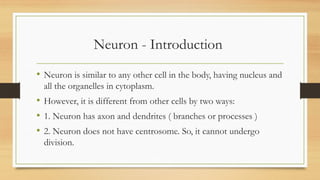
• Neuron is similar to any other cell in the body, having nucleus and
all the organelles in cytoplasm.
• However, it is different from other cells by two ways:
• 1. Neuron has axon and dendrites ( branches or processes )
• 2. Neuron does not have centrosome. So, it cannot undergo
division.
Structure of Neuron
STRUCTURE OF NEURON
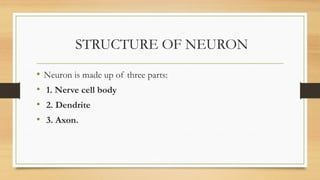
• Neuron is made up of three parts:
• 1. Nerve cell body
• 2. Dendrite
• 3. Axon.
NERVE CELL BODY
• Nerve cell body is also known as soma or perikaryon.
• It is irregular in shape.
• Like any other cell, it is constituted by a mass of
cytoplasm called neuroplasm, which is covered by a cell
membrane.
Classification of Neurons
• Neurons are classified by three different methods.
• A. Depending upon the number of poles
• B. Depending upon the function
• C. Depending upon the length of axon.
DEPENDING UPON THE NUMBER OF POLES
• Based on the number of poles from which the nerve fibers arise, neurons are
divided into three types:
• 1. Unipolar neurons
• 2. Bipolar neurons
• 3. Multipolar neurons.
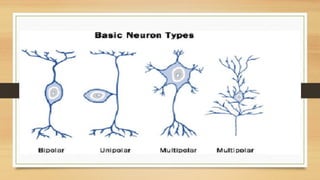
1. Unipolar Neurons
• Unipolar neurons are the neurons that have only one pole.
• From a single pole, both axon and dendrite arise.
• This type of nerve cells is present only in embryonic stage in human beings.
2. Bipolar Neurons
• Neurons with two poles are known as bipolar neurons.
• Axon arises from one pole and dendrites arise from the other pole.
3. Multipolar Neurons
• Multipolar neurons are the neurons which have many poles.
• One of the poles gives rise to axon and all other poles give rise to
dendrites.
DEPENDING UPON THE
„ FUNCTION
• On the basis of function, nerve cells are classified into
• two types:
• 1. Motor or efferent neurons
• 2. Sensory or afferent neurons.
1. Motor or Efferent Neurons
• Motor or efferent neurons are the neurons which carry the motor
impulses from central nervous system to peripheral effector
organs like muscles, glands, blood vessels, etc.
• Generally, each motor neuron has a long axon and short
dendrites.
2. Sensory or Afferent Neurons
• Sensory or afferent neurons are the neurons which carry the
sensory impulses from periphery to central nervous system.
• Generally, each sensory neuron has a short axon and long
dendrites.
DEPENDING UPON THE LENGTH OF AXON
• Depending upon the length of axon, neurons are divided into two types:
• 1. Golgi type I neurons
• 2. Golgi type II neurons.
1. Golgi Type I Neurons
• Golgi type I neurons have long axons.
• Cell body of these neurons is in different parts of central
nervous system and their axons reach the remote
peripheral organs.
2. Golgi Type II Neurons
• Neurons of this type have short axons.
• These neurons are present in cerebral cortex and spinal
cord.
NERVE CELL BODY
• The cytoplasm contains a large nucleus, Nissl bodies,
neurofibrils, mitochondria and Golgi apparatus.
• Nissl bodies and neurofibrils are found only in nerve cell
and not in other cells.
Nucleus
• Each neuron has one nucleus, which is centrally placed in
the nerve cell body.
• Nucleus has one or two prominent nucleoli.
• Nucleus does not contain centrosome. So, the nerve cell
cannot multiply like other cells.
Nissl Bodies
• Nissl bodies or Nissl granules are small basophilic granules
found in cytoplasm of neurons and are named after the
discoverer.
• These bodies are present in soma and dendrite but not in
axon and axon hillock.
Nissl Bodies
• Nissl bodies are called tigroid substances, since these bodies
are responsible for tigroid or spotted appearance of soma after
suitable staining.
• Nissl bodies contain ribosomes, so these bodies are concerned
with synthesis of proteins in the neurons.
• During fatigue or injury of the neuron, these bodies fragment
and disappear by a process called chromatolysis.
Neurofibrils
• Neurofibrils are thread-like structures present in the form
of network in the soma and the nerve processes.
• Presence of neurofibrils is another characteristic feature
of the neurons.
• The neurofibrils consist of microfilaments and
microtubules.
Mitochondria
• Mitochondria are present in soma and in axon.
• As in other cells, here also mitochondria form the
powerhouse of the nerve cell, where ATP is produce.
Golgi apparatus
• Golgi Apparatus of nerve cell body is similar to that of
other cells.
• It is concerned with processing and packing of proteins
into granules
Dendrite and Axon
• Dendrite and axon form the processes of neuron.
• Dendrites are short processes and the axons are long processes.
• Dendrites and axons are usually called nerve fibers.
• Dendrites are distinguished from axons by the presence of Nissl
granules under microscope.
DENDRITE
• Dendrite is the branched process of neuron and it is branched repeatedly.
• Dendrite may be present or absent.
• If present, it may be one or many in number.
• Dendrite has Nissl granules and neurofibrils.
• Dendrite transmits impulses towards the nerve cell body.
• Usually, the dendrite is shorter than axon.
AXON
• Axon is the longer process of nerve cell.
• Each neuron has only one axon. Axon arises from axon hillock of the nerve
cell body and it is devoid of Nissl granules.
• Axon extends for a long distance away from the nerve cell body.
• Length of longest axon is about 1 meter.
• Axon transmits impulses away from the nerve cell body.
Neuron structural & functional cell.pptx

Neuron structural & functional cell.pptx

  • 1.
  • 2.
    Neuron - Introduction •Neuron is similar to any other cell in the body, having nucleus and all the organelles in cytoplasm. • However, it is different from other cells by two ways: • 1. Neuron has axon and dendrites ( branches or processes ) • 2. Neuron does not have centrosome. So, it cannot undergo division.
  • 3.
  • 4.
    STRUCTURE OF NEURON •Neuron is made up of three parts: • 1. Nerve cell body • 2. Dendrite • 3. Axon.
  • 5.
    NERVE CELL BODY •Nerve cell body is also known as soma or perikaryon. • It is irregular in shape. • Like any other cell, it is constituted by a mass of cytoplasm called neuroplasm, which is covered by a cell membrane.
  • 6.
    Classification of Neurons •Neurons are classified by three different methods. • A. Depending upon the number of poles • B. Depending upon the function • C. Depending upon the length of axon.
  • 7.
    DEPENDING UPON THENUMBER OF POLES • Based on the number of poles from which the nerve fibers arise, neurons are divided into three types: • 1. Unipolar neurons • 2. Bipolar neurons • 3. Multipolar neurons.
  • 9.
    1. Unipolar Neurons •Unipolar neurons are the neurons that have only one pole. • From a single pole, both axon and dendrite arise. • This type of nerve cells is present only in embryonic stage in human beings.
  • 10.
    2. Bipolar Neurons •Neurons with two poles are known as bipolar neurons. • Axon arises from one pole and dendrites arise from the other pole.
  • 11.
    3. Multipolar Neurons •Multipolar neurons are the neurons which have many poles. • One of the poles gives rise to axon and all other poles give rise to dendrites.
  • 12.
    DEPENDING UPON THE „FUNCTION • On the basis of function, nerve cells are classified into • two types: • 1. Motor or efferent neurons • 2. Sensory or afferent neurons.
  • 13.
    1. Motor orEfferent Neurons • Motor or efferent neurons are the neurons which carry the motor impulses from central nervous system to peripheral effector organs like muscles, glands, blood vessels, etc. • Generally, each motor neuron has a long axon and short dendrites.
  • 14.
    2. Sensory orAfferent Neurons • Sensory or afferent neurons are the neurons which carry the sensory impulses from periphery to central nervous system. • Generally, each sensory neuron has a short axon and long dendrites.
  • 15.
    DEPENDING UPON THELENGTH OF AXON • Depending upon the length of axon, neurons are divided into two types: • 1. Golgi type I neurons • 2. Golgi type II neurons.
  • 16.
    1. Golgi TypeI Neurons • Golgi type I neurons have long axons. • Cell body of these neurons is in different parts of central nervous system and their axons reach the remote peripheral organs.
  • 17.
    2. Golgi TypeII Neurons • Neurons of this type have short axons. • These neurons are present in cerebral cortex and spinal cord.
  • 18.
    NERVE CELL BODY •The cytoplasm contains a large nucleus, Nissl bodies, neurofibrils, mitochondria and Golgi apparatus. • Nissl bodies and neurofibrils are found only in nerve cell and not in other cells.
  • 19.
    Nucleus • Each neuronhas one nucleus, which is centrally placed in the nerve cell body. • Nucleus has one or two prominent nucleoli. • Nucleus does not contain centrosome. So, the nerve cell cannot multiply like other cells.
  • 20.
    Nissl Bodies • Nisslbodies or Nissl granules are small basophilic granules found in cytoplasm of neurons and are named after the discoverer. • These bodies are present in soma and dendrite but not in axon and axon hillock.
  • 21.
    Nissl Bodies • Nisslbodies are called tigroid substances, since these bodies are responsible for tigroid or spotted appearance of soma after suitable staining. • Nissl bodies contain ribosomes, so these bodies are concerned with synthesis of proteins in the neurons. • During fatigue or injury of the neuron, these bodies fragment and disappear by a process called chromatolysis.
  • 22.
    Neurofibrils • Neurofibrils arethread-like structures present in the form of network in the soma and the nerve processes. • Presence of neurofibrils is another characteristic feature of the neurons. • The neurofibrils consist of microfilaments and microtubules.
  • 23.
    Mitochondria • Mitochondria arepresent in soma and in axon. • As in other cells, here also mitochondria form the powerhouse of the nerve cell, where ATP is produce.
  • 24.
    Golgi apparatus • GolgiApparatus of nerve cell body is similar to that of other cells. • It is concerned with processing and packing of proteins into granules
  • 25.
    Dendrite and Axon •Dendrite and axon form the processes of neuron. • Dendrites are short processes and the axons are long processes. • Dendrites and axons are usually called nerve fibers. • Dendrites are distinguished from axons by the presence of Nissl granules under microscope.
  • 26.
    DENDRITE • Dendrite isthe branched process of neuron and it is branched repeatedly. • Dendrite may be present or absent. • If present, it may be one or many in number. • Dendrite has Nissl granules and neurofibrils. • Dendrite transmits impulses towards the nerve cell body. • Usually, the dendrite is shorter than axon.
  • 27.
    AXON • Axon isthe longer process of nerve cell. • Each neuron has only one axon. Axon arises from axon hillock of the nerve cell body and it is devoid of Nissl granules. • Axon extends for a long distance away from the nerve cell body. • Length of longest axon is about 1 meter. • Axon transmits impulses away from the nerve cell body.