NEUROMUSCULAR
JUNCTION
PRESENTED BY
DR. N.D.KHAN
M.D (HOM.)
(HOMOEOPATHY UNIVERSITY JAIPUR RAJASTHAN)
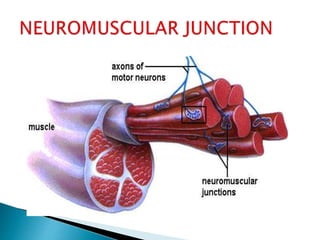
 „Junction between terminal branch of the
nerve fibre and muscle fibre. It is called
myoneural junction or motor end plate
 Action potential from nerve transmitted to
muscles through this junction.
 Skeletal muscle fibres are innervated by the
motor nerve fibre. Each nerve fibre (axon)
divides into many terminal branches. Each
terminal branch innervates one muscle fibre
through the neuromuscular junction
 Terminal branch of nerve fibre is called axon
terminal. When the axon comes close to
muscle fibre, it loses the myelin sheath. So,
the axis cylinder is exposed and expanded
like a bulb, which is called motor endplate.
 Motor end plate invaginates inside the muscle
fibre and forms a depression called synaptic
gutter
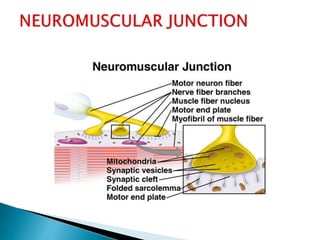
 Axon terminal contains mitochondria and
synaptic vesicles which contain acetylcholine.
 synaptic cleft.- A space between nerve ending
and muscles ending membrane 50-100 nm wide.
 Nerve ending membrane-Presynaptic membrane-
nerve ending membrane contains mitochondria
and synaptic vesicles which contains
Acetylcholine
 Muscle ending Membrane-Post synaptic
membrane or End plate menbrane-is the
membrane of MF. It’s a part of sarcolemma & lies
under terminal bottom. It is thrown into several
folds called junctional fold or subneural clefts.
contains Nicotinic acetylcholine receptors which
contains Na channels
 Synaptic cleft contains basement
membrane which cover MF. It is a thin
layer of spongy reticular matrix
through which, the ECF diffuses.
Acetylcholinesterase attached to it and
hydrolysed Ach in Acetate and Choline
 Nicotinic type
 15-40 millions/ end plate
 Chemically gated ion channals
 Blocked by a Bungarotoxin
 Contains voltage gated Na channels & allow
passes of only cations
 Transmission of information or impulses
from motor neuron to skeletal muscles
through neuromuscular junction. motor
nerve impulses initiate muscle
contraction by series of three events.
 Presynaptic events-Release and action of
acetylcholine
 Synaptic events-binding of Ach. to
receptors
 Post synaptic events- development of AP
 When action potential reaches axon terminal,
it activates and opens the voltage-gated Ca
channels in the membrane of axon terminal.
Calcium ions from ECF enter the axon
terminal Ca influx –increase movement of
MicrotUbules & Microfilaments- causes
migration of Neurotransmiter vesicles to pre
syneptic membrane – DOKING
 These cause bursting of the vesicles Now,
acetylcholine is released from the ruptured
vesicles. By exocytosis, acetylcholine diffuses
through the presynaptic membrane and
enters the synaptic cleft.
 Acetylcholine release as Quantal
 One Quanta generates miniature end plate
potential (MEPP)
 Sir Bernard Kart, Julius Axelrod and Ulf von
Euler received Nobel prize in 1970 for the
study of neurotransmitter in medicine or
physiology
 Acetylcholine molecules bind with nicotinic
acetylcholine receptors and form
acetylcholine-receptor complex. It increases
the permeability of PSM for sodium by
opening the ligand-gated sodium channels.
Now, sodium ions from ECF enter the NMJ
through these channels. And alter the resting
membrane potential and develops the
electrical potential called the endplate
potential.
 Endplate potential is the change in resting
membrane potential when an impulse reaches
the neuromuscular junction.
 RMP at neuromuscular junction is -80 to –90
mV. When sodium ions enter inside, slight
depolarization occurs up to –60 mV, OR local
positive potential change occurs which is
called endplate potential.
 It is localized Non propagated dose not obey
All or None low
 When it reached critical level of -60 mV It
causes the development of action potential in
the muscle fibre in both direction.
 Miniature endplate potential is a weak
endplate potential that is developed by the
release of a small quantity of acetylcholine
from axon terminal up to 0.5 mV.
 Miniature endplate potential cannot produce
action potential in the muscle. When more
and more quanta of acetylcholine are
released continuously, the miniature endplate
potentials are added together and finally
produce endplate potential resulting in action
potential in the muscle.
 Acetylcholine released into the synaptic cleft
is destroyed very quickly, within 1 ms by the
enzyme, acetylcholinesterase. However, the
acetylcholine is so potent, that even this
short duration of 1 ms is sufficient to excite
the muscle fibre. Rapid destruction of
acetylcholine has got some important
functional significance. It prevents the
repeated excitation of the muscle fibre and
allows the muscle to relax.
 Remaining diffused out of synaptic space &
no longer available for action
 Reuptake is a process in neuromuscular
junction, by which a degraded product of
neurotransmitter re-enters the presynaptic
axon terminal where it is reused.
Acetylcholinesterase splits acetylcholine into
inactive choline and acetate. Choline is taken
back into axon terminal from synaptic cleft by
reuptake process. There, it is reused in
synaptic vesicle to form new acetylcholine
molecule.
 Neuromuscular blockers are the drugs, which
prevent transmission of impulses from nerve
fibre to the muscle fibre through the NMJ.
Neuromuscular blockers used during
anaesthesia relax the skeletal muscles and
induce paralysis so that surgery can be
conducted with less complication. Following
are important neuromuscular blockers, which
are commonly used in clinics and research.
 1. Curare – active principle D- Tubocurarine
(cobra) Curare prevents the neuromuscular
transmission by combining with acetylcholine
receptors. So, the acetylcholine cannot combine
with the receptors. And, the endplate potential
cannot develop. Since curare blocks the
neuromuscular transmission by acting on the
acetylcholine receptors, it is called receptor
blocker.
 2. Bungarotoxin- Bungarotoxin is a toxin from
the venom of deadly snakes Krait . It affects the
neuromuscular transmission by blocking the
acetylcholine receptors.
 3. Succinylcholine and Carbamylcholine These
drugs block the neuromuscular transmission
by acting like acetylcholine and keeping the
muscle in a depolarized state. But, these
drugs are not destroyed by cholinesterase.
So, the muscle remains in a depolarized state
for a long time.
 4. Botulinum Toxin Botulinum toxin is derived
from the bacteria Clostridium Botulinum. It
prevents release of acetylcholine from axon
terminal into the neuromuscular junction.
 Drugs having acetylcholine like action
 Methacholine, Carbachol & Nicoitn
 Drugs antichilinesterase
 Neostigmine,
 Physostigmine
 Diisopropyl fluorophosphates.
 These drugs inactivate the enzyme, acetyl
cholinesterase. So, the acetylcholine is not
hydrolyzed. It leads to repeated stimulation
and continuous contraction of the muscle.
 Single motor neuron, its axon terminals and
the muscle fibres innervated by it are
together called motor unit. Each motor
neuron activates a group of muscle fibres
through the axon terminals. Stimulation of a
motor neuron causes contraction of all the
muscle fibres innervated by that neuron.
 Number of muscle fiber in each motor unit
varies. The motor units of the muscles concerned
with fine, graded
 Laryngeal muscles : 2 to 3 muscle fibers per
motor unit Pharyngeal muscles : 2 to 6 muscle
fibers per motor unit Ocular muscles : 3 to 6
muscle fibers per motor unit Muscles concerned
with crude or coarse movements have motor
units with large number of muscle fibers. There
are about 120 to 165 muscle fibers in each
motor unit in these muscles. Examples are the
muscles of leg and back
 While stimulating the muscle with weak
strength, only a few motor units are involved.
When the strength of stimulus is increased,
many motor units are put into action. So, the
force of contraction increases. The process by
which more and more motor units are put
into action is called recruitment of motor
unit. Thus, the graded response in the muscle
is directly proportional to the number of
motor units activated. Activation of motor
units can be studied by electromyography.
 MYASTHENIA GRAVIS -Myasthenia gravis is an
autoimmune disorder of neuromuscular
junction. Antibodies are produced against
Acetylcholine receptors & destroyed these
channels
 So acetyl choline released will not produced
adequate end plate potential & exite MF
 So patient dies of paralysis of Respiratory
muscles
 Eaton-Lambert syndrome is also an
autoimmune disorder of neuromuscular
junction. It is caused by antibodies against to
calcium channels in axon terminal in pre-
synaptic membrane so Ca influx decrease &
decrease of release of acetylcholine
 loss of motor power (power of movement)
inability of muscles to contract, by damaging
UMN OR LMN
 Damage of UMN causes spastic paralysis with
exaggerated tendon jerk.
 Damage to UMN causes flaccid paralysis with
loss of tendon jerk e.g. Poliomyelitis
 Atrophy & hypertrophy, Hyperplasia
 Muscular spasm- tetanus, epilepsy
Doing the same thing
over and over again and expecting
different result
- Albert Einstein
THANK YOU

Neuromuscular junction

  • 1.
    NEUROMUSCULAR JUNCTION PRESENTED BY DR. N.D.KHAN M.D(HOM.) (HOMOEOPATHY UNIVERSITY JAIPUR RAJASTHAN)
  • 5.
     „Junction betweenterminal branch of the nerve fibre and muscle fibre. It is called myoneural junction or motor end plate  Action potential from nerve transmitted to muscles through this junction.  Skeletal muscle fibres are innervated by the motor nerve fibre. Each nerve fibre (axon) divides into many terminal branches. Each terminal branch innervates one muscle fibre through the neuromuscular junction
  • 6.
     Terminal branchof nerve fibre is called axon terminal. When the axon comes close to muscle fibre, it loses the myelin sheath. So, the axis cylinder is exposed and expanded like a bulb, which is called motor endplate.  Motor end plate invaginates inside the muscle fibre and forms a depression called synaptic gutter  Axon terminal contains mitochondria and synaptic vesicles which contain acetylcholine.
  • 7.
     synaptic cleft.-A space between nerve ending and muscles ending membrane 50-100 nm wide.  Nerve ending membrane-Presynaptic membrane- nerve ending membrane contains mitochondria and synaptic vesicles which contains Acetylcholine  Muscle ending Membrane-Post synaptic membrane or End plate menbrane-is the membrane of MF. It’s a part of sarcolemma & lies under terminal bottom. It is thrown into several folds called junctional fold or subneural clefts. contains Nicotinic acetylcholine receptors which contains Na channels
  • 8.
     Synaptic cleftcontains basement membrane which cover MF. It is a thin layer of spongy reticular matrix through which, the ECF diffuses. Acetylcholinesterase attached to it and hydrolysed Ach in Acetate and Choline
  • 9.
     Nicotinic type 15-40 millions/ end plate  Chemically gated ion channals  Blocked by a Bungarotoxin  Contains voltage gated Na channels & allow passes of only cations
  • 10.
     Transmission ofinformation or impulses from motor neuron to skeletal muscles through neuromuscular junction. motor nerve impulses initiate muscle contraction by series of three events.  Presynaptic events-Release and action of acetylcholine  Synaptic events-binding of Ach. to receptors  Post synaptic events- development of AP
  • 11.
     When actionpotential reaches axon terminal, it activates and opens the voltage-gated Ca channels in the membrane of axon terminal. Calcium ions from ECF enter the axon terminal Ca influx –increase movement of MicrotUbules & Microfilaments- causes migration of Neurotransmiter vesicles to pre syneptic membrane – DOKING  These cause bursting of the vesicles Now, acetylcholine is released from the ruptured vesicles. By exocytosis, acetylcholine diffuses through the presynaptic membrane and enters the synaptic cleft.
  • 12.
     Acetylcholine releaseas Quantal  One Quanta generates miniature end plate potential (MEPP)  Sir Bernard Kart, Julius Axelrod and Ulf von Euler received Nobel prize in 1970 for the study of neurotransmitter in medicine or physiology
  • 13.
     Acetylcholine moleculesbind with nicotinic acetylcholine receptors and form acetylcholine-receptor complex. It increases the permeability of PSM for sodium by opening the ligand-gated sodium channels. Now, sodium ions from ECF enter the NMJ through these channels. And alter the resting membrane potential and develops the electrical potential called the endplate potential.
  • 14.
     Endplate potentialis the change in resting membrane potential when an impulse reaches the neuromuscular junction.  RMP at neuromuscular junction is -80 to –90 mV. When sodium ions enter inside, slight depolarization occurs up to –60 mV, OR local positive potential change occurs which is called endplate potential.  It is localized Non propagated dose not obey All or None low  When it reached critical level of -60 mV It causes the development of action potential in the muscle fibre in both direction.
  • 15.
     Miniature endplatepotential is a weak endplate potential that is developed by the release of a small quantity of acetylcholine from axon terminal up to 0.5 mV.  Miniature endplate potential cannot produce action potential in the muscle. When more and more quanta of acetylcholine are released continuously, the miniature endplate potentials are added together and finally produce endplate potential resulting in action potential in the muscle.
  • 16.
     Acetylcholine releasedinto the synaptic cleft is destroyed very quickly, within 1 ms by the enzyme, acetylcholinesterase. However, the acetylcholine is so potent, that even this short duration of 1 ms is sufficient to excite the muscle fibre. Rapid destruction of acetylcholine has got some important functional significance. It prevents the repeated excitation of the muscle fibre and allows the muscle to relax.  Remaining diffused out of synaptic space & no longer available for action
  • 17.
     Reuptake isa process in neuromuscular junction, by which a degraded product of neurotransmitter re-enters the presynaptic axon terminal where it is reused. Acetylcholinesterase splits acetylcholine into inactive choline and acetate. Choline is taken back into axon terminal from synaptic cleft by reuptake process. There, it is reused in synaptic vesicle to form new acetylcholine molecule.
  • 18.
     Neuromuscular blockersare the drugs, which prevent transmission of impulses from nerve fibre to the muscle fibre through the NMJ. Neuromuscular blockers used during anaesthesia relax the skeletal muscles and induce paralysis so that surgery can be conducted with less complication. Following are important neuromuscular blockers, which are commonly used in clinics and research.
  • 19.
     1. Curare– active principle D- Tubocurarine (cobra) Curare prevents the neuromuscular transmission by combining with acetylcholine receptors. So, the acetylcholine cannot combine with the receptors. And, the endplate potential cannot develop. Since curare blocks the neuromuscular transmission by acting on the acetylcholine receptors, it is called receptor blocker.  2. Bungarotoxin- Bungarotoxin is a toxin from the venom of deadly snakes Krait . It affects the neuromuscular transmission by blocking the acetylcholine receptors.
  • 20.
     3. Succinylcholineand Carbamylcholine These drugs block the neuromuscular transmission by acting like acetylcholine and keeping the muscle in a depolarized state. But, these drugs are not destroyed by cholinesterase. So, the muscle remains in a depolarized state for a long time.  4. Botulinum Toxin Botulinum toxin is derived from the bacteria Clostridium Botulinum. It prevents release of acetylcholine from axon terminal into the neuromuscular junction.
  • 21.
     Drugs havingacetylcholine like action  Methacholine, Carbachol & Nicoitn  Drugs antichilinesterase  Neostigmine,  Physostigmine  Diisopropyl fluorophosphates.  These drugs inactivate the enzyme, acetyl cholinesterase. So, the acetylcholine is not hydrolyzed. It leads to repeated stimulation and continuous contraction of the muscle.
  • 22.
     Single motorneuron, its axon terminals and the muscle fibres innervated by it are together called motor unit. Each motor neuron activates a group of muscle fibres through the axon terminals. Stimulation of a motor neuron causes contraction of all the muscle fibres innervated by that neuron.
  • 23.
     Number ofmuscle fiber in each motor unit varies. The motor units of the muscles concerned with fine, graded  Laryngeal muscles : 2 to 3 muscle fibers per motor unit Pharyngeal muscles : 2 to 6 muscle fibers per motor unit Ocular muscles : 3 to 6 muscle fibers per motor unit Muscles concerned with crude or coarse movements have motor units with large number of muscle fibers. There are about 120 to 165 muscle fibers in each motor unit in these muscles. Examples are the muscles of leg and back
  • 24.
     While stimulatingthe muscle with weak strength, only a few motor units are involved. When the strength of stimulus is increased, many motor units are put into action. So, the force of contraction increases. The process by which more and more motor units are put into action is called recruitment of motor unit. Thus, the graded response in the muscle is directly proportional to the number of motor units activated. Activation of motor units can be studied by electromyography.
  • 25.
     MYASTHENIA GRAVIS-Myasthenia gravis is an autoimmune disorder of neuromuscular junction. Antibodies are produced against Acetylcholine receptors & destroyed these channels  So acetyl choline released will not produced adequate end plate potential & exite MF  So patient dies of paralysis of Respiratory muscles
  • 26.
     Eaton-Lambert syndromeis also an autoimmune disorder of neuromuscular junction. It is caused by antibodies against to calcium channels in axon terminal in pre- synaptic membrane so Ca influx decrease & decrease of release of acetylcholine
  • 27.
     loss ofmotor power (power of movement) inability of muscles to contract, by damaging UMN OR LMN  Damage of UMN causes spastic paralysis with exaggerated tendon jerk.  Damage to UMN causes flaccid paralysis with loss of tendon jerk e.g. Poliomyelitis  Atrophy & hypertrophy, Hyperplasia  Muscular spasm- tetanus, epilepsy
  • 28.
    Doing the samething over and over again and expecting different result - Albert Einstein THANK YOU