NEUROGENIC PULMONARY EDEMA
Dr. Muhammed Thasneem
K

Junior Resident, Dept. of General Surgery 1
CONTENT
Introductio
n

Epidemiolog
y

Pathophysiolog
y

NPE Trigger Zone
s

Pathogenesi
s

Clinical Feature
s

Diagnosi
s

Management 2
INTRODUCTION
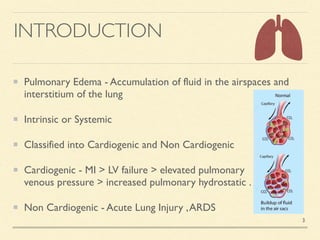
Pulmonary Edema - Accumulation of fluid in the airspaces and
interstitium of the lun
g

Intrinsic or Systemi
c

Classified into Cardiogenic and Non Cardiogeni
c

Cardiogenic - MI > LV failure > elevated pulmonary
venous pressure > increased pulmonary hydrostatic
.

Non Cardiogenic - Acute Lung Injury ,ARDS
3
NEUROGENIC
PULMONARY EDEMA
Rare form of Pulmonary Edema, follows CNS insult
.

Caused by increase in pulmonary interstitial and alveolar fluid
.

Potential to increase the secondary injury to brain - fatal
.

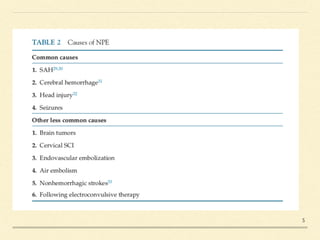
SAH,Traumatic Brain Injury, Cervical Spinal Cord Injury,
Intracerebral Hemorrhage are associated with NPE.
4
5
EPIDEMIOLOGY
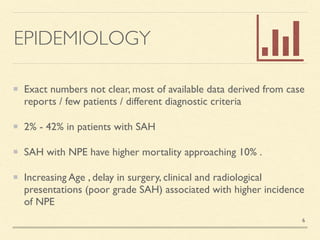
Exact numbers not clear, most of available data derived from case
reports / few patients / different diagnostic criteri
a

2% - 42% in patients with SA
H

SAH with NPE have higher mortality approaching 10%
.

Increasing Age , delay in surgery, clinical and radiological
presentations (poor grade SAH) associated with higher incidence
of NPE
6
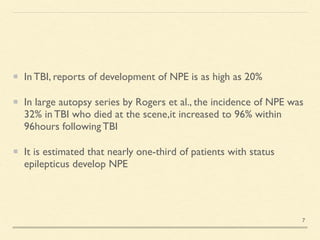
In TBI, reports of development of NPE is as high as 20
%

In large autopsy series by Rogers et al., the incidence of NPE was
32% in TBI who died at the scene,it increased to 96% within
96hours following TB
I

It is estimated that nearly one-third of patients with status
epilepticus develop NPE
7
PATHOPHYSIOLOGY OF
NPE
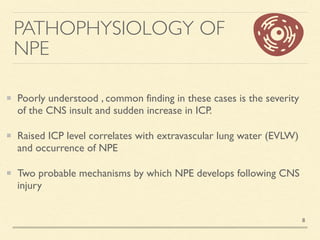
Poorly understood , common finding in these cases is the severity
of the CNS insult and sudden increase in ICP
.

Raised ICP level correlates with extravascular lung water (EVLW)
and occurrence of NP
E

Two probable mechanisms by which NPE develops following CNS
injury
8
1. Damages to the neurons directly or indirectly affects the
pulmonary vascular bed, leading to increased permeability and
hence pulmonary edem
a

11. Overstimulation of the vasomotor center inflicts changes in
autonomic function.
9
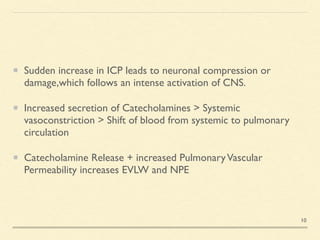
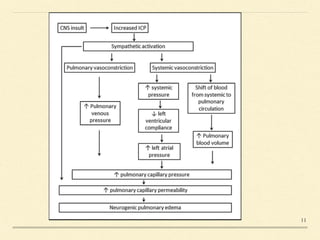
Sudden increase in ICP leads to neuronal compression or
damage,which follows an intense activation of CNS
.

Increased secretion of Catecholamines > Systemic
vasoconstriction > Shift of blood from systemic to pulmonary
circulatio
n

Catecholamine Release + increased PulmonaryVascular
Permeability increases EVLW and NPE
10
11
NPETRIGGER ZONES
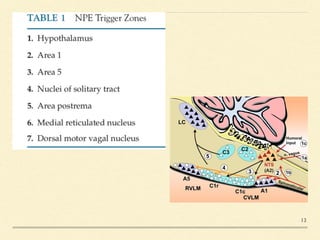
Hypothalamus ,Brain Stem,Upper Cervical Spinal Cor
d

The imp. centres for triggering NPE are A1,A5 nuclei, nuclei of
solitary tract, area postrem
a

A1 nuclei - present inVentroLateral aspect of Medulla and
project in hypothalamu
s

A5 neurons are located in the upper brain stem and project into
centres for sympathetic flow in the spinal cord
12
13
PATHOGENESIS
Sudden increase in ICP, in association with sympathetic discharge ,
has been associated with development of NPE , four mechanisms
have been proposed by which PE develop
s

1 . NEUROCARDIAC NP
E

directly inflicts myocardial injury, inturn lead to pulmonary
edema,characterised by cardiomyopathy with diastolic
dysfunction ,decreased contractility and global hypokinesia
14
histology-myocytolysis and contraction band necrosis
 

ECG - regional wall , motion wall abnormalit
y

Sudden surge of catecholamines is the causative factor in this
form of NPE
15
2.NEUROHEMODYNAMIC THEOR
Y

Alteration in ventricular compliance is believed to cause abrupt
increase in pulmonary and systemic pressures after a CNS injur
y

Sudden increase in afterload causes altered LVF , blood shifts to
low resistance PulmonaryVascular System , increased pressure in
pulmonary circulation forms Hydrostatic Pulmonary Edema
16
3. BLAST THEOR
Y

Explains the presence of RBCs and exudative fluid in alveolar
space
 

The Shift in the blood from systemic circulation to pulmonary
circulation causes altered permeability and forms exudative
pulmonary edem
a

The sudden increase in pulmonary circulation also leads to
damage of alveolar - capillary membrane, explains presence of
RBCs and protein rich PE.
17
4.ADRENERGIC HYPERSENSITIVITY of pulmonary venules to
catecholamines . Catecholamine surge leads to endothelial injury
irrespective of systemic changes
18
CLINICAL FEATURES
Depending on onset of symptoms and signs , two forms of NP
E

1. Early Onset - onset of symptoms within minutes to hour
s

2. Delayed Onset - following 12-24 h of CNS insult
.

Severity of Neurologic Insult = Severity of NPE
19
Typically , patient may complain of difficulty in breathin
g

Acute Onset Dyspnea ,Tachypnoea and Hypoxia - onset of NP
E

Auscultation - B/l Crackle
s

Pink, Frothy Sputu
m

Sympathetic Hyperactivity - Tachycardia,Hypertension and Fever
Spikes.
20
DIAGNOSIS
No specific diagnostic test for NP
E

neurologic origin is a diagnosis of exclusio
n

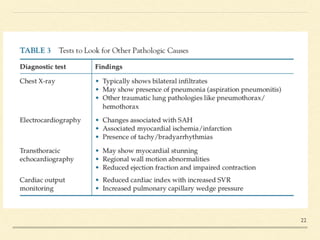
ECG changes and elevated Cardiac enzymes may be asso. with
SA
H

high degree of suspicion to rule out cardiogenic PE
21
22
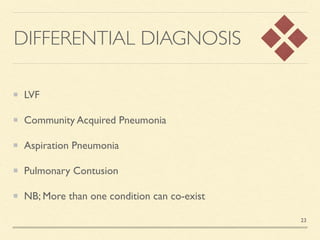
DIFFERENTIAL DIAGNOSIS
LV
F

Community Acquired Pneumoni
a

Aspiration Pneumoni
a

Pulmonary Contusio
n

NB; More than one condition can co-exist
23
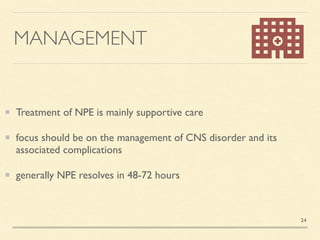
MANAGEMENT
Treatment of NPE is mainly supportive care
 

focus should be on the management of CNS disorder and its
associated complication
s

generally NPE resolves in 48-72 hours
24
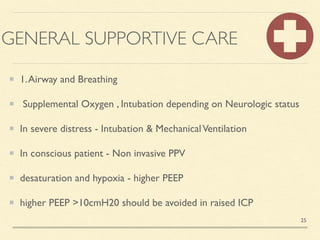
GENERAL SUPPORTIVE CARE
1.Airway and Breathin
g

Supplemental Oxygen , Intubation depending on Neurologic statu
s

In severe distress - Intubation & MechanicalVentilatio
n

In conscious patient - Non invasive PPV
 

desaturation and hypoxia - higher PEE
P

higher PEEP >10cmH20 should be avoided in raised ICP
25
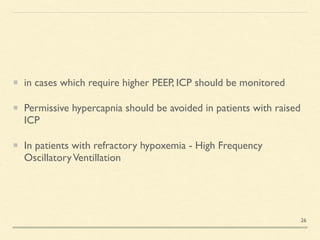
in cases which require higher PEEP, ICP should be monitore
d

Permissive hypercapnia should be avoided in patients with raised
IC
P

In patients with refractory hypoxemia - High Frequency
OscillatoryVentillation
26
2. CIRCULATION
:

Choice of drug depends on associated injuries and preexisting
patholog
y

Cardiac Index should be maintained >2.5L / min / M^
2

SystemicVascular Resistance < 1000dynes/second/cm-
5

Dobutamine is the first line of drug
 

addl, beta1 agonists and alpha adrenergic blockers have been
tried
27
SPECIFICTHERAPY
Pharmacological agents not routinely used in the management of
NP
E

beta blockers and alpha adrenergic blockers have been trie
d

NPE is self limiting and resolves spontaneously , care should be
ensured for adequate Cerebral Perfusion Pressur
e

EFforts to reduce ICP like Decompression, Hematoma
Evacuation, anti epileptics ,tumor resection and steroids -
improvement in Oxygenation
28
CONCLUSION
SUDDEN ONSET OF HYPOXEMIC RESPIRATORY FAILURE IN
ASSOCIATION WITH A CNS CATASTROPHE ,WHICH
CANNOT BE ATTRIBUTED TO ANY OTHER CAUSE , POINTS
TOWARDS NPE
.

SUPPORTIVE CARE OF PATIENTS TO PREVENT HYPOXIA IS
THE MAINSTAY OF TREATMENT
29
REFERENCE
Complications in Neuroanaesthesia - Hemanshu Prabhaka
r

Rosen's Emergency Medicine
30
–Wilder Penfield
“The brain is the organ of destiny. It holds within its
humming mechanism secrets that will determine the
future of human race .”
31
THANKYOU
32

Neurogenic Pulmonary Edema

  • 1.
    NEUROGENIC PULMONARY EDEMA Dr.Muhammed Thasneem K Junior Resident, Dept. of General Surgery 1
  • 2.
  • 3.
    INTRODUCTION Pulmonary Edema -Accumulation of fluid in the airspaces and interstitium of the lun g Intrinsic or Systemi c Classified into Cardiogenic and Non Cardiogeni c Cardiogenic - MI > LV failure > elevated pulmonary venous pressure > increased pulmonary hydrostatic . Non Cardiogenic - Acute Lung Injury ,ARDS 3
  • 4.
    NEUROGENIC PULMONARY EDEMA Rare formof Pulmonary Edema, follows CNS insult . Caused by increase in pulmonary interstitial and alveolar fluid . Potential to increase the secondary injury to brain - fatal . SAH,Traumatic Brain Injury, Cervical Spinal Cord Injury, Intracerebral Hemorrhage are associated with NPE. 4
  • 5.
  • 6.
    EPIDEMIOLOGY Exact numbers notclear, most of available data derived from case reports / few patients / different diagnostic criteri a 2% - 42% in patients with SA H SAH with NPE have higher mortality approaching 10% . Increasing Age , delay in surgery, clinical and radiological presentations (poor grade SAH) associated with higher incidence of NPE 6
  • 7.
    In TBI, reportsof development of NPE is as high as 20 % In large autopsy series by Rogers et al., the incidence of NPE was 32% in TBI who died at the scene,it increased to 96% within 96hours following TB I It is estimated that nearly one-third of patients with status epilepticus develop NPE 7
  • 8.
    PATHOPHYSIOLOGY OF NPE Poorly understood, common finding in these cases is the severity of the CNS insult and sudden increase in ICP . Raised ICP level correlates with extravascular lung water (EVLW) and occurrence of NP E Two probable mechanisms by which NPE develops following CNS injury 8
  • 9.
    1. Damages tothe neurons directly or indirectly affects the pulmonary vascular bed, leading to increased permeability and hence pulmonary edem a 11. Overstimulation of the vasomotor center inflicts changes in autonomic function. 9
  • 10.
    Sudden increase inICP leads to neuronal compression or damage,which follows an intense activation of CNS . Increased secretion of Catecholamines > Systemic vasoconstriction > Shift of blood from systemic to pulmonary circulatio n Catecholamine Release + increased PulmonaryVascular Permeability increases EVLW and NPE 10
  • 11.
  • 12.
    NPETRIGGER ZONES Hypothalamus ,BrainStem,Upper Cervical Spinal Cor d The imp. centres for triggering NPE are A1,A5 nuclei, nuclei of solitary tract, area postrem a A1 nuclei - present inVentroLateral aspect of Medulla and project in hypothalamu s A5 neurons are located in the upper brain stem and project into centres for sympathetic flow in the spinal cord 12
  • 13.
  • 14.
    PATHOGENESIS Sudden increase inICP, in association with sympathetic discharge , has been associated with development of NPE , four mechanisms have been proposed by which PE develop s 1 . NEUROCARDIAC NP E directly inflicts myocardial injury, inturn lead to pulmonary edema,characterised by cardiomyopathy with diastolic dysfunction ,decreased contractility and global hypokinesia 14
  • 15.
    histology-myocytolysis and contractionband necrosis ECG - regional wall , motion wall abnormalit y Sudden surge of catecholamines is the causative factor in this form of NPE 15
  • 16.
    2.NEUROHEMODYNAMIC THEOR Y Alteration inventricular compliance is believed to cause abrupt increase in pulmonary and systemic pressures after a CNS injur y Sudden increase in afterload causes altered LVF , blood shifts to low resistance PulmonaryVascular System , increased pressure in pulmonary circulation forms Hydrostatic Pulmonary Edema 16
  • 17.
    3. BLAST THEOR Y Explainsthe presence of RBCs and exudative fluid in alveolar space The Shift in the blood from systemic circulation to pulmonary circulation causes altered permeability and forms exudative pulmonary edem a The sudden increase in pulmonary circulation also leads to damage of alveolar - capillary membrane, explains presence of RBCs and protein rich PE. 17
  • 18.
    4.ADRENERGIC HYPERSENSITIVITY ofpulmonary venules to catecholamines . Catecholamine surge leads to endothelial injury irrespective of systemic changes 18
  • 19.
    CLINICAL FEATURES Depending ononset of symptoms and signs , two forms of NP E 1. Early Onset - onset of symptoms within minutes to hour s 2. Delayed Onset - following 12-24 h of CNS insult . Severity of Neurologic Insult = Severity of NPE 19
  • 20.
    Typically , patientmay complain of difficulty in breathin g Acute Onset Dyspnea ,Tachypnoea and Hypoxia - onset of NP E Auscultation - B/l Crackle s Pink, Frothy Sputu m Sympathetic Hyperactivity - Tachycardia,Hypertension and Fever Spikes. 20
  • 21.
    DIAGNOSIS No specific diagnostictest for NP E neurologic origin is a diagnosis of exclusio n ECG changes and elevated Cardiac enzymes may be asso. with SA H high degree of suspicion to rule out cardiogenic PE 21
  • 22.
  • 23.
    DIFFERENTIAL DIAGNOSIS LV F Community AcquiredPneumoni a Aspiration Pneumoni a Pulmonary Contusio n NB; More than one condition can co-exist 23
  • 24.
    MANAGEMENT Treatment of NPEis mainly supportive care focus should be on the management of CNS disorder and its associated complication s generally NPE resolves in 48-72 hours 24
  • 25.
    GENERAL SUPPORTIVE CARE 1.Airwayand Breathin g Supplemental Oxygen , Intubation depending on Neurologic statu s In severe distress - Intubation & MechanicalVentilatio n In conscious patient - Non invasive PPV desaturation and hypoxia - higher PEE P higher PEEP >10cmH20 should be avoided in raised ICP 25
  • 26.
    in cases whichrequire higher PEEP, ICP should be monitore d Permissive hypercapnia should be avoided in patients with raised IC P In patients with refractory hypoxemia - High Frequency OscillatoryVentillation 26
  • 27.
    2. CIRCULATION : Choice ofdrug depends on associated injuries and preexisting patholog y Cardiac Index should be maintained >2.5L / min / M^ 2 SystemicVascular Resistance < 1000dynes/second/cm- 5 Dobutamine is the first line of drug addl, beta1 agonists and alpha adrenergic blockers have been tried 27
  • 28.
    SPECIFICTHERAPY Pharmacological agents notroutinely used in the management of NP E beta blockers and alpha adrenergic blockers have been trie d NPE is self limiting and resolves spontaneously , care should be ensured for adequate Cerebral Perfusion Pressur e EFforts to reduce ICP like Decompression, Hematoma Evacuation, anti epileptics ,tumor resection and steroids - improvement in Oxygenation 28
  • 29.
    CONCLUSION SUDDEN ONSET OFHYPOXEMIC RESPIRATORY FAILURE IN ASSOCIATION WITH A CNS CATASTROPHE ,WHICH CANNOT BE ATTRIBUTED TO ANY OTHER CAUSE , POINTS TOWARDS NPE . SUPPORTIVE CARE OF PATIENTS TO PREVENT HYPOXIA IS THE MAINSTAY OF TREATMENT 29
  • 30.
    REFERENCE Complications in Neuroanaesthesia- Hemanshu Prabhaka r Rosen's Emergency Medicine 30
  • 31.
    –Wilder Penfield “The brainis the organ of destiny. It holds within its humming mechanism secrets that will determine the future of human race .” 31
  • 32.