
NEURAXIAL ANESTHESIA
AND
ANTICOAGULATION
BY
Mohamed Abu-Elnaga
INTRODUCTION:
 The major complication of anticoagulant therapy is
bleeding.
 Bleeding can occur in the following anatomical areas:
intraspinal, intracranial, intraocular, retroperitoneal, and
mediastinal. This may result in hospitalization, transfusion,
and death.
 Factors increasing the risk of bleeding while on
anticoagulants include the following:
intensity of anticoagulant effect, increased age, female
gender, concomitant use of aspirin, history of gastrointestinal
bleeding,duration of anticoagulant treatment.
Spinal and Epidural Hematoma Formation
 Hematoma formation may be the result of a spontaneous
bleeding or trauma induced by a needle.
 The epidural space is at particular risk for bleeding due to the
rich epidural venous plexus.
 Excessive bleeding into the epidural space may lead to
compression, ischemia, nerve trauma, or paralysis. A bleed
into the intrathecal space is generally less devastating,
secondary to dilution by the cerebral spinal fluid.
 The risk of epidural hematoma formation is rare. The true
incidence is unknown. It has been estimated that the
incidence of epidural hematoma formation related to
epidural anesthesia is between 1:150,000 and 1:190,000.
The estimated incidence for spinal anesthesia is 1:220,000.
 There is a relationship between regional anesthesia and
patients that receive anticoagulant medications during
surgery. The incidence of epidural hematoma formation
increases to 33:100,000 for epidural anesthesia and
1:100,000 for spinal anesthesia.
Risk Factors for the Development of Epidural /
Spinal Hematoma
 These factors are related to the administration of spinal and
epidural anesthesia.
 These factors include the following:
 Anatomic abnormalities of the spinal cord or vertebral
column
 Vascular abnormalities
 Pathological or medication related alterations in
homeostasis
 Alcohol abuse
 Difficult and traumatic needle placement
 Epidural catheter removal
Signs and Symptoms of Epidural/Spinal Hematoma
 Low back pain (sharp and may radiate)
 Sensory and motor loss (numbness and tingling/motor
weakness long after the block should have worn off)
 Bowel and bladder dysfunction
 Paraplegia
 In the past, persistent low back pain was thought to be the
classic symptom for epidural hematoma.
 Recent research indicates that the first symptoms may
include sensory or motor loss, bowel and bladder
dysfunction, numbness and tingling, prolonged motor
weakness, and paraplegia.
Diagnostic Testing, Treatment and Outcomes
 Diagnosis of an epidural hematoma is made by MRI
(preferred), CT scan (may miss a small hematoma), and
myelogram.
 Treatment is emergency decompressive laminectomy with
hematoma evacuation. This must be done within 8-12
hours after the onset of signs and symptoms.
 The outcome is generally poor.
 There are three factors that affect the patient s recovery‟
from this devastating complication: size and location of
the hematoma, speed of development, and severity/nature
of pre-existing neurological problems.
Neuraxial Blockade and AnticoagulationNeuraxial Blockade and Anticoagulation
UNFRACTIONATED HEPARINUNFRACTIONATED HEPARIN
• Mechanism of action: binds with antithrombin III,
neutralizing the activated factors of X, XII, XI and IX.
• Duration of action: for IV heparin the elimination half life is
56 minutes.
 ASRA recommendations For patients receiving heparin:
 No contraindication to use of neuraxial blocks in patients
receiving mini-dose, subcutaneous heparin. The
administration of subcutaneous heparin should be held
until after block administration. Patient should be
screened for concurrent medications that may impact
clotting.
 Patients on heparin for more than 4 days should have a
platelet count checked prior to the administration of
neuraxial blockade secondary to the risk of heparin
induced thrombocytopenia
Neuraxial techniques and intraoperative anticoagulation
(vascular surgery):
 Heparin to be administered 1 hour after the needle
placement.
 Indwelling catheters should be removed 2-4 hours after
the last dose and reevaluation of coagulation status.
Heparin should not be reinitiated until at least 1 hour has
passed.
 Difficult placement or blood in the needle may increase the
risk, but case does not have to be cancelled, as there is no
supporting data. Be advised to use your clinical judgment.
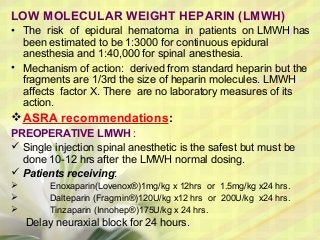
LOW MOLECULAR WEIGHT HEPARIN (LMWH)
• The risk of epidural hematoma in patients on LMWH has
been estimated to be 1:3000 for continuous epidural
anesthesia and 1:40,000 for spinal anesthesia.
• Mechanism of action: derived from standard heparin but the
fragments are 1/3rd the size of heparin molecules. LMWH
affects factor X. There are no laboratory measures of its
action.
ASRA recommendations:
PREOPERATIVE LMWH :
 Single injection spinal anesthetic is the safest but must be
done 10-12 hrs after the LMWH normal dosing.
 Patients receiving:
 Enoxaparin(Lovenox®)1mg/kg x 12hrs or 1.5mg/kg x24 hrs.
 Dalteparin (Fragmin®)120U/kg x12 hrs or 200U/kg x24 hrs.
 Tinzaparin (Innohep®)175U/kg x 24 hrs.
Delay neuraxial block for 24 hours.
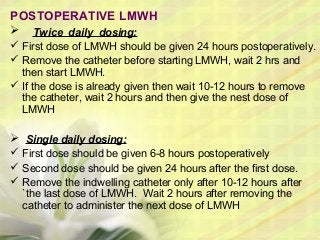
POSTOPERATIVE LMWH
 Twice daily dosing:
 First dose of LMWH should be given 24 hours postoperatively.
 Remove the catheter before starting LMWH, wait 2 hrs and
then start LMWH.
 If the dose is already given then wait 10-12 hours to remove
the catheter, wait 2 hours and then give the nest dose of
LMWH
 Single daily dosing:
 First dose should be given 6-8 hours postoperatively
 Second dose should be given 24 hours after the first dose.
 Remove the indwelling catheter only after 10-12 hours after
`the last dose of LMWH. Wait 2 hours after removing the
catheter to administer the next dose of LMWH
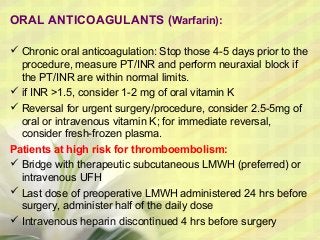
ORAL ANTICOAGULANTS (Warfarin):
 Chronic oral anticoagulation: Stop those 4-5 days prior to the
procedure, measure PT/INR and perform neuraxial block if
the PT/INR are within normal limits.
 if INR >1.5, consider 1-2 mg of oral vitamin K
 Reversal for urgent surgery/procedure, consider 2.5-5mg of
oral or intravenous vitamin K; for immediate reversal,
consider fresh-frozen plasma.
Patients at high risk for thromboembolism:
 Bridge with therapeutic subcutaneous LMWH (preferred) or
intravenous UFH
 Last dose of preoperative LMWH administered 24 hrs before
surgery, administer half of the daily dose
 Intravenous heparin discontinued 4 hrs before surgery
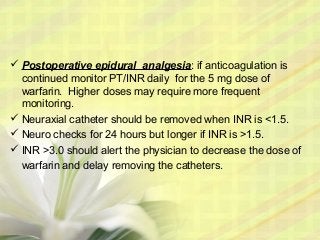
 Postoperative epidural analgesia: if anticoagulation is
continued monitor PT/INR daily for the 5 mg dose of
warfarin. Higher doses may require more frequent
monitoring.
 Neuraxial catheter should be removed when INR is <1.5.
 Neuro checks for 24 hours but longer if INR is >1.5.
 INR >3.0 should alert the physician to decrease the dose of
warfarin and delay removing the catheters.
ANTIPLATELET MEDICATIONS
1. Aspirin:
 Mechanism of action: blocks cyclooxygenase.
Cyclooxygenase is responsible for the production of
thromboxane A2, which induces platelet aggregation causing
vasoconstriction.
 Duration of action: irreversible effect on platelets. The effect
will last for the life of the platelet (7-10 days).
2. NSAIDS:
 Mechanism of action: inhibits cyclooxygenase by
decreasing tissue prostaglandin synthesis.
 Duration of action: reversible. Duration of action depends
on half life of the medication and ranges from 1 hour to 3
days.
 ASRA recommendations for aspirin and NSAIDs
 Spinal and epidural blocks can be safely done .
 There are no laboratory tests that are accepted for
preoperative testing. This includes bleeding time.
 A normal bleeding time does not necessarily indicate
normal platelet function. On the other hand, an abnormal
bleeding time does not necessarily indicate abnormal clotting
function.
 Conditions that should increase the anesthesia providers‟
concern would include a history of bruising easily, history
of excessive bleeding, female gender, and increased age.
3.3. Thienopyridine DerivativesThienopyridine Derivatives::
 Mechanism of action: Thienopyridine derivatives
interfere with platelet membrane function by inhibition of
adenosine diphosphate (ADP) induced platelet-fibrinogen
binding.
 Duration of action: Thienopyridine derivatives exert an
irreversible effect on platelet function for the life of the
platelet.
 ASRA recommendations:
 Discontinue ticlopidine (Ticlid®) 14 days before neuraxial
block.
 Discontinue clopidrogel (Plavix®) 7 days before the
neuraxial block.
 There are no accepted preoperative tests for these two
medications.
4.4. Platelet GP IIb/IIIa inhibitorsPlatelet GP IIb/IIIa inhibitors
 Mechanism of action: reversibly inhibits platelet
aggregation by preventing the adhesion of ligands to
glycoprotein IIb/IIIa, including plasminogen and von
Willebrand factor.
 Duration of action: time to normal platelet aggregation
for abciximab is 24-48 hours. For eptifibatide and
tirofiban (Aggrastat®) normal platelet function should occur
in 4-8 hours.
 ASRA recommendations:
 Discontinue eptifibatide (Integrilin®) 8 hours before the
neuraxial block.
 Discontinue abciximab (Reopro®) 48 hours before the
neuraxial block.
 These drugs are contraindicated within 4 weeks of
surgery.
 If administered postoperatively, after a spinal/epidural
anesthetic, there should be careful neurological monitoring
of the patient.
THROMBOLYTIC AND FIBRINOLYTIC
MEDICATIONS:
 Avoid therapy if neuraxial puncture occurred in the last 10
days.
 If a patient has received a neuraxial block and
fibrinolytic/thrombolytic therapy is unexpectedly initiated in
the postoperative patient, the patient should be
monitored closely for neurological complications.
 There are no recommendations for the removal of indwelling
catheters in patients who unexpectedly receive thrombolytic/
fibrinolytic therapy.
NEW ANTICOAGULANTS
 New thrombin inhibitors such as bivalirudin and lepirudin
have no specific recommendations.Careful assessment of
patient history, and risk and benefits ratio should be
assessed. There are no current recommendations for
neuraxial blockade.
 (Bivalirudin and lepirudin are two new thrombin inhibitors. Bivalirudin is
used in interventional cardiology and lepirudin is used to treat heparin-
induced thrombocytopenia.)
 Fondaparinux (Arixtra) is an antithrombotic medication used
for DVT prophylaxis. It binds with antithrombin III and
neutralizes factor Xa. Peak effect is in 3 hours and half life is
17-21 hours. Its effects are irreversible Actual risk is
unknown as it has sustained antithrombotic effect ,So best is
to avoid neuraxial blocks
HERBAL THERAPY
 Mechanism of action: varies with the preparation.
 Garlic, ginger, feverfew: inhibit platelet aggregation
 Ginseng: antiplatelet components.
 Alfalfa, chamomile, horse chestnut, ginseng: contain a
coumadin component.
 Vitamin E: reduces platelet thromboxane production.
 Ginko: inhibits platelet activating factor.
 The risk for epidural/spinal hematoma is unknown.
 Surgical patients should be advised to stop herbal
products 5-7 days before surgery.
Anticoagulation and Peripheral Nerve Blocks /
Plexus Blocks
 It has been recommended that the ASRA guidelines to
neuraxial blockade be applied to plexus and peripheral nerve
blocks.
 The most serious complication of non-neuraxial regional
techniques in anticoagulated patients is hemorrhage.
 Case reports highlight major bleeding occurring with psoas
compartment and/or lumbar sympathetic blocks.
 In patients with neurological deficits, it has been found that
complete recovery occurred in 6-12 months.
 The key to the reversal of neurological deficits is the fact
that the bleeding occurs in an expandable site as
opposed to bleeding associated with neuraxial blockade.
Neuraxial anesthesia and

Neuraxial anesthesia and

  • 1.
  • 2.
    INTRODUCTION:  The majorcomplication of anticoagulant therapy is bleeding.  Bleeding can occur in the following anatomical areas: intraspinal, intracranial, intraocular, retroperitoneal, and mediastinal. This may result in hospitalization, transfusion, and death.  Factors increasing the risk of bleeding while on anticoagulants include the following: intensity of anticoagulant effect, increased age, female gender, concomitant use of aspirin, history of gastrointestinal bleeding,duration of anticoagulant treatment.
  • 3.
    Spinal and EpiduralHematoma Formation  Hematoma formation may be the result of a spontaneous bleeding or trauma induced by a needle.  The epidural space is at particular risk for bleeding due to the rich epidural venous plexus.  Excessive bleeding into the epidural space may lead to compression, ischemia, nerve trauma, or paralysis. A bleed into the intrathecal space is generally less devastating, secondary to dilution by the cerebral spinal fluid.  The risk of epidural hematoma formation is rare. The true incidence is unknown. It has been estimated that the incidence of epidural hematoma formation related to epidural anesthesia is between 1:150,000 and 1:190,000. The estimated incidence for spinal anesthesia is 1:220,000.  There is a relationship between regional anesthesia and patients that receive anticoagulant medications during surgery. The incidence of epidural hematoma formation increases to 33:100,000 for epidural anesthesia and 1:100,000 for spinal anesthesia.
  • 4.
    Risk Factors forthe Development of Epidural / Spinal Hematoma  These factors are related to the administration of spinal and epidural anesthesia.  These factors include the following:  Anatomic abnormalities of the spinal cord or vertebral column  Vascular abnormalities  Pathological or medication related alterations in homeostasis  Alcohol abuse  Difficult and traumatic needle placement  Epidural catheter removal
  • 5.
    Signs and Symptomsof Epidural/Spinal Hematoma  Low back pain (sharp and may radiate)  Sensory and motor loss (numbness and tingling/motor weakness long after the block should have worn off)  Bowel and bladder dysfunction  Paraplegia  In the past, persistent low back pain was thought to be the classic symptom for epidural hematoma.  Recent research indicates that the first symptoms may include sensory or motor loss, bowel and bladder dysfunction, numbness and tingling, prolonged motor weakness, and paraplegia.
  • 6.
    Diagnostic Testing, Treatmentand Outcomes  Diagnosis of an epidural hematoma is made by MRI (preferred), CT scan (may miss a small hematoma), and myelogram.  Treatment is emergency decompressive laminectomy with hematoma evacuation. This must be done within 8-12 hours after the onset of signs and symptoms.  The outcome is generally poor.  There are three factors that affect the patient s recovery‟ from this devastating complication: size and location of the hematoma, speed of development, and severity/nature of pre-existing neurological problems.
  • 7.
    Neuraxial Blockade andAnticoagulationNeuraxial Blockade and Anticoagulation UNFRACTIONATED HEPARINUNFRACTIONATED HEPARIN • Mechanism of action: binds with antithrombin III, neutralizing the activated factors of X, XII, XI and IX. • Duration of action: for IV heparin the elimination half life is 56 minutes.  ASRA recommendations For patients receiving heparin:  No contraindication to use of neuraxial blocks in patients receiving mini-dose, subcutaneous heparin. The administration of subcutaneous heparin should be held until after block administration. Patient should be screened for concurrent medications that may impact clotting.
  • 8.
     Patients onheparin for more than 4 days should have a platelet count checked prior to the administration of neuraxial blockade secondary to the risk of heparin induced thrombocytopenia Neuraxial techniques and intraoperative anticoagulation (vascular surgery):  Heparin to be administered 1 hour after the needle placement.  Indwelling catheters should be removed 2-4 hours after the last dose and reevaluation of coagulation status. Heparin should not be reinitiated until at least 1 hour has passed.  Difficult placement or blood in the needle may increase the risk, but case does not have to be cancelled, as there is no supporting data. Be advised to use your clinical judgment.
  • 9.
    LOW MOLECULAR WEIGHTHEPARIN (LMWH) • The risk of epidural hematoma in patients on LMWH has been estimated to be 1:3000 for continuous epidural anesthesia and 1:40,000 for spinal anesthesia. • Mechanism of action: derived from standard heparin but the fragments are 1/3rd the size of heparin molecules. LMWH affects factor X. There are no laboratory measures of its action. ASRA recommendations: PREOPERATIVE LMWH :  Single injection spinal anesthetic is the safest but must be done 10-12 hrs after the LMWH normal dosing.  Patients receiving:  Enoxaparin(Lovenox®)1mg/kg x 12hrs or 1.5mg/kg x24 hrs.  Dalteparin (Fragmin®)120U/kg x12 hrs or 200U/kg x24 hrs.  Tinzaparin (Innohep®)175U/kg x 24 hrs. Delay neuraxial block for 24 hours.
  • 10.
    POSTOPERATIVE LMWH  Twicedaily dosing:  First dose of LMWH should be given 24 hours postoperatively.  Remove the catheter before starting LMWH, wait 2 hrs and then start LMWH.  If the dose is already given then wait 10-12 hours to remove the catheter, wait 2 hours and then give the nest dose of LMWH  Single daily dosing:  First dose should be given 6-8 hours postoperatively  Second dose should be given 24 hours after the first dose.  Remove the indwelling catheter only after 10-12 hours after `the last dose of LMWH. Wait 2 hours after removing the catheter to administer the next dose of LMWH
  • 11.
    ORAL ANTICOAGULANTS (Warfarin): Chronic oral anticoagulation: Stop those 4-5 days prior to the procedure, measure PT/INR and perform neuraxial block if the PT/INR are within normal limits.  if INR >1.5, consider 1-2 mg of oral vitamin K  Reversal for urgent surgery/procedure, consider 2.5-5mg of oral or intravenous vitamin K; for immediate reversal, consider fresh-frozen plasma. Patients at high risk for thromboembolism:  Bridge with therapeutic subcutaneous LMWH (preferred) or intravenous UFH  Last dose of preoperative LMWH administered 24 hrs before surgery, administer half of the daily dose  Intravenous heparin discontinued 4 hrs before surgery
  • 12.
     Postoperative epiduralanalgesia: if anticoagulation is continued monitor PT/INR daily for the 5 mg dose of warfarin. Higher doses may require more frequent monitoring.  Neuraxial catheter should be removed when INR is <1.5.  Neuro checks for 24 hours but longer if INR is >1.5.  INR >3.0 should alert the physician to decrease the dose of warfarin and delay removing the catheters.
  • 13.
    ANTIPLATELET MEDICATIONS 1. Aspirin: Mechanism of action: blocks cyclooxygenase. Cyclooxygenase is responsible for the production of thromboxane A2, which induces platelet aggregation causing vasoconstriction.  Duration of action: irreversible effect on platelets. The effect will last for the life of the platelet (7-10 days). 2. NSAIDS:  Mechanism of action: inhibits cyclooxygenase by decreasing tissue prostaglandin synthesis.  Duration of action: reversible. Duration of action depends on half life of the medication and ranges from 1 hour to 3 days.
  • 14.
     ASRA recommendationsfor aspirin and NSAIDs  Spinal and epidural blocks can be safely done .  There are no laboratory tests that are accepted for preoperative testing. This includes bleeding time.  A normal bleeding time does not necessarily indicate normal platelet function. On the other hand, an abnormal bleeding time does not necessarily indicate abnormal clotting function.  Conditions that should increase the anesthesia providers‟ concern would include a history of bruising easily, history of excessive bleeding, female gender, and increased age.
  • 15.
    3.3. Thienopyridine DerivativesThienopyridineDerivatives::  Mechanism of action: Thienopyridine derivatives interfere with platelet membrane function by inhibition of adenosine diphosphate (ADP) induced platelet-fibrinogen binding.  Duration of action: Thienopyridine derivatives exert an irreversible effect on platelet function for the life of the platelet.  ASRA recommendations:  Discontinue ticlopidine (Ticlid®) 14 days before neuraxial block.  Discontinue clopidrogel (Plavix®) 7 days before the neuraxial block.  There are no accepted preoperative tests for these two medications.
  • 16.
    4.4. Platelet GPIIb/IIIa inhibitorsPlatelet GP IIb/IIIa inhibitors  Mechanism of action: reversibly inhibits platelet aggregation by preventing the adhesion of ligands to glycoprotein IIb/IIIa, including plasminogen and von Willebrand factor.  Duration of action: time to normal platelet aggregation for abciximab is 24-48 hours. For eptifibatide and tirofiban (Aggrastat®) normal platelet function should occur in 4-8 hours.  ASRA recommendations:  Discontinue eptifibatide (Integrilin®) 8 hours before the neuraxial block.  Discontinue abciximab (Reopro®) 48 hours before the neuraxial block.  These drugs are contraindicated within 4 weeks of surgery.  If administered postoperatively, after a spinal/epidural anesthetic, there should be careful neurological monitoring of the patient.
  • 17.
    THROMBOLYTIC AND FIBRINOLYTIC MEDICATIONS: Avoid therapy if neuraxial puncture occurred in the last 10 days.  If a patient has received a neuraxial block and fibrinolytic/thrombolytic therapy is unexpectedly initiated in the postoperative patient, the patient should be monitored closely for neurological complications.  There are no recommendations for the removal of indwelling catheters in patients who unexpectedly receive thrombolytic/ fibrinolytic therapy.
  • 18.
    NEW ANTICOAGULANTS  Newthrombin inhibitors such as bivalirudin and lepirudin have no specific recommendations.Careful assessment of patient history, and risk and benefits ratio should be assessed. There are no current recommendations for neuraxial blockade.  (Bivalirudin and lepirudin are two new thrombin inhibitors. Bivalirudin is used in interventional cardiology and lepirudin is used to treat heparin- induced thrombocytopenia.)  Fondaparinux (Arixtra) is an antithrombotic medication used for DVT prophylaxis. It binds with antithrombin III and neutralizes factor Xa. Peak effect is in 3 hours and half life is 17-21 hours. Its effects are irreversible Actual risk is unknown as it has sustained antithrombotic effect ,So best is to avoid neuraxial blocks
  • 19.
    HERBAL THERAPY  Mechanismof action: varies with the preparation.  Garlic, ginger, feverfew: inhibit platelet aggregation  Ginseng: antiplatelet components.  Alfalfa, chamomile, horse chestnut, ginseng: contain a coumadin component.  Vitamin E: reduces platelet thromboxane production.  Ginko: inhibits platelet activating factor.  The risk for epidural/spinal hematoma is unknown.  Surgical patients should be advised to stop herbal products 5-7 days before surgery.
  • 21.
    Anticoagulation and PeripheralNerve Blocks / Plexus Blocks  It has been recommended that the ASRA guidelines to neuraxial blockade be applied to plexus and peripheral nerve blocks.  The most serious complication of non-neuraxial regional techniques in anticoagulated patients is hemorrhage.  Case reports highlight major bleeding occurring with psoas compartment and/or lumbar sympathetic blocks.  In patients with neurological deficits, it has been found that complete recovery occurred in 6-12 months.  The key to the reversal of neurological deficits is the fact that the bleeding occurs in an expandable site as opposed to bleeding associated with neuraxial blockade.