McGraw-Hill Technology Education Copyright   © 2006 by The McGraw-Hill Companies, Inc. All rights reserved.
Chapter 7B Survey of PC and Network Operating Systems
PC Operating Systems Microsoft Windows is the most popular Installed more than other OS combined Installed on about 95% of computers Apple and Linux represent the other 5%
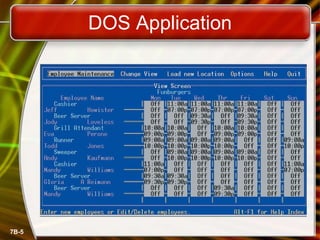
PC Operating Systems DOS Disk Operating System Single user single-tasking OS Command line interface 16-bit OS Powerful Fast Supports legacy applications
DOS Application
PC Operating Systems Windows NT Designed for a powerful system 32-bit OS Very stable Windows NT Workstation Single user multi tasking OS Windows NT Server Multi user multi tasking OS Network operating system
PC Operating Systems Windows 9x 95, 98, and Millennium Edition (Me) 32-bit OS Supported 16-bit programs well Very pretty not stable OS Still found in large corporations 95 introduced the Start button 98 introduced active desktop Me improved multimedia software
PC Operating Systems Windows 2000 Look of 9x with NT stability Optimized for office and developers Application software ran very well Entertainment software ran very poorly
PC Operating Systems Windows XP Microsoft’s newest desktop product Different look from 2000 Many different versions Digital multimedia support was enhanced Communications was enhanced Mobile computing became a priority
PC Operating Systems UNIX Runs on all computer types 32- or 64-bit Very stable and fast Command-line interface Can cost thousands of dollars
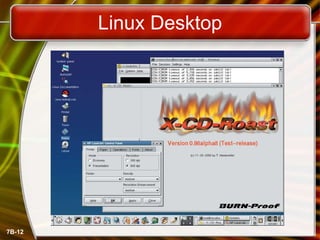
PC Operating Systems Linux Free or inexpensive version of UNIX 32-bit OS Very stable and fast Most flavors are open source X Windows GUI Command line interface is available
Linux Desktop
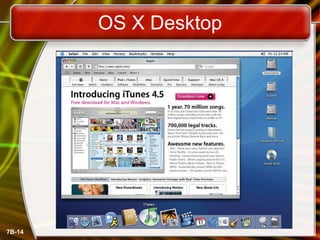
PC Operating Systems Macintosh operating systems OS X Based on FreeBSD Linux Very stable and easy to configure Only runs on Mac hardware
OS X Desktop
NOS Features Network operating system Fast and stable Runs on servers Multi-user and multitasking OS 32- or 64-bit
NOS Features File and print sharing Users access the same files Hundreds of users use a printer Different OS can interact
NOS Features Data integrity Backups copies data onto tape RAID copies data onto other drives Redundant Array of Inexpensive Disks Relies on two or more hard drives May speed access to data
NOS Features Data security Access to data can be restricted Access to server resources is controlled Audits can be kept
Networking Operating Systems NT Server Same core as NT Workstation Security added Multi user capability added RAID support included
Networking Operating Systems Windows 2000 Server Same technology as 2000 workstation Active Directory (AD) Central database of server resources Simplifies network management Distributed programs supported Server Standard Edition Advanced Server Edition Data Center Edition
Networking Operating Systems Windows 2003 Server Designed to compete with UNIX XP like interface Better support for XP computers MS .NET framework supported Distributed programs are supported Server Standard Edition Data Center Edition
Networking Operating Systems UNIX for servers Oldest NOS in widespread use Stable secure and fast Main OS for Internet and Web Large organizations depend on UNIX
Networking Operating Systems Linux for servers Popular in small businesses Stable, fast and inexpensive Linux’s popularity is growing
Embedded Operating Systems Devices have EOS built in Cell phones, PDAs, medical equipment Stable and fast
Embedded Operating Systems Windows XP embedded Based on Windows XP Customized for each device
Embedded Operating Systems Windows CE Not based on a desktop OS Customized for each device PDA and cell phones Microsoft Automotive will run in cars
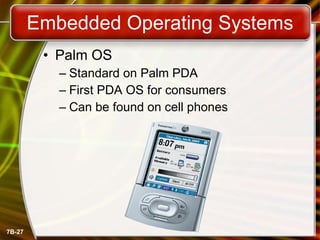
Embedded Operating Systems Palm OS Standard on Palm PDA First PDA OS for consumers Can be found on cell phones
Embedded Operating Systems Pocket PC Developed to compete with Palm Not customizable  Interacts securely with business networks Can control PCs through PC
Embedded Operating Systems Symbian Found in smart cell phones Games, Instant Messaging, Internet Full color display
Chapter 7B End of Chapter

Network operating system

  • 1.
    McGraw-Hill Technology EducationCopyright © 2006 by The McGraw-Hill Companies, Inc. All rights reserved.
  • 2.
    Chapter 7B Surveyof PC and Network Operating Systems
  • 3.
    PC Operating SystemsMicrosoft Windows is the most popular Installed more than other OS combined Installed on about 95% of computers Apple and Linux represent the other 5%
  • 4.
    PC Operating SystemsDOS Disk Operating System Single user single-tasking OS Command line interface 16-bit OS Powerful Fast Supports legacy applications
  • 5.
  • 6.
    PC Operating SystemsWindows NT Designed for a powerful system 32-bit OS Very stable Windows NT Workstation Single user multi tasking OS Windows NT Server Multi user multi tasking OS Network operating system
  • 7.
    PC Operating SystemsWindows 9x 95, 98, and Millennium Edition (Me) 32-bit OS Supported 16-bit programs well Very pretty not stable OS Still found in large corporations 95 introduced the Start button 98 introduced active desktop Me improved multimedia software
  • 8.
    PC Operating SystemsWindows 2000 Look of 9x with NT stability Optimized for office and developers Application software ran very well Entertainment software ran very poorly
  • 9.
    PC Operating SystemsWindows XP Microsoft’s newest desktop product Different look from 2000 Many different versions Digital multimedia support was enhanced Communications was enhanced Mobile computing became a priority
  • 10.
    PC Operating SystemsUNIX Runs on all computer types 32- or 64-bit Very stable and fast Command-line interface Can cost thousands of dollars
  • 11.
    PC Operating SystemsLinux Free or inexpensive version of UNIX 32-bit OS Very stable and fast Most flavors are open source X Windows GUI Command line interface is available
  • 12.
  • 13.
    PC Operating SystemsMacintosh operating systems OS X Based on FreeBSD Linux Very stable and easy to configure Only runs on Mac hardware
  • 14.
  • 15.
    NOS Features Networkoperating system Fast and stable Runs on servers Multi-user and multitasking OS 32- or 64-bit
  • 16.
    NOS Features Fileand print sharing Users access the same files Hundreds of users use a printer Different OS can interact
  • 17.
    NOS Features Dataintegrity Backups copies data onto tape RAID copies data onto other drives Redundant Array of Inexpensive Disks Relies on two or more hard drives May speed access to data
  • 18.
    NOS Features Datasecurity Access to data can be restricted Access to server resources is controlled Audits can be kept
  • 19.
    Networking Operating SystemsNT Server Same core as NT Workstation Security added Multi user capability added RAID support included
  • 20.
    Networking Operating SystemsWindows 2000 Server Same technology as 2000 workstation Active Directory (AD) Central database of server resources Simplifies network management Distributed programs supported Server Standard Edition Advanced Server Edition Data Center Edition
  • 21.
    Networking Operating SystemsWindows 2003 Server Designed to compete with UNIX XP like interface Better support for XP computers MS .NET framework supported Distributed programs are supported Server Standard Edition Data Center Edition
  • 22.
    Networking Operating SystemsUNIX for servers Oldest NOS in widespread use Stable secure and fast Main OS for Internet and Web Large organizations depend on UNIX
  • 23.
    Networking Operating SystemsLinux for servers Popular in small businesses Stable, fast and inexpensive Linux’s popularity is growing
  • 24.
    Embedded Operating SystemsDevices have EOS built in Cell phones, PDAs, medical equipment Stable and fast
  • 25.
    Embedded Operating SystemsWindows XP embedded Based on Windows XP Customized for each device
  • 26.
    Embedded Operating SystemsWindows CE Not based on a desktop OS Customized for each device PDA and cell phones Microsoft Automotive will run in cars
  • 27.
    Embedded Operating SystemsPalm OS Standard on Palm PDA First PDA OS for consumers Can be found on cell phones
  • 28.
    Embedded Operating SystemsPocket PC Developed to compete with Palm Not customizable Interacts securely with business networks Can control PCs through PC
  • 29.
    Embedded Operating SystemsSymbian Found in smart cell phones Games, Instant Messaging, Internet Full color display
  • 30.
    Chapter 7B Endof Chapter

Editor's Notes

  • #4 Teaching tip Www.w3schools.com/browsers/browsers_stats.asp provides a neutral look at OS statistics. Refer to this page as you lecture. Visit www.wordiq.com/definition/Microsoft_Windows for an excellent timeline and description of Windows operating systems.
  • #5 Teaching tip Students often fail to see the value in older OS or applications. As an example, a metal fabrication plant in Pittsburgh PA is still using a program written in the early 70’s that calculates metal temperatures .
  • #9 Discussion point There are many computer professionals that say that Windows 2000 was the first stable Microsoft product. Engage your class in a discussion regarding a software developer’s obligation to create stable products.
  • #10 Teaching tip At press time, the 64 bit version of XP was still in the late beta stage. More information can be found at www.microsoft.com/presspass/press/2003/sep03/09-23athlon64betapr.asp .
  • #14 Teaching tip OS X versions change often. Keep track of the most current and present this to the class. Visit www.apple.com/macosx/ to keep up to date. At press time the latest version was 10.4 Tiger.
  • #19 Teaching tip Tell your students what NOS your school uses.
  • #21 Teaching tip Spend some time describing how distributed applications can reduce network needs.
  • #24 Insider information The email service hotmail was originally hosted on Linux servers. Microsoft purchased Hotmail and moved it to Windows servers. It took Microsoft nearly a year to make Hotmail work as well on Windows as it did on Linux.
  • #27 Teaching tip Have a little fun with this one. Windows CE has the unfortunate and unofficial shortcut name of WinCE.