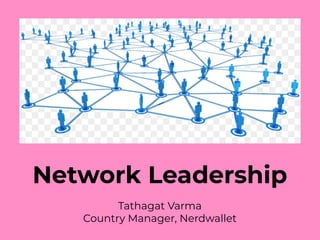
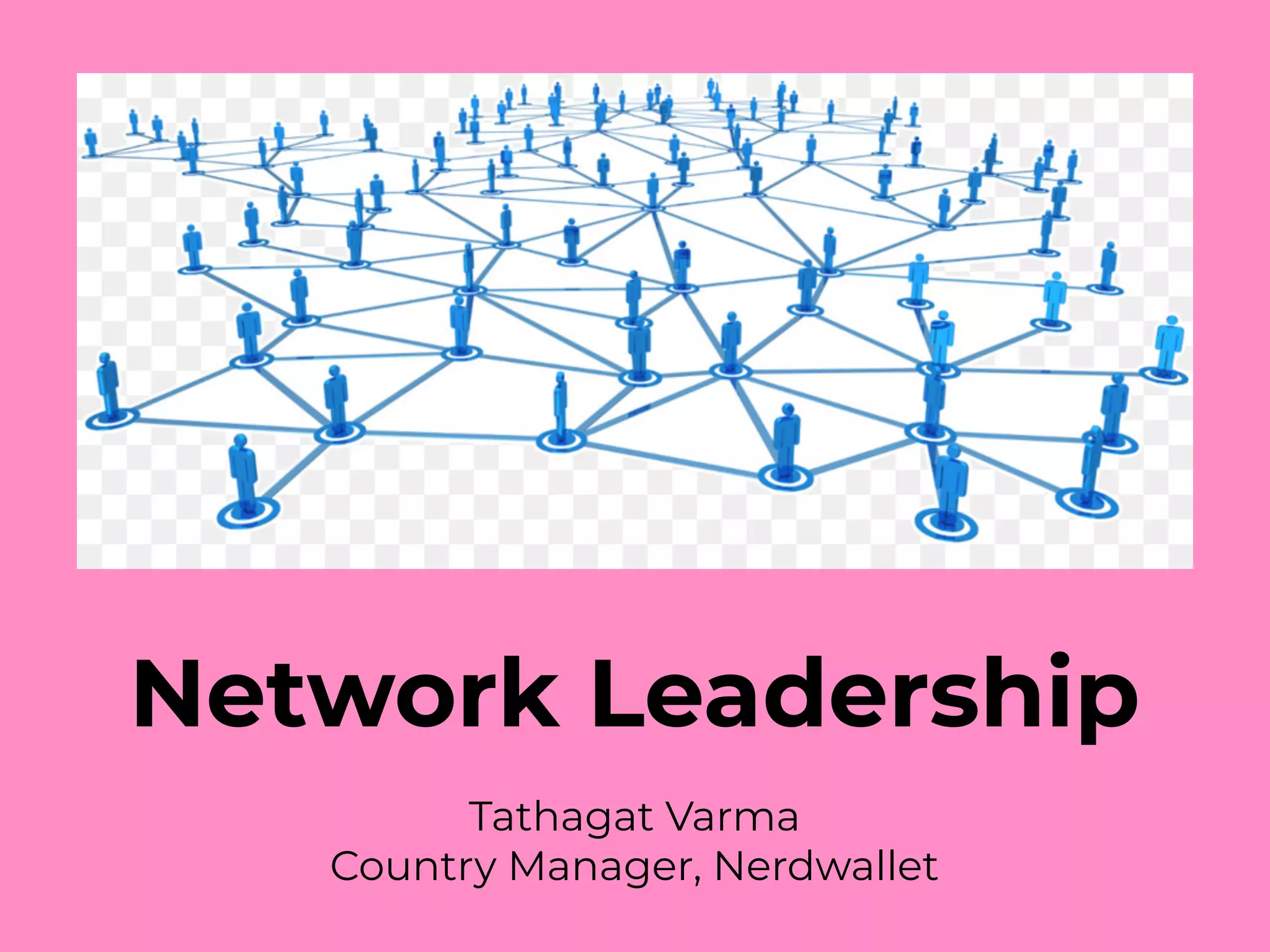
Network Leadership
Tathagat Varma
Country Manager, Nerdwallet
Personal views
Warm-up
•Think of leaders whom
you’ve worked with, and
who have influenced you
personally!
•What did they have or do
differently?
Leadership
Ability to influence
people in order to
accomplish a
common task
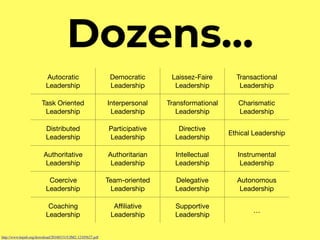
Dozens…
Autocratic
Leadership
Democratic
Leadership
Laissez-Faire
Leadership
Transactional
Leadership
Task Oriented
Leadership
Interpersonal
Leadership
Transformational
Leadership
Charismatic
Leadership
Distributed
Leadership
Participative
Leadership
Directive
Leadership
Ethical Leadership
Authoritative
Leadership
Authoritarian
Leadership
Intellectual
Leadership
Instrumental
Leadership
Coercive
Leadership
Team-oriented
Leadership
Delegative
Leadership
Autonomous
Leadership
Coaching
Leadership
Affiliative
Leadership
Supportive
Leadership
…
http://www.hrpub.org/download/20160331/UJM2-12105627.pdf
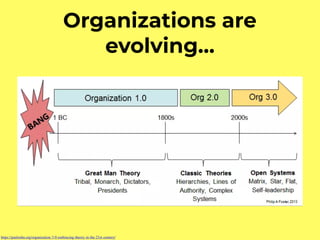
Organizations are
evolving…
https://paulsohn.org/organization-3-0-embracing-theory-in-the-21st-century/
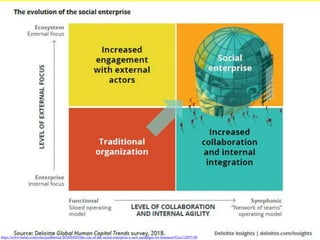
https://www.forbes.com/sites/joshbersin/2018/04/03/the-rise-of-the-social-enterprise-a-new-paradigm-for-business/#2ce1126971f0
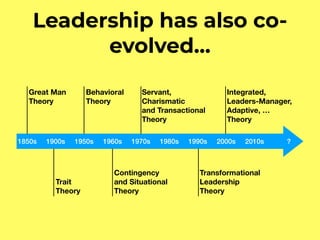
Leadership has also co-
evolved…
Great Man
Theory
1850s 1900s 1950s 1960s 1970s 1980s 1990s 2000s 2010s ?
Trait
Theory
Behavioral
Theory
Contingency
and Situational
Theory
Servant,
Charismatic
and Transactional
Theory
Transformational
Leadership
Theory
Integrated,
Leaders-Manager,
Adaptive, …
Theory
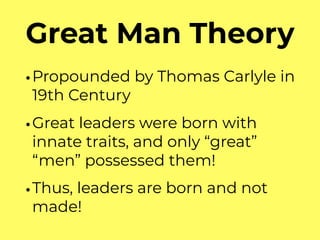
Great Man Theory
•Propounded by Thomas Carlyle in
19th Century
•Great leaders were born with
innate traits, and only “great”
“men” possessed them!
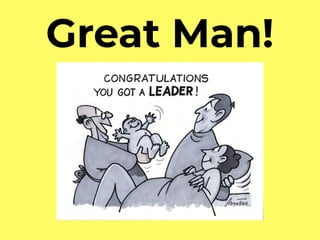
•Thus, leaders are born and not
made!
Great Man!
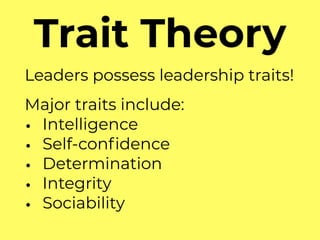
Trait Theory
Leaders possess leadership traits!
Major traits include:
• Intelligence
• Self-confidence
• Determination
• Integrity
• Sociability
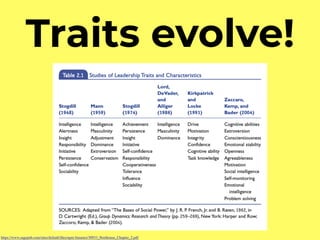
Traits evolve!
https://www.sagepub.com/sites/default/files/upm-binaries/30933_Northouse_Chapter_2.pdf
Big Five Personality
Traits
Strong relation
between Big Five and
Leadership
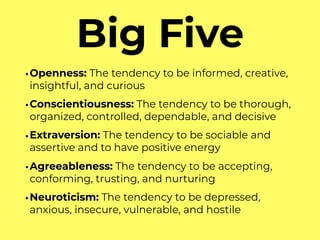
Big Five
•Openness: The tendency to be informed, creative,
insightful, and curious
•Conscientiousness: The tendency to be thorough,
organized, controlled, dependable, and decisive
•Extraversion: The tendency to be sociable and
assertive and to have positive energy
•Agreeableness: The tendency to be accepting,
conforming, trusting, and nurturing
•Neuroticism: The tendency to be depressed,
anxious, insecure, vulnerable, and hostile
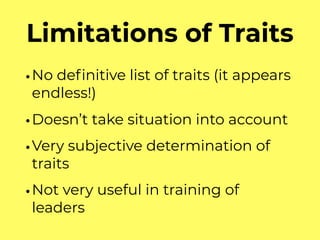
Limitations of Traits
•No definitive list of traits (it appears
endless!)
•Doesn’t take situation into account
•Very subjective determination of
traits
•Not very useful in training of
leaders
Are traits enough in
today’s orgs?
Power
The potential or
capacity to
influence other
people or groups
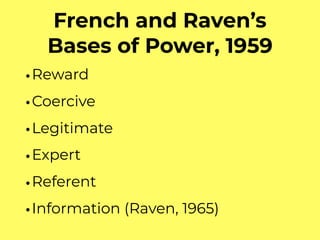
French and Raven’s
Bases of Power, 1959
•Reward
•Coercive
•Legitimate
•Expert
•Referent
•Information (Raven, 1965)
Influence
To influence is to have an impact on the behaviors,
attitudes, opinions and choices of others.
Influence is not to be confused with power or control.
It’s not about manipulating others to get your way. It’s
about noticing what motivates employee
commitment and using that knowledge to leverage
performance and positive results.
A leader’s ability to have influence with others is based
on trust; in fact, our influence expands in proportion to
the amount of trust that exists in a relationship.
http://training.hr.ufl.edu/resources/LeadershipToolkit/job_aids/LeadingbyInfluence.pdf
Social Power and
Influence
Social Influence: A change in the belief,
attitude, or behavior of a person (the target of
influence) which results from the action of
another person (an influencing agent), and
they defined 

Social Power: The potential for such
influence, that is, the ability of the agent to
bring about such a change using available
resources.
https://en.wikipedia.org/wiki/French_and_Raven%27s_bases_of_power
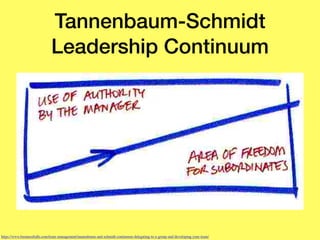
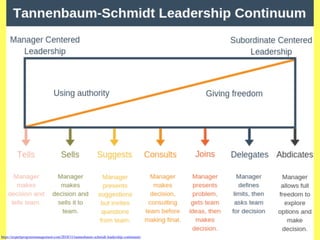
Tannenbaum-Schmidt
Leadership Continuum
https://www.businessballs.com/team-management/tannenbaum-and-schmidt-continuum-delegating-to-a-group-and-developing-your-team/
https://expertprogrammanagement.com/2018/11/tannenbaum-schmidt-leadership-continuum/
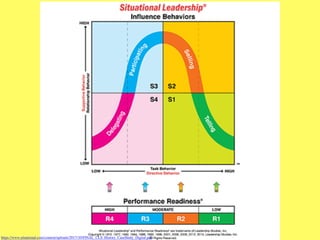
https://www.situational.com/content/uploads/2017/10/FINAL_CLS_History_CaseStudy_Digital.pdf
Modern times!
https://www.itlab.com/a-modern-workplace-with-microsoft
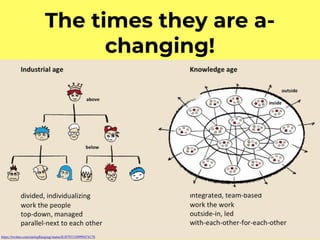
The times they are a-
changing!
https://twitter.com/nielspflaeging/status/818793310999474176
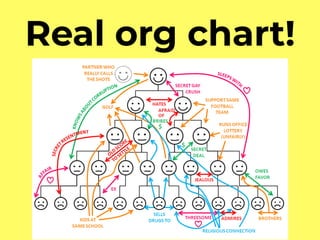
Real org chart!
Challenges?
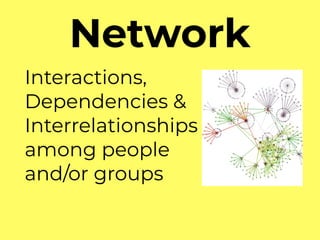
Network
Interactions,
Dependencies &
Interrelationships
among people
and/or groups
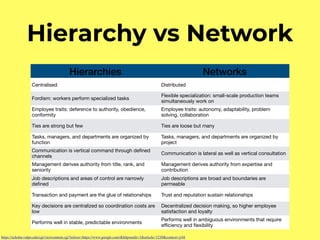
Hierarchy vs Network
Hierarchies Networks
Centralised Distributed
Fordism: workers perform specialized tasks
Flexible specialization: small-scale production teams
simultaneously work on
Employee traits: deference to authority, obedience,
conformity
Employee traits: autonomy, adaptability, problem
solving, collaboration
Ties are strong but few Ties are loose but many
Tasks, managers, and departments are organized by
function
Tasks, managers, and departments are organized by
project
Communication is vertical command through defined
channels
Communication is lateral as well as vertical consultation
Management derives authority from title, rank, and
seniority
Management derives authority from expertise and
contribution
Job descriptions and areas of control are narrowly
defined
Job descriptions are broad and boundaries are
permeable
Transaction and payment are the glue of relationships Trust and reputation sustain relationships
Key decisions are centralized so coordination costs are
low
Decentralized decision making, so higher employee
satisfaction and loyalty
Performs well in stable, predictable environments
Performs well in ambiguous environments that require
efficiency and flexibility
https://scholar.valpo.edu/cgi/viewcontent.cgi?referer=https://www.google.com/&httpsredir=1&article=1210&context=jvbl
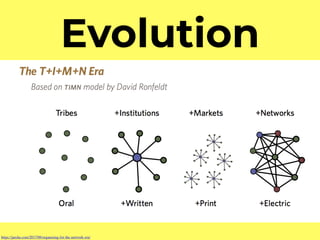
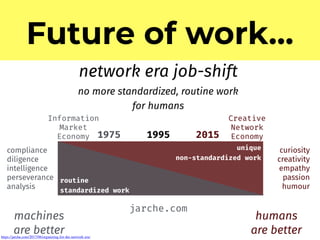
Evolution
https://jarche.com/2017/06/organizing-for-the-network-era/
Future of work…
https://jarche.com/2017/06/organizing-for-the-network-era/
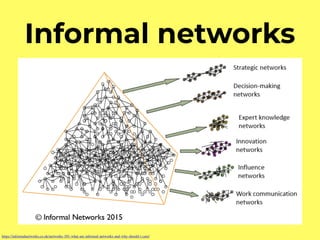
Informal networks
https://informalnetworks.co.uk/networks-101-what-are-informal-networks-and-why-should-i-care/
Reflection
•Does you org have
networks? Give some
examples.
•What are some of the ways
you have seen work (or
not!)
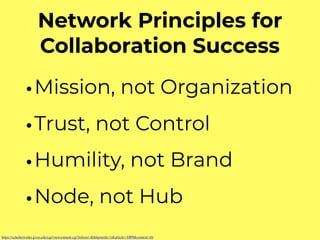
Network Principles for
Collaboration Success
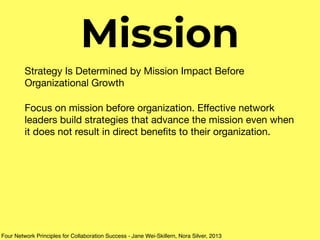
•Mission, not Organization
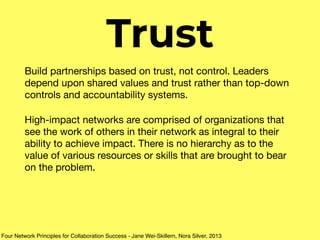
•Trust, not Control
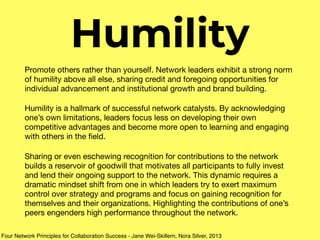
•Humility, not Brand
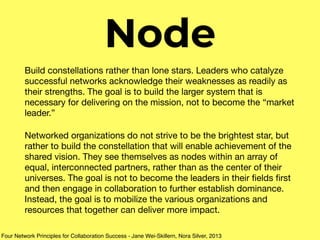
•Node, not Hub
https://scholarworks.gvsu.edu/cgi/viewcontent.cgi?referer=&httpsredir=1&article=1009&context=tfr
Mission
Strategy Is Determined by Mission Impact Before
Organizational Growth 

Focus on mission before organization. Effective network
leaders build strategies that advance the mission even when
it does not result in direct benefits to their organization.
Four Network Principles for Collaboration Success - Jane Wei-Skillern, Nora Silver, 2013
Trust
Build partnerships based on trust, not control. Leaders
depend upon shared values and trust rather than top-down
controls and accountability systems.

High-impact networks are comprised of organizations that
see the work of others in their network as integral to their
ability to achieve impact. There is no hierarchy as to the
value of various resources or skills that are brought to bear
on the problem.
Four Network Principles for Collaboration Success - Jane Wei-Skillern, Nora Silver, 2013
Humility
Promote others rather than yourself. Network leaders exhibit a strong norm
of humility above all else, sharing credit and foregoing opportunities for
individual advancement and institutional growth and brand building.

Humility is a hallmark of successful network catalysts. By acknowledging
one’s own limitations, leaders focus less on developing their own
competitive advantages and become more open to learning and engaging
with others in the field.

Sharing or even eschewing recognition for contributions to the network
builds a reservoir of goodwill that motivates all participants to fully invest
and lend their ongoing support to the network. This dynamic requires a
dramatic mindset shift from one in which leaders try to exert maximum
control over strategy and programs and focus on gaining recognition for
themselves and their organizations. Highlighting the contributions of one’s
peers engenders high performance throughout the network.
Four Network Principles for Collaboration Success - Jane Wei-Skillern, Nora Silver, 2013
Node
Build constellations rather than lone stars. Leaders who catalyze
successful networks acknowledge their weaknesses as readily as
their strengths. The goal is to build the larger system that is
necessary for delivering on the mission, not to become the “market
leader.”

Networked organizations do not strive to be the brightest star, but
rather to build the constellation that will enable achievement of the
shared vision. They see themselves as nodes within an array of
equal, interconnected partners, rather than as the center of their
universes. The goal is not to become the leaders in their fields first
and then engage in collaboration to further establish dominance.
Instead, the goal is to mobilize the various organizations and
resources that together can deliver more impact.
Four Network Principles for Collaboration Success - Jane Wei-Skillern, Nora Silver, 2013
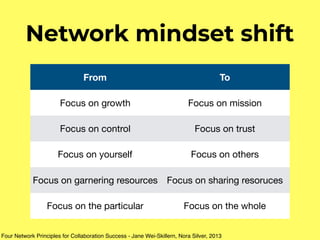
Network mindset shift
From To
Focus on growth Focus on mission
Focus on control Focus on trust
Focus on yourself Focus on others
Focus on garnering resources Focus on sharing resoruces
Focus on the particular Focus on the whole
Four Network Principles for Collaboration Success - Jane Wei-Skillern, Nora Silver, 2013
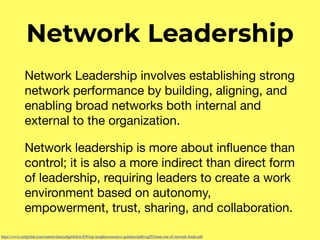
Network Leadership
Network Leadership involves establishing strong
network performance by building, aligning, and
enabling broad networks both internal and
external to the organization. 

Network leadership is more about influence than
control; it is also a more indirect than direct form
of leadership, requiring leaders to create a work
environment based on autonomy,
empowerment, trust, sharing, and collaboration.
https://www.cebglobal.com/content/dam/cebglobal/us/EN/top-insights/executive-guidance/pdfs/eg2014ann-rise-of-network-leader.pdf
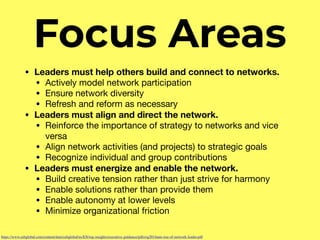
Focus Areas
• Leaders must help others build and connect to networks.
• Actively model network participation

• Ensure network diversity

• Refresh and reform as necessary

• Leaders must align and direct the network.
• Reinforce the importance of strategy to networks and vice
versa

• Align network activities (and projects) to strategic goals

• Recognize individual and group contributions

• Leaders must energize and enable the network.
• Build creative tension rather than just strive for harmony

• Enable solutions rather than provide them

• Enable autonomy at lower levels

• Minimize organizational friction
https://www.cebglobal.com/content/dam/cebglobal/us/EN/top-insights/executive-guidance/pdfs/eg2014ann-rise-of-network-leader.pdf
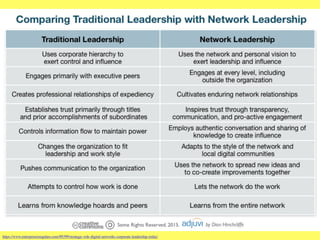
https://www.enterpriseirregulars.com/89399/strategic-role-digital-networks-corporate-leadership-today/
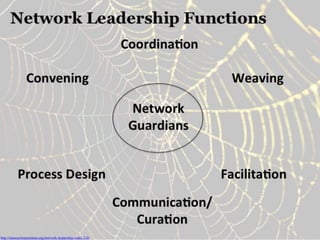
Network Leadership
Functions
http://interactioninstitute.org/network-leadership-roles-2-0/
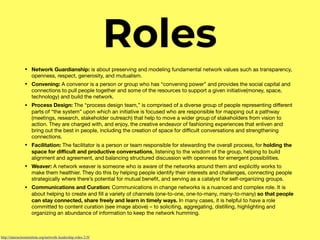
Roles
• Network Guardianship: is about preserving and modeling fundamental network values such as transparency,
openness, respect, generosity, and mutualism.

• Convening: A convenor is a person or group who has “convening power” and provides the social capital and
connections to pull people together and some of the resources to support a given initiative(money, space,
technology) and build the network.

• Process Design: The “process design team,” is comprised of a diverse group of people representing different
parts of “the system” upon which an initiative is focused who are responsible for mapping out a pathway
(meetings, research, stakeholder outreach) that help to move a wider group of stakeholders from vision to
action. They are charged with, and enjoy, the creative endeavor of fashioning experiences that enliven and
bring out the best in people, including the creation of space for difficult conversations and strengthening
connections.

• Facilitation: The facilitator is a person or team responsible for stewarding the overall process, for holding the
space for difficult and productive conversations, listening to the wisdom of the group, helping to build
alignment and agreement, and balancing structured discussion with openness for emergent possibilities.

• Weaver: A network weaver is someone who is aware of the networks around them and explicitly works to
make them healthier. They do this by helping people identify their interests and challenges, connecting people
strategically where there’s potential for mutual benefit, and serving as a catalyst for self-organizing groups.

• Communications and Curation: Communications in change networks is a nuanced and complex role. It is
about helping to create and fill a variety of channels (one-to-one, one-to-many, many-to-many) so that people
can stay connected, share freely and learn in timely ways. In many cases, it is helpful to have a role
committed to content curation (see image above) – to soliciting, aggregating, distilling, highlighting and
organizing an abundance of information to keep the network humming.
http://interactioninstitute.org/network-leadership-roles-2-0/
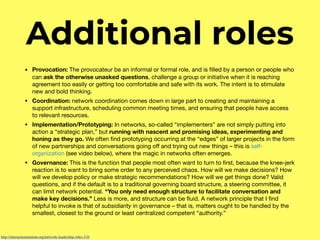
Additional roles
• Provocation: The provocateur be an informal or formal role, and is filled by a person or people who
can ask the otherwise unasked questions, challenge a group or initiative when it is reaching
agreement too easily or getting too comfortable and safe with its work. The intent is to stimulate
new and bold thinking.

• Coordination: network coordination comes down in large part to creating and maintaining a
support infrastructure, scheduling common meeting times, and ensuring that people have access
to relevant resources.

• Implementation/Prototyping: In networks, so-called “implementers” are not simply putting into
action a “strategic plan,” but running with nascent and promising ideas, experimenting and
honing as they go. We often find prototyping occurring at the “edges” of larger projects in the form
of new partnerships and conversations going off and trying out new things – this is self-
organization (see video below), where the magic in networks often emerges.

• Governance: This is the function that people most often want to turn to first, because the knee-jerk
reaction is to want to bring some order to any perceived chaos. How will we make decisions? How
will we develop policy or make strategic recommendations? How will we get things done? Valid
questions, and if the default is to a traditional governing board structure, a steering committee, it
can limit network potential. “You only need enough structure to facilitate conversation and
make key decisions.” Less is more, and structure can be fluid. A network principle that I find
helpful to invoke is that of subsidiarity in governance – that is, matters ought to be handled by the
smallest, closest to the ground or least centralized competent “authority.” 
http://interactioninstitute.org/network-leadership-roles-2-0/
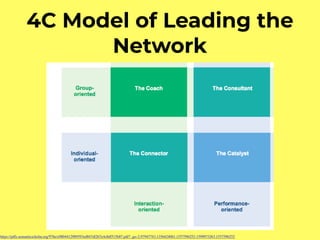
4C Model of Leading the
Network
https://pdfs.semanticscholar.org/976e/e9804412989593ed847df267e4c8df515b87.pdf?_ga=2.97947743.1356424061.1557596252-1599973263.1557596252
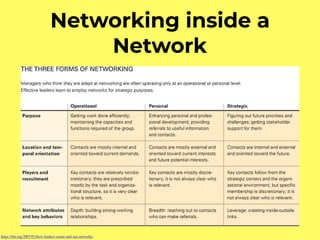
Networking inside a
Network
https://hbr.org/2007/01/how-leaders-create-and-use-networks
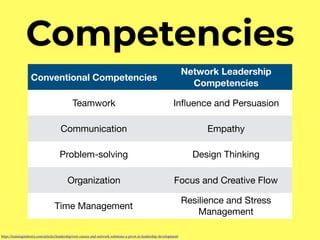
Competencies
Conventional Competencies
Network Leadership
Competencies
Teamwork Influence and Persuasion
Communication Empathy
Problem-solving Design Thinking
Organization Focus and Creative Flow
Time Management
Resilience and Stress
Management
https://trainingindustry.com/articles/leadership/root-causes-and-network-solutions-a-pivot-in-leadership-development/
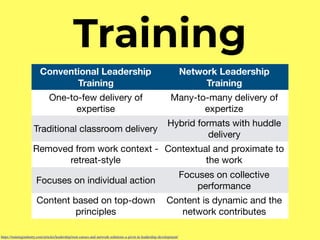
Training
Conventional Leadership
Training
Network Leadership
Training
One-to-few delivery of
expertise
Many-to-many delivery of
expertize
Traditional classroom delivery
Hybrid formats with huddle
delivery
Removed from work context -
retreat-style
Contextual and proximate to
the work
Focuses on individual action
Focuses on collective
performance
Content based on top-down
principles
Content is dynamic and the
network contributes
https://trainingindustry.com/articles/leadership/root-causes-and-network-solutions-a-pivot-in-leadership-development/
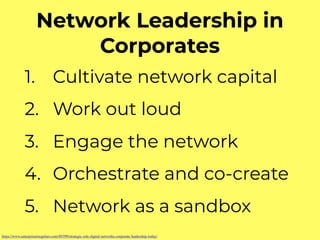
Network Leadership in
Corporates
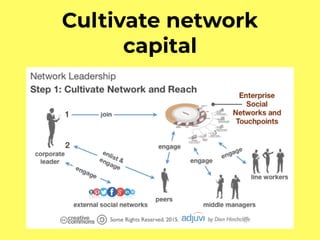
1. Cultivate network capital
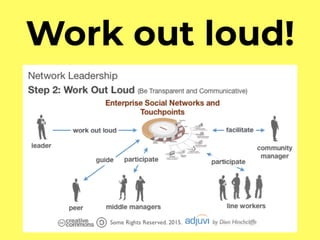
2. Work out loud
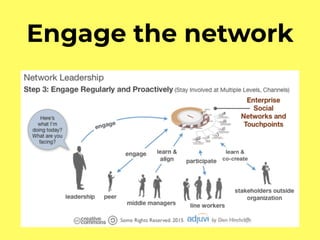
3. Engage the network
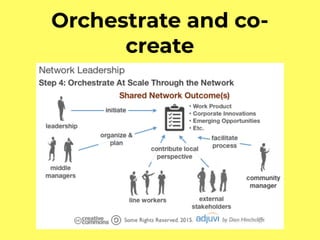
4. Orchestrate and co-create
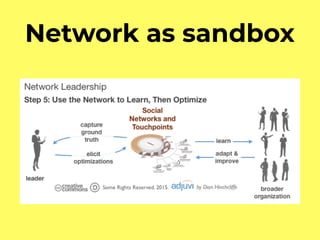
5. Network as a sandbox
https://www.enterpriseirregulars.com/89399/strategic-role-digital-networks-corporate-leadership-today/
Cultivate network
capital
Work out loud!
Engage the network
Orchestrate and co-
create
Network as sandbox
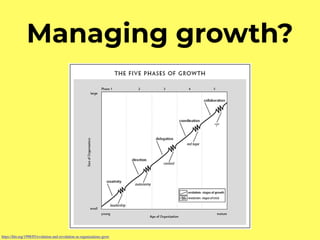
Managing growth?
https://hbr.org/1998/05/evolution-and-revolution-as-organizations-grow
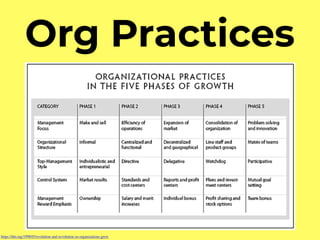
Org Practices
https://hbr.org/1998/05/evolution-and-revolution-as-organizations-grow
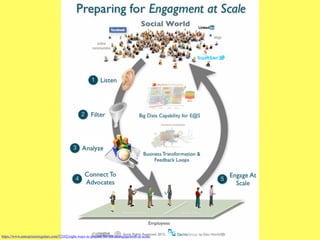
https://www.enterpriseirregulars.com/52162/eight-ways-to-prepare-for-social-engagement-at-scale/
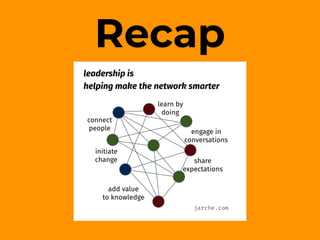
Recap
References
• https://hbr.org/2007/01/how-leaders-create-and-use-networks

• https://youtu.be/mkSYP-2lLR0?t=835

• https://youtu.be/u6-Afopw_SY

• https://vimeo.com/229758158

• https://newnetworkleader.org/

• https://hbr.org/2007/01/how-leaders-create-and-use-networks

• https://www.pcc-cic.org.uk/article/network-leadership

• https://networkweaver.com/network-weaving-handbook/

Network Leadership