Grid Network
Presented by
Gamit Jaysing
[Eno:201504100120256]
[TYMCA-C]
Network Grid
A Network Grid provides fault-tolerant and high-performance
communication services. Each grid node works as a data router between
two communication points, providing data-caching and other facilities
to speed up the communications between such points.
WHAT IS GRID?
“Resource sharing & coordinated problem solving in dynamic,
multi-institutional virtual organizations”.
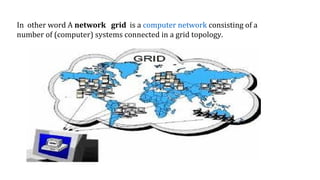
In other word A network grid is a computer network consisting of a
number of (computer) systems connected in a grid topology.
1.In a regular grid topology, each node in the network is connected with two
neighbors along one or more dimensions.
2.If the network is one-dimensional, and the chain of nodes is connected to
form a circular loop, the resulting topology is known as ring.
3.Network systems such as FDDI use counter-rotating token-passing rings to
achieve high reliability and performance.
How to Work network Grid
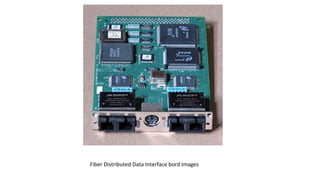
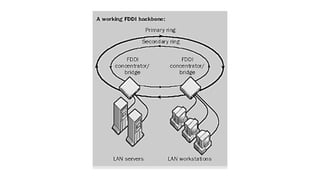
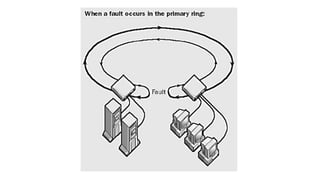
Fiber Distributed Data Interface bord Images
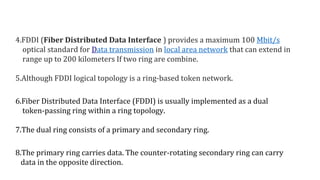
4.FDDI (Fiber Distributed Data Interface ) provides a maximum 100 Mbit/s
optical standard for Data transmission in local area network that can extend in
range up to 200 kilometers If two ring are combine.
5.Although FDDI logical topology is a ring-based token network.
6.Fiber Distributed Data Interface (FDDI) is usually implemented as a dual
token-passing ring within a ring topology.
7.The dual ring consists of a primary and secondary ring.
8.The primary ring carries data. The counter-rotating secondary ring can carry
data in the opposite direction.
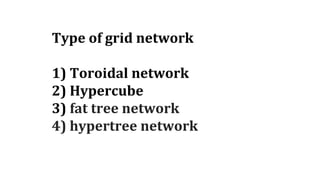
Type of grid network
1) Toroidal network
2) Hypercube
3) fat tree network
4) hypertree network
1. Toroidal network
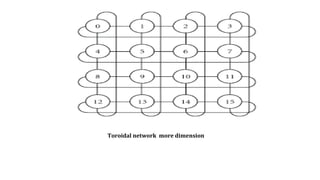
I.In general, when an n-dimensional grid network is connected circularly in
more than one dimension, the resulting network topology is a torus,also
known as "toroidal".
II.The grid network topology is a topology in which the each node of the
network is connected with two neighboring nodes along one or more
dimensions.
III.The Torus is a topology with n-dimensional grid network with circularly
connection of the nodes.
Toroidal network more dimension
2.Hypercube
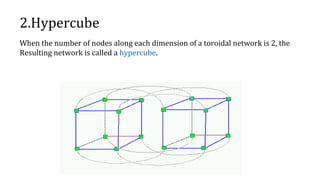
When the number of nodes along each dimension of a toroidal network is 2, the
Resulting network is called a hypercube.
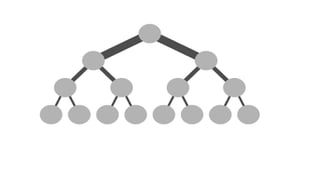
3. Fat tree network
I.The fat tree network is a universal network for provably efficient
communication
II.In a tree data structure, every branch has the same thickness, regardless of
their place in the hierarchy—they are all "skinny" (skinny in this context
means low-bandwidth).
III.In a fat tree, branches nearer the top of the hierarchy are "fatter" (thicker)
than branches further down the hierarchy. In a telecommunications network,
the branches are data links.
IV. The varied thickness (bandwidth) of the data links allows for more efficient
and technology-specific use.
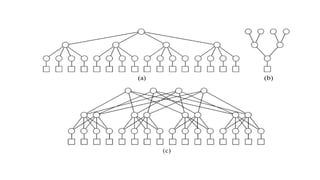
4. Hypertree network
I.A hypertree network is a network topology that shares some traits with the
binary tree network. It is a variation of the fat tree architecture.
II.A Tree network, or star-bus network, is a hybrid network topology in
which star networks are interconnected via bus networks.Tree networks are
hierarchical, and each node can have an arbitrary number of child nodes.
Thank you.

Network grid

  • 1.
    Grid Network Presented by GamitJaysing [Eno:201504100120256] [TYMCA-C]
  • 2.
    Network Grid A NetworkGrid provides fault-tolerant and high-performance communication services. Each grid node works as a data router between two communication points, providing data-caching and other facilities to speed up the communications between such points. WHAT IS GRID? “Resource sharing & coordinated problem solving in dynamic, multi-institutional virtual organizations”.
  • 3.
    In other wordA network grid is a computer network consisting of a number of (computer) systems connected in a grid topology.
  • 4.
    1.In a regulargrid topology, each node in the network is connected with two neighbors along one or more dimensions. 2.If the network is one-dimensional, and the chain of nodes is connected to form a circular loop, the resulting topology is known as ring. 3.Network systems such as FDDI use counter-rotating token-passing rings to achieve high reliability and performance. How to Work network Grid
  • 5.
    Fiber Distributed DataInterface bord Images
  • 6.
    4.FDDI (Fiber DistributedData Interface ) provides a maximum 100 Mbit/s optical standard for Data transmission in local area network that can extend in range up to 200 kilometers If two ring are combine. 5.Although FDDI logical topology is a ring-based token network. 6.Fiber Distributed Data Interface (FDDI) is usually implemented as a dual token-passing ring within a ring topology. 7.The dual ring consists of a primary and secondary ring. 8.The primary ring carries data. The counter-rotating secondary ring can carry data in the opposite direction.
  • 9.
    Type of gridnetwork 1) Toroidal network 2) Hypercube 3) fat tree network 4) hypertree network
  • 10.
    1. Toroidal network I.Ingeneral, when an n-dimensional grid network is connected circularly in more than one dimension, the resulting network topology is a torus,also known as "toroidal". II.The grid network topology is a topology in which the each node of the network is connected with two neighboring nodes along one or more dimensions. III.The Torus is a topology with n-dimensional grid network with circularly connection of the nodes.
  • 11.
  • 12.
    2.Hypercube When the numberof nodes along each dimension of a toroidal network is 2, the Resulting network is called a hypercube.
  • 13.
    3. Fat treenetwork I.The fat tree network is a universal network for provably efficient communication II.In a tree data structure, every branch has the same thickness, regardless of their place in the hierarchy—they are all "skinny" (skinny in this context means low-bandwidth). III.In a fat tree, branches nearer the top of the hierarchy are "fatter" (thicker) than branches further down the hierarchy. In a telecommunications network, the branches are data links. IV. The varied thickness (bandwidth) of the data links allows for more efficient and technology-specific use.
  • 15.
    4. Hypertree network I.Ahypertree network is a network topology that shares some traits with the binary tree network. It is a variation of the fat tree architecture. II.A Tree network, or star-bus network, is a hybrid network topology in which star networks are interconnected via bus networks.Tree networks are hierarchical, and each node can have an arbitrary number of child nodes.
  • 17.