NETWORK FUNCTIONS
VIRTUALIZATION
Symposium on Computer Science and Engineering
University of Massachusetts at Amherst
May 2, 2015
K. ARVIND
https://www.linkedin.com/in/karvind
KRITHI60
Plan of the Presentation
• Problem
• Solution – Network Functions Virtualization
• Standards
• Benefits
• Enabling Technologies: Virtualization and Cloud
• Orchestration
• Conclusion
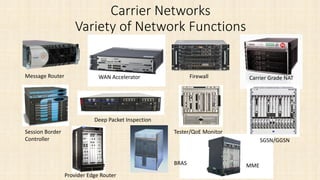
Carrier Networks
Variety of Network Functions
Message Router
Session Border
Controller
WAN Accelerator
Deep Packet Inspection
Carrier Grade NATFirewall
Tester/QoE Monitor
SGSN/GGSN
Provider Edge Router
BRAS MME
Problem
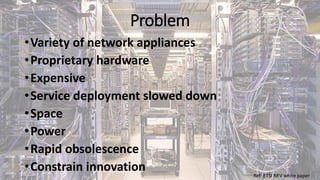
•Variety of network appliances
•Proprietary hardware
•Expensive
•Service deployment slowed down
•Space
•Power
•Rapid obsolescence
•Constrain innovation Ref: ETSI NFV white paper
Solution: NFV
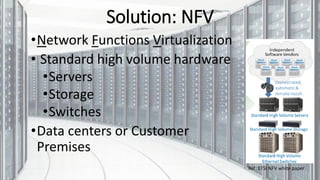
•Network Functions Virtualization
• Standard high volume hardware
•Servers
•Storage
•Switches
•Data centers or Customer
Premises
Ref: ETSI NFV white paper
Network Functions Virtualization
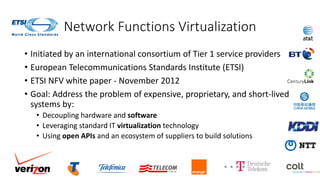
• Initiated by an international consortium of Tier 1 service providers
• European Telecommunications Standards Institute (ETSI)
• ETSI NFV white paper - November 2012
• Goal: Address the problem of expensive, proprietary, and short-lived
systems by:
• Decoupling hardware and software
• Leveraging standard IT virtualization technology
• Using open APIs and an ecosystem of suppliers to build solutions
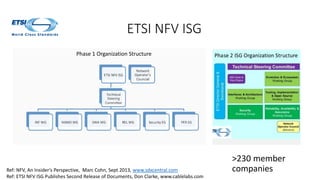
ETSI NFV ISG
>230 member
companiesRef: NFV, An Insider’s Perspective, Marc Cohn, Sept 2013, www.sdxcentral.com
Ref: ETSI NFV ISG Publishes Second Release of Documents, Don Clarke, www.cablelabs.com
Phase 1 Organization Structure
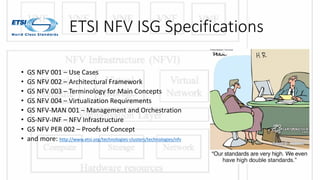
ETSI NFV ISG Specifications
• GS NFV 001 – Use Cases
• GS NFV 002 – Architectural Framework
• GS NFV 003 – Terminology for Main Concepts
• GS NFV 004 – Virtualization Requirements
• GS NFV-MAN 001 – Management and Orchestration
• GS-NFV-INF – NFV Infrastructure
• GS NFV PER 002 – Proofs of Concept
• and more: http://www.etsi.org/technologies-clusters/technologies/nfv
NFV Benefits
•Cost Savings
•Economies of Scale
•COTS hardware produced in high volume
•Order of magnitude more servers shipped
than routers
•Consolidation
•Reduced equipment costs
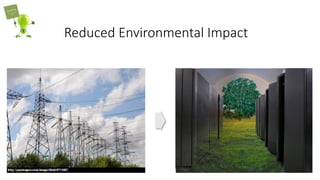
•Reduced power consumption
NFV Benefits
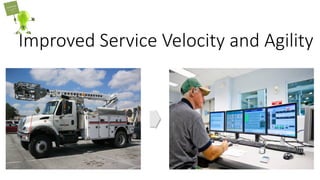
•Increased service velocity
•Increased service agility
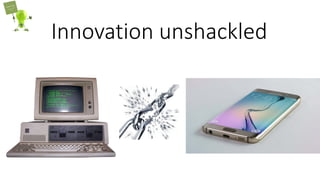
•Increased pace of innovation
NFV Enabling Technologies
• Standard commodity hardware
• Virtualization
• Cloud Computing
Standard Commodity Hardware
•Industry standard servers (e.g.,
x86), switches and storage
•High volume – millions
•Interchangeable subcomponent
market
•Economies of scale
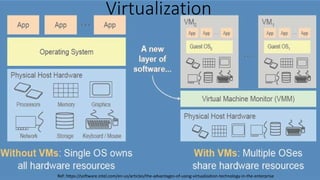
Virtualization
Ref: https://software.intel.com/en-us/articles/the-advantages-of-using-virtualization-technology-in-the-enterprise
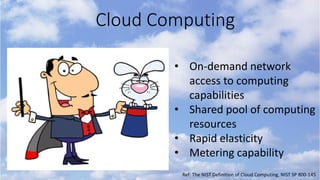
Cloud Computing
• On-demand network
access to computing
capabilities
• Shared pool of computing
resources
• Rapid elasticity
• Metering capability
Ref: The NIST Definition of Cloud Computing, NIST SP 800-145
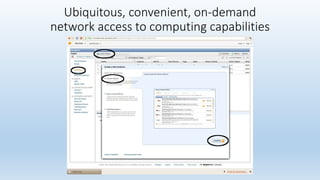
Ubiquitous, convenient, on-demand
network access to computing capabilities
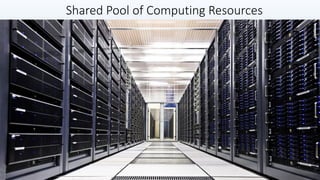
Shared Pool of Computing Resources
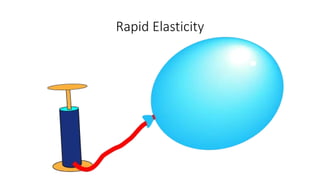
Rapid Elasticity
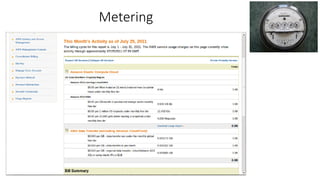
Metering
What do we have so far?
•Virtual Network Appliances => CapEx and OpEx savings
•Open Standards => Ecosystem of virtual appliance suppliers
•Cloud Infrastructure => On-demand creation of any
number of appliances
•What is missing?
• Orchestration
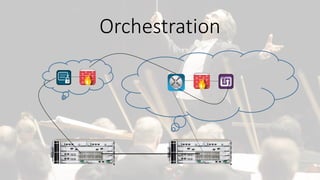
Orchestration
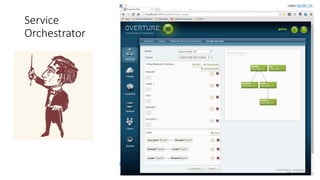
Service
Orchestrator
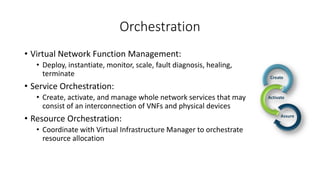
Orchestration
• Virtual Network Function Management:
• Deploy, instantiate, monitor, scale, fault diagnosis, healing,
terminate
• Service Orchestration:
• Create, activate, and manage whole network services that may
consist of an interconnection of VNFs and physical devices
• Resource Orchestration:
• Coordinate with Virtual Infrastructure Manager to orchestrate
resource allocation
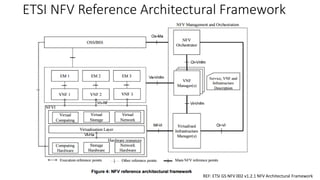
ETSI NFV Reference Architectural Framework
REF: ETSI GS NFV 002 v1.2.1 NFV Architectural Framework
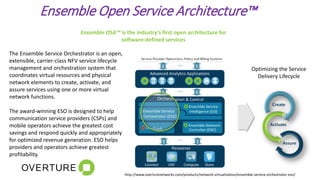
Ensemble Open Service Architecture™
Ensemble OSA™ is the industry’s first open architecture for
software-defined services
Optimizing the Service
Delivery Lifecycle
The Ensemble Service Orchestrator is an open,
extensible, carrier-class NFV service lifecycle
management and orchestration system that
coordinates virtual resources and physical
network elements to create, activate, and
assure services using one or more virtual
network functions.
The award-winning ESO is designed to help
communication service providers (CSPs) and
mobile operators achieve the greatest cost
savings and respond quickly and appropriately
for optimized revenue generation. ESO helps
providers and operators achieve greatest
profitability.
http://www.overturenetworks.com/products/network-virtualization/ensemble-service-orchestrator-eso/
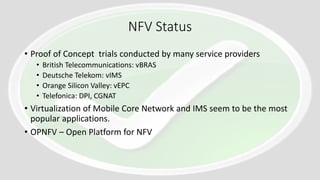
NFV Status
• Proof of Concept trials conducted by many service providers
• British Telecommunications: vBRAS
• Deutsche Telekom: vIMS
• Orange Silicon Valley: vEPC
• Telefonica: DPI, CGNAT
• Virtualization of Mobile Core Network and IMS seem to be the most
popular applications.
• OPNFV – Open Platform for NFV
Carrier Networks are on the
cusp of a paradigm shift
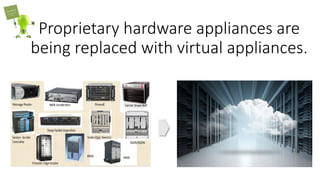
Proprietary hardware appliances are
being replaced with virtual appliances.
Improved Service Velocity and Agility
Cost Savings
Reduced Environmental Impact
Innovation unshackled
ETSI is developing open specs for NFV
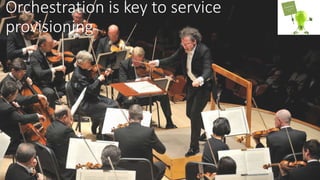
Orchestration is key to service
provisioning
Network Function Virtualization Orchestration LI

Network Function Virtualization Orchestration LI

  • 1.
    NETWORK FUNCTIONS VIRTUALIZATION Symposium onComputer Science and Engineering University of Massachusetts at Amherst May 2, 2015 K. ARVIND https://www.linkedin.com/in/karvind KRITHI60
  • 2.
    Plan of thePresentation • Problem • Solution – Network Functions Virtualization • Standards • Benefits • Enabling Technologies: Virtualization and Cloud • Orchestration • Conclusion
  • 3.
    Carrier Networks Variety ofNetwork Functions Message Router Session Border Controller WAN Accelerator Deep Packet Inspection Carrier Grade NATFirewall Tester/QoE Monitor SGSN/GGSN Provider Edge Router BRAS MME
  • 4.
    Problem •Variety of networkappliances •Proprietary hardware •Expensive •Service deployment slowed down •Space •Power •Rapid obsolescence •Constrain innovation Ref: ETSI NFV white paper
  • 5.
    Solution: NFV •Network FunctionsVirtualization • Standard high volume hardware •Servers •Storage •Switches •Data centers or Customer Premises Ref: ETSI NFV white paper
  • 6.
    Network Functions Virtualization •Initiated by an international consortium of Tier 1 service providers • European Telecommunications Standards Institute (ETSI) • ETSI NFV white paper - November 2012 • Goal: Address the problem of expensive, proprietary, and short-lived systems by: • Decoupling hardware and software • Leveraging standard IT virtualization technology • Using open APIs and an ecosystem of suppliers to build solutions
  • 7.
    ETSI NFV ISG >230member companiesRef: NFV, An Insider’s Perspective, Marc Cohn, Sept 2013, www.sdxcentral.com Ref: ETSI NFV ISG Publishes Second Release of Documents, Don Clarke, www.cablelabs.com Phase 1 Organization Structure
  • 8.
    ETSI NFV ISGSpecifications • GS NFV 001 – Use Cases • GS NFV 002 – Architectural Framework • GS NFV 003 – Terminology for Main Concepts • GS NFV 004 – Virtualization Requirements • GS NFV-MAN 001 – Management and Orchestration • GS-NFV-INF – NFV Infrastructure • GS NFV PER 002 – Proofs of Concept • and more: http://www.etsi.org/technologies-clusters/technologies/nfv
  • 9.
    NFV Benefits •Cost Savings •Economiesof Scale •COTS hardware produced in high volume •Order of magnitude more servers shipped than routers •Consolidation •Reduced equipment costs •Reduced power consumption
  • 10.
    NFV Benefits •Increased servicevelocity •Increased service agility •Increased pace of innovation
  • 11.
    NFV Enabling Technologies •Standard commodity hardware • Virtualization • Cloud Computing
  • 12.
    Standard Commodity Hardware •Industrystandard servers (e.g., x86), switches and storage •High volume – millions •Interchangeable subcomponent market •Economies of scale
  • 13.
  • 14.
    Cloud Computing • On-demandnetwork access to computing capabilities • Shared pool of computing resources • Rapid elasticity • Metering capability Ref: The NIST Definition of Cloud Computing, NIST SP 800-145
  • 15.
    Ubiquitous, convenient, on-demand networkaccess to computing capabilities
  • 16.
    Shared Pool ofComputing Resources
  • 17.
  • 18.
  • 19.
    What do wehave so far? •Virtual Network Appliances => CapEx and OpEx savings •Open Standards => Ecosystem of virtual appliance suppliers •Cloud Infrastructure => On-demand creation of any number of appliances •What is missing? • Orchestration
  • 20.
  • 21.
  • 22.
    Orchestration • Virtual NetworkFunction Management: • Deploy, instantiate, monitor, scale, fault diagnosis, healing, terminate • Service Orchestration: • Create, activate, and manage whole network services that may consist of an interconnection of VNFs and physical devices • Resource Orchestration: • Coordinate with Virtual Infrastructure Manager to orchestrate resource allocation
  • 23.
    ETSI NFV ReferenceArchitectural Framework REF: ETSI GS NFV 002 v1.2.1 NFV Architectural Framework
  • 24.
    Ensemble Open ServiceArchitecture™ Ensemble OSA™ is the industry’s first open architecture for software-defined services Optimizing the Service Delivery Lifecycle The Ensemble Service Orchestrator is an open, extensible, carrier-class NFV service lifecycle management and orchestration system that coordinates virtual resources and physical network elements to create, activate, and assure services using one or more virtual network functions. The award-winning ESO is designed to help communication service providers (CSPs) and mobile operators achieve the greatest cost savings and respond quickly and appropriately for optimized revenue generation. ESO helps providers and operators achieve greatest profitability. http://www.overturenetworks.com/products/network-virtualization/ensemble-service-orchestrator-eso/
  • 25.
    NFV Status • Proofof Concept trials conducted by many service providers • British Telecommunications: vBRAS • Deutsche Telekom: vIMS • Orange Silicon Valley: vEPC • Telefonica: DPI, CGNAT • Virtualization of Mobile Core Network and IMS seem to be the most popular applications. • OPNFV – Open Platform for NFV
  • 27.
    Carrier Networks areon the cusp of a paradigm shift
  • 28.
    Proprietary hardware appliancesare being replaced with virtual appliances.
  • 29.
  • 30.
  • 31.
  • 32.
  • 33.
    ETSI is developingopen specs for NFV
  • 34.
    Orchestration is keyto service provisioning