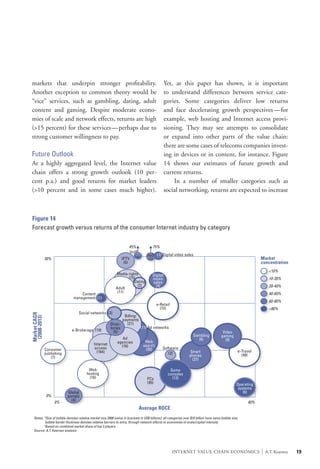
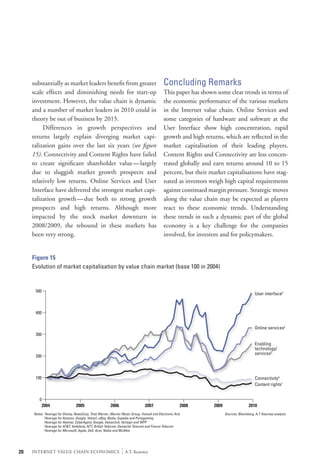
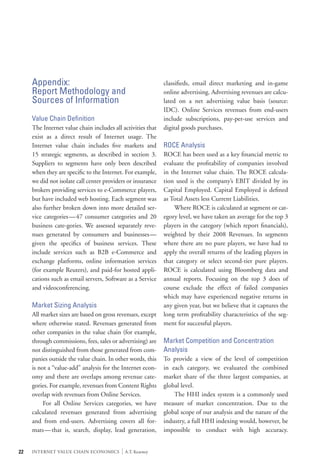
Internet Value Chain
Economics
Gaining a deeper understanding of the Internet economy
W
            hen considering the technological innovations of the past
            50 years, the Internet is probably the one that has had the
            greatest impact on everyday life in developed economies.
Nearly six out of 10 Americans now shop online and more than four out
of 10 bank online. Twenty hours of video are uploaded to YouTube every
minute, while 5 percent of all time online is spent on the social net-
working site, Facebook. The Internet has also changed the way in which
businesses operate—today, 64 percent of C-level executives conduct
six or more searches per day to locate business information. The Internet
has been a source of great good—as evidenced by the role played by
Internet-based mapping and communications in the relief effort follow-
ing the recent Haiti earthquake. The Internet also has shown a negative
side—more than 97 percent of all emails are spam, while more than 70
percent of Americans fear online identity theft and 57 percent feel that
their personal privacy has been greatly diminished by the Internet.1

Behind these statistics and headlines, however,                                tions, a sound understanding of the Internet
there remains a low level of understanding of                                  economy will be important for all stakeholders.
how the Internet economy works. Who are the                                    This includes the companies playing a role in the
different players involved in the Internet, beyond                             Internet economy, private and business consum-
the flagship names? How is the industry struc-                                 ers, and the regulators and policy-makers who are
tured and how concentrated is it? How do players                               increasingly being asked to oversee or intervene in
make money and how do revenues flow across                                     multiple aspects of the Internet.
the value chain? Is the industry attractive in terms                           	 To help improve the understanding of the
of growth and returns?                                                         Internet landscape, Vodafone commissioned
	 As the Internet continues to grow and                                        A.T. Kearney to conduct a review of the Internet’s
develop, playing an increasingly important role in                             value chain and economics. This paper has been
the lives and activities of people and organiza-                               produced independently and does not necessarily
1
 Data sources include Pew Internet & American Life Project survey, 2009; YouTube, May 2009; ComScore, April 2009; Google, Forbes, BtoB, June2009;
“Social media get quake reports out fast,” Los Angeles Times, January 2010; Microsoft, 2009, quoted in http://news.bbc.co.uk/2/hi/technology/7988579.stm;
ABC News/Washington Post, 2009, quoted in http://www.spendonlife.com/blog/new-poll-shows-increased-id-theft-fear.


                                                                                    INTERNET VALUE CHAIN ECONOMICS                         |   A.T. Kearney   1
represent the views of Vodafone. Neither Vodafone        	 Total Internet value chain revenues are esti-
    nor A.T. Kearney is responsible for the use that         mated at US$1,930 billion in 2008, growing on
    might be made of this paper.                             average at 10 percent p.a. More than 60 percent
    	 This paper has a global scope but most exam-           derives from business-to-business activities as
    ples and illustrations focus on North American           many organisations have embraced the Internet to
    and European markets. Terminology has been               market and sell their services and to manage rela-
    standardised and may differ from regional usage.         tionships with suppliers and partners. On the
    The paper begins with a brief overview of the            consumer side, the largest categories of spend are
    Internet’s growth and usage trends. Next, it lays        for retail Internet access and end-user devices/
    out the Internet value chain and describes each          hardware. Between them, these enablers for
    part of the value chain in terms of key players and      households to access the Internet account for 44
    revenue models. Finally, it provides an assessment       percent of total consumer value chain revenues.
    of the industry’s market size, growth trends, prof-      	 Consumer Online Services, the most visible
    itability and competitive structure.                     part of the Internet economy, represent a US$242
    	 It is not the purpose of this paper to offer rec-      billion market, of which a substantial part relates
    ommendations, but rather to provide a consistent         to e-Commerce. Search engines capture more
    framework and fact base to inform public debate.         than one-third of remaining online service reve-
    With such a broad remit we may inevitably dis-           nues and indeed 59 percent of online advertising
    appoint readers who would like more detail about         revenues.
    individual markets or issues; for that reason we         	 Revenues for consumer Online Services are
    have provided documentation of our sources and           growing more than twice as fast as those for
    assumptions to assist further research.                  Internet access provision and more than five times
                                                             faster than sales of hardware and software.
                                                             Bandwidth growth has been even stronger, but
    1. Summary of Findings                                   online service revenues are for the most part
                                                             disconnected from bandwidth consumption — in
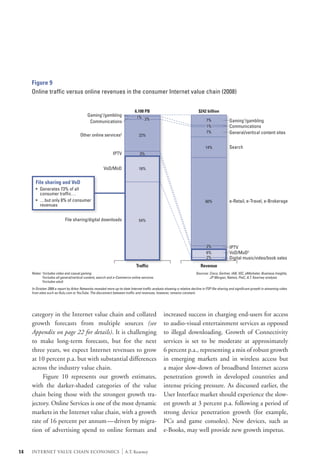
    The number of Internet users has grown rapidly to        2008 file-sharing and video-on-demand accounted
    1.7 billion in 2009, or a quarter of the world’s pop-    for nearly three-quarters of bandwidth but only
    ulation. Consumers use the Internet for an increas-      8 percent of revenues.
    ing range of everyday activities, from shopping and      	 Our analysis shows that the most concentrated
    banking to sharing photos and watching TV. As a          markets in the value chain are the Online Services
    result, they spend a growing proportion of their         of VoIP, gaming and search plus certain categories
    media consumption time and wallet on the Internet.       of hardware/software, namely games consoles,
    A complex value chain has developed to deliver           smart phones and operating systems. The online
    these services, comprising global and local players      advertising network market is also highly concen-
    with assets as diverse as content rights, communi-       trated. In all of these categories the top three play-
    cations and IT infrastructure, proprietary software      ers account for more than 60 percent of revenues,
    and global brands. Businesses also use the Internet      driven by strong network and/or scale effects.
    extensively to market and distribute their services      	 We also analysed the profitability of the larg-
    as well as to procure and manage supply chains.          est players in all categories. While many factors


2   INTERNET VALUE CHAIN ECONOMICS        |   A.T. Kearney
influence a company’s profitability in a given year,                                        value chain to influence corporate strategic activity
 we found the most concentrated categories to be                                             and regulatory decision-making in the years ahead.
 among those with the highest returns on capital
 employed (ROCE) in the value chain, at least
 20 percent in all cases. Content Rights and                                                 2. Growth of Internet Usage
 Connectivity, on the other hand, are less concen-
 trated markets when measured at a global level,                                             The number of Internet users globally has grown
 although local differences apply. Both of these                                             dramatically in the past 15 years (see figure 1). In
 markets also have lower ROCE (10 to 15 percent)                                             1995, there were only 16 million Internet users,
 and the market capitalisations of their largest                                             equating to 0.4 percent of the world’s population.
 players have been stagnant for years.                                                       By 2009, this had risen to 1.7 billion users, corre-
 	 The Internet has a short history characterised                                            sponding to more than a quarter of the world’s
 by rapid bursts of technological and economic                                               population. In most West European and North
 development, often stimulated by the emergence of                                           American markets, Internet usage penetration
 new entrants on a global scale. Whether it will con-                                        now surpasses 75 percent of the population.
 tinue to be so dynamic or is now of such a size and                                         	 In recent years the strongest growth has come
 relative maturity that it begins to resemble other                                          from emerging markets. In China, the penetra-
 parts of the global economy, is beyond the scope of                                         tion rate has jumped from 2 percent in 2000 to 27
 this paper. Certainly one could expect such differ-                                         percent by the end of 2009. With 360 million
 ences in economic performance across the Internet                                           people online, China has more Internet users than


  Figure 1
  Global Internet users and penetration rate (1995-2009)


                                                                                                                                               25.6%
                            2,600                               A quarter of the world’s population is online                                               26%
                                                                                                                                       23.5%
                            2,400                                                                                                                           24%
                            2,200                                                                                                                           22%
                                                                                                                               20.0%
                                                                                                                                                                   World population penetration


                            2,000                                                                                                                           20%
Internet users (millions)


                            1,800                                                                                      16.7%                   1,734        18%
                                                                                                               15.7%                   1,574
                            1,600                                                                                                                           16%
                            1,400                                                                      12.7%                   1,319                        14%
                            1,200                                                              11.1%                                                        12%
                                                                                                                       1,093
                                                                                       9.4%                    1,018
                            1,000                                               8.6%                                                                        10%
                                                                                                        817
                             800                                                                719                                                         8%
                                                                         5.8%          587
                             600                                                513                                                                         6%
                                                                  4.1%
                                                         3.6%            361
                             400            36     70                                                                                                       4%
                                     16                           248
                                                  1.7%
                             200           0.9%          147                                                                                                2%
                                    0.4%
                               0                                                                                                                            0%
                                    1995   1996   1997   1998     1999   2000   2001   2002    2003    2004    2005    2006    2007    2008    2009
  Sources: Nielsen, ITU; A.T. Kearney analysis


                                                                                                INTERNET VALUE CHAIN ECONOMICS                         |   A.T. Kearney                           3
the whole of Western Europe, and 60 percent                                       	 More recently, mobile devices have become
    more than the United States. Brazil already has                                   a key means to access the Internet, driven by the
    more Internet users than any European country,                                    availability and increasing affordability of smart-
    while the Middle East has gone from 3 million to                                  phones as well as high-speed data modems and
    57 million users between 2000 and 2009.                                           USB “dongles” that provide Internet access for
    	 Most users access the Internet via fixed-line                                   laptop computers. Total shipments for smart-
    broadband connections at home or at work.                                         phones, for instance, are projected to grow from
    The take-up of broadband, delivered via multiple                                  54 million in 2005 to 289 million in 2013.2
    technology options but primarily via DSL con-                                     	 Time spent online is also growing substan-
    nections over the original copper telephone net-                                  tially, to some extent at the expense of traditional
    works, has transformed the telecommunications                                     media. A recent study conducted in Germany, for
    landscape in most countries. With plans to deploy                                 instance, projected that the Internet’s share of
    fibre to deliver far greater bandwidth per connec-                                media consumption time would increase from 4
    tion, the telecommunications sector faces a major                                 percent in 2000 to 24 percent in 2015. This, how-
    investment wave in the next decade and is cur-                                    ever, does not come solely at the expense of other
    rently engaged in extensive debate over the future                                media. Total media consumption time grew by
    regulatory framework and commercial model to                                      nearly 50 percent between 2000 and 2009 to an
    support such investments.                                                         average of 10.3 hours per day. There is a growing


    Figure 2
    Internet share of consumers’ time and wallet                                                                                      EXAMPLE: Germany


    Share of time by media1 (2000-2015e)                                              Share of wallet by media (2000-2015e)
    (hours/day/person)                                                                (US$ billion)
            7.2              8.3              9.6               10.3                       71               75               99              134

            20%             23%               23%               23%       Others2
                                                                                                                                             34%       Others2
            4%                                                                                                              40%
                             3%               2%                2%        Magazines                        47%
                                                                                          58%
                                              24%               21%       Radio                                                               4%       Magazines
            37%             29%                                                                                                               4%       Radio
                                                                                                                            5%
                                                                                                                            5%               17%       TV
                                                                                                           7%
                                                                                                           6%
                                                                29%       TV               8%                               20%
                                              30%
                                                                                           6%
                            34%                                                                            23%
            36%                                                                                                                              42%       Internet3
                                                                                          23%                               29%
                                              21%               24%       Internet
                            12%                                                                            16%
            4%                                                                             5%
           2000            2005             2010e             2015e                       2000            2005             2010e            2015e
    Notes: 1Includes simultaneous media consumption                                         Sources: PwC, SevenOne Media, ARD/ZDF online study; A.T. Kearney analysis
           2
            Books, films, newspapers, offline-video games and video
           3
            Internet advertising and access spending
    2
        Credit Suisse, June 2009


4   INTERNET VALUE CHAIN ECONOMICS                               |    A.T. Kearney
trend of consuming multiple media at the same                   	 Internet usage patterns have evolved rapidly,
time—for instance, browsing the Internet while                  as illustrated by consumers’ preferred websites. Of
watching TV.                                                    the top 15 websites in the United States in 1999,
	 With increasing share of time, the Internet is                measured by unique visitors, only four remained
inevitably also capturing an increasing share of                in this league table by 2009 (see figure 3). Most of
consumer and advertiser spend—from 5 percent                    the top 11 websites have been launched fairly
in 2000 to 42 percent of total by 2015 in Germany,              recently and include sites such as Google,
potentially twice as much as TV and Radio com-                  Facebook, eBay and Apple iTunes.
bined. This trend is likely to be repeated for other            	 Search and Social Networking are two exam-
European markets (see figure 2).                                ples of services where market leadership has
	 Internet usage is expanding to a broader range                changed rapidly. In 1999, Google captured only
of services and becoming central to everyday lives.             4 percent of global search revenues. Today Google
In the United States, 56 percent of people reported             has two-thirds of the market, while 1999 leader
having bought a product online in 2009 com-                     Yahoo!’s share has shrunk from 29 percent to 7
pared with just 27 percent in 2000; 42 percent                  percent. In social networking, Facebook did not
bank online, compared to 10 percent in 2000; 28                 exist in 2003. Five years later, it held 23 percent of
percent use social networking sites, in contrast                the market, while 2003 market leader Xanga is no
with only 5 percent in 2000.                                    longer among the top five players.


Figure 3
Top 15 Internet websites (1999 versus 2009)


                      U.S. top 15 sites 1999                                              U.S. top 15 sites 2009
     Web property                     UVs (m)
                                           2
                                                    Genre                Web property                     UVs (m)               Genre
  1. AOL sites                            46        Portal            1. Google sites                        164                Search
  2. Microsoft sites                      32        Portal            2. Yahoo sites                         158                Portal
  3. Yahoo sites                          31        Portal            3. Microsoft sites                     133                Portal
  4. Lycos                                29       Search             4. AOL sites                           99                 Portal
  5. Go Network                           21        Portal            5. Facebook                            97            Social network
  6. GeoCities1                           19     Web hosting          6. Ask Network                         88                 Search
  7. The Excite Network                   17        Portal            7. Fox Interactive Media               83        Media/social network
  8. Time Warner Online                   13        Media             8. Amazon                              70             e-Commerce
  9. Blue Mountain Arts                   12       e-Cards            9. Wikimedia Foundation                69               Reference
 10. AltaVista                            11       Search           10. eBay                                 67             e-Commerce
 11. Amazon                               10     e-Commerce         11. Turner Network                       63                 Media
 12. Xoom                                 9      Web hosting        12. CBS Interactive                      59                 Media
 13. Snap                                 9        Search           13. Apple Inc.                           58                 Music
 14. Real Networks                        8      Media player       14. Glam Media                           56                Lifestyle
 15. CNET                                 8         Media           15. Answers.com                          55               Reference

   = No longer operating                                           Note: 1Now only available in Japan
                                                                         2
                                                                           The Unique Viewers (UV) metric enables a clearer comparison of different
   = No longer exists as an independent entity
                                                                          types of websites than the more commonly referenced Page Views metric
                                                                   Sources: ComScore, A.T. Kearney analysis


                                                                   INTERNET VALUE CHAIN ECONOMICS                                |   A.T. Kearney     5
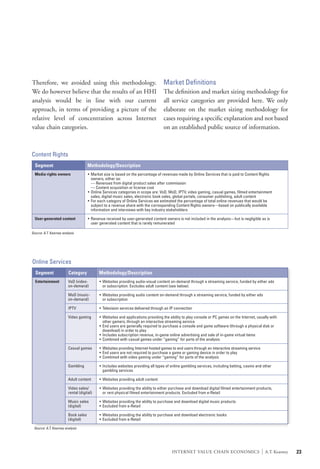
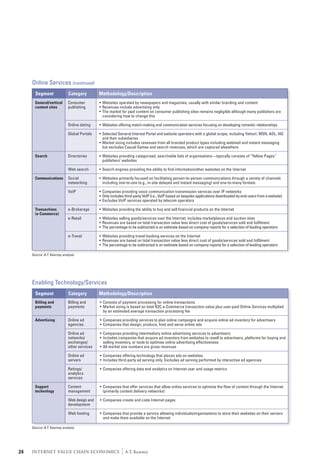
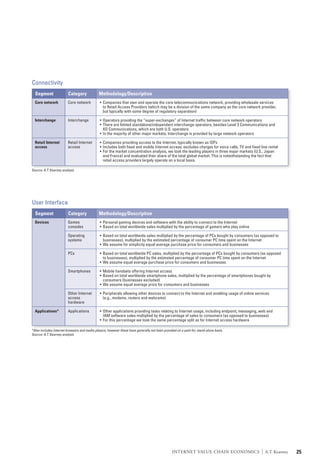
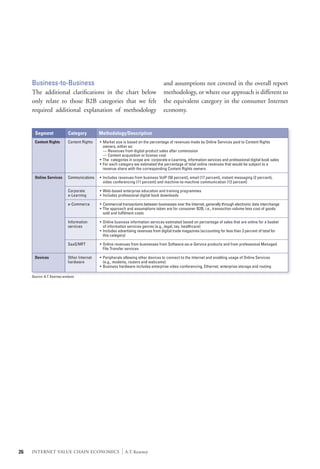
3. Overview of the Internet                                                         	 Content Rights owners are typically media
       Value Chain                                                                      companies such as Warner Brothers, the BBC or
                                                                                        Electronic Arts providing their content for a share
    The Internet ecosystem is complex and involves                                      of revenues and/or license fees. Content Rights
    multiple activities and players. We break down                                      owners typically retain 50 to 70 percent of the rev-
    the Internet value chain into five main markets:                                    enues generated by the online service provider
    Content Rights, Online Services, Enabling Tech-                                     that makes the content accessible to Internet
    nology/Services, Connectivity and User Interface                                    users. For instance, iTunes shares approximately
    (devices and applications). Figure 4 shows the main                                 70 percent of revenues earned on each music pur-
    strategic segments within each market and the dif-                                  chase with the music majors.3 In some cases,
    ferent service categories within those segments,                                    Content Rights owners provide their own Online
    together with the logos of some of the larger players.                              Services, such as the BBC iPlayer service. Of course,
    	 A number of industry players operate in two                                       there is still considerable illegal or unauthorised
    or more segments of the value chain. This can be                                    use of content on the Internet for which there is
    powerful in terms of creating a seamless customer                                   no payment made.
    experience but can also be used to take full advan-
    tage of assets such as technology, brands and                                       Online Services
    customer relationships in order to strengthen                                       Online Services correspond to the range of ser-
    competitive positioning.                                                            vices accessed by Internet users and are, as a result,
                                                                                        very diverse. For simplification, we have grouped
                                                                                        Online Services into five main segments:4
    Description of the Key Markets in the                                               	 Communications. Includes all forms of com-
    Internet Value Chain                                                                munications among Internet users, including
                                                                                        voice (VoIP), social networking, email and instant
    Content Rights                                                                      messaging. Leading providers of such services
    Much Internet content is user-generated, for                                        include Skype (part of eBay), Facebook and
    example, an individual’s page on a social network-                                  Hotmail (part of Microsoft). With the exception
    ing site or a “tweet” message on Twitter. Such con-                                 of VoIP, these services are invariably provided free-
    tent typically does not involve remuneration to                                     of-charge and funded by advertising revenues.
    content creators, although they may well retain                                     	 General/vertical content destinations. This
    copyright or some degree of privacy protection                                      segment includes general content portals (Yahoo!)
    over how their content is used by others. The                                       and more targeted services such as dating web-
    Content Rights market quantified in our subse-                                      sites, general news/consumer publishing or special
    quent analysis corresponds to the provisioning of                                   interest content websites on a diverse range of
    content to online service providers on a commer-                                    topics from wine to politics. Revenues are mostly
    cial basis. Examples of such content include                                        generated through advertising, although some
    music, filmed entertainment, games, news or the                                     websites charge for access to their services (for
    content of books and magazines.                                                     example, dating websites and FT.com).
    3
        Content Rights are often more complex than described here: an artist may own rights to different elements of a composition and receive royalties out of the 	
         revenues collected by the media company.
    4
        In subsequent analyses we also refer to the main categories of service within these segments where market characteristics are distinct.


6   INTERNET VALUE CHAIN ECONOMICS                            |   A.T. Kearney
Figure 4
Overview of the Internet value chain                                                                                                                  ILLUSTRATIVE


       Content rights1                 Online services2                    Enabling                        Connectivity                     User interface
                                                                      technology services3
   Media rights owners                  Communications                  Support technology                Core network                     Applications
   •   Video                             Skype           Vonage        • Web-hosting                                                  • Software
                                                                       • Web-design/development           AT&T            NTT
                                                                                                                                      • Media players
   •   Audio                           Hotmail      Facebook           • Content management                                           • Internet browsers
   •   Books                                                              NTT/Verio   Rackspace
                                                                                                        British         France
                                                                                                       Telecom         Telecom
   •   Gaming                       General/vertical content             Limelight     Akamai                                              McAfee       RealNetworks
   •   Adult content                     Yahoo!      Wikipedia
                                                                           Group
   •   Editorial content                                                                                                                  Symantec          Firefox
                                       Financial    match.com          Billing and payments
                                         Times                                                              Interchange
                                                                       • Online billing and
    TimeWarner            EMI                                            payment system                  Level 3         XO
                                                Search                                                Communications Communications
       Harper                                                            providers
                       Blizzard
       Collins                           Google          Baidu
                                                                           PayPal      First Data                                                                     User
                 BBC                                                                                                                            Devices
                                         Bing        Ask.com              Chase        Google             Retail Internet
                                                                        Paymentech    Checkout               access                   • PCs
                                                                                                                                      • Smart phones
                                          Entertainment                      Advertising                                              • Game consoles
                                        YouTube      Xbox Live         • Online ad agencies              AT&T         Vodafone        • Other internet access
       User-generated                                                                                                                   hardware
          content                                                      • Online ad networks/             SingTel         Tiscali
                                       Last.fm       iTunes              exchanges                                                    • Operating systems
   • Text          • Voice                                             • Third party ad servers          United         Road
                                                                                                        Internet       Runner                Dell           Nintendo
   • Images        • Video                Transactions                 • Ratings/analytics services
                                                                                                           NTT            Free
                                                                            WPP        Razorfish                                          Microsoft         Apple
                                          eBay           Amazon
                                                                          Double      Nielsen                                                       Nokia
                                       Expedia     Boursorama              Click

Notes: 1Content rights abbreviated to CR in subsequent value chains                                                                          Source: A.T. Kearney analysis
       2
        See online services categories list in methodology for details
       3
        Enabling technology/services abbreviated to ETS in subsequent value chains


	 Search. This segment consists primarily of                                             products and services. The largest service catego-
web search engines such as Google or Baidu, as                                           ries include e-Retail (Amazon), e-Travel (Expedia)
well as local/national directories such as Yell in                                       and online brokerage (Boursorama.com). Both
the United Kingdom or Pages Jaunes in France.                                            bricks-and-mortar and pure-play online players are
Revenues are primarily generated from advertis-                                          active in this segment. The e-Commerce site oper-
ing, with sophisticated models such as auctioned                                         ator will collect payment from the customer and
keyword references or pay-per-click having estab-                                        retain a margin, with the remainder passed on to
lished themselves in recent years.                                                       the manufacturer or service provider. Online costs
	 Entertainment. This comprises websites                                                 are typically much lower than for traditional retail-
focused on audio-visual entertainment, such as                                           ing so that prices are often, although not always,
downloads of digital content (iTunes), music and                                         lower. This has triggered substantial growth and
video streaming/online radio (YouTube, last.fm),                                         a displacement of volumes from traditional retail
IPTV, gaming (Xbox Live), gambling (Party-                                               to e-Commerce for items such as books.
Poker) or adult content. Revenues are generated                                          	 Revenues generated by Online Services there-
almost equally from advertising and payments                                             fore originate from a combination of advertising,
from end-users.                                                                          paid-for access to content and services, and
	 e-Commerce. Many websites sell non-digital                                             e-Commerce transaction fees.


                                                                                                 INTERNET VALUE CHAIN ECONOMICS                             |   A.T. Kearney   7
Enabling Technology/Services                             provided by banks and payment processors such
    Enabling Technology/Services are generally invis-        as First Data, there are also pure-play online pay-
    ible to the end-user, but are essential for the tech-    ment service providers such as PayPal (part of
    nical delivery of web content and the generation         eBay) and Google Check-Out.
    of revenues. Highly fragmented, these services fall      	 Advertising services providers are funda-
    into three broad segments: support technology,           mental to revenue generation for most online
    billing and payments and advertising services.           service providers. This segment includes four
    	 Support technology refers to a set of technical        categories:
    services provided to online service providers and        •	 Advertising agencies that provide a range of ser-
    includes website design and development, web                vices to their clients, including media campaign
    hosting and technical service platforms (such as            planning, ad inventory acquisition for online
    content management platforms). Akamai, for                  advertising campaigns, and creative services to
                                                                             	 design and produce online adver-
                                                                             	 tising. They charge commissions
                                                                             	 based on the total volume of adver-
                                                                             	 tising spend and, in the case of
    Revenues for consumer Online                                             	 large multi-service agencies such as

    Services are growing more than                                           	 OMD and WPP, online advertis-
                                                                             	 ing is simply part of their portfolio
    twice as fast as Internet access                                         	 of client services, albeit a growing
                                                                             	 part that requires specific skills.
    provision and more than five                                             •	 Dedicated online advertising net-
                                                                             	 works and exchanges such as
    times faster than sales of hard-                                         	 Doubleclick (part of Google). Ad
                                                                             	 networks are a technical and pay-
    ware and software.                                                       	 ment clearing house for adver-
                                                                             	 tising space. They both acquire
                                                                             	 advertising space on behalf of
                                                                             	 media buyers and advertisers and
    example, provides content delivery services                 sell ad inventory on behalf of Internet websites.
    through its network of servers that improve the             They also provide the technical platforms that
    speed and reliability of the connection and manage          facilitate the placement of display ads on web-
    the network load efficiently on behalf of online            sites. In some cases, such as Advertising.com
    service providers.                                          (owned by AOL), ad networks will acquire and
    	 Billing and payments comprise all payment                 resell ad inventory with a mark-up.
    platforms used to process monetary transactions          •	 Third-party ad serving providers that host and
    made by consumers on the Internet—to pay for                distribute online ads. This is also often per-
    accessing specific services (such as music down-            formed by the advertising agency that provides
    loads) or to conduct online e-Commerce transac-             the creative services.
    tions. Beyond payment processing services                •	 Ratings and analytics service providers that pro-


8   INTERNET VALUE CHAIN ECONOMICS        |   A.T. Kearney
vide Internet user and usage metrics. Advertisers    Assigned Names and Numbers (ICANN). Major
  have the option to buy advertising space either      core network providers exchange traffic with each
  through ad networks, through their regular           other on the basis of “peering,” whereby each
  advertising agency or directly from the website/     covers its own costs for installing and operating
  content publisher.                                   equipment that interconnects with others. Many
                                                       providers also procure interconnection on the
Connectivity                                           basis of IP transit, since this is more cost effective
Connectivity refers to Internet access services pro-   at lower traffic volumes.
vided by telecommunications network operators,         	 Both core network and interchange operators
whether fixed or wireless. Telecommunications          tend to be part of large, integrated telecoms oper-
markets vary in their structure based on regula-       ators such as Verizon or BT, but there are specialist
tory and competitive dynamics, particularly with       companies such as Level 3 or XO.
regard to the “access layer,” colloquially known as
the “last mile.”                                       User Interface
	 Many customers will arrange their Internet           The User Interface is an essential part of the
access service via their home telecommunications       Internet value chain, involving both devices (such
provider, but cable TV companies, independent          as PCs, game consoles and mobile phones) and
resellers or service providers and wireless opera-     the related software (such as operating systems,
tors provide highly competitive offers in terms of     web browsers, media players and games) used to
network speed and pricing. These services are          render services to end-users. Key players include
typically provided on the basis of a monthly sub-      hardware manufacturers such as Dell, Nintendo,
scription fee, which in some instances can include     Apple and Nokia, as well as software providers
the fixed-line subscription fee and bundled voice      such Microsoft, Real Media and McAfee.
calls and TV subscriptions. As usage volumes           	 Revenues generated from the User Interface
grow exponentially for some heavy users, there is      mainly derive from the end-user’s acquisition
debate on the future revenue model, with options       of the device, which often includes pre-installed
including volume-based pricing (benefitting occa-      software. Subscription models are increasingly
sional users) or models where the online service       common for some applications, such as anti-virus
provider pays for the customer connectivity to         security software. In some cases, software is pro-
ensure a particular quality of service that matches    vided free-of-charge (for example via Internet
its content offering.                                  browsers and media players) — as providers seek
	 Also involved in providing connectivity are          to maximize their user base and generate revenues
core network operators that provide the so-called      from advertising. In wireless markets, it has been
“highways” of Internet traffic transport. Core net-    common for the connectivity provider to supply
work operators tend to be remunerated based on         the device on a subsidised basis and recover the
the capacity they provide to the access providers.     cost through ongoing subscription revenues. In
They connect the access network nodes to the           some markets there have been trials with laptop
“super-exchanges” of Internet traffic, which route     computers provided on a similar basis.
global Internet traffic based on technical stan-       	 The replacement cycle for devices from PCs
dards defined by the Internet Corporation for          to wireless phones has been very short, with


                                                          INTERNET VALUE CHAIN ECONOMICS         |   A.T. Kearney   9
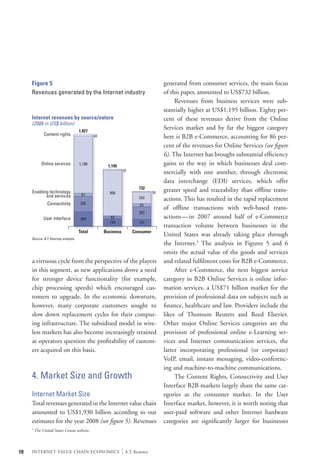
Figure 5                                                                        generated from consumer services, the main focus
     Revenues generated by the Internet industry                                     of this paper, amounted to US$732 billion.
                                                                                     	 Revenues from business services were sub-
                                                                                     stantially higher at US$1,195 billion. Eighty per-
     Internet revenues by source/nature                                              cent of these revenues derive from the Online
     (2008 in US$ billion)
                                     1,927
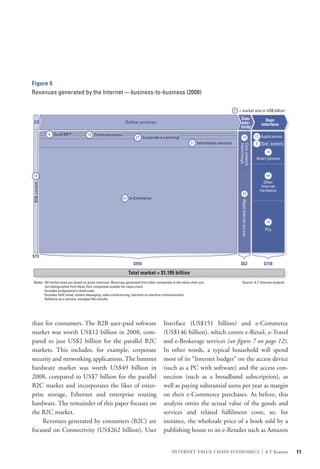
                                                                                     Services market and by far the biggest category
              Content rights                 34                                      here is B2B e-Commerce, accounting for 86 per-
                                                                                     cent of the revenues for Online Services (see figure
                                                                                     6). The Internet has brought substantial efficiency
             Online services         1,198         1,195
                                                                                     gains to the way in which businesses deal com-
                                                             19                      mercially with one another, through electronic
                                                                                     data interchange (EDI) services, which offer
                                                                        732          greater speed and traceability than offline trans-
     Enabling technology                            956                         16
            and services              61
                                                                        242          actions. This has resulted in the rapid replacement
                Connectivity          325                               61
                                                                                     of offline transactions with web-based trans-
                                                                        262
              User interface          309            62                              actions — in 2007 around half of e-Commerce
                                                    158                 151
                                                                                     transaction volume between businesses in the
                                     Total        Business          Consumer
                                                                                     United States was already taking place through
     Source: A.T. Kearney analysis
                                                                                     the Internet.5 The analysis in Figures 5 and 6
                                                                                     omits the actual value of the goods and services
     a virtuous cycle from the perspective of the players                            and related fulfilment costs for B2B e-Commerce.
     in this segment, as new applications drove a need                               	 After e-Commerce, the next biggest service
     for stronger device functionality (for example,                                 category in B2B Online Services is online infor-
     chip processing speeds) which encouraged cus-                                   mation services, a US$71 billion market for the
     tomers to upgrade. In the economic downturn,                                    provision of professional data on subjects such as
     however, many corporate customers sought to                                     finance, healthcare and law. Providers include the
     slow down replacement cycles for their comput-                                  likes of Thomson Reuters and Reed Elsevier.
     ing infrastructure. The subsidised model in wire-                               Other major Online Services categories are the
     less markets has also become increasingly strained                              provision of professional online e-Learning ser-
     as operators question the profitability of custom-                              vices and Internet communication services, the
     ers acquired on this basis.                                                     latter incorporating professional (or corporate)
                                                                                     VoIP, email, instant messaging, video-conferenc-
                                                                                     ing and machine-to-machine communications.
     4. Market Size and Growth                                                       	 The Content Rights, Connectivity and User
                                                                                     Interface B2B markets largely share the same cat-
     Internet Market Size                                                            egories as the consumer market. In the User
     Total revenues generated in the Internet value chain                            Interface market, however, it is worth noting that
     amounted to US$1,930 billion according to our                                   user-paid software and other Internet hardware
     estimates for the year 2008 (see figure 5). Revenues                            categories are significantly larger for businesses
     5
         The United States Census website.


10   INTERNET VALUE CHAIN ECONOMICS                          |   A.T. Kearney
Figure 6
Revenues generated by the Internet — business-to-business (2008)

                                                                                                                                     # = market size in US$ billion1
                                                                                                                                         Con-                           User
 CR                                                           Online services                                                            nec-                         interface
                                                                                                                                         tivity
              8 SaaS/MFT4           19 Communications
                                                                     27 Corporate e-Learning2                                               19                     12 Applications
                                                                                                           71 Information services                                 5 Oper. systems


                                                                                                                                        interchange
                                                                                                                                        Core network
                                                                                                                                                                           14
                                                                                                                                                                   Smart phones


 19                                                                                                                                                                        49
                                                                                                                                                                       Other
B2B content


                                                                                                                                                                      Internet
                                                                                                                                                                     hardware
                                                                                                                                            43
                                                            831 e-Commerce


                                                                                                                                          Retail Internet access
                                                                                                                                                                           78
                                                                                                                                                                          PCs


$19
                                                                    $956                                                                 $62                              $158
                                                                Total market = $1,195 billion
Notes: 1All market sizes are based on gross revenues. Revenues generated from other companies in the value chain are                      Source: A.T. Kearney analysis
        not distinguished from those from companies outside the value chain;
       2
        Includes professional e-book sales
       3
        Includes VoIP, email, instant messaging, video conferencing, machine-to-machine communication
       4
        Software as a service, managed file transfer


than for consumers. The B2B user-paid software                                          Interface (US$151 billion) and e-Commerce
market was worth US$12 billion in 2008, com-                                            (US$146 billion), which covers e-Retail, e-Travel
pared to just US$2 billion for the parallel B2C                                         and e-Brokerage services (see figure 7 on page 12).
markets. This includes, for example, corporate                                          In other words, a typical household will spend
security and networking applications. The Internet                                      most of its “Internet budget” on the access device
hardware market was worth US$49 billion in                                              (such as a PC with software) and the access con-
2008, compared to US$7 billion for the parallel                                         nection (such as a broadband subscription), as
B2C market and incorporates the likes of enter-                                         well as paying substantial sums per year as margin
prise storage, Ethernet and enterprise routing                                          on their e-Commerce purchases. As before, this
hardware. The remainder of this paper focuses on                                        analysis omits the actual value of the goods and
the B2C market.                                                                         services and related fulfilment costs, so, for
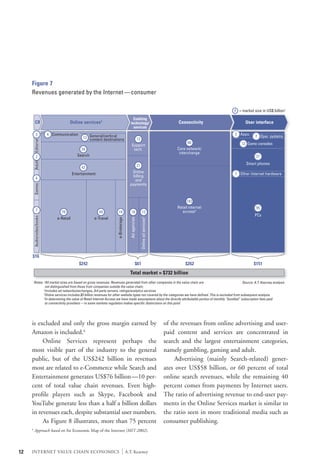
	 Revenues generated by consumers (B2C) are                                             instance, the wholesale price of a book sold by a
focused on Connectivity (US$262 billion), User                                          publishing house to an e-Retailer such as Amazon


                                                                                              INTERNET VALUE CHAIN ECONOMICS                                          |   A.T. Kearney   11
Figure 7
     Revenues generated by the Internet — consumer

                                                                                                                                                          # = market size in US$ billion1
                                                                                         Enabling
            CR                           Online services3                              technology/                                  Connectivity                User interface
                                                                                         services
              3              4 Communication                                                                                                               2 Apps.
                                                   13 General/vertical
                                                      content destinations                 12
                                                                                                                                                                      7 Oper. systems
         Editorial


                                                                                                                                          80                  13 Game consoles
                                                                                        Support
                                                 34                                      tech.                                      Core network/
                                                                                                                                     interchange
              2                                Search                                                                                                                  27
         Adult


                                                                                                    21                                                           Smart phones
                                                  42
                                             Entertainment                             Online                                                              7 Other Internet hardware
                                                                                       billing
              4                                                                         and
                                                                                      payments
         Games


                                                                                                                                         182
                                                                                                                                    Retail internet                    95
              7                     78                       49         19              16                  12                         access4
                                                                                                                                                                      PCs
         Audio/video/books


                                  e-Retail               e-Travel
                                                                                                         Online ad services2
                                                                                      Ad agencies
                                                                      e-Brokerage


     $16
                                                $242                                           $61                                      $262                         $151
                                                                                      Total market = $732 billion
         Notes: 1All market sizes are based on gross revenues. Revenues generated from other companies in the value chain are                               Source: A.T. Kearney analysis
                 not distinguished from those from companies outside the value chain;
                2
                 Includes ad networks/exchanges, 3rd party servers, ratings/analytics services
                3
                 Online services includes $3 billion revenues for other website types not covered by the categories we have defined. This is excluded from subsequent analysis.
                4
                 In determining the value of Retail Internet Access we have made assumptions about the directly attributable portion of monthly “bundled” subscription fees paid
                 to connectivity providers —in some markets regulation makes specific distinctions on this point


     is excluded and only the gross margin earned by                                                                           of the revenues from online advertising and user-
     Amazon is included.6                                                                                                      paid content and services are concentrated in
     	 Online Services represent perhaps the                                                                                   search and the largest entertainment categories,
     most visible part of the industry to the general                                                                          namely gambling, gaming and adult.
     public, but of the US$242 billion in revenues                                                                             	 Advertising (mainly Search-related) gener-
     most are related to e-Commerce while Search and                                                                           ates over US$58 billion, or 60 percent of total
     Entertainment generates US$76 billion—10 per-                                                                             online search revenues, while the remaining 40
     cent of total value chain revenues. Even high-                                                                            percent comes from payments by Internet users.
     profile players such as Skype, Facebook and                                                                               The ratio of advertising revenue to end-user pay-
     YouTube generate less than a half a billion dollars                                                                       ments in the Online Services market is similar to
     in revenues each, despite substantial user numbers.                                                                       the ratio seen in more traditional media such as
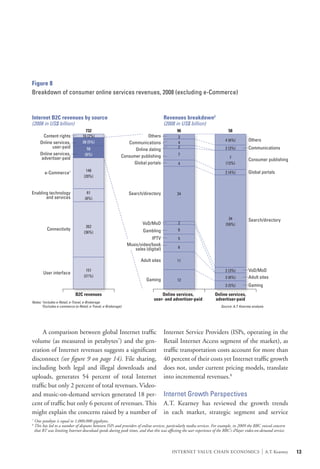
     	 As Figure 8 illustrates, more than 75 percent                                                                           consumer publishing.
     6
          Approach based on An Economic Map of the Internet (MIT 2002).


12   INTERNET VALUE CHAIN ECONOMICS                                            |    A.T. Kearney
Figure 8
Breakdown of consumer online services revenues, 2008 (excluding e-Commerce)


Internet B2C revenues by source                                                      Revenues breakdown2
(2008 in US$ billion)                                                                (2008 in US$ billion)
                                    732                                                       96                              58
         Content rights           16 (2%)                               Others                3
                                                                                                                            4 (6%)         Others
       Online services,           38 (5%)                      Communications                 4
             user-paid               58                                                       2                             2 (3%)         Communications
                                                                  Online dating
       Online services,             (8%)                                                      7
        advertiser-paid                                     Consumer publishing                                               7
                                                                                                                                           Consumer publishing
                                                                 Global portals               4                             (13%)
                                    146                                                                                                    Global portals
          e-Commerce1                                                                                                       2 (4%)
                                   (20%)


Enabling technology                  61                         Search/directory              34
       and services                 (8%)


                                                                                                                              34           Search/directory
                                                                        VoD/MoD               2                             (59%)
                                    262
            Connectivity                                                Gambling              6
                                   (36%)
                                                                            IPTV              5
                                                                Music/video/book
                                                                   sales (digital)            6


                                                                       Adult sites            11

                                    151                                                                                     2 (3%)         VoD/MoD
         User interface
                                   (21%)                                                                                    3 (6%)         Adult sites
                                                                          Gaming              12
                                                                                                                            3 (5%)         Gaming
                             B2C revenues                                          Online services,                  Online services,
                                                                               user- and advertiser-paid             advertiser-paid
Notes: 1Includes e-Retail, e-Travel, e-Brokerage
       2
        Excludes e-commerce (e-Retail, e-Travel, e-Brokerage)                                                            Source: A.T. Kearney analysis


	 A comparison between global Internet traffic                                       Internet Service Providers (ISPs, operating in the
volume (as measured in petabytes7) and the gen-                                      Retail Internet Access segment of the market), as
eration of Internet revenues suggests a significant                                  traffic transportation costs account for more than
disconnect (see figure 9 on page 14). File sharing,                                  40 percent of their costs yet Internet traffic growth
including both legal and illegal downloads and                                       does not, under current pricing models, translate
uploads, generates 54 percent of total Internet                                      into incremental revenues.8
traffic but only 2 percent of total revenues. Video-
and music-on-demand services generated 18 per-                                       Internet Growth Perspectives
cent of traffic but only 6 percent of revenues. This                                 A.T. Kearney has reviewed the growth trends
might explain the concerns raised by a number of                                     in each market, strategic segment and service
7
    One petabyte is equal to 1,000,000 gigabytes.
8
    This has led to a number of disputes between ISPs and providers of online services, particularly media services. For example, in 2009 the BBC voiced concern
    that BT was limiting Internet download speeds during peak times, and that this was affecting the user experience of the BBC’s iPlayer video-on-demand service.


                                                                                          INTERNET VALUE CHAIN ECONOMICS                             |   A.T. Kearney   13
Figure 9
     Online traffic versus online revenues in the consumer Internet value chain (2008)


                                                                              6,100 PB                                      $242 billion
                                            Gaming1/gambling                   1% 2%
                                             Communications                                                                      7%              Gaming1/gambling
                                                                                                                                 1%              Communications
                                                                                                                                 7%              General/vertical content sites
                                       Other online services2                    22%

                                                                                                                                14%              Search
                                                              IPTV                3%


                                                        VoD/MoD                  18%


       File sharing and VoD
       • Generates 73% of all
         consumer traffic…
       • …but only 8% of consumer                                                                                               60%              e-Retail, e-Travel, e-Brokerage
         revenues


                            File sharing/digital downloads                       54%


                                                                                                                                 2%              IPTV
                                                                                                                                 6%              VoD/MoD3
                                                                                                                                 2%              Digital music/video/book sales
                                                                               Traffic                                       Revenue
     Notes: 1Includes video and casual gaming                                                                             Sources: Cisco, Gartner, IAB, IDC, eMarketer, Business Insights,
            2
             Includes all general/vertical content, search and e-Commerce online services                                          JP Morgan, Natixis, PwC, A.T. Kearney analysis
            3
             Includes adult

     In October 2009 a report by Arbor Networks revealed more up-to-date Internet traffic analysis showing a relative decline in P2P file-sharing and significant growth in streaming video
     from sites such as Hulu.com or YouTube. The disconnect between traffic and revenues, however, remains constant.


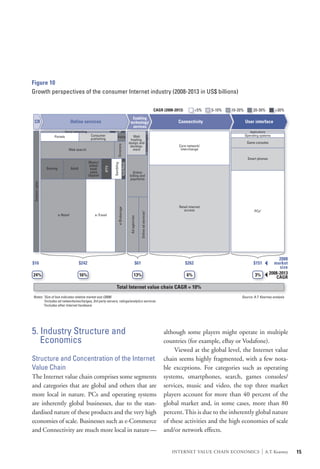
     category in the Internet value chain and collated                                             increased success in charging end-users for access
     growth forecasts from multiple sources (see                                                   to audio-visual entertainment services as opposed
     Appendix on page 22 for details). It is challenging                                           to illegal downloading. Growth of Connectivity
     to make long-term forecasts, but for the next                                                 services is set to be moderate at approximately
     three years, we expect Internet revenues to grow                                              6 percent p.a., representing a mix of robust growth
     at 10 percent p.a. but with substantial differences                                           in emerging markets and in wireless access but
     across the industry value chain.                                                              a major slow-down of broadband Internet access
     	 Figure 10 represents our growth estimates,                                                  penetration growth in developed countries and
     with the darker-shaded categories of the value                                                intense pricing pressure. As discussed earlier, the
     chain being those with the strongest growth tra-                                              User Interface market should experience the slow-
     jectory. Online Services is one of the most dynamic                                           est growth at 3 percent p.a. following a period of
     markets in the Internet value chain, with a growth                                            strong device penetration growth (for example,
     rate of 16 percent per annum—driven by migra-                                                 PCs and game consoles). New devices, such as
     tion of advertising spend to online formats and                                               e-Books, may well provide new growth impetus.


14   INTERNET VALUE CHAIN ECONOMICS                                  |   A.T. Kearney
Figure 10
Growth perspectives of the consumer Internet industry (2008-2013 in US$ billions)

                                                                                                                                               CAGR (2008-2013)          <5%   5-10%   10-20%        20-30%           >30%
                                                                                                  Enabling
 CR                                  Online services                                            technology/                                                 Connectivity                        User interface
                                                                                                  services
                               Social networking                        VoIP                                                                                                                       Applications
                                                      Consumer                                                                                                                                  Operating systems


                                                                                                                               Content mgmt.
                     Portals                                                Dating                Web
                                                      publishing                                hosting,
                                                                                               design and                                                                                        Game consoles
                                                                            Directory


                                                                                                develop-                                                    Core network/
                                 Web search                                                       ment                                                       interchange

                                                                                                                                                                                                 Smart phones
                                                    Music/
                                                                                     VoD/MoD
                                                                       Gambling


                                                     video/
                                                                IPTV


                 Gaming              Adult            book
                                                     sales                                       Online
                                                    (digital)                                  billing and
                                                                                               payments
Content rights


                                                                                                                                                            Retail internet
                                                                             e-Brokerage


                                                                                                                                                               access                                 PCs2
                                                                                                               Online ad services1


                          e-Retail                       e-Travel
                                                                                                Ad agencies


                                                                                                                                                                                                                        2008
$16                                          $242                                                        $61                                                      $262                               $151            market
                                                                                                                                                                                                                        size
24%                                          16%                                                       13%                                                        6%                                  3%           2008-2013
                                                                                                                                                                                                                       CAGR

                                                                          Total Internet value chain CAGR = 10%
Notes: *Size of box indicates relative market size (2008)                                                                                                                                   Source: A.T. Kearney analysis
       1
        Includes ad networks/exchanges, 3rd party servers, ratings/analytics services
       2
        Includes other Internet hardware


5. Industry Structure and                                                                                                                           although some players might operate in multiple
   Economics                                                                                                                                        countries (for example, eBay or Vodafone).
                                                                                                                                                    	 Viewed at the global level, the Internet value
Structure and Concentration of the Internet                                                                                                         chain seems highly fragmented, with a few nota-
Value Chain                                                                                                                                         ble exceptions. For categories such as operating
The Internet value chain comprises some segments                                                                                                    systems, smartphones, search, games consoles/
and categories that are global and others that are                                                                                                  services, music and video, the top three market
more local in nature. PCs and operating systems                                                                                                     players account for more than 40 percent of the
are inherently global businesses, due to the stan-                                                                                                  global market and, in some cases, more than 80
dardised nature of these products and the very high                                                                                                 percent. This is due to the inherently global nature
economies of scale. Businesses such as e-Commerce                                                                                                   of these activities and the high economies of scale
and Connectivity are much more local in nature—                                                                                                     and/or network effects.


                                                                                                                                                         INTERNET VALUE CHAIN ECONOMICS                      |   A.T. Kearney   15
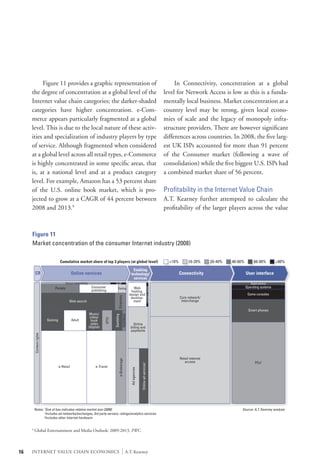
Figure 11 provides a graphic representation of                                                                                                 	 In Connectivity, concentration at a global
     the degree of concentration at a global level of the                                                                                             level for Network Access is low as this is a funda-
     Internet value chain categories; the darker-shaded                                                                                               mentally local business. Market concentration at a
     categories have higher concentration. e-Com-                                                                                                     country level may be strong, given local econo-
     merce appears particularly fragmented at a global                                                                                                mies of scale and the legacy of monopoly infra-
     level. This is due to the local nature of these activ-                                                                                           structure providers. There are however significant
     ities and specialization of industry players by type                                                                                             differences across countries. In 2008, the five larg-
     of service. Although fragmented when considered                                                                                                  est UK ISPs accounted for more than 91 percent
     at a global level across all retail types, e-Commerce                                                                                            of the Consumer market (following a wave of
     is highly concentrated in some specific areas, that                                                                                              consolidation) while the five biggest U.S. ISPs had
     is, at a national level and at a product category                                                                                                a combined market share of 56 percent.
     level. For example, Amazon has a 53 percent share
     of the U.S. online book market, which is pro-                                                                                                    Profitability in the Internet Value Chain
     jected to grow at a CAGR of 44 percent between                                                                                                   A.T. Kearney further attempted to calculate the
     2008 and 2013.9                                                                                                                                  profitability of the larger players across the value


     Figure 11
     Market concentration of the consumer Internet industry (2008)

                                    Cumulative market share of top 3 players (at global level)                                                          <10%         10-20%      20-40%   40-60%        60-80%         >80%
                                                                                                          Enabling
          CR                                  Online services                                           technology/                                            Connectivity                        User interface
                                                                                                          services
                                        Social networking                       VoIP                                                                                                                  Applications
                                                              Consumer                                                                                                                             Operating systems
                                                                                                                                      Content mgmt.


                              Portals                                               Dating                Web
                                                              publishing                                hosting,
                                                                                                       design and                                                                                   Game consoles
                                                                                    Directory


                                                                                                        develop-                                               Core network/
                                          Web search                                                      ment                                                  interchange

                                                                                                                                                                                                    Smart phones
                                                            Music/
                                                                                             VoD/MoD
                                                                               Gambling


                                                             video/
                                                                        IPTV


                          Gaming              Adult           book
                                                             sales                                       Online
                                                            (digital)                                  billing and
                                                                                                       payments
         Content rights


                                                                                                                                                               Retail internet
                                                                                     e-Brokerage


                                                                                                                                                                  access                                 PCs2
                                                                                                                      Online ad services1


                                   e-Retail                      e-Travel
                                                                                                        Ad agencies


         Notes: *Size of box indicates relative market size (2008)                                                                                                                             Source: A.T. Kearney analysis
                1
                 Includes ad networks/exchanges, 3rd party servers, ratings/analytics services
                2
                 Includes other Internet hardware


     9
         Global Entertainment and Media Outlook: 2009-2013, PWC.


16   INTERNET VALUE CHAIN ECONOMICS                                                          |     A.T. Kearney
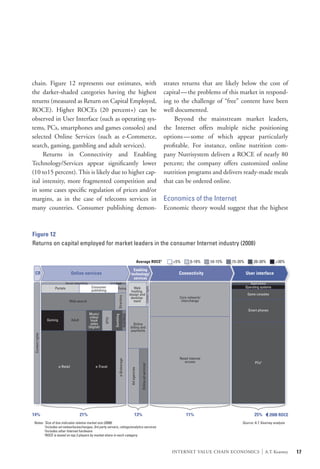
chain. Figure 12 represents our estimates, with                                                                                                 strates returns that are likely below the cost of
the darker-shaded categories having the highest                                                                                                 capital — the problems of this market in respond-
returns (measured as Return on Capital Employed,                                                                                                ing to the challenge of “free” content have been
ROCE). Higher ROCEs (20 percent+) can be                                                                                                        well documented.
observed in User Interface (such as operating sys-                                                                                              	 Beyond the mainstream market leaders,
tems, PCs, smartphones and games consoles) and                                                                                                  the Internet offers multiple niche positioning
selected Online Services (such as e-Commerce,                                                                                                   options — some of which appear particularly
search, gaming, gambling and adult services).                                                                                                   profitable. For instance, online nutrition com-
	 Returns in Connectivity and Enabling                                                                                                          pany Nutrisystem delivers a ROCE of nearly 80
Technology/Services appear significantly lower                                                                                                  percent; the company offers customized online
(10 to15 percent). This is likely due to higher cap-                                                                                            nutrition programs and delivers ready-made meals
ital intensity, more fragmented competition and                                                                                                 that can be ordered online.
in some cases specific regulation of prices and/or
margins, as in the case of telecoms services in                                                                                                 Economics of the Internet
many countries. Consumer publishing demon-                                                                                                      Economic theory would suggest that the highest


Figure 12
Returns on capital employed for market leaders in the consumer Internet industry (2008)

                                                                                                              Average ROCE3                        <5%       5-10%      10-15%   15-20%        20-30%           >30%
                                                                                                  Enabling
  CR                                  Online services                                           technology/                                           Connectivity                        User interface
                                                                                                  services
                                Social networking                       VoIP                                                                                                                 Applications
                                                      Consumer                                                                                                                            Operating systems
                                                                                                                                Content mgmt.


                      Portals                                               Dating                Web
                                                      publishing                                hosting,
                                                                                               design and                                                                                  Game consoles
                                                                            Directory


                                                                                                develop-                                              Core network/
                                  Web search                                                      ment                                                 interchange

                                                                                                                                                                                           Smart phones
                                                    Music/
                                                                                     VoD/MoD
                                                                       Gambling


                                                     video/
                                                                IPTV


                  Gaming              Adult           book
                                                     sales                                       Online
                                                    (digital)                                  billing and
                                                                                               payments
 Content rights


                                                                                                                                                      Retail internet
                                                                             e-Brokerage


                                                                                                                                                         access                                 PCs2
                                                                                                                Online ad services1


                           e-Retail                      e-Travel
                                                                                                Ad agencies


14%                                           21%                                                      13%                                                11%                                  25%           2008 ROCE
Notes: *Size of box indicates relative market size (2008)                                                                                                                             Source: A.T. Kearney analysis
       1
        Includes ad networks/exchanges, 3rd party servers, ratings/analytics services
       2
        Includes other Internet hardware
       3
        ROCE is based on top 3 players by market share in each category


                                                                                                                                                   INTERNET VALUE CHAIN ECONOMICS                      |   A.T. Kearney   17
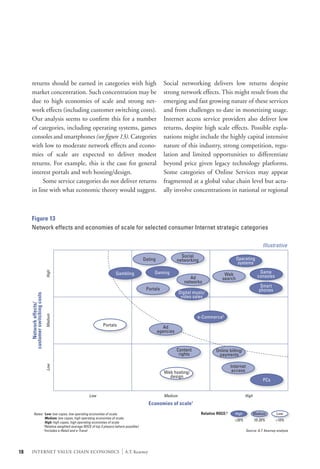
returns should be earned in categories with high                                           Social networking delivers low returns despite
      market concentration. Such concentration may be                                            strong network effects. This might result from the
      due to high economies of scale and strong net-                                             emerging and fast growing nature of these services
      work effects (including customer switching costs).                                         and from challenges to date in monetizing usage.
      Our analysis seems to confirm this for a number                                            Internet access service providers also deliver low
      of categories, including operating systems, games                                          returns, despite high scale effects. Possible expla-
      consoles and smartphones (see figure 13). Categories                                       nations might include the highly capital intensive
      with low to moderate network effects and econo-                                            nature of this industry, strong competition, regu-
      mies of scale are expected to deliver modest                                               lation and limited opportunities to differentiate
      returns. For example, this is the case for general                                         beyond price given legacy technology platforms.
      interest portals and web hosting/design.                                                   Some categories of Online Services may appear
      	 Some service categories do not deliver returns                                           fragmented at a global value chain level but actu-
      in line with what economic theory would suggest.                                           ally involve concentrations in national or regional


      Figure 13
      Network effects and economies of scale for selected consumer Internet strategic categories

                                                                                                                                                            Illustrative
                                                                                                           Social
                                                                                     Dating              networking                        Operating
                                                                                                                                            systems

                                                                                           Gaming                                                          Game
                                High


                                                                  Gambling                                                         Web
                                                                                                               Ad                                         consoles
                                                                                                                                  search
                                                                                                            networks
                                                                                                                                                           Smart
                                                                                      Portals                                                             phones
                                                                                                          Digital music/
     customer switching costs


                                                                                                           video sales
         Network effects/

                                Medium


                                                                                                                    e-Commerce3
                                                         Portals                                 Ad
                                                                                              agencies


                                                                                                         Content              Online billing/
                                                                                                          rights               payments

                                                                                                                                        Internet
                                Low


                                                                                                 Web hosting/                            access
                                                                                                   design
                                                                                                                                                            PCs


                                                Low                                              Medium                                          High
                                                                                         Economies of scale1
          Notes: 1Low: low capex, low operating economies of scale;                                                   Relative ROCE:2     High          Medium        Low
                  Medium: low capex, high operating economies of scale;
                                                                                                                                          >20%          10-20%       <10%
                  High: high capex, high operating economies of scale
                 2
                  Relative weighted average ROCE of top 3 players (where possible)
                 3
                  Includes e-Retail and e-Travel                                                                                                 Source: A.T. Kearney analysis


18    INTERNET VALUE CHAIN ECONOMICS                                  |   A.T. Kearney
markets that underpin stronger profitability.                                                     Yet, as this paper has shown, it is important
Another exception to common theory would be                                                       to understand differences between service cate-
“vice” services, such as gambling, dating, adult                                                  gories. Some categories deliver low returns
content and gaming. Despite moderate econo-                                                       and face decelerating growth perspectives — for
mies of scale and network effects, returns are high                                               example, web hosting and Internet access provi-
(>15 percent) for these services—perhaps due to                                                   sioning. They may see attempts to consolidate
strong customer willingness to pay.                                                               or expand into other parts of the value chain:
                                                                                                  there are some cases of telecoms companies invest-
Future Outlook                                                                                    ing in devices or in content, for instance. Figure
At a highly aggregated level, the Internet value                                                  14 shows our estimates of future growth and
chain offers a strong growth outlook (10 per-                                                     current returns.
cent p.a.) and good returns for market leaders                                                    	 In a number of smaller categories such as
(>10 percent and in some cases much higher).                                                      social networking, returns are expected to increase


Figure 14
Forecast growth versus returns of the consumer Internet industry by category


                                                                      45%               75%
                                                                      VoIP
                                                                         (1)        VoD (1) Digital video sales
               30%                                               IPTV                (1)                                                                        Market
                                                                  (5)                                                                                           concentration
                                                                                                                                                                     <10%
                                                             Media rights               Digital
                                                                   (15)                 music                                                                        10-20%
                                                                      Dating            sales
                                                                         (2)              (4)                                                                        20-40%
                                                             Adult
                                                              (11)                                                                                                   40-60%
                                   Content
                               management (1)
                                                                                                                                                                     60-80%
                                                                                           e-Retail
                                                                                             (72)                                                                    >80%
                                  Social networks (3)
Market CAGR


                                                                 Billing/
 (2008-2013)


                                                                payments
                                                         Direc-   (21)
                                                         tories           (11) Ad networks
                              e-Brokerage (19)             (5)                                                                            Video
                                                                                                                     Gambling            gaming
                                                                 Ad                                                    (6)                 (9)
                                                              agencies            Web
                                             Internet           (16)             search
               Consumer                       access                              (30)         Software
                                               (164)                                              (2)              Smart                             e-Travel
               publishing                                                                                         phones                               (49)
                  (7)                                                                                               (27)

                                         Web                                                        Game
                                        hosting                                                    consoles
                                          (10)                                      PCs              (13)
                                                                                    (95)                                                            Operating
                                                                                                                                                     systems
                            Global                                                                                                                      (6)
                0%          portals
                              (4)
                     0%                                                                                                                                   40%
                                                                              Average ROCE
  Notes: *Size of bubble denotes relative market size 2008 (value in brackets in US$ billions); all categories over $10 billion have same bubble size;
          bubble border thickness denotes relative barriers to entry, through network effects or economies of scale/capital intensity
         1
          Based on combined market share of top 3 players
  Source: A.T. Kearney analysis


                                                                                                      INTERNET VALUE CHAIN ECONOMICS                            |   A.T. Kearney   19
substantially as market leaders benefit from greater                                  Concluding Remarks
     scale effects and diminishing needs for start-up                                      This paper has shown some clear trends in terms of
     investment. However, the value chain is dynamic                                       the economic performance of the various markets
     and a number of market leaders in 2010 could in                                       in the Internet value chain. Online Services and
     theory be out of business by 2015.                                                    some categories of hardware and software at the
     	 Differences in growth perspectives and                                              User Interface show high concentration, rapid
     returns largely explain diverging market capi-                                        growth and high returns, which are reflected in the
     talization gains over the last six years (see figure                                  market capitalisation of their leading players.
     15). Connectivity and Content Rights have failed                                      Content Rights and Connectivity are less concen-
     to create significant shareholder value—largely                                       trated globally and earn returns around 10 to 15
     due to sluggish market growth prospects and                                           percent, but their market capitalisations have stag-
     relatively low returns. Online Services and User                                      nated as investors weigh high capital requirements
     Interface have delivered the strongest market capi-                                   against continued margin pressure. Strategic moves
     talization growth—due both to strong growth                                           along the value chain may be expected as players
     prospects and high returns. Although more                                             react to these economic trends. Understanding
     impacted by the stock market downturn in                                              these trends in such a dynamic part of the global
     2008/2009, the rebound in these markets has                                           economy is a key challenge for the companies
     been very strong.                                                                     involved, for investors and for policymakers.


     Figure 15
     Evolution of market capitalisation by value chain market (base 100 in 2004)


      500
                                                                                                                                           User interface5


      400


                                                                                                                                           Online services2
      300

                                                                                                                                           Enabling
                                                                                                                                           technology/
                                                                                                                                           services3
      200


      100                                                                                                                                  Connectivity4
                                                                                                                                           Content rights1


        0
          2004                   2005                  2006                   2007                   2008       2009                   2010
     Notes: Average for Disney, NewsCorp, Time Warner ,Warner Music Group, Vivendi and Electronic Arts
            1
                                                                                                                       Sources: Bloomberg, A.T. Kearney analysis
           2
            Average for Amazon, Google, Yahoo!, eBay, Baidu, Expedia and Partygaming
           3
            Average for Akamai, CyberAgent, Google, Valueclick, Verisign and WPP
           4
            Average for AT&T, Vodafone, NTT, British Telecom, Deutsche Telecom and France Telecom
           5
            Average for Microsoft, Apple, Dell, Acer, Nokia and McAfee


20   INTERNET VALUE CHAIN ECONOMICS                            |   A.T. Kearney
Authors
Mark Page is a partner and global leader of the firm’s communications, media and high-tech practice. Based in the
London office, he can be reached at mark.page@atkearney.com.
Laurent Viviez is a principal in the firm’s communications, media and high-tech practice. Based in the London
office, he can be reached at laurent.viviez@atkearney.com.
Christophe Firth is a consultant based in the Dubai office. He can be reached at christophe.firth@atkearney.com.


                                                               INTERNET VALUE CHAIN ECONOMICS           |   A.T. Kearney   21
Appendix:                                                classifieds, email direct marketing and in-game
     Report Methodology and                                   online advertising. Advertising revenues are calcu-
     Sources of Information                                   lated on a net advertising value basis (source:
                                                              IDC). Online Services revenues from end-users
     Value Chain Definition                                   include subscriptions, pay-per-use services and
     The Internet value chain includes all activities that    digital goods purchases.
     exist as a direct result of Internet usage. The
     Internet value chain includes five markets and           ROCE Analysis
     15 strategic segments, as described in section 3.        ROCE has been used as a key financial metric to
     Suppliers to segments have only been described           evaluate the profitability of companies involved
     when they are specific to the Internet. For example,     in the Internet value chain. The ROCE calcula-
     we did not isolate call center providers or insurance    tion used is the company’s EBIT divided by its
     brokers providing services to e-Commerce players,        Capital Employed. Capital Employed is defined
     but have included web hosting. Each segment was          as Total Assets less Current Liabilities.
     also further broken down into more detailed ser-         	 Where ROCE is calculated at segment or cat-
     vice categories—47 consumer categories and 20            egory level, we have taken an average for the top 3
     business cate-gories. We assessed separately reve-       players in the category (which report financials),
     nues generated by consumers and businesses—              weighted by their 2008 Revenues. In segments
     given the specifics of business services. These          where there are no pure players, we have had to
     include services such as B2B e-Commerce and              apply the overall returns of the leading players in
     exchange platforms, online information services          that category or select second-tier pure players.
     (for example Reuters), and paid-for hosted appli-        ROCE is calculated using Bloomberg data and
     cations such as email servers, Software as a Service     annual reports. Focusing on the top 3 does of
     and videoconferencing.                                   course exclude the effect of failed companies
                                                              which may have experienced negative returns in
     Market Sizing Analysis                                   any given year, but we believe that it captures the
     All market sizes are based on gross revenues, except     long term profitability characteristics of the seg-
     where otherwise stated. Revenues generated from          ment for successful players.
     other companies in the value chain (for example,
     through commissions, fees, sales or advertising) are     Market Competition and Concentration
     not distinguished from those generated from com-         Analysis
     panies outside the value chain. In other words, this     To provide a view of the level of competition
     is not a “value-add” analysis for the Internet econ-     in each category, we evaluated the combined
     omy and there are overlaps among revenue cate-           market share of the three largest companies, at
     gories. For example, revenues from Content Rights        global level.
     overlap with revenues from Online Services.              	 The HHI index system is a commonly used
     	 For all Online Services categories, we have            measure of market concentration. Due to the
     calculated revenues generated from advertising           global scope of our analysis and the nature of the
     and from end-users. Advertising covers all for-          industry, a full HHI indexing would, however, be
     mats—that is, search, display, lead generation,          impossible to conduct with high accuracy.


22   INTERNET VALUE CHAIN ECONOMICS        |   A.T. Kearney
Therefore, we avoided using this methodology.                                     Market Definitions
We do however believe that the results of an HHI                                  The definition and market sizing methodology for
analysis would be in line with our current                                        all service categories are provided here. We only
approach, in terms of providing a picture of the                                  elaborate on the market sizing methodology for
relative level of concentration across Internet                                   cases requiring a specific explanation and not based
value chain categories.                                                           on an established public source of information.


Content Rights
  Segment                             Methodology/Description
  Media rights owners                 • Market size is based on the percentage of revenues made by Online Services that is paid to Content Rights
                                        owners, either as:
                                        — Revenues from digital product sales after commission
                                        — Content acquisition or license cost
                                      • Online Services categories in scope are: VoD, MoD, IPTV, video gaming, casual games, filmed entertainment
                                        sales, digital music sales, electronic book sales, global portals, consumer publishing, adult content
                                      • For each category of Online Services we estimated the percentage of total online revenues that would be
                                        subject to a revenue share with the corresponding Content Rights owners—based on publically available
                                        information and interviews with key industry stakeholders

  User-generated content              • Revenue received by user-generated content owners is not included in the analysis—but is negligible as is
                                        user generated content that is rarely remunerated

Source: A.T. Kearney analysis


Online Services
  Segment                Category           Methodology/Description
                VoD (video-
  Enabling Technology/Services
  Entertainment
                on-demand)
                            • Websites providing audio-visual content on-demand through a streaming service, funded by either ads
                              or subscription. Excludes adult content (see below).
    Segment                Category
                         MoD (music-        • Methodology/Description on-demand through a streaming service, funded by either ads
                                              Websites providing audio content
                         on-demand)           or subscription
    Billing and           Billing and         • Consists of payment processing for online transactions
    payments              payments
                         IPTV               • • Market sizing is based on total B2C an IP connection
                                              Television services delivered through e-Commerce transaction value plus user-paid Online Services multiplied
                                                by an estimated average transaction processing fee
                         Video gaming       • Websites and applications providing the ability to play console or PC games on the Internet, usually with
    Advertising           Online ad           • Companies providing an interactive streaming service and acquire online ad inventory for advertisers
                                              other gamers, through services to plan online campaigns
                          agencies          • • Companies that design, produce, host and serve onlineand game software (through a physical disk or
                                              End users are generally required to purchase a console ads
                                              download) in order to play
                          Online ad         • • Companies providing intermediary online advertising servicessale of in-game virtual items
                                              Includes subscription revenue, in-game online advertising and to advertisers
                          networks/         • • Includes with casual that acquire ad inventory from websitesanalysis to advertisers, platforms for buying and
                                              Combined companies games under “gaming” for parts of the to resell
                          exchanges/            selling inventory, or tools to optimise online advertising effectiveness
                         Casual services
                          other games       • • All market size numbers are gross revenues users through an interactive streaming service
                                              Websites providing Internet-hosted games to end
                                            • End users are not required to purchase a game or gaming device in order to play
                          Online ad         • • Companies offering gaming under “gaming”ads parts of the analysis
                                              Combined with video technology that places for on websites
                          servers             • Includes third-party ad serving only. Excludes ad serving performed by interactive ad agencies.
                         Gambling           • Includes websites providing all types of online gambling services, including betting, casino and other
                          Ratings/            • Companies offering data and analytics on Internet user and usage metrics
                                              gambling services
                          analytics
                          services
                         Adult content      • Websites providing adult content
    Support               Content
                         Video sales/       • • Companies that offer services that allow online and download digitalthe flow of content through the Internet
                                              Websites providing the ability to either purchase services to optimise filmed entertainment products,
    technology            management
                         rental (digital)     or(primarily content delivery networks)
                                                 rent physical filmed entertainment products. Excluded from e-Retail

                         Musicdesign and • • Companies createthe ability to purchase and download digital music products
                           Web sales       Websites providing and code Internet pages
                           development
                         (digital)       • Excluded from e-Retail
                           Web hosting
                         Book sales         • • Companies that provide a service allowing individuals/organisations to store their websites on their servers
                                              Websites providing the ability to purchase and download electronic books
                         (digital)              and make them available on the Internet
                                            • Excluded from e-Retail

  General/vertical Consumer
 Source: A.T. Kearney analysis              • Websites operated by newspapers and magazines, usually with similar branding and content
  content sites          publishing         • Revenues include advertising only
                                            • The market for paid content on consumer publishing sites remains negligible although many publishers are
                                              considering how to change this

                         Online dating      • Websites offering match-making and communication services focusing on developing romantic relationships
                                                                                     INTERNET VALUE CHAIN ECONOMICS | A.T. Kearney                              23
                         Global Portals     • Selected General Interest Portal and website operators with a global scope, including Yahoo!, MSN, AOL, IAC
                                              and their subsidiaries
• End users are generally required to purchase a console and game software (through a physical disk or
                                                  download) in order to play
                                                • Includes subscription revenue, in-game online advertising and sale of in-game virtual items
                                                • Combined with casual games under “gaming” for parts of the analysis

                             Casual games       • Websites providing Internet-hosted games to end users through an interactive streaming service
                                                • End users are not required to purchase a game or gaming device in order to play
                                                • Combined with video gaming under “gaming” for parts of the analysis

                             Gambling           • Includes websites providing all types of online gambling services, including betting, casino and other
                                                  gambling services

                             Adult content      • Websites providing adult content

                             Video sales/       • Websites providing the ability to either purchase and download digital filmed entertainment products,
                             rental (digital)     or rent physical filmed entertainment products. Excluded from e-Retail

                             Music sales        • Websites providing the ability to purchase and download digital music products
                   (digital)                    • Excluded from e-Retail
     Online Services (continued)
                             Book sales         • Websites providing the ability to purchase and download electronic books
       Segment               Category
                             (digital)          Methodology/Description
                                                • Excluded from e-Retail

       Entertainment
       General/vertical      VoD (video-
                             Consumer           •   Websites providing by newspapers and magazines, usually with similar branding and contenteither ads
                                                              operated audio-visual content on-demand through a streaming service, funded by
       content sites         on-demand)
                             publishing         •   or subscription. Excludes adult content (see below).
                                                    Revenues include advertising only
                                                •   The market for paid content on consumer publishing sites remains negligible although many publishers are
                             MoD (music-        •   Websites providing change this on-demand through a streaming service, funded by either ads
                                                    considering how to audio content
                             on-demand)             or subscription
                             Online dating      •   Websites offering match-making and communication services focusing on developing romantic relationships
                             IPTV               •   Television services delivered through an IP connection
                             Global Portals     •   Selected General Interest Portal and website operators with a global scope, including Yahoo!, MSN, AOL, IAC
                             Video gaming       •   Websitessubsidiaries
                                                    and their and applications providing the ability to play console or PC games on the Internet, usually with
                                                •   other gamers, includes an interactive streaming service types including webmail and instant messaging
                                                    Market sizing through revenues from all branded product
                                                •   Endexcludes Casual Games and search revenues, which aregame software (through a physical disk or
                                                    but users are generally required to purchase a console and captured elsewhere
                                                    download) in order to play
       Search                Directories        •   Includes subscription revenue, in-game online advertising and sale of in-game virtual items
                                                    Websites providing categorised, searchable lists of organisations—typically consists of “Yellow Pages”
                                                •   Combined with casual games under “gaming” for parts of the analysis
                                                    publishers’ websites

                             Casual games
                             Web search         •   Websites providing Internet-hosted games to end users through an interactive streaming service
                                                    Search engines providing the ability to find information/other websites on the Internet
                                                •   End users are not required to purchase a game or gaming device in order to play
       Communications        Social             •   Combinedprimarily focused on facilitating person-to-person communications through a variety of channels
                                                    Websites with video gaming under “gaming” for parts of the analysis
                             networking             including one-to-one (e.g., in-site delayed and instant messaging) and one-to-many formats
                             Gambling           •   Includes websites providing all types of online gambling services, including betting, casino and other
                             VoIP               •   gambling services voice communication transmission services over IP networks
                                                    Companies providing
                                                •   Only includes third-party VoIP (i.e., VoIP based on bespoke applications downloaded by end-users from a website)
                             Adult content      •   Websites VoIP services operated by telecom operators
                                                    Excludes providing adult content

       Transactions          Video sales/
                             e-Brokerage        • Websites providing the ability to either purchase and download digital filmed entertainment products,
                                                                                    buy and sell financial products on the Internet
       (e-Commerce)          rental (digital)     or rent physical filmed entertainment products. Excluded from e-Retail
                             e-Retail           • Websites selling goods/services over the Internet; includes marketplaces and auction sites
                             Music sales        • Websites providing the abilitytransaction value download digital music products sold and fulfilment
                                                  Revenues are based on total to purchase and less direct cost of goods/services
                             (digital)          • Excluded from e-Retail
                                                  The percentage to be subtracted is an estimate based on company reports for a selection of leading operators

                             Book sales
                             e-Travel           •   Websites providing the ability to purchase and the Internet
                                                                        travel booking services on download electronic books
                             (digital)          •   Excluded frombased on total transaction value less direct cost of goods/services sold and fulfilment
                                                    Revenues are e-Retail
                                                •   The percentage to be subtracted is an estimate based on company reports for a selection of leading operators
       General/vertical      Consumer           •   Websites operated by newspapers and magazines, usually with similar branding and content
                            publishing
     Source: A.T. sites analysis
       content Kearney                          •   Revenues include advertising only
                                                •   The market for paid content on consumer publishing sites remains negligible although many publishers are
                                                    considering how to change this

                             Online dating      • Websites offering match-making and communication services focusing on developing romantic relationships

                             Global Portals
                              • Selected General Interest
     Enabling Technology/Services their subsidiaries Portal and website operators with a global scope, including Yahoo!, MSN, AOL, IAC
                                and
                                                • Market sizing includes revenues from all branded product types including webmail and instant messaging
       Segment                Category          Methodology/Description search revenues, which are captured elsewhere
                                                 but excludes Casual Games and

       Billing
       Search and            Billing and
                             Directories        •• Websitesof payment processing for online transactions
                                                    Consists providing categorised, searchable lists of organisations—typically consists of “Yellow Pages”
       payments              payments            • publishers’ websites on total B2C e-Commerce transaction value plus user-paid Online Services multiplied
                                                    Market sizing is based
                                                    by an estimated average transaction processing fee
                             Web search         • Search engines providing the ability to find information/other websites on the Internet
       Advertising           Online ad           • Companies providing services to plan online campaigns and acquire online ad inventory for advertisers
       Communications        agencies
                             Social             •• Websites primarily focused on facilitating person-to-person communications through a variety of channels
                                                    Companies that design, produce, host and serve online ads
                             networking            including one-to-one (e.g., in-site delayed and instant messaging) and one-to-many formats
                             Online ad           • Companies providing intermediary online advertising services to advertisers
                             networks/
                             VoIP               •• Companies providing that acquire ad inventory from websites to resell to advertisers, platforms for buying and
                                                    Includes companies voice communication transmission services over IP networks
                             exchanges/         • Only includes third-party VoIP optimise online on bespoke applications downloaded by end-users from a website)
                                                    selling inventory, or tools to (i.e., VoIP based advertising effectiveness
                             other services     •• Excludes VoIP services operated by telecom operators
                                                    All market size numbers are gross revenues

       Transactions          Online ad
                             e-Brokerage        •• Websites providing the ability tothat places ads on websites
                                                   Companies offering technology buy and sell financial products on the Internet
       (e-Commerce)          servers             • Includes third-party ad serving only. Excludes ad serving performed by interactive ad agencies.
                             e-Retail           • Websites selling goods/services over the Internet; includes marketplaces and auction sites
                             Ratings/           •• Revenues are baseddata andtransaction value lessuser and usage metrics
                                                   Companies offering on total analytics on Internet direct cost of goods/services sold and fulfilment
                             analytics          • The percentage to be subtracted is an estimate based on company reports for a selection of leading operators
                             services
                             e-Travel           • Websites providing travel booking services on the Internet
       Support               Content            •• Revenues are based on total transaction value less directto optimise the flow of content through the Internet
                                                   Companies that offer services that allow online services cost of goods/services sold and fulfilment
       technology            management            (primarily content delivery networks)
                                                • The percentage to be subtracted is an estimate based on company reports for a selection of leading operators

     Source: A.T. Kearney analysis design and
                              Web               • Companies create and code Internet pages
                             development

                             Web hosting        • Companies that provide a service allowing individuals/organisations to store their websites on their servers
                                                  and make them available on the Internet

     Source: A.T. Kearney analysis


24   INTERNET VALUE CHAIN ECONOMICS                             |   A.T. Kearney
Connectivity
  Segment                Category             Methodology/Description
  Core network          Core network          • Companies that own and operate the core telecommunications network, providing wholesale services
                                                to Retail Access Providers (which may be a division of the same company as the core network provider,
                                                but typically with some degree of regulatory separation)

  Interchange           Interchange           • Operators providing the “super-exchanges” of Internet traffic between core network operators
                                              • There are limited standalone/independent interchange operators, besides Level 3 Communications and
                                                XO Communications, which are both U.S. operators
                                              • In the majority of other major markets, Interchange is provided by large network operators

  Retail Internet       Retail Internet       • Companies providing access to the Internet, typically known as ISPs
  access                access                • Includes both fixed and mobile Internet access; excludes charges for voice calls, TV and fixed line rental
                                              • For the market concentration analysis, we took the leading players in three major markets (U.S., Japan
                                                and France) and evaluated their share of the total global market. This is notwithstanding the fact that
                                                retail access providers largely operate on a local basis.

Source: A.T. Kearney analysis


User Interface
  Segment                Category             Methodology/Description
  Devices               Games                 • Personal gaming devices and software with the ability to connect to the Internet
                        consoles              • Based on total worldwide sales multiplied by the percentage of gamers who play online

                        Operating             • Based on total worldwide sales multiplied by the percentage of PCs bought by consumers (as opposed to
                        systems                 businesses), multiplied by the estimated percentage of consumer PC time spent on the Internet
                                              • We assume for simplicity equal average purchase price for consumers and businesses

                        PCs                   • Based on total worldwide PC sales, multiplied by the percentage of PCs bought by consumers (as opposed
                                                to businesses), multiplied by the estimated percentage of consumer PC time spent on the Internet
                                              • We assume equal average purchase price for consumers and businesses

                        Smartphones           • Mobile handsets offering Internet access
                                              • Based on total worldwide smartphone sales, multiplied by the percentage of smartphones bought by
                                                consumers (businesses excluded)
                                              • We assume equal average price for consumers and businesses

                        Other Internet        • Peripherals allowing other devices to connect to the Internet and enabling usage of online services
                        access                  (e.g., modems, routers and webcams)
                        hardware

  Applications*         Applications          • Other applications providing tasks relating to Internet usage, including endpoint, messaging, web and
                                                IAM software sales multiplied by the percentage of sales to consumers (as opposed to businesses)
                                              • For this percentage we took the same percentage split as for Internet access hardware

*Also includes Internet browsers and media players, however these have generally not been provided on a paid-for, stand-alone basis
Source: A.T. Kearney analysis


                                                                                                INTERNET VALUE CHAIN ECONOMICS                  |   A.T. Kearney   25
Business-to-Business                                                           and assumptions not covered in the overall report
     The additional clarifications in the chart below                               methodology, or where our approach is different to
     only relate to those B2B categories that we felt                               the equivalent category in the consumer Internet
     required additional explanation of methodology                                 economy.


       Segment                Category        Methodology/Description
       Content Rights        Content Rights   • Market size is based on the percentage of revenues made by Online Services paid to Content Rights
                                                owners, either as:
                                                — Revenues from digital product sales after commission
                                                — Content acquisition or license cost
                                              • The categories in scope are: corporate e-Learning, information services and professional digital book sales
                                              • For each category we estimated the percentage of total online revenues that would be subject to a
                                                revenue share with the corresponding Content Rights owners

       Online Services       Communications   • Includes revenues from business VoIP (58 percent), email (17 percent), instant messaging (2 percent),
                                                video conferencing (11 percent) and machine-to-machine communication (12 percent)

                             Corporate        • Web-based enterprise education and training programmes
                             e-Learning       • Includes professional digital book downloads

                             e-Commerce       • Commercial transactions between businesses over the Internet, generally through electronic data interchange
                                              • The approach and assumptions taken are for consumer B2B, i.e., transaction volume less cost of goods
                                                sold and fulfilment costs

                             Information      • Online business information services estimated based on percentage of sales that are online for a basket
                             services           of information services genres (e.g., legal, tax, healthcare)
                                              • Includes advertising revenues from digital trade magazines (accounting for less than 3 percent of total for
                                                this category)

                             SaaS/MFT         • Online revenues from businesses from Software-as-a-Service products and from professional Managed
                                                File Transfer services

       Devices               Other Internet   • Peripherals allowing other devices to connect to the Internet and enabling usage of Online Services
                             hardware           (e.g., modems, routers and webcams)
                                              • Business hardware includes enterprise video conferencing, Ethernet, enterprise storage and routing

     Source: A.T. Kearney analysis


26   INTERNET VALUE CHAIN ECONOMICS                        |   A.T. Kearney
Sources of Information                              	 Secondary research covers a broad range of
Market sizing and profitability estimates in this   publicly available research resources. Many market
report are based on a large set of recognized       size and growth forecasts are from Telecoms/
sources of information—both primary and sec-        Media/Technology industry research reports such
ondary. Primary research includes interviews with   as PwC’s Global Media & Entertainment Outlook,
experts in the field of online media and the        and general industry and category-specific fore-
Internet value chain, including both A.T. Kearney   casts are from research companies such as Forrester,
and external experts. We thank interviewees for     Gartner, Screen Digest, Business Insights and
their time and openness in supporting this          Ovum. We also used relevant industry broker
research paper.                                     reports. For Internet traffic and usage data, we
	 The data collected from financial statements      used sources such as IDC, ComScore Media
and press releases by companies in the Internet     Metrix, Nielsen Netratings, Hitwise, Zenith,
value chain has been primarily used to estimate     Bloomberg, OneSource and Reuters Knowledge.
total market size and growth, market concentra-     	 In addition to industry-specific reports, we
tion levels and ROCE for each category. For         have also drawn on general economic/macro
market sizing, ROCE and market concentration        research reports, including reports by the OECD,
analyses, we used 2008 data where possible. At      ITU, Pew, IAB, U.S. Department of Commerce
the time of writing, this is the latest year for    and Economist Intelligence Unit. Most exhibits
which full-year company financial data was          include a reference to the primary sources used
widely available. For market growth estimates, we   but some are composites of multiple sources,
used a five-year forecast covering the 2008-2013    together with A.T. Kearney assumptions and are
timeframe.                                          therefore sourced as “A.T. Kearney analysis.”


                                                       INTERNET VALUE CHAIN ECONOMICS        |   A.T. Kearney   27
A.T. Kearney is a global management consulting firm that employs strategic                                       For information on obtaining
insight, tailored solutions and a collaborative working style to help clients                                    additional copies, permission
achieve sustainable results. Since 1926, we have been trusted advisors                                           to reprint or translate this work,
to top management of the world’s leading corporations across all major                                           and all other correspondence,
industries, addressing their most important strategic and operational chal-                                      please contact:
lenges. Our offices are located in major business centers in 37 countries.
The firm’s telecommunications, media and high-tech practice advises
                                                                                                                 A.T. Kearney, Inc.
network operators, service providers, content companies and technology
                                                                                                                 Lansdowne House
vendors as well as industry associations and regulatory authorities.
                                                                                                                 Berkeley Square
                                                                                                                 London W1J 6ER
AMERICAS	           Atlanta | Boston | Chicago | Dallas | Detroit | Mexico City                                  United Kingdom
	                   New York | San Francisco | São Paulo | Toronto | Washington, D.C.                            www.atkearney.com
EUROPE	             Amsterdam | Berlin | Brussels | Bucharest | Copenhagen
	                   Düsseldorf | Frankfurt | Helsinki | Kiev | Lisbon | Ljubljana	
	                   London | Madrid | Milan | Moscow | Munich | Oslo | Paris
	                   Prague | Rome | Stockholm | Stuttgart | Vienna | Warsaw | Zurich


ASIA	               Bangkok | Beijing | Hong Kong | Jakarta | Kuala Lumpur
PACIFIC	            Melbourne | Mumbai | New Delhi | Seoul | Shanghai
	                   Singapore | Sydney | Tokyo

MIDDLE	             Abu Dhabi | Dubai | Manama | Riyadh
EAST


Copyright 2010, A.T. Kearney, Inc. All rights reserved. No part of this work may be reproduced in any form
without written permission from the copyright holder. A.T. Kearney® is a registered mark of A.T. Kearney, Inc.
A.T. Kearney, Inc. is an equal opportunity employer.
PDF ATK.0410.128

Internet Value Chain Economics Final 050210

  • 1.
    Internet Value Chain Economics Gaininga deeper understanding of the Internet economy
  • 3.
    W hen considering the technological innovations of the past 50 years, the Internet is probably the one that has had the greatest impact on everyday life in developed economies. Nearly six out of 10 Americans now shop online and more than four out of 10 bank online. Twenty hours of video are uploaded to YouTube every minute, while 5 percent of all time online is spent on the social net- working site, Facebook. The Internet has also changed the way in which businesses operate—today, 64 percent of C-level executives conduct six or more searches per day to locate business information. The Internet has been a source of great good—as evidenced by the role played by Internet-based mapping and communications in the relief effort follow- ing the recent Haiti earthquake. The Internet also has shown a negative side—more than 97 percent of all emails are spam, while more than 70 percent of Americans fear online identity theft and 57 percent feel that their personal privacy has been greatly diminished by the Internet.1 Behind these statistics and headlines, however, tions, a sound understanding of the Internet there remains a low level of understanding of economy will be important for all stakeholders. how the Internet economy works. Who are the This includes the companies playing a role in the different players involved in the Internet, beyond Internet economy, private and business consum- the flagship names? How is the industry struc- ers, and the regulators and policy-makers who are tured and how concentrated is it? How do players increasingly being asked to oversee or intervene in make money and how do revenues flow across multiple aspects of the Internet. the value chain? Is the industry attractive in terms To help improve the understanding of the of growth and returns? Internet landscape, Vodafone commissioned As the Internet continues to grow and A.T. Kearney to conduct a review of the Internet’s develop, playing an increasingly important role in value chain and economics. This paper has been the lives and activities of people and organiza- produced independently and does not necessarily 1 Data sources include Pew Internet & American Life Project survey, 2009; YouTube, May 2009; ComScore, April 2009; Google, Forbes, BtoB, June2009; “Social media get quake reports out fast,” Los Angeles Times, January 2010; Microsoft, 2009, quoted in http://news.bbc.co.uk/2/hi/technology/7988579.stm; ABC News/Washington Post, 2009, quoted in http://www.spendonlife.com/blog/new-poll-shows-increased-id-theft-fear. INTERNET VALUE CHAIN ECONOMICS | A.T. Kearney 1
  • 4.
    represent the viewsof Vodafone. Neither Vodafone Total Internet value chain revenues are esti- nor A.T. Kearney is responsible for the use that mated at US$1,930 billion in 2008, growing on might be made of this paper. average at 10 percent p.a. More than 60 percent This paper has a global scope but most exam- derives from business-to-business activities as ples and illustrations focus on North American many organisations have embraced the Internet to and European markets. Terminology has been market and sell their services and to manage rela- standardised and may differ from regional usage. tionships with suppliers and partners. On the The paper begins with a brief overview of the consumer side, the largest categories of spend are Internet’s growth and usage trends. Next, it lays for retail Internet access and end-user devices/ out the Internet value chain and describes each hardware. Between them, these enablers for part of the value chain in terms of key players and households to access the Internet account for 44 revenue models. Finally, it provides an assessment percent of total consumer value chain revenues. of the industry’s market size, growth trends, prof- Consumer Online Services, the most visible itability and competitive structure. part of the Internet economy, represent a US$242 It is not the purpose of this paper to offer rec- billion market, of which a substantial part relates ommendations, but rather to provide a consistent to e-Commerce. Search engines capture more framework and fact base to inform public debate. than one-third of remaining online service reve- With such a broad remit we may inevitably dis- nues and indeed 59 percent of online advertising appoint readers who would like more detail about revenues. individual markets or issues; for that reason we Revenues for consumer Online Services are have provided documentation of our sources and growing more than twice as fast as those for assumptions to assist further research. Internet access provision and more than five times faster than sales of hardware and software. Bandwidth growth has been even stronger, but 1. Summary of Findings online service revenues are for the most part disconnected from bandwidth consumption — in The number of Internet users has grown rapidly to 2008 file-sharing and video-on-demand accounted 1.7 billion in 2009, or a quarter of the world’s pop- for nearly three-quarters of bandwidth but only ulation. Consumers use the Internet for an increas- 8 percent of revenues. ing range of everyday activities, from shopping and Our analysis shows that the most concentrated banking to sharing photos and watching TV. As a markets in the value chain are the Online Services result, they spend a growing proportion of their of VoIP, gaming and search plus certain categories media consumption time and wallet on the Internet. of hardware/software, namely games consoles, A complex value chain has developed to deliver smart phones and operating systems. The online these services, comprising global and local players advertising network market is also highly concen- with assets as diverse as content rights, communi- trated. In all of these categories the top three play- cations and IT infrastructure, proprietary software ers account for more than 60 percent of revenues, and global brands. Businesses also use the Internet driven by strong network and/or scale effects. extensively to market and distribute their services We also analysed the profitability of the larg- as well as to procure and manage supply chains. est players in all categories. While many factors 2 INTERNET VALUE CHAIN ECONOMICS | A.T. Kearney
  • 5.
    influence a company’sprofitability in a given year, value chain to influence corporate strategic activity we found the most concentrated categories to be and regulatory decision-making in the years ahead. among those with the highest returns on capital employed (ROCE) in the value chain, at least 20 percent in all cases. Content Rights and 2. Growth of Internet Usage Connectivity, on the other hand, are less concen- trated markets when measured at a global level, The number of Internet users globally has grown although local differences apply. Both of these dramatically in the past 15 years (see figure 1). In markets also have lower ROCE (10 to 15 percent) 1995, there were only 16 million Internet users, and the market capitalisations of their largest equating to 0.4 percent of the world’s population. players have been stagnant for years. By 2009, this had risen to 1.7 billion users, corre- The Internet has a short history characterised sponding to more than a quarter of the world’s by rapid bursts of technological and economic population. In most West European and North development, often stimulated by the emergence of American markets, Internet usage penetration new entrants on a global scale. Whether it will con- now surpasses 75 percent of the population. tinue to be so dynamic or is now of such a size and In recent years the strongest growth has come relative maturity that it begins to resemble other from emerging markets. In China, the penetra- parts of the global economy, is beyond the scope of tion rate has jumped from 2 percent in 2000 to 27 this paper. Certainly one could expect such differ- percent by the end of 2009. With 360 million ences in economic performance across the Internet people online, China has more Internet users than Figure 1 Global Internet users and penetration rate (1995-2009) 25.6% 2,600 A quarter of the world’s population is online 26% 23.5% 2,400 24% 2,200 22% 20.0% World population penetration 2,000 20% Internet users (millions) 1,800 16.7% 1,734 18% 15.7% 1,574 1,600 16% 1,400 12.7% 1,319 14% 1,200 11.1% 12% 1,093 9.4% 1,018 1,000 8.6% 10% 817 800 719 8% 5.8% 587 600 513 6% 4.1% 3.6% 361 400 36 70 4% 16 248 1.7% 200 0.9% 147 2% 0.4% 0 0% 1995 1996 1997 1998 1999 2000 2001 2002 2003 2004 2005 2006 2007 2008 2009 Sources: Nielsen, ITU; A.T. Kearney analysis INTERNET VALUE CHAIN ECONOMICS | A.T. Kearney 3
  • 6.
    the whole ofWestern Europe, and 60 percent More recently, mobile devices have become more than the United States. Brazil already has a key means to access the Internet, driven by the more Internet users than any European country, availability and increasing affordability of smart- while the Middle East has gone from 3 million to phones as well as high-speed data modems and 57 million users between 2000 and 2009. USB “dongles” that provide Internet access for Most users access the Internet via fixed-line laptop computers. Total shipments for smart- broadband connections at home or at work. phones, for instance, are projected to grow from The take-up of broadband, delivered via multiple 54 million in 2005 to 289 million in 2013.2 technology options but primarily via DSL con- Time spent online is also growing substan- nections over the original copper telephone net- tially, to some extent at the expense of traditional works, has transformed the telecommunications media. A recent study conducted in Germany, for landscape in most countries. With plans to deploy instance, projected that the Internet’s share of fibre to deliver far greater bandwidth per connec- media consumption time would increase from 4 tion, the telecommunications sector faces a major percent in 2000 to 24 percent in 2015. This, how- investment wave in the next decade and is cur- ever, does not come solely at the expense of other rently engaged in extensive debate over the future media. Total media consumption time grew by regulatory framework and commercial model to nearly 50 percent between 2000 and 2009 to an support such investments. average of 10.3 hours per day. There is a growing Figure 2 Internet share of consumers’ time and wallet EXAMPLE: Germany Share of time by media1 (2000-2015e) Share of wallet by media (2000-2015e) (hours/day/person) (US$ billion) 7.2 8.3 9.6 10.3 71 75 99 134 20% 23% 23% 23% Others2 34% Others2 4% 40% 3% 2% 2% Magazines 47% 58% 24% 21% Radio 4% Magazines 37% 29% 4% Radio 5% 5% 17% TV 7% 6% 29% TV 8% 20% 30% 6% 34% 23% 36% 42% Internet3 23% 29% 21% 24% Internet 12% 16% 4% 5% 2000 2005 2010e 2015e 2000 2005 2010e 2015e Notes: 1Includes simultaneous media consumption Sources: PwC, SevenOne Media, ARD/ZDF online study; A.T. Kearney analysis 2 Books, films, newspapers, offline-video games and video 3 Internet advertising and access spending 2 Credit Suisse, June 2009 4 INTERNET VALUE CHAIN ECONOMICS | A.T. Kearney
  • 7.
    trend of consumingmultiple media at the same Internet usage patterns have evolved rapidly, time—for instance, browsing the Internet while as illustrated by consumers’ preferred websites. Of watching TV. the top 15 websites in the United States in 1999, With increasing share of time, the Internet is measured by unique visitors, only four remained inevitably also capturing an increasing share of in this league table by 2009 (see figure 3). Most of consumer and advertiser spend—from 5 percent the top 11 websites have been launched fairly in 2000 to 42 percent of total by 2015 in Germany, recently and include sites such as Google, potentially twice as much as TV and Radio com- Facebook, eBay and Apple iTunes. bined. This trend is likely to be repeated for other Search and Social Networking are two exam- European markets (see figure 2). ples of services where market leadership has Internet usage is expanding to a broader range changed rapidly. In 1999, Google captured only of services and becoming central to everyday lives. 4 percent of global search revenues. Today Google In the United States, 56 percent of people reported has two-thirds of the market, while 1999 leader having bought a product online in 2009 com- Yahoo!’s share has shrunk from 29 percent to 7 pared with just 27 percent in 2000; 42 percent percent. In social networking, Facebook did not bank online, compared to 10 percent in 2000; 28 exist in 2003. Five years later, it held 23 percent of percent use social networking sites, in contrast the market, while 2003 market leader Xanga is no with only 5 percent in 2000. longer among the top five players. Figure 3 Top 15 Internet websites (1999 versus 2009) U.S. top 15 sites 1999 U.S. top 15 sites 2009 Web property UVs (m) 2 Genre Web property UVs (m) Genre 1. AOL sites 46 Portal 1. Google sites 164 Search 2. Microsoft sites 32 Portal 2. Yahoo sites 158 Portal 3. Yahoo sites 31 Portal 3. Microsoft sites 133 Portal 4. Lycos 29 Search 4. AOL sites 99 Portal 5. Go Network 21 Portal 5. Facebook 97 Social network 6. GeoCities1 19 Web hosting 6. Ask Network 88 Search 7. The Excite Network 17 Portal 7. Fox Interactive Media 83 Media/social network 8. Time Warner Online 13 Media 8. Amazon 70 e-Commerce 9. Blue Mountain Arts 12 e-Cards 9. Wikimedia Foundation 69 Reference 10. AltaVista 11 Search 10. eBay 67 e-Commerce 11. Amazon 10 e-Commerce 11. Turner Network 63 Media 12. Xoom 9 Web hosting 12. CBS Interactive 59 Media 13. Snap 9 Search 13. Apple Inc. 58 Music 14. Real Networks 8 Media player 14. Glam Media 56 Lifestyle 15. CNET 8 Media 15. Answers.com 55 Reference = No longer operating Note: 1Now only available in Japan 2 The Unique Viewers (UV) metric enables a clearer comparison of different = No longer exists as an independent entity types of websites than the more commonly referenced Page Views metric Sources: ComScore, A.T. Kearney analysis INTERNET VALUE CHAIN ECONOMICS | A.T. Kearney 5
  • 8.
    3. Overview ofthe Internet Content Rights owners are typically media Value Chain companies such as Warner Brothers, the BBC or Electronic Arts providing their content for a share The Internet ecosystem is complex and involves of revenues and/or license fees. Content Rights multiple activities and players. We break down owners typically retain 50 to 70 percent of the rev- the Internet value chain into five main markets: enues generated by the online service provider Content Rights, Online Services, Enabling Tech- that makes the content accessible to Internet nology/Services, Connectivity and User Interface users. For instance, iTunes shares approximately (devices and applications). Figure 4 shows the main 70 percent of revenues earned on each music pur- strategic segments within each market and the dif- chase with the music majors.3 In some cases, ferent service categories within those segments, Content Rights owners provide their own Online together with the logos of some of the larger players. Services, such as the BBC iPlayer service. Of course, A number of industry players operate in two there is still considerable illegal or unauthorised or more segments of the value chain. This can be use of content on the Internet for which there is powerful in terms of creating a seamless customer no payment made. experience but can also be used to take full advan- tage of assets such as technology, brands and Online Services customer relationships in order to strengthen Online Services correspond to the range of ser- competitive positioning. vices accessed by Internet users and are, as a result, very diverse. For simplification, we have grouped Online Services into five main segments:4 Description of the Key Markets in the Communications. Includes all forms of com- Internet Value Chain munications among Internet users, including voice (VoIP), social networking, email and instant Content Rights messaging. Leading providers of such services Much Internet content is user-generated, for include Skype (part of eBay), Facebook and example, an individual’s page on a social network- Hotmail (part of Microsoft). With the exception ing site or a “tweet” message on Twitter. Such con- of VoIP, these services are invariably provided free- tent typically does not involve remuneration to of-charge and funded by advertising revenues. content creators, although they may well retain General/vertical content destinations. This copyright or some degree of privacy protection segment includes general content portals (Yahoo!) over how their content is used by others. The and more targeted services such as dating web- Content Rights market quantified in our subse- sites, general news/consumer publishing or special quent analysis corresponds to the provisioning of interest content websites on a diverse range of content to online service providers on a commer- topics from wine to politics. Revenues are mostly cial basis. Examples of such content include generated through advertising, although some music, filmed entertainment, games, news or the websites charge for access to their services (for content of books and magazines. example, dating websites and FT.com). 3 Content Rights are often more complex than described here: an artist may own rights to different elements of a composition and receive royalties out of the revenues collected by the media company. 4 In subsequent analyses we also refer to the main categories of service within these segments where market characteristics are distinct. 6 INTERNET VALUE CHAIN ECONOMICS | A.T. Kearney
  • 9.
    Figure 4 Overview ofthe Internet value chain ILLUSTRATIVE Content rights1 Online services2 Enabling Connectivity User interface technology services3 Media rights owners Communications Support technology Core network Applications • Video Skype Vonage • Web-hosting • Software • Web-design/development AT&T NTT • Media players • Audio Hotmail Facebook • Content management • Internet browsers • Books NTT/Verio Rackspace British France Telecom Telecom • Gaming General/vertical content Limelight Akamai McAfee RealNetworks • Adult content Yahoo! Wikipedia Group • Editorial content Symantec Firefox Financial match.com Billing and payments Times Interchange • Online billing and TimeWarner EMI payment system Level 3 XO Search Communications Communications Harper providers Blizzard Collins Google Baidu PayPal First Data User BBC Devices Bing Ask.com Chase Google Retail Internet Paymentech Checkout access • PCs • Smart phones Entertainment Advertising • Game consoles YouTube Xbox Live • Online ad agencies AT&T Vodafone • Other internet access User-generated hardware content • Online ad networks/ SingTel Tiscali Last.fm iTunes exchanges • Operating systems • Text • Voice • Third party ad servers United Road Internet Runner Dell Nintendo • Images • Video Transactions • Ratings/analytics services NTT Free WPP Razorfish Microsoft Apple eBay Amazon Double Nielsen Nokia Expedia Boursorama Click Notes: 1Content rights abbreviated to CR in subsequent value chains Source: A.T. Kearney analysis 2 See online services categories list in methodology for details 3 Enabling technology/services abbreviated to ETS in subsequent value chains Search. This segment consists primarily of products and services. The largest service catego- web search engines such as Google or Baidu, as ries include e-Retail (Amazon), e-Travel (Expedia) well as local/national directories such as Yell in and online brokerage (Boursorama.com). Both the United Kingdom or Pages Jaunes in France. bricks-and-mortar and pure-play online players are Revenues are primarily generated from advertis- active in this segment. The e-Commerce site oper- ing, with sophisticated models such as auctioned ator will collect payment from the customer and keyword references or pay-per-click having estab- retain a margin, with the remainder passed on to lished themselves in recent years. the manufacturer or service provider. Online costs Entertainment. This comprises websites are typically much lower than for traditional retail- focused on audio-visual entertainment, such as ing so that prices are often, although not always, downloads of digital content (iTunes), music and lower. This has triggered substantial growth and video streaming/online radio (YouTube, last.fm), a displacement of volumes from traditional retail IPTV, gaming (Xbox Live), gambling (Party- to e-Commerce for items such as books. Poker) or adult content. Revenues are generated Revenues generated by Online Services there- almost equally from advertising and payments fore originate from a combination of advertising, from end-users. paid-for access to content and services, and e-Commerce. Many websites sell non-digital e-Commerce transaction fees. INTERNET VALUE CHAIN ECONOMICS | A.T. Kearney 7
  • 10.
    Enabling Technology/Services provided by banks and payment processors such Enabling Technology/Services are generally invis- as First Data, there are also pure-play online pay- ible to the end-user, but are essential for the tech- ment service providers such as PayPal (part of nical delivery of web content and the generation eBay) and Google Check-Out. of revenues. Highly fragmented, these services fall Advertising services providers are funda- into three broad segments: support technology, mental to revenue generation for most online billing and payments and advertising services. service providers. This segment includes four Support technology refers to a set of technical categories: services provided to online service providers and • Advertising agencies that provide a range of ser- includes website design and development, web vices to their clients, including media campaign hosting and technical service platforms (such as planning, ad inventory acquisition for online content management platforms). Akamai, for advertising campaigns, and creative services to design and produce online adver- tising. They charge commissions based on the total volume of adver- tising spend and, in the case of Revenues for consumer Online large multi-service agencies such as Services are growing more than OMD and WPP, online advertis- ing is simply part of their portfolio twice as fast as Internet access of client services, albeit a growing part that requires specific skills. provision and more than five • Dedicated online advertising net- works and exchanges such as times faster than sales of hard- Doubleclick (part of Google). Ad networks are a technical and pay- ware and software. ment clearing house for adver- tising space. They both acquire advertising space on behalf of media buyers and advertisers and example, provides content delivery services sell ad inventory on behalf of Internet websites. through its network of servers that improve the They also provide the technical platforms that speed and reliability of the connection and manage facilitate the placement of display ads on web- the network load efficiently on behalf of online sites. In some cases, such as Advertising.com service providers. (owned by AOL), ad networks will acquire and Billing and payments comprise all payment resell ad inventory with a mark-up. platforms used to process monetary transactions • Third-party ad serving providers that host and made by consumers on the Internet—to pay for distribute online ads. This is also often per- accessing specific services (such as music down- formed by the advertising agency that provides loads) or to conduct online e-Commerce transac- the creative services. tions. Beyond payment processing services • Ratings and analytics service providers that pro- 8 INTERNET VALUE CHAIN ECONOMICS | A.T. Kearney
  • 11.
    vide Internet userand usage metrics. Advertisers Assigned Names and Numbers (ICANN). Major have the option to buy advertising space either core network providers exchange traffic with each through ad networks, through their regular other on the basis of “peering,” whereby each advertising agency or directly from the website/ covers its own costs for installing and operating content publisher. equipment that interconnects with others. Many providers also procure interconnection on the Connectivity basis of IP transit, since this is more cost effective Connectivity refers to Internet access services pro- at lower traffic volumes. vided by telecommunications network operators, Both core network and interchange operators whether fixed or wireless. Telecommunications tend to be part of large, integrated telecoms oper- markets vary in their structure based on regula- ators such as Verizon or BT, but there are specialist tory and competitive dynamics, particularly with companies such as Level 3 or XO. regard to the “access layer,” colloquially known as the “last mile.” User Interface Many customers will arrange their Internet The User Interface is an essential part of the access service via their home telecommunications Internet value chain, involving both devices (such provider, but cable TV companies, independent as PCs, game consoles and mobile phones) and resellers or service providers and wireless opera- the related software (such as operating systems, tors provide highly competitive offers in terms of web browsers, media players and games) used to network speed and pricing. These services are render services to end-users. Key players include typically provided on the basis of a monthly sub- hardware manufacturers such as Dell, Nintendo, scription fee, which in some instances can include Apple and Nokia, as well as software providers the fixed-line subscription fee and bundled voice such Microsoft, Real Media and McAfee. calls and TV subscriptions. As usage volumes Revenues generated from the User Interface grow exponentially for some heavy users, there is mainly derive from the end-user’s acquisition debate on the future revenue model, with options of the device, which often includes pre-installed including volume-based pricing (benefitting occa- software. Subscription models are increasingly sional users) or models where the online service common for some applications, such as anti-virus provider pays for the customer connectivity to security software. In some cases, software is pro- ensure a particular quality of service that matches vided free-of-charge (for example via Internet its content offering. browsers and media players) — as providers seek Also involved in providing connectivity are to maximize their user base and generate revenues core network operators that provide the so-called from advertising. In wireless markets, it has been “highways” of Internet traffic transport. Core net- common for the connectivity provider to supply work operators tend to be remunerated based on the device on a subsidised basis and recover the the capacity they provide to the access providers. cost through ongoing subscription revenues. In They connect the access network nodes to the some markets there have been trials with laptop “super-exchanges” of Internet traffic, which route computers provided on a similar basis. global Internet traffic based on technical stan- The replacement cycle for devices from PCs dards defined by the Internet Corporation for to wireless phones has been very short, with INTERNET VALUE CHAIN ECONOMICS | A.T. Kearney 9
  • 12.
    Figure 5 generated from consumer services, the main focus Revenues generated by the Internet industry of this paper, amounted to US$732 billion. Revenues from business services were sub- stantially higher at US$1,195 billion. Eighty per- Internet revenues by source/nature cent of these revenues derive from the Online (2008 in US$ billion) 1,927 Services market and by far the biggest category Content rights 34 here is B2B e-Commerce, accounting for 86 per- cent of the revenues for Online Services (see figure 6). The Internet has brought substantial efficiency Online services 1,198 1,195 gains to the way in which businesses deal com- 19 mercially with one another, through electronic data interchange (EDI) services, which offer 732 greater speed and traceability than offline trans- Enabling technology 956 16 and services 61 242 actions. This has resulted in the rapid replacement Connectivity 325 61 of offline transactions with web-based trans- 262 User interface 309 62 actions — in 2007 around half of e-Commerce 158 151 transaction volume between businesses in the Total Business Consumer United States was already taking place through Source: A.T. Kearney analysis the Internet.5 The analysis in Figures 5 and 6 omits the actual value of the goods and services a virtuous cycle from the perspective of the players and related fulfilment costs for B2B e-Commerce. in this segment, as new applications drove a need After e-Commerce, the next biggest service for stronger device functionality (for example, category in B2B Online Services is online infor- chip processing speeds) which encouraged cus- mation services, a US$71 billion market for the tomers to upgrade. In the economic downturn, provision of professional data on subjects such as however, many corporate customers sought to finance, healthcare and law. Providers include the slow down replacement cycles for their comput- likes of Thomson Reuters and Reed Elsevier. ing infrastructure. The subsidised model in wire- Other major Online Services categories are the less markets has also become increasingly strained provision of professional online e-Learning ser- as operators question the profitability of custom- vices and Internet communication services, the ers acquired on this basis. latter incorporating professional (or corporate) VoIP, email, instant messaging, video-conferenc- ing and machine-to-machine communications. 4. Market Size and Growth The Content Rights, Connectivity and User Interface B2B markets largely share the same cat- Internet Market Size egories as the consumer market. In the User Total revenues generated in the Internet value chain Interface market, however, it is worth noting that amounted to US$1,930 billion according to our user-paid software and other Internet hardware estimates for the year 2008 (see figure 5). Revenues categories are significantly larger for businesses 5 The United States Census website. 10 INTERNET VALUE CHAIN ECONOMICS | A.T. Kearney
  • 13.
    Figure 6 Revenues generatedby the Internet — business-to-business (2008) # = market size in US$ billion1 Con- User CR Online services nec- interface tivity 8 SaaS/MFT4 19 Communications 27 Corporate e-Learning2 19 12 Applications 71 Information services 5 Oper. systems interchange Core network 14 Smart phones 19 49 Other B2B content Internet hardware 43 831 e-Commerce Retail Internet access 78 PCs $19 $956 $62 $158 Total market = $1,195 billion Notes: 1All market sizes are based on gross revenues. Revenues generated from other companies in the value chain are Source: A.T. Kearney analysis not distinguished from those from companies outside the value chain; 2 Includes professional e-book sales 3 Includes VoIP, email, instant messaging, video conferencing, machine-to-machine communication 4 Software as a service, managed file transfer than for consumers. The B2B user-paid software Interface (US$151 billion) and e-Commerce market was worth US$12 billion in 2008, com- (US$146 billion), which covers e-Retail, e-Travel pared to just US$2 billion for the parallel B2C and e-Brokerage services (see figure 7 on page 12). markets. This includes, for example, corporate In other words, a typical household will spend security and networking applications. The Internet most of its “Internet budget” on the access device hardware market was worth US$49 billion in (such as a PC with software) and the access con- 2008, compared to US$7 billion for the parallel nection (such as a broadband subscription), as B2C market and incorporates the likes of enter- well as paying substantial sums per year as margin prise storage, Ethernet and enterprise routing on their e-Commerce purchases. As before, this hardware. The remainder of this paper focuses on analysis omits the actual value of the goods and the B2C market. services and related fulfilment costs, so, for Revenues generated by consumers (B2C) are instance, the wholesale price of a book sold by a focused on Connectivity (US$262 billion), User publishing house to an e-Retailer such as Amazon INTERNET VALUE CHAIN ECONOMICS | A.T. Kearney 11
  • 14.
    Figure 7 Revenues generated by the Internet — consumer # = market size in US$ billion1 Enabling CR Online services3 technology/ Connectivity User interface services 3 4 Communication 2 Apps. 13 General/vertical content destinations 12 7 Oper. systems Editorial 80 13 Game consoles Support 34 tech. Core network/ interchange 2 Search 27 Adult 21 Smart phones 42 Entertainment Online 7 Other Internet hardware billing 4 and payments Games 182 Retail internet 95 7 78 49 19 16 12 access4 PCs Audio/video/books e-Retail e-Travel Online ad services2 Ad agencies e-Brokerage $16 $242 $61 $262 $151 Total market = $732 billion Notes: 1All market sizes are based on gross revenues. Revenues generated from other companies in the value chain are Source: A.T. Kearney analysis not distinguished from those from companies outside the value chain; 2 Includes ad networks/exchanges, 3rd party servers, ratings/analytics services 3 Online services includes $3 billion revenues for other website types not covered by the categories we have defined. This is excluded from subsequent analysis. 4 In determining the value of Retail Internet Access we have made assumptions about the directly attributable portion of monthly “bundled” subscription fees paid to connectivity providers —in some markets regulation makes specific distinctions on this point is excluded and only the gross margin earned by of the revenues from online advertising and user- Amazon is included.6 paid content and services are concentrated in Online Services represent perhaps the search and the largest entertainment categories, most visible part of the industry to the general namely gambling, gaming and adult. public, but of the US$242 billion in revenues Advertising (mainly Search-related) gener- most are related to e-Commerce while Search and ates over US$58 billion, or 60 percent of total Entertainment generates US$76 billion—10 per- online search revenues, while the remaining 40 cent of total value chain revenues. Even high- percent comes from payments by Internet users. profile players such as Skype, Facebook and The ratio of advertising revenue to end-user pay- YouTube generate less than a half a billion dollars ments in the Online Services market is similar to in revenues each, despite substantial user numbers. the ratio seen in more traditional media such as As Figure 8 illustrates, more than 75 percent consumer publishing. 6 Approach based on An Economic Map of the Internet (MIT 2002). 12 INTERNET VALUE CHAIN ECONOMICS | A.T. Kearney
  • 15.
    Figure 8 Breakdown ofconsumer online services revenues, 2008 (excluding e-Commerce) Internet B2C revenues by source Revenues breakdown2 (2008 in US$ billion) (2008 in US$ billion) 732 96 58 Content rights 16 (2%) Others 3 4 (6%) Others Online services, 38 (5%) Communications 4 user-paid 58 2 2 (3%) Communications Online dating Online services, (8%) 7 advertiser-paid Consumer publishing 7 Consumer publishing Global portals 4 (13%) 146 Global portals e-Commerce1 2 (4%) (20%) Enabling technology 61 Search/directory 34 and services (8%) 34 Search/directory VoD/MoD 2 (59%) 262 Connectivity Gambling 6 (36%) IPTV 5 Music/video/book sales (digital) 6 Adult sites 11 151 2 (3%) VoD/MoD User interface (21%) 3 (6%) Adult sites Gaming 12 3 (5%) Gaming B2C revenues Online services, Online services, user- and advertiser-paid advertiser-paid Notes: 1Includes e-Retail, e-Travel, e-Brokerage 2 Excludes e-commerce (e-Retail, e-Travel, e-Brokerage) Source: A.T. Kearney analysis A comparison between global Internet traffic Internet Service Providers (ISPs, operating in the volume (as measured in petabytes7) and the gen- Retail Internet Access segment of the market), as eration of Internet revenues suggests a significant traffic transportation costs account for more than disconnect (see figure 9 on page 14). File sharing, 40 percent of their costs yet Internet traffic growth including both legal and illegal downloads and does not, under current pricing models, translate uploads, generates 54 percent of total Internet into incremental revenues.8 traffic but only 2 percent of total revenues. Video- and music-on-demand services generated 18 per- Internet Growth Perspectives cent of traffic but only 6 percent of revenues. This A.T. Kearney has reviewed the growth trends might explain the concerns raised by a number of in each market, strategic segment and service 7 One petabyte is equal to 1,000,000 gigabytes. 8 This has led to a number of disputes between ISPs and providers of online services, particularly media services. For example, in 2009 the BBC voiced concern that BT was limiting Internet download speeds during peak times, and that this was affecting the user experience of the BBC’s iPlayer video-on-demand service. INTERNET VALUE CHAIN ECONOMICS | A.T. Kearney 13
  • 16.
    Figure 9 Online traffic versus online revenues in the consumer Internet value chain (2008) 6,100 PB $242 billion Gaming1/gambling 1% 2% Communications 7% Gaming1/gambling 1% Communications 7% General/vertical content sites Other online services2 22% 14% Search IPTV 3% VoD/MoD 18% File sharing and VoD • Generates 73% of all consumer traffic… • …but only 8% of consumer 60% e-Retail, e-Travel, e-Brokerage revenues File sharing/digital downloads 54% 2% IPTV 6% VoD/MoD3 2% Digital music/video/book sales Traffic Revenue Notes: 1Includes video and casual gaming Sources: Cisco, Gartner, IAB, IDC, eMarketer, Business Insights, 2 Includes all general/vertical content, search and e-Commerce online services JP Morgan, Natixis, PwC, A.T. Kearney analysis 3 Includes adult In October 2009 a report by Arbor Networks revealed more up-to-date Internet traffic analysis showing a relative decline in P2P file-sharing and significant growth in streaming video from sites such as Hulu.com or YouTube. The disconnect between traffic and revenues, however, remains constant. category in the Internet value chain and collated increased success in charging end-users for access growth forecasts from multiple sources (see to audio-visual entertainment services as opposed Appendix on page 22 for details). It is challenging to illegal downloading. Growth of Connectivity to make long-term forecasts, but for the next services is set to be moderate at approximately three years, we expect Internet revenues to grow 6 percent p.a., representing a mix of robust growth at 10 percent p.a. but with substantial differences in emerging markets and in wireless access but across the industry value chain. a major slow-down of broadband Internet access Figure 10 represents our growth estimates, penetration growth in developed countries and with the darker-shaded categories of the value intense pricing pressure. As discussed earlier, the chain being those with the strongest growth tra- User Interface market should experience the slow- jectory. Online Services is one of the most dynamic est growth at 3 percent p.a. following a period of markets in the Internet value chain, with a growth strong device penetration growth (for example, rate of 16 percent per annum—driven by migra- PCs and game consoles). New devices, such as tion of advertising spend to online formats and e-Books, may well provide new growth impetus. 14 INTERNET VALUE CHAIN ECONOMICS | A.T. Kearney
  • 17.
    Figure 10 Growth perspectivesof the consumer Internet industry (2008-2013 in US$ billions) CAGR (2008-2013) <5% 5-10% 10-20% 20-30% >30% Enabling CR Online services technology/ Connectivity User interface services Social networking VoIP Applications Consumer Operating systems Content mgmt. Portals Dating Web publishing hosting, design and Game consoles Directory develop- Core network/ Web search ment interchange Smart phones Music/ VoD/MoD Gambling video/ IPTV Gaming Adult book sales Online (digital) billing and payments Content rights Retail internet e-Brokerage access PCs2 Online ad services1 e-Retail e-Travel Ad agencies 2008 $16 $242 $61 $262 $151 market size 24% 16% 13% 6% 3% 2008-2013 CAGR Total Internet value chain CAGR = 10% Notes: *Size of box indicates relative market size (2008) Source: A.T. Kearney analysis 1 Includes ad networks/exchanges, 3rd party servers, ratings/analytics services 2 Includes other Internet hardware 5. Industry Structure and although some players might operate in multiple Economics countries (for example, eBay or Vodafone). Viewed at the global level, the Internet value Structure and Concentration of the Internet chain seems highly fragmented, with a few nota- Value Chain ble exceptions. For categories such as operating The Internet value chain comprises some segments systems, smartphones, search, games consoles/ and categories that are global and others that are services, music and video, the top three market more local in nature. PCs and operating systems players account for more than 40 percent of the are inherently global businesses, due to the stan- global market and, in some cases, more than 80 dardised nature of these products and the very high percent. This is due to the inherently global nature economies of scale. Businesses such as e-Commerce of these activities and the high economies of scale and Connectivity are much more local in nature— and/or network effects. INTERNET VALUE CHAIN ECONOMICS | A.T. Kearney 15
  • 18.
    Figure 11 providesa graphic representation of In Connectivity, concentration at a global the degree of concentration at a global level of the level for Network Access is low as this is a funda- Internet value chain categories; the darker-shaded mentally local business. Market concentration at a categories have higher concentration. e-Com- country level may be strong, given local econo- merce appears particularly fragmented at a global mies of scale and the legacy of monopoly infra- level. This is due to the local nature of these activ- structure providers. There are however significant ities and specialization of industry players by type differences across countries. In 2008, the five larg- of service. Although fragmented when considered est UK ISPs accounted for more than 91 percent at a global level across all retail types, e-Commerce of the Consumer market (following a wave of is highly concentrated in some specific areas, that consolidation) while the five biggest U.S. ISPs had is, at a national level and at a product category a combined market share of 56 percent. level. For example, Amazon has a 53 percent share of the U.S. online book market, which is pro- Profitability in the Internet Value Chain jected to grow at a CAGR of 44 percent between A.T. Kearney further attempted to calculate the 2008 and 2013.9 profitability of the larger players across the value Figure 11 Market concentration of the consumer Internet industry (2008) Cumulative market share of top 3 players (at global level) <10% 10-20% 20-40% 40-60% 60-80% >80% Enabling CR Online services technology/ Connectivity User interface services Social networking VoIP Applications Consumer Operating systems Content mgmt. Portals Dating Web publishing hosting, design and Game consoles Directory develop- Core network/ Web search ment interchange Smart phones Music/ VoD/MoD Gambling video/ IPTV Gaming Adult book sales Online (digital) billing and payments Content rights Retail internet e-Brokerage access PCs2 Online ad services1 e-Retail e-Travel Ad agencies Notes: *Size of box indicates relative market size (2008) Source: A.T. Kearney analysis 1 Includes ad networks/exchanges, 3rd party servers, ratings/analytics services 2 Includes other Internet hardware 9 Global Entertainment and Media Outlook: 2009-2013, PWC. 16 INTERNET VALUE CHAIN ECONOMICS | A.T. Kearney
  • 19.
    chain. Figure 12represents our estimates, with strates returns that are likely below the cost of the darker-shaded categories having the highest capital — the problems of this market in respond- returns (measured as Return on Capital Employed, ing to the challenge of “free” content have been ROCE). Higher ROCEs (20 percent+) can be well documented. observed in User Interface (such as operating sys- Beyond the mainstream market leaders, tems, PCs, smartphones and games consoles) and the Internet offers multiple niche positioning selected Online Services (such as e-Commerce, options — some of which appear particularly search, gaming, gambling and adult services). profitable. For instance, online nutrition com- Returns in Connectivity and Enabling pany Nutrisystem delivers a ROCE of nearly 80 Technology/Services appear significantly lower percent; the company offers customized online (10 to15 percent). This is likely due to higher cap- nutrition programs and delivers ready-made meals ital intensity, more fragmented competition and that can be ordered online. in some cases specific regulation of prices and/or margins, as in the case of telecoms services in Economics of the Internet many countries. Consumer publishing demon- Economic theory would suggest that the highest Figure 12 Returns on capital employed for market leaders in the consumer Internet industry (2008) Average ROCE3 <5% 5-10% 10-15% 15-20% 20-30% >30% Enabling CR Online services technology/ Connectivity User interface services Social networking VoIP Applications Consumer Operating systems Content mgmt. Portals Dating Web publishing hosting, design and Game consoles Directory develop- Core network/ Web search ment interchange Smart phones Music/ VoD/MoD Gambling video/ IPTV Gaming Adult book sales Online (digital) billing and payments Content rights Retail internet e-Brokerage access PCs2 Online ad services1 e-Retail e-Travel Ad agencies 14% 21% 13% 11% 25% 2008 ROCE Notes: *Size of box indicates relative market size (2008) Source: A.T. Kearney analysis 1 Includes ad networks/exchanges, 3rd party servers, ratings/analytics services 2 Includes other Internet hardware 3 ROCE is based on top 3 players by market share in each category INTERNET VALUE CHAIN ECONOMICS | A.T. Kearney 17
  • 20.
    returns should beearned in categories with high Social networking delivers low returns despite market concentration. Such concentration may be strong network effects. This might result from the due to high economies of scale and strong net- emerging and fast growing nature of these services work effects (including customer switching costs). and from challenges to date in monetizing usage. Our analysis seems to confirm this for a number Internet access service providers also deliver low of categories, including operating systems, games returns, despite high scale effects. Possible expla- consoles and smartphones (see figure 13). Categories nations might include the highly capital intensive with low to moderate network effects and econo- nature of this industry, strong competition, regu- mies of scale are expected to deliver modest lation and limited opportunities to differentiate returns. For example, this is the case for general beyond price given legacy technology platforms. interest portals and web hosting/design. Some categories of Online Services may appear Some service categories do not deliver returns fragmented at a global value chain level but actu- in line with what economic theory would suggest. ally involve concentrations in national or regional Figure 13 Network effects and economies of scale for selected consumer Internet strategic categories Illustrative Social Dating networking Operating systems Gaming Game High Gambling Web Ad consoles search networks Smart Portals phones Digital music/ customer switching costs video sales Network effects/ Medium e-Commerce3 Portals Ad agencies Content Online billing/ rights payments Internet Low Web hosting/ access design PCs Low Medium High Economies of scale1 Notes: 1Low: low capex, low operating economies of scale; Relative ROCE:2 High Medium Low Medium: low capex, high operating economies of scale; >20% 10-20% <10% High: high capex, high operating economies of scale 2 Relative weighted average ROCE of top 3 players (where possible) 3 Includes e-Retail and e-Travel Source: A.T. Kearney analysis 18 INTERNET VALUE CHAIN ECONOMICS | A.T. Kearney
  • 21.
    markets that underpinstronger profitability. Yet, as this paper has shown, it is important Another exception to common theory would be to understand differences between service cate- “vice” services, such as gambling, dating, adult gories. Some categories deliver low returns content and gaming. Despite moderate econo- and face decelerating growth perspectives — for mies of scale and network effects, returns are high example, web hosting and Internet access provi- (>15 percent) for these services—perhaps due to sioning. They may see attempts to consolidate strong customer willingness to pay. or expand into other parts of the value chain: there are some cases of telecoms companies invest- Future Outlook ing in devices or in content, for instance. Figure At a highly aggregated level, the Internet value 14 shows our estimates of future growth and chain offers a strong growth outlook (10 per- current returns. cent p.a.) and good returns for market leaders In a number of smaller categories such as (>10 percent and in some cases much higher). social networking, returns are expected to increase Figure 14 Forecast growth versus returns of the consumer Internet industry by category 45% 75% VoIP (1) VoD (1) Digital video sales 30% IPTV (1) Market (5) concentration <10% Media rights Digital (15) music 10-20% Dating sales (2) (4) 20-40% Adult (11) 40-60% Content management (1) 60-80% e-Retail (72) >80% Social networks (3) Market CAGR Billing/ (2008-2013) payments Direc- (21) tories (11) Ad networks e-Brokerage (19) (5) Video Gambling gaming Ad (6) (9) agencies Web Internet (16) search Consumer access (30) Software (164) (2) Smart e-Travel publishing phones (49) (7) (27) Web Game hosting consoles (10) PCs (13) (95) Operating systems Global (6) 0% portals (4) 0% 40% Average ROCE Notes: *Size of bubble denotes relative market size 2008 (value in brackets in US$ billions); all categories over $10 billion have same bubble size; bubble border thickness denotes relative barriers to entry, through network effects or economies of scale/capital intensity 1 Based on combined market share of top 3 players Source: A.T. Kearney analysis INTERNET VALUE CHAIN ECONOMICS | A.T. Kearney 19
  • 22.
    substantially as marketleaders benefit from greater Concluding Remarks scale effects and diminishing needs for start-up This paper has shown some clear trends in terms of investment. However, the value chain is dynamic the economic performance of the various markets and a number of market leaders in 2010 could in in the Internet value chain. Online Services and theory be out of business by 2015. some categories of hardware and software at the Differences in growth perspectives and User Interface show high concentration, rapid returns largely explain diverging market capi- growth and high returns, which are reflected in the talization gains over the last six years (see figure market capitalisation of their leading players. 15). Connectivity and Content Rights have failed Content Rights and Connectivity are less concen- to create significant shareholder value—largely trated globally and earn returns around 10 to 15 due to sluggish market growth prospects and percent, but their market capitalisations have stag- relatively low returns. Online Services and User nated as investors weigh high capital requirements Interface have delivered the strongest market capi- against continued margin pressure. Strategic moves talization growth—due both to strong growth along the value chain may be expected as players prospects and high returns. Although more react to these economic trends. Understanding impacted by the stock market downturn in these trends in such a dynamic part of the global 2008/2009, the rebound in these markets has economy is a key challenge for the companies been very strong. involved, for investors and for policymakers. Figure 15 Evolution of market capitalisation by value chain market (base 100 in 2004) 500 User interface5 400 Online services2 300 Enabling technology/ services3 200 100 Connectivity4 Content rights1 0 2004 2005 2006 2007 2008 2009 2010 Notes: Average for Disney, NewsCorp, Time Warner ,Warner Music Group, Vivendi and Electronic Arts 1 Sources: Bloomberg, A.T. Kearney analysis 2 Average for Amazon, Google, Yahoo!, eBay, Baidu, Expedia and Partygaming 3 Average for Akamai, CyberAgent, Google, Valueclick, Verisign and WPP 4 Average for AT&T, Vodafone, NTT, British Telecom, Deutsche Telecom and France Telecom 5 Average for Microsoft, Apple, Dell, Acer, Nokia and McAfee 20 INTERNET VALUE CHAIN ECONOMICS | A.T. Kearney
  • 23.
    Authors Mark Page isa partner and global leader of the firm’s communications, media and high-tech practice. Based in the London office, he can be reached at mark.page@atkearney.com. Laurent Viviez is a principal in the firm’s communications, media and high-tech practice. Based in the London office, he can be reached at laurent.viviez@atkearney.com. Christophe Firth is a consultant based in the Dubai office. He can be reached at christophe.firth@atkearney.com. INTERNET VALUE CHAIN ECONOMICS | A.T. Kearney 21
  • 24.
    Appendix: classifieds, email direct marketing and in-game Report Methodology and online advertising. Advertising revenues are calcu- Sources of Information lated on a net advertising value basis (source: IDC). Online Services revenues from end-users Value Chain Definition include subscriptions, pay-per-use services and The Internet value chain includes all activities that digital goods purchases. exist as a direct result of Internet usage. The Internet value chain includes five markets and ROCE Analysis 15 strategic segments, as described in section 3. ROCE has been used as a key financial metric to Suppliers to segments have only been described evaluate the profitability of companies involved when they are specific to the Internet. For example, in the Internet value chain. The ROCE calcula- we did not isolate call center providers or insurance tion used is the company’s EBIT divided by its brokers providing services to e-Commerce players, Capital Employed. Capital Employed is defined but have included web hosting. Each segment was as Total Assets less Current Liabilities. also further broken down into more detailed ser- Where ROCE is calculated at segment or cat- vice categories—47 consumer categories and 20 egory level, we have taken an average for the top 3 business cate-gories. We assessed separately reve- players in the category (which report financials), nues generated by consumers and businesses— weighted by their 2008 Revenues. In segments given the specifics of business services. These where there are no pure players, we have had to include services such as B2B e-Commerce and apply the overall returns of the leading players in exchange platforms, online information services that category or select second-tier pure players. (for example Reuters), and paid-for hosted appli- ROCE is calculated using Bloomberg data and cations such as email servers, Software as a Service annual reports. Focusing on the top 3 does of and videoconferencing. course exclude the effect of failed companies which may have experienced negative returns in Market Sizing Analysis any given year, but we believe that it captures the All market sizes are based on gross revenues, except long term profitability characteristics of the seg- where otherwise stated. Revenues generated from ment for successful players. other companies in the value chain (for example, through commissions, fees, sales or advertising) are Market Competition and Concentration not distinguished from those generated from com- Analysis panies outside the value chain. In other words, this To provide a view of the level of competition is not a “value-add” analysis for the Internet econ- in each category, we evaluated the combined omy and there are overlaps among revenue cate- market share of the three largest companies, at gories. For example, revenues from Content Rights global level. overlap with revenues from Online Services. The HHI index system is a commonly used For all Online Services categories, we have measure of market concentration. Due to the calculated revenues generated from advertising global scope of our analysis and the nature of the and from end-users. Advertising covers all for- industry, a full HHI indexing would, however, be mats—that is, search, display, lead generation, impossible to conduct with high accuracy. 22 INTERNET VALUE CHAIN ECONOMICS | A.T. Kearney
  • 25.
    Therefore, we avoidedusing this methodology. Market Definitions We do however believe that the results of an HHI The definition and market sizing methodology for analysis would be in line with our current all service categories are provided here. We only approach, in terms of providing a picture of the elaborate on the market sizing methodology for relative level of concentration across Internet cases requiring a specific explanation and not based value chain categories. on an established public source of information. Content Rights Segment Methodology/Description Media rights owners • Market size is based on the percentage of revenues made by Online Services that is paid to Content Rights owners, either as: — Revenues from digital product sales after commission — Content acquisition or license cost • Online Services categories in scope are: VoD, MoD, IPTV, video gaming, casual games, filmed entertainment sales, digital music sales, electronic book sales, global portals, consumer publishing, adult content • For each category of Online Services we estimated the percentage of total online revenues that would be subject to a revenue share with the corresponding Content Rights owners—based on publically available information and interviews with key industry stakeholders User-generated content • Revenue received by user-generated content owners is not included in the analysis—but is negligible as is user generated content that is rarely remunerated Source: A.T. Kearney analysis Online Services Segment Category Methodology/Description VoD (video- Enabling Technology/Services Entertainment on-demand) • Websites providing audio-visual content on-demand through a streaming service, funded by either ads or subscription. Excludes adult content (see below). Segment Category MoD (music- • Methodology/Description on-demand through a streaming service, funded by either ads Websites providing audio content on-demand) or subscription Billing and Billing and • Consists of payment processing for online transactions payments payments IPTV • • Market sizing is based on total B2C an IP connection Television services delivered through e-Commerce transaction value plus user-paid Online Services multiplied by an estimated average transaction processing fee Video gaming • Websites and applications providing the ability to play console or PC games on the Internet, usually with Advertising Online ad • Companies providing an interactive streaming service and acquire online ad inventory for advertisers other gamers, through services to plan online campaigns agencies • • Companies that design, produce, host and serve onlineand game software (through a physical disk or End users are generally required to purchase a console ads download) in order to play Online ad • • Companies providing intermediary online advertising servicessale of in-game virtual items Includes subscription revenue, in-game online advertising and to advertisers networks/ • • Includes with casual that acquire ad inventory from websitesanalysis to advertisers, platforms for buying and Combined companies games under “gaming” for parts of the to resell exchanges/ selling inventory, or tools to optimise online advertising effectiveness Casual services other games • • All market size numbers are gross revenues users through an interactive streaming service Websites providing Internet-hosted games to end • End users are not required to purchase a game or gaming device in order to play Online ad • • Companies offering gaming under “gaming”ads parts of the analysis Combined with video technology that places for on websites servers • Includes third-party ad serving only. Excludes ad serving performed by interactive ad agencies. Gambling • Includes websites providing all types of online gambling services, including betting, casino and other Ratings/ • Companies offering data and analytics on Internet user and usage metrics gambling services analytics services Adult content • Websites providing adult content Support Content Video sales/ • • Companies that offer services that allow online and download digitalthe flow of content through the Internet Websites providing the ability to either purchase services to optimise filmed entertainment products, technology management rental (digital) or(primarily content delivery networks) rent physical filmed entertainment products. Excluded from e-Retail Musicdesign and • • Companies createthe ability to purchase and download digital music products Web sales Websites providing and code Internet pages development (digital) • Excluded from e-Retail Web hosting Book sales • • Companies that provide a service allowing individuals/organisations to store their websites on their servers Websites providing the ability to purchase and download electronic books (digital) and make them available on the Internet • Excluded from e-Retail General/vertical Consumer Source: A.T. Kearney analysis • Websites operated by newspapers and magazines, usually with similar branding and content content sites publishing • Revenues include advertising only • The market for paid content on consumer publishing sites remains negligible although many publishers are considering how to change this Online dating • Websites offering match-making and communication services focusing on developing romantic relationships INTERNET VALUE CHAIN ECONOMICS | A.T. Kearney 23 Global Portals • Selected General Interest Portal and website operators with a global scope, including Yahoo!, MSN, AOL, IAC and their subsidiaries
  • 26.
    • End usersare generally required to purchase a console and game software (through a physical disk or download) in order to play • Includes subscription revenue, in-game online advertising and sale of in-game virtual items • Combined with casual games under “gaming” for parts of the analysis Casual games • Websites providing Internet-hosted games to end users through an interactive streaming service • End users are not required to purchase a game or gaming device in order to play • Combined with video gaming under “gaming” for parts of the analysis Gambling • Includes websites providing all types of online gambling services, including betting, casino and other gambling services Adult content • Websites providing adult content Video sales/ • Websites providing the ability to either purchase and download digital filmed entertainment products, rental (digital) or rent physical filmed entertainment products. Excluded from e-Retail Music sales • Websites providing the ability to purchase and download digital music products (digital) • Excluded from e-Retail Online Services (continued) Book sales • Websites providing the ability to purchase and download electronic books Segment Category (digital) Methodology/Description • Excluded from e-Retail Entertainment General/vertical VoD (video- Consumer • Websites providing by newspapers and magazines, usually with similar branding and contenteither ads operated audio-visual content on-demand through a streaming service, funded by content sites on-demand) publishing • or subscription. Excludes adult content (see below). Revenues include advertising only • The market for paid content on consumer publishing sites remains negligible although many publishers are MoD (music- • Websites providing change this on-demand through a streaming service, funded by either ads considering how to audio content on-demand) or subscription Online dating • Websites offering match-making and communication services focusing on developing romantic relationships IPTV • Television services delivered through an IP connection Global Portals • Selected General Interest Portal and website operators with a global scope, including Yahoo!, MSN, AOL, IAC Video gaming • Websitessubsidiaries and their and applications providing the ability to play console or PC games on the Internet, usually with • other gamers, includes an interactive streaming service types including webmail and instant messaging Market sizing through revenues from all branded product • Endexcludes Casual Games and search revenues, which aregame software (through a physical disk or but users are generally required to purchase a console and captured elsewhere download) in order to play Search Directories • Includes subscription revenue, in-game online advertising and sale of in-game virtual items Websites providing categorised, searchable lists of organisations—typically consists of “Yellow Pages” • Combined with casual games under “gaming” for parts of the analysis publishers’ websites Casual games Web search • Websites providing Internet-hosted games to end users through an interactive streaming service Search engines providing the ability to find information/other websites on the Internet • End users are not required to purchase a game or gaming device in order to play Communications Social • Combinedprimarily focused on facilitating person-to-person communications through a variety of channels Websites with video gaming under “gaming” for parts of the analysis networking including one-to-one (e.g., in-site delayed and instant messaging) and one-to-many formats Gambling • Includes websites providing all types of online gambling services, including betting, casino and other VoIP • gambling services voice communication transmission services over IP networks Companies providing • Only includes third-party VoIP (i.e., VoIP based on bespoke applications downloaded by end-users from a website) Adult content • Websites VoIP services operated by telecom operators Excludes providing adult content Transactions Video sales/ e-Brokerage • Websites providing the ability to either purchase and download digital filmed entertainment products, buy and sell financial products on the Internet (e-Commerce) rental (digital) or rent physical filmed entertainment products. Excluded from e-Retail e-Retail • Websites selling goods/services over the Internet; includes marketplaces and auction sites Music sales • Websites providing the abilitytransaction value download digital music products sold and fulfilment Revenues are based on total to purchase and less direct cost of goods/services (digital) • Excluded from e-Retail The percentage to be subtracted is an estimate based on company reports for a selection of leading operators Book sales e-Travel • Websites providing the ability to purchase and the Internet travel booking services on download electronic books (digital) • Excluded frombased on total transaction value less direct cost of goods/services sold and fulfilment Revenues are e-Retail • The percentage to be subtracted is an estimate based on company reports for a selection of leading operators General/vertical Consumer • Websites operated by newspapers and magazines, usually with similar branding and content publishing Source: A.T. sites analysis content Kearney • Revenues include advertising only • The market for paid content on consumer publishing sites remains negligible although many publishers are considering how to change this Online dating • Websites offering match-making and communication services focusing on developing romantic relationships Global Portals • Selected General Interest Enabling Technology/Services their subsidiaries Portal and website operators with a global scope, including Yahoo!, MSN, AOL, IAC and • Market sizing includes revenues from all branded product types including webmail and instant messaging Segment Category Methodology/Description search revenues, which are captured elsewhere but excludes Casual Games and Billing Search and Billing and Directories •• Websitesof payment processing for online transactions Consists providing categorised, searchable lists of organisations—typically consists of “Yellow Pages” payments payments • publishers’ websites on total B2C e-Commerce transaction value plus user-paid Online Services multiplied Market sizing is based by an estimated average transaction processing fee Web search • Search engines providing the ability to find information/other websites on the Internet Advertising Online ad • Companies providing services to plan online campaigns and acquire online ad inventory for advertisers Communications agencies Social •• Websites primarily focused on facilitating person-to-person communications through a variety of channels Companies that design, produce, host and serve online ads networking including one-to-one (e.g., in-site delayed and instant messaging) and one-to-many formats Online ad • Companies providing intermediary online advertising services to advertisers networks/ VoIP •• Companies providing that acquire ad inventory from websites to resell to advertisers, platforms for buying and Includes companies voice communication transmission services over IP networks exchanges/ • Only includes third-party VoIP optimise online on bespoke applications downloaded by end-users from a website) selling inventory, or tools to (i.e., VoIP based advertising effectiveness other services •• Excludes VoIP services operated by telecom operators All market size numbers are gross revenues Transactions Online ad e-Brokerage •• Websites providing the ability tothat places ads on websites Companies offering technology buy and sell financial products on the Internet (e-Commerce) servers • Includes third-party ad serving only. Excludes ad serving performed by interactive ad agencies. e-Retail • Websites selling goods/services over the Internet; includes marketplaces and auction sites Ratings/ •• Revenues are baseddata andtransaction value lessuser and usage metrics Companies offering on total analytics on Internet direct cost of goods/services sold and fulfilment analytics • The percentage to be subtracted is an estimate based on company reports for a selection of leading operators services e-Travel • Websites providing travel booking services on the Internet Support Content •• Revenues are based on total transaction value less directto optimise the flow of content through the Internet Companies that offer services that allow online services cost of goods/services sold and fulfilment technology management (primarily content delivery networks) • The percentage to be subtracted is an estimate based on company reports for a selection of leading operators Source: A.T. Kearney analysis design and Web • Companies create and code Internet pages development Web hosting • Companies that provide a service allowing individuals/organisations to store their websites on their servers and make them available on the Internet Source: A.T. Kearney analysis 24 INTERNET VALUE CHAIN ECONOMICS | A.T. Kearney
  • 27.
    Connectivity Segment Category Methodology/Description Core network Core network • Companies that own and operate the core telecommunications network, providing wholesale services to Retail Access Providers (which may be a division of the same company as the core network provider, but typically with some degree of regulatory separation) Interchange Interchange • Operators providing the “super-exchanges” of Internet traffic between core network operators • There are limited standalone/independent interchange operators, besides Level 3 Communications and XO Communications, which are both U.S. operators • In the majority of other major markets, Interchange is provided by large network operators Retail Internet Retail Internet • Companies providing access to the Internet, typically known as ISPs access access • Includes both fixed and mobile Internet access; excludes charges for voice calls, TV and fixed line rental • For the market concentration analysis, we took the leading players in three major markets (U.S., Japan and France) and evaluated their share of the total global market. This is notwithstanding the fact that retail access providers largely operate on a local basis. Source: A.T. Kearney analysis User Interface Segment Category Methodology/Description Devices Games • Personal gaming devices and software with the ability to connect to the Internet consoles • Based on total worldwide sales multiplied by the percentage of gamers who play online Operating • Based on total worldwide sales multiplied by the percentage of PCs bought by consumers (as opposed to systems businesses), multiplied by the estimated percentage of consumer PC time spent on the Internet • We assume for simplicity equal average purchase price for consumers and businesses PCs • Based on total worldwide PC sales, multiplied by the percentage of PCs bought by consumers (as opposed to businesses), multiplied by the estimated percentage of consumer PC time spent on the Internet • We assume equal average purchase price for consumers and businesses Smartphones • Mobile handsets offering Internet access • Based on total worldwide smartphone sales, multiplied by the percentage of smartphones bought by consumers (businesses excluded) • We assume equal average price for consumers and businesses Other Internet • Peripherals allowing other devices to connect to the Internet and enabling usage of online services access (e.g., modems, routers and webcams) hardware Applications* Applications • Other applications providing tasks relating to Internet usage, including endpoint, messaging, web and IAM software sales multiplied by the percentage of sales to consumers (as opposed to businesses) • For this percentage we took the same percentage split as for Internet access hardware *Also includes Internet browsers and media players, however these have generally not been provided on a paid-for, stand-alone basis Source: A.T. Kearney analysis INTERNET VALUE CHAIN ECONOMICS | A.T. Kearney 25
  • 28.
    Business-to-Business and assumptions not covered in the overall report The additional clarifications in the chart below methodology, or where our approach is different to only relate to those B2B categories that we felt the equivalent category in the consumer Internet required additional explanation of methodology economy. Segment Category Methodology/Description Content Rights Content Rights • Market size is based on the percentage of revenues made by Online Services paid to Content Rights owners, either as: — Revenues from digital product sales after commission — Content acquisition or license cost • The categories in scope are: corporate e-Learning, information services and professional digital book sales • For each category we estimated the percentage of total online revenues that would be subject to a revenue share with the corresponding Content Rights owners Online Services Communications • Includes revenues from business VoIP (58 percent), email (17 percent), instant messaging (2 percent), video conferencing (11 percent) and machine-to-machine communication (12 percent) Corporate • Web-based enterprise education and training programmes e-Learning • Includes professional digital book downloads e-Commerce • Commercial transactions between businesses over the Internet, generally through electronic data interchange • The approach and assumptions taken are for consumer B2B, i.e., transaction volume less cost of goods sold and fulfilment costs Information • Online business information services estimated based on percentage of sales that are online for a basket services of information services genres (e.g., legal, tax, healthcare) • Includes advertising revenues from digital trade magazines (accounting for less than 3 percent of total for this category) SaaS/MFT • Online revenues from businesses from Software-as-a-Service products and from professional Managed File Transfer services Devices Other Internet • Peripherals allowing other devices to connect to the Internet and enabling usage of Online Services hardware (e.g., modems, routers and webcams) • Business hardware includes enterprise video conferencing, Ethernet, enterprise storage and routing Source: A.T. Kearney analysis 26 INTERNET VALUE CHAIN ECONOMICS | A.T. Kearney
  • 29.
    Sources of Information Secondary research covers a broad range of Market sizing and profitability estimates in this publicly available research resources. Many market report are based on a large set of recognized size and growth forecasts are from Telecoms/ sources of information—both primary and sec- Media/Technology industry research reports such ondary. Primary research includes interviews with as PwC’s Global Media & Entertainment Outlook, experts in the field of online media and the and general industry and category-specific fore- Internet value chain, including both A.T. Kearney casts are from research companies such as Forrester, and external experts. We thank interviewees for Gartner, Screen Digest, Business Insights and their time and openness in supporting this Ovum. We also used relevant industry broker research paper. reports. For Internet traffic and usage data, we The data collected from financial statements used sources such as IDC, ComScore Media and press releases by companies in the Internet Metrix, Nielsen Netratings, Hitwise, Zenith, value chain has been primarily used to estimate Bloomberg, OneSource and Reuters Knowledge. total market size and growth, market concentra- In addition to industry-specific reports, we tion levels and ROCE for each category. For have also drawn on general economic/macro market sizing, ROCE and market concentration research reports, including reports by the OECD, analyses, we used 2008 data where possible. At ITU, Pew, IAB, U.S. Department of Commerce the time of writing, this is the latest year for and Economist Intelligence Unit. Most exhibits which full-year company financial data was include a reference to the primary sources used widely available. For market growth estimates, we but some are composites of multiple sources, used a five-year forecast covering the 2008-2013 together with A.T. Kearney assumptions and are timeframe. therefore sourced as “A.T. Kearney analysis.” INTERNET VALUE CHAIN ECONOMICS | A.T. Kearney 27
  • 31.
    A.T. Kearney isa global management consulting firm that employs strategic For information on obtaining insight, tailored solutions and a collaborative working style to help clients additional copies, permission achieve sustainable results. Since 1926, we have been trusted advisors to reprint or translate this work, to top management of the world’s leading corporations across all major and all other correspondence, industries, addressing their most important strategic and operational chal- please contact: lenges. Our offices are located in major business centers in 37 countries. The firm’s telecommunications, media and high-tech practice advises A.T. Kearney, Inc. network operators, service providers, content companies and technology Lansdowne House vendors as well as industry associations and regulatory authorities. Berkeley Square London W1J 6ER AMERICAS Atlanta | Boston | Chicago | Dallas | Detroit | Mexico City United Kingdom New York | San Francisco | São Paulo | Toronto | Washington, D.C. www.atkearney.com EUROPE Amsterdam | Berlin | Brussels | Bucharest | Copenhagen Düsseldorf | Frankfurt | Helsinki | Kiev | Lisbon | Ljubljana London | Madrid | Milan | Moscow | Munich | Oslo | Paris Prague | Rome | Stockholm | Stuttgart | Vienna | Warsaw | Zurich ASIA Bangkok | Beijing | Hong Kong | Jakarta | Kuala Lumpur PACIFIC Melbourne | Mumbai | New Delhi | Seoul | Shanghai Singapore | Sydney | Tokyo MIDDLE Abu Dhabi | Dubai | Manama | Riyadh EAST Copyright 2010, A.T. Kearney, Inc. All rights reserved. No part of this work may be reproduced in any form without written permission from the copyright holder. A.T. Kearney® is a registered mark of A.T. Kearney, Inc. A.T. Kearney, Inc. is an equal opportunity employer.
  • 32.