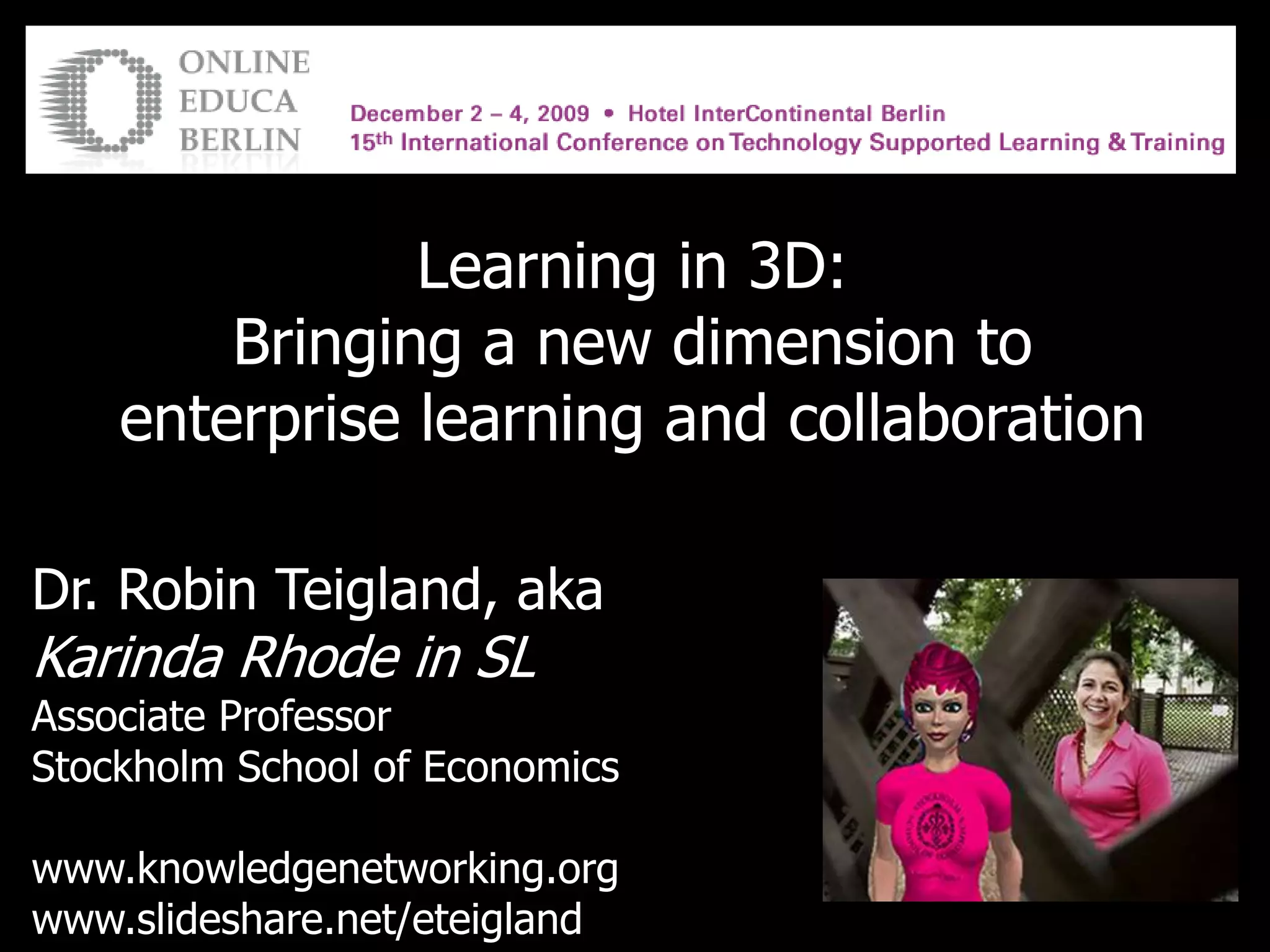
Learning in 3D: Bringing a new dimension to enterprise learning and collaborationDr. Robin Teigland, akaKarinda Rhode in SLAssociate ProfessorStockholm School of Economicswww.knowledgenetworking.orgwww.slideshare.net/eteigland
Today’s discussionIntroduction and some facts and figures on virtual worldsA look at education and collaboration in virtual worldsStepping into Second LifeTony O’Driscoll on his new book, Learning in 3D
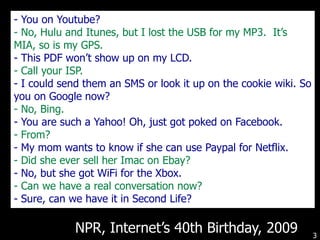
3- You on Youtube? No, Hulu and Itunes, but I lost the USB for my MP3.  It’s MIA, so is my GPS.
 This PDF won’t show up on my LCD.
 Call your ISP.- I could send them an SMS or look it up on the cookie wiki. So you on Google now?- No, Bing. - You are such a Yahoo! Oh, just got poked on Facebook. From?
 My mom wants to know if she can use Paypal for Netflix.
 Did she ever sell her Imac on Ebay?- No, but she got WiFi for the Xbox. Can we have a real conversation now?- Sure, can we have it in Second Life?NPR, Internet’s 40th Birthday, 2009
4"...when the rate of change outside an organization is greater than the rate of change inside, the end is near...." Jack Welch…
Did You Know: Shift Happenshttp://www.youtube.com/watch?v=jpEnFwiqdx8&feature=fvstWhat does this mean for organizations?5
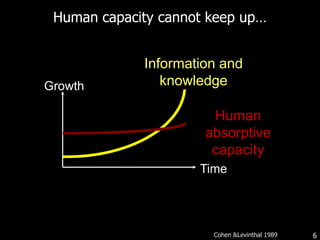
Information and knowledgeGrowthHuman absorptive capacityTimeHuman capacity cannot keep up…Cohen & Levinthal 19896
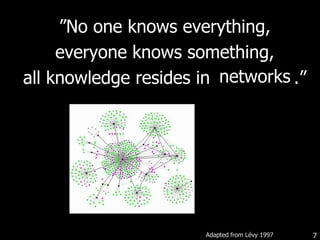
7”No one knows everything, everyone knows something, all knowledge resides in  humanity.”networksAdapted from Lévy 1997
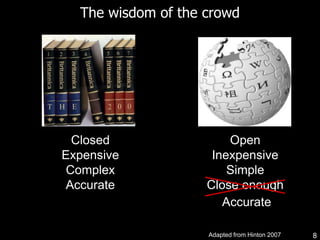
8The wisdom of the crowdClosedExpensiveComplexAccurateOpenInexpensiveSimpleClose enoughAccurateAdapted from Hinton 2007
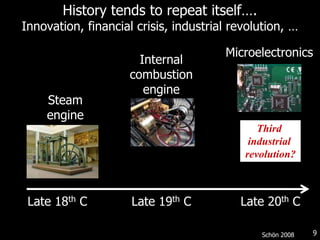
History tends to repeat itself….Innovation, financial crisis, industrial revolution, … MicroelectronicsInternal combustion engineSteam engineThird industrial revolution?Late 18th CLate 19th CLate 20th C9Schön 2008
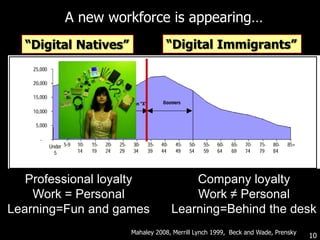
A new workforce is appearing…10“Digital Immigrants”“Digital Natives”Company loyaltyWork ≠ PersonalLearning=Behind the deskProfessional loyaltyWork = PersonalLearning=Fun and gamesMahaley 2008, Merrill Lynch 1999,  Beck and Wade, Prensky
A new workforce is appearingControl
Community
Collaboration
Challenge
Creationhttp://www.youtube.com/watch?v=MbX_I2fuqJk11
12Using the social web to build relationships, find information and knowledge, solve problems, and learn
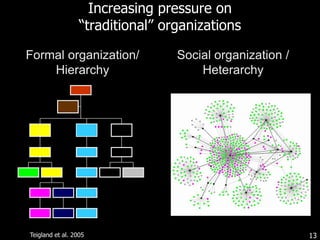
13Increasing pressure on “traditional” organizationsFormal organization/ Hierarchy Social organization /HeterarchyTeigland et al. 2005
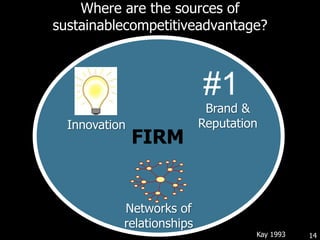
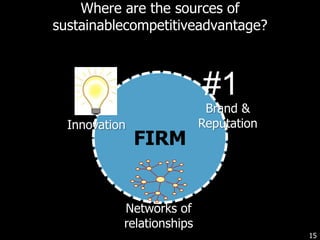
Where are the sources of sustainablecompetitiveadvantage?#1Brand & ReputationInnovationFIRMNetworks of relationshipsKay 199314
Where are the sources of sustainablecompetitiveadvantage?#1Brand & ReputationInnovationFIRMNetworks of relationships15
eZ Systems and its open source business modelThe eZ ecosystem of relationships eZPartnersCommunityCustomers#1 open source content management software
Enterprise open source – “Grow the cake”
60 Employees in 8 countries (Europe & Asia)
230+ Partners
5000+ Customers
30,000+ Community memberswww.ez.noSkien, Norway16
Innovation in the eZ ecosystemeZ Software development teamJillJackRobAlexWho are the company employees?   JimJasonLisaGeorgeJaneDougMaryBobSarahFlåten et al, 2009Bill17
From Brand owners to Brand advocates18“Organizations no longer own their brand…rather they should see their brand as a relay race baton that people should pick up and pass on to others.”Berlin, CEO Silver, 2009
What came first – the community or the company?19http://www.youtube.com/watch?v=9VKRbmnqXR4
20eBay allowed people to selltheir personal items in a worldwide yard sale, the Immersive Internet willallow people to sell their personal skills and abilities in much the same way.Kapp & O’Driscoll, 2009
Towards 3D InternetSENSORY3D InternetThinkingConnectedWeb 2.0 ThinkingSecondLife, There Active Worlds,Entropia, SimsOnline, Club Penguin,Habbo, ToonTown,World of Warcraft, 3D planets, VSlide, ProtosphereIndividualWeb 1.0 ThinkingFacebook, Friendster, Yahoo, Blogger, Wikipedia, eBay, Typepad, LinkedIn. Amazon, MySpace, Textamerica, Delicious, HubPagesMosaic, Prodigy, Compuserve, AOL, NetscapeLevel of InteractionTimeHamilton 200821
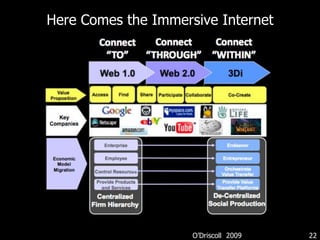
Here Comes the Immersive InternetO’Driscoll  200922
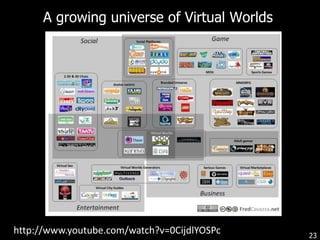
A growing universe of Virtual Worldshttp://www.youtube.com/watch?v=0CijdlYOSPc23
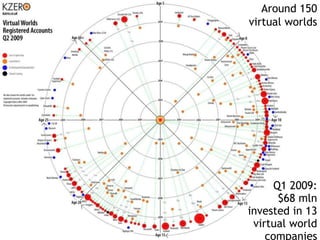
Around 150 virtual worldsQ1 2009:
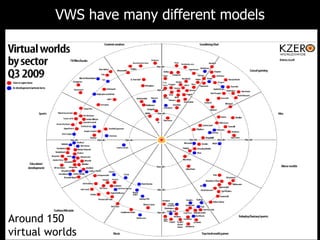
$68 mln invested in 13 virtual world  companiesVWS have many different models25Around 150 virtual worlds
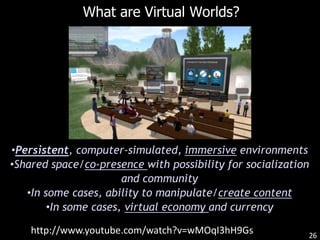
What are Virtual Worlds?Persistent, computer-simulated, immersive environments
Shared space/co-presence with possibility for socialization and community
In some cases, ability to manipulate/create content
In some cases, virtual economy and currencyhttp://www.youtube.com/watch?v=wMOqI3hH9Gs26
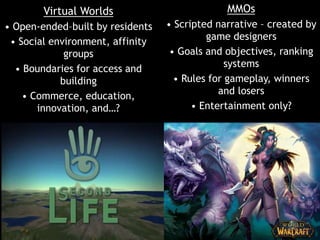
MMOs Scripted narrative – created by game designers
 Goals and objectives, ranking systems
 Rules for gameplay, winners and losers
 Entertainment only?Virtual Worlds Open-ended–built by residents
 Social environment, affinity groups
 Boundaries for access and building
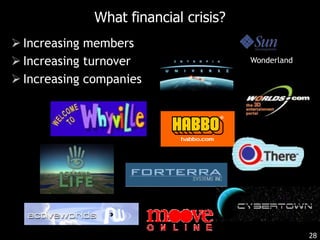
 Commerce, education, innovation, and…?What financial crisis?Increasing membersIncreasing turnoverIncreasing companiesWonderland28
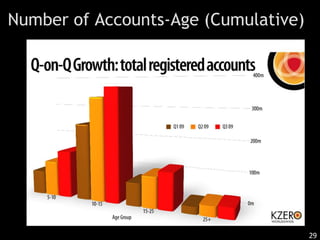
Number of Accounts-Age (Cumulative)39% increase from Q1 2009 29
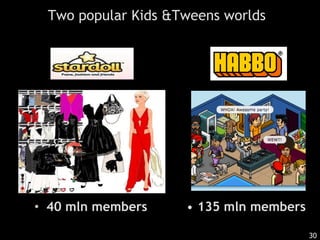
 Two popular Kids & Tweens worlds40 mln members
135 mln members30
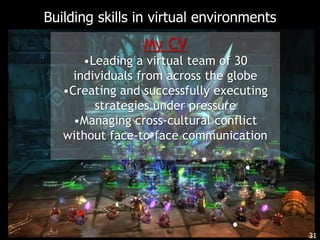
Building skills in virtual environmentsMy CVLeading a virtual team of 30 individuals from across the globe
Creating and successfully executing strategies under pressure
Managing cross-cultural conflict without face-to-face communication31
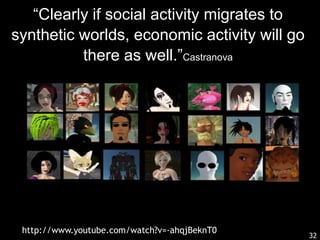
“Clearly if social activity migrates to synthetic worlds, economic activity will go there as well.”Castranovahttp://www.youtube.com/watch?v=-ahqjBeknT032
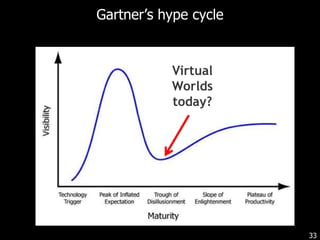
Gartner’s hype cycleVirtual Worlds today?33
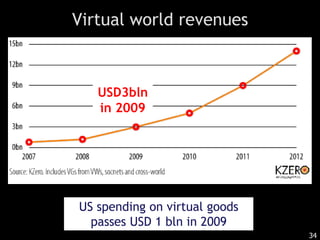
Virtual world revenuesUSD 3bln in 2009 US spending on virtual goods passes USD 1 bln in 2009 34
Microtransactions business modelZynga- Majority revenues comes from 2% to 10% of users who pay $1 an hour to play premium games or buy virtual goods- Annual sales of about USD 100 mlnPlaydom - Estimated USD 50 mln in sales per year from virtual goods Social Gaming Network - Estimated USD 50 mln sales mainly from virtual goodsWeeworld- Estimated 2008 revenue USD 10 mln+ mainly from virtual goodsHabbo- Estimated 2008 revenue USD 50 mln from virtual goods - 10% monthly players pay $10.30/month 35http://www.businessweek.com/technology/content/apr2009/tc20090429_963394_page_2.htm
800,000 users
USD 420 mln turnover 2008
Bank license from Swedish Government in March 2009 to MindArk Bank36
Entropia Universe by MindArkVirtual universe with real cash economy
Fixed exchange rate to US Dollar, 1 USD = 10 PED
Five banks auctioned for USD 404,000 in 2007
Real life bank license granted by Swedish Government to MindArk Bank in March 2009
Ability to develop skills and sell virtual goods
Asteroid space resort sold for USD 100,000 in 2005
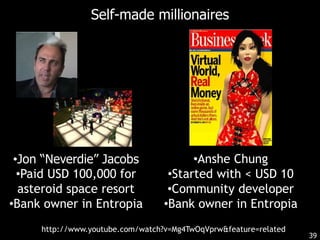
Jon “Neverdie” Jacobs – Self-made millionaire
Clothes Against Violence – limited edition virtual jackets sold for more than same model of real world jackets37
Second Life by Linden Lab1.4 million residents logged in/60 day period
71,200 logged on Monday, Nov 30
Average age=32, 43% female, 55% non-US
Grew 33% in one year to 126 mln at end of 2Q 2009
Economy grew by 94% 2Q 2008-2009
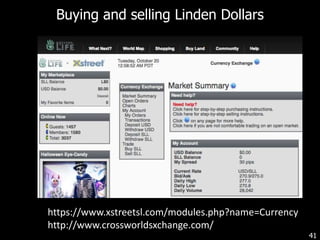
270 Linden dollars ≅ USD 1
350,000 hours of use per day
68,000 people making profitIT Businessedge, Linden Lab, 2009 38
Self-made millionairesJon “Neverdie” Jacobs

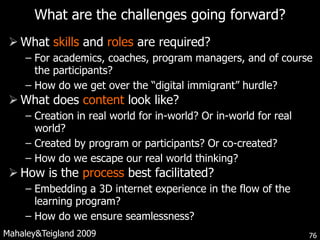
Teigland 3D Learning Online Education Conference

  • 1.
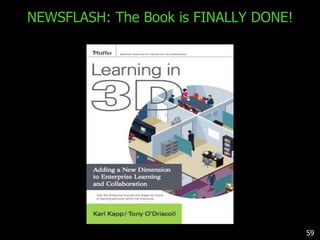
    Learning in 3D:Bringing a new dimension to enterprise learning and collaborationDr. Robin Teigland, akaKarinda Rhode in SLAssociate ProfessorStockholm School of Economicswww.knowledgenetworking.orgwww.slideshare.net/eteigland
  • 2.
    Today’s discussionIntroduction andsome facts and figures on virtual worldsA look at education and collaboration in virtual worldsStepping into Second LifeTony O’Driscoll on his new book, Learning in 3D
  • 3.
    3- You onYoutube? No, Hulu and Itunes, but I lost the USB for my MP3. It’s MIA, so is my GPS.
  • 4.
    This PDFwon’t show up on my LCD.
  • 5.
    Call yourISP.- I could send them an SMS or look it up on the cookie wiki. So you on Google now?- No, Bing. - You are such a Yahoo! Oh, just got poked on Facebook. From?
  • 6.
    My momwants to know if she can use Paypal for Netflix.
  • 7.
    Did sheever sell her Imac on Ebay?- No, but she got WiFi for the Xbox. Can we have a real conversation now?- Sure, can we have it in Second Life?NPR, Internet’s 40th Birthday, 2009
  • 8.
    4"...when the rateof change outside an organization is greater than the rate of change inside, the end is near...." Jack Welch…
  • 9.
    Did You Know:Shift Happenshttp://www.youtube.com/watch?v=jpEnFwiqdx8&feature=fvstWhat does this mean for organizations?5
  • 10.
    Information and knowledgeGrowthHumanabsorptive capacityTimeHuman capacity cannot keep up…Cohen & Levinthal 19896
  • 11.
    7”No one knowseverything, everyone knows something, all knowledge resides in humanity.”networksAdapted from Lévy 1997
  • 12.
    8The wisdom ofthe crowdClosedExpensiveComplexAccurateOpenInexpensiveSimpleClose enoughAccurateAdapted from Hinton 2007
  • 13.
    History tends torepeat itself….Innovation, financial crisis, industrial revolution, … MicroelectronicsInternal combustion engineSteam engineThird industrial revolution?Late 18th CLate 19th CLate 20th C9Schön 2008
  • 14.
    A new workforceis appearing…10“Digital Immigrants”“Digital Natives”Company loyaltyWork ≠ PersonalLearning=Behind the deskProfessional loyaltyWork = PersonalLearning=Fun and gamesMahaley 2008, Merrill Lynch 1999, Beck and Wade, Prensky
  • 15.
    A new workforceis appearingControl
  • 16.
  • 17.
  • 18.
  • 19.
  • 20.
    12Using the socialweb to build relationships, find information and knowledge, solve problems, and learn
  • 21.
    13Increasing pressure on“traditional” organizationsFormal organization/ Hierarchy Social organization /HeterarchyTeigland et al. 2005
  • 22.
    Where are thesources of sustainablecompetitiveadvantage?#1Brand & ReputationInnovationFIRMNetworks of relationshipsKay 199314
  • 23.
    Where are thesources of sustainablecompetitiveadvantage?#1Brand & ReputationInnovationFIRMNetworks of relationships15
  • 24.
    eZ Systems andits open source business modelThe eZ ecosystem of relationships eZPartnersCommunityCustomers#1 open source content management software
  • 25.
    Enterprise open source– “Grow the cake”
  • 26.
    60 Employees in8 countries (Europe & Asia)
  • 27.
  • 28.
  • 29.
  • 30.
    Innovation in theeZ ecosystemeZ Software development teamJillJackRobAlexWho are the company employees? JimJasonLisaGeorgeJaneDougMaryBobSarahFlåten et al, 2009Bill17
  • 31.
    From Brand ownersto Brand advocates18“Organizations no longer own their brand…rather they should see their brand as a relay race baton that people should pick up and pass on to others.”Berlin, CEO Silver, 2009
  • 32.
    What came first– the community or the company?19http://www.youtube.com/watch?v=9VKRbmnqXR4
  • 33.
    20eBay allowed peopleto selltheir personal items in a worldwide yard sale, the Immersive Internet willallow people to sell their personal skills and abilities in much the same way.Kapp & O’Driscoll, 2009
  • 34.
    Towards 3D InternetSENSORY3DInternetThinkingConnectedWeb 2.0 ThinkingSecondLife, There Active Worlds,Entropia, SimsOnline, Club Penguin,Habbo, ToonTown,World of Warcraft, 3D planets, VSlide, ProtosphereIndividualWeb 1.0 ThinkingFacebook, Friendster, Yahoo, Blogger, Wikipedia, eBay, Typepad, LinkedIn. Amazon, MySpace, Textamerica, Delicious, HubPagesMosaic, Prodigy, Compuserve, AOL, NetscapeLevel of InteractionTimeHamilton 200821
  • 35.
    Here Comes theImmersive InternetO’Driscoll 200922
  • 36.
    A growing universeof Virtual Worldshttp://www.youtube.com/watch?v=0CijdlYOSPc23
  • 37.
    Around 150 virtualworldsQ1 2009:
  • 38.
    $68 mln investedin 13 virtual world companiesVWS have many different models25Around 150 virtual worlds
  • 39.
    What are VirtualWorlds?Persistent, computer-simulated, immersive environments
  • 40.
    Shared space/co-presence withpossibility for socialization and community
  • 41.
    In some cases,ability to manipulate/create content
  • 42.
    In some cases,virtual economy and currencyhttp://www.youtube.com/watch?v=wMOqI3hH9Gs26
  • 43.
    MMOs Scripted narrative– created by game designers
  • 44.
    Goals andobjectives, ranking systems
  • 45.
    Rules forgameplay, winners and losers
  • 46.
    Entertainment only?VirtualWorlds Open-ended–built by residents
  • 47.
    Social environment,affinity groups
  • 48.
    Boundaries foraccess and building
  • 49.
    Commerce, education,innovation, and…?What financial crisis?Increasing membersIncreasing turnoverIncreasing companiesWonderland28
  • 50.
    Number of Accounts-Age(Cumulative)39% increase from Q1 2009 29
  • 51.
     Two popular Kids& Tweens worlds40 mln members
  • 52.
  • 53.
    Building skills invirtual environmentsMy CVLeading a virtual team of 30 individuals from across the globe
  • 54.
    Creating and successfullyexecuting strategies under pressure
  • 55.
    Managing cross-cultural conflictwithout face-to-face communication31
  • 56.
    “Clearly if socialactivity migrates to synthetic worlds, economic activity will go there as well.”Castranovahttp://www.youtube.com/watch?v=-ahqjBeknT032
  • 57.
  • 58.
    Virtual world revenuesUSD3bln in 2009 US spending on virtual goods passes USD 1 bln in 2009 34
  • 59.
    Microtransactions business modelZynga-Majority revenues comes from 2% to 10% of users who pay $1 an hour to play premium games or buy virtual goods- Annual sales of about USD 100 mlnPlaydom - Estimated USD 50 mln in sales per year from virtual goods Social Gaming Network - Estimated USD 50 mln sales mainly from virtual goodsWeeworld- Estimated 2008 revenue USD 10 mln+ mainly from virtual goodsHabbo- Estimated 2008 revenue USD 50 mln from virtual goods - 10% monthly players pay $10.30/month 35http://www.businessweek.com/technology/content/apr2009/tc20090429_963394_page_2.htm
  • 60.
  • 61.
    USD 420 mlnturnover 2008
  • 62.
    Bank license fromSwedish Government in March 2009 to MindArk Bank36
  • 63.
    Entropia Universe byMindArkVirtual universe with real cash economy
  • 64.
    Fixed exchange rateto US Dollar, 1 USD = 10 PED
  • 65.
    Five banks auctionedfor USD 404,000 in 2007
  • 66.
    Real life banklicense granted by Swedish Government to MindArk Bank in March 2009
  • 67.
    Ability to developskills and sell virtual goods
  • 68.
    Asteroid space resortsold for USD 100,000 in 2005
  • 69.
    Jon “Neverdie” Jacobs– Self-made millionaire
  • 70.
    Clothes Against Violence– limited edition virtual jackets sold for more than same model of real world jackets37
  • 71.
    Second Life byLinden Lab1.4 million residents logged in/60 day period
  • 72.
    71,200 logged onMonday, Nov 30
  • 73.
    Average age=32, 43%female, 55% non-US
  • 74.
    Grew 33% inone year to 126 mln at end of 2Q 2009
  • 75.
    Economy grew by94% 2Q 2008-2009
  • 76.
  • 77.
    350,000 hours ofuse per day
  • 78.
    68,000 people makingprofitIT Businessedge, Linden Lab, 2009 38
  • 79.

Editor's Notes

  • #4 So if there is no one-liner to celebrate the birth of the Internet, maybe this skit, aired on National Public Radio in the US on the 40-year anniversary of the Internet in October 2009, can serve as a reminder of how far we have come
  • #10 I always like to put things into perspective. The theme of today’s event is that of seeing opportunities in the midst of the financial crisis and I think that what is interesting and relevant here is that several economic historians had actually predicted the crisis that we are experiencing now. I don’t have time to go into all the details, but what we are seeing is a pattern repeating itself. As in the late 18th and 19th Centuries there was a technological innovation that led to a period first of transformation as the innovation began to be diffused, then a period of rationalization leading to an imbalance, and then to a financial crisis coming around 40 years after the innovation. However, in the past, these financial crises have then led to periods of great economic development – industrial revolutions, in which industry profitability has been restored through a redistribution of the value-added between capital and labor. But more importantly, these crises filtered out those organizations that could not adapt and change to stay competitive in the new industrial environment. And one of the most important things that is of interest for today’s discussion is that in one of the factors facilitating these new phases of economic growth following the crisis has been that a generation of people that had never experienced life without the innovation starts to enter the workforce – thus they are not restricted by old ways of thinking.experiencing now some economic historians claim to be due to the innovation of the microprocessor and microelectronics in the 1970s. Similar to what we experienced with the innovation of the steam engine in the late 18th C and the internal combustion engine and electric motor in the late 19th C, there was a subsequent crisis about due to various forces converging. We saw that as these basic innovations were diffused, people stopped investing in the existing industrial structure and instead focused on investing in a new generation of competitive machinery, which then led to an industrial revolution in both cases as the innovations became embedded in society. At the same time, the crisis served to release the negative pressure that had been built up as well as to restore industry profitability through the redistribution of value-added between capital and labor. Other notesNotes from article - Schön, L, Economic Crises and Restructuring in HistoryA crisis is connected with changes in the long term or structural conditions built up during a rather long period of time and effects behavior for a long time to comeTransformation – changes in industrial structure – resources are reallocated between industries and diffusion of basic innovations with industry that provides new bases for such reallocationRationalization – concentration of resources to most productive units within the branches and measures to increase efficiency in different lines of productionShifts between transformation and rationalization have occurred with considerable regularity in structural cycle of 40 years – 25 years on transformation, and 15 years on rationalization. Crises been part of this cycle as wellInternational crisis in 1840s – How go from crisis to expansion quickly – went quite rapidly in 1930s for Sweden – but Sweden in opposite corner in 1970s1850s – upswing of industrial and infrastructural investments was linked to breakthrough of mechanized factories in Sweden, modernization of steel processes and construction of railways1930s and more marked after WWII late 1940s - expansion of electrification and diffusion of automobiles, processing of electrosteel to small motors in handicraft and household – combination with motorcar – new styles in living and consumptionWaves of investments around development of an infrastructure from basic innovation of preceding cycle mid 1970s – microprocessor – knowledge and information in production of goods and servicesIt is not the basic innovation itself – but the diffusion of the innovation that counts!When invented, then expensive to implement, have a narrow range of application – Following generalization – A structural crisis (that has been preceded by an early development of basic innovations) has put an end to old directions of investments mainly in rationalization of existing industrial structure and given rise to investments in ne and devt of new tech that after one decade (the length of the classical Juglar cycle of machinery investments) has created a new generation of economically competitive machineryReallocation of labor occurs approx 15-30 years after the structural crisisDevelopment of markets – distribution of value added between capital and labour is one mirror of these changesDiffusion of innovations leads to expansion of markets and arrival of new competitors – Structural crises – release negative pressure and restored profitability in industry – get rid of those who not competitive
  • #12 Thanks to Philippe Des Autels for picture.Impatience