Local E-commerce
Local e-commerce is a form of e-commerce that is focused on
engaging the consumer based on his or her current geographic
location.
Merchants use a variety of online marketing techniques to drive
consumers to their stores.
It is a branch of mobile, social, local e-commerce wave.
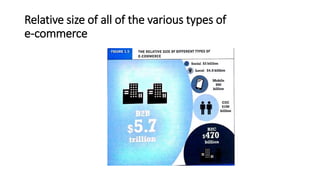
Relative size of all of the various types of
e-commerce
Growth of Internet, Web, and Mobile Platform
 The technological juggernauts behind e-commerce are the Internet,
the web, and increasingly, the mobile platform.
 The Internet is a worldwide network of computer networks built on
common standards.
 Created in the late 1960s to connect a small number of mainframe
computers and their users.
 It links many agencies, institutions, etc.
 In January 2014, there were more than 1 billion Internet hosts over
245 countries, up from 70 million in 2000. (Internet systems Consortium, 2014)
Growth
• 38 years for Radio to achieve 30% share of U. S. households.
• 17 years for Television to achieve 30%.
• 10 years for Internet to achieve 53%.
World Wide Web (The Web)
• One of the most popular service that runs on the Internet
infrastructure.
• It was developed in the early 1990s and hence much more recent
origin than the Internet.
• Provides access to billions of web pages indexed by Google and other
search engines.
• Pages are created in a language called HTML.
• The Internet prior to the Web was primarily used for text
communications, file transfers, and remote computing.
• It created a communications infrastructure & Information storage
system that rivals television, radio, etc.
#Google has identified over 60 trillion unique URLs, up from 1 trillion in
2008, although many of these pages do not contain unique content.
(Google, 2014)
Mobile platform
• This is the newest “latest and greatest” development in Internet
infrastructure.
• The Mobile platform provides the ability to access the Internet from
a variety of mobile devices.
• There was over 365 million mobile devices in the U. S. that can be
connected to the Internet and is expected to grow over 385 ,illion by
2018. (eMarketer, Inc., 2014c)
Origins and Growth of e-Commerce
• In 1970s, a pharmaceutical firm named Baxter Healthcare initiated a
primitive form of B2B e-commerce.
• In 1980s the development of Electronic Data Interchange (EDI)
standards that permitted firms to exchange commercial documents
and conduct digital commercial transactions across private networks.
• The e-commerce begins in 1995, following the appearance of the first
banner advertisement placed by AT&T, Volvo, Sprint, and others on
Hotwired in late October 1994.
• The data suggests that, over the next five years, B2C e-commerce in
the U.S. will grow by 13% annually, faster than the traditional retail
sales.
• As online sales become a larger percentage of all sales, online sales
growth will likely eventually decline up to a certain growth level.
•THANK YOU

Local e-Commerce

  • 1.
    Local E-commerce Local e-commerceis a form of e-commerce that is focused on engaging the consumer based on his or her current geographic location. Merchants use a variety of online marketing techniques to drive consumers to their stores. It is a branch of mobile, social, local e-commerce wave.
  • 2.
    Relative size ofall of the various types of e-commerce
  • 3.
    Growth of Internet,Web, and Mobile Platform  The technological juggernauts behind e-commerce are the Internet, the web, and increasingly, the mobile platform.  The Internet is a worldwide network of computer networks built on common standards.  Created in the late 1960s to connect a small number of mainframe computers and their users.  It links many agencies, institutions, etc.  In January 2014, there were more than 1 billion Internet hosts over 245 countries, up from 70 million in 2000. (Internet systems Consortium, 2014)
  • 4.
    Growth • 38 yearsfor Radio to achieve 30% share of U. S. households. • 17 years for Television to achieve 30%. • 10 years for Internet to achieve 53%.
  • 5.
    World Wide Web(The Web) • One of the most popular service that runs on the Internet infrastructure. • It was developed in the early 1990s and hence much more recent origin than the Internet. • Provides access to billions of web pages indexed by Google and other search engines. • Pages are created in a language called HTML. • The Internet prior to the Web was primarily used for text communications, file transfers, and remote computing. • It created a communications infrastructure & Information storage system that rivals television, radio, etc.
  • 6.
    #Google has identifiedover 60 trillion unique URLs, up from 1 trillion in 2008, although many of these pages do not contain unique content. (Google, 2014)
  • 7.
    Mobile platform • Thisis the newest “latest and greatest” development in Internet infrastructure. • The Mobile platform provides the ability to access the Internet from a variety of mobile devices. • There was over 365 million mobile devices in the U. S. that can be connected to the Internet and is expected to grow over 385 ,illion by 2018. (eMarketer, Inc., 2014c)
  • 8.
    Origins and Growthof e-Commerce • In 1970s, a pharmaceutical firm named Baxter Healthcare initiated a primitive form of B2B e-commerce. • In 1980s the development of Electronic Data Interchange (EDI) standards that permitted firms to exchange commercial documents and conduct digital commercial transactions across private networks. • The e-commerce begins in 1995, following the appearance of the first banner advertisement placed by AT&T, Volvo, Sprint, and others on Hotwired in late October 1994.
  • 9.
    • The datasuggests that, over the next five years, B2C e-commerce in the U.S. will grow by 13% annually, faster than the traditional retail sales. • As online sales become a larger percentage of all sales, online sales growth will likely eventually decline up to a certain growth level.
  • 10.