Dynamical Processes on Complex Networks 1st Edition Alain Barrat
1.
Dynamical Processes onComplex Networks 1st
Edition Alain Barrat download
https://ebookgate.com/product/dynamical-processes-on-complex-
networks-1st-edition-alain-barrat/
Get Instant Ebook Downloads – Browse at https://ebookgate.com
2.
Get Your DigitalFiles Instantly: PDF, ePub, MOBI and More
Quick Digital Downloads: PDF, ePub, MOBI and Other Formats
Channel Coding in Communication Networks From Theory to
Turbo Codes 1st edition Edition Alain Glavieux
https://ebookgate.com/product/channel-coding-in-communication-
networks-from-theory-to-turbo-codes-1st-edition-edition-alain-
glavieux/
Numerical Continuation Methods for Dynamical Systems
Path following and boundary value problems
Understanding Complex Systems 1st Edition Bernd
Krauskopf
https://ebookgate.com/product/numerical-continuation-methods-for-
dynamical-systems-path-following-and-boundary-value-problems-
understanding-complex-systems-1st-edition-bernd-krauskopf/
Iterated Maps on the Interval as Dynamical Systems 1st
Edition Pierre Collet
https://ebookgate.com/product/iterated-maps-on-the-interval-as-
dynamical-systems-1st-edition-pierre-collet/
Lecture Notes on Complex Analysis Ivan Francis Wilde
https://ebookgate.com/product/lecture-notes-on-complex-analysis-
ivan-francis-wilde/
3.
Probability Statistics andRandom Processes with
Queueing Theory and Queueing Networks 4th Edition
Veerara
https://ebookgate.com/product/probability-statistics-and-random-
processes-with-queueing-theory-and-queueing-networks-4th-edition-
veerara/
Recovery of Values from Low Grade and Complex Minerals
Development of Sustainable Processes 1st Edition Elvis
Fosso-Kankeu
https://ebookgate.com/product/recovery-of-values-from-low-grade-
and-complex-minerals-development-of-sustainable-processes-1st-
edition-elvis-fosso-kankeu/
Probability on Trees and Networks 1st Edition Russell
Lyons
https://ebookgate.com/product/probability-on-trees-and-
networks-1st-edition-russell-lyons/
Collective Dynamics in Complex Networks of Noisy Phase
Oscillators Towards Models of Neuronal Network Dynamics
1st Edition Bernard Sonnenschein
https://ebookgate.com/product/collective-dynamics-in-complex-
networks-of-noisy-phase-oscillators-towards-models-of-neuronal-
network-dynamics-1st-edition-bernard-sonnenschein/
Superhydrophobic Surfaces 1st Edition Alain Carré
https://ebookgate.com/product/superhydrophobic-surfaces-1st-
edition-alain-carre/
D Y NA M I C A L P R O C E S S E S O N
C O M P L E X N E T W O R K S
The availability of large data sets has allowed researchers to uncover complex
properties such as large-scale fluctuations and heterogeneities in many networks,
leading to the breakdown of standard theoretical frameworks and models. Until
recently these systems were considered as haphazard sets of points and connec-
tions. Recent advances have generated a vigorous research effort in understanding
the effect of complex connectivity patterns on dynamical phenomena. This book
presents a comprehensive account of these effects.
A vast number of systems, from the brain to ecosystems, power grids and the
Internet, can be represented as large complex networks. This book will interest
graduate students and researchers in many disciplines, from physics and statis-
tical mechanics, to mathematical biology and information science. Its modular
approach allows readers to readily access the sections of most interest to them,
and complicated maths is avoided so the text can be easily followed by non-experts
in the subject.
ALAIN BARRAT is Senior Researcher at the Laboratoire de Physique Théorique
(CNRS and Université de Paris-Sud, France), and the Complex Networks Lagrange
Laboratory at the Institute for Scientific Interchange in Turin, Italy. His research
interests are in the field of out-of-equilibrium statistical mechanics.
MARC BARTHÉLEMY is Senior Researcher at the Département de Physique
Théorique et Appliquée at the Commissariat à l’Énergie Atomique (CEA),
France. His research interests are in the application of statistical physics to com-
plex systems.
ALESSANDRO VESPIGNANI is Professor of Informatics and Adjunct Professor of
Physics and Statistics at Indiana University, USA, and Director of the Complex
Networks Lagrange Laboratory at the Institute for Scientific Interchange in Turin,
Italy. His research interests are in the theoretical and computational modeling of
complex systems and networks.
8.
DYNAMICAL PROCESSES ON
COMPLEXNETWORKS
A L A I N B A R R A T
Laboratoire de Physique Théorique, Université de Paris-Sud, France
Centre National de la Recherche Scientifique, France
Complex Networks Lagrange Laboratory, ISI Foundation, Italy
M A R C B A R T H É L E M Y
Commissariat à l’Energie Atomique – Département de Physique
Théorique et Appliquée, France
A L E S S A N D R O V E S P I G N A N I
School of Informatics, Department of Physics and Biocomplexity Institute,
Indiana University, USA
Complex Networks Lagrange Laboratory, ISI Foundation, Italy
Centre National de la Recherche Scientifique, France
Contents
Preface page xi
Acknowledgementsxv
List of abbreviations xvii
1 Preliminaries: networks and graphs 1
1.1 What is a network? 1
1.2 Basic concepts in graph theory 2
1.3 Statistical characterization of networks 11
1.4 Weighted networks 19
2 Networks and complexity 24
2.1 Real-world systems 24
2.2 Network classes 34
2.3 The complicated and the complex 47
3 Network models 50
3.1 Randomness and network models 50
3.2 Exponential random graphs 58
3.3 Evolving networks and the non-equilibrium approach 60
3.4 Modeling higher order statistics and other attributes 72
3.5 Modeling frameworks and model validation 74
4 Introduction to dynamical processes: theory and simulation 77
4.1 A microscopic approach to dynamical phenomena 77
4.2 Equilibrium and non-equilibrium systems 79
4.3 Approximate solutions of the Master Equation 82
4.4 Agent-based modeling and numerical simulations 85
5 Phase transitions on complex networks 92
5.1 Phase transitions and the Ising model 92
5.2 Equilibrium statistical physics of critical phenomena 96
5.3 The Ising model in complex networks 101
vii
13.
viii Contents
5.4 Dynamicsof ordering processes 108
5.5 Phenomenological theory of phase transitions 111
6 Resilience and robustness of networks 116
6.1 Damaging networks 116
6.2 Percolation phenomena as critical phase transitions 120
6.3 Percolation in complex networks 124
6.4 Damage and resilience in networks 126
6.5 Targeted attacks on large degree nodes 129
6.6 Damage in real-world networks 135
7 Synchronization phenomena in networks 136
7.1 General framework 136
7.2 Linearly coupled identical oscillators 138
7.3 Non-linear coupling: firing and pulse 148
7.4 Non-identical oscillators: the Kuramoto model 151
7.5 Synchronization paths in complex networks 156
7.6 Synchronization phenomena as a topology probing tool 158
8 Walking and searching on networks 160
8.1 Diffusion processes and random walks 160
8.2 Diffusion in directed networks and ranking algorithms 166
8.3 Searching strategies in complex networks 170
9 Epidemic spreading in population networks 180
9.1 Epidemic models 180
9.2 Epidemics in heterogeneous networks 189
9.3 The large time limit of epidemic outbreaks 197
9.4 Immunization of heterogeneous networks 207
9.5 Complex networks and epidemic forecast 212
10 Social networks and collective behavior 216
10.1 Social influence 216
10.2 Rumor and information spreading 218
10.3 Opinion formation and the Voter model 225
10.4 The Axelrod model 232
10.5 Prisoner’s dilemma 235
10.6 Coevolution of opinions and network 238
11 Traffic on complex networks 242
11.1 Traffic and congestion 242
11.2 Traffic and congestion in distributed routing 246
11.3 Avalanches 256
11.4 Stylized models and real-world infrastructures 264
12 Networks in biology: from the cell to ecosystems 267
12.1 Cell biology and networks 268
14.
Contents ix
12.2 Flux-balanceapproaches and the metabolic activity 271
12.3 Boolean networks and gene regulation 274
12.4 The brain as a network 279
12.5 Ecosystems and food webs 282
12.6 Future directions 293
13 Postface: critically examining complex networks science 294
Appendix 1 Random graphs 298
Appendix 2 Generating functions formalism 303
Appendix 3 Percolation in directed networks 306
Appendix 4 Laplacian matrix of a graph 310
Appendix 5 Return probability and spectral density 311
References 313
Index 344
16.
Preface
In the pastfew years, the study of large networked systems has received a boost
from the ever-increasing availability of large data sets and computer power for their
storage and manipulation. In particular, mapping projects of the World Wide Web
and the physical Internet offered the first chance to study the topology of large
complex networks. Gradually, other maps followed describing many networks of
practical interest in social science, critical infrastructures, and biology. Indeed,
large complex networks arise in a vast number of natural and artificial systems.
The brain consists of many interconnected neurons; ecosystems consist of species
whose interdependency can be mapped into intricate food webs. Social systems
may be represented by graphs describing various interactions among individuals.
Large networked infrastructures such as power grids and transportation networks
are critical to our modern society. Finally, the living cell is not an exception, its
organization and function being the outcome of a complex web of interactions
among genes, proteins, and other molecules. In the search for the underlying laws
governing the dynamics and evolution of these complex systems, researchers have
started the systematic analysis and characterization of their network representa-
tions. A central result of these activities is that large-scale networks are generally
characterized by complex topologies and very heterogeneous structures. These
features usually find their signature in connectivity patterns statistically charac-
terized by heavy tails and large fluctuations, scale-free properties, and non-trivial
correlations such as high clustering and hierarchical ordering.
The large size and dynamic nature of complex networks has attracted the atten-
tion of the statistical physics community. In this context the statistical physics
approach has been exploited as a very convenient strategy because of its deep con-
nection with statistical graph theory and the possibility of characterizing emergent
macroscopic phenomena in terms of the dynamical evolution of the basic elements
of the system. In addition, the large scale analysis of networks appearing in very
xi
17.
xii Preface
different fieldshas provided evidence for the sharing of several asymptotic proper-
ties and raised the issue of the supposed emergence in complex networks of general
and common organizing principles that go beyond the particulars of the individual
system, and are thus amenable to general modeling principles.
The advances in understanding large complex networks have generated
increased attention towards the potential implications of their structure for the
most important questions concerning the various physical and dynamical processes
occurring on top of them. Questions of how pathogens spread in population net-
works, how blackouts can spread on a nationwide scale, or how efficiently we can
search and retrieve data on large information structures are all related to spreading
and diffusion phenomena. The resilience and robustness of large infrastructures
can be studied by percolation models in which we progressively damage the net-
work. Social behavior may be often modeled through simple dynamical processes
and agent-based models. Since the early studies of percolation and spreading pro-
cesses in complex networks, a theoretical picture has emerged in which many of
the standard results were radically altered by the topological fluctuations and the
complex features observed in most real-world networks. Indeed, complex prop-
erties often imply a virtual infinite heterogeneity of the system and large scale
fluctuations extending over several orders of magnitude, generally corresponding
to the breakdown of standard theoretical frameworks and models. Therefore, while
the definitions of the basic models are expected to remain unchanged, the scien-
tific community has become aware of the need to investigate systematically the
impact of the various network characteristics on the basic features of equilibrium
and non-equilibrium dynamical processes.
The study of models unfolding on complex networks has generated results of
conceptual and practical relevance. The resilience of networks, their vulnerability
to attacks, and their synchronization properties are all strongly affected by topolog-
ical heterogeneities. Consensus formation, disease spreading, and our accessibility
to information can benefit from or be impaired by the connectivity pattern of the
population or infrastructure we are looking at. Noticeably, all these results have
been obtained in different contexts and have relevance across several disciplines
including physics, biology, and computer and information science. The purpose of
this book is to provide a unified presentation of these results and their impact on
our understanding of a wide range of networked systems.
While several techniques and methods have been used in the field, the mas-
sive size and heterogeneity of the systems have favored the use of techniques akin
to the analysis of non-linear, equilibrium, and non-equilibrium physical systems.
As previously mentioned, the statistical physics approach has indeed revealed its
convenience and has proven very useful in this context, particularly regarding its
ability to shed light on the link between the microscopic dynamical evolution of
18.
Preface xiii
the basicelements of the system and the emergence of macroscopic phenomena.
For this reason we will follow this approach and structure the book according to the
general framework provided by statistical physics. In doing this, however, we will
make a special effort in defining for each phenomenon or system under study the
appropriate language used in the field and offer to the reader a mapping between
languages and techniques used in the different disciplines.
For the sake of clarity and readability we have used a modular approach to the
material that allows the reader interested in just one phenomenon to refer directly
to the corresponding specific chapter. The basic definitions and methods used
throughout the book are introduced in the first four chapters that set the stage for
the remaining chapters, each one clearly self-contained and addressing a specific
class of processes. The material is ordered in a path that goes from equilibrium
to non-equilibrium phenomena, in accordance with the general framework of sta-
tistical physics and in terms of the homogeneity of the techniques used in each
context.
More precisely, we start in Chapter 1 by defining the basics of graph theory
and some tools for the statistical characterization and classification of large net-
works. These tools are used in Chapter 2, where we discuss the complex features
which characterize a large number of real-world networks. Chapter 3 is devoted to
a brief presentation of the various network modeling techniques and the general
approaches used for their analysis. Approximations and computational techniques
are discussed as well. Chapter 4 provides an introduction to the basic theoretical
concepts and tools needed for the analysis of dynamical processes taking place on
networks. All these introductory chapters will allow researchers not familiar with
mathematical and computational modeling to get acquainted with the approaches
and techniques used in the book.
In Chapter 5, we report the analysis of equilibrium processes and we review the
behaviors of basic equilibrium physical models such as the Ising model in com-
plex networks. Chapter 6 addresses the analysis of damage and attack processes
in complex networks by mapping those processes into percolation phase transi-
tions. Chapter 7 is devoted to synchronization in coupled systems with complex
connectivity patterns. This is a transition chapter in that some of the phenomena
analyzed and their respective models can be considered in the equilibrium pro-
cesses domains while others fall into the non-equilibrium class. The following four
chapters of the book are devoted to non-equilibrium processes. One chapter con-
siders search, navigation, and exploration processes of complex networks; the three
other chapters concern epidemic spreading, the emergence of social behavior, and
traffic avalanche and congestion, respectively. These chapters, therefore, are con-
sidering far from equilibrium systems with absorbing states and driven-dissipative
19.
xiv Preface
dynamics. Finally,Chapter 12 is devoted to a discussion of the recent applica-
tion of network science to biological systems. A final set of convenient appendices
are used to detail very technical calculations or discussions in order to make the
reading of the main chapters more accessible to non-expert readers. The postface
occupies a special place at the end of the book as it expresses our view on the value
of complex network science.
We hope that our work will result in a first coherent and comprehensive expo-
sition of the vast research activity concerning dynamical processes in complex
networks. The large number of references and research focus areas that find room
in this book make us believe that the present volume will be a convenient entry ref-
erence to all researchers and students who consider working in this exciting area of
interdisciplinary research. Although this book reviews or mentions more than 600
scientific works, it is impossible to discuss in detail all relevant contributions to the
field. We have therefore used our author privilege and made choices based on our
perception of what is more relevant to the focus and the structure of the present
book. This does not imply that work not reported or cited here is less valuable, and
we apologize in advance to all the colleagues who feel that their contributions have
been overlooked.
20.
Acknowledgements
There are manypeople we must thank for their help in the preparation and com-
pletion of this book. First of all, we wish to thank all the colleagues who helped us
shape our view and knowledge of complex networks through invaluable scientific
collaborations: J. I. Alvarez-Hamelin, F. P. Alvarez, L. A. N. Amaral, D. Balcan, A.
Baronchelli, M. Boguñá, K. Börner, G. Caldarelli, C. Caretta Cartozo, C. Castel-
lano, F. Cecconi, A. Chessa, E. Chow, V. Colizza, P. Crépey, A. De Montis, L.
Dall’Asta, T. Eliassi-Rad, A. Flammini, S. Fortunato, F. Gargiulo, D. Garlaschelli,
A. Gautreau, B. Gondran, E. Guichard, S. Havlin, H. Hu, C. Herrmann, W. Ke, E.
Kolaczyk, B. Kozma, M. Leone, V. Loreto, F. Menczer, Y. Moreno, M. Nekovee,
A. Maritan, M. Marsili, A. Maguitman, M. Meiss, S. Mossa, S. Myers, C. Nardini,
M. Nekovee, D. Parisi, R. Pastor-Satorras, R. Percacci, P. Provero, F. Radicchi, J.
Ramasco, C. Ricotta, A. Scala, M. Angeles Serrano, H. E. Stanley, A.-J. Valleron,
A. Vàzquez, M. Vergassola, F. Viger, D. Vilone, M. Weigt, R. Zecchina, and C.-H.
Zhang.
We also acknowledge with pleasure the many discussions with, encouragements,
and useful criticisms from: R. Albert, E. Almaas, L. Adamic, A. Arenas, A. L.
Barabási, J. Banavar, C. Cattuto, kc claffy, P. De Los Rios, S. Dorogovtsev, A.
Erzan, R. Goldstone, S. Havlin, C. Hidalgo, D. Krioukov, H. Orland, N. Mar-
tinez, R. May, J. F. Mendes, A. Motter, M. Mungan, M. Newman, A. Pagnani,
T. Petermann, D. Rittel, L. Rocha, G. Schehr, S. Schnell, O. Sporns, E. Trizac, Z.
Toroczkai, S. Wasserman, F. van Wijland, W. Willinger, L. Yaeger, and S. Zapperi.
Special thanks go to E. Almaas, C. Castellano, V. Colizza, J. Dunne, S. Fortu-
nato, H. Jeong, Y. Moreno, N. Martinez, M. E. J. Newman, M. Angeles Serrano,
and O. Sporns for their kind help in retrieving data and adapting figures from
their work. A. Baronchelli, C. Castellano, L. Dall’Asta, A. Flammini, S. Fortu-
nato, and R. Pastor-Satorras reviewed earlier versions of this book and made many
suggestions for improvement. B. Hook deserves a special acknowledgement for
xv
21.
xvi Acknowledgements
proofreading andediting the first version of the manuscript. Simon Capelin and
his outstanding editorial staff at Cambridge University Press were a source of
continuous encouragement and help and greatly contributed to make the writing
of this book a truly exciting and enjoyable experience. We also thank all those
institutions that helped in making this book a reality. The Centre National de la
Recherche Scientifique, the Laboratoire de Physique Théorique at the University
of Paris-Sud, the Commissariat à l’Energie Atomique, the School of Informatics
at Indiana University, and the Institute for Scientific Interchange in Turin have
provided us with great environments and the necessary resources to complete this
work. We also acknowledge the generous funding support at various stages of our
research by the following awards: NSF-IIS0513650, EC-001907 Delis, and CRT-
foundation Lagrange laboratory. Finally, A.B. thanks the SNCF for providing fast
trains between Paris, Dijon, and Turin which are not always late, M.B. expresses his
gratitude to the Cannibale Café which is probably the best coffee-office in Paris,
and A.V. thanks Continental Airlines for having power plug-ins in all classes of
reservations.
22.
Abbreviations
AS Autonomous System
BABarabási–Albert
BGP Border Gateway Protocol
CAIDA Cooperative Association for Internet Data Analysis
CPU central processing unit
ER Erdős–Rényi
IATA International Air Transport Association
DIMES Distributed Internet Measurements and Simulations
GIN giant in-component
GOUT giant out-component
GSCC giant strongly connected component
GWCC giant weakly connected component
HOT Heuristically Optimized Trade-off
ICT Information and communication technology
LAN Local Area Network
ME master equation
MF mean-field
P2P peer-to-peer
SCN scientific collaboration network
SI Susceptible-Infected model
SIR Susceptible-Infected-Removed model
SIS Susceptible-Infected-Susceptible model
TTL time-to-live
WAN worldwide airport network
WS Watts–Strogatz
WWW World Wide Web
xvii
24.
1
Preliminaries: networks andgraphs
In this chapter we introduce the reader to the basic definitions of network and graph
theory. We define metrics such as the shortest path length, the clustering coefficient,
and the degree distribution, which provide a basic characterization of network sys-
tems. The large size of many networks makes statistical analysis the proper tool for
a useful mathematical characterization of these systems. We therefore describe the
many statistical quantities characterizing the structural and hierarchical ordering
of networks including multipoint degree correlation functions, clustering spec-
trum, and several other local and non-local quantities, hierarchical measures and
weighted properties.
This chapter will give the reader a crash course on the basic notions of net-
work analysis which are prerequisites for understanding later chapters of the book.
Needless to say the expert reader can freely skip this chapter and use it later as a
reference if needed.
1.1 What is a network?
In very general terms a network is any system that admits an abstract mathemat-
ical representation as a graph whose nodes (vertices) identify the elements of the
system and in which the set of connecting links (edges) represent the presence of a
relation or interaction among those elements. Clearly such a high level of abstrac-
tion generally applies to a wide array of systems. In this sense, networks provide a
theoretical framework that allows a convenient conceptual representation of inter-
relations in complex systems where the system level characterization implies the
mapping of interactions among a large number of individuals.
The study of networks has a long tradition in graph theory, discrete mathema-
tics, sociology, and communication research and has recently infiltrated physics
and biology. While each field concerned with networks has introduced, in many
cases, its own nomenclature, the rigorous language for the description of networks
1
25.
2 Preliminaries: networksand graphs
is found in mathematical graph theory. On the other hand, the study of very large
networks has spurred the definitions of new metrics and statistical observables
specifically aimed at the study of large-scale systems. In the following we pro-
vide an introduction to the basic notions and notations used in network theory and
set the cross-disciplinary language that will be used throughout this book.
1.2 Basic concepts in graph theory
Graph theory – a vast field of mathematics – can be traced back to the pioneering
work of Leonhard Euler in solving the Königsberg bridges problem (Euler, 1736).
Our intention is to select those notions and notations which will be used throughout
the rest of this book. The interested reader can find excellent textbooks on graph
theory by Bergé (1976), Chartrand and Lesniak (1986), Bollobás (1985, 1998) and
Clark and Holton (1991).
1.2.1 Graphs and subgraphs
An undirected graph G is defined by a pair of sets G = (V, E), where V is a
non-empty countable set of elements, called vertices or nodes, and E is a set of
unordered pairs of different vertices, called edges or links. Throughout the book
we will refer to a vertex by its order i in the set V. The edge (i, j) joins the vertices
i and j, which are said to be adjacent or connected. It is also common to call
connected vertices neighbors or nearest neighbors. The total number of vertices in
the graph (the cardinality of the set V) is denoted as N and defines the order of
the graph. It is worth remarking that in many biological and physical contexts, N
defines the physical size of the network since it identifies the number of distinct
elements composing the system. However, in graph theory, the size of the graph
is identified by the total number of edges E. Unless specified in the following, we
will refer to N as the size of the network.
For a graph of size N, the maximum number of edges is
N
2
. A graph with
E =
N
2
, i.e. in which all possible pairs of vertices are joined by edges, is called
a complete N-graph. Undirected graphs are depicted graphically as a set of dots,
representing the vertices, joined by lines between pairs of vertices, representing the
corresponding edges.
An interesting class of undirected graph is formed by hierarchical graphs where
each edge (known as a child) has exactly one parent (node from which it origi-
nates). Such a structure defines a tree and if there is a parent node, or root, from
which the whole structure arises, then it is known as a rooted tree. It is easy to
prove that the number of nodes in a tree equals the number of edges plus one, i.e.,
26.
1.2 Basic conceptsin graph theory 3
N = E +1 and that the deletion of any edge will break a tree into two disconnected
trees.
A directed graph D, or digraph, is defined by a non-empty countable set of ver-
tices V and a set of ordered pairs of different vertices E that are called directed
edges. In a graphical representation, the directed nature of the edges is depicted
by means of an arrow, indicating the direction of each edge. The main difference
between directed and undirected graphs is represented in Figure 1.1. In an undi-
rected graph the presence of an edge between vertices i and j connects the vertices
in both directions. On the other hand, the presence of an edge from i and j in a
directed graph does not necessarily imply the presence of the reverse edge between
j and i. This fact has important consequences for the connectedness of a directed
graph, as will be discussed in more detail in Section 1.2.2.
From a mathematical point of view, it is convenient to define a graph by means
of the adjacency matrix X = {xi j }. This is a N × N matrix defined such that
xi j =
1 if (i, j) ∈ E
0 if (i, j) /
∈ E
. (1.1)
For undirected graphs the adjacency matrix is symmetric, xi j = xji , and therefore
contains redundant information. For directed graphs, the adjacency matrix is not
0
1
2
3
0
1
1
1
1
0
1
1 1
0
1
1 1
1
1
0
0
1
2
3
0
1
0
0
1
0
1
1 1
0
1
0 0
1
1
0
0
1
2
3
0
0
0
0
1
0
1
1 1
0
0
0 1
0
0
0
0
1
2
0
1
1
1
0
1 0
1
1
0
1
2
0
1
0
1
0
1 0
1
0
0 1 2 3
0 1 2 3
0 1 2 3
0 1 2
0 1 2
0 1 2
0
1
2
0
0
0
1
0
1 0
0
0
0
0
0 0
0
0
1
1
1 1
1
1
2
2
2 2
2
2
3
3
3
Undirected
graphs
Directed
graphs
Original graph Subgraph of original graph
Fig. 1.1. Adjacency matrix and graphical representation of different networks.
In the graphical representation of an undirected graph, the dots represent the ver-
tices and pairs of adjacent vertices are connected by a line (edge). In directed
graphs, adjacent vertices are connected by arrows, indicating the direction of the
corresponding edge.
27.
4 Preliminaries: networksand graphs
symmetric. In Figure 1.1 we show the graphical illustrations of different undirected
and directed graphs and their corresponding adjacency matrices.
An important feature of many graphs, which helps in dealing with their structure,
is their sparseness. The number of edges E for a connected graph (i.e., with no
disconnected parts) ranges from N − 1 to
N
2
. There are different definitions of
sparseness, but we will adopt the convention that when the number of edges scales
as E ∼ Nα
with α 2, the graph is said to be sparse. In the case where E ∼ N2
,
the corresponding graph is called dense. By defining the connectance or density of
a graph as the number of existing edges divided by the maximal possible number
of edges D = E/[N(N − 1)/2], a graph is then sparse if D 1. This feature
implies, in the case of large graphs, that the adjacency matrix is mostly defined by
zero elements and its complete representation, while costly, does not contain much
relevant information. With large graphs, it is customary to represent the graph in
the compact form defined by the adjacency lists (i, v ∈ V(i)), where the set of all
neighbors of a fixed vertex i is called the neighborhood (set) of i and is denoted by
V(i). The manipulation of these lists is obviously very convenient in computational
applications because they efficiently store large sparse networks.
In many cases, we are also interested in subsets of a graph. A graph G
= (V
, E
)
is said to be a subgraph of the graph G = (V, E) if all the vertices in V
belong to V
and all the edges in E
belong to E, i.e. E
⊂ E and V
⊂ V. A clique is a complete
n-subgraph of size n N. In Figure 1.1 we provide the graphical and adjacency
matrix representations of subgraphs in the undirected and directed cases. The abun-
dance of given types of subgraphs and their properties are extremely relevant in the
characterization of real networks.1
Small, statistically significant, coherent sub-
graphs, called motifs, that contribute to the set-up of networks have been identified
as relevant building blocks of network architecture and evolution (see Milo et al.
[2002] and Chapter 12).
The characterization of local structures is also related to the identification of
communities. Loosely speaking, communities are identified by subgraphs where
nodes are highly interconnected among themselves and poorly connected with
nodes outside the subgraph. In this way, different communities can be traced back
with respect to varying levels of cohesiveness. In directed networks, edge direc-
tionality introduces the possibility of different types of local structures. A possible
mathematical way to account for these local cohesive groups consists in examin-
ing the number of bipartite cliques present in the graph. A bipartite clique Kn,m
identifies a group of n nodes, all of which have a direct edge to the same m
1 Various approaches exist to determine the structural equivalence, the automorphic equivalence, or the regular
equivalence of subnetworks, and measures for structural similarity comprise correlation coefficients, Euclidean
distances, rates of exact matches, etc.
28.
1.2 Basic conceptsin graph theory 5
nodes. The presence of subgraphs and communities raises the issue of modularity
in networks. Modularity in a network is determined by the existence of specific sub-
graphs, called modules (or communities). Clustering techniques can be employed
to determine major clusters. They comprise non-hierarchical methods (e.g., sin-
gle pass methods or reallocation methods), hierarchical methods (e.g., single-link,
complete-link, average-link, centroid-link, Ward), and linkage based methods (we
refer the interested reader to the books of Mirkin (1996) and Banks et al. (2004)
for detailed expositions of clustering methods). Non-hierarchical and hierarchical
clustering methods typically work on attribute value information. For example, the
similarity of social actors might be judged based on their hobbies, ages, etc. Non-
hierarchical clustering typically starts with information on the number of clusters
that a data set is expected to have and sorts the data items into clusters such that an
optimality criterion is satisfied. Hierarchical clustering algorithms create a hierar-
chy of clusters grouping similar data items. Connectivity-based approaches exploit
the topological information of a network to identify dense subgraphs. They com-
prise measures such as betweenness centrality of nodes and edges (Girvan and
Newman, 2002; Newman, 2006), superparamagnetic clustering (Blatt, Wiseman
and Domany, 1996; Domany, 1999), hubs and bridging edges (Jungnickel, 2004),
and others. Recently, a series of sophisticated overlapping and non-overlapping
clustering methods has been developed, aiming to uncover the modular structure
of real networks (Reichardt and Bornholdt, 2004; Palla et al., 2005).
1.2.2 Paths and connectivity
A central issue in the structure of graphs is the reachability of vertices, i.e. the
possibility of going from one vertex to another following the connections given by
the edges in the network. In a connected network every vertex is reachable from
any other vertex. The connected components of a graph thus define many properties
of its physical structure.
In order to analyze the connectivity properties let us define a path Pi0,in in a
graph G = (V, E) as an ordered collection of n + 1 vertices VP = {i0, i1, . . . , in}
and n edges EP = {(i0, i1), (i1, i2), . . . , (in−1, in)}, such that iα ∈ V and
(iα−1, iα) ∈ E, for all α. The path Pi0,in is said to connect the vertices i0 and in.
The length of the path Pi0,in is n. The number Ni j of paths of length n between two
nodes i and j is given by the i j element of the nth power of the adjacency matrix:
Ni j = (Xn
)i j .
A cycle – sometimes called a loop – is a closed path (i0 = in) in which all
vertices and all edges are distinct. A graph is called connected if there exists a path
connecting any two vertices in the graph. A component C of a graph is defined
29.
6 Preliminaries: networksand graphs
as a connected subgraph. Two components C1 = (V1, E1) and C2 = (V2, E2) are
disconnected if it is impossible to construct a path Pi, j with i ∈ V1 and j ∈ V2.
It is clear that for a given number of nodes the number of loops increases with
the number of edges. It can easily be shown (Bergé, 1976) that for any graph
with p disconnected components, the number of independent loops, or cyclomatic
number, is given by
= E − N + p. (1.2)
It is easy to check that this relation gives = 0 for a tree.
A most interesting property of random graphs (Section 3.1) is the distribution
of components, and in particular the existence of a giant component G, defined
as a component whose size scales with the number of vertices of the graph, and
therefore diverges in the limit N → ∞. The presence of a giant component implies
that a macroscopic fraction of the graph is connected.
The structure of the components of directed graphs is somewhat more complex
as the presence of a path from the node i to the node j does not necessarily guar-
antee the presence of a corresponding path from j to i. Therefore, the definition
of a giant component needs to be adapted to this case. In general, the component
structure of a directed network can be decomposed into a giant weakly connected
component (GWCC), corresponding to the giant component of the same graph in
which the edges are considered as undirected, plus a set of smaller disconnected
components, as sketched in Figure 1.2. The GWCC is itself composed of several
parts because of the directed nature of its edges: (1) the giant strongly connected
Giant weakly
connected component
Giant
in-component
Giant
out-component
Giant strongly
connected component
Disconnected
components
Tube Tendril
Tendril
Tendril
Fig. 1.2. Component structure of a directed graph. Figure adapted from
Dorogovtsev et al. (2001a).
30.
1.2 Basic conceptsin graph theory 7
component (GSCC), in which there is a directed path joining any pair of nodes;
(2) the giant in-component (GIN), formed by the nodes from which it is possible to
reach the GSCC by means of a directed path; (3) the giant out-component (GOUT),
formed by the nodes that can be reached from the GSCC by means of a directed
path; and (4) the tendrils containing nodes that cannot reach or be reached by the
GSCC (among them, the tubes that connect the GIN and GOUT), which form the
rest of the GWCC.
The concept of “path” lies at the basis of the definition of distance among ver-
tices. Indeed, while graphs usually lack a metric, the natural distance measure
between two vertices i and j is defined as the number of edges traversed by the
shortest connecting path (see Figure 1.3). This distance, equivalent to the chemi-
cal distance usually considered in percolation theory (Bunde and Havlin, 1991), is
called the shortest path length and denoted as i j . When two vertices belong to two
disconnected components of the graph, we define i j = ∞. While it is a symmet-
ric quantity for undirected graphs, the shortest path length i j does not coincide in
general with ji for directed graphs.
A B
C
C = 0 C = 0.5 C = 1
1
2
3
4
k
Fig. 1.3. Basic metrics characterizing a vertex i in the network. A, The degree
k quantifies the vertex connectivity. B, The shortest path length identifies the
minimum connecting path (dashed line) between two different vertices. C, The
clustering coefficient provides a measure of the interconnectivity in the vertex’s
neighborhood. As an example, the central vertex in the figure has a cluster-
ing coefficient C = 1 if all its neighbors are connected and C = 0 if no
interconnections are present.
31.
8 Preliminaries: networksand graphs
By using the shortest path length as a measure of distance among vertices, it
is possible to define the diameter and the typical size of a graph. The diameter is
traditionally defined as
dG = max
i, j
i j . (1.3)
Another effective definition of the linear size of the network is the average short-
est path length,2
defined as the average value of i j over all the possible pairs of
vertices in the network
=
1
N(N − 1)
i j
i j . (1.4)
By definition ≤ dG, and in the case of a well-behaved and bounded shortest
path length distribution, it is possible to show heuristically that in many cases the
two definitions behave in the same way with the network size.
There are also other measures of interest which are related to the characterization
of the linear size of a graph. The eccentricity of a vertex i is defined by ec(i) =
maxj=i i j , and the radius of a graph G by radG = mini ec(i). These different
quantities are not independent and one can prove (Clark and Holton, 1991) that the
following inequalities hold for any graph
radG ≤ dG ≤ 2 radG. (1.5)
Simple examples of distances in graphs include the complete graph where
= 1 and the regular hypercubic lattice in D dimensions composed by N
vertices for which the average shortest path length scales as ∼ N1/D
. In
most random graphs (Sections 2.2 and 3.1), the average shortest path length
grows logarithmically with the size N, as ( ∼ log N) – a much slower
growth than that found in regular hypercubic lattices. The fact that any pair of
nodes is connected by a small shortest path constitutes the so-called small-world
effect.
1.2.3 Degree and centrality measures
When looking at networks, one of the main insights is provided by the impor-
tance of their basic elements (Freeman, 1977). The importance of a node or edge
is commonly defined as its centrality and this depends on the characteristics or
specific properties we are interested in. Various measurements exist to character-
ize the centrality of a node in a network. Among those characterizations, the most
2 It is worth stressing that the average shortest path length has also been referred to in the physics literature as
another definition for the diameter of the graph.
32.
1.2 Basic conceptsin graph theory 9
commonly used are the degree centrality, the closeness centrality, or the between-
ness centrality of a vertex. Edges are frequently characterized by their betweenness
centrality.
Degree centrality
The degree ki of a vertex i is defined as the number of edges in the graph incident
on the vertex i. While this definition is clear for undirected graphs, it needs some
refinement for the case of directed graphs. Thus, we define the in-degree kin,i of the
vertex i as the number of edges arriving at i, while its out-degree kout,i is defined as
the number of edges departing from i. The degree of a vertex in a directed graph is
defined by the sum of the in-degree and the out-degree, ki = kin,i + kout,i . In terms
of the adjacency matrix, we can write
kin,i =
j
xji , kout,i =
j
xi j . (1.6)
For an undirected graph with a symmetric adjacency matrix, kin,i = kout,i . The
degree of a vertex has an immediate interpretation in terms of centrality quantifying
how well an element is connected to other elements in the graph. The Bonacich
power index takes into account not only the degree of a node but also the degrees
of its neighbors.
Closeness centrality
The closeness centrality expresses the average distance of a vertex to all others as
gi =
1
j=i i j
. (1.7)
This measure gives a large centrality to nodes which have small shortest path
distances to the other nodes.
Betweenness centrality
While the previous measures consider nodes which are topologically better con-
nected to the rest of the network, they overlook vertices which may be crucial
for connecting different regions of the network by acting as bridges. In order to
account quantitatively for the role of such nodes, the concept of betweenness cen-
trality has been introduced (Freeman, 1977; Newman, 2001a): it is defined as the
number of shortest paths between pairs of vertices that pass through a given vertex.
More precisely, if σhj is the total number of shortest paths from h to j and σhj (i) is
the number of these shortest paths that pass through the vertex i, the betweenness
of i is defined as
bi =
h= j=i
σhj (i)
σhj
. (1.8)
33.
10 Preliminaries: networksand graphs
A similar quantity, the load or stress centrality, does not discount the multiplic-
ity of equivalent paths and reads as Li =
h= j=i σhj (i). The above definitions
may include a factor 1/2 to avoid counting each path twice in undirected networks.
The calculation of this measure is computationally very expensive. The basic algo-
rithm for its computation would lead to a complexity of order O(N2
E), which
is prohibitive for large networks. An efficient algorithm to compute betweenness
centrality is reported by Brandes (2001) and reduces the complexity to O(N E) for
unweighted networks.
According to these definitions, central nodes are therefore part of more shortest
paths within the network than less important nodes. Moreover, the betweenness
centrality of a node is often used in transport networks to provide an estimate of
the traffic handled by the vertices, assuming that the number of shortest paths is a
zero-th order approximation to the frequency of use of a given node. Analogously
to the vertex betweenness, the betweenness centrality of edges can be calculated as
the number of shortest paths among all possible vertex couples that pass through
the given edge. Edges with the maximum score are assumed to be important for the
graph to stay interconnected. These high-scoring edges are the “bridges” that inter-
connect clusters of nodes. Removing them frequently leads to unconnected clusters
of nodes. The “bridges” are particularly important for decreasing the average path
length among nodes in a network, for speeding up the diffusion of information, or
for increasing the size of the part of the network at a given distance from a node.
However, networks with many such bridges are more fragile and less clustered.
1.2.4 Clustering
Along with centrality measures, vertices are characterized by the structure of their
local neighborhood. The concept of clustering3
of a graph refers to the tendency
observed in many natural networks to form cliques in the neighborhood of any
given vertex. In this sense, clustering implies the property that, if the vertex i is
connected to the vertex j, and at the same time j is connected to l, then with a
high probability i is also connected to l. The clustering of an undirected graph can
be quantitatively measured by means of the clustering coefficient which measures
the local group cohesiveness (Watts and Strogatz, 1998). Given a vertex i, the clus-
tering C(i) of a node i is defined as the ratio of the number of links between the
neighbors of i and the maximum number of such links. If the degree of node i is ki
and if these nodes have ei edges between them, we have
C(i) =
ei
ki (ki − 1)/2
, (1.9)
3 Also called transitivity in the context of sociology (Wasserman and Faust, 1994).
34.
1.3 Statistical characterizationof networks 11
where it is worth remarking that this measure of clustering only has a meaning for
ki 1. For ki ≤ 1 we define C(i) ≡ 0. Given the definition of ei , it is easy to check
that the number of edges among the neighbors of i can be computed in terms of the
adjacency matrix X as
ei =
1
2
jl
xi j xjl xli . (1.10)
In Figure 1.3, we provide an illustration of some simple examples of the clustering
of vertices with a given neighborhood. The average clustering coefficient of a graph
is simply given by
C =
1
N
i
C(i). (1.11)
It is worth noting that the clustering coefficient has been defined in a number of
similar ways, for instance as a function of triples in the network (triples are defined
as subgraphs which contain exactly three nodes) and reversing the order of average
and division in Equation (1.11)
C =
3 × number of fully connected triples
number of triples
, (1.12)
where the factor 3 is due to the fact that each triangle is associated with three nodes.
This definition corresponds to the concept of the fraction of transitive triples intro-
duced in sociology (Wasserman and Faust, 1994). Different definitions give rise
to different values of the clustering coefficient for a given graph. Hence, the com-
parison of clustering coefficients among different graphs must use the very same
measure. In any case, both measures are normalized and bounded to be between 0
and 1.
1.3 Statistical characterization of networks
One of the elements that has fostered the recent development of network science
can be found in the recent possibility of systematic gathering and handling of data
sets on several large-scale networks. Indeed, in large systems, asymptotic regular-
ities cannot be detected by looking at local elements or properties. In other words,
one has to shift the attention to statistical measures that take into account the global
behavior of these quantities.
35.
12 Preliminaries: networksand graphs
1.3.1 Degree distribution
The degree distribution P(k) of undirected graphs is defined as the probability that
any randomly chosen vertex has degree k. It is obtained by constructing the nor-
malized histogram of the degree of the nodes in a network. In the case of directed
graphs, one has to consider instead two distributions, the in-degree P(kin) and
out-degree P(kout) distributions, defined as the probability that a randomly cho-
sen vertex has in-degree kin and out-degree kout, respectively. The average degree
of an undirected graph is defined as the average value of k over all the vertices in
the network,
k =
1
N
i
ki =
k
kP(k) ≡
2E
N
, (1.13)
since each edge end contributes to the degree of a vertex. For a directed graph, the
average in-degree and out-degree must be equal,
kin =
kin
kin P(kin) = kout =
kout
kout P(kout) ≡
k
2
, (1.14)
since an edge departing from any vertex must arrive at another vertex. Analo-
gously to the average degree, it is possible to define the nth moment of the degree
distribution,
kn
=
k
kn
P(k). (1.15)
A sparse graph has an average degree that is much smaller than the size of the
graph, k N. In the next chapters we will see that the properties of the degree
distribution will be crucial to identify different classes of networks.
1.3.2 Betweenness distribution
Analogously to the degree, it is possible to introduce the probability distribution
Pb(b) that a vertex has betweenness b, and the average betweenness b defined as
b =
b
b Pb(b) ≡
1
N
i
bi . (1.16)
For this quantity it is worth showing its relation with the average shortest path
length . By simply reordering the sums in the betweenness definition we have
i
bi =
i
h, j=i
σhj (i)
σhj
=
h= j
1
σhj
i=h, j
σhj (i). (1.17)
36.
1.3 Statistical characterizationof networks 13
A simple topological reasoning gives
i=h, j σhj (i) = σhj (hj − 1). Plugged into
the previous equation, this yields
i bi = N(N − 1)( − 1), and therefore
b = (N − 1)( − 1). (1.18)
As this formula shows, it is easy to realize that the betweenness usually takes values
of the order O(N) or larger. For instance, in a star graph, formed by N −1 vertices
with a single edge connected to a central vertex, the betweenness takes a maximum
value (N − 1)(N − 2) at the central vertex (the other peripheral vertices having 0
betweenness). For this reason, in the case of very large graphs (N → ∞) it is
sometimes convenient to define a rescaled betweenness b̃ ≡ N−1
b.
Finally, it is clear that in most cases the larger the degree ki of a node, the larger
its betweenness centrality bi will be. More quantitatively, it has been observed
that for large networks and for large degrees there is a direct association of the
form (Goh, Kahng and Kim, 2001, 2003; Barthélemy, 2004)
bi ∼ k
η
i , (1.19)
where η is a positive exponent depending on the network. Such associations are
extremely relevant as they correspond to the fact that a large number of short-
est paths go through the nodes with large degree (the hubs). These nodes will
therefore be visited and discovered easily in processes of network exploration (see
Chapter 8). They will also typically see high traffic which may result in conges-
tion (see Chapter 11). Of course, fluctuations are also observed in real and model
networks, and small-degree nodes may also have large values of the betweenness
centrality if they connect different regions of the network, acting as bridges. Such
low-degree nodes with high centrality appear, for instance, in networks where
spatial constraints limit the ability of hubs to deploy long links (Guimerà and
Amaral, 2004; Barrat, Barthélemy and Vespignani, 2005).
1.3.3 Mixing patterns and degree correlations
As a discriminator of structural ordering of large-scale networks, the attention of the
research community has initially been focused on the degree distribution, but it is
clear that this function is only one of the many statistics characterizing the struc-
tural and hierarchical ordering of a network. In particular, it is likely that nodes do
not connect to each other irrespective of their property or type. On the contrary, in
many cases it is possible to collect empirical evidence of specific mixing patterns in
networks. A typical pattern known in ecology, epidemiology, and social science as
“assortative mixing” refers to the tendency of nodes to connect to other nodes with
similar properties. This is common to observe in the social context where people pre-
fer to associate with others who share their interests. Interesting observations about
37.
14 Preliminaries: networksand graphs
assortative mixing by language or race are abundant in the literature. Likewise, it
is possible to define a “disassortative mixing” pattern whenever the elements of the
network prefer to share edges with those who have a different property or attribute.
Mixing patterns have a profound effect on the topological properties of a network as
they affect the community formation and the detailed structural arrangements of the
connections among nodes.
While mixing patterns can be defined with respect to any type or property of
the nodes (Newman, 2003a), in the case of large-scale networks the research com-
munity’s interest has focused on the mixing by vertex degree. This type of mixing
refers to the likelihood that nodes with a given degree connect with nodes with
similar degree, and is investigated through the detailed study of multipoint degree
correlation functions. Most real networks do exhibit the presence of non-trivial
correlations in their degree connectivity patterns. Empirical measurements provide
evidence that high or low degree vertices of the network tend, in many cases, to
preferentially connect to other vertices with similar degree. In this situation, corre-
lations are named assortative. In contrast, connections in many technological and
biological networks are more likely to attach vertices of very different degree. Cor-
relations are then referred to as disassortative. The correlations, although other
possibilities could be considered, are characterized through the conditional proba-
bilities P(k
, k
, . . ., k(n)
| k) that a vertex of degree k is simultaneously connected
to a number n of other vertices with corresponding degrees k
, k
, . . ., k(n)
. Such
quantities might be the simplest theoretical functions that encode degree correla-
tion information from a local perspective. A network is said to be uncorrelated
when the conditional probability is structureless, in which case the only relevant
function is just the degree distribution P(k).
In order to characterize correlations, a more compact quantity is given by the
Pearson assortativity coefficient r (Newman, 2002a)
r =
e jeke/E −
e( je + ke)/(2E)
2
e( j2
e + k2
e )/(2E)
−
e( je + ke)/(2E)
2
, (1.20)
where je and ke denote the degree of the extremities of edge e and E is the total
number of edges. This quantity varies from −1 (disassortative network) up to 1
(perfectly assortative network). However, such a measure can be misleading when
a complicated behavior of the correlation functions (non-monotonous behavior) is
observed. In this case the Pearson coefficient gives a larger weight to the more
abundant degree classes, which in many cases might not express the variations of
the correlation function behavior.
More details on the degree correlations are provided by the two-point conditional
probability P(k
| k) that any edge emitted by a vertex with degree k is connected
to a vertex with degree k
. Even in this simple case, however, the direct evaluation
38.
1.3 Statistical characterizationof networks 15
of the function from empirical data is a rather cumbersome task. In general, two
nodes’ degree correlations can be represented as the three-dimensional histograms
of P(k
| k) or related quantities4
(Maslov and Sneppen, 2002). On the other hand,
such a histogram is highly affected by statistical fluctuations and, thus, it is not
a good candidate when the data set is not extremely large and accurate. A more
practical quantity in the study of the network structure is given by the average
nearest neighbors degree of a vertex i
knn,i =
1
ki
j∈V(i)
kj , (1.21)
where the sum is over the nearest neighbors vertices of i. From this quan-
tity a convenient measure to investigate the behavior of the degree correlation
function is obtained by the average degree of the nearest neighbors, knn(k), for
vertices of degree k (Pastor-Satorras, Vázquez and Vespignani, 2001; Vázquez,
Pastor-Satorras and Vespignani, 2002)
knn(k) =
1
Nk
i/ki =k
knn,i , (1.22)
where Nk is the number of nodes of degree k. This last quantity is related to the
correlations between the degrees of connected vertices since on average it can be
expressed as
knn(k) =
k
k
P(k
|k). (1.23)
If degrees of neighboring vertices are uncorrelated, P(k
|k) is only a function of k
and thus knn(k) is a constant. In the presence of correlations, the behavior of knn(k)
identifies two general classes of networks (see Figure 1.4). If knn(k) is an increasing
function of k, vertices with high degree have a larger probability of being connected
knn(k)
k
Disassortative
Assortative
Fig. 1.4. Pictorial representation of the assortative (disassortative) mixing prop-
erty of networks as indicated by the behavior of the average degree of the nearest
neighbors, knn(k), for vertices of degree k.
4 For instance, the joint degree distribution P(k, k) that defines the probability that a randomly chosen edge
connects two vertices of degrees k and k.
39.
16 Preliminaries: networksand graphs
with large degree vertices. This corresponds to an assortative mixing (Newman,
2002a). On the contrary, a decreasing behavior of knn(k) defines a disassortative
mixing, in the sense that high degree vertices have a majority of neighbors with
low degree, while the opposite holds for low degree vertices (Newman, 2002a).
It is important to stress, however, that given a certain degree distribution, a com-
pletely degree–degree uncorrelated network with finite size is not always realizable
owing to structural constraints. Indeed, any finite-size random network presents a
structural cut-off value kc over which the requirement of the lack of dangling edges
introduces the presence of multiple and self-connections and/or degree–degree cor-
relations (Boguñá, Pastor-Satorras and Vespignani, 2004; Moreira, Andrade and
Amaral, 2002). Networks with bounded degree distributions and finite second
moments k2
present a maximal degree kmax that is below the structural one kc.
However, in networks with heavy-tailed degree distribution (see Section 2.1), this
is not always the case and kc is generally smaller than kmax. In this instance, struc-
tural degree–degree correlations and higher order effects, such as the emergence
of large cliques (Bianconi and Marsili, 2006a; Bianconi and Marsili, 2006b), are
present even in maximally random networks.5
Structural correlations are genuine
correlations, which is not surprising since they are just imposed by topological
constraints and not by a special ordering or evolutionary principle shaping the net-
work. A more detailed discussion on topological constraints and the properties of
random networks can be found in Appendix 1.
In the case of random uncorrelated networks, it is possible to obtain an explicit
form for the conditional probability P(k
| k). In this case P(k
| k) does not depend
on k and its functional form in terms of k
can be easily obtained by calculating the
probability that any given edge is pointing to a node of degree k
. The probability
that one edge is wired to one node of degree k
is just the total number of edges
departing from nodes of degree k
divided by the number of all edges departing
from nodes of any degree. Since each one of the Nk nodes emanates k
edges, we
obtain
Punc(k
| k) =
k
Nk
k k Nk
, (1.24)
where considering that P(k) = Nk/N, finally yields
Punc(k
| k) =
1
k
k
P(k
). (1.25)
This expression states that even in an uncorrelated network, the probability that
any edge points to a node of a given degree k
is not uniform but proportional to
5 Operatively, the maximally random network can be thought of as the stationary ensemble of networks visited
by a process that, at any time step, randomly selects a couple of links of the original network and exchanges
two of their ending points (automatically preserving the degree distribution).
40.
1.3 Statistical characterizationof networks 17
the degree itself. In other words, by following any edge at random it is more likely
you will end up in a node with large degree: the more connected you are, the easier
it is to find you. This result is particularly relevant in the case of networks where
degree values may be very different, and will prove to be particularly useful in
several analytical calculations where the heterogeneous nature of the network is
affecting equilibrium and non-equilibrium processes even in the uncorrelated case.
The behavior of knn(k) in the uncorrelated case can be easily derived from Equation
(1.25) and reads as
kunc
nn (k) =
k2
k
. (1.26)
As we stated previously, in a random uncorrelated network the average nearest
neighbor degree does not depend on k and has a constant value determined by the
two first moments of the degree distribution.
1.3.4 Clustering spectrum
Correlations among three vertices can be measured by means of the probability
P(k
, k
| k) that a vertex of degree k is simultaneously connected to two ver-
tices with degrees k
and k
. As previously indicated, the conditional probabilities
P(k
, k
| k) or P(k
| k) are difficult to estimate directly from real data, so other
assessments have been proposed. All of them are based on the concept of cluster-
ing coefficient C(i) as expressed in Equation (1.9), which refers to the tendency
to form triangles in the network (see Section 1.2.4). A measure customarily used
in graph characterization is the average clustering coefficient C = N−1
i C(i)
which expresses the statistical level of cohesiveness measuring the global density
of interconnected vertex triplets in the network. Although statistical scalar mea-
sures are helpful as a first indication of clustering, it is always more informative
to work with quantities that explicitly depend on the degree. As in the case of
two vertices’ correlations, a uniparametric function is defined by the average clus-
tering coefficient C(k) restricted to classes of vertices with degree k (Vázquez
et al., 2002; Ravasz et al., 2002)
C(k) =
1
Nk
i/ki =k
C(i) (1.27)
where Nk is the number of vertices with degree k. A functional dependence of the
local clustering on the degree can be attributed to the presence of a complex struc-
ture in the three-vertex correlation pattern. Indeed, it has been observed that C(k)
exhibits, in many cases, a non-trivial dependence on k that is supposed to partly
41.
18 Preliminaries: networksand graphs
encode the hierarchical structure of the network (Vázquez et al., 2002; Ravasz
et al., 2002).
1.3.5 Rich-club phenomenon
Several other statistical measures have been defined in the case of large-scale
networks as simple proxies for their architectures and many of them are specifi-
cally devised for certain types of graphs, as seen in the density of bipartite cliques
Kn,m in directed graphs. Analogously, the “rich-club” phenomenon has been dis-
cussed in both social and computer sciences (de Solla Price, 1986; Wasserman and
Faust, 1994; Zhou and Mondragon, 2004; Pastor-Satorras and Vespignani, 2004),
and refers to the tendency of high degree nodes, the hubs of the network (the rich
nodes), to be very well connected to each other, forming well-interconnected sub-
graphs (clubs) more easily than low degree nodes. Zhou and Mondragon (2004)
have introduced a quantitative measure of this tendency through the rich-club
coefficient, expressed as
φ(k) =
2Ek
Nk(Nk − 1)
, (1.28)
where Ek is the number of edges among the Nk nodes with degree larger than
k, and Nk(Nk − 1)/2 represents the maximum possible number of edges among
these Nk nodes, so that φ(k) measures the fraction of edges actually connect-
ing those nodes out of the maximum number of edges they might possibly share.
A growing behavior as a function of k indicates that high degree nodes tend to
be increasingly connected among themselves.6
On the other hand, a monotonic
increase of φ(k) does not necessarily imply the presence of a rich-club organizing
principle. Indeed, even in the case of the Erdős–Rényi graph – a completely random
network – there is an increasing rich-club coefficient. This implies that the increase
of φ(k) is a natural consequence of the fact that vertices with large degree have a
larger probability of sharing edges than low degree vertices. This feature is there-
fore imposed by construction and does not represent a signature of any particular
organizing principle or structure. For this reason, it is appropriate to measure the
rich-club phenomenon as ρran(k) = φ(k)/φran(k), where φran(k) is the rich-club
coefficient of the maximally random network with the same degree distribution
P(k) as the network under study (Colizza et al., 2006b). In this case an actual
rich-club ordering is denoted by a ratio ρran(k) 1. In other words, ρran(k) is a
6 It is also worth stressing that the rich-club phenomenon is not trivially related to the mixing properties of
networks described in Section 1.3.3, which permit the distinction between assortative networks, where large
degree nodes preferentially attach to large degree nodes, and disassortative networks, showing the opposite
tendency (Colizza et al., 2006b).
42.
1.4 Weighted networks19
normalized measure which discounts the structural correlations due to unavoidable
connectivity constraints, providing a better discrimination of the actual presence
of the rich-club phenomenon due to the ordering principles shaping the network.
This example makes explicit the need to consider the appropriate null hypotheses
when measuring correlations or statistical properties. Such properties might either
be simply inherent to the connectivity constraints present in networks, or be the
signature of real ordering principles and structural properties due to other reasons.
1.4 Weighted networks
Along with a complex topological structure, real networks display a large hetero-
geneity in the capacity and intensity of their connections: the weights of the edges.
While the topological properties of a graph are encoded in the adjacency matrix xi j ,
weighted networks are similarly described by a matrix wi j specifying the weight
on the edge connecting the vertices i and j (wi j = 0 if the nodes i and j are not
connected). The weight wi j may assume any value and usually represents a phys-
ical property of the edge: capacity, bandwidth, traffic. A very significant measure
of a network’s properties in terms of the actual weights is also obtained by looking
at the vertex strength si defined as (Yook et al., 2001; Barrat et al. 2004a)
si =
j∈V(i)
wi j , (1.29)
where the sum runs over the set V(i) of neighbors of i. The strength of a node
integrates the information about its degree and the importance of the weights of its
links and can be considered as the natural generalization of the degree. When the
weights are independent of the topology, the strength typically grows linearly with
the degree, i.e. with the number of terms in the sum (1.29): s w k where w is
the average weight. In the presence of correlations we obtain in general s Akβ
with β = 1 and A = w , or β 1. Statistical measures for weighted networks
are readily provided by the probability distributions P(w) and P(s) that any given
edge and node have weight w and strength s, respectively.
In general, topological measures do not take into account that some edges are
more important than others. This can easily be understood with the simple exam-
ple of a network in which the weights of all edges forming triples of interconnected
vertices are extremely small. Even for a large clustering coefficient, it is clear that
these triples have a minor role in the network’s dynamics and organization, and
the network’s clustering properties are definitely overestimated by a simple topo-
logical analysis. Similarly, high degree vertices could be connected to a majority
of low degree vertices while concentrating the largest fraction of their strength
only on the vertices with high degree. In this case the topological information
43.
20 Preliminaries: networksand graphs
would point to disassortative properties while the network could be considered
as effectively assortative, since the more relevant edges in terms of weight are
linking high degree vertices. In order to solve these incongruities, it is possi-
ble to introduce specific definitions that explicitly consider the weights of the
links and combine the topological information with the weight distribution of the
network. Many different clustering coefficient definitions have been introduced
in the literature (Barrat et al., 2004; Onnela et al., 2005; Serrano, Boguñá and
Pastor-Satorras, 2006; Saramäki et al., 2007). A convenient weighted clustering
coefficient is defined as
Cw
(i) =
1
si (ki − 1)
j,h
(wi j + wih)
2
xi j xih xjh. (1.30)
The quantity Cw
(i) is a count of the weight of the two participating edges of the
vertex i for each triple formed in the neighborhood of i. This definition not only
considers the number of closed triangles in the neighborhood of a vertex but also
considers their total relative edge weights with respect to the vertex’s strength. The
factor si (ki − 1) is a normalization factor that ensures that 0 ≤ Cw
(i) ≤ 1. Con-
sistently, the Cw
(i) definition recovers the topological clustering coefficient in the
case that wi j = const. It is customary to define Cw
and Cw
(k) as the weighted clus-
tering coefficient averaged over all vertices of the network and over all vertices with
degree k, respectively. For a large randomized network (without any correlations
between weights and topology), it is easy to see that Cw
= C and Cw
(k) = C(k).
In real weighted networks, however, we can face two opposite cases. If Cw
C,
we observe a network in which the interconnected triples are more likely formed
by edges with larger weights (see Figure 1.5). In contrast, Cw
C signals a net-
work in which the topological clustering is generated by edges with low weight.
In the latter, it is explicit that the clustering has a minor effect in the organization
of the network since the largest part of the interactions (traffic, frequency of the
relations, etc. . .) occurs on edges not belonging to interconnected triples. In order
to obtain a more detailed knowledge of the structure of the network, the variations
of Cw
(k) with respect to the degree class k can be analyzed and compared with
those of C(k).
Similarly, the weighted average nearest neighbors degree is defined as (Barrat
et al., 2004a)
kw
nn,i =
1
si
N
j=1
xi j wi j kj . (1.31)
44.
1.4 Weighted networks21
A B
knn, i knn, i
C(i) Cw(i)
w
w = 5
w = 1
i
i
Fig. 1.5. A, The weighted clustering of a node i is larger than its topological coun-
terpart if the weights of the links (i, j) are concentrated on the cliques in which i
participates. B, Example of a node i with small average nearest neighbors degree
but large weighted average nearest neighbors degree: i is mostly connected to
low-degree nodes but the link with largest weight points towards a well-connected
hub.
This quantity (see also Serrano et al., 2006) is a simple generalization of the
average nearest neighbors degree (Pastor-Satorras et al., 2001)
knn,i =
1
ki
N
j=1
xi j kj (1.32)
and performs a local weighted average of the nearest neighbor degree according to
the normalized weight of the connecting edges, wi j /si . This definition implies that
kw
nn,i knn,i if the edges with the larger weights point to the neighbors with larger
degree and kw
nn,i knn,i for the opposite (see Figure 1.5). Thus, kw
nn,i measures
the effective affinity to connect with high or low degree neighbors according to
the magnitude of the actual interactions. Also, the behavior of the function kw
nn(k)
(defined as the average of kw
nn,i over all vertices with degree k) marks the weighted
assortative or disassortative properties considering the actual interactions among
the system’s elements.
A final note should be made concerning the local heterogeneities introduced
by weights. The strength of a node i is the sum of the weights of all links in
which i participates. The same strength can, however, be obtained with very dif-
ferent configurations: the weights wi j may be either of the same order si /ki or
heterogeneously distributed among the links. For example, the most heteroge-
neous situation is obtained when one weight dominates over all the others. A
simple way to measure this “disparity” is given by the quantity Y2 introduced in
other contexts (Herfindal, 1959; Hirschman, 1964; Derrida and Flyvbjerg, 1987;
Barthélemy, Gondran and Guichard, 2003).
45.
22 Preliminaries: networksand graphs
w = 10
w = 1
Y2 = 0.46 Y2 = 0.17
Fig. 1.6. If there is a small number of important connections around a node, the
quantity Y2 is of order 1/m with m of order unity. In contrast, if all the connections
are of the same order, Y2 is small and of order 1/k where k is the node’s degree.
Y2(i) =
j∈V(i)
wi j
si
2
. (1.33)
If all weights are of the same order then Y2 ∼ 1/ki (for ki 1) and if a small
number of weights dominate then Y2 is of the order 1/m with m of order unity (see
Figure 1.6).
A similar finding is encoded in the local entropy, defined for nodes of degree
larger than 2 as
f (i) = −
1
ln ki
j∈V(i)
wi j
si
ln
wi j
si
. (1.34)
This quantity goes from 0 if the strength of i is fully concentrated on one link to the
maximal value 1 for homogeneous weights: it can thus be used as an alternative or
complement to the disparity Y2 to investigate the local heterogeneity of the weights.
It is important to stress regarding weighted networks that we have emphasized
some of the measures that are customarily used to analyze large-scale complex
systems. In particular, most of them have been adopted in the context of the
recent analysis of infrastructure and communication networks, and will be used
to evaluate the effect of heterogeneities and complexity in dynamical phenomena
affected by the weighted nature of the connections. Several other quantities related
to weighted properties are, however, defined and used in graph theory. In particular,
weighted distances between two nodes are defined by assigning an effective length
(depending on the weight) to each edge and summing these lengths along the path
followed. The minimum spanning tree corresponds to the way of connecting all the
vertices together with the smallest possible global weight. In standard graph the-
ory, mostly flows have been studied, which represent a particular case of weighted
networks where the weights must satisfy the conservation equation at each node,
stating that the total amount of flow into a node is equal to the amount of flow
46.
1.4 Weighted networks23
going out of it. Although this problem is very important in many instances (such as
electrical networks, fluids in pipes, etc.), the conservation equation is not satisfied
in all real-world networks and we refer the reader interested in flow problems (such
as the maximum flow) to graph theory books (Clark and Holton, 1991; Cormen
et al., 2003; Jungnickel, 2004).
47.
2
Networks and complexity
Undeniably,the visualizations of the Internet or the airport network convey the
notion of intricate, in some cases haphazard, systems of a very complicated nature.
Complexity, however, is not the same as the addition of complicated features.
Despite the fact that there is no unique and commonly accepted definition of
complexity – it is indeed very unlikely to find two scientists sharing the same def-
inition of complex system – we discuss from what perspectives many real-world
networks can be considered as complex systems, and what are the peculiar fea-
tures signaling this occurrence. In this chapter we review the basic topological
and dynamical features that characterize real-world networks and we attempt to
categorize networks into a few broad classes according to their observed statisti-
cal properties. In particular, self-organized dynamical evolution and the emergence
of the small-world and scale-free properties of many networks are discussed as
prominent concepts which have led to a paradigm shift in which the dynamics
of networks have become a central issue in their characterization as well as in
their modeling (which will be discussed in the next chapter). We do not aim, how-
ever, at an exhaustive exposition of the theory and modeling of complex networked
structures since, as of today, there are reference textbooks on these topics such as
those by Dorogovtsev and Mendes (2003), Pastor-Satorras and Vespignani (2004),
and Caldarelli (2007), along with journal reviews by Albert and Barabási (2002),
Dorogovtsev and Mendes (2002), Newman (2003c), and Boccaletti et al. ([2006]).
2.1 Real-world systems
In recent times, the increased power of computers and the informatics revolution
have made possible the systematic gathering and handling of data sets on several
large-scale networks, allowing detailed analysis of their structural and functional
properties. As a first guide to the classification of the data obtained, we can pro-
vide a rudimentary taxonomy of real-world networks. Two main different classes
24
48.
2.1 Real-world systems25
are infrastructure systems, and natural or living systems. Each of these classes can
be further divided into different subgroups. Natural systems networks can be differ-
entiated into the subgroups of biology, social systems, food webs and ecosystems,
among others. For instance, biological networks refer to the complicated sets of
interactions among genes, proteins and molecular processes which regulate bio-
logical life, while social networks describe the relations between individuals such
as family links, friendships, and work relations. In particular, leading sociologists
refer to our societies as networked societies and even if their analysis has been
largely focused on small and medium-scale networks, social network studies play a
key role in introducing basic definitions and quantities of network science. Indeed,
biological and social networks are prominent research topics and much of network
science is influenced by what has happened in these fields recently.
In turning our attention to infrastructure networks we can readily separate two
main subcategories. The first contains virtual or cyber networks. These networks
exist and operate in the digital world of cyberspace. The second subcategory
includes physical systems such as energy and transportation networks. This is
a rough classification since there are many interrelations and interdependencies
existing among physical infrastructure networks, as well as between physical and
digital networks. In the Internet, for instance, the cyber features are mixed with the
physical features. The physical Internet is composed of physical objects such as
routers – the main computers which allow us to communicate – and transmission
lines, the cables which connect the various computers. On top of this physical layer
lies a virtual world made of software that may define different networks, such as the
World Wide Web (WWW), email networks, and Peer-to-Peer networks. These net-
works are the information transfer channels for hundreds of millions of users and,
like the physical Internet, have grown to become enormous and intricate networks
as the result of a self-organized growing process. Their dynamics are the outcomes
of the interactions among the many individuals forming the various communities,
and therefore are mixtures of complex socio-technical aspects. Infrastructure net-
works represent a combination of social, economic, and technological processes.
Further examples can be found in the worldwide airport network (WAN) and power
distribution networks where physical and technological constraints cooperate with
social, demographic, and economic factors.
2.1.1 Networks everywhere
The various systems mentioned so far are characterized by the very different nature
of their constitutive elements. It is therefore appropriate to offer a list of some
network data sets prototypically considered in the literature, making clear to which
property and elements their graph representation refers.
William Seabury, 1stMelvin Wilbur
Thomas McTaggart
CONNECTICUT.
E. H. Davis, 1st Quartus S. Sparks
VERMONT.
Erastus Snow, 1st Warren Snow
William Hyde Dominicus Carter
Denman Cornish, Levi W. Hancock
Jeremiah Hatch Alfred Cordon
Martin Titus Charles Snow
William Haight James C. Snow
John D. Chase A. M. Harding
Josiah H. Perry Isaac Houston
Amos Hodges
NEW YORK.
C. W. Wandell, 1st William Newland
Marcellus Bates, 2nd Allen Wait
Truman Gillett William H. Parshall,
A. A. Farnham C. H. Wheelock
Edmund Ellsworth, Timothy B. Foote
Gregory Bentley George W. Fowler
Homer C. Hoyt Henry L. Cook
Isaac Chase, William W. Dryer
Simeon A. Dunn Elijah Reed
Daniel Shearer Solon Foster
James W. Phippin Hiram Bennett
J. H. Van Natta Chandler Holbrook
Samuel P. Bacon Lyman Hall
Bradford W. Elliott William Felshaw
J. R. G. Phelps Daniel Fisher
Joseph P. Noble D. H. Redfield
John Tanner Martin R. Tanner
Thomas Fuller G. D. Goldsmith
O. M. Duel Charles Thompson
51.
Samuel White B.C. Elsworth
W. R. R. Stowell Archibald Bates
William D. Pratt David Pettigrew
Marcellus McKeown Ellis Eames
Horace S. Eldredge
NEW JERSEY.
Ezra T. Benson, 1st John Pack
PENNSYLVANIA.
D. D. Yearsley, 1st Wm. P. McIntyre
Edson Whipple, 2nd Jacob Zundall
John Duncan Orrin D. Farlin
Stephen Post Henry Mouer
G. W. Crouse G. Chamberlain
Jacob Shoemaker Thomas Hess
Stephen Winchester A. J. Glaefke
Hyrum Nyman Henry Dean
J. M. Cole James Downing
Charles Warner.
DELAWARE.
John Jones Jonathan O. Duke
Warren Snow Justus Morse
MARYLAND.
Jacob Hamblin Patrick Norris
Lyman Stoddard.
VIRGINIA.
B. Winchester, 1st James Park
S. C. Shelton, 2nd A. W. Whitney
Geo. D. Watt, 3rd Pleasant Ewell
Chapman Duncan W. E. Higginbottom
Joseph King John F. Betts
Peter Fife Alfred B. Lambson
Robert Hamilton David Evans
52.
NORTH CAROLINA.
A. McRae,1st John Holt
Aaron Razer, 2nd John Houston
Thomas Guymon James Sanderson
George Watt
SOUTH CAROLINA.
Alonzo LeBaron, 1st Ekells Truly
John M. Emell William Smith
William D. Lyman
GEORGIA.
Morgan L. Gardner Miles Anderson
Isaac Beebe S. E. Carpenter
KENTUCKY.
John D. Lee, 1st D. D. Hunt
D. H. Rogers M. B. Welton
Samuel B. Frost Horace B. Owens
John O. Angus Joseph Holbrook
Charles Spry Hiram W. Mikesell
John H. Reid Garret W. Mikesell
William Watkins
TENNESSEE.
A. O. Smoot, 1st J. J. Castell
Alphonzo Young, 2nd J. A. Kelting
W. W. Riley J. Hampton
Amos Davis Alfred Bell
L. T. Coon Armstead Moffitt
Jackson Smith D. P. Rainey
W. P. Vance James Holt
H. D. Buys Warren Smith
A. D. Young J. J. Sasnett
Joseph Younger H. B. Jacobs
G. W. Langley John L. Fullmer
G. Penn Joseph Mount
53.
ALABAMA.
B. L. Clapp,1st L. D. Butler
G. W. Brandon T. J. Brandon
MISSISSIPPI.
J. B. Walker Daniel Tyler
Ethan Barrus.
LOUISIANA.
J. B. Bosworth, 1st John Kelly
H. H. Wilson George Pew
Wm. Nelson Lorenzo Moore
ARKANSAS.
A. A. Simmons J. A. McIntosh
Darwin Chase Nathaniel Leavitt.
OHIO.
Lorenzo Snow, 1st William Batson
L. Brooks, 2nd G. C. Riser
Alfred Brown Clark Lewis
J. J. Riser B. W. Wilson
J. Carroll A. W. Condit
L. O. Littlefield Loren Babbitt
J. M. Powers Elijah Newman
Milo Andrus Milton Stow
John Lovelace Edson Barney
W. H. Folsom Hiram Dayton
John Cooper Jacob Morris
S. Carter Ezra Strong
John Nichols J. M. Emmett
David Jones Allen Tulley
Nathaniel Childs P. H. Young
Jesse Johnson S. P. Hutchins
J. A. Casper J. H. Foster
Joseph Rose Nathan T. Porter
W. Brothers Ezra Vincent
54.
Jared Porter LysanderDayton
John W. Roberts
INDIANA.
Amasa Lyman, 1st U. V. Stewart
G. P. Dykes, 2nd Washington Lemon
A. L. Lamoreaux Edward Carlin
Charles Hopkins L. D. Young
F. M. Edwards Wm. Snow
Salmon Warner Nathan Tanner
F. D. Richards Wm. Martindale
S. W. Richards Henry Elliott
John Mackey A. F. Farr
James Newberry John Jones
Abraham Palmer Frederick Ott
John G. Smith
MICHIGAN.
Charles C. Rich, 1st Wm. Savage
Harvey Green, 2nd David Savage
Thomas Dunn Graham Coltrin
R. C. Sprague Samuel Parker
Joseph Curtis Jeremiah Curtis
Zebedee Coltrin C. W. Hubbard
Reuben W. Strong S. D. Willard
L. N. Kendall Wm. Gribble
ILLINOIS.
E. H. Groves, 1st Morris Phelps, 2nd
John Vance S. Mulliner
H. Olmstead, Galena John Gould
H. W. Barnes, do. Zenus R. Gurley
Hiram Mott, Jefferson Hunt
David Candland Jacob L. Burnham
W. A. Duncan D. J. Kershner
Wm. O. Clark N. Leavitt
Almon Bathrick John Laurence
55.
P. H. BuzzardNathan A. West
Zachariah Hardy Levi Jackman
John Hammond Abel Lamb
G. W. Hickerson Howard Coray
Daniel Allen Stephen Markham
David Judah Levi Stewart
Thomas Dobson James Graham
James Nelson Timothy S. Hoit
David Lewis Duncan McArthur
MISSOURI.
A. H. Perkins, 1st Wm. Coray
John Lowry, 2nd O. M. Allen
Wm. G. Rule Wm. H. Jordan
WISCONSIN TERRITORY.
S. H. Briggs
FREE.
F. Nickerson, 1st A. C. Nickerson L. S. Nickerson
Those Elders who are numbered in the foregoing list to preside over
the different states will appoint conferences in all places in their
several states where opportunities present, and will attend all the
conferences, or send experienced and able Elders, who will preach the
truth in righteousness, and present before the people General Smith's
Views of the Powers and Policy of the General Government, and seek
diligently to get up electors who will go for him for the Presidency. All
the Elders will be faithful in preaching the Gospel in its simplicity and
beauty, in all meekness, humility, long-suffering and prayerfulness;
and the Twelve will devote the season to traveling, and will attend as
many conferences as possible.
Elder B. Winchester is instructed to pass through Mississippi,
Alabama, Georgia, North and South Carolina and Virginia, to visit the
churches, hold conferences, and preside over them.
BRIGHAM YOUNG, President
56.
Excommunicat
ion of the
Laws,Fosters,
et. al.
W. RICHARDS, Clerk of the Quorum of the Twelve.
Tuesday, 16.—Rode out to Brother Greenwood's, but he had not returned.
Five p.m. had a long talk with Chauncey L. Higbee and Esq. Marr, in front
of my house, and read to them Dr. A. B. Williams' and M. G. Eaton's
affidavit before Esq. Wells.
The Twelve Apostles met in council.
Wednesday 17.—Rode out with Brother Heber C. Kimball and William
Clayton to the steamboat landing. Remainder of the day at home.
Thursday, 18.—Nine a.m. went into general council until noon and
introduced J. W. Coolidge, D. S. Hollister, and added Lyman Wight's name.
While at dinner I made mention of the report that Foster, Higbee, et al. were
paying someone's board at my table so as to catch something against me; so
that, if the report is true, they may have something to carry back.
Two to five thirty p.m. in council.
At 6 p.m. Brigham Young, Willard Richards, John Taylor,
George A. Smith, Heber C. Kimball, Wilford Woodruff, of the
Twelve Apostles; Alpheus Cutler, Samuel Bent, George W.
Harris, A. Johnson, William Marks, of the City Council;
Charles C. Rich, Amasa M. Lyman, of the High Council;
William W. Phelps, Newel K. Whitney, John Smith, John M.
Bernhisel, Joseph Fielding, George J. Adams, Erastus Snow, Reynolds
Cahoon, J. W. Coolidge, John Scott, John D. Lee, Levi W. Hancock, S.
Williams, Jos. Young, John P. Greene, John D. Parker, Alexander McRae,
George D. Watt, and William Clayton held a council and unanimously cut
off Robert D. Foster, Wilson Law, William Law and Jane Law, of Nauvoo,
and Howard Smith of Scott county, Illinois, from the Church of Jesus Christ
of Latter-day Saints, for unchristian-like conduct; and their names were
published in the Times and Seasons.
Friday, 19.—A company of about eighty Saints arrived.
57.
In the eveningrode to the upper steamboat landing.
Saturday, 20.—Emma started for St. Louis to purchase goods.
I rode out with Dr. Bernhisel and my boys Frederick and Alexander to the
prairie, which is now very green.
Elders Brigham Young and Wilford Woodruff rode to Lima and spent the
night with Father Morley.
Sunday, 21.—At home; rainy day. A meeting at the Stand. Elder Erastus
Snow preached on The Law of Nature.
Elders Young and Woodruff attended a conference and preached to the
Saints in Lima, where twenty-six Elders volunteered to go out preaching.
Elder Kimball attended a conference at Ramus.
Monday, 22.—All night lightning, thundering, raining, with strong east
wind which continued through the day.
The river very high; all the mills in the city stopped on account of the high
water.
This morning a man, who had put up at my house told me he wanted to see
me alone. I went into my room with him, when he told me he was a prophet
of God, that he came from Vermont, and he prophesied that this
Government, was about to be overthrown, and the kingdom which Daniel
speaks of was about to be established somewhere in the West, and he
thought in Illinois.
My brother William arrived from New Jersey with some forty or fifty
Saints. I spent some time with him in the evening.
Elders Young and Woodruff started for Nauvoo; but on account of a
tremendous storm of hail and rain, they were glad to take shelter at Brother
William Draper's where they spent the night.
58.
Tuesday, 9.—From 9to 12 a general meeting of citizens friendly to my
election, was held in the hall, to elect a delegate to go to the Baltimore
Convention, to be held on the first Monday in May. D. S. Hollister was
elected.
From 3 to 5 p.m. again assembled, and many speeches were made, c.; and
appointed the second Monday in May to hold a State Convention at
Nauvoo.
In the evening, visited Agnes, my brother Carlos' widow, and Dr. Richards,
with Hyrum.
Wednesday, 24.—Rode up to the steamboat landing, where we found Elder
J. M. Grant, who introduced me to judge William Richards, of New Jersey,
took him to Brother Winchester's.
In the evening Brother Ezra Thayer, Dr. Richards, and Dr. Williams were in
my room, and a man who boarded at the Masonic Hall. At their request, I
gave them a history of the Laws' proceedings, in part, in trying to make a
difficulty in my family, c.
Gave recommendations to Elders Amasa M. Lyman and D. S. Hollister.
Thursday, 25.—Emma returned from St. Louis.
A brother who works in the St. Louis Gazette office came up at the same
time, and wanted to know by what principle I got so much power, how
many inhabitants and armed men we had, c. I told him I obtained power
on the principles of truth and virtue, which would last when I was dead and
gone, c.
In general council from 10 till 12, and from 2 to 5, When they adjourned
sine die, after appointing a State Convention to meet in Nauvoo on 17th
May. The council then dispersed to go abroad in the nations.
Instructed Dr. Richards to make out a writ of habeas corpus for Mr.
Jeremiah Smith, of Iowa, who was expecting to be arrested by the U. S.
Marshal for getting money which was due him, as he says, at Washington.
59.
Violence of the
Fostersand
Higbees.
A play on rational amusement was to commence this evening, but a most
tremendous shower of rain and large hail from the southwest commenced
about six p.m. which prevented it. The small creeks rose over four feet high,
overflowed their banks, sweeping away fences, and doing considerable
damage.
The Mississippi river is higher at this place than ever known by the oldest
inhabitant.
Friday, 26.—At home. At 10 a.m. the Marshal went up on the
hill to arrest Augustine Spencer for an assault on his brother,
Orson Spencer, in his own house. Robert D. Foster, Charles
Foster and Chauncey L. Higbee came down. Charles Foster
drew a pistol pointed towards me, and threatened to shoot
while standing on the steps of my office. I ordered him to be arrested and
the pistol taken from him, when a struggle ensued, in which Charles Foster,
Robert D. Foster and Chauncey L. Higbee resisted, and I ordered them to be
arrested also, and I as the Mayor ordered the policemen to be called; then
went on to try Augustine Spencer. He was fined $100, and required to give
bonds in $100 to keep the peace for six months. He appealed the case at
once to the Municipal Court.
Robert D. Foster, Chauncey L. Higbee, and Charles Foster were also tried
for resisting the authorities of the city.
O. P. Rockwell sworn. Marshal John P. Greene sworn:—Said Dr. Foster
swore by God that he would not assist the Marshal, and swore by God they
would see the Mayor in hell before they would go; and that Charles Foster
drew a pistol and presented at the Mayor, which was being wrested from
him when Dr. Robert D. Foster interfered. Charles Foster and Chauncey L.
Higbee said they would be G—d—d if they would not shoot the Mayor.
They breathed out many hard threatenings and menacing sayings. They said
they would consider themselves the favored of God for the privilege of
shooting or ridding the world of such a tyrant (referring to the Mayor).
Joseph W. Coolidge sworn, and confirmed the Marshal's testimony.
Elbridge Tufts sworn, and confirmed the foregoing statements.
60.
Robert D. Foster,Charles Foster and Chauncey L. Higbee were each fined
$100. They immediately took an appeal to the Municipal Court.
I issued a warrant for Robert D. Foster, on complaint of Willard Richards,
for a breach of ordinance, in that Foster said to Richards; You, shaking his
fist in the doctor's face, are another d—ned black-hearted villain! You tried
to seduce my wife on the boat, when she was going to New York and I can
prove it; and the oath is out against you.
Saturday, 27.—A large company of gentlemen from St. Louis and other
places on the river, called at the Mansion. After spending some time, they
returned to the boat, but it was gone, when they again returned to the
Mansion.
At 9 a.m. the case of Dr. Robert D. Foster came up for trial before the
Municipal Court. I had a conversation with Foster in which he charged me
with many crimes, and said that Daniteism was in Nauvoo; and he used a
great variety of vile and false epithets and charges.
The court adjourned to Monday, the 29th at 9 a.m.
Foster agreed to meet me on the second Monday in May, at the Stand, and
have a settlement, and he would publish the result of it in the Warsaw
papers. I told him if he did not agree to be quiet, and not attempt to raise a
mob, I would not meet him; if he would agree to be quiet, I would be
willing to publish the settlement in the Neighbor. But Foster would not
agree to be quiet. I then told him I had done my duty; the skirts of my
garments were free from his (Foster's) blood; I had made the last overtures
of peace to him; and then delivered him into the hands of God, and shook
my garments against him as a testimony thereof.
I continued in the office some time afterwards in conversation, and then
went into the big room and read in the Warsaw Signal a vile article against
the Saints.
Elder Hiram Smith arrived from Liverpool accompanied by one hundred
and fifty immigrating Saints.
61.
There was ameeting at the Stand at one o'clock, to give instructions to the
Elders going out electioneering. They were addressed by President Rigdon
and William Smith.
Dr. Richards prosecuted Robert D. Foster for slander, c.
Sunday, 28.—At home. A beautiful clear day.
My brother Hyrum preached at the Stand in the morning, and among other
things, said the time will shortly come that when one man makes another an
offender for a word, he shall be cut off from the Church of Jesus Christ.
There were prophets before, but Joseph has the spirit and power of all the
prophets.
President Brigham Young also spoke very pointedly and very truly about
Dr. Foster and others. Dr. Foster was cursed, and the people cried Amen.
Several persons were baptized in the river at the foot of Main street.
There was a meeting of the Twelve Apostles, Seventies and others, in the
Seventies' Hall, in the afternoon.
Prayer meeting in the evening: the brethren prayed for the sick, a
deliverance from our enemies, a favorable termination to lawsuits, c., c.
I had been suddenly taken sick, and was therefore unable to attend.
A conference of Elders assembled at Yelrome, or Morley Settlement, Lima,
Isaac Morley presiding, when a quorum of High Priests was organized,
consisting of thirty-one members. Horace Rawson president, Philip Gardner
and Joseph S. Allen, his counselors, and James C. Snow, clerk.
There was a meeting at Wilson Law's, near the sawmill, of those who had
been cut off from the Church, and their dupes. Several affidavits which they
had taken against me and others were read. William Law, Wilson Law,
Austin A. Cowles, John Scott, Sen., Francis M. Higbee, Robert D. Foster,
and Robert Pierce were appointed a committee to visit the different families
in the city, and see who would join the new church; i.e., as they had decided
that I was a fallen prophet, c.; and they appointed William Law in my
62.
place, who choseAustin Cowles and Wilson Law as his counselors. Robert
D. Foster and Francis M. Higbee to be two of the Twelve Apostles, c.,
c., as report says.
Elder James Blackeslee preached in the forenoon, bearing a faithful
testimony of the truth of the work and my being a true prophet, and in the
afternoon joined the Anties. They chose Charles Ivins Bishop.
A conference was held in Sheffield, England, representing 215 members, 7
Elders, 19 Priests, 5 Teachers, and 3 Deacons.
Monday, 29.—At home; received a visit from L. R. Foster of New York,
who gave me a good pencil case, sent me by Brother Theodore Curtis, who
is now in New York; and the first words I wrote with it were, God bless the
man!
At 11 a.m., Robert D. Foster came up for trial. I transferred the case to
Alderman William Marks. Foster objected to the jurisdiction of the court,
also to an informality in the writ, c.
The court decided he had not jurisdiction. Esquire Noble, from Rock river,
assisted the City Attorney. Esquire Patrick was present.
I called a special session of the City Council at 3:30 p.m., when it was
voted that W. W. Phelps take the place of John Taylor during his absence
this season; also Aaron Johnson in place of Orson Hyde; Phineas Richards
in place of Heber C. Kimball; Edward Hunter in place of Daniel Spencer;
Levi Richards in place of Brigham Young as councilors in the City Council;
and Elias Smith as alderman in place of George A. Smith.
Lieutenant Williams filed his affidavit versus Major-General Wilson Law,
and he was suspended from office to await his trial before a court-martial of
the Nauvoo Legion for ungentlemanly conduct, c.; and he was notified of
his command in the Legion being suspended, and Charles C. Rich was
notified to take command, and also notified seven officers to sit as a court-
martial.
William Law was suspended for trial about the same time.
63.
Steamer Mermaid touchedat Nauvoo House, landing at 5 p.m. for a short
time when going down.
John P. Greene published the following in the Neighbor: (Impression of
May 1st.)
The Foster-Higbee Embroilment.
All is peace at Nauvoo, among the Saints:
But, Mr. Taylor, I wish you to give the following outrage an insertion
in the Neighbor, that the public mind may be disabused, and the
disgrace and shame fall on those who have justly deserved it and
merited the people's rebuke!
On Friday morning, the 26th inst., I was informed by Mr. Orrin P.
Rockwell that one Mr. Augustine Spencer had committed an assault on
the person of Alderman Orson Spencer, and the Mayor of the city had
sent for Augustine Spencer, and found him in Mr. Marr's law office,
made him a prisoner, and informed him he must go with me to the
Mayor's office, when he said he would not go.
I then called upon Robert D. Foster, Chauncey L. Higbee, and Charles
A. Foster to assist me in taking said Spencer to the Mayor's office; but
they swore they would not, and used many threatening oaths and
aspersions, saying they would see the Mayor and the city damned, and
then they would not; but soon followed me and Mr. Augustine Spencer
to the office door, when the Mayor ordered me to arrest these three
men for refusing to assist me in the discharge of my duty; and when
attempting to arrest them, they all resisted, and with horrid
imprecations threatened to shoot.
I called for help, and there not being sufficient, the Mayor laid hold on
the two Fosters at the same time. At that instant Charles A. Foster drew
a double-barrel pistol on Mr. Smith, but it was instantly wrenched from
his hand; and afterwards he declared he would have shot the Mayor, if
we had let his pistol alone, and also he would thank God for the
64.
privilege of riddingthe world of a tyrant! Chauncey L. Higbee
responded to Foster's threats, and swore that he would do it.
However, the three were arrested and brought before the Mayor,
whereupon Orrin P. Rockwell, Joseph Coolidge, John P. Greene and E.
Tufts testified to the amount of the above statements; upon which
evidence the court assessed a fine of one hundred dollars to each of the
above-named aggressors, who appealed to the Municipal Court.
I wish the public to know who it is that makes insurrections and
disturbs the peace and quiet of the people of the city of Nauvoo; and in
order to do this I need only to tell the world that this Robert D. Foster
is a county magistrate, and the same Robert D. Foster that was fined
for gambling a few weeks since; and that this Chauncey L. Higbee is a
lawyer and notary public of Hancock county, and the same Chauncey
L. Higbee that was fined for insulting the city officers (the marshal and
constable) when in the discharge of their official duties, a few weeks
since.
When the wicked rule the people mourn, but righteousness exalteth
any nation—SOLOMON.
J. P. GREENE, City Marshal.
N. B.—We wish it to be distinctly understood that neither of the three
above-named individuals are members of the Church of Latter-day
Saints, but we believe Charles A. Foster is a Methodist.—J. P. G.
Tuesday, 30.—At home counseling the brethren about many things; received
much company, c.
In the afternoon in council with Hiram Clark and Brigham Young, at
Brigham Young's house, on the affairs of the Church in England.
A complaint was commenced against William and Wilson Law in the
Masonic Lodge, c.
65.
Sent notification totwo more officers to sit in the court-martial on the trial
of William and Wilson Law.
The Osprey steamer touched at the Nauvoo House landing in the evening.
Wednesday, May 1.—Heavy rain and wind last night.
At home counseling the brethren, and rode out a short time in the afternoon
with a gentleman from Quincy.
Elder Lyman Wight and Bishop George Miller arrived from the Pine
country.
Mr. Thomas A. Lyne, a tragedian from New York, assisted by George J.
Adams and others, got up a theatrical exhibition in the lower room of the
Masonic Hall, which was fitted up with very tasteful scenery. They
performed Pizarro, The Orphan of Geneva, Douglas, The Idiot
Witness, Damon and Pythias, and other plays with marked success. The
Hall was well attended each evening, and the audience expressed their
entire satisfaction and approbation.
Thursday, 2.—Very windy all night, breaking down large trees; a thunder
storm also.
At home and counseling the brethren.
Sent William Clayton to Wilson Law to find out why he refused paying his
note, when he brought in some claims as a set-off which Clayton knew were
paid, leaving me no remedy but the glorious uncertainty of the law.
At 10 a.m. the Maid of Iowa steamer started for Rock River for a load of
wheat and corn to feed the laborers on the Temple.
William Clayton and Colonel Stephen Markham started to attend court at
Dixon, on the case of Joseph Smith vs. Harmon T. Wilson and Joseph H.
Reynolds.
In the afternoon I rode to the prairie to sell some land, and during my
absence Lucien Woodworth returned from Texas.
66.
Lieut. Aaron Johnsonmade the following affidavit;
NAUVOO, May 2nd, 1844.
STATE OF ILLINOIS, HANCOCK CO.,
CITY OF NAUVOO, ss
Personally appeared before me, John Taylor, Judge-Advocate of the
Nauvoo Legion, Aaron Johnson; and being duly sworn deposes and
says that on or about the 28th day of April, 1844, at the dwelling house
of Wilson Law in Nauvoo aforesaid, Colonel R. D. Foster, Surgeon-in-
Chief, and Brevet Brigadier-General of said Nauvoo Legion, while
talking about General Joseph Smith, said that General Smith kept a
gang of robbers and plunderers about his house for the purpose of
robbing and plundering, and he (Smith) received half the spoils; also
that said General Joseph Smith tried to get him (Foster) to go and kill
Boggs, with many other ungentlemanly and unofficer-like observations
concerning said General Smith and others.
AARON JOHNSON,
2nd Lieut., 1st Comp., 1st Regiment, 2nd Cohort, Nauvoo Legion.
Personally appeared, Aaron Johnson, the signer of the above
complaint, and made oath the same was true according to the best of
his knowledge and belief, the day and year above written before me.
JOHN TAYLOR,
Judge-Advocate of the Nauvoo Legion.
Friday, 3.—At home giving advice to brethren who were constantly calling
to ask for counsel. Several thunder showers during the day.
In general council from 2 to 6, and from 8 to 10 p.m. Lucien Woodworth
gave an account of his mission.
67.
Wrote a letterto Uncle John Smith, and requested him to attend general
council next Monday.
The following letter was written:
Letter: Brigham Young and Willard Richards to Reuben Hedlock—
Instructions on Immigration Matters.
NAUVOO, May 3rd, 1844.
Elder Reuben Hedlock:
DEAR BROTHER—Your long communication by Elder Kay was
received two weeks last Saturday, also the one by Elder Clark last
Saturday, and we feel to thank you for the care you have taken to write
us so particularly. We are glad to receive such communications, and
wish you to continue the same course as opportunities present. The
brethren have all had good passages (four ships). Elder Clark was only
five weeks and three days to New Orleans. All things safe.
All things are going on gloriously at Nauvoo. We shall make a great
wake in the nation. Joseph for President. Your family is well, and
friends generally. We have already received several hundred volunteers
to go out electioneering and preaching and more offering. We go for
storming the nation. But we must proceed to realities.
The whisperings of the Spirit to us are that you do well to content
yourself awhile longer in old England, and let your wife remain where
she is. We hope the Temple may be completed, say one year from this
spring, when in many respects changes will take place. Until then, who
can do better in England than yourself! But we will not leave you
comfortless; we will send Elders to your assistance. For three or four
months we want all the help we can get in the United States; after
which you may expect help.
In the meantime you are at liberty to print as many Stars, pamphlets
hymn books, tracts, cards, c., as you can sell; and make all the
money you can in righteousness. Don't reprint everything you get from
68.
Nauvoo. Many thingsare printed here not best to circulate in England.
Select and write doctrine, and matter, (new) such as will be useful to
the Saints in England and new to us; so that when we exchange papers
all will be edified. God shall give you wisdom, if you will seek to Him,
and you shall prosper in your printing.
We also wish you to unfurl your flag on your shipping office, and send
all the Saints you can to New York, or Boston, or Philadelphia or any
other port of the United States, but not at our expense any longer. We
have need of something to sustain us in our labors, and we want you to
go ahead with printing and shipping, and make enough to support
yourself and help us a bit. You will doubtless find it necessary to
employ Brother Ward. Keep all your books straight, so that we in the
end can know every particular.
Ship everybody to America you can get the money for—Saint and
sinner—a general shipping-office. And we would like to have our
shipping-agent in Liverpool sleep on as good a bed, eat at as
respectable a house, keep as genteel an office, and have his boots shine
as bright, and blacked as often as any other office-keeper. Yes sir;
make you money enough to wear a good broadcloth, and show the
world that you represent gentlemen of worth, character and
respectability.
We will by-and-by have offices from the rivers to the ends of the earth,
and we will begin at Liverpool from this time and increase and
increase and increase the business of the office as fast as it can be done
in safety, and circumstances will permit. Employ a runner, if necessary,
and show the world you can do a better and more honorable business
than anybody else, and more of it. Don't be afraid to blow your
trumpet.
We need not say, deal with everybody so that they will want to deal
with you again, and make all the money you honestly can. Send no
more emigrants on emigration books or Star money. Temple orders for
emigrants may be filled on Temple funds. Keep account of all moneys
in their separate departments and favor us with a report occasionally.
69.
Sell the Booksof Mormon the first opportunity, if it be at a reduced
price, and forward the money by the first safe conveyance to Brigham
Young.
We will pay your wife as you requested in your letter, as soon as
possible. We wish you to take care of yourself and family, and withal
help us besides; and we have now put you in possession of means to
do it.
Let nobody know your business but the underwriters. Our wives know
not all our business, neither does any wise man's wife know all things,
for the secret of the Lord is with those that fear Him and do His
business. A hint to the wise is sufficient. But we will add, if you want
us to do anything for your wife, write us, and we will do it; but keep
our business from your wife and from everybody else.
We are glad to hear a door is open in France, and sure we have no
objections to your going over and preaching, c.; but we think perhaps
you will now find as much to do in England as you can find time to do
it in; if not, go by all means. We are in hopes of sending a special
messenger to France in a few days; if so, very likely he may call on
you, and you pass over and give him an introduction: this would be
pleasant for you all.
Brother Hedlock, a word with you privately. Joseph said, last
conference, that Zion included all North and South America; and after
the Temple was done, and the Elders endowed, they would spread and
build up cities all over the United States; but at present we are not to
teach this doctrine. Nay, hold your tongue. But by this you can see
why it is wisdom for the Saints to get into the United States—
anywhere rather than stay in England to starve.
The prophet has a charter for a dam from the lower line of the city to
the island opposite Montrose, and from thence to the sand-bar above in
the Mississippi. Could five, six or seven thousand dollars be raised to
commence the dam at the lower extremity, and erect a building, any
machinery might be propelled by water. The value of a steam-engine
would nearly build the dam sufficient for a cotton-factory, which we
70.
much need. Startsome capitalists, if you can: 'tis the greatest
speculation in the world: a world of cotton and woollen goods are
wanted here.
We have proposed to Brother Clark to return to your assistance in the
shipping business soon; also to enter into exchanges of goods and
produce. Which he will do, he has not decided. What will hinder your
doing a good business in shipping this season? Good? Yes, in
competing with the first offices in the city, and by next season taking
the lead, if not this! When the Saints get to New York, Boston, c., let
them go to work, spread abroad in the land, or come to Nauvoo, as
they and convenient and have means, and when the season arrives,
start again for New Orleans. Write soon after the receipt of this, and let
us know the prospect.
Tell the Saints, when they arrive in America, to make themselves as
comfortable as they can, and be diligent in business, and not be over
anxious if they cannot come to Nauvoo. They will find Elders in all the
states who will be ready to give them instruction; and if they can
gather something by the way by their industry to assist themselves
with when they arrive here, it will be well for them.
We have dropped the Nauvoo House until the Temple can be
completed, and the Temple is going on finely. We have had an open
winter and a forward spring. The Twelve are holding general
conferences all over the United States. They will go East soon, and
Brother Young will write to you as soon as he gets the information to
tell what house you can remit the book money to in New York.
We shall have a State Convention at Nauvoo on the 17th inst.,—an
election. A great many are believing the doctrine. If any of the brethren
wish to go to Texas, we have no particular objection. You may send a
hundred thousand there if you can, in eighteen months, though we
expect before that you will return to receive your endowments; and
then we will consult your interest, with others who may be going
abroad, about taking their families with them.
71.
The kingdom isorganized; and, although as yet no bigger than a grain
of mustard seed, the little plant is in a flourishing condition, and our
prospects brighter than ever. Cousin Lemuel is very friendly, and
cultivating the spirit of peace and union in his family very extensively.
William and Wilson Law, Robert D. Foster, Chauncey L. and Francis
Higbee, Father Cowles, c., have organized a new church. (Laws and
Fosters were first cut off). William Law is Prophet; James Blakesley
and Cowles, Counselors; Higbee and Foster of the Twelve. Cannot
learn all particulars. Charles Ivins, Bishop; old Dr. Green and old John
Scott, his counselors. They are talking of sending a mission to
England, but it will probably be after this when they come among you.
'Tis the same old story over again—The doctrine is right, but Joseph
is a fallen prophet.
Your brethren in the new covenant,
BRIGHAM YOUNG,
WILLARD RICHARDS.
Elder Parley P. Pratt wrote from Richmond, Mass., as follows:
Letter: Parley P. Pratt to Joseph Smith et al., Denouncing Augustine
Spencer.
Dear Brother Joseph and Brother Orson Spencer, or whom it may
concern:
This is to forewarn you that you have a snake in the grass—a base
traitor and hypocrite in your midst, of whom perhaps you may not be
fully aware. You may think these harsh terms, but I speak from good
evidence and speak the truth.
Mr. Augustine Spencer, brother to Elder Orson Spencer, has written a
letter from Nauvoo, which is now going the rounds in this
neighborhood, and is fraught with the most infamous slander and lies
concerning Joseph Smith and others, and which is calculated to
72.
embitter the mindsof the people who read or hear it. It affirms that
Joseph Smith is in the habit of drinking, swearing, carousing, dancing
all night, c., and that he keeps six or seven young females as wives,
c., and many other such like insinuations.
At the same time he cautions the people to whom he writes to keep the
letter in such a way that a knowledge of its contents may not reach
Nauvoo, as he says he is on intimate terms and confidential friendship
with the Prophet Joe and the Mormons, and that he hopes to get into
office by their means. This is his own acknowledgment of his own
baseness, imposition and hypocrisy. I have not seen the letter myself,
but have carefully examined the testimony of those who have, and I
have also seen and witnessed its baneful effect upon the people here.
Now, I say to the Saints, Let such a man alone severely; shun him as
they would the pestilence; be not deceived by a smooth tongue nor
flattering words; neither accept of any excuse or apology until he
boldly contradicts and counteracts his lying words abroad; but rather
expose and unmask him in your midst, that he may be known and
consequently become powerless, if he is not already so. I am well and
expect to be in Boston tomorrow.
I remain, as ever, your friend and brother, in the love of truth,
P. P. PRATT.
RICHMOND, MASS., May 3rd, 1844.
Saturday, 4.—Rode out on the prairie to sell some land. The Stone work for
four circular windows finished cutting for the middle story of the Temple.
Elder Wilford Woodruff moved into his new brick house.
A court-martial was detailed as follows:
HEADQUARTERS NAUVOO LEGION May 4, 1844.
To Alanson Ripley, Sergeant-Major, 2nd Cohort, Nauvoo Legion:
73.
You are herebyforthwith commanded to notify the following named
officers of the Nauvoo Legion to assemble at the office of Lieut.-
General Joseph Smith, on Friday, the 10th inst., at 9 o'clock a.m., as
members of a court-martial detailed for the trial of Robert D. Foster,
Surgeon-in-Chief and Brevet Brigadier-General of the Nauvoo Legion,
on the complaint of Lieut. Aaron Johnson for unofficer-like and
unbecoming conduct, and hereof fail not, and make returns of your
proceedings to the President of the Court on the first day of its sitting
—viz.
Brig.-Gen. George Miller as President; Brevet Brig.-Gen. Hugh
McFall, Brevet Brig.-General Daniel H. Wells, Brevet Brig.-Gen. John
S. Fullmer, Colonel Jonathan Dunham, Colonel Stephen Markham,
Colonel Hosea Stout, Colonel John Scott, Lieut.-Colonel John D.
Parker, Lieut.-Colonel Jonathan H. Hale, Lieut.-Colonel Theodore
Turley, as members of said court, and Colonel John Taylor as Judge-
Advocate. Also to summons Willard Richards and Aaron Johnson to
appear at the same time and place as witnesses.
Given under my hand the day and year above written.
CHARLES C. RICH,
Major-General N. L., Commanding.
Dr. Richards wrote a letter, at President Brigham Young's request, to
Reuben Hedlock.
Sunday, 5.—At home. Rainy day. Elder Jedediah M. Grant preached at the
Mansion at 2 p.m. A large company of friends at my house afternoon and
evening, whom I addressed on the true policy of this people in our
intercourse with the national government.
A conference was held at Marsh Hill, (formerly Froom's Hill) England,
comprising 681 members, 22 Elders, 43 Priests, 15 Teachers, 7 Deacons.
Monday, 6.—Attended general council all day. Elder J. M. Grant was added
to the council. Voted to send Almon W. Babbitt on a mission to France and
74.
Lucien Woodworth toTexas. Sidney Rigdon was nominated as a candidate
for the Vice-Presidency of the United States.
I had a warrant served on me by John D. Parker, issued by the clerk of the
Circuit Court at Carthage, on the complaint of Francis M. Higbee, who had
laid his damages at $5,000, but for what the writ does not state. I petitioned
the Municipal Court for a writ of habeas corpus, which I obtained.
At 6 p.m. I was in conversation with Jeremiah Smith and a number of
gentlemen, in my office on the subject of Emma's correspondence with
Governor Carlin.
Beautiful day. West wind.
Tuesday 7.—Rode out on the prairie at nine a.m., with some gentlemen, to
sell them some land. A tremendous thunder shower in the afternoon, with a
strong wind and rain, which abated about sunset, and I stayed at my farm all
night.
Esquire Daniel H. Wells issued a writ of ejectment against all persons who
had bought land of Robert D. Foster on the block east of the Temple, Foster
having given them warranty deeds, but not having paid for the land himself.
An opposition printing press arrives at Dr. Foster's.
The following notice was issued by the Recorder:
STATE OF ILLINOIS,
CITY OF NAUVOO.
To the Marshal of the said City, greeting:
You are hereby required to notify Phineas Richards, Edward Hunter
and Levi Richards, that they have been elected members of the City
Council of said city; and Elias Smith, that he has been elected
Alderman of said city by said City Council; and the said Councilors
and Alderman and Gustavus Hills are required to appear, receive their
oath of office, and take seats in said Council on Saturday, the 8th of
75.
June, 1844, at10 o'clock a.m., at the Council Chamber. By order of the
Council.
Witness my hand and corporation seal this 7th May, 1844.
[L. S.]
W. RICHARDS, Recorder.
Thursday, 8.—Returned home. At 10 a.m. went before the Municipal Court
on the case, Francis M. Higbee versus Joseph Smith.
The Prophet's Petition for Writ of Habeas Corpus.
MUNICIPAL COURT, CITY OF NAUVOO, ILLINOIS.
Third day, regular term, May 8, 1844.
Before Alderman N. K. Whitney, acting Chief Justice, and Aldermen
Daniel H. Wells, William Marks, Orson Spencer, George W. Harris,
Gustavus Hills, George A. Smith and Samuel Bennett, Associate
Justices presiding.
Exparte Joseph Smith Sen., on habeas corpus.
Messrs. Styles and Rigdon, Counsel for Smith.
This case came before the court upon a return to a writ of habeas
corpus, which was issued by this court on the 6th of May instant, upon
the petition of Joseph Smith, Sen., as follows:
STATE OF ILLINOIS,
CITY OF NAUVOO, Sct.
To the Honorable Municipal Court and for the City of Nauvoo:
The undersigned, your petitioner, most respectfully represents that he
is an inhabitant of said city. Your petitioner further represents that he is
76.
under arrest insaid city, and is now in the custody of one John D.
Parker, deputy sheriff of the county of Hancock, and state of Illinois;
and that the said Parker holds your petitioner by a writ of Capias ad
respondendum, issued by the clerk of the Circuit Court of the county
of Hancock and state of Illinois, at the instance of one Francis M.
Higbee of said county, requiring your petitioner to answer the said
Francis M. Higbee, of a plea of the case; damage, five thousand
dollars. Your petitioner further represents that the proceedings against
him are illegal; that the said warrant of arrest is informal, and not of
that character which the law recognizes as valid; that the said writ is
wanting and deficient in the plea therein contained; that the charge or
complaint which your petitioner is therein required to answer is not
known to the law.
Your petitioner further avers that the said writ does not disclose in any
way or manner whatever any cause of action; which matter your
petitioner most respectfully submits for your consideration, together
with a copy of the said warrant of arrest which is hereunto attached.
Your petitioner further states that this proceeding has been instituted
against him without any just or legal cause; and further that the said
Francis M. Higbee is actuated by no other motive than a desire to
persecute and harass your petitioner for the base purpose of gratifying
feelings of revenge, which, without any cause, the said Francis M.
Higbee has for a long time been fostering and cherishing.
Your petitioner further states that he is not guilty of the charge
preferred against him, or of any act against him, by which the said
Francis M. Higbee could have any charge, claim or demand whatever
against your petitioner.
Your petitioner further states that he verily believes that another object
the said F. M. Higbee had in instituting the proceeding was and is to
throw your petitioner into the hands of his enemies, that he might the
better carry out a conspiracy which has for some time been brewing
against the life of your petitioner.
77.
Welcome to OurBookstore - The Ultimate Destination for Book Lovers
Are you passionate about books and eager to explore new worlds of
knowledge? At our website, we offer a vast collection of books that
cater to every interest and age group. From classic literature to
specialized publications, self-help books, and children’s stories, we
have it all! Each book is a gateway to new adventures, helping you
expand your knowledge and nourish your soul
Experience Convenient and Enjoyable Book Shopping Our website is more
than just an online bookstore—it’s a bridge connecting readers to the
timeless values of culture and wisdom. With a sleek and user-friendly
interface and a smart search system, you can find your favorite books
quickly and easily. Enjoy special promotions, fast home delivery, and
a seamless shopping experience that saves you time and enhances your
love for reading.
Let us accompany you on the journey of exploring knowledge and
personal growth!
ebookgate.com










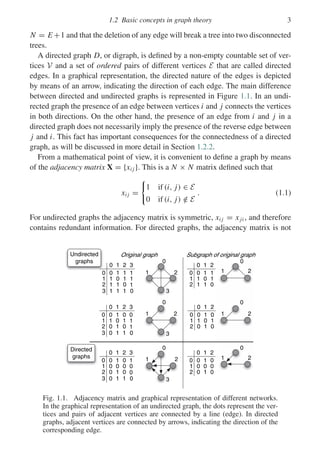
![4 Preliminaries: networks and graphs
symmetric. In Figure 1.1 we show the graphical illustrations of different undirected
and directed graphs and their corresponding adjacency matrices.
An important feature of many graphs, which helps in dealing with their structure,
is their sparseness. The number of edges E for a connected graph (i.e., with no
disconnected parts) ranges from N − 1 to
N
2
. There are different definitions of
sparseness, but we will adopt the convention that when the number of edges scales
as E ∼ Nα
with α 2, the graph is said to be sparse. In the case where E ∼ N2
,
the corresponding graph is called dense. By defining the connectance or density of
a graph as the number of existing edges divided by the maximal possible number
of edges D = E/[N(N − 1)/2], a graph is then sparse if D 1. This feature
implies, in the case of large graphs, that the adjacency matrix is mostly defined by
zero elements and its complete representation, while costly, does not contain much
relevant information. With large graphs, it is customary to represent the graph in
the compact form defined by the adjacency lists (i, v ∈ V(i)), where the set of all
neighbors of a fixed vertex i is called the neighborhood (set) of i and is denoted by
V(i). The manipulation of these lists is obviously very convenient in computational
applications because they efficiently store large sparse networks.
In many cases, we are also interested in subsets of a graph. A graph G
= (V
, E
)
is said to be a subgraph of the graph G = (V, E) if all the vertices in V
belong to V
and all the edges in E
belong to E, i.e. E
⊂ E and V
⊂ V. A clique is a complete
n-subgraph of size n N. In Figure 1.1 we provide the graphical and adjacency
matrix representations of subgraphs in the undirected and directed cases. The abun-
dance of given types of subgraphs and their properties are extremely relevant in the
characterization of real networks.1
Small, statistically significant, coherent sub-
graphs, called motifs, that contribute to the set-up of networks have been identified
as relevant building blocks of network architecture and evolution (see Milo et al.
[2002] and Chapter 12).
The characterization of local structures is also related to the identification of
communities. Loosely speaking, communities are identified by subgraphs where
nodes are highly interconnected among themselves and poorly connected with
nodes outside the subgraph. In this way, different communities can be traced back
with respect to varying levels of cohesiveness. In directed networks, edge direc-
tionality introduces the possibility of different types of local structures. A possible
mathematical way to account for these local cohesive groups consists in examin-
ing the number of bipartite cliques present in the graph. A bipartite clique Kn,m
identifies a group of n nodes, all of which have a direct edge to the same m
1 Various approaches exist to determine the structural equivalence, the automorphic equivalence, or the regular
equivalence of subnetworks, and measures for structural similarity comprise correlation coefficients, Euclidean
distances, rates of exact matches, etc.](https://image.slidesharecdn.com/58946-250507121034-20bf01e8/85/Dynamical-Processes-on-Complex-Networks-1st-Edition-Alain-Barrat-27-320.jpg)
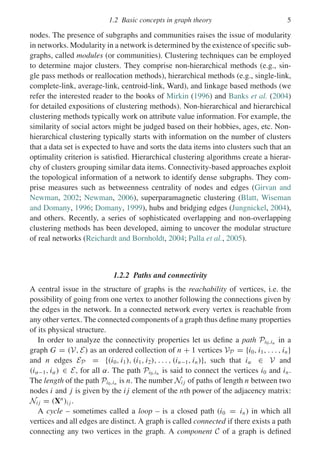
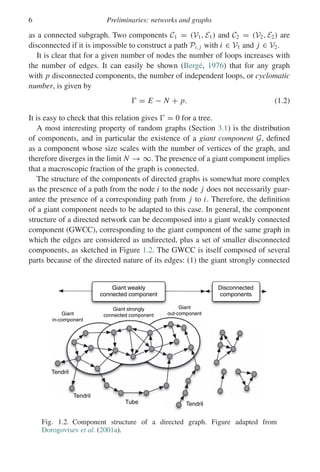
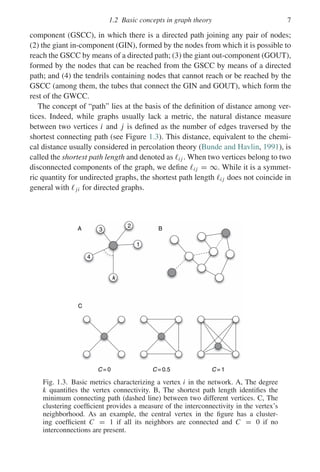
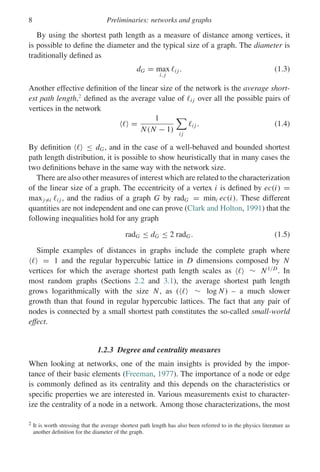
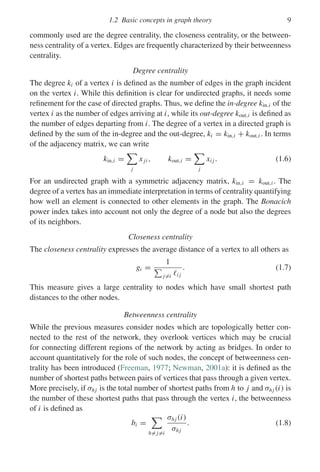
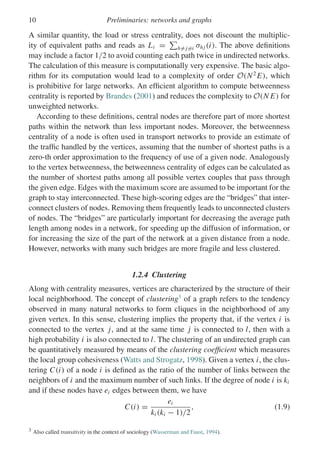
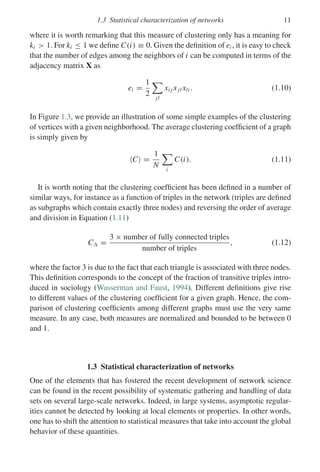
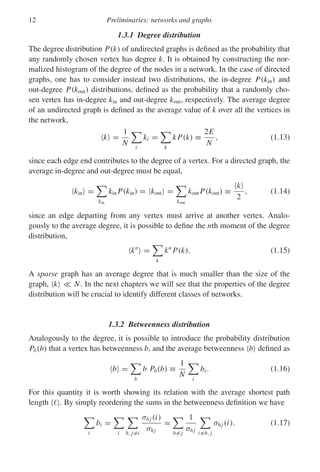
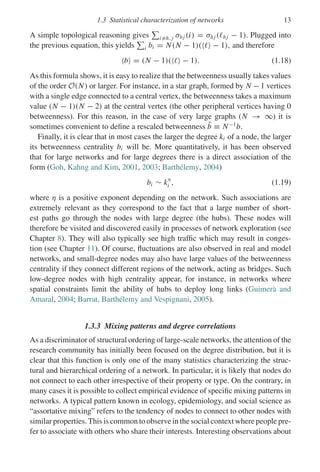
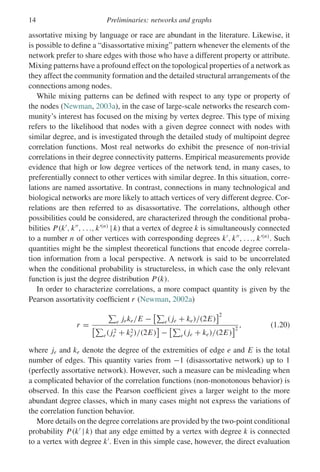
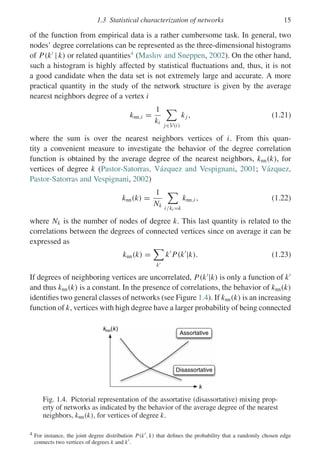
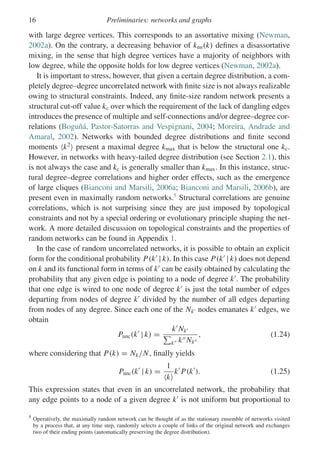
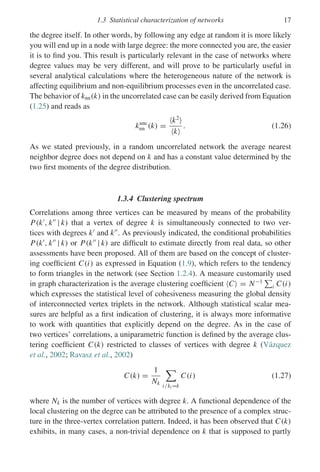
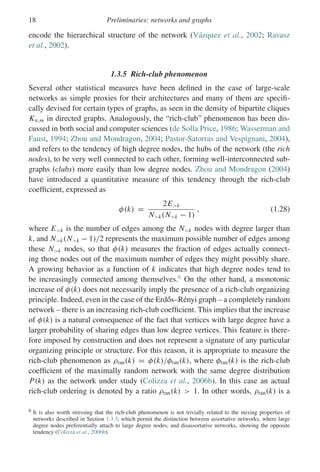
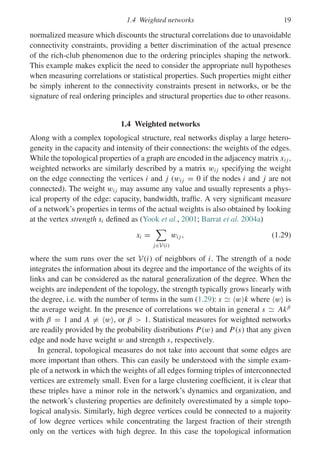
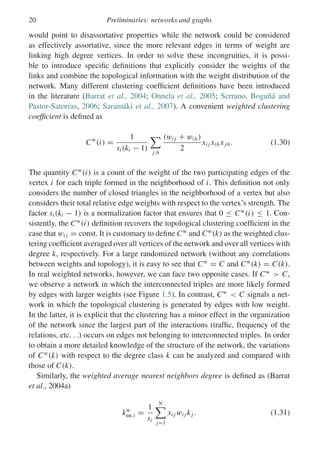
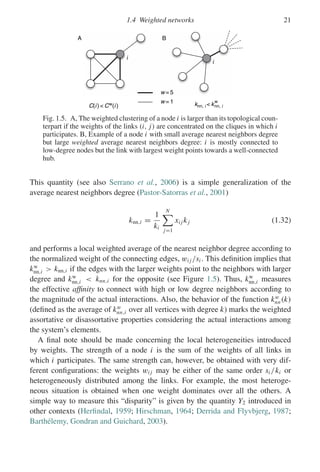
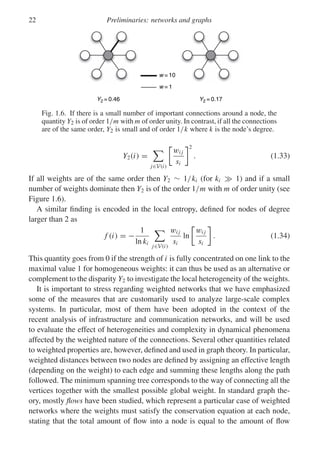
![2
Networks and complexity
Undeniably, the visualizations of the Internet or the airport network convey the
notion of intricate, in some cases haphazard, systems of a very complicated nature.
Complexity, however, is not the same as the addition of complicated features.
Despite the fact that there is no unique and commonly accepted definition of
complexity – it is indeed very unlikely to find two scientists sharing the same def-
inition of complex system – we discuss from what perspectives many real-world
networks can be considered as complex systems, and what are the peculiar fea-
tures signaling this occurrence. In this chapter we review the basic topological
and dynamical features that characterize real-world networks and we attempt to
categorize networks into a few broad classes according to their observed statisti-
cal properties. In particular, self-organized dynamical evolution and the emergence
of the small-world and scale-free properties of many networks are discussed as
prominent concepts which have led to a paradigm shift in which the dynamics
of networks have become a central issue in their characterization as well as in
their modeling (which will be discussed in the next chapter). We do not aim, how-
ever, at an exhaustive exposition of the theory and modeling of complex networked
structures since, as of today, there are reference textbooks on these topics such as
those by Dorogovtsev and Mendes (2003), Pastor-Satorras and Vespignani (2004),
and Caldarelli (2007), along with journal reviews by Albert and Barabási (2002),
Dorogovtsev and Mendes (2002), Newman (2003c), and Boccaletti et al. ([2006]).
2.1 Real-world systems
In recent times, the increased power of computers and the informatics revolution
have made possible the systematic gathering and handling of data sets on several
large-scale networks, allowing detailed analysis of their structural and functional
properties. As a first guide to the classification of the data obtained, we can pro-
vide a rudimentary taxonomy of real-world networks. Two main different classes
24](https://image.slidesharecdn.com/58946-250507121034-20bf01e8/85/Dynamical-Processes-on-Complex-Networks-1st-Edition-Alain-Barrat-47-320.jpg)





















![June, 1844, at 10 o'clock a.m., at the Council Chamber. By order of the
Council.
Witness my hand and corporation seal this 7th May, 1844.
[L. S.]
W. RICHARDS, Recorder.
Thursday, 8.—Returned home. At 10 a.m. went before the Municipal Court
on the case, Francis M. Higbee versus Joseph Smith.
The Prophet's Petition for Writ of Habeas Corpus.
MUNICIPAL COURT, CITY OF NAUVOO, ILLINOIS.
Third day, regular term, May 8, 1844.
Before Alderman N. K. Whitney, acting Chief Justice, and Aldermen
Daniel H. Wells, William Marks, Orson Spencer, George W. Harris,
Gustavus Hills, George A. Smith and Samuel Bennett, Associate
Justices presiding.
Exparte Joseph Smith Sen., on habeas corpus.
Messrs. Styles and Rigdon, Counsel for Smith.
This case came before the court upon a return to a writ of habeas
corpus, which was issued by this court on the 6th of May instant, upon
the petition of Joseph Smith, Sen., as follows:
STATE OF ILLINOIS,
CITY OF NAUVOO, Sct.
To the Honorable Municipal Court and for the City of Nauvoo:
The undersigned, your petitioner, most respectfully represents that he
is an inhabitant of said city. Your petitioner further represents that he is](https://image.slidesharecdn.com/58946-250507121034-20bf01e8/85/Dynamical-Processes-on-Complex-Networks-1st-Edition-Alain-Barrat-75-320.jpg)