Networks: Switching 1 
PointPoint--toto--Point NetworkPoint NetworkSwitching Switching
Networks: Switching 2 
Point Point-to to-Point Network Switching 
•Circuit Switching, Message Switching, Packet Switching, Cell Switching 
•Connection-Oriented versus Connectionless 
•Virtual Circuit versus Datagram Networks 
•Internal/External Abstractions
Networks: Switching 3 
Point Point-to to-Point Switching 
•Circuit Switching 
•Store-and -Forward Networks 
–Message Switching 
–Packet Switching 
•connection-oriented vs connectionless 
•virtual circuit vs datagram 
–Cell Switching
Networks: Switching 4 
Circuit Switching 
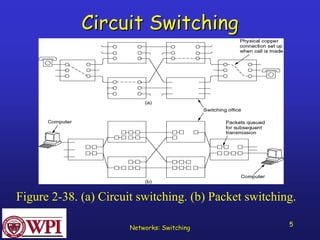
•Seeking out and establishing a physical copper path from end-to-end [historic definition]. 
•Circuit switching implies the need to first set upa dedicated, end-to-end path for the connection before the information transfer takes place. 
•Once the connection is made the only delay is propagation time.
Networks: Switching 5 
Circuit Switching 
Figure 2-38. (a)Circuit switching. (b)Packet switching.
Networks: Switching 6 
Store Store-and and-Forward 
Networks 
•Intermediate processors (IMPS, nodes, routers, gateways, switches) along the path store the incoming block of data. 
•Each block is received in its entirety, inspected for errors, and retransmitted along the path to the destination. This implies buffering at the router and one transmission time per hop.
Networks: Switching 7 
Message Switching 
•A store-and-forward network where the block of transfer is a complete message. 
•Since messages can be quite large, this can cause: 
–buffering problems 
–high mean delay times
Networks: Switching 8 
Packet Switching 
•A store-and-forward network where the block of transfer is a complete packet. A packet is a variable length block of data with a tight upper bound. 
ÖUsing packets improves mean message delay.
Networks: Switching 9 
Cell Switching 
53 bytes 
•A network where the unit of transfer is a small, fixed-size block of date (i.e., a cell). 
•ATM (Asynchronous Transfer Mode) networks use 53-byte cells.
Networks: Switching 10 
Packet Switched Networks 
Connection-oriented Protocols 
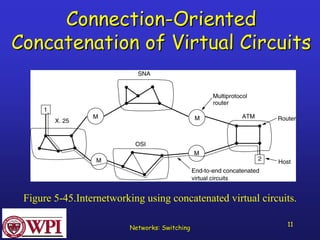
–A setup stage is used to determine the end-to- end path before a connection is established. 
–Data flow streams are identified by some type of connection indicator (e.g. OSI, X.25, SNA).
Networks: Switching 11 
Connection Connection-Oriented 
Concatenation of Virtual Circuits 
Figure 5-45.Internetworking using concatenated virtual circuits.
Networks: Switching 12 
Packet Switched Networks 
Connectionless Protocols 
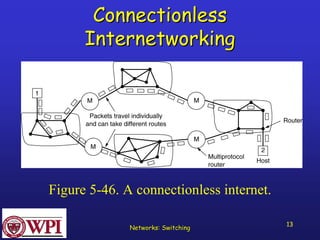
–No set up is needed. 
–Each packet contains information which allows the packet to be individually routed hop-by-hop through the network.
Networks: Switching 13 
Connectionless 
Internetworking 
Figure 5-46. A connectionless internet.
Networks: Switching 14 
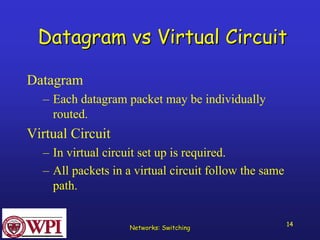
Datagram vs Virtual Circuit 
Datagram 
–Each datagram packet may be individually routed. 
Virtual Circuit 
–In virtual circuit set up is required. 
–All packets in a virtual circuit follow the same path.
Networks: Switching 15 
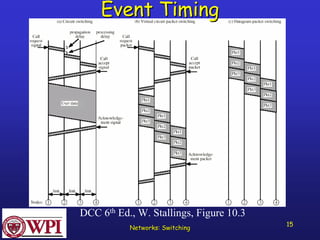
Event TimingEvent TimingDCC 6thEd., W. Stallings, Figure 10.3
Networks: Switching 16 
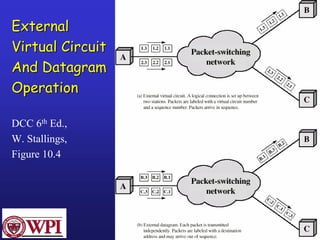
External 
Virtual Circuit 
And Datagram 
Operation 
DCC 6thEd., 
W. Stallings, 
Figure 10.4
Networks: Switching 17 
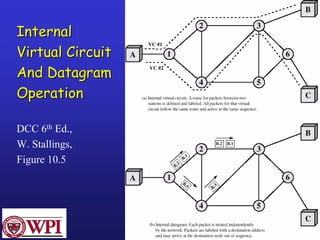
Internal 
Virtual Circuit 
And Datagram 
Operation 
DCC 6thEd., 
W. Stallings, 
Figure 10.5

Net switching

  • 1.
    Networks: Switching 1 PointPoint--toto--Point NetworkPoint NetworkSwitching Switching
  • 2.
    Networks: Switching 2 Point Point-to to-Point Network Switching •Circuit Switching, Message Switching, Packet Switching, Cell Switching •Connection-Oriented versus Connectionless •Virtual Circuit versus Datagram Networks •Internal/External Abstractions
  • 3.
    Networks: Switching 3 Point Point-to to-Point Switching •Circuit Switching •Store-and -Forward Networks –Message Switching –Packet Switching •connection-oriented vs connectionless •virtual circuit vs datagram –Cell Switching
  • 4.
    Networks: Switching 4 Circuit Switching •Seeking out and establishing a physical copper path from end-to-end [historic definition]. •Circuit switching implies the need to first set upa dedicated, end-to-end path for the connection before the information transfer takes place. •Once the connection is made the only delay is propagation time.
  • 5.
    Networks: Switching 5 Circuit Switching Figure 2-38. (a)Circuit switching. (b)Packet switching.
  • 6.
    Networks: Switching 6 Store Store-and and-Forward Networks •Intermediate processors (IMPS, nodes, routers, gateways, switches) along the path store the incoming block of data. •Each block is received in its entirety, inspected for errors, and retransmitted along the path to the destination. This implies buffering at the router and one transmission time per hop.
  • 7.
    Networks: Switching 7 Message Switching •A store-and-forward network where the block of transfer is a complete message. •Since messages can be quite large, this can cause: –buffering problems –high mean delay times
  • 8.
    Networks: Switching 8 Packet Switching •A store-and-forward network where the block of transfer is a complete packet. A packet is a variable length block of data with a tight upper bound. ÖUsing packets improves mean message delay.
  • 9.
    Networks: Switching 9 Cell Switching 53 bytes •A network where the unit of transfer is a small, fixed-size block of date (i.e., a cell). •ATM (Asynchronous Transfer Mode) networks use 53-byte cells.
  • 10.
    Networks: Switching 10 Packet Switched Networks Connection-oriented Protocols –A setup stage is used to determine the end-to- end path before a connection is established. –Data flow streams are identified by some type of connection indicator (e.g. OSI, X.25, SNA).
  • 11.
    Networks: Switching 11 Connection Connection-Oriented Concatenation of Virtual Circuits Figure 5-45.Internetworking using concatenated virtual circuits.
  • 12.
    Networks: Switching 12 Packet Switched Networks Connectionless Protocols –No set up is needed. –Each packet contains information which allows the packet to be individually routed hop-by-hop through the network.
  • 13.
    Networks: Switching 13 Connectionless Internetworking Figure 5-46. A connectionless internet.
  • 14.
    Networks: Switching 14 Datagram vs Virtual Circuit Datagram –Each datagram packet may be individually routed. Virtual Circuit –In virtual circuit set up is required. –All packets in a virtual circuit follow the same path.
  • 15.
    Networks: Switching 15 Event TimingEvent TimingDCC 6thEd., W. Stallings, Figure 10.3
  • 16.
    Networks: Switching 16 External Virtual Circuit And Datagram Operation DCC 6thEd., W. Stallings, Figure 10.4
  • 17.
    Networks: Switching 17 Internal Virtual Circuit And Datagram Operation DCC 6thEd., W. Stallings, Figure 10.5