8-3 PACKET SWITCHING
•In data communications, we need to
send messages from one end system to
another.
• If the message is going to pass through
a packet-switched network, it needs to be
divided into packets of fixed or variable
size.
• The size of the packet is determined by
the network and the governing protocol.
2.
Datagram Networks
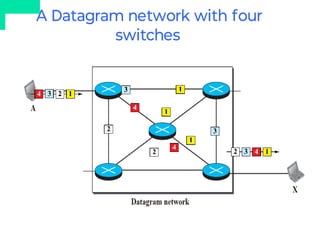
• Ina datagram network, each packet is
treated independently of all others.
• Even if a packet is part of a multi packet
transmission, the network treats it as though
it existed alone.
Packets in this approach are referred to as
data grams.
• Data gram switching is done at the N/W
Layer.
• Data gram N/w’s are sometimes referred to
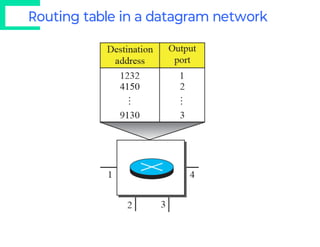
Routing table
■ Connectionless means the switch does not
keep information about the connection state.
■ There is no setup or teardown phase Each
switch has a routing table which is based on
destination address.
■ Routing tables are dynamic and updated
periodically.
■ The destination addresses and the
corresponding forwarding o/p ports are
recorded in the routing table.
■ Every packet in the datagram N/W, carries the
destination address along with the other
header information.
Routing table
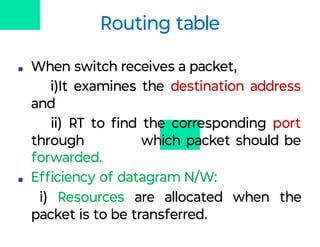
■ Whenswitch receives a packet,
i)It examines the destination address
and
ii) RT to find the corresponding port
through which packet should be
forwarded.
■ Efficiency of datagram N/W:
i) Resources are allocated when the
packet is to be transferred.
7.
Delay
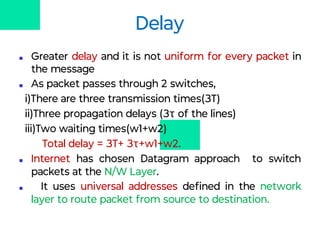
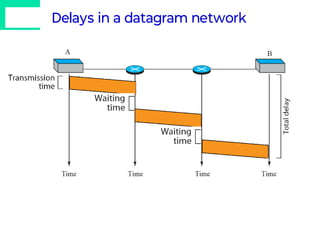
■ Greater delayand it is not uniform for every packet in
the message
■ As packet passes through 2 switches,
i)There are three transmission times(3T)
ii)Three propagation delays (3τ of the lines)
iii)Two waiting times(w1+w2)
Total delay = 3T+ 3τ+w1+w2.
■ Internet has chosen Datagram approach to switch
packets at the N/W Layer.
■ It uses universal addresses defined in the network
layer to route packet from source to destination.
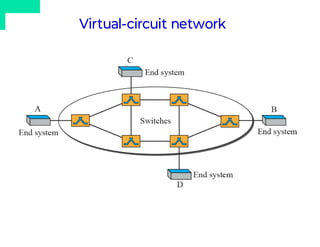
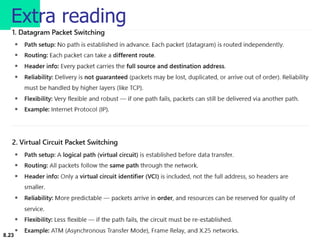
Virtual-Circuit Networks
• Avirtual-circuit network is a cross between a
circuit-
switched network and a datagram network.
• It has some characteristics of both.
10.
Virtual –Circuit Networks
(VCN)
■A virtual-circuit network is a cross
between a circuit-switched network and a
datagram network. It has some
characteristics of both.
1)There is setup and tear down phase in
addition to the data transfer phase.
2)Resources are allocated during setup
phase.
3)Data are packetized and each packet
carries an address in the header.
Address in the packet has local jurisdiction
which defines which is the next switch and
the channel to forward the packet.
11.
Virtual –Circuit Networks
4)Allpackets follow the same path
established during the connection setup
phase
5) Implemented in Data Link Layer
(while a circuit-switched network is implemented
in the physical layer and a datagram network in
the network layer)
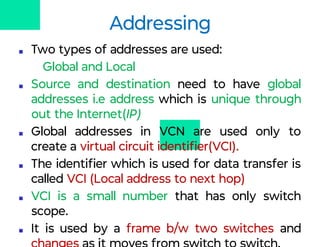
Addressing
■ Two typesof addresses are used:
Global and Local
■ Source and destination need to have global
addresses i.e address which is unique through
out the Internet(IP)
■ Global addresses in VCN are used only to
create a virtual circuit identifier(VCI).
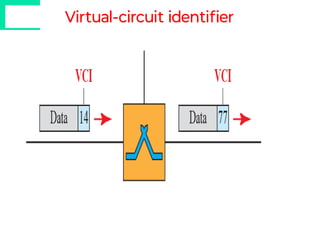
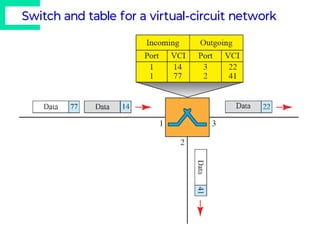
■ The identifier which is used for data transfer is
called VCI (Local address to next hop)
■ VCI is a small number that has only switch
scope.
■ It is used by a frame b/w two switches and
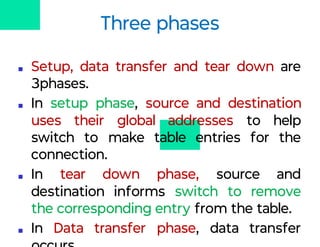
Three phases
■ Setup,data transfer and tear down are
3phases.
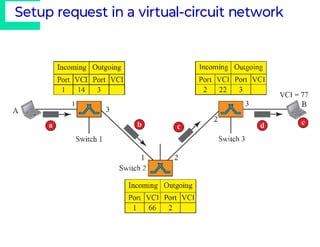
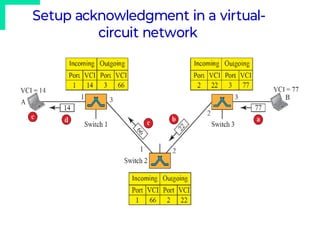
■ In setup phase, source and destination
uses their global addresses to help
switch to make table entries for the
connection.
■ In tear down phase, source and
destination informs switch to remove
the corresponding entry from the table.
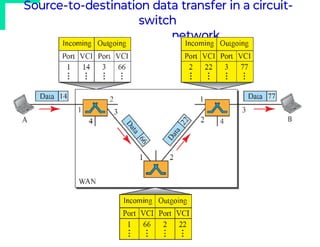
■ In Data transfer phase, data transfer
Efficiency
■ As resourcesare reserved in VCN during
connection setup or can be on demand
during data transfer phase.
i) If connection set up, delay for each
packet is same.
ii) If during data transfer phase, each
packet may encounter different delays.
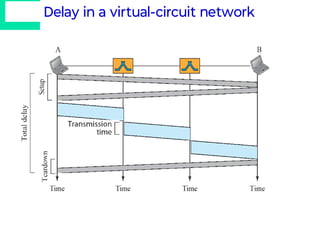
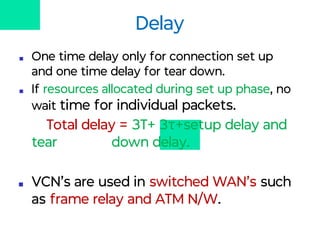
Delay
■ One timedelay only for connection set up
and one time delay for tear down.
■ If resources allocated during set up phase, no
wait time for individual packets.
Total delay = 3T+ 3τ+setup delay and
tear down delay.
■ VCN’s are used in switched WAN’s such
as frame relay and ATM N/W.