Smart Recommendation for Cluster Policy Makers
Dr. Gerd Meier zu Köcker
Managing Director
iit – Institute for Innovation and Technology
Limerick, 30 September 2015
2
Why are some regions doing better than others?
3
Cluster Policy and Involvement of Cluster Initiatives
in Regional Economic Development Varies Over Europe
• Cluster initiatives as active tool for regional development policy vs.
ignored by regional policy
• RIS based on cluster (initiatives) vs.
not involved in RIS development
• High continuity of supporting cluster initiatives
vs. frequent changes / lack of continuity
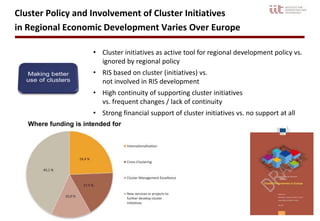
• Strong financial support of cluster initiatives vs. no support at all
Where funding is intended for
4
© VDI/VDE-IT
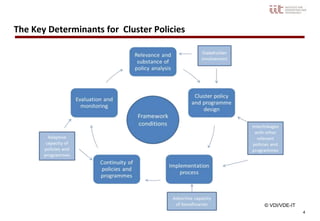
The Key Determinants for Cluster Policies
5
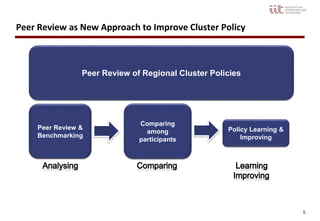
Peer Review as New Approach to Improve Cluster Policy
Peer Review &
Benchmarking
Comparing
among
participants
Peer Review of Regional Cluster Policies
Policy Learning &
Improving
6
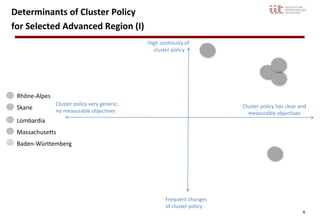
Cluster policy has clear and
measurable objectives
Rhône-Alpes
Skane
Lombardia
Massachusetts
Baden-Württemberg
Frequent changes
of cluster policy
Cluster policy very generic;
no measurable objectives
High continuity of
cluster policy
Determinants of Cluster Policy
for Selected Advanced Region (I)
7
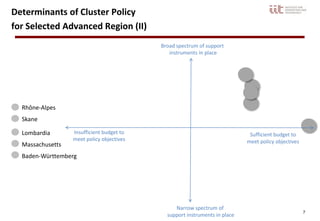
Broad spectrum of support
instruments in place
Rhône-Alpes
Skane
Lombardia
Massachusetts
Baden-Württemberg
Insufficient budget to
meet policy objectives
Narrow spectrum of
support instruments in place
Sufficient budget to
meet policy objectives
Determinants of Cluster Policy
for Selected Advanced Region (II)
8
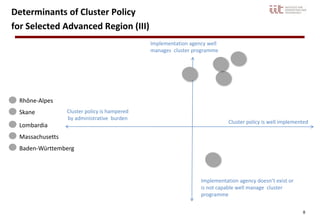
Rhône-Alpes
Skane
Lombardia
Massachusetts
Baden-Württemberg
Implementation agency doesn’t exist or
is not capable well manage cluster
programme
Cluster policy is hampered
by administrative burden
Implementation agency well
manages cluster programme
Cluster policy is well implemented
Determinants of Cluster Policy
for Selected Advanced Region (III)
9
How innovations happen today
10
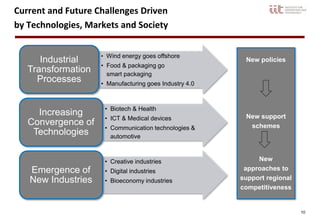
Current and Future Challenges Driven
by Technologies, Markets and Society
• Wind energy goes offshore
• Food & packaging go
smart packaging
• Manufacturing goes Industry 4.0
Industrial
Transformation
Processes
• Biotech & Health
• ICT & Medical devices
• Communication technologies &
automotive
Increasing
Convergence of
Technologies
• Creative industries
• Digital industries
• Bioeconomy industries
Emergence of
New Industries
New policies
New support
schemes
New
approaches to
support regional
competitiveness
11
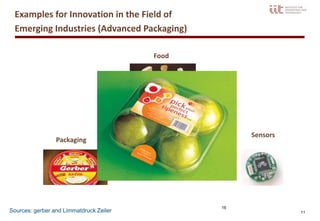
Examples for Innovation in the Field of
Emerging Industries (Advanced Packaging)
16
Sources: gerber and Limmatdruck Zeiler
Food
Sensors
Packaging
12
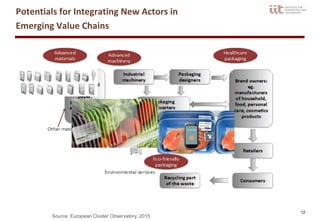
Potentials for Integrating New Actors in
Emerging Value Chains
Source: European Cluster Observatory, 2015
13
Consequences for Cluster Initiatives
14
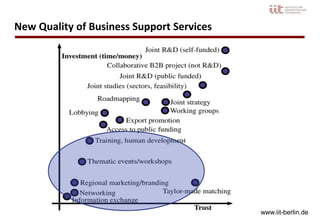
New Quality of Business Support Services
www.iit-berlin.de
15
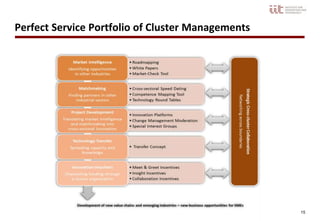
Perfect Service Portfolio of Cluster Managements
17
Consequences for Cluster and Regional
Economic Policies
18
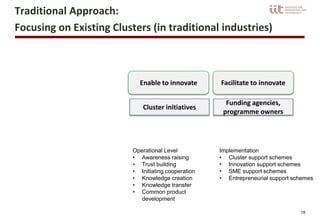
Traditional Approach:
Focusing on Existing Clusters (in traditional industries)
Funding agencies,
programme owners
Facilitate to innovateEnable to innovate
Cluster initiatives
Implementation
• Cluster support schemes
• Innovation support schemes
• SME support schemes
• Entrepreneurial support schemes
Operational Level
• Awareness raising
• Trust building
• Initiating cooperation
• Knowledge creation
• Knowledge transfer
• Common product
development
19
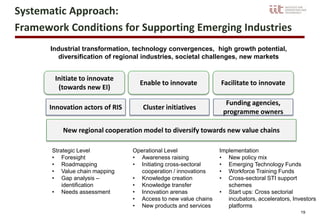
Systematic Approach:
Framework Conditions for Supporting Emerging Industries
New regional cooperation model to diversify towards new value chains
Industrial transformation, technology convergences, high growth potential,
diversification of regional industries, societal challenges, new markets
Funding agencies,
programme owners
Facilitate to innovate
Initiate to innovate
(towards new EI)
Enable to innovate
Innovation actors of RIS Cluster initiatives
Strategic Level
• Foresight
• Roadmapping
• Value chain mapping
• Gap analysis –
identification
• Needs assessment
Implementation
• New policy mix
• Emerging Technology Funds
• Workforce Training Funds
• Cross-sectoral STI support
schemes
• Start ups: Cross sectorial
incubators, accelerators, Investors
platforms
Operational Level
• Awareness raising
• Initiating cross-sectoral
cooperation / innovations
• Knowledge creation
• Knowledge transfer
• Innovation arenas
• Access to new value chains
• New products and services
20
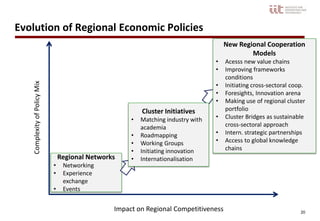
ComplexityofPolicyMix
Regional Networks
• Networking
• Experience
exchange
• Events
Impact on Regional Competitiveness
Evolution of Regional Economic Policies
New Regional Cooperation
Models
• Acesss new value chains
• Improving frameworks
conditions
• Initiating cross-sectoral coop.
• Foresights, Innovation arena
• Making use of regional cluster
portfolio
• Cluster Bridges as sustainable
cross-sectoral approach
• Intern. strategic partnerships
• Access to global knowledge
chains
Cluster Initiatives
• Matching industry with
academia
• Roadmapping
• Working Groups
• Initiating innovation
• Internationalisation
21
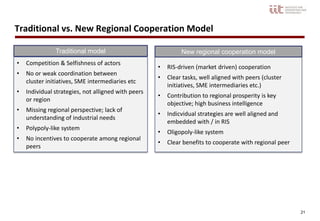
• Competition & Selfishness of actors
• No or weak coordination between
cluster initiatives, SME intermediaries etc
• Individual strategies, not alligned with peers
or region
• Missing regional perspective; lack of
understanding of industrial needs
• Polypoly-like system
• No incentives to cooperate among regional
peers
• RIS-driven (market driven) cooperation
• Clear tasks, well aligned with peers (cluster
initiatives, SME intermediaries etc.)
• Contribution to regional prosperity is key
objective; high business intelligence
• Indicvidual strategies are well aligned and
embedded with / in RIS
• Oligopoly-like system
• Clear benefits to cooperate with regional peer
Traditional model New regional cooperation model
Traditional vs. New Regional Cooperation Model
2222
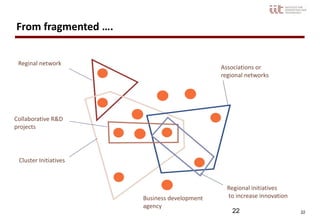
From fragmented ….
Cluster Initiatives
Collaborative R&D
projects
Associations or
regional networks
Regional initiatives
to increase innovationBusiness development
agency
Reginal network
2323
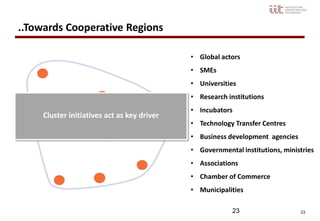
..Towards Cooperative Regions
• Global actors
• SMEs
• Universities
• Research institutions
• Incubators
• Technology Transfer Centres
• Business development agencies
• Governmental institutions, ministries
• Associations
• Chamber of Commerce
• Municipalities
Cluster initiatives act as key driver
24
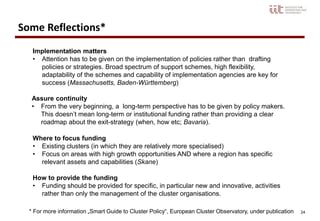
Where to focus funding
• Existing clusters (in which they are relatively more specialised)
• Focus on areas with high growth opportunities AND where a region has specific
relevant assets and capabilities (Skane)
How to provide the funding
• Funding should be provided for specific, in particular new and innovative, activities
rather than only the management of the cluster organisations.
Assure continuity
• From the very beginning, a long-term perspective has to be given by policy makers.
This doesn’t mean long-term or institutional funding rather than providing a clear
roadmap about the exit-strategy (when, how etc; Bavaria).
Implementation matters
• Attention has to be given on the implementation of policies rather than drafting
policies or strategies. Broad spectrum of support schemes, high flexibility,
adaptability of the schemes and capability of implementation agencies are key for
success (Massachusetts, Baden-Württemberg)
Some Reflections*
* For more information „Smart Guide to Cluster Policy“, European Cluster Observatory, under publication
25
Aligning cluster programmes with the realities
• Cluster programmes can focus on different levels / leagues, but have to follow realistic
goals according to cluster profiles, industrial strengths and regional assets. In addition,
the implementation of such policies in terms of spectrum of support schemes and
amount of funding has to be meaningful (Norway)
Monitoring and evaluation is key for good policy governance
• For a successful cluster policy it is indispensable to include periodic monitoring exercises and
evaluations in different intervals and plan these from the very start of cluster initiatives
(Rhone-Alps)
Openness for policy benchmarking and learning
• Cluster policy is a comparable new discipline. Thus policy benchmarking and learning,
based on mutual regional peer reviews, is a promising approach to continuous improvements
(Catalonia).
Towards a new policy mix
• Cluster and other policies have to follow the reality. While new industries emerging and
technologies converging, policies (and ministries) are often stuck in traditional structures
supporting separate industries or technologies. New policy mix based on a systematic approach
can better support regions and clusters in coping with new challenges.
Some Reflections*
* For more information „Smart Guide to Cluster Policy“, European Cluster Observatory, under publication
26
Dr. Gerd Meier zu Köcker
Managing Director
Institute for Innovation and Technology
Berlin
Germany
E-Mail: mzk@iit-berlin.de
Further readings:
www.cluster-analysis.org
www.iit-berlin.de

New Regional Cooperation Model by Integrating Cluster Initiatives

  • 1.
    Smart Recommendation forCluster Policy Makers Dr. Gerd Meier zu Köcker Managing Director iit – Institute for Innovation and Technology Limerick, 30 September 2015
  • 2.
    2 Why are someregions doing better than others?
  • 3.
    3 Cluster Policy andInvolvement of Cluster Initiatives in Regional Economic Development Varies Over Europe • Cluster initiatives as active tool for regional development policy vs. ignored by regional policy • RIS based on cluster (initiatives) vs. not involved in RIS development • High continuity of supporting cluster initiatives vs. frequent changes / lack of continuity • Strong financial support of cluster initiatives vs. no support at all Where funding is intended for
  • 4.
    4 © VDI/VDE-IT The KeyDeterminants for Cluster Policies
  • 5.
    5 Peer Review asNew Approach to Improve Cluster Policy Peer Review & Benchmarking Comparing among participants Peer Review of Regional Cluster Policies Policy Learning & Improving
  • 6.
    6 Cluster policy hasclear and measurable objectives Rhône-Alpes Skane Lombardia Massachusetts Baden-Württemberg Frequent changes of cluster policy Cluster policy very generic; no measurable objectives High continuity of cluster policy Determinants of Cluster Policy for Selected Advanced Region (I)
  • 7.
    7 Broad spectrum ofsupport instruments in place Rhône-Alpes Skane Lombardia Massachusetts Baden-Württemberg Insufficient budget to meet policy objectives Narrow spectrum of support instruments in place Sufficient budget to meet policy objectives Determinants of Cluster Policy for Selected Advanced Region (II)
  • 8.
    8 Rhône-Alpes Skane Lombardia Massachusetts Baden-Württemberg Implementation agency doesn’texist or is not capable well manage cluster programme Cluster policy is hampered by administrative burden Implementation agency well manages cluster programme Cluster policy is well implemented Determinants of Cluster Policy for Selected Advanced Region (III)
  • 9.
  • 10.
    10 Current and FutureChallenges Driven by Technologies, Markets and Society • Wind energy goes offshore • Food & packaging go smart packaging • Manufacturing goes Industry 4.0 Industrial Transformation Processes • Biotech & Health • ICT & Medical devices • Communication technologies & automotive Increasing Convergence of Technologies • Creative industries • Digital industries • Bioeconomy industries Emergence of New Industries New policies New support schemes New approaches to support regional competitiveness
  • 11.
    11 Examples for Innovationin the Field of Emerging Industries (Advanced Packaging) 16 Sources: gerber and Limmatdruck Zeiler Food Sensors Packaging
  • 12.
    12 Potentials for IntegratingNew Actors in Emerging Value Chains Source: European Cluster Observatory, 2015
  • 13.
  • 14.
    14 New Quality ofBusiness Support Services www.iit-berlin.de
  • 15.
    15 Perfect Service Portfolioof Cluster Managements
  • 16.
    17 Consequences for Clusterand Regional Economic Policies
  • 17.
    18 Traditional Approach: Focusing onExisting Clusters (in traditional industries) Funding agencies, programme owners Facilitate to innovateEnable to innovate Cluster initiatives Implementation • Cluster support schemes • Innovation support schemes • SME support schemes • Entrepreneurial support schemes Operational Level • Awareness raising • Trust building • Initiating cooperation • Knowledge creation • Knowledge transfer • Common product development
  • 18.
    19 Systematic Approach: Framework Conditionsfor Supporting Emerging Industries New regional cooperation model to diversify towards new value chains Industrial transformation, technology convergences, high growth potential, diversification of regional industries, societal challenges, new markets Funding agencies, programme owners Facilitate to innovate Initiate to innovate (towards new EI) Enable to innovate Innovation actors of RIS Cluster initiatives Strategic Level • Foresight • Roadmapping • Value chain mapping • Gap analysis – identification • Needs assessment Implementation • New policy mix • Emerging Technology Funds • Workforce Training Funds • Cross-sectoral STI support schemes • Start ups: Cross sectorial incubators, accelerators, Investors platforms Operational Level • Awareness raising • Initiating cross-sectoral cooperation / innovations • Knowledge creation • Knowledge transfer • Innovation arenas • Access to new value chains • New products and services
  • 19.
    20 ComplexityofPolicyMix Regional Networks • Networking •Experience exchange • Events Impact on Regional Competitiveness Evolution of Regional Economic Policies New Regional Cooperation Models • Acesss new value chains • Improving frameworks conditions • Initiating cross-sectoral coop. • Foresights, Innovation arena • Making use of regional cluster portfolio • Cluster Bridges as sustainable cross-sectoral approach • Intern. strategic partnerships • Access to global knowledge chains Cluster Initiatives • Matching industry with academia • Roadmapping • Working Groups • Initiating innovation • Internationalisation
  • 20.
    21 • Competition &Selfishness of actors • No or weak coordination between cluster initiatives, SME intermediaries etc • Individual strategies, not alligned with peers or region • Missing regional perspective; lack of understanding of industrial needs • Polypoly-like system • No incentives to cooperate among regional peers • RIS-driven (market driven) cooperation • Clear tasks, well aligned with peers (cluster initiatives, SME intermediaries etc.) • Contribution to regional prosperity is key objective; high business intelligence • Indicvidual strategies are well aligned and embedded with / in RIS • Oligopoly-like system • Clear benefits to cooperate with regional peer Traditional model New regional cooperation model Traditional vs. New Regional Cooperation Model
  • 21.
    2222 From fragmented …. ClusterInitiatives Collaborative R&D projects Associations or regional networks Regional initiatives to increase innovationBusiness development agency Reginal network
  • 22.
    2323 ..Towards Cooperative Regions •Global actors • SMEs • Universities • Research institutions • Incubators • Technology Transfer Centres • Business development agencies • Governmental institutions, ministries • Associations • Chamber of Commerce • Municipalities Cluster initiatives act as key driver
  • 23.
    24 Where to focusfunding • Existing clusters (in which they are relatively more specialised) • Focus on areas with high growth opportunities AND where a region has specific relevant assets and capabilities (Skane) How to provide the funding • Funding should be provided for specific, in particular new and innovative, activities rather than only the management of the cluster organisations. Assure continuity • From the very beginning, a long-term perspective has to be given by policy makers. This doesn’t mean long-term or institutional funding rather than providing a clear roadmap about the exit-strategy (when, how etc; Bavaria). Implementation matters • Attention has to be given on the implementation of policies rather than drafting policies or strategies. Broad spectrum of support schemes, high flexibility, adaptability of the schemes and capability of implementation agencies are key for success (Massachusetts, Baden-Württemberg) Some Reflections* * For more information „Smart Guide to Cluster Policy“, European Cluster Observatory, under publication
  • 24.
    25 Aligning cluster programmeswith the realities • Cluster programmes can focus on different levels / leagues, but have to follow realistic goals according to cluster profiles, industrial strengths and regional assets. In addition, the implementation of such policies in terms of spectrum of support schemes and amount of funding has to be meaningful (Norway) Monitoring and evaluation is key for good policy governance • For a successful cluster policy it is indispensable to include periodic monitoring exercises and evaluations in different intervals and plan these from the very start of cluster initiatives (Rhone-Alps) Openness for policy benchmarking and learning • Cluster policy is a comparable new discipline. Thus policy benchmarking and learning, based on mutual regional peer reviews, is a promising approach to continuous improvements (Catalonia). Towards a new policy mix • Cluster and other policies have to follow the reality. While new industries emerging and technologies converging, policies (and ministries) are often stuck in traditional structures supporting separate industries or technologies. New policy mix based on a systematic approach can better support regions and clusters in coping with new challenges. Some Reflections* * For more information „Smart Guide to Cluster Policy“, European Cluster Observatory, under publication
  • 25.
    26 Dr. Gerd Meierzu Köcker Managing Director Institute for Innovation and Technology Berlin Germany E-Mail: mzk@iit-berlin.de Further readings: www.cluster-analysis.org www.iit-berlin.de