INTRODUCTION
“Nestlé” is a Swiss-German word which means “Little
Nest” which is its trademark
Nestlé is the worlds’ number one food company
5th
largest company of the world according to its turn
over
2 million 31 thousand people employed from all over
the world
Present in 81 countries of the globe having 522
factories
Over 700 products renovated or innovated in the past
five years, with wellness in mind
( source slide share)
HISTORY
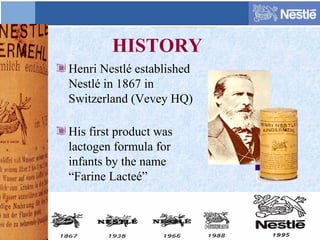
Henri Nestlé established
Nestlé in 1867 in
Switzerland (Vevey HQ)
His first product was
lactogen formula for
infants by the name
“Farine Lacteé”
KEY DATES 1866 COMPANY
FOUNDATION
Major joint ventures 1981 Galderma
1971 Merger with Ursina-Franck
1974 L'Oreal (equity interest)
1988 Acquisition of Rowntree
1990 Cereal Partners Worldwide
1991 Beverage Partners Worldwide (formerly CCNR)
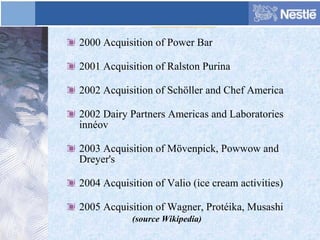
2000 Acquisition of Power Bar
2001 Acquisition of Ralston Purina
2002 Acquisition of Schöller and Chef America
2002 Dairy Partners Americas and Laboratories
innéov
2003 Acquisition of Mövenpick, Powwow and
Dreyer's
2004 Acquisition of Valio (ice cream activities)
2005 Acquisition of Wagner, Protéika, Musashi
(source Wikipedia)
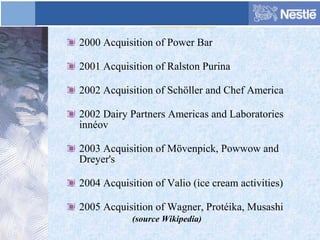
2000 Acquisition of Power Bar
2001 Acquisition of Ralston Purina
2002 Acquisition of Schöller and Chef America
2002 Dairy Partners Americas and Laboratories
innéov
2003 Acquisition of Mövenpick, Powwow and
Dreyer's
2004 Acquisition of Valio (ice cream activities)
2005 Acquisition of Wagner, Protéika, Musashi
(source Wikipedia)
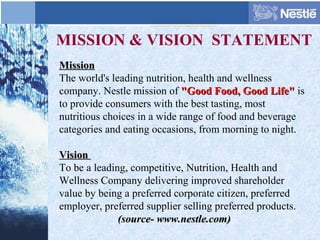
MISSION & VISION STATEMENT
MissionMission
The world's leading nutrition, health and wellness
company. Nestle mission of "Good Food, Good Life""Good Food, Good Life" is
to provide consumers with the best tasting, most
nutritious choices in a wide range of food and beverage
categories and eating occasions, from morning to night.
VisionVision
To be a leading, competitive, Nutrition, Health and
Wellness Company delivering improved shareholder
value by being a preferred corporate citizen, preferred
employer, preferred supplier selling preferred products.
(source- www.nestle.com)(source- www.nestle.com)
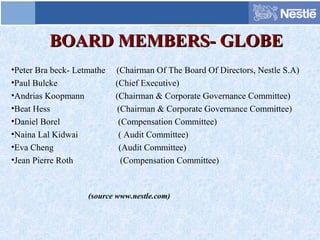
BOARD MEMBERS- GLOBEBOARD MEMBERS- GLOBE
•Peter Bra beck- Letmathe (Chairman Of The Board Of Directors, Nestle S.A)
•Paul Bulcke (Chief Executive)
•Andrias Koopmann (Chairman & Corporate Governance Committee)
•Beat Hess (Chairman & Corporate Governance Committee)
•Daniel Borel (Compensation Committee)
•Naina Lal Kidwai ( Audit Committee)
•Eva Cheng (Audit Committee)
•Jean Pierre Roth (Compensation Committee)
(source www.nestle.com)
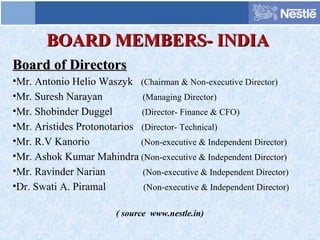
BOARD MEMBERS- INDIABOARD MEMBERS- INDIA
Board of DirectorsBoard of Directors
•Mr. Antonio Helio Waszyk (Chairman & Non-executive Director)
•Mr. Suresh Narayan (Managing Director)
•Mr. Shobinder Duggel (Director- Finance & CFO)
•Mr. Aristides Protonotarios (Director- Technical)
•Mr. R.V Kanorio (Non-executive & Independent Director)
•Mr. Ashok Kumar Mahindra (Non-executive & Independent Director)
•Mr. Ravinder Narian (Non-executive & Independent Director)
•Dr. Swati A. Piramal (Non-executive & Independent Director)
( source www.nestle.in)
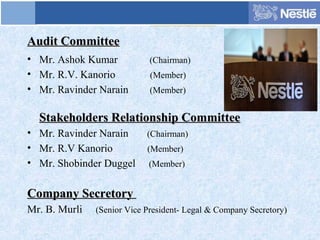
Audit CommitteeAudit Committee
• Mr. Ashok Kumar (Chairman)
• Mr. R.V. Kanorio (Member)
• Mr. Ravinder Narain (Member)
Stakeholders Relationship CommitteeStakeholders Relationship Committee
• Mr. Ravinder Narain (Chairman)
• Mr. R.V Kanorio (Member)
• Mr. Shobinder Duggel (Member)
Company SecretoryCompany Secretory
Mr. B. Murli (Senior Vice President- Legal & Company Secretory)
Corporate Governance & SRCCorporate Governance & SRC
•Mr. Antonio Helio Waszyk (Chairman)
•Mr. Ravinder Narain (Member)
•Dr. Swati A. Piramal (Member)
Risk Management CommitteeRisk Management Committee
•Mr. Shobinder Duggel (Chairman)
•Mr. Aristides Protonotarios (Member)
•Anurag Dikshit (Member)
(source www.nestle.in)
MARKET MIX STRATEGYMARKET MIX STRATEGY
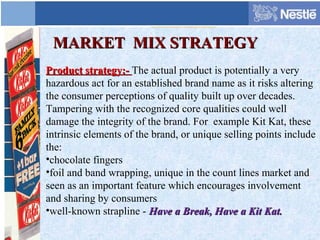
Product strategy:-Product strategy:- The actual product is potentially a very
hazardous act for an established brand name as it risks altering
the consumer perceptions of quality built up over decades.
Tampering with the recognized core qualities could well
damage the integrity of the brand. For example Kit Kat, these
intrinsic elements of the brand, or unique selling points include
the:
•chocolate fingers
•foil and band wrapping, unique in the count lines market and
seen as an important feature which encourages involvement
and sharing by consumers
•well-known strapline - Have a Break, Have a Kit Kat.Have a Break, Have a Kit Kat.
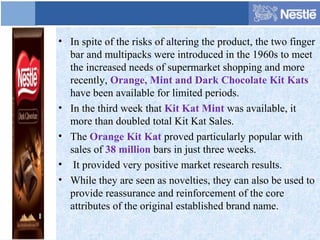
• In spite of the risks of altering the product, the two finger
bar and multipacks were introduced in the 1960s to meet
the increased needs of supermarket shopping and more
recently, Orange, Mint and Dark Chocolate Kit Kats
have been available for limited periods.
• In the third week that Kit Kat Mint was available, it
more than doubled total Kit Kat Sales.
• The Orange Kit Kat proved particularly popular with
sales of 38 million bars in just three weeks.
• It provided very positive market research results.
• While they are seen as novelties, they can also be used to
provide reassurance and reinforcement of the core
attributes of the original established brand name.
Pricing strategy:-Pricing strategy:-
•It is a common characteristic of imperfectly competitive
markets for producers to concentrate on non-price
competition.
•When looking at the pricing strategy for Kit Kat, it can be
seen from the figures that the real price has remained
remarkably stable over the last sixty years.
Promotional strategy:-Promotional strategy:-
•Nestlé has used a wide range of promotional tactics with
Kit Kat.
• Promotion offers have included free bars in the multi-bar
family packs and an instant win deal with Burger King in
1996.
• This promotion, where over 75 million free burgers were
on offer, increased sales of Kit Kat by an estimated 30 In
1998, an on-pack promotion featuring 'The Simpsons,'
with the chance to win £20,000 cash and hundreds of
other prizes, increased sales of Kit Kat by a staggering
41.
• TThe Have a Break, Have a Kit Kathe Have a Break, Have a Kit Kat theme appeared
briefly in 1939, but has been the on-going Kit Kat
slogan, or strapline, since the mid 1950s. Kit Kat's
advertising is concentrated in two media:
 television commercials - which follow the well-known
Have a Break tradition
 posters - where the powerful colors of the pack and
product are used to dramatise the message.
Distribution strategy:-Distribution strategy:-
•Nestlé has developed distribution channels which ensure
the availability of Kit Kat to buy wherever and whenever
the consumer wishes to purchase it.
•Nestlé tries to supply as many outlets as possible - both
wholesaler and retailer channels.
•point of sale merchandising is also important when
consumers are making instant, snap decisions from a
wide range of products on view.
•Internationally, Kit Kat is now also manufactured in
Canada, Germany, India, Malaysia, China, Japan,
Australia, South Africa and the United States. It is
available in more than 100 countries throughout the
World.
(Source-businesscasestudies.co.uk)
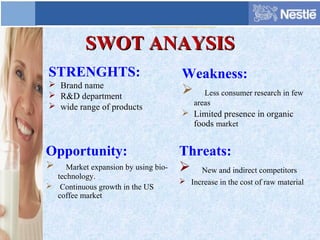
SWOT ANAYSISSWOT ANAYSIS
STRENGHTS:
 Brand name
 R&D department
 wide range of products
Weakness:
 Less consumer research in few
areas
 Limited presence in organic
foods market
Opportunity:
 Market expansion by using bio-
technology.
 Continuous growth in the US
coffee market
Threats:
 New and indirect competitors
 Increase in the cost of raw material
CONCLUSION
Nestle is a market leader due to different reasons:
 Its price is high against its competitors but it matches
its quality with its competitors.
 Nestle is using its brand name to promote its products
& it’s very popular as compared to its competitors.
 Its packaging is good.
 We can easily find Nestle from any retailer shop.
Nestle

Nestle

  • 2.
    INTRODUCTION “Nestlé” is aSwiss-German word which means “Little Nest” which is its trademark Nestlé is the worlds’ number one food company 5th largest company of the world according to its turn over 2 million 31 thousand people employed from all over the world Present in 81 countries of the globe having 522 factories Over 700 products renovated or innovated in the past five years, with wellness in mind ( source slide share)
  • 3.
    HISTORY Henri Nestlé established Nestléin 1867 in Switzerland (Vevey HQ) His first product was lactogen formula for infants by the name “Farine Lacteé”
  • 4.
    KEY DATES 1866COMPANY FOUNDATION Major joint ventures 1981 Galderma 1971 Merger with Ursina-Franck 1974 L'Oreal (equity interest) 1988 Acquisition of Rowntree 1990 Cereal Partners Worldwide 1991 Beverage Partners Worldwide (formerly CCNR)
  • 5.
    2000 Acquisition ofPower Bar 2001 Acquisition of Ralston Purina 2002 Acquisition of Schöller and Chef America 2002 Dairy Partners Americas and Laboratories innéov 2003 Acquisition of Mövenpick, Powwow and Dreyer's 2004 Acquisition of Valio (ice cream activities) 2005 Acquisition of Wagner, Protéika, Musashi (source Wikipedia)
  • 6.
    2000 Acquisition ofPower Bar 2001 Acquisition of Ralston Purina 2002 Acquisition of Schöller and Chef America 2002 Dairy Partners Americas and Laboratories innéov 2003 Acquisition of Mövenpick, Powwow and Dreyer's 2004 Acquisition of Valio (ice cream activities) 2005 Acquisition of Wagner, Protéika, Musashi (source Wikipedia)
  • 7.
    MISSION & VISIONSTATEMENT MissionMission The world's leading nutrition, health and wellness company. Nestle mission of "Good Food, Good Life""Good Food, Good Life" is to provide consumers with the best tasting, most nutritious choices in a wide range of food and beverage categories and eating occasions, from morning to night. VisionVision To be a leading, competitive, Nutrition, Health and Wellness Company delivering improved shareholder value by being a preferred corporate citizen, preferred employer, preferred supplier selling preferred products. (source- www.nestle.com)(source- www.nestle.com)
  • 8.
    BOARD MEMBERS- GLOBEBOARDMEMBERS- GLOBE •Peter Bra beck- Letmathe (Chairman Of The Board Of Directors, Nestle S.A) •Paul Bulcke (Chief Executive) •Andrias Koopmann (Chairman & Corporate Governance Committee) •Beat Hess (Chairman & Corporate Governance Committee) •Daniel Borel (Compensation Committee) •Naina Lal Kidwai ( Audit Committee) •Eva Cheng (Audit Committee) •Jean Pierre Roth (Compensation Committee) (source www.nestle.com)
  • 9.
    BOARD MEMBERS- INDIABOARDMEMBERS- INDIA Board of DirectorsBoard of Directors •Mr. Antonio Helio Waszyk (Chairman & Non-executive Director) •Mr. Suresh Narayan (Managing Director) •Mr. Shobinder Duggel (Director- Finance & CFO) •Mr. Aristides Protonotarios (Director- Technical) •Mr. R.V Kanorio (Non-executive & Independent Director) •Mr. Ashok Kumar Mahindra (Non-executive & Independent Director) •Mr. Ravinder Narian (Non-executive & Independent Director) •Dr. Swati A. Piramal (Non-executive & Independent Director) ( source www.nestle.in)
  • 10.
    Audit CommitteeAudit Committee •Mr. Ashok Kumar (Chairman) • Mr. R.V. Kanorio (Member) • Mr. Ravinder Narain (Member) Stakeholders Relationship CommitteeStakeholders Relationship Committee • Mr. Ravinder Narain (Chairman) • Mr. R.V Kanorio (Member) • Mr. Shobinder Duggel (Member) Company SecretoryCompany Secretory Mr. B. Murli (Senior Vice President- Legal & Company Secretory)
  • 11.
    Corporate Governance &SRCCorporate Governance & SRC •Mr. Antonio Helio Waszyk (Chairman) •Mr. Ravinder Narain (Member) •Dr. Swati A. Piramal (Member) Risk Management CommitteeRisk Management Committee •Mr. Shobinder Duggel (Chairman) •Mr. Aristides Protonotarios (Member) •Anurag Dikshit (Member) (source www.nestle.in)
  • 12.
    MARKET MIX STRATEGYMARKETMIX STRATEGY Product strategy:-Product strategy:- The actual product is potentially a very hazardous act for an established brand name as it risks altering the consumer perceptions of quality built up over decades. Tampering with the recognized core qualities could well damage the integrity of the brand. For example Kit Kat, these intrinsic elements of the brand, or unique selling points include the: •chocolate fingers •foil and band wrapping, unique in the count lines market and seen as an important feature which encourages involvement and sharing by consumers •well-known strapline - Have a Break, Have a Kit Kat.Have a Break, Have a Kit Kat.
  • 13.
    • In spiteof the risks of altering the product, the two finger bar and multipacks were introduced in the 1960s to meet the increased needs of supermarket shopping and more recently, Orange, Mint and Dark Chocolate Kit Kats have been available for limited periods. • In the third week that Kit Kat Mint was available, it more than doubled total Kit Kat Sales. • The Orange Kit Kat proved particularly popular with sales of 38 million bars in just three weeks. • It provided very positive market research results. • While they are seen as novelties, they can also be used to provide reassurance and reinforcement of the core attributes of the original established brand name.
  • 14.
    Pricing strategy:-Pricing strategy:- •Itis a common characteristic of imperfectly competitive markets for producers to concentrate on non-price competition. •When looking at the pricing strategy for Kit Kat, it can be seen from the figures that the real price has remained remarkably stable over the last sixty years. Promotional strategy:-Promotional strategy:- •Nestlé has used a wide range of promotional tactics with Kit Kat. • Promotion offers have included free bars in the multi-bar family packs and an instant win deal with Burger King in 1996.
  • 15.
    • This promotion,where over 75 million free burgers were on offer, increased sales of Kit Kat by an estimated 30 In 1998, an on-pack promotion featuring 'The Simpsons,' with the chance to win £20,000 cash and hundreds of other prizes, increased sales of Kit Kat by a staggering 41. • TThe Have a Break, Have a Kit Kathe Have a Break, Have a Kit Kat theme appeared briefly in 1939, but has been the on-going Kit Kat slogan, or strapline, since the mid 1950s. Kit Kat's advertising is concentrated in two media:  television commercials - which follow the well-known Have a Break tradition  posters - where the powerful colors of the pack and product are used to dramatise the message.
  • 16.
    Distribution strategy:-Distribution strategy:- •Nestléhas developed distribution channels which ensure the availability of Kit Kat to buy wherever and whenever the consumer wishes to purchase it. •Nestlé tries to supply as many outlets as possible - both wholesaler and retailer channels. •point of sale merchandising is also important when consumers are making instant, snap decisions from a wide range of products on view. •Internationally, Kit Kat is now also manufactured in Canada, Germany, India, Malaysia, China, Japan, Australia, South Africa and the United States. It is available in more than 100 countries throughout the World. (Source-businesscasestudies.co.uk)
  • 17.
    SWOT ANAYSISSWOT ANAYSIS STRENGHTS: Brand name  R&D department  wide range of products Weakness:  Less consumer research in few areas  Limited presence in organic foods market Opportunity:  Market expansion by using bio- technology.  Continuous growth in the US coffee market Threats:  New and indirect competitors  Increase in the cost of raw material
  • 18.
    CONCLUSION Nestle is amarket leader due to different reasons:  Its price is high against its competitors but it matches its quality with its competitors.  Nestle is using its brand name to promote its products & it’s very popular as compared to its competitors.  Its packaging is good.  We can easily find Nestle from any retailer shop.