2
Learning objectives
Introduction of PCR
Types of PCR
Nested PCR
Pictorial Representation of
process
Protocol for Nested PCR
Advantages of Nested PCR
Disadvantages of Nested PCR
Applications
3.
3
Polymerase chain reaction(PCR)
PCR is a revolutionary method developed by kary Mullis in the 1980s
PCR is based on using the ability of DNA polymerase to synthesize new
strand of DNA complimentary to the template strand.
Because DNA polymerase can add a nucleotide only onto a preexisting 3’-OH
group. It needs a primer to which it can add the first nucleotide.
This requirement makes it possible to delineate a specific region of template
sequence that the researcher wants to amplify.
At the end of the PCR reaction, the specific sequence will be accumulated in
billions of copies(amplicons).
4.
4
TYPES OF PCR
Nested PCR
Inverse PCR
AFLP-PCR
Allele specific PCR
Assembly PCR
Asymmetric PCR
Hot start PCR
Colony PCR
Single cell PCR
Real time PCR/qPCR
5.
5
Nested PCR
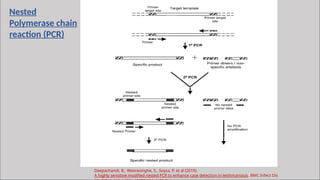
NestedPCR is a modification of conventional PCR that was
designed to improve sensitivity and specificity
Nested PCR involves the use of two primer sets and two
successive PCR reactions
6.
6
SETS OF PRIMERS
Theouter set of Primer
The outer primers are primers that
are upstream to the inner set of
primers.
The outer primers are bind to the
outside to the flanking region of
out target DNA
In the first round of PCR, it is
possible that this primer can bind
to the site other than the target
site and amplifies it.
Multiple DNA bands might be
observed and lead to false positive
results.
The inner set of primer:
Even if the non-specific DNA
sequences can be amplified in the
first round of PCR that non-specific
DNA will not be amplified in the
second set of amplification.
The second set of primer is specific to
the inner sequence (amplicon of the
first round of PCR).
8
Protocol of theNested PCR
In the year 1993, kamolvarin and co-workers describe the method for use
of two sets of primers for increasing the specificity and sensitivity of the
PCR.
The nested PCR reaction is completed into two steps, a first round of
amplification with outer forward and reverse primers.
After completion of the first round of the amplification, take the
tubes and prepare the reaction for the second round of amplification.
3μl of PCR product is taken from the first amplification and use it as a
template,
In the second reaction, set the PCR at 35 cycles, higher
amplification is achieved by increasing the cycles in the second
round of PCR. We can amplify more amount of gene of our interest
9.
9
ADVANTAGES OF NESTEDPCR
It is beneficial in studies such as phylogenetic analysis and genetic
polymorphism.
The main advantage is it gives 100% accuracy, specificity and
sensitivity.
It also useful in the amplification of genes with the low abundance.
Further, nested PCR is the best choice for the carcinoma and viral
infection studies.
10.
10
DISADVANTAGES OF NESTEDPCR
This method is time-consuming.
Required more reagents such as an extra set of primer and one extra
round of agarose gel electrophoresis which means this method is quite
costly.
The chance of contamination is also higher.
11.
11
APPLICATIONS
Nested PCR iseffective for amplifying DNA from suboptimal samples,
such as formalin-fixed, paraffin-embedded tissue, where DNA might be
degraded.
Nested PCR is widely used to identify microorganisms present in very
low quantities, such as Rickettsia, Bartonella, M. tuberculosis,
herpesvirus, and enterovirus in clinical samples like blood, cerebrospinal
fluid (CSF), and sputum.
Nested PCR helps detect low-abundance genetic markers or mutations
associated with cancer, improving diagnostic accuracy.
12.
12
Summary
Nested PCRincreases specificity and sensitivity using two primer sets and
two amplification rounds.
Widely used for detecting low-abundance targets and in situations
requiring high accuracy.
Drawbacks include increased time, cost, and contamination risk.
13.
13
Chang-Hui Shen (2019).Amplification of Nucleic Acids. Diagnostic Molecular Biology.
Deepachandi, B., Weerasinghe, S., Soysa, P. et al (2019).
A highly sensitive modified nested PCR to enhance case detection in leishmaniasis. BMC
Infect Dis 19, 623 doi:10.1186/s12879-019-4180-3
Souza G., Almeida A., Farias A., Leal N., Abath F. (2007). Development and Evaluation of a
Single Tube Nested PCR Based Approach (STNPCR) for the Diagnosis of Plague. In: Perry
R.D., Fetherston J.D. (eds) The Genus Yersinia. Advances In Experimental Medicine And
Biology, vol 603. Springer, New York, NY
References