• A committee under the Cabinet Secretary T. S. R. Subramanian
was established to formulate the new National Education Policy.
• The committee was chaired by Dr. K Kasturirangan.
• It was released on 29 July 2020.
• The policy aims to transform both the structure and the content
of education, focusing on holistic development, flexibility, and
inclusivity.
FEATURES
• recognizing, identifying, and fostering the unique capabilities of each student, in both academic
and non-academic spheres
• highest priority to achieving Foundational Literacy and Numeracy by all students by Grade 3
• emphasis on conceptual understanding rather than rote learning and learning-for-exams, to
create an active learner
• creativity and critical thinking to encourage logical decision-making and innovation
• life skills such as communication, cooperation, teamwork, and resilience
• teachers and faculty as the heart of the learning process – their recruitment, continuous
professional development, positive working environments and service conditions
• education is a public service; access to quality education must be considered a basic right of
every child
• The extant 10+2 structure in school education will be modified with a new pedagogical and
curricular restructuring of 5+3+3+4 covering ages 3-18.
• Currently, children in the age group of 3-6
are not covered in the 10+2 structure as
Class 1 begins at age 6. In the new 5+3+3+4
structure, a strong base of Early Childhood
Care and Education (ECCE) from age 3 is
also included.
• The progress card of all students for school-
based assessment will be redesigned. The
progress card will be a holistic, 360-degree,
multidimensional report that reflects in great
detail the progress and the uniqueness of
each learner in the cognitive, affective, and
psychomotor domains.
• Every child to learn at least one vocation
and exposed to several more
Possibilities :
1. Holistic Education Approach: NEP 2020 emphasizes a shift from rote learning
to holistic education. The aim of education will not only be cognitive
development, but also building character and creating holistic and well-
rounded individuals equipped with the key 21st century skills. The policy
aims to prepare students for success not only in academics but also in life
beyond school. This means focusing on not just studying to pass exams but
also learning other important things like problem-solving, creativity, and
communication skills, which are useful in real life.
weekly yoga
sessions to
promote
physical fitness
and mental
relaxation
community
service
projects
Creative
workshops,
guest lectures
and
discussions
2. Flexibility and Choice: The policy allows students to choose their subjects
and courses based on their interests, aptitudes, and career aspirations. This
flexibility enables students to explore diverse fields of study and pursue their
passions, thereby fostering a love for learning and self-discovery.
Ways to:
1. Multidisciplinary Education
2. Multiple Entry and Exit Points
3. Choice of Languages
4. Vocational Education and
Skills Training
5. Credit Transfer and Academic
Bank of Credits (ABC)
6. Flexible Learning Modes
7. Assessment Reforms
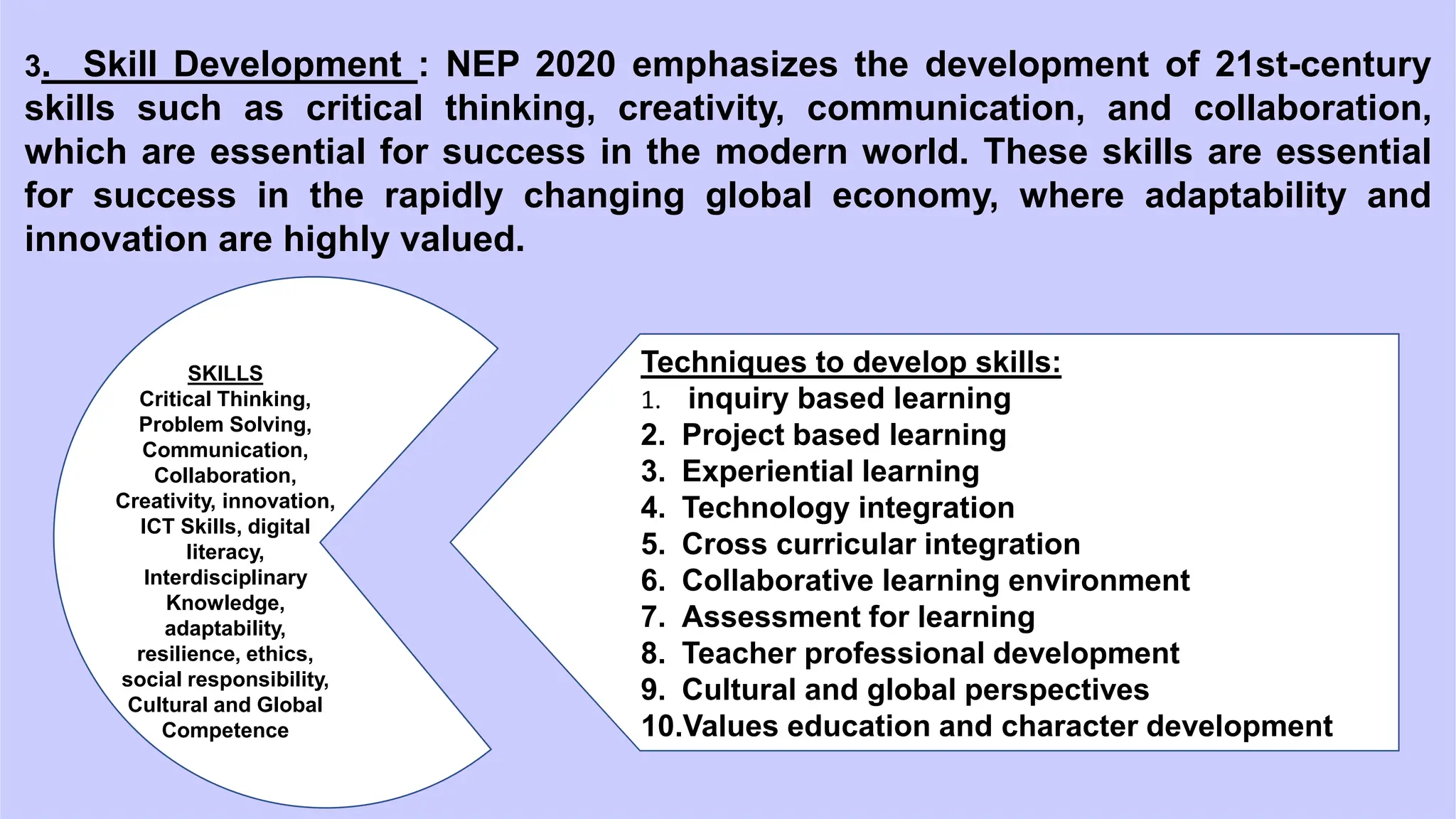
3. Skill Development : NEP 2020 emphasizes the development of 21st-century
skills such as critical thinking, creativity, communication, and collaboration,
which are essential for success in the modern world. These skills are essential
for success in the rapidly changing global economy, where adaptability and
innovation are highly valued.
SKILLS
Critical Thinking,
Problem Solving,
Communication,
Collaboration,
Creativity, innovation,
ICT Skills, digital
literacy,
Interdisciplinary
Knowledge,
adaptability,
resilience, ethics,
social responsibility,
Cultural and Global
Competence
Techniques to develop skills:
1. inquiry based learning
2. Project based learning
3. Experiential learning
4. Technology integration
5. Cross curricular integration
6. Collaborative learning environment
7. Assessment for learning
8. Teacher professional development
9. Cultural and global perspectives
10.Values education and character development
4. Integration of Technology: NEP 2020 recognizes that technology plays a crucial
role in education and emphasizes the integration of technology in teaching and
learning processes. This means using computers, tablets, and the internet to
help students learn better. It can enhance learning outcomes, increase access to
quality education, and facilitate personalized learning experiences.
It focuses on-
1. Digital infrastructure
2. Online learning platforms
3. Teacher training
4. Adaptive Learning
Systems
5. Open education resources
6. Blended learning
7. Assessment and feedback
5. Promotion of Regional Languages: NEP 2020 advocates for the promotion of
regional languages as the medium of instruction in early education. This not
only helps preserve linguistic diversity but also ensures better understanding
and retention of concepts among students. By incorporating regional languages
into the education system, the policy promotes inclusivity and cultural
sensitivity.
To achieve this-
1. Medium of instruction
2. Flexible language
options
3. Promotion of
Indigenous Languages
4. Cultural Integration
5. Teacher Training
CHALLENGES:
1. Implementation: Implementing NEP 2020 is a complex and multifaceted task
that requires coordination among various stakeholders, including
policymakers, educators, administrators, and communities. Ensuring that the
policy objectives are effectively translated into action at all levels of the
education system poses a significant challenge. This requires adequate
infrastructure, human resources, funding, and administrative support.
How to overcome: stakeholders, red tape
2. Teacher Training and Capacity Building: Teachers play a central role in the
education ecosystem, and their capacity to deliver quality education is crucial for
the success of NEP 2020. However, many teachers may require training and
professional development to adapt to new pedagogical approaches, integrate
technology into their teaching practices, and foster the holistic development of
students. Scaling up teacher training programs and ensuring their quality and
effectiveness is a challenge that needs to be addressed.
How to overcome: in service and pre service
3. Assessment and Evaluation: The transition from traditional, exam-centric
assessment methods to more holistic, competency-based approaches is a
fundamental aspect of NEP 2020. However, designing and implementing
effective assessment tools that accurately measure students' holistic
development and skills pose challenges. This includes developing standardized
frameworks, training educators in assessment practices, and ensuring that
assessments are fair, transparent, and aligned with learning objectives.
How to overcome: PARAKH(performance assessment, review, and analysis of
knowledge for holistic development)
4. Equity and Inclusion: Despite efforts to promote equity and inclusion in
education, disparities based on socioeconomic status, gender, geography, and
other factors continue to persist in India. Bridging these gaps and ensuring
equal access to quality education for all remains a significant challenge. This
requires targeted interventions, such as scholarships, affirmative action
policies, and community outreach programs, to address the specific needs of
marginalized and underserved groups.
How to overcome: collaborative learning, peer activities
5. Financial Constraints: Implementing NEP 2020 requires substantial financial
resources for infrastructure development, teacher training, curriculum reform,
technology integration, and other initiatives. Mobilizing resources from diverse
sources, optimizing expenditure, and ensuring efficient utilization of funds are
essential for overcoming financial challenges.
How to overcome: stakeholders and government
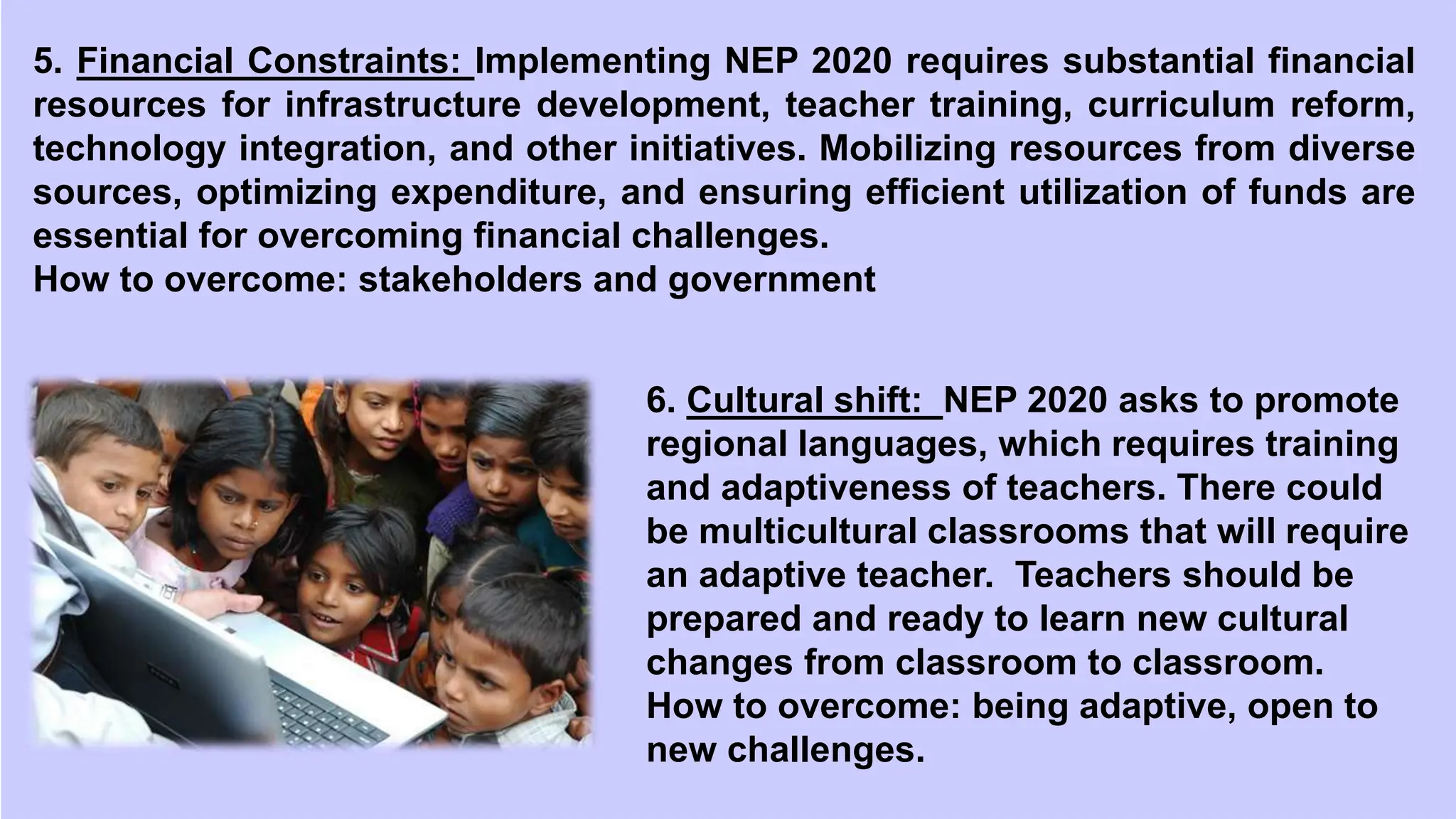
6. Cultural shift: NEP 2020 asks to promote
regional languages, which requires training
and adaptiveness of teachers. There could
be multicultural classrooms that will require
an adaptive teacher. Teachers should be
prepared and ready to learn new cultural
changes from classroom to classroom.
How to overcome: being adaptive, open to
new challenges.
In conclusion, the National Education Policy 2020 presents both promising
possibilities and daunting challenges for the Indian education system. By
embracing a holistic education approach, promoting flexibility and choice,
integrating technology, fostering skill development, and promoting regional
languages, NEP 2020 has the potential to revolutionize education in India and
empower learners for the future.
However, realizing these possibilities requires overcoming challenges such
as implementation bottlenecks, teacher training and capacity building, equity
and inclusion concerns, assessment and evaluation reforms, and financial
constraints. Addressing these challenges will require concerted efforts from
policymakers, educators, civil society organizations, and other stakeholders
to ensure that the vision of NEP 2020 translates into tangible improvements in
the quality, accessibility, and inclusivity of education across India.
Submitted to- Dr. D. Parimala
Submitted by- Komil Sehgal
Course – B.Ed(B)
Paper – F.1 Education In Contemporary India
Roll no. – 49

NEP2020.possibilties&challenges.pptx 2024

  • 2.
    • A committeeunder the Cabinet Secretary T. S. R. Subramanian was established to formulate the new National Education Policy. • The committee was chaired by Dr. K Kasturirangan. • It was released on 29 July 2020. • The policy aims to transform both the structure and the content of education, focusing on holistic development, flexibility, and inclusivity.
  • 3.
    FEATURES • recognizing, identifying,and fostering the unique capabilities of each student, in both academic and non-academic spheres • highest priority to achieving Foundational Literacy and Numeracy by all students by Grade 3 • emphasis on conceptual understanding rather than rote learning and learning-for-exams, to create an active learner • creativity and critical thinking to encourage logical decision-making and innovation • life skills such as communication, cooperation, teamwork, and resilience • teachers and faculty as the heart of the learning process – their recruitment, continuous professional development, positive working environments and service conditions • education is a public service; access to quality education must be considered a basic right of every child
  • 4.
    • The extant10+2 structure in school education will be modified with a new pedagogical and curricular restructuring of 5+3+3+4 covering ages 3-18. • Currently, children in the age group of 3-6 are not covered in the 10+2 structure as Class 1 begins at age 6. In the new 5+3+3+4 structure, a strong base of Early Childhood Care and Education (ECCE) from age 3 is also included. • The progress card of all students for school- based assessment will be redesigned. The progress card will be a holistic, 360-degree, multidimensional report that reflects in great detail the progress and the uniqueness of each learner in the cognitive, affective, and psychomotor domains. • Every child to learn at least one vocation and exposed to several more
  • 6.
    Possibilities : 1. HolisticEducation Approach: NEP 2020 emphasizes a shift from rote learning to holistic education. The aim of education will not only be cognitive development, but also building character and creating holistic and well- rounded individuals equipped with the key 21st century skills. The policy aims to prepare students for success not only in academics but also in life beyond school. This means focusing on not just studying to pass exams but also learning other important things like problem-solving, creativity, and communication skills, which are useful in real life. weekly yoga sessions to promote physical fitness and mental relaxation community service projects Creative workshops, guest lectures and discussions
  • 7.
    2. Flexibility andChoice: The policy allows students to choose their subjects and courses based on their interests, aptitudes, and career aspirations. This flexibility enables students to explore diverse fields of study and pursue their passions, thereby fostering a love for learning and self-discovery. Ways to: 1. Multidisciplinary Education 2. Multiple Entry and Exit Points 3. Choice of Languages 4. Vocational Education and Skills Training 5. Credit Transfer and Academic Bank of Credits (ABC) 6. Flexible Learning Modes 7. Assessment Reforms
  • 8.
    3. Skill Development: NEP 2020 emphasizes the development of 21st-century skills such as critical thinking, creativity, communication, and collaboration, which are essential for success in the modern world. These skills are essential for success in the rapidly changing global economy, where adaptability and innovation are highly valued. SKILLS Critical Thinking, Problem Solving, Communication, Collaboration, Creativity, innovation, ICT Skills, digital literacy, Interdisciplinary Knowledge, adaptability, resilience, ethics, social responsibility, Cultural and Global Competence Techniques to develop skills: 1. inquiry based learning 2. Project based learning 3. Experiential learning 4. Technology integration 5. Cross curricular integration 6. Collaborative learning environment 7. Assessment for learning 8. Teacher professional development 9. Cultural and global perspectives 10.Values education and character development
  • 9.
    4. Integration ofTechnology: NEP 2020 recognizes that technology plays a crucial role in education and emphasizes the integration of technology in teaching and learning processes. This means using computers, tablets, and the internet to help students learn better. It can enhance learning outcomes, increase access to quality education, and facilitate personalized learning experiences. It focuses on- 1. Digital infrastructure 2. Online learning platforms 3. Teacher training 4. Adaptive Learning Systems 5. Open education resources 6. Blended learning 7. Assessment and feedback
  • 10.
    5. Promotion ofRegional Languages: NEP 2020 advocates for the promotion of regional languages as the medium of instruction in early education. This not only helps preserve linguistic diversity but also ensures better understanding and retention of concepts among students. By incorporating regional languages into the education system, the policy promotes inclusivity and cultural sensitivity. To achieve this- 1. Medium of instruction 2. Flexible language options 3. Promotion of Indigenous Languages 4. Cultural Integration 5. Teacher Training
  • 11.
    CHALLENGES: 1. Implementation: ImplementingNEP 2020 is a complex and multifaceted task that requires coordination among various stakeholders, including policymakers, educators, administrators, and communities. Ensuring that the policy objectives are effectively translated into action at all levels of the education system poses a significant challenge. This requires adequate infrastructure, human resources, funding, and administrative support. How to overcome: stakeholders, red tape 2. Teacher Training and Capacity Building: Teachers play a central role in the education ecosystem, and their capacity to deliver quality education is crucial for the success of NEP 2020. However, many teachers may require training and professional development to adapt to new pedagogical approaches, integrate technology into their teaching practices, and foster the holistic development of students. Scaling up teacher training programs and ensuring their quality and effectiveness is a challenge that needs to be addressed. How to overcome: in service and pre service
  • 12.
    3. Assessment andEvaluation: The transition from traditional, exam-centric assessment methods to more holistic, competency-based approaches is a fundamental aspect of NEP 2020. However, designing and implementing effective assessment tools that accurately measure students' holistic development and skills pose challenges. This includes developing standardized frameworks, training educators in assessment practices, and ensuring that assessments are fair, transparent, and aligned with learning objectives. How to overcome: PARAKH(performance assessment, review, and analysis of knowledge for holistic development) 4. Equity and Inclusion: Despite efforts to promote equity and inclusion in education, disparities based on socioeconomic status, gender, geography, and other factors continue to persist in India. Bridging these gaps and ensuring equal access to quality education for all remains a significant challenge. This requires targeted interventions, such as scholarships, affirmative action policies, and community outreach programs, to address the specific needs of marginalized and underserved groups. How to overcome: collaborative learning, peer activities
  • 13.
    5. Financial Constraints:Implementing NEP 2020 requires substantial financial resources for infrastructure development, teacher training, curriculum reform, technology integration, and other initiatives. Mobilizing resources from diverse sources, optimizing expenditure, and ensuring efficient utilization of funds are essential for overcoming financial challenges. How to overcome: stakeholders and government 6. Cultural shift: NEP 2020 asks to promote regional languages, which requires training and adaptiveness of teachers. There could be multicultural classrooms that will require an adaptive teacher. Teachers should be prepared and ready to learn new cultural changes from classroom to classroom. How to overcome: being adaptive, open to new challenges.
  • 14.
    In conclusion, theNational Education Policy 2020 presents both promising possibilities and daunting challenges for the Indian education system. By embracing a holistic education approach, promoting flexibility and choice, integrating technology, fostering skill development, and promoting regional languages, NEP 2020 has the potential to revolutionize education in India and empower learners for the future. However, realizing these possibilities requires overcoming challenges such as implementation bottlenecks, teacher training and capacity building, equity and inclusion concerns, assessment and evaluation reforms, and financial constraints. Addressing these challenges will require concerted efforts from policymakers, educators, civil society organizations, and other stakeholders to ensure that the vision of NEP 2020 translates into tangible improvements in the quality, accessibility, and inclusivity of education across India.
  • 16.
    Submitted to- Dr.D. Parimala Submitted by- Komil Sehgal Course – B.Ed(B) Paper – F.1 Education In Contemporary India Roll no. – 49