SIX MONTH TRAINING AT
HALDIRAM SNACK PVT. LTD.
Submitted To : Submitted By:
Cheshta Mamgain
B.Tech (Food Tech)
BS15BTFT004
CONTENTS
• Introduction
• Haldiram’s products
• Quality Assurance
• Chemical test
 Test for milk
 Test for oil
 Tests for products
 Water testing
• Microbiological analysis
• Products manufacturing
• BRC issue audit
• Conclusion
• Reference
INTRODUCTION
• HALDIRAM’S – a name associated with discerning consumers for sweets and
namkeen’s for past seven decades in India and abroad.
• It made its modest start in the beginning of 1937 in Bikaner, a city of Rajasthan,
India and was founded by Shivkishan Aggarwal.
• It was the first company in India to brand NAMKEENS and also the first company
in India to open a restaurant in new Delhi offering traditional snack foods.
• It comprises of three unite, one each in Kolkata, Nagpur and New Delhi offering
similar products and sharing same brand name.
• Haldiram’s products reached millions of consumers not only in India, but also in
several other countries, including US, Canada, UK, UAE, Australia, New Zealand
Haldiram’s Products
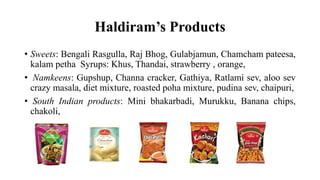
• Sweets: Bengali Rasgulla, Raj Bhog, Gulabjamun, Chamcham pateesa,
kalam petha Syrups: Khus, Thandai, strawberry , orange,
• Namkeens: Gupshup, Channa cracker, Gathiya, Ratlami sev, aloo sev
crazy masala, diet mixture, roasted poha mixture, pudina sev, chaipuri,
• South Indian products: Mini bhakarbadi, Murukku, Banana chips,
chakoli,
Chemical test
Test for milk
• Ammonia Test
• Detergent Test
• Sulphate Test
• BR Test
• Gerber Method (Fat Test)
• Specific gravity(Lactometer reading)
• Ammonia Test Ammonium sulphate is added to milk because it increases the
lactometer reading by maintaining the density of milk. It also increases the protein
content of milk.
• Detergent Test: These are substances added to maintain acidity and prevent
curdling and thus increase the shelf life of milk. During the transportation of milk
from rural to urban areas, milker’s remove fat and add water in skimmed milk.
This result the milk watery and lack of foams so the milker’s add detergent to
improve the milk foam formation. These could be added in the form of caustic
soda, sodium, bicarbonate and sodium carbonate.
• Sulphate Test: Ammonium sulphate is added to milk because it increases the
lactometer reading by maintaining the density of milk. It also increases the protein
content in the milk.
• Butyro Refractometer Test: BR is done to check the adulteration of vegetable oil
Tests for Oils
• Free Fatty Acids (FFA)
• Oxidation Value (OV)
• Peroxide Value (PV)
Test for final products
• Moisture Analysis
• Oil Analysis
• Acidity%
• Salt%
Water Testing
• Determination of Total Hardness
• Carbon oxygen demand
Micro Analysis
Micro Analysis
• Preparation of Stock solution
• Preparation of Media
• Serial Dilution
• Streaking
• Staining
• Microbiological testing for sterility of equipments
Media prepared
• Chloramphenicol Yeast Glucose Agar (CYGA)
It is recommended for selective enumeration of yeasts and moulds in milk and milk products.
• EMB Agar (Eosin methylene blue)
It is used for different isolation of gram –ve enteric bacilli from clinical and non-clinical specimens.
• Plate Count Agar (PCA)
It is used for determination of the plate counts of microorganisms in food, water, and wastewater.
• Violet Red Bile Agar (VRBA)
It is used for selective isolation, detection and enumeration of coli-aero genes bacterial in water, milk,
and other dairy food products.
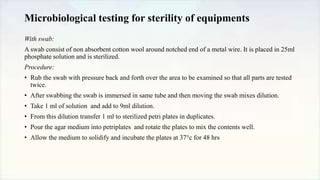
Microbiological testing for sterility of equipments
With swab:
A swab consist of non absorbent cotton wool around notched end of a metal wire. It is placed in 25ml
phosphate solution and is sterilized.
Procedure:
• Rub the swab with pressure back and forth over the area to be examined so that all parts are tested
twice.
• After swabbing the swab is immersed in same tube and then moving the swab mixes dilution.
• Take 1 ml of solution and add to 9ml dilution.
• From this dilution transfer 1 ml to sterilized petri plates in duplicates.
• Pour the agar medium into petriplates and rotate the plates to mix the contents well.
• Allow the medium to solidify and incubate the plates at 37°c for 48 hrs
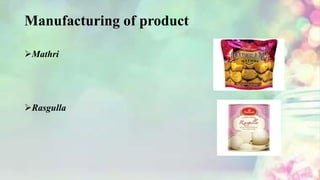
Manufacturing of product
Mathri
Rasgulla
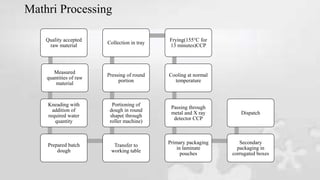
Mathri Processing
Quality accepted
raw material
Measured
quantities of raw
material
Kneading with
addition of
required water
quantity
Prepared batch
dough
Transfer to
working table
Portioning of
dough in round
shape( through
roller machine)
Pressing of round
portion
Collection in tray
Frying(155°C for
13 minutes)CCP
Cooling at normal
temperature
Passing through
metal and X ray
detector CCP
Primary packaging
in laminate
pouches
Secondary
packaging in
corrugated boxes
Dispatch
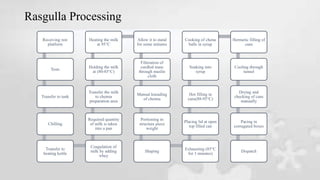
Rasgulla Processing
Receiving raw
platform
Tests
Transfer to tank
Chilling
Transfer to
heating kettle
Coagulation of
milk by adding
whey
Required quantity
of milk is taken
into a pan
Transfer the milk
to chenna
preparation area
Holding the milk
at (80-85°C)
Heating the milk
at 95°C
Allow it to stand
for some minutes
Filteration of
curdled mass
through muslin
cloth
Manual kneading
of chenna
Portioning in
structure piece
weight
Shaping
Exhausting (85°C
for 3 minutes)
Placing lid at open
top filled can
Hot filling in
cans(88-95°C)
Soaking into
syrup
Cooking of chena
balls in syrup
Hermetic filling of
cans
Cooling through
tunnel
Drying and
checking of cans
manually
Pacing in
corrugated boxes
Dispatch
BRC issue audit
Conclusion
• The internship at Haldiram’s was a good learning experience
at a large industrial unit in food processing sector.
• It helped in learning the functioning of quality assurance
production department.
• It gave an idea about how the various departments in an
organization coordinate to achieve the common goal i.e. mass
production.
• The various experiments like to estimate moisture content, fat
estimation, free fatty acid test, water activity, coli-form test
are performed to check the quality of raw material and final
product.
REFERENCES
Presentation on haldiram

Presentation on haldiram

  • 1.
    SIX MONTH TRAININGAT HALDIRAM SNACK PVT. LTD. Submitted To : Submitted By: Cheshta Mamgain B.Tech (Food Tech) BS15BTFT004
  • 2.
    CONTENTS • Introduction • Haldiram’sproducts • Quality Assurance • Chemical test  Test for milk  Test for oil  Tests for products  Water testing • Microbiological analysis • Products manufacturing • BRC issue audit • Conclusion • Reference
  • 3.
    INTRODUCTION • HALDIRAM’S –a name associated with discerning consumers for sweets and namkeen’s for past seven decades in India and abroad. • It made its modest start in the beginning of 1937 in Bikaner, a city of Rajasthan, India and was founded by Shivkishan Aggarwal. • It was the first company in India to brand NAMKEENS and also the first company in India to open a restaurant in new Delhi offering traditional snack foods. • It comprises of three unite, one each in Kolkata, Nagpur and New Delhi offering similar products and sharing same brand name. • Haldiram’s products reached millions of consumers not only in India, but also in several other countries, including US, Canada, UK, UAE, Australia, New Zealand
  • 4.
    Haldiram’s Products • Sweets:Bengali Rasgulla, Raj Bhog, Gulabjamun, Chamcham pateesa, kalam petha Syrups: Khus, Thandai, strawberry , orange, • Namkeens: Gupshup, Channa cracker, Gathiya, Ratlami sev, aloo sev crazy masala, diet mixture, roasted poha mixture, pudina sev, chaipuri, • South Indian products: Mini bhakarbadi, Murukku, Banana chips, chakoli,
  • 5.
  • 6.
    Test for milk •Ammonia Test • Detergent Test • Sulphate Test • BR Test • Gerber Method (Fat Test) • Specific gravity(Lactometer reading)
  • 7.
    • Ammonia TestAmmonium sulphate is added to milk because it increases the lactometer reading by maintaining the density of milk. It also increases the protein content of milk. • Detergent Test: These are substances added to maintain acidity and prevent curdling and thus increase the shelf life of milk. During the transportation of milk from rural to urban areas, milker’s remove fat and add water in skimmed milk. This result the milk watery and lack of foams so the milker’s add detergent to improve the milk foam formation. These could be added in the form of caustic soda, sodium, bicarbonate and sodium carbonate. • Sulphate Test: Ammonium sulphate is added to milk because it increases the lactometer reading by maintaining the density of milk. It also increases the protein content in the milk. • Butyro Refractometer Test: BR is done to check the adulteration of vegetable oil
  • 8.
    Tests for Oils •Free Fatty Acids (FFA) • Oxidation Value (OV) • Peroxide Value (PV)
  • 9.
    Test for finalproducts • Moisture Analysis • Oil Analysis • Acidity% • Salt%
  • 10.
    Water Testing • Determinationof Total Hardness • Carbon oxygen demand
  • 11.
  • 12.
    Micro Analysis • Preparationof Stock solution • Preparation of Media • Serial Dilution • Streaking • Staining • Microbiological testing for sterility of equipments
  • 13.
    Media prepared • ChloramphenicolYeast Glucose Agar (CYGA) It is recommended for selective enumeration of yeasts and moulds in milk and milk products. • EMB Agar (Eosin methylene blue) It is used for different isolation of gram –ve enteric bacilli from clinical and non-clinical specimens. • Plate Count Agar (PCA) It is used for determination of the plate counts of microorganisms in food, water, and wastewater. • Violet Red Bile Agar (VRBA) It is used for selective isolation, detection and enumeration of coli-aero genes bacterial in water, milk, and other dairy food products.
  • 14.
    Microbiological testing forsterility of equipments With swab: A swab consist of non absorbent cotton wool around notched end of a metal wire. It is placed in 25ml phosphate solution and is sterilized. Procedure: • Rub the swab with pressure back and forth over the area to be examined so that all parts are tested twice. • After swabbing the swab is immersed in same tube and then moving the swab mixes dilution. • Take 1 ml of solution and add to 9ml dilution. • From this dilution transfer 1 ml to sterilized petri plates in duplicates. • Pour the agar medium into petriplates and rotate the plates to mix the contents well. • Allow the medium to solidify and incubate the plates at 37°c for 48 hrs
  • 15.
  • 16.
    Mathri Processing Quality accepted rawmaterial Measured quantities of raw material Kneading with addition of required water quantity Prepared batch dough Transfer to working table Portioning of dough in round shape( through roller machine) Pressing of round portion Collection in tray Frying(155°C for 13 minutes)CCP Cooling at normal temperature Passing through metal and X ray detector CCP Primary packaging in laminate pouches Secondary packaging in corrugated boxes Dispatch
  • 17.
    Rasgulla Processing Receiving raw platform Tests Transferto tank Chilling Transfer to heating kettle Coagulation of milk by adding whey Required quantity of milk is taken into a pan Transfer the milk to chenna preparation area Holding the milk at (80-85°C) Heating the milk at 95°C Allow it to stand for some minutes Filteration of curdled mass through muslin cloth Manual kneading of chenna Portioning in structure piece weight Shaping Exhausting (85°C for 3 minutes) Placing lid at open top filled can Hot filling in cans(88-95°C) Soaking into syrup Cooking of chena balls in syrup Hermetic filling of cans Cooling through tunnel Drying and checking of cans manually Pacing in corrugated boxes Dispatch
  • 18.
  • 19.
    Conclusion • The internshipat Haldiram’s was a good learning experience at a large industrial unit in food processing sector. • It helped in learning the functioning of quality assurance production department. • It gave an idea about how the various departments in an organization coordinate to achieve the common goal i.e. mass production. • The various experiments like to estimate moisture content, fat estimation, free fatty acid test, water activity, coli-form test are performed to check the quality of raw material and final product.
  • 20.