Litigation 
Risk Management 
Institute 
Negotiation Strategies: 
Achieving Your Objectives 
Litigation Settlement Case Study 
Bruce Beron, Ph.D., President 
34 Coquito Court, Menlo Park • California 94028 • Phone 650.854.1914 • www.litigationriskmanagement.com • bruceberon@lrmi.com
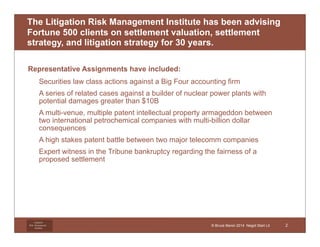
The Litigation Risk Management Institute has been advising 
Fortune 500 clients on settlement valuation, settlement 
strategy, and litigation strategy for 30 years. 
Litigation 
Risk Management 
Institute 
© Bruce Beron 2014 Negot Start Lit 
• Representative Assignments have included: 
• Securities law class actions against a Big Four accounting firm 
• A series of related cases against a builder of nuclear power plants with 
potential damages greater than $10B 
• A multi-venue, multiple patent intellectual property armageddon between 
two international petrochemical companies with multi-billion dollar 
consequences 
• A high stakes patent battle between two major telecomm companies 
• Expert witness in the Tribune bankruptcy regarding the fairness of a 
proposed settlement 
2
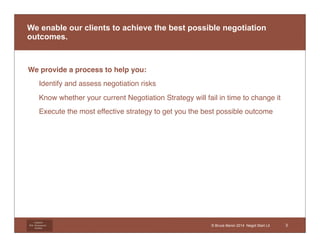
We enable our clients to achieve the best possible negotiation 
outcomes. 
Litigation 
Risk Management 
Institute 
© Bruce Beron 2014 Negot Start Lit 
• We provide a process to help you: 
• Identify and assess negotiation risks 
• Know whether your current Negotiation Strategy will fail in time to change it 
• Execute the most effective strategy to get you the best possible outcome 
3
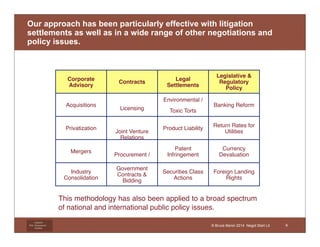
Our approach has been particularly effective with litigation 
settlements as well as in a wide range of other negotiations and 
policy issues. 
Litigation 
Risk Management 
Institute 
© Bruce Beron 2014 Negot Start Lit 
Corporate 
Advisory 
Contracts 
Legal 
Settlements 
Legislative & 
Regulatory 
Policy 
Acquisitions 
Licensing 
Environmental / 
Toxic Torts 
Banking Reform 
Privatization 
Joint Venture 
Relations 
Product Liability 
Return Rates for 
Utilities 
Mergers 
Procurement / 
Sales 
Patent 
Infringement 
Currency 
Devaluation 
Industry 
Consolidation 
Government 
Contracts & 
Bidding 
Securities Class 
Actions 
Foreign Landing 
Rights 
This methodology has also been applied to a broad spectrum 
of national and international public policy issues. 
4
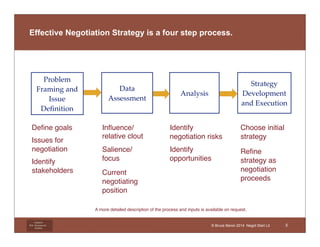
Effective Negotiation Strategy is a four step process. 
Litigation 
Risk Management 
Institute 
© Bruce Beron 2014 Negot Start Lit 
Problem 
Framing and 
Issue 
Definition 
Data 
Assessment 
Analysis 
Strategy 
Development 
and Execution 
Define goals 
Issues for 
negotiation 
Identify 
stakeholders 
Influence/ 
relative clout 
Salience/ 
focus 
Current 
negotiating 
position 
Identify 
negotiation risks 
Identify 
opportunities 
Choose initial 
strategy 
Refine 
strategy as 
negotiation 
proceeds 
A more detailed description of the process and inputs is available on request. 
5
Litigation 
Risk Management 
Institute 
© Bruce Beron 2014 Negot Start Lit 
The first step is to know what your goals are. 
Problem 
Framing and 
Issue 
Definition 
• What do you want to get out of the negotiation? 
• What are the possible components of value? 
• What are the consequences of getting what you want? 
• “Be careful what you ask for — you might get it.” 
Data 
Assessment 
Analysis 
Strategy 
Development 
and 
Execution 
6
You should establish a Reservation Price before commencing 
negotiations. 
• What is the maximum you should be willing to pay or the minimum you 
should be willing to accept? 
• It is the value to you of what you are buying or selling. 
• In litigation it is the expected net present value of the trial outcome and 
the related business consequences. 
• Plus expected litigation costs if you are a defendant, minus, if you are a 
Litigation 
Risk Management 
Institute 
© Bruce Beron 2014 Negot Start Lit 
plaintiff 
• Include a risk premium when appropriate. 
Problem 
Framing and 
Issue 
Definition 
Data 
Assessment 
Analysis 
Strategy 
Development 
and 
Execution 
7
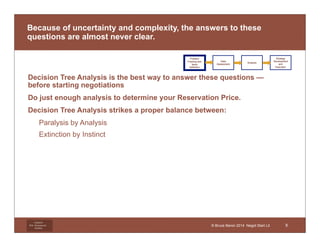
Because of uncertainty and complexity, the answers to these 
questions are almost never clear. 
• Decision Tree Analysis is the best way to answer these questions — 
Litigation 
Risk Management 
Institute 
© Bruce Beron 2014 Negot Start Lit 
before starting negotiations 
• Do just enough analysis to determine your Reservation Price. 
• Decision Tree Analysis strikes a proper balance between: 
• Paralysis by Analysis 
• Extinction by Instinct 
Problem 
Framing and 
Issue 
Definition 
Data 
Assessment 
Analysis 
Strategy 
Development 
and 
Execution 
8
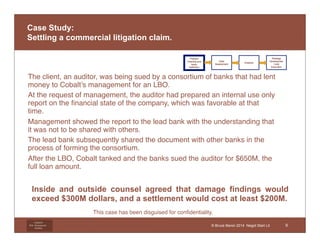
Inside and outside counsel agreed that damage findings would 
exceed $300M dollars, and a settlement would cost at least $200M. 
Litigation 
Risk Management 
Institute 
© Bruce Beron 2014 Negot Start Lit 
Case Study: 
Settling a commercial litigation claim. 
• The client, an auditor, was being sued by a consortium of banks that had lent 
money to Cobalt’s management for an LBO. 
• At the request of management, the auditor had prepared an internal use only 
report on the financial state of the company, which was favorable at that 
time. 
• Management showed the report to the lead bank with the understanding that 
it was not to be shared with others. 
• The lead bank subsequently shared the document with other banks in the 
process of forming the consortium. 
• After the LBO, Cobalt tanked and the banks sued the auditor for $650M, the 
full loan amount. 
Problem 
Framing and 
Issue 
Definition 
Data 
Assessment 
Analysis 
Strategy 
Developmen 
t and 
Execution 
This case has been disguised for confidentiality. 
9
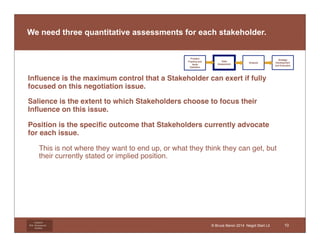
We need three quantitative assessments for each stakeholder. 
• Influence is the maximum control that a Stakeholder can exert if fully 
Litigation 
Risk Management 
Institute 
© Bruce Beron 2014 Negot Start Lit 
focused on this negotiation issue. 
• Salience is the extent to which Stakeholders choose to focus their 
Influence on this issue. 
• Position is the specific outcome that Stakeholders currently advocate 
for each issue. 
• This is not where they want to end up, or what they think they can get, but 
their currently stated or implied position. 
Problem 
Framing and 
Issue 
Definition 
Data 
Assessment 
Analysis 
Strategy 
Development 
and Execution 
10
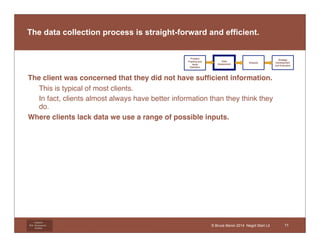
The data collection process is straight-forward and efficient. 
Problem 
Framing and 
Issue 
Definition 
Data 
Assessment 
• The client was concerned that they did not have sufficient information. 
• This is typical of most clients. 
• In fact, clients almost always have better information than they think they 
Litigation 
Risk Management 
Institute 
© Bruce Beron 2014 Negot Start Lit 
do. 
• Where clients lack data we use a range of possible inputs. 
Analysis 
Strategy 
Development 
and Execution 
11
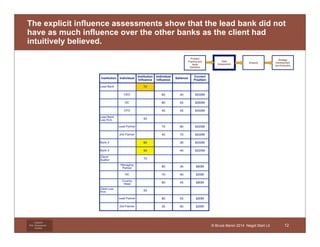
The explicit influence assessments show that the lead bank did not 
have as much influence over the other banks as the client had 
intuitively believed. 
Litigation 
Risk Management 
Institute 
© Bruce Beron 2014 Negot Start Lit 
Problem 
Framing and 
Issue 
Definition 
Data 
Assessment 
Analysis 
Strategy 
Development 
and Execution 
12
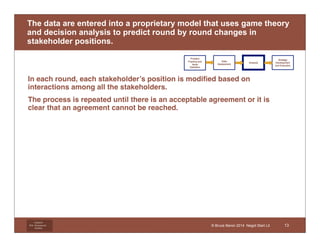
The data are entered into a proprietary model that uses game theory 
and decision analysis to predict round by round changes in 
stakeholder positions. 
• In each round, each stakeholder’s position is modified based on 
Litigation 
Risk Management 
Institute 
© Bruce Beron 2014 Negot Start Lit 
interactions among all the stakeholders. 
• The process is repeated until there is an acceptable agreement or it is 
clear that an agreement cannot be reached. 
Problem 
Framing and 
Issue 
Definition 
Data 
Assessment 
Analysis 
Strategy 
Development 
and Execution 
13
The model predicted a settlement of $225M if the client had 
proceeded normally. 
Litigation 
Risk Management 
Institute 
© Bruce Beron 2014 Negot Start Lit 
Problem 
Framing and 
Issue 
Definition 
Data 
Assessment 
Analysis 
Strategy 
Development 
and Execution 
14
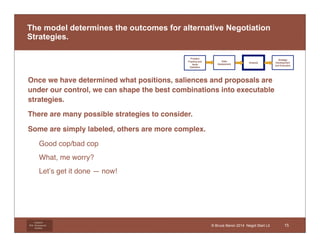
The model determines the outcomes for alternative Negotiation 
Strategies. 
• Once we have determined what positions, saliences and proposals are 
under our control, we can shape the best combinations into executable 
strategies. 
Litigation 
Risk Management 
Institute 
© Bruce Beron 2014 Negot Start Lit 
• There are many possible strategies to consider. 
• Some are simply labeled, others are more complex. 
• Good cop/bad cop 
• What, me worry? 
• Let’s get it done — now! 
Problem 
Framing and 
Issue 
Definition 
Data 
Assessment 
Analysis 
Strategy 
Development 
and Execution 
15
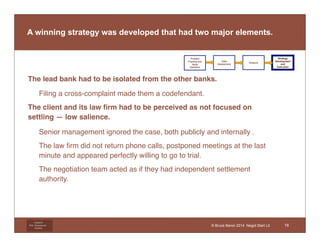
A winning strategy was developed that had two major elements. 
• The lead bank had to be isolated from the other banks. 
Litigation 
Risk Management 
Institute 
© Bruce Beron 2014 Negot Start Lit 
• Filing a cross-complaint made them a codefendant. 
• The client and its law firm had to be perceived as not focused on 
settling — low salience. 
• Senior management ignored the case, both publicly and internally . 
• The law firm did not return phone calls, postponed meetings at the last 
minute and appeared perfectly willing to go to trial. 
• The negotiation team acted as if they had independent settlement 
authority. 
Problem 
Framing and 
Issue 
Definition 
Data 
Assessment 
Analysis 
Strategy 
Development 
and 
Execution 
16
The negotiation played out exactly as the model predicted, and the 
case was settled for $40M, $185M less than anyone had thought 
possible. 
Litigation 
Risk Management 
Institute 
© Bruce Beron 2014 Negot Start Lit 
Problem 
Framing and 
Issue 
Definition 
Data 
Assessment 
Analysis 
Strategy 
Development 
and 
Execution 
17
Litigation 
Risk Management 
Institute 
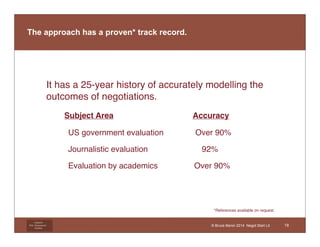
It has a 25-year history of accurately modelling the 
outcomes of negotiations. 
Subject Area ! Accuracy 
• US government evaluation! Over 90% 
• Journalistic evaluation! 92%! 
• Evaluation by academics! Over 90% 
© Bruce Beron 2014 Negot Start Lit 
The approach has a proven* track record. 
*References available on request. 
18
The process delivers practical answers to the key questions in high-stakes 
Litigation 
Risk Management 
Institute 
© Bruce Beron 2014 Negot Start Lit 
negotiations. 
• Should we be making side proposals? 
• Who on our side, should make what proposal, to which of our opponents, 
at what point in the negotiation? 
• Who on the other side is bluffing, and who is the best person to 
call their bluff? 
• How aggressive an opening position should we take? 
• Who should be at the table? 
• Should we present a unified position or imply internal 
differences? 
Problem 
Framing and 
Issue 
Definition 
Data 
Assessment 
Analysis 
Strategy 
Development 
and 
Execution 
19
Clients are consistently amazed with the results. 
Senior CIA Official: 
The model “has resulted in accurate predictions in 90% of the situations in 
which it has been utilized.” 
U.S. Defense Department Official: 
“Of all quantitative political forecasting methodologies of which I am aware, 
the expected utility work is the most useful to policy makers because it has 
the power to predict specific policies, their nuances, and ways in which they 
might be changed.” 
U.S. CEO: 
“I will reserve a page in the Book of Prophets for it.” 
This approach has been featured in: 
The Financial Times, The Economist, The Independent, US News and World 
Reports, International Herald Tribune, New York Times Magazine, ....... 
Litigation 
Risk Management 
Institute 
© Bruce Beron 2014 Negot Start Lit 
20
Litigation 
Risk Management 
Institute 
© Bruce Beron 2014 Negot Start Lit 
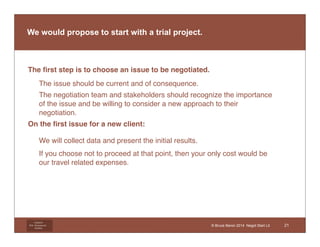
We would propose to start with a trial project. 
• The first step is to choose an issue to be negotiated. 
• The issue should be current and of consequence. 
• The negotiation team and stakeholders should recognize the importance 
of the issue and be willing to consider a new approach to their 
negotiation. 
• On the first issue for a new client: 
• We will collect data and present the initial results. 
• If you choose not to proceed at that point, then your only cost would be 
our travel related expenses. 
21
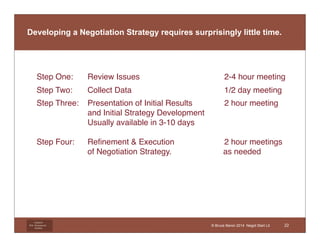
Developing a Negotiation Strategy requires surprisingly little time. 
Step One: ! Review Issues! 2-4 hour meeting 
Step Two: ! Collect Data! 1/2 day meeting 
Step Three: ! Presentation of Initial Results! 2 hour meeting 
Litigation 
Risk Management 
Institute 
© Bruce Beron 2014 Negot Start Lit 
! and Initial Strategy Development 
! ! Usually available in 3-10 days 
Step Four: ! Refinement & Execution! 2 hour meetings 
! of Negotiation Strategy. as needed 
22
We enable our clients to achieve the best possible negotiation 
outcomes. 
Litigation 
Risk Management 
Institute 
© Bruce Beron 2014 Negot Start Lit 
• We provide a process to help you: 
• Identify and assess negotiation risks 
• Know whether your current Negotiation Strategy will 
fail in time to change it 
• Execute the most effective strategy to get you the best 
possible outcome 
This process has saved companies 
$100’s of millions. 
23

Negotiation Strategies: Using Game Theory and Decision Tree Analysis to Determine An Optimum Litigation Settlement Strategy

  • 1.
    Litigation Risk Management Institute Negotiation Strategies: Achieving Your Objectives Litigation Settlement Case Study Bruce Beron, Ph.D., President 34 Coquito Court, Menlo Park • California 94028 • Phone 650.854.1914 • www.litigationriskmanagement.com • bruceberon@lrmi.com
  • 2.
    The Litigation RiskManagement Institute has been advising Fortune 500 clients on settlement valuation, settlement strategy, and litigation strategy for 30 years. Litigation Risk Management Institute © Bruce Beron 2014 Negot Start Lit • Representative Assignments have included: • Securities law class actions against a Big Four accounting firm • A series of related cases against a builder of nuclear power plants with potential damages greater than $10B • A multi-venue, multiple patent intellectual property armageddon between two international petrochemical companies with multi-billion dollar consequences • A high stakes patent battle between two major telecomm companies • Expert witness in the Tribune bankruptcy regarding the fairness of a proposed settlement 2
  • 3.
    We enable ourclients to achieve the best possible negotiation outcomes. Litigation Risk Management Institute © Bruce Beron 2014 Negot Start Lit • We provide a process to help you: • Identify and assess negotiation risks • Know whether your current Negotiation Strategy will fail in time to change it • Execute the most effective strategy to get you the best possible outcome 3
  • 4.
    Our approach hasbeen particularly effective with litigation settlements as well as in a wide range of other negotiations and policy issues. Litigation Risk Management Institute © Bruce Beron 2014 Negot Start Lit Corporate Advisory Contracts Legal Settlements Legislative & Regulatory Policy Acquisitions Licensing Environmental / Toxic Torts Banking Reform Privatization Joint Venture Relations Product Liability Return Rates for Utilities Mergers Procurement / Sales Patent Infringement Currency Devaluation Industry Consolidation Government Contracts & Bidding Securities Class Actions Foreign Landing Rights This methodology has also been applied to a broad spectrum of national and international public policy issues. 4
  • 5.
    Effective Negotiation Strategyis a four step process. Litigation Risk Management Institute © Bruce Beron 2014 Negot Start Lit Problem Framing and Issue Definition Data Assessment Analysis Strategy Development and Execution Define goals Issues for negotiation Identify stakeholders Influence/ relative clout Salience/ focus Current negotiating position Identify negotiation risks Identify opportunities Choose initial strategy Refine strategy as negotiation proceeds A more detailed description of the process and inputs is available on request. 5
  • 6.
    Litigation Risk Management Institute © Bruce Beron 2014 Negot Start Lit The first step is to know what your goals are. Problem Framing and Issue Definition • What do you want to get out of the negotiation? • What are the possible components of value? • What are the consequences of getting what you want? • “Be careful what you ask for — you might get it.” Data Assessment Analysis Strategy Development and Execution 6
  • 7.
    You should establisha Reservation Price before commencing negotiations. • What is the maximum you should be willing to pay or the minimum you should be willing to accept? • It is the value to you of what you are buying or selling. • In litigation it is the expected net present value of the trial outcome and the related business consequences. • Plus expected litigation costs if you are a defendant, minus, if you are a Litigation Risk Management Institute © Bruce Beron 2014 Negot Start Lit plaintiff • Include a risk premium when appropriate. Problem Framing and Issue Definition Data Assessment Analysis Strategy Development and Execution 7
  • 8.
    Because of uncertaintyand complexity, the answers to these questions are almost never clear. • Decision Tree Analysis is the best way to answer these questions — Litigation Risk Management Institute © Bruce Beron 2014 Negot Start Lit before starting negotiations • Do just enough analysis to determine your Reservation Price. • Decision Tree Analysis strikes a proper balance between: • Paralysis by Analysis • Extinction by Instinct Problem Framing and Issue Definition Data Assessment Analysis Strategy Development and Execution 8
  • 9.
    Inside and outsidecounsel agreed that damage findings would exceed $300M dollars, and a settlement would cost at least $200M. Litigation Risk Management Institute © Bruce Beron 2014 Negot Start Lit Case Study: Settling a commercial litigation claim. • The client, an auditor, was being sued by a consortium of banks that had lent money to Cobalt’s management for an LBO. • At the request of management, the auditor had prepared an internal use only report on the financial state of the company, which was favorable at that time. • Management showed the report to the lead bank with the understanding that it was not to be shared with others. • The lead bank subsequently shared the document with other banks in the process of forming the consortium. • After the LBO, Cobalt tanked and the banks sued the auditor for $650M, the full loan amount. Problem Framing and Issue Definition Data Assessment Analysis Strategy Developmen t and Execution This case has been disguised for confidentiality. 9
  • 10.
    We need threequantitative assessments for each stakeholder. • Influence is the maximum control that a Stakeholder can exert if fully Litigation Risk Management Institute © Bruce Beron 2014 Negot Start Lit focused on this negotiation issue. • Salience is the extent to which Stakeholders choose to focus their Influence on this issue. • Position is the specific outcome that Stakeholders currently advocate for each issue. • This is not where they want to end up, or what they think they can get, but their currently stated or implied position. Problem Framing and Issue Definition Data Assessment Analysis Strategy Development and Execution 10
  • 11.
    The data collectionprocess is straight-forward and efficient. Problem Framing and Issue Definition Data Assessment • The client was concerned that they did not have sufficient information. • This is typical of most clients. • In fact, clients almost always have better information than they think they Litigation Risk Management Institute © Bruce Beron 2014 Negot Start Lit do. • Where clients lack data we use a range of possible inputs. Analysis Strategy Development and Execution 11
  • 12.
    The explicit influenceassessments show that the lead bank did not have as much influence over the other banks as the client had intuitively believed. Litigation Risk Management Institute © Bruce Beron 2014 Negot Start Lit Problem Framing and Issue Definition Data Assessment Analysis Strategy Development and Execution 12
  • 13.
    The data areentered into a proprietary model that uses game theory and decision analysis to predict round by round changes in stakeholder positions. • In each round, each stakeholder’s position is modified based on Litigation Risk Management Institute © Bruce Beron 2014 Negot Start Lit interactions among all the stakeholders. • The process is repeated until there is an acceptable agreement or it is clear that an agreement cannot be reached. Problem Framing and Issue Definition Data Assessment Analysis Strategy Development and Execution 13
  • 14.
    The model predicteda settlement of $225M if the client had proceeded normally. Litigation Risk Management Institute © Bruce Beron 2014 Negot Start Lit Problem Framing and Issue Definition Data Assessment Analysis Strategy Development and Execution 14
  • 15.
    The model determinesthe outcomes for alternative Negotiation Strategies. • Once we have determined what positions, saliences and proposals are under our control, we can shape the best combinations into executable strategies. Litigation Risk Management Institute © Bruce Beron 2014 Negot Start Lit • There are many possible strategies to consider. • Some are simply labeled, others are more complex. • Good cop/bad cop • What, me worry? • Let’s get it done — now! Problem Framing and Issue Definition Data Assessment Analysis Strategy Development and Execution 15
  • 16.
    A winning strategywas developed that had two major elements. • The lead bank had to be isolated from the other banks. Litigation Risk Management Institute © Bruce Beron 2014 Negot Start Lit • Filing a cross-complaint made them a codefendant. • The client and its law firm had to be perceived as not focused on settling — low salience. • Senior management ignored the case, both publicly and internally . • The law firm did not return phone calls, postponed meetings at the last minute and appeared perfectly willing to go to trial. • The negotiation team acted as if they had independent settlement authority. Problem Framing and Issue Definition Data Assessment Analysis Strategy Development and Execution 16
  • 17.
    The negotiation playedout exactly as the model predicted, and the case was settled for $40M, $185M less than anyone had thought possible. Litigation Risk Management Institute © Bruce Beron 2014 Negot Start Lit Problem Framing and Issue Definition Data Assessment Analysis Strategy Development and Execution 17
  • 18.
    Litigation Risk Management Institute It has a 25-year history of accurately modelling the outcomes of negotiations. Subject Area ! Accuracy • US government evaluation! Over 90% • Journalistic evaluation! 92%! • Evaluation by academics! Over 90% © Bruce Beron 2014 Negot Start Lit The approach has a proven* track record. *References available on request. 18
  • 19.
    The process deliverspractical answers to the key questions in high-stakes Litigation Risk Management Institute © Bruce Beron 2014 Negot Start Lit negotiations. • Should we be making side proposals? • Who on our side, should make what proposal, to which of our opponents, at what point in the negotiation? • Who on the other side is bluffing, and who is the best person to call their bluff? • How aggressive an opening position should we take? • Who should be at the table? • Should we present a unified position or imply internal differences? Problem Framing and Issue Definition Data Assessment Analysis Strategy Development and Execution 19
  • 20.
    Clients are consistentlyamazed with the results. Senior CIA Official: The model “has resulted in accurate predictions in 90% of the situations in which it has been utilized.” U.S. Defense Department Official: “Of all quantitative political forecasting methodologies of which I am aware, the expected utility work is the most useful to policy makers because it has the power to predict specific policies, their nuances, and ways in which they might be changed.” U.S. CEO: “I will reserve a page in the Book of Prophets for it.” This approach has been featured in: The Financial Times, The Economist, The Independent, US News and World Reports, International Herald Tribune, New York Times Magazine, ....... Litigation Risk Management Institute © Bruce Beron 2014 Negot Start Lit 20
  • 21.
    Litigation Risk Management Institute © Bruce Beron 2014 Negot Start Lit We would propose to start with a trial project. • The first step is to choose an issue to be negotiated. • The issue should be current and of consequence. • The negotiation team and stakeholders should recognize the importance of the issue and be willing to consider a new approach to their negotiation. • On the first issue for a new client: • We will collect data and present the initial results. • If you choose not to proceed at that point, then your only cost would be our travel related expenses. 21
  • 22.
    Developing a NegotiationStrategy requires surprisingly little time. Step One: ! Review Issues! 2-4 hour meeting Step Two: ! Collect Data! 1/2 day meeting Step Three: ! Presentation of Initial Results! 2 hour meeting Litigation Risk Management Institute © Bruce Beron 2014 Negot Start Lit ! and Initial Strategy Development ! ! Usually available in 3-10 days Step Four: ! Refinement & Execution! 2 hour meetings ! of Negotiation Strategy. as needed 22
  • 23.
    We enable ourclients to achieve the best possible negotiation outcomes. Litigation Risk Management Institute © Bruce Beron 2014 Negot Start Lit • We provide a process to help you: • Identify and assess negotiation risks • Know whether your current Negotiation Strategy will fail in time to change it • Execute the most effective strategy to get you the best possible outcome This process has saved companies $100’s of millions. 23