34 Coquito Court, Menlo Park • CA 94028 • Phone 650.854.1914 • www.litigationriskmanagement.com• bruceberon@lrmi.com
Litigation
Risk Management
Institute
Defensive Patent Acquisition Valuation
Bruce Beron Ph.D., President
Click to edit Master title
style
Litigation
Risk Management
Institute
© 2015 Bruce Beron Defensive Patent Valuation 2
Objective: Quantify expected value to Client (C) of seven
recommended patents as defensive patents-in-suit
against Potential Plaintiff (PP).
Framework
Notable considerations simplified and excluded from this valuation
Methodology
Valuation
Further thoughts and considerations
Click to edit Master title
style
Litigation
Risk Management
Institute
© 2015 Bruce Beron Defensive Patent Valuation 3
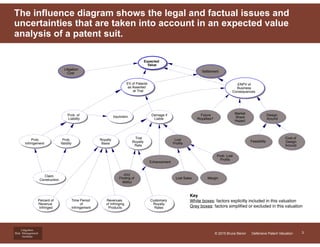
The influence diagram shows the legal and factual issues and
uncertainties that are taken into account in an expected value
analysis of a patent suit.
Expected
Value
Damage if
Liable
Prob. of
Liability
Trial
Royalty
Rate
Customary
Royalty
Rates
Design
Around
Settlement
Litigation
Cost
Lost
Profits
Royalty
Basis
Lost Sales Margin
ENPV of
Business
Consequences
Feasibility
Cost of
Design
Around
Future
Royalties?
Prob.
Infringement
Prob.
Validity
Jury
Finding of
Willful
Enhancement
Market
Share
Impact
Injunction
Time Period
of
Infringement
Revenues
of Infringing
Products
Claim
Construction
Percent of
Revenue
Infringed
EV of Patents
as Asserted
at Trial
Prob. Lost
Profits
Key
White boxes: factors explicitly included in this valuation
Grey boxes: factors simplified or excluded in this valuation
Click to edit Master title
style
Litigation
Risk Management
Institute
© 2015 Bruce Beron Defensive Patent Valuation 4
Several notable considerations are simplified or
excluded in this valuation.
Shown as grayed out on previous slide
Excluded
Any offensive/defensive litigation by PP
Likelihood and value of a settlement
Litigation costs
Simplified
Infringement and validity probability assessments (including claim construction
considerations):
Click to edit Master title
style
Litigation
Risk Management
Institute
© 2015 Bruce Beron Defensive Patent Valuation 5
Several notable considerations are simplified or
excluded in the present analysis. (cont’d)
Simplified (cont’d)
Monetary remedies simplified to include only reasonable royalties as
conservative estimate
Royalties simplified to 5% (rough industry standard) for 3 years (assuming no marking,
so only for litigation period)
Lost profits are less than likely and require information beyond the scope of this inquiry
—C market share, lost sales, profit margin in patent candidate technologies, etc.
Rough estimates of associated 2007 revenues used for damage basis—increases/
decreases not taken into account.
Business value, to C, of an injunction is included, but as a direct assessment,
rather than through a financial model.
“How big a check would C be willing to write to guarantee an injunction against PP in
the relevant business area?”
Assumes no willfulness, based on presumed lack of notice.
Click to edit Master title
style
Litigation
Risk Management
Institute
© 2015 Bruce Beron Defensive Patent Valuation 6
We are using a direct calculation to determine the
expected value of the patent candidates asserted against
PP.
Probability of prevailing =
Value of monetary remedy if we prevail =
Value of equitable remedy if we prevail =
Value of Injunction if Granted =
Expected Value of Patents =
Net Expected Value =
Value-to-Cost Ratio =
Probability Valid x Probability Infringed
Royalty Rate x Revenue x Years
Prob. of Injunction Award x Injunction Value Assessment
Prob. of Prevailing x (Monetary + Equitable Remedy)
Expected Value - Cost to Purchase
Net Expected Value / Cost to Purchase
The calculations are equivalent to evaluating the tree for the monetary and equitable remedies.
.70
.30
Yes
No
Equitable
Remedy
5% Royalty
for 3 years
1.0 if liability
Monetary
Remedy
Infringed
.40
Yes
.60
No
Valid
.70
Yes
.30
No
Direct assessment of business
value of injunction
Click to edit Master title
style
Litigation
Risk Management
Institute
© 2015 Bruce Beron Defensive Patent Valuation 7
This summary table shows a conservative estimate of
the expected value of each patent candidate as asserted
against PP’s relevant technology.
Click to edit Master title
style
Litigation
Risk Management
Institute
© 2015 Bruce Beron Defensive Patent Valuation 8
The bottom line is the ratio of the net expected value to
the cost of each patent.
The purchase of each patent is justified based on our model and
current knowledge.
Lowest return is 3x for ’567—highest is 136x for ’024
Most expensive—’789 & ’567 —have 27x & 3x returns
Note, on a purely damages basis, after prevailing on a 1st patent,
prevailing on an additional patent against the same product has only
incremental value.
The total cost of $8.7M does not buy an expected value of $256M,
the sum of all of the expected values.
However, as a litigation strategy, multiple patents create an effective
“thicket of patents.”
Click to edit Master title
style
Litigation
Risk Management
Institute
© 2015 Bruce Beron Defensive Patent Valuation 9
Alternate/Additional Valuation: 

Future License Revenue
Click to edit Master title
style
Litigation
Risk Management
Institute
© 2015 Bruce Beron Defensive Patent Valuation 10
Further thoughts and considerations for present and
future valuations.
Although difficult to assess, we should keep in mind the defensive context of this valuation.
Will PP initiate litigation?
Against which business areas and products?
How serious is the threat?
Likelihood of losing
Monetary damages
Impact of potential injunction on business
What would our counterclaims look like?
With and without the additional patents
Given the relative strengths and inclinations of both sides, what would the expected settlement be?
How much better is the settlement (or net litigation) value for us with the additional patents?
This incremental value is the value of the patents
Click to edit Master title
style
Litigation
Risk Management
Institute
© 2015 Bruce Beron Defensive Patent Valuation 11
Additional Background
Incremental Portfolio Analysis
Further Searching
Click to edit Master title
style
Litigation
Risk Management
Institute
© 2015 Bruce Beron Defensive Patent Valuation 12
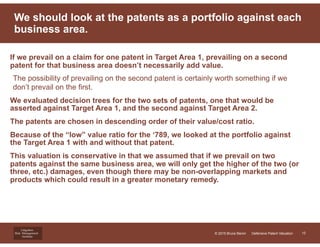
We should look at the patents as a portfolio against each
business area.
If we prevail on a claim for one patent in Target Area 1, prevailing on a second
patent for that business area doesn’t necessarily add value.
The possibility of prevailing on the second patent is certainly worth something if we
don’t prevail on the first.
We evaluated decision trees for the two sets of patents, one that would be
asserted against Target Area 1, and the second against Target Area 2.
The patents are chosen in descending order of their value/cost ratio.
Because of the “low” value ratio for the ‘789, we looked at the portfolio against
the Target Area 1 with and without that patent.
This valuation is conservative in that we assumed that if we prevail on two
patents against the same business area, we will only get the higher of the two (or
three, etc.) damages, even though there may be non-overlapping markets and
products which could result in a greater monetary remedy.
Click to edit Master title
style
Litigation
Risk Management
Institute
© 2015 Bruce Beron Defensive Patent Valuation 13
We calculated the Cumulative Expected Value and an Incremental
Net Value to Cost Ratio for each portfolio, starting with only one
patent and then incrementing the number of patents asserted.
If we were looking just at the value of this portfolio as asserted by C, it is
not clear that the fifth patent against the Product 1, ‘567, is a bargain.
On the other hand, the value might be much higher if we accounted for
defensive and settlement values in our analysis.
See next slide for a more detailed explanation.
Click to edit Master title
style
Litigation
Risk Management
Institute
© 2015 Bruce Beron Defensive Patent Valuation 14
Further Explanation of Incremental Value Table for the
portfolio of potentially asserted patents.
Evident Value of monetary remedy
(RR…Inj. n/a) with 1 to n
patents to assert, in order
of increasing Individual
Value Ratio
Value added by each
additional patent asserted
Subtract the Cost
Incr. Net Exp Value/Cost
Click to edit Master title
style
Litigation
Risk Management
Institute
© 2015 Bruce Beron Defensive Patent Valuation 15
We should consider a proactive search for further
patents.
The analysis should include, in addition to the issues discussed on
the previous slide:
Which potential acquisitions have the greatest value?
Target areas of PP’s core products and greatest growth.
We should conduct the search, not the seller.
Should we purchase them in anticipation of possible litigation?
What is the trade-off between
Buying them sooner at a lower price and possibly not needing them
v.
Having to buy them at a much higher price if and when litigation is initiated?

Defensive Patent Acquisition Case Study

  • 1.
    34 Coquito Court,Menlo Park • CA 94028 • Phone 650.854.1914 • www.litigationriskmanagement.com• bruceberon@lrmi.com Litigation Risk Management Institute Defensive Patent Acquisition Valuation Bruce Beron Ph.D., President
  • 2.
    Click to editMaster title style Litigation Risk Management Institute © 2015 Bruce Beron Defensive Patent Valuation 2 Objective: Quantify expected value to Client (C) of seven recommended patents as defensive patents-in-suit against Potential Plaintiff (PP). Framework Notable considerations simplified and excluded from this valuation Methodology Valuation Further thoughts and considerations
  • 3.
    Click to editMaster title style Litigation Risk Management Institute © 2015 Bruce Beron Defensive Patent Valuation 3 The influence diagram shows the legal and factual issues and uncertainties that are taken into account in an expected value analysis of a patent suit. Expected Value Damage if Liable Prob. of Liability Trial Royalty Rate Customary Royalty Rates Design Around Settlement Litigation Cost Lost Profits Royalty Basis Lost Sales Margin ENPV of Business Consequences Feasibility Cost of Design Around Future Royalties? Prob. Infringement Prob. Validity Jury Finding of Willful Enhancement Market Share Impact Injunction Time Period of Infringement Revenues of Infringing Products Claim Construction Percent of Revenue Infringed EV of Patents as Asserted at Trial Prob. Lost Profits Key White boxes: factors explicitly included in this valuation Grey boxes: factors simplified or excluded in this valuation
  • 4.
    Click to editMaster title style Litigation Risk Management Institute © 2015 Bruce Beron Defensive Patent Valuation 4 Several notable considerations are simplified or excluded in this valuation. Shown as grayed out on previous slide Excluded Any offensive/defensive litigation by PP Likelihood and value of a settlement Litigation costs Simplified Infringement and validity probability assessments (including claim construction considerations):
  • 5.
    Click to editMaster title style Litigation Risk Management Institute © 2015 Bruce Beron Defensive Patent Valuation 5 Several notable considerations are simplified or excluded in the present analysis. (cont’d) Simplified (cont’d) Monetary remedies simplified to include only reasonable royalties as conservative estimate Royalties simplified to 5% (rough industry standard) for 3 years (assuming no marking, so only for litigation period) Lost profits are less than likely and require information beyond the scope of this inquiry —C market share, lost sales, profit margin in patent candidate technologies, etc. Rough estimates of associated 2007 revenues used for damage basis—increases/ decreases not taken into account. Business value, to C, of an injunction is included, but as a direct assessment, rather than through a financial model. “How big a check would C be willing to write to guarantee an injunction against PP in the relevant business area?” Assumes no willfulness, based on presumed lack of notice.
  • 6.
    Click to editMaster title style Litigation Risk Management Institute © 2015 Bruce Beron Defensive Patent Valuation 6 We are using a direct calculation to determine the expected value of the patent candidates asserted against PP. Probability of prevailing = Value of monetary remedy if we prevail = Value of equitable remedy if we prevail = Value of Injunction if Granted = Expected Value of Patents = Net Expected Value = Value-to-Cost Ratio = Probability Valid x Probability Infringed Royalty Rate x Revenue x Years Prob. of Injunction Award x Injunction Value Assessment Prob. of Prevailing x (Monetary + Equitable Remedy) Expected Value - Cost to Purchase Net Expected Value / Cost to Purchase The calculations are equivalent to evaluating the tree for the monetary and equitable remedies. .70 .30 Yes No Equitable Remedy 5% Royalty for 3 years 1.0 if liability Monetary Remedy Infringed .40 Yes .60 No Valid .70 Yes .30 No Direct assessment of business value of injunction
  • 7.
    Click to editMaster title style Litigation Risk Management Institute © 2015 Bruce Beron Defensive Patent Valuation 7 This summary table shows a conservative estimate of the expected value of each patent candidate as asserted against PP’s relevant technology.
  • 8.
    Click to editMaster title style Litigation Risk Management Institute © 2015 Bruce Beron Defensive Patent Valuation 8 The bottom line is the ratio of the net expected value to the cost of each patent. The purchase of each patent is justified based on our model and current knowledge. Lowest return is 3x for ’567—highest is 136x for ’024 Most expensive—’789 & ’567 —have 27x & 3x returns Note, on a purely damages basis, after prevailing on a 1st patent, prevailing on an additional patent against the same product has only incremental value. The total cost of $8.7M does not buy an expected value of $256M, the sum of all of the expected values. However, as a litigation strategy, multiple patents create an effective “thicket of patents.”
  • 9.
    Click to editMaster title style Litigation Risk Management Institute © 2015 Bruce Beron Defensive Patent Valuation 9 Alternate/Additional Valuation: 
 Future License Revenue
  • 10.
    Click to editMaster title style Litigation Risk Management Institute © 2015 Bruce Beron Defensive Patent Valuation 10 Further thoughts and considerations for present and future valuations. Although difficult to assess, we should keep in mind the defensive context of this valuation. Will PP initiate litigation? Against which business areas and products? How serious is the threat? Likelihood of losing Monetary damages Impact of potential injunction on business What would our counterclaims look like? With and without the additional patents Given the relative strengths and inclinations of both sides, what would the expected settlement be? How much better is the settlement (or net litigation) value for us with the additional patents? This incremental value is the value of the patents
  • 11.
    Click to editMaster title style Litigation Risk Management Institute © 2015 Bruce Beron Defensive Patent Valuation 11 Additional Background Incremental Portfolio Analysis Further Searching
  • 12.
    Click to editMaster title style Litigation Risk Management Institute © 2015 Bruce Beron Defensive Patent Valuation 12 We should look at the patents as a portfolio against each business area. If we prevail on a claim for one patent in Target Area 1, prevailing on a second patent for that business area doesn’t necessarily add value. The possibility of prevailing on the second patent is certainly worth something if we don’t prevail on the first. We evaluated decision trees for the two sets of patents, one that would be asserted against Target Area 1, and the second against Target Area 2. The patents are chosen in descending order of their value/cost ratio. Because of the “low” value ratio for the ‘789, we looked at the portfolio against the Target Area 1 with and without that patent. This valuation is conservative in that we assumed that if we prevail on two patents against the same business area, we will only get the higher of the two (or three, etc.) damages, even though there may be non-overlapping markets and products which could result in a greater monetary remedy.
  • 13.
    Click to editMaster title style Litigation Risk Management Institute © 2015 Bruce Beron Defensive Patent Valuation 13 We calculated the Cumulative Expected Value and an Incremental Net Value to Cost Ratio for each portfolio, starting with only one patent and then incrementing the number of patents asserted. If we were looking just at the value of this portfolio as asserted by C, it is not clear that the fifth patent against the Product 1, ‘567, is a bargain. On the other hand, the value might be much higher if we accounted for defensive and settlement values in our analysis. See next slide for a more detailed explanation.
  • 14.
    Click to editMaster title style Litigation Risk Management Institute © 2015 Bruce Beron Defensive Patent Valuation 14 Further Explanation of Incremental Value Table for the portfolio of potentially asserted patents. Evident Value of monetary remedy (RR…Inj. n/a) with 1 to n patents to assert, in order of increasing Individual Value Ratio Value added by each additional patent asserted Subtract the Cost Incr. Net Exp Value/Cost
  • 15.
    Click to editMaster title style Litigation Risk Management Institute © 2015 Bruce Beron Defensive Patent Valuation 15 We should consider a proactive search for further patents. The analysis should include, in addition to the issues discussed on the previous slide: Which potential acquisitions have the greatest value? Target areas of PP’s core products and greatest growth. We should conduct the search, not the seller. Should we purchase them in anticipation of possible litigation? What is the trade-off between Buying them sooner at a lower price and possibly not needing them v. Having to buy them at a much higher price if and when litigation is initiated?