



NEEDS ANALYSIS FOR THE REAL WORLD:
Practical tips for Business English trainers
Presenter: Philip Saxon
(Corvinus University & IATEFL BESIG)
Philip Saxon 1
Your presenter’s background
• Business English trainer and HE teacher since 2009.
• Used to work in IT: understands how it supports the business.
• MA in ELT (ICT/Multimedia) with distinction from University of
Warwick (2014).
• Now speak regularly at IATEFL-Hungary and other events.
Growing following as a blogger, too:
– English for Authentic Purposes:
http://englishforauthenticpurposes.blogspot.hu
– Teaching English with Technology:
http://techieenglishteacher.blogspot.hu
Philip Saxon 2
Who this is for – and how they’ll benefit
This talk is aimed at:
1) Teachers of Business English
2) Teachers wishing to train students to present
3) Teacher Trainers
4) Language School Managers
By the end of this talk, participants should hopefully:
• Understand how and when to to use the “English for Specific
Purposes” (ESP) approach to Needs Analysis.
Philip Saxon 3
Needs analysis
for the real world
Are your corporate customers a handful?
Why not try the ESP approach?
Needs Analysis Icebreaker
Do any of these problems look familiar?
1) The learners have very different aims;
2) The textbook isn’t really what the learners are looking for;
3) You want to help learners with their actual jobs – but how?
4) Learners aren’t motivated to do homework;
5) Learners aren’t motivated by textbook activities – or by
speaking in front of their boss.
In groups of four (or so), discuss which look likely to occur with
Business English learners. After 5 minutes, report back.
Philip Saxon 5
My aims today are to show you how to:
1) Design and deliver Business English courses based around
learner needs, and not simply textbook content.
2) Respond to new or changing needs as courses progress.
In other words:
You’ll see how to implement the ESP approach!
Philip Saxon 6
Contents
1) The commercial reality
2) Limitations of textbooks
3) The problem with diagnosing needs
4) The ESP Approach
5) Be flexible!
6) Continuous Improvement
7) Conclusion: when to “go ESP”
Philip Saxon 7
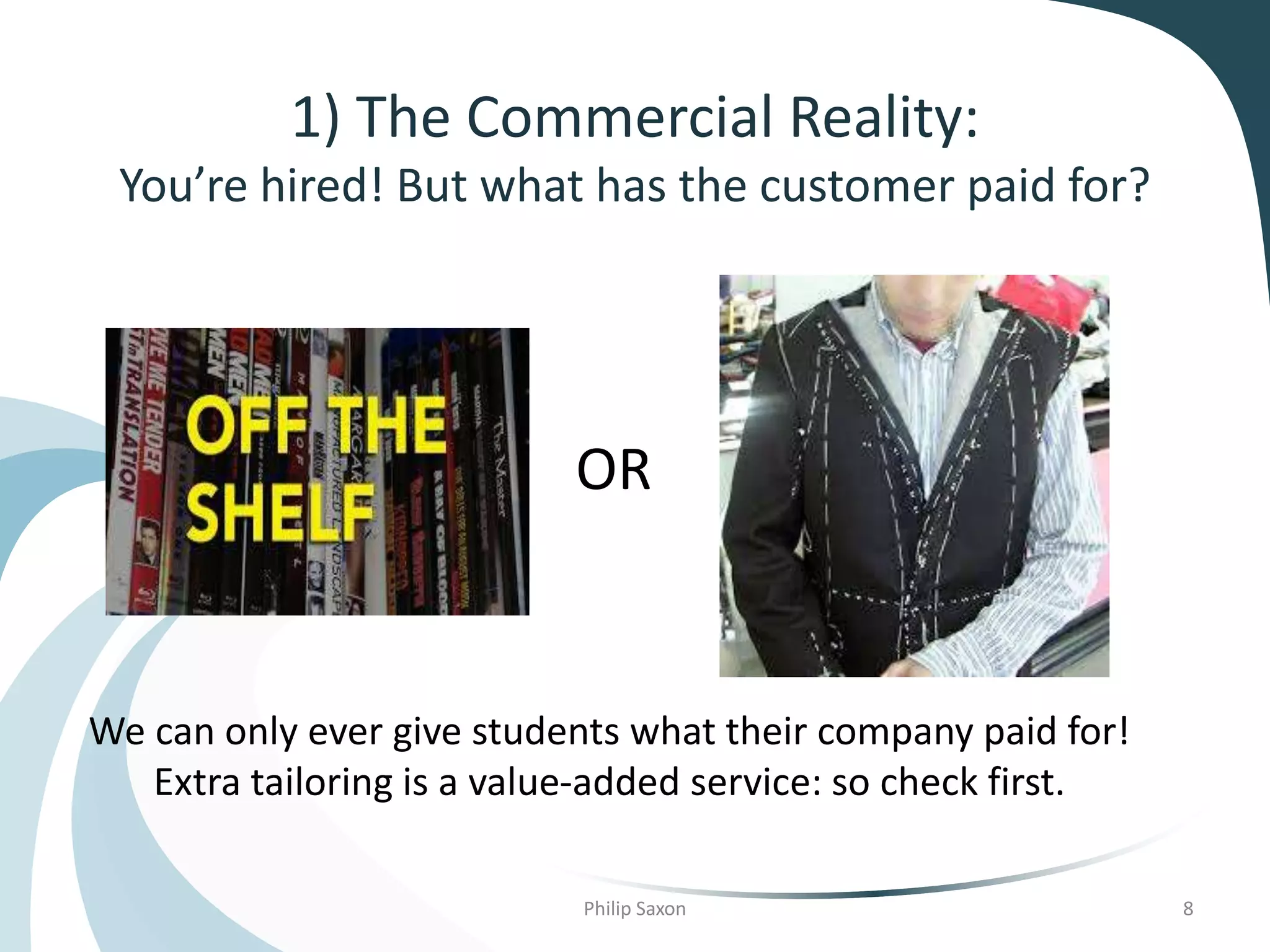
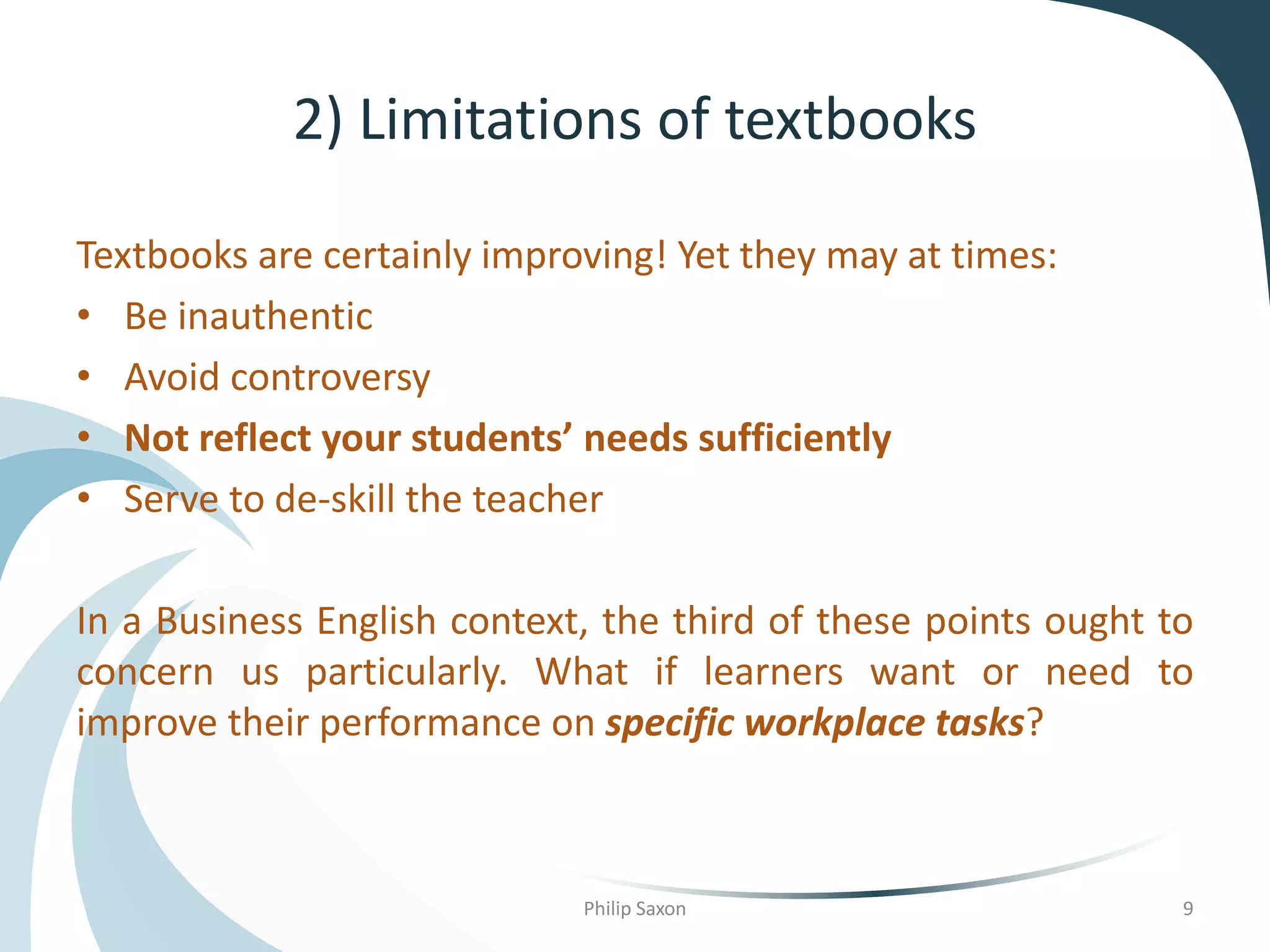
1) The Commercial Reality:
You’re hired! But what has the customer paid for?
Philip Saxon 8
OR
We can only ever give students what their company paid for!
Extra tailoring is a value-added service: so check first.
2) Limitations of textbooks
Textbooks are certainly improving! Yet they may at times:
• Be inauthentic
• Avoid controversy
• Not reflect your students’ needs sufficiently
• Serve to de-skill the teacher
In a Business English context, the third of these points ought to
concern us particularly. What if learners want or need to
improve their performance on specific workplace tasks?
Philip Saxon 9
3) The problem of diagnosing needs
First of all, whose needs are we REALLY talking about?
The business (as it
perceives needs)?
Or the student’s
(felt/actual needs)?
Philip Saxon 10
Discuss in pairs for a minute. What do you think?
Analysis: let’s start with the business.
Are they looking for a return on investment?
Philip Saxon 11
BENEFIT > COST
($$$ > $$)
Or are they simply spending a benefits allocation?
Philip Saxon 12
A “frictionless” experience – the ideal
In an ideal world the task would be easy:
• You’d learn what the students need just by asking!
• There would be plenty of time to plan.
• Balancing requests would be no problem.
• Customization would be easy to implement.
Philip Saxon 13
However, we don’t live in utopia!
• There may be no time to plan – you must start immediately.
• Students may think you’re wasting their time.
• Students in the same class may have very different needs
from each other – there are too many demands!
• There may be pressure to stick to an agreed syllabus.
Philip Saxon 14
Other problems might also arise:
• Students may be unaware of their real needs. Surprises await.
• Students may not want to make personal disclosures.
• If the boss is present, students may “clam up”.
Philip Saxon 15
Or indeed:
• The course may just be a “perk” to the students. So much for
intrinsic motivation.
• Or their expectations may be way too high – expect trouble!
Philip Saxon 16
4) The ESP Approach
The English for Special Purposes approach can work well.
In its standard form, it is relatively flexible:
1) Perform needs analysis when you meet your students;
2) Design the course, taking student needs into account;
3) Adapt the course as it progresses, in response to
observations, student feedback and changing needs.
So let’s try and put this idea into practice…
Philip Saxon 17
“High Level” Needs Analysis
A basic Business English needs analysis might ask the learner(s)
what skills or communicative functions they wish to improve, in
rather general, “high level” terms.
If you’ve done Needs Analysis for Katedra clients before, what
questionnaire was used? How did you implement it?
Discuss for 1 minute with a partner and report back.
Philip Saxon 18
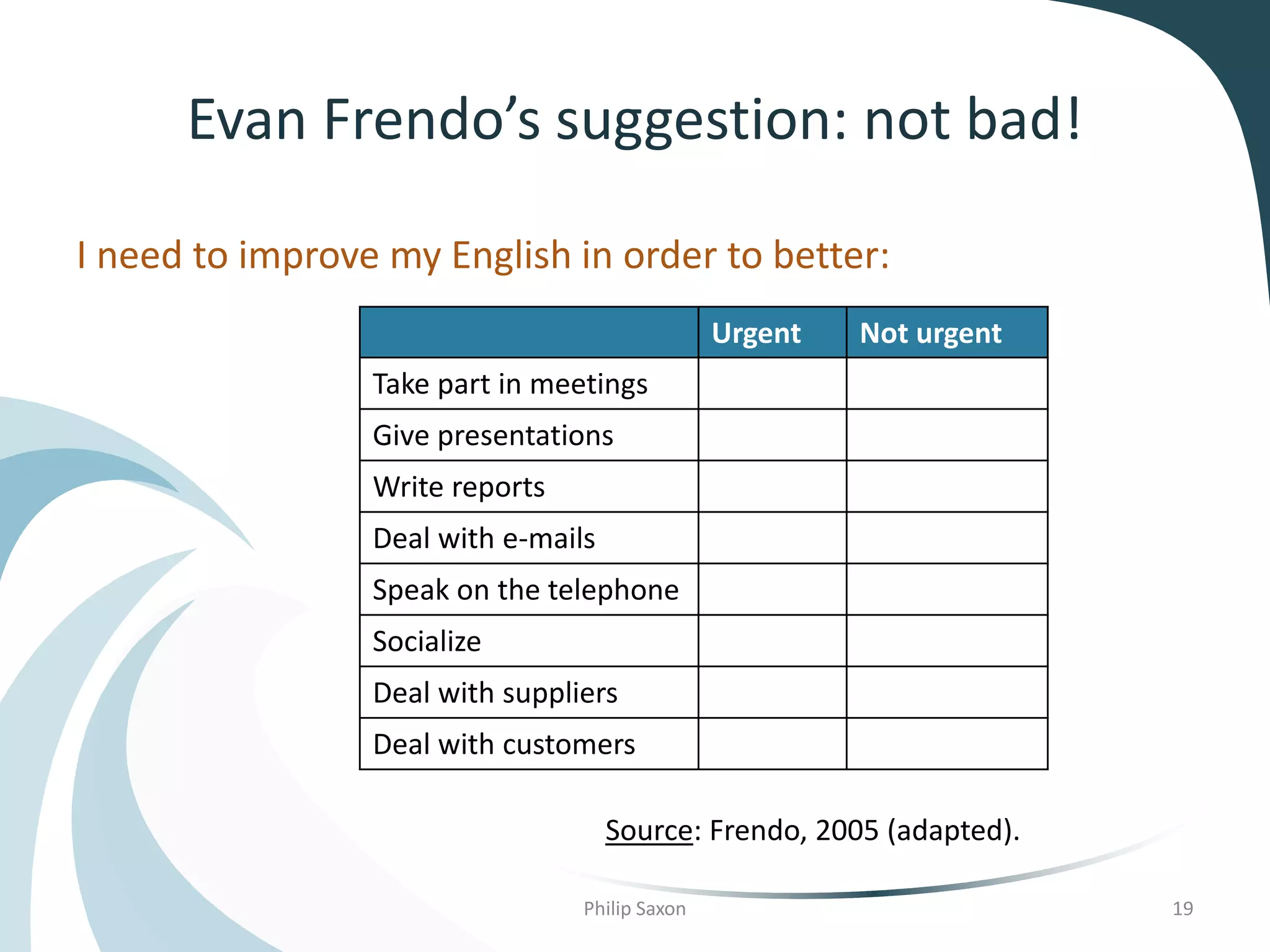
Evan Frendo’s suggestion: not bad!
I need to improve my English in order to better:
Urgent Not urgent
Take part in meetings
Give presentations
Write reports
Deal with e-mails
Speak on the telephone
Socialize
Deal with suppliers
Deal with customers
Source: Frendo, 2005 (adapted).
Philip Saxon 19
“Communicative events” (1)
True customization means getting closer to the actual business
that your students do in English every day.
This is where “communicative events” (Rei, 2012) come in:
• “I can write an e-mail” is a general, “can-do” statement.
• “I can give my boss a project status update by e-mail” is a
specific use of communication skills.
This kind of specificity is what we’re now talking about.
Philip Saxon 20
“Communicative events” (2)
So why not ask students what specific “communicative events”
matter most to them?
You can use the information gained this way to:
• Develop job-specific skills work;
• Work with authentic texts from the learners’ jobs;
• Introduce task-based role plays;
• Create realistic simulations.
So let’s examine what needs analysis can do for us here…
Philip Saxon 21
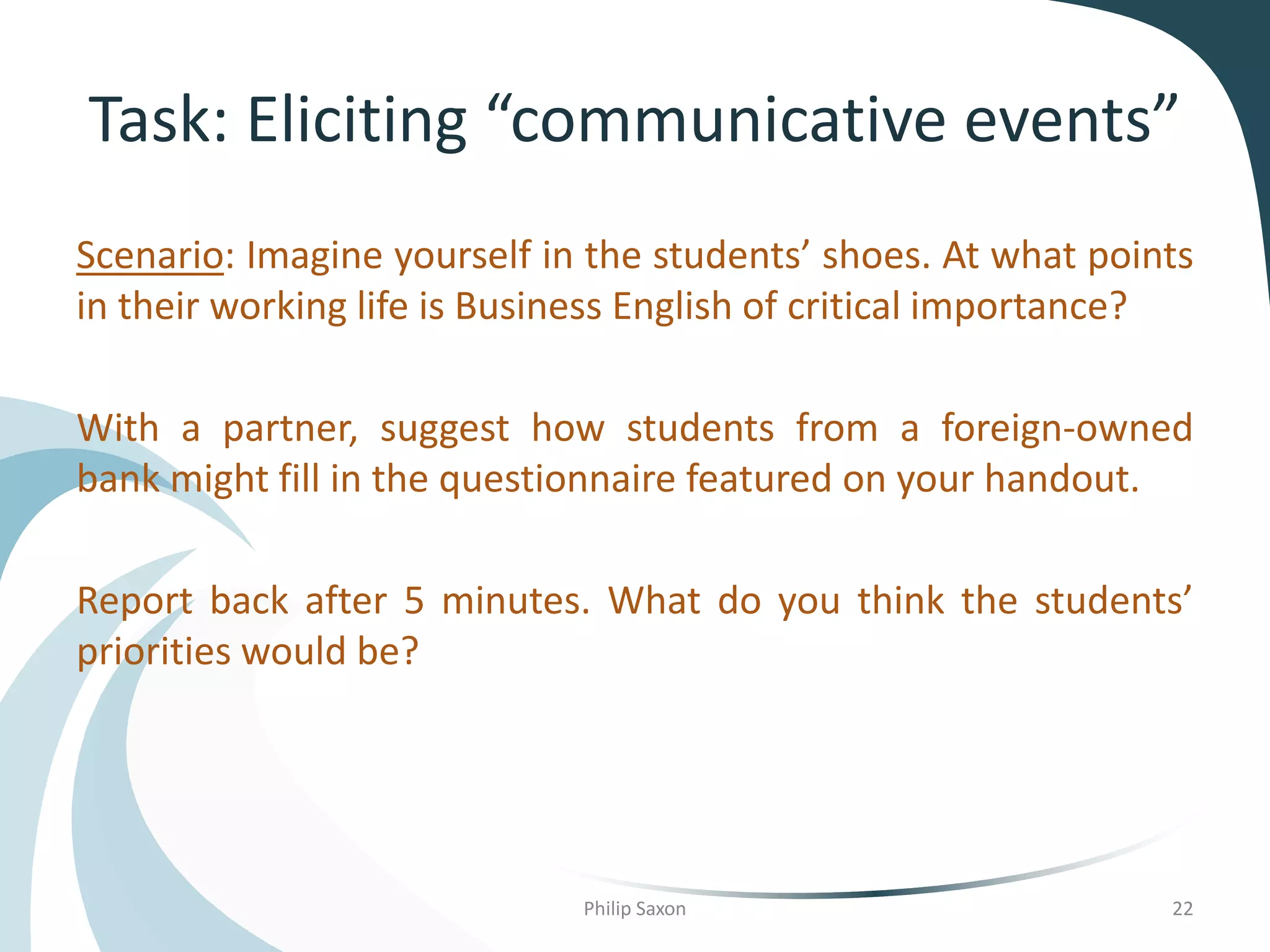
Task: Eliciting “communicative events”
Scenario: Imagine yourself in the students’ shoes. At what points
in their working life is Business English of critical importance?
With a partner, suggest how students from a foreign-owned
bank might fill in the questionnaire featured on your handout.
Report back after 5 minutes. What do you think the students’
priorities would be?
Philip Saxon 22
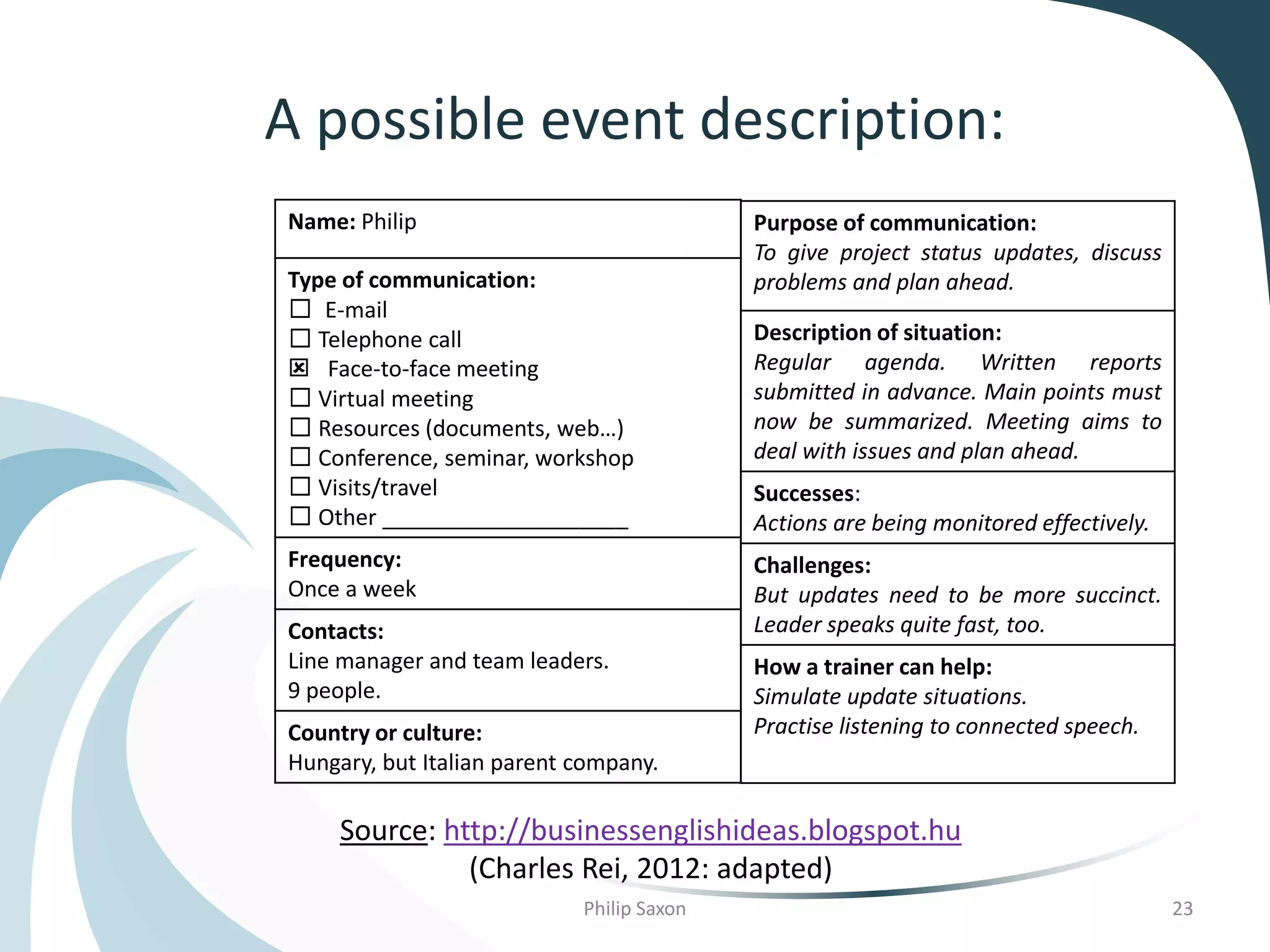
A possible event description:
Name: Philip
Type of communication:
☐ E-mail
☐ Telephone call
 Face-to-face meeting
☐ Virtual meeting
☐ Resources (documents, web…)
☐ Conference, seminar, workshop
☐ Visits/travel
☐ Other ____________________
Frequency:
Once a week
Contacts:
Line manager and team leaders.
9 people.
Country or culture:
Hungary, but Italian parent company.
Purpose of communication:
To give project status updates, discuss
problems and plan ahead.
Description of situation:
Regular agenda. Written reports
submitted in advance. Main points must
now be summarized. Meeting aims to
deal with issues and plan ahead.
Successes:
Actions are being monitored effectively.
Challenges:
But updates need to be more succinct.
Leader speaks quite fast, too.
How a trainer can help:
Simulate update situations.
Practise listening to connected speech.
Source: http://businessenglishideas.blogspot.hu
(Charles Rei, 2012: adapted)
Philip Saxon 23
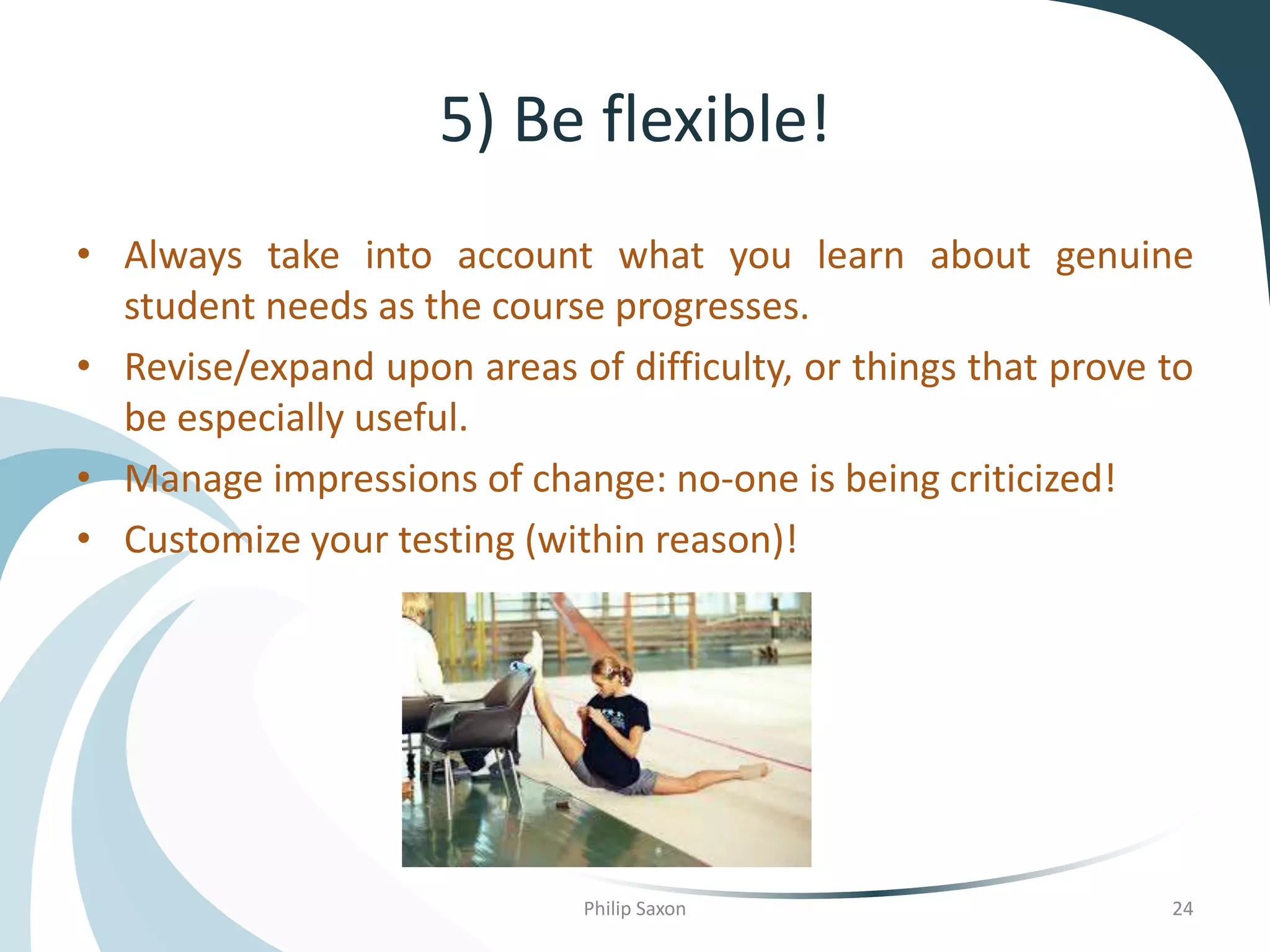
5) Be flexible!
• Always take into account what you learn about genuine
student needs as the course progresses.
• Revise/expand upon areas of difficulty, or things that prove to
be especially useful.
• Manage impressions of change: no-one is being criticized!
• Customize your testing (within reason)!
Philip Saxon 24
As well as:
• Be open: indicate where the course plan might change, and
perhaps reasons why, too.
• Include general headings in the course description: everyone
will like that.
Philip Saxon 25
So what goes into a course description?
A textbook-based syllabus will likely feature the following:
1) A topic strand;
2) A lexico-grammar strand;
3) A skills development strand – in rather general terms.
Tailoring implies we add to this a fourth strand:
4) A communicative event strand.
Learners ought to appreciate a course plan. They’ll see at a
glance what customization to expect.
Philip Saxon 26
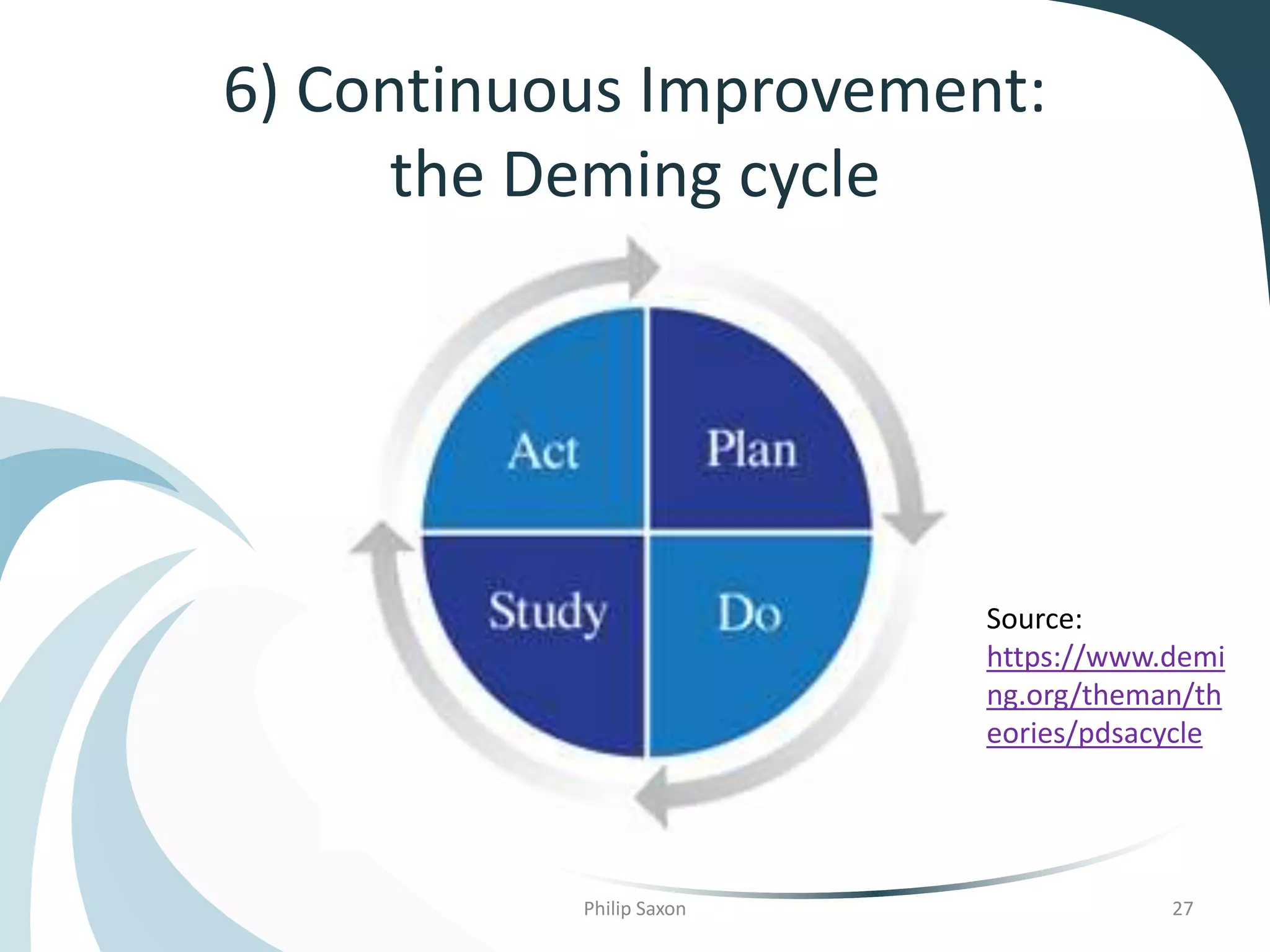
6) Continuous Improvement:
the Deming cycle
Philip Saxon 27
Source:
https://www.demi
ng.org/theman/th
eories/pdsacycle
Reviewing your initial needs analysis
In the spirit of Deming’s cycle, you can review your needs analysis at
regular intervals!
You’ll get useful interim feedback regarding client satisfaction this way.
If something’s not perfect, you can address it!
So: discuss these questions with a partner.
1) How often should you elicit such feedback on a 32-lesson course?
2) How much class time should be spent on the feedback process?
3) Should teachers fear customer feedback? Or embrace it?
Report back after three minutes.
Philip Saxon 28
Course evaluation – make it cyclical!
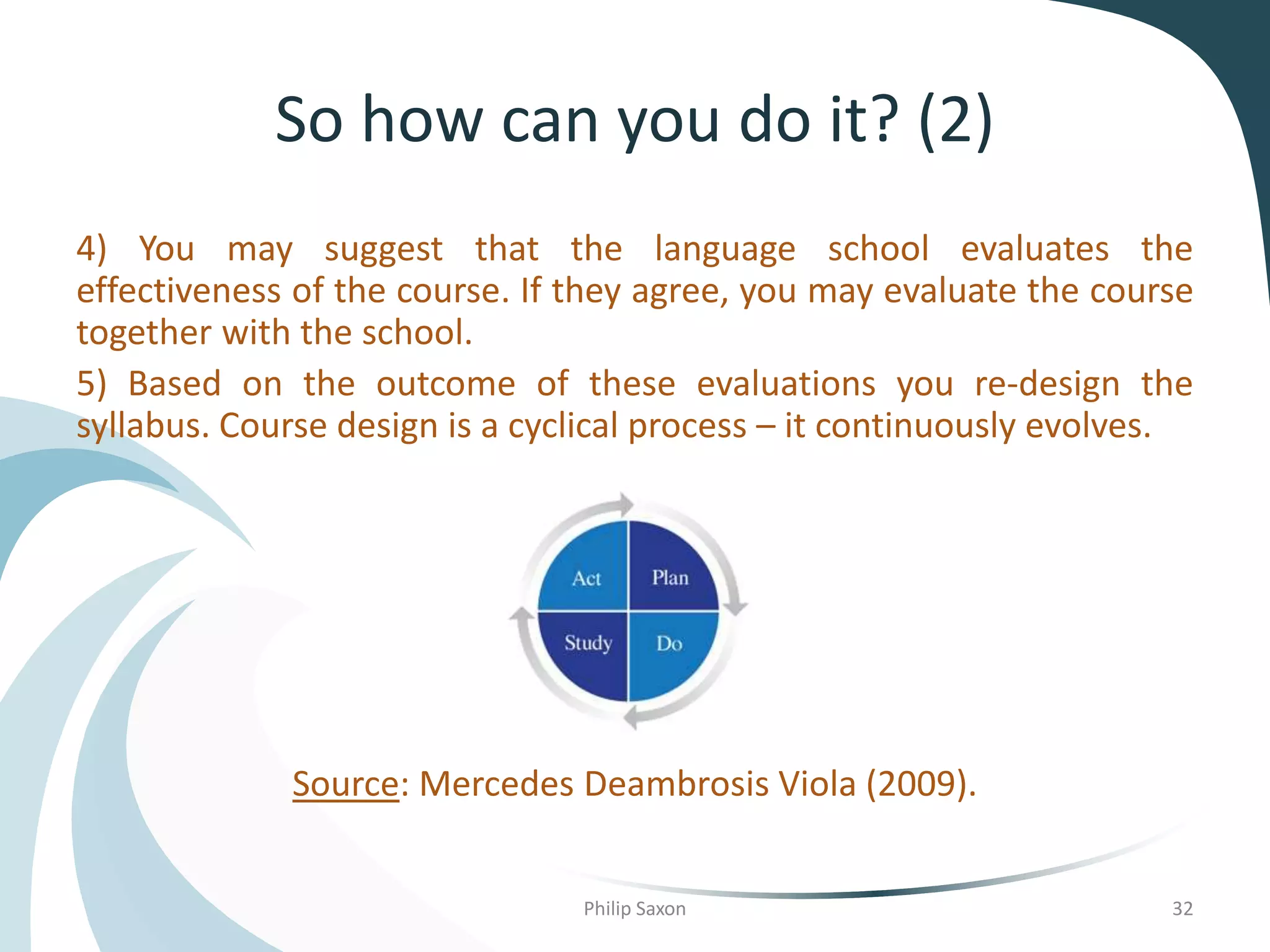
According to Viola (2009), course evaluation should be an on-
going and cyclical process.
A learner-centred teacher ought constantly to be thinking about
the needs of their students, the course objectives and how both
materials and teaching can be made more supportive.
Viewed this way, continuous course evaluation is all about
continuous improvement.
Philip Saxon 29
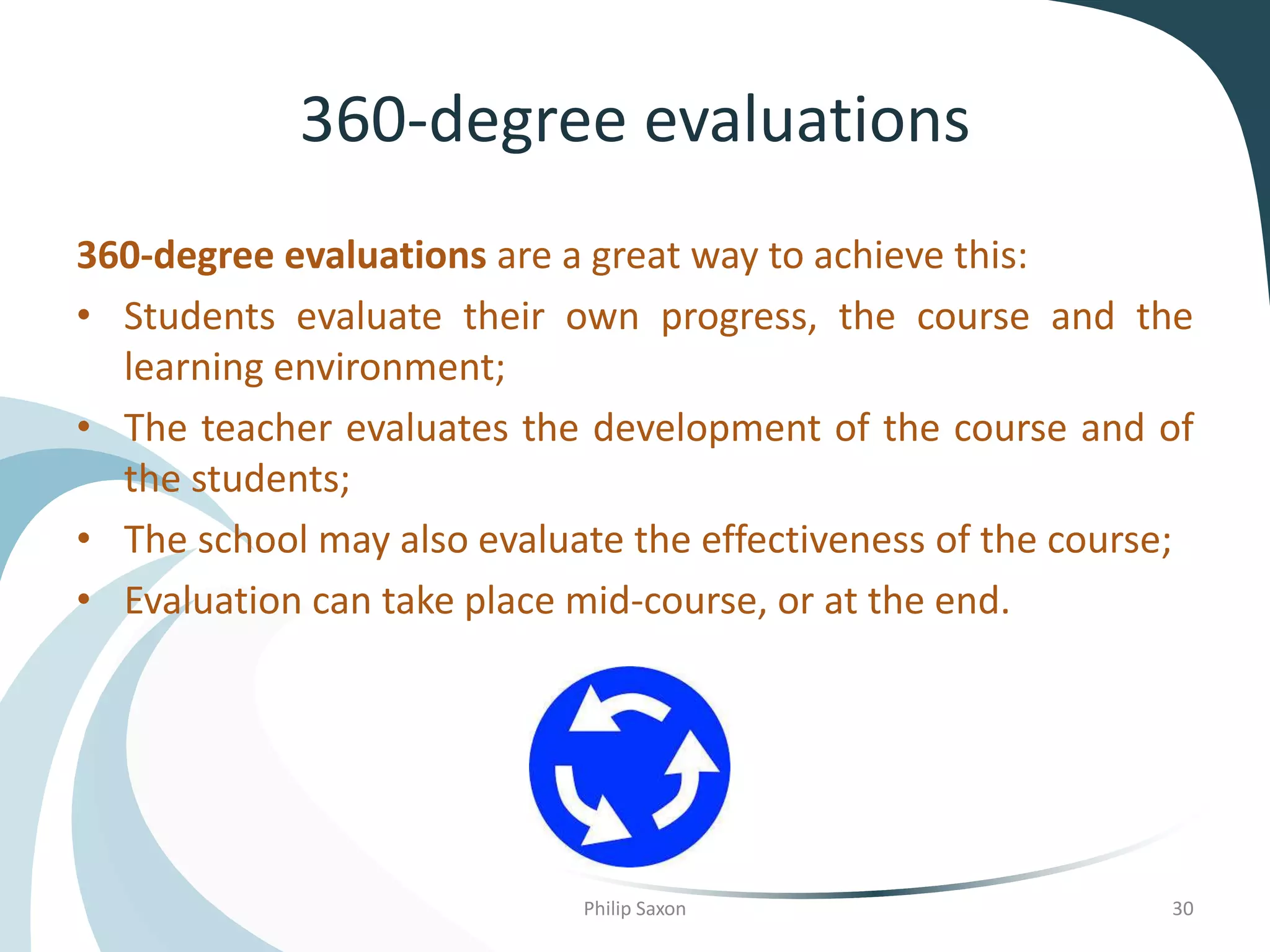
360-degree evaluations
360-degree evaluations are a great way to achieve this:
• Students evaluate their own progress, the course and the
learning environment;
• The teacher evaluates the development of the course and of
the students;
• The school may also evaluate the effectiveness of the course;
• Evaluation can take place mid-course, or at the end.
Philip Saxon 30
So how can you do it? (1)
1) After 16 lessons or so, prepare a self-assessment quiz based
on the needs, objectives and syllabus.
2) In class go over the syllabus, see what has been done so far
and what has been accomplished.
3) In class evaluate the effectiveness of the objectives and
discuss if anyone’s needs have changed at all.
Philip Saxon 31
So how can you do it? (2)
4) You may suggest that the language school evaluates the
effectiveness of the course. If they agree, you may evaluate the course
together with the school.
5) Based on the outcome of these evaluations you re-design the
syllabus. Course design is a cyclical process – it continuously evolves.
Source: Mercedes Deambrosis Viola (2009).
Philip Saxon 32
7) Conclusion: when to “go ESP”
The ESP approach is best when any of these are true:
• The client has expressly paid for tailoring;
• You have space to accommodate individual needs;
• Those needs are expressed in terms of “communicative
events” where there is a clear performance target;
• You’re in a one-to-one teaching situation, where
personalization is easy.
Philip Saxon 33
Caveats: ESP’s limitations
However, the ESP approach has its limitations:
• It’s probably only appropriate to the extent it has been paid
for. It’s added value!
• Personalization is harder to achieve in a group setting. There
may be too many demands! You’ll have to compromise.
• The worst motivational or attendance problems won’t be
solved by it. The students have other priorities – period.
• An over-rigid implementation may damage rapport. Free
conversation still has an important role to play.
Philip Saxon 34
Recap: how ESP can work as a strategy (1)
1) The learners have very different aims
It depends on the class size as well as the product purchased by the
company. But ESP still offers teachers a chance to negotiate (and/or re-
negotiate) training priorities with students.
2) The textbook isn’t really what the learners are looking for
ESP helps you take a step back. Ask learners what they need English for
in real life. Then supply materials/training accordingly. The Internet
and other books can certainly help here.
3) You want to help learners with their actual jobs – but how?
The solution is to pursue situational authenticity in the tasks/activities
you set students. If the training is relevant and helpful, it should
engage them. ESP helps you elicit what matters to them.
Philip Saxon 35
Recap: how ESP can work as a strategy (2)
4) Learners aren’t motivated to do homework
If homework is job-related, they may just do it!
5) Learners aren’t motivated by textbook activities – or by
speaking in front of their boss.
More relevant activities may help. If learners are anxious, that’s
more problematic: you want to promote a “safe learning
environment” for all students. If power distance is the issue,
consider escalating the matter to your manager and seek help.
Philip Saxon 36
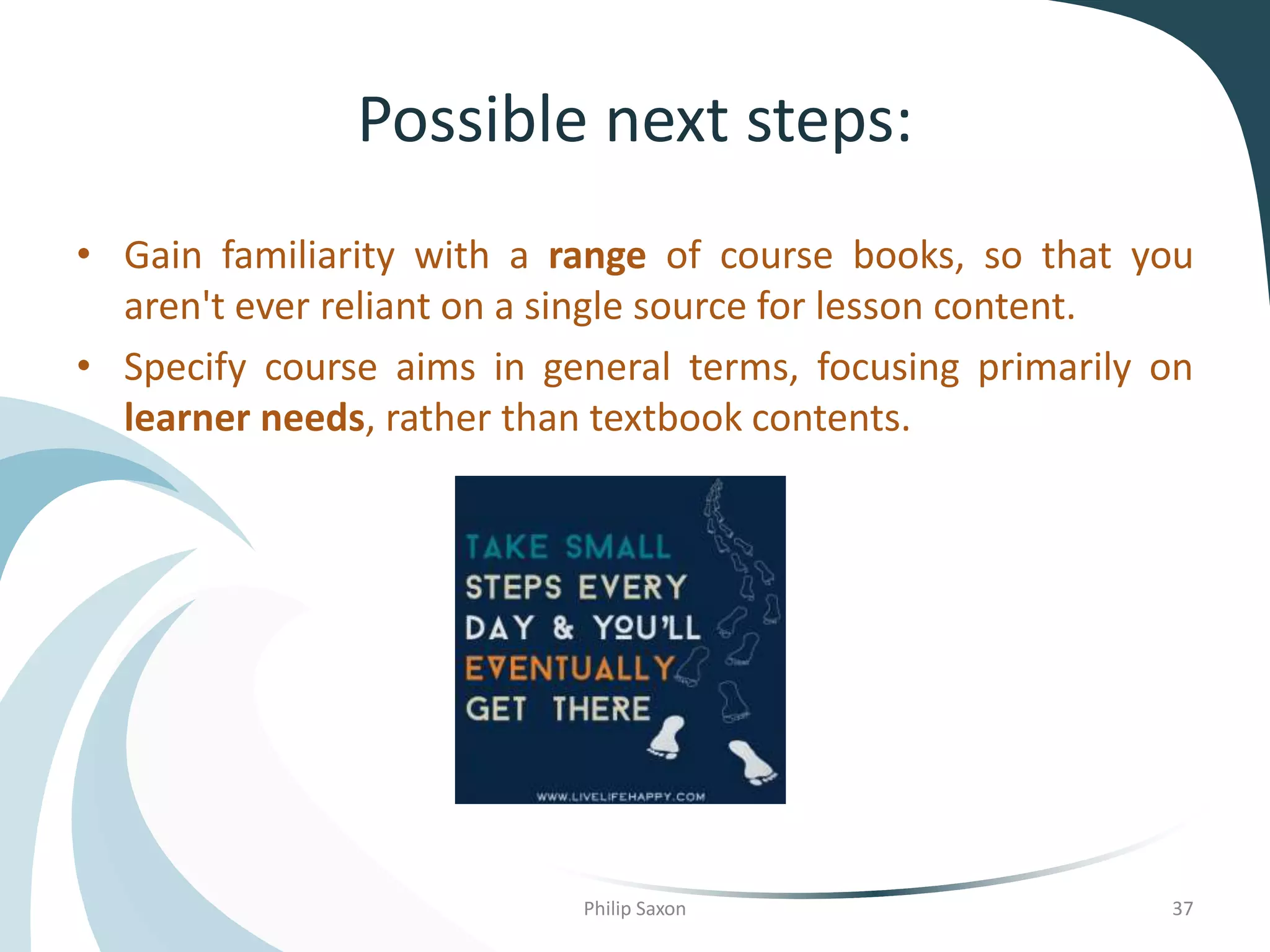
Possible next steps:
• Gain familiarity with a range of course books, so that you
aren't ever reliant on a single source for lesson content.
• Specify course aims in general terms, focusing primarily on
learner needs, rather than textbook contents.
Philip Saxon 37
So be prepared – and be flexible!
Philip Saxon 38
And enjoy teaching businesspeople!
Philip Saxon 39
Acknowledgements
Case, A. (2013). The ESP approach - theory and reality of needs analysis
and course design.
http://www.usingenglish.com/articles/esp-approach-theory-reality-
needs-analysis-course-design.html.
Frendo, E. (2005). How To Teach Business English. (Pearson Education
Ltd).
Rei, C. (2014). Business English Ideas: selected posts from
http://businessenglishideas.blogspot.hu.
Viola, M. D. (2009). Designing Business English Programmes.
http://www.teachingenglish.org.uk/article/designing-business-english-
programmes-3
Philip Saxon 40

Needs Analysis For The Real World: A Workshop

  • 1.
    NEEDS ANALYSIS FORTHE REAL WORLD: Practical tips for Business English trainers Presenter: Philip Saxon (Corvinus University & IATEFL BESIG) Philip Saxon 1
  • 2.
    Your presenter’s background •Business English trainer and HE teacher since 2009. • Used to work in IT: understands how it supports the business. • MA in ELT (ICT/Multimedia) with distinction from University of Warwick (2014). • Now speak regularly at IATEFL-Hungary and other events. Growing following as a blogger, too: – English for Authentic Purposes: http://englishforauthenticpurposes.blogspot.hu – Teaching English with Technology: http://techieenglishteacher.blogspot.hu Philip Saxon 2
  • 3.
    Who this isfor – and how they’ll benefit This talk is aimed at: 1) Teachers of Business English 2) Teachers wishing to train students to present 3) Teacher Trainers 4) Language School Managers By the end of this talk, participants should hopefully: • Understand how and when to to use the “English for Specific Purposes” (ESP) approach to Needs Analysis. Philip Saxon 3
  • 4.
    Needs analysis for thereal world Are your corporate customers a handful? Why not try the ESP approach?
  • 5.
    Needs Analysis Icebreaker Doany of these problems look familiar? 1) The learners have very different aims; 2) The textbook isn’t really what the learners are looking for; 3) You want to help learners with their actual jobs – but how? 4) Learners aren’t motivated to do homework; 5) Learners aren’t motivated by textbook activities – or by speaking in front of their boss. In groups of four (or so), discuss which look likely to occur with Business English learners. After 5 minutes, report back. Philip Saxon 5
  • 6.
    My aims todayare to show you how to: 1) Design and deliver Business English courses based around learner needs, and not simply textbook content. 2) Respond to new or changing needs as courses progress. In other words: You’ll see how to implement the ESP approach! Philip Saxon 6
  • 7.
    Contents 1) The commercialreality 2) Limitations of textbooks 3) The problem with diagnosing needs 4) The ESP Approach 5) Be flexible! 6) Continuous Improvement 7) Conclusion: when to “go ESP” Philip Saxon 7
  • 8.
    1) The CommercialReality: You’re hired! But what has the customer paid for? Philip Saxon 8 OR We can only ever give students what their company paid for! Extra tailoring is a value-added service: so check first.
  • 9.
    2) Limitations oftextbooks Textbooks are certainly improving! Yet they may at times: • Be inauthentic • Avoid controversy • Not reflect your students’ needs sufficiently • Serve to de-skill the teacher In a Business English context, the third of these points ought to concern us particularly. What if learners want or need to improve their performance on specific workplace tasks? Philip Saxon 9
  • 10.
    3) The problemof diagnosing needs First of all, whose needs are we REALLY talking about? The business (as it perceives needs)? Or the student’s (felt/actual needs)? Philip Saxon 10 Discuss in pairs for a minute. What do you think?
  • 11.
    Analysis: let’s startwith the business. Are they looking for a return on investment? Philip Saxon 11 BENEFIT > COST ($$$ > $$)
  • 12.
    Or are theysimply spending a benefits allocation? Philip Saxon 12
  • 13.
    A “frictionless” experience– the ideal In an ideal world the task would be easy: • You’d learn what the students need just by asking! • There would be plenty of time to plan. • Balancing requests would be no problem. • Customization would be easy to implement. Philip Saxon 13
  • 14.
    However, we don’tlive in utopia! • There may be no time to plan – you must start immediately. • Students may think you’re wasting their time. • Students in the same class may have very different needs from each other – there are too many demands! • There may be pressure to stick to an agreed syllabus. Philip Saxon 14
  • 15.
    Other problems mightalso arise: • Students may be unaware of their real needs. Surprises await. • Students may not want to make personal disclosures. • If the boss is present, students may “clam up”. Philip Saxon 15
  • 16.
    Or indeed: • Thecourse may just be a “perk” to the students. So much for intrinsic motivation. • Or their expectations may be way too high – expect trouble! Philip Saxon 16
  • 17.
    4) The ESPApproach The English for Special Purposes approach can work well. In its standard form, it is relatively flexible: 1) Perform needs analysis when you meet your students; 2) Design the course, taking student needs into account; 3) Adapt the course as it progresses, in response to observations, student feedback and changing needs. So let’s try and put this idea into practice… Philip Saxon 17
  • 18.
    “High Level” NeedsAnalysis A basic Business English needs analysis might ask the learner(s) what skills or communicative functions they wish to improve, in rather general, “high level” terms. If you’ve done Needs Analysis for Katedra clients before, what questionnaire was used? How did you implement it? Discuss for 1 minute with a partner and report back. Philip Saxon 18
  • 19.
    Evan Frendo’s suggestion:not bad! I need to improve my English in order to better: Urgent Not urgent Take part in meetings Give presentations Write reports Deal with e-mails Speak on the telephone Socialize Deal with suppliers Deal with customers Source: Frendo, 2005 (adapted). Philip Saxon 19
  • 20.
    “Communicative events” (1) Truecustomization means getting closer to the actual business that your students do in English every day. This is where “communicative events” (Rei, 2012) come in: • “I can write an e-mail” is a general, “can-do” statement. • “I can give my boss a project status update by e-mail” is a specific use of communication skills. This kind of specificity is what we’re now talking about. Philip Saxon 20
  • 21.
    “Communicative events” (2) Sowhy not ask students what specific “communicative events” matter most to them? You can use the information gained this way to: • Develop job-specific skills work; • Work with authentic texts from the learners’ jobs; • Introduce task-based role plays; • Create realistic simulations. So let’s examine what needs analysis can do for us here… Philip Saxon 21
  • 22.
    Task: Eliciting “communicativeevents” Scenario: Imagine yourself in the students’ shoes. At what points in their working life is Business English of critical importance? With a partner, suggest how students from a foreign-owned bank might fill in the questionnaire featured on your handout. Report back after 5 minutes. What do you think the students’ priorities would be? Philip Saxon 22
  • 23.
    A possible eventdescription: Name: Philip Type of communication: ☐ E-mail ☐ Telephone call  Face-to-face meeting ☐ Virtual meeting ☐ Resources (documents, web…) ☐ Conference, seminar, workshop ☐ Visits/travel ☐ Other ____________________ Frequency: Once a week Contacts: Line manager and team leaders. 9 people. Country or culture: Hungary, but Italian parent company. Purpose of communication: To give project status updates, discuss problems and plan ahead. Description of situation: Regular agenda. Written reports submitted in advance. Main points must now be summarized. Meeting aims to deal with issues and plan ahead. Successes: Actions are being monitored effectively. Challenges: But updates need to be more succinct. Leader speaks quite fast, too. How a trainer can help: Simulate update situations. Practise listening to connected speech. Source: http://businessenglishideas.blogspot.hu (Charles Rei, 2012: adapted) Philip Saxon 23
  • 24.
    5) Be flexible! •Always take into account what you learn about genuine student needs as the course progresses. • Revise/expand upon areas of difficulty, or things that prove to be especially useful. • Manage impressions of change: no-one is being criticized! • Customize your testing (within reason)! Philip Saxon 24
  • 25.
    As well as: •Be open: indicate where the course plan might change, and perhaps reasons why, too. • Include general headings in the course description: everyone will like that. Philip Saxon 25
  • 26.
    So what goesinto a course description? A textbook-based syllabus will likely feature the following: 1) A topic strand; 2) A lexico-grammar strand; 3) A skills development strand – in rather general terms. Tailoring implies we add to this a fourth strand: 4) A communicative event strand. Learners ought to appreciate a course plan. They’ll see at a glance what customization to expect. Philip Saxon 26
  • 27.
    6) Continuous Improvement: theDeming cycle Philip Saxon 27 Source: https://www.demi ng.org/theman/th eories/pdsacycle
  • 28.
    Reviewing your initialneeds analysis In the spirit of Deming’s cycle, you can review your needs analysis at regular intervals! You’ll get useful interim feedback regarding client satisfaction this way. If something’s not perfect, you can address it! So: discuss these questions with a partner. 1) How often should you elicit such feedback on a 32-lesson course? 2) How much class time should be spent on the feedback process? 3) Should teachers fear customer feedback? Or embrace it? Report back after three minutes. Philip Saxon 28
  • 29.
    Course evaluation –make it cyclical! According to Viola (2009), course evaluation should be an on- going and cyclical process. A learner-centred teacher ought constantly to be thinking about the needs of their students, the course objectives and how both materials and teaching can be made more supportive. Viewed this way, continuous course evaluation is all about continuous improvement. Philip Saxon 29
  • 30.
    360-degree evaluations 360-degree evaluationsare a great way to achieve this: • Students evaluate their own progress, the course and the learning environment; • The teacher evaluates the development of the course and of the students; • The school may also evaluate the effectiveness of the course; • Evaluation can take place mid-course, or at the end. Philip Saxon 30
  • 31.
    So how canyou do it? (1) 1) After 16 lessons or so, prepare a self-assessment quiz based on the needs, objectives and syllabus. 2) In class go over the syllabus, see what has been done so far and what has been accomplished. 3) In class evaluate the effectiveness of the objectives and discuss if anyone’s needs have changed at all. Philip Saxon 31
  • 32.
    So how canyou do it? (2) 4) You may suggest that the language school evaluates the effectiveness of the course. If they agree, you may evaluate the course together with the school. 5) Based on the outcome of these evaluations you re-design the syllabus. Course design is a cyclical process – it continuously evolves. Source: Mercedes Deambrosis Viola (2009). Philip Saxon 32
  • 33.
    7) Conclusion: whento “go ESP” The ESP approach is best when any of these are true: • The client has expressly paid for tailoring; • You have space to accommodate individual needs; • Those needs are expressed in terms of “communicative events” where there is a clear performance target; • You’re in a one-to-one teaching situation, where personalization is easy. Philip Saxon 33
  • 34.
    Caveats: ESP’s limitations However,the ESP approach has its limitations: • It’s probably only appropriate to the extent it has been paid for. It’s added value! • Personalization is harder to achieve in a group setting. There may be too many demands! You’ll have to compromise. • The worst motivational or attendance problems won’t be solved by it. The students have other priorities – period. • An over-rigid implementation may damage rapport. Free conversation still has an important role to play. Philip Saxon 34
  • 35.
    Recap: how ESPcan work as a strategy (1) 1) The learners have very different aims It depends on the class size as well as the product purchased by the company. But ESP still offers teachers a chance to negotiate (and/or re- negotiate) training priorities with students. 2) The textbook isn’t really what the learners are looking for ESP helps you take a step back. Ask learners what they need English for in real life. Then supply materials/training accordingly. The Internet and other books can certainly help here. 3) You want to help learners with their actual jobs – but how? The solution is to pursue situational authenticity in the tasks/activities you set students. If the training is relevant and helpful, it should engage them. ESP helps you elicit what matters to them. Philip Saxon 35
  • 36.
    Recap: how ESPcan work as a strategy (2) 4) Learners aren’t motivated to do homework If homework is job-related, they may just do it! 5) Learners aren’t motivated by textbook activities – or by speaking in front of their boss. More relevant activities may help. If learners are anxious, that’s more problematic: you want to promote a “safe learning environment” for all students. If power distance is the issue, consider escalating the matter to your manager and seek help. Philip Saxon 36
  • 37.
    Possible next steps: •Gain familiarity with a range of course books, so that you aren't ever reliant on a single source for lesson content. • Specify course aims in general terms, focusing primarily on learner needs, rather than textbook contents. Philip Saxon 37
  • 38.
    So be prepared– and be flexible! Philip Saxon 38
  • 39.
    And enjoy teachingbusinesspeople! Philip Saxon 39
  • 40.
    Acknowledgements Case, A. (2013).The ESP approach - theory and reality of needs analysis and course design. http://www.usingenglish.com/articles/esp-approach-theory-reality- needs-analysis-course-design.html. Frendo, E. (2005). How To Teach Business English. (Pearson Education Ltd). Rei, C. (2014). Business English Ideas: selected posts from http://businessenglishideas.blogspot.hu. Viola, M. D. (2009). Designing Business English Programmes. http://www.teachingenglish.org.uk/article/designing-business-english- programmes-3 Philip Saxon 40

Editor's Notes

  • #6  ----- Meeting Notes (08/01/15 11:34) ----- AIMS: 1) Activate participants' mental schemata. 2) Share a range of experiences - look for common factors. 3) Elicit training needs and promise to address them in talk.
  • #11  ----- Meeting Notes (08/01/15 11:57) ----- AIM: Invite the audience to speak at this point. What do they think? ----- Meeting Notes (09/01/15 14:25) ----- ASK AUDIENCE TO DISCUSS IN PAIRS AND REPORT BACK
  • #12  ----- Meeting Notes (08/01/15 11:57) ----- AIM: 1) Elicit suggestions from audience as to how often this is true.
  • #13  ----- Meeting Notes (08/01/15 11:57) ----- AIM: 1) Elicit suggestions from audience as to how often this is true. ----- Meeting Notes (08/01/15 12:13) ----- AIM: 2) Ask audience: who, in the main, are Katedra's clients? What do they appear to be looking for from BE trainers? ----- Meeting Notes (08/01/15 12:14) ----- 3) Ask audience: what clues are there in the brief teachers are given when they accept work from Katedra? ----- Meeting Notes (08/01/15 12:14) ----- 4) What questions can teachers usefully ask their ADOS or Key Account Manager at this point? ----- Meeting Notes (09/01/15 14:28) ----- ASK AUDIENCE WHAT TYPE OF COMPANIES BUY THIS TYPE OF PACKAGE ASK AUDIENCE WHAT CLUES ARE CONTAINED IN THE BRIEF
  • #14  ----- Meeting Notes (08/01/15 11:57) ----- AIM: 1) Elicit suggestions from audience as to how often this is true.
  • #15  ----- Meeting Notes (08/01/15 11:57) ----- AIM: 1) Elicit suggestions from audience as to how often this is true.
  • #16  ----- Meeting Notes (08/01/15 11:57) ----- AIM: 1) Elicit suggestions from audience as to how often this is true.
  • #17  ----- Meeting Notes (08/01/15 11:57) ----- AIM: 1) Elicit suggestions from audience as to how often this is true.