Need
Analysis
Language
Policy and
Curriculum
Design
Saffira Ramadhani
2110302010
Nurul Ngaini K.
2110302006
Diva Maulida
2120302040
GROUP MEMBER
Needs analysis is directed
mainly at the goals and
content of a course. It
examines what the learners
know already and what they
need to know.
Definition
The Various Focuses of Needs Analysis
Hutchinson and Waters (1987) divide needs into:
Needs
Target Needs  what the learner
needs to do in the target situation
Learning Needs  what the learner
needs to do in order to learn
Wants
Lacks
Necessities
Psychological
Motivational
Material
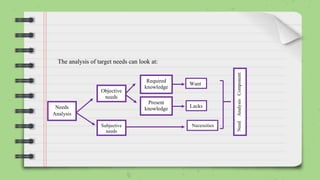
The analysis of target needs can look at:
Needs
Analysis
Objective
needs
Subjective
needs
Required
knowledge
Present
knowledge
Want
s
Lacks
Necessities
Need
Analysis
Component
Needs Analysis
Tools !
1. Necessities
Necessities are about
what the learners has to
know in order to function
effectively in the target
situation. In other word,
necessities also mean the
need of someone to be
success in his or her
business. Moreover,
according to Allwright
(1982, quoted in West,
1994) wants is the skills
which a student’s sees as
being relevant to himself
or herself.
For example : a businessman or -
woman might need to understand
business letters, to communicate
effectively as sales conferences,
to get the necessary information
from sales catalogues and so on.
He or she will presumably also
need to know the linguistic
features- discoursal, functional,
structural, lexical- which are
commonly used in that situation
identified. Thus, observing the
situation the learner will need
to function and then analyzing
the constituent parts of them is
important in order to now the
necessities of the learners.
2. Lacks
One way to investigate
where the learners are at
present and how good they
are at writing assignments
now is to look at an
assignment or two that the
learners have just written.
It can be analyzed from an
information, a grammar and
the discourse perspective.
Another source of
information about lacks
could come from the
university lecturer who
marks such assignments and
the way to get the learner
talk about the assignment
task.
To gather data about the
learners’ general
proficiency, we can
interview them, get them
to sit tests such as
vocabulary tests,
grammar tests, writing
tests and comprehension
tests, or we can get
them to do self-
assessment using a
specially prepared
checklist.
3. Wants
Learners have their own views
about what they think is
useful for them. Information
about this is useful in
working out whether the
learners’ views and the needs
analyst’s views are the same
or not. If they are not the
same, then the curriculum
designer may need to rethink
the results of the needs
analysis or persuade the
learners that there is a more
useful view of what they
need. We can gather such
information through an
interview or a questionnaire.
Evaluating Needs Analysis
Reliable needs analysis involves using well-thought-out,
standardized tools that are applied systematically. Valid
needs analysis involves looking at what is relevant and
important. Consideration of the type of need that is being
looked at and the type of information that is being gathered
is important. Before needs analysis begins it may be necessary
to do a ranking activity to decide what type of need should
get priority in the needs analysis investigation.
Issues in Needs Analysis
1.Common core and specialized language
From a vocabulary point of view (Nation and Hwang, 1995; Sutarsyah et
al., 1994) there is evidence to support the idea that learners should
first focus on a common core of 2,000 words, then focus on general
academic vocabulary common to a wide range. Study of vocabulary
occurrence shows that this sequence of goals is sensible and generally
gives the best return for learning effort. If goals are very focused, it
is possible to shorten each step a little.
2. Narrow focus – wide focus
The arguments in favor of a narrow focus include the faster meeting of
needs, the reduction of the quantity of learning needed, and the
motivation that comes from getting an immediate return from being able
to apply learning. however, runs the risk of teaching “parole” and not
“langue” (De Saussure, 1983), that is, of not teaching the language
system so that learners can be flexible and creative in their language
use.
Issues in Needs Analysis
3. Critical needs analysis
The questions they ask, the areas they investigate, and the
conclusions they draw are inevitably influenced by their
attitudes to change and the status quo. So, it is worth
considering a wide range of possible viewpoints when deciding
on the focus of needs analysis, and seeking others’ views on
where change could be made.
Thankyou
Revise Need Analysis - Group 3.pptx

Revise Need Analysis - Group 3.pptx

  • 1.
  • 2.
    Saffira Ramadhani 2110302010 Nurul NgainiK. 2110302006 Diva Maulida 2120302040 GROUP MEMBER
  • 3.
    Needs analysis isdirected mainly at the goals and content of a course. It examines what the learners know already and what they need to know. Definition
  • 4.
    The Various Focusesof Needs Analysis Hutchinson and Waters (1987) divide needs into: Needs Target Needs  what the learner needs to do in the target situation Learning Needs  what the learner needs to do in order to learn Wants Lacks Necessities Psychological Motivational Material
  • 5.
    The analysis oftarget needs can look at: Needs Analysis Objective needs Subjective needs Required knowledge Present knowledge Want s Lacks Necessities Need Analysis Component
  • 6.
    Needs Analysis Tools ! 1.Necessities Necessities are about what the learners has to know in order to function effectively in the target situation. In other word, necessities also mean the need of someone to be success in his or her business. Moreover, according to Allwright (1982, quoted in West, 1994) wants is the skills which a student’s sees as being relevant to himself or herself. For example : a businessman or - woman might need to understand business letters, to communicate effectively as sales conferences, to get the necessary information from sales catalogues and so on. He or she will presumably also need to know the linguistic features- discoursal, functional, structural, lexical- which are commonly used in that situation identified. Thus, observing the situation the learner will need to function and then analyzing the constituent parts of them is important in order to now the necessities of the learners.
  • 7.
    2. Lacks One wayto investigate where the learners are at present and how good they are at writing assignments now is to look at an assignment or two that the learners have just written. It can be analyzed from an information, a grammar and the discourse perspective. Another source of information about lacks could come from the university lecturer who marks such assignments and the way to get the learner talk about the assignment task. To gather data about the learners’ general proficiency, we can interview them, get them to sit tests such as vocabulary tests, grammar tests, writing tests and comprehension tests, or we can get them to do self- assessment using a specially prepared checklist.
  • 8.
    3. Wants Learners havetheir own views about what they think is useful for them. Information about this is useful in working out whether the learners’ views and the needs analyst’s views are the same or not. If they are not the same, then the curriculum designer may need to rethink the results of the needs analysis or persuade the learners that there is a more useful view of what they need. We can gather such information through an interview or a questionnaire.
  • 9.
    Evaluating Needs Analysis Reliableneeds analysis involves using well-thought-out, standardized tools that are applied systematically. Valid needs analysis involves looking at what is relevant and important. Consideration of the type of need that is being looked at and the type of information that is being gathered is important. Before needs analysis begins it may be necessary to do a ranking activity to decide what type of need should get priority in the needs analysis investigation.
  • 10.
    Issues in NeedsAnalysis 1.Common core and specialized language From a vocabulary point of view (Nation and Hwang, 1995; Sutarsyah et al., 1994) there is evidence to support the idea that learners should first focus on a common core of 2,000 words, then focus on general academic vocabulary common to a wide range. Study of vocabulary occurrence shows that this sequence of goals is sensible and generally gives the best return for learning effort. If goals are very focused, it is possible to shorten each step a little. 2. Narrow focus – wide focus The arguments in favor of a narrow focus include the faster meeting of needs, the reduction of the quantity of learning needed, and the motivation that comes from getting an immediate return from being able to apply learning. however, runs the risk of teaching “parole” and not “langue” (De Saussure, 1983), that is, of not teaching the language system so that learners can be flexible and creative in their language use.
  • 11.
    Issues in NeedsAnalysis 3. Critical needs analysis The questions they ask, the areas they investigate, and the conclusions they draw are inevitably influenced by their attitudes to change and the status quo. So, it is worth considering a wide range of possible viewpoints when deciding on the focus of needs analysis, and seeking others’ views on where change could be made.
  • 12.