Copyright 2015 111/21/2016 Copyright 2016 1
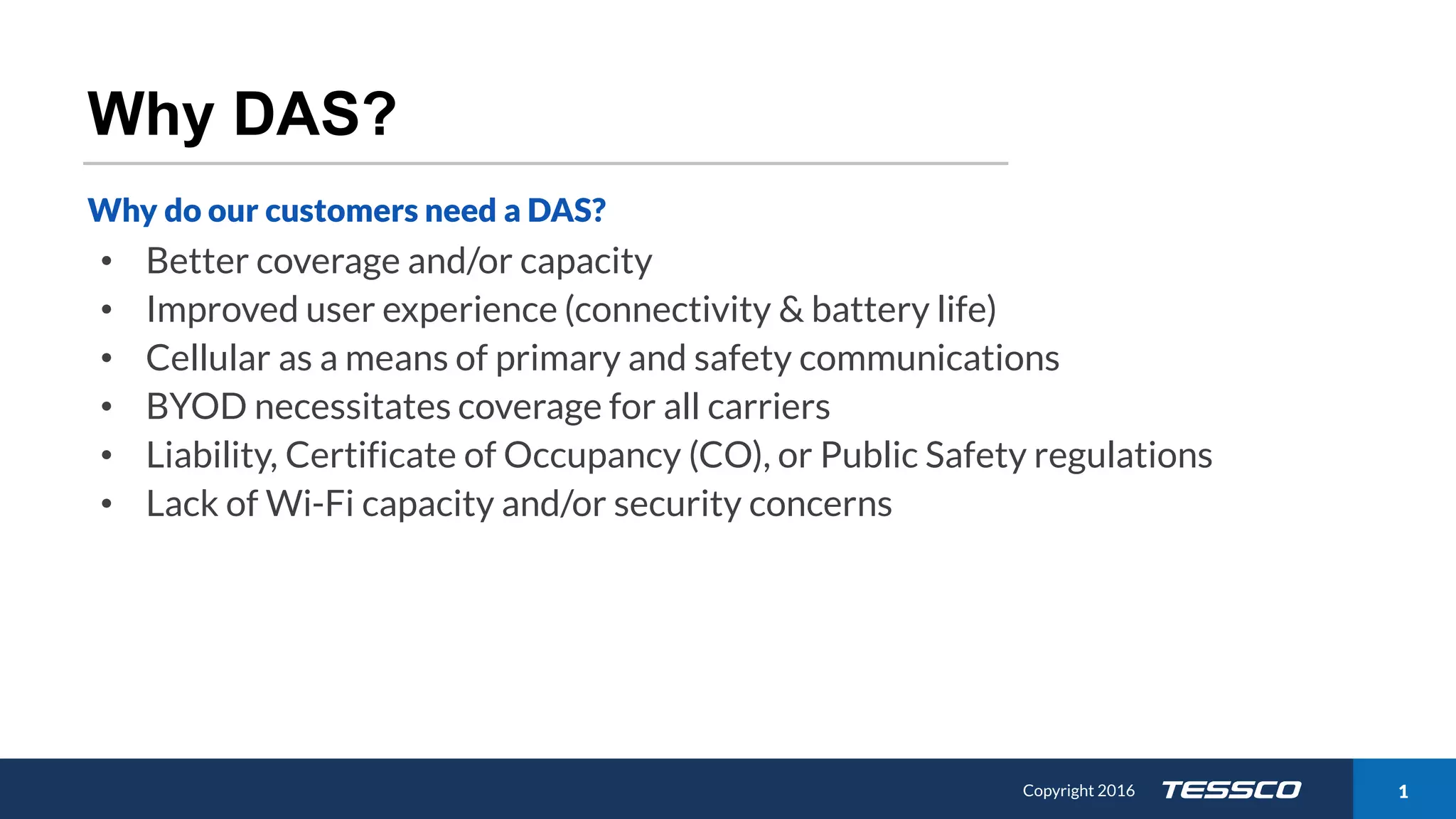
Why DAS?
Why do our customers need a DAS?
• Better coverage and/or capacity
• Improved user experience (connectivity & battery life)
• Cellular as a means of primary and safety communications
• BYOD necessitates coverage for all carriers
• Liability, Certificate of Occupancy (CO), or Public Safety regulations
• Lack of Wi-Fi capacity and/or security concerns
Copyright 2015 211/21/2016 Copyright 2016 2
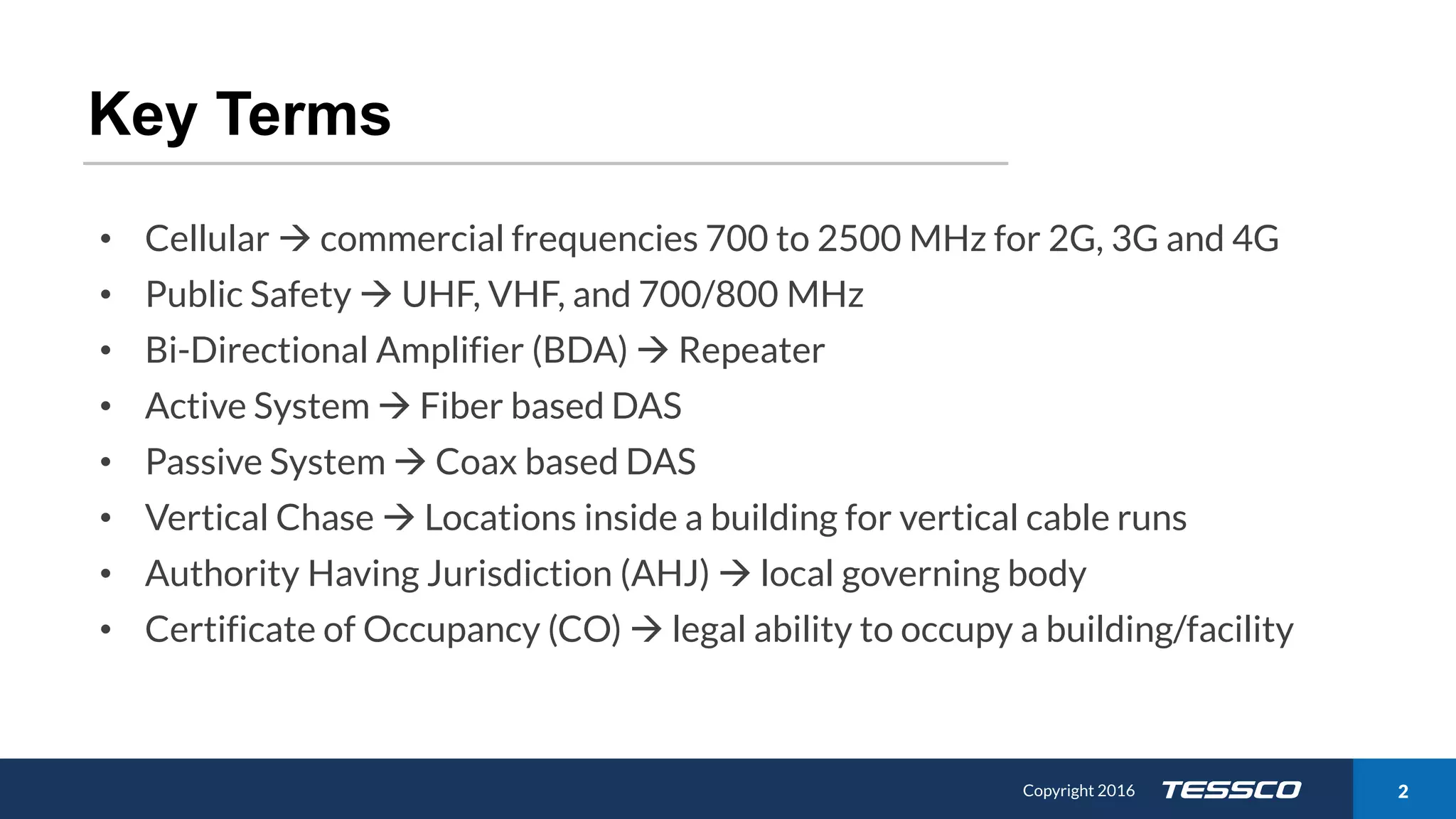
Key Terms
• Cellular  commercial frequencies 700 to 2500 MHz for 2G, 3G and 4G
• Public Safety  UHF, VHF, and 700/800 MHz
• Bi-Directional Amplifier (BDA)  Repeater
• Active System  Fiber based DAS
• Passive System  Coax based DAS
• Vertical Chase  Locations inside a building for vertical cable runs
• Authority Having Jurisdiction (AHJ)  local governing body
• Certificate of Occupancy (CO)  legal ability to occupy a building/facility
Copyright 2015 311/21/2016 Copyright 2016 3
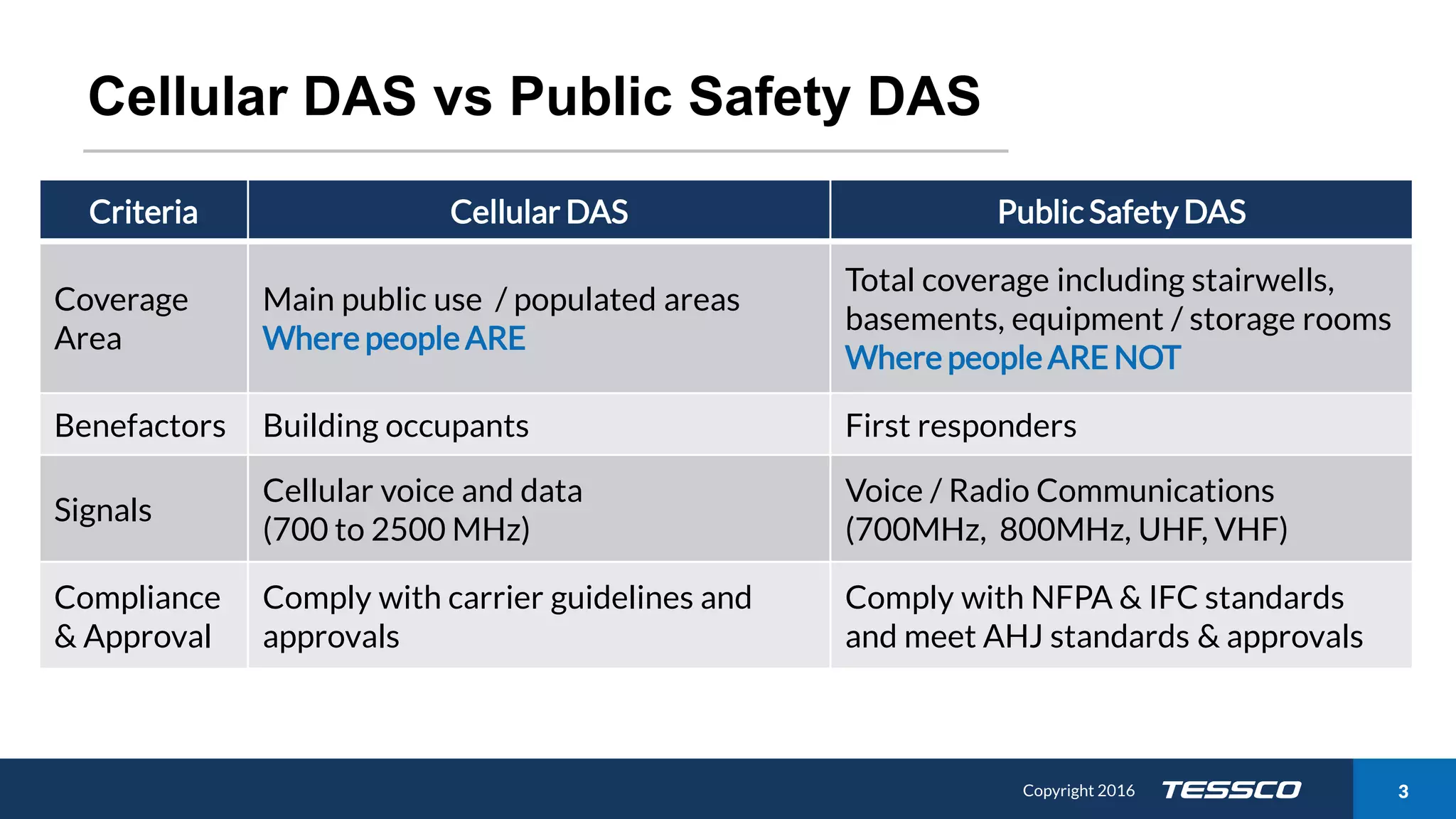
Cellular DAS vs Public Safety DAS
Criteria Cellular DAS Public Safety DAS
Coverage
Area
Main public use / populated areas
Where people ARE
Total coverage including stairwells,
basements, equipment / storage rooms
Where people ARE NOT
Benefactors Building occupants First responders
Signals
Cellular voice and data
(700 to 2500 MHz)
Voice / Radio Communications
(700MHz, 800MHz, UHF, VHF)
Compliance
& Approval
Comply with carrier guidelines and
approvals
Comply with NFPA & IFC standards
and meet AHJ standards & approvals
Copyright 2015 411/21/2016 Copyright 2016 4
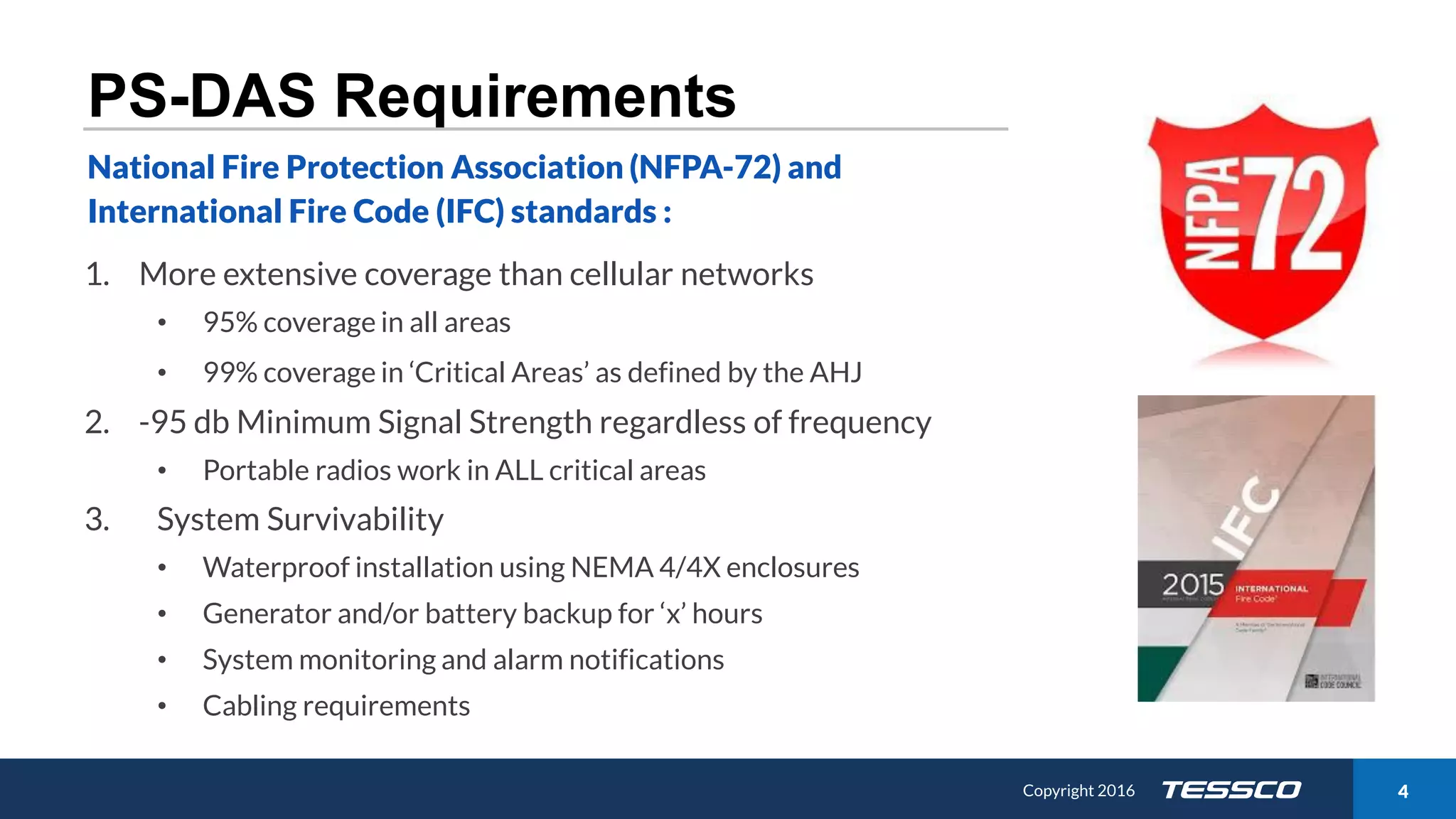
PS-DAS Requirements
1. More extensive coverage than cellular networks
• 95% coverage in all areas
• 99% coverage in ‘Critical Areas’ as defined by the AHJ
2. -95 db Minimum Signal Strength regardless of frequency
• Portable radios work in ALL critical areas
3. System Survivability
• Waterproof installation using NEMA 4/4X enclosures
• Generator and/or battery backup for ‘x’ hours
• System monitoring and alarm notifications
• Cabling requirements
National Fire Protection Association (NFPA-72) and
International Fire Code (IFC) standards :
Copyright 2015 511/21/2016 Copyright 2016 5
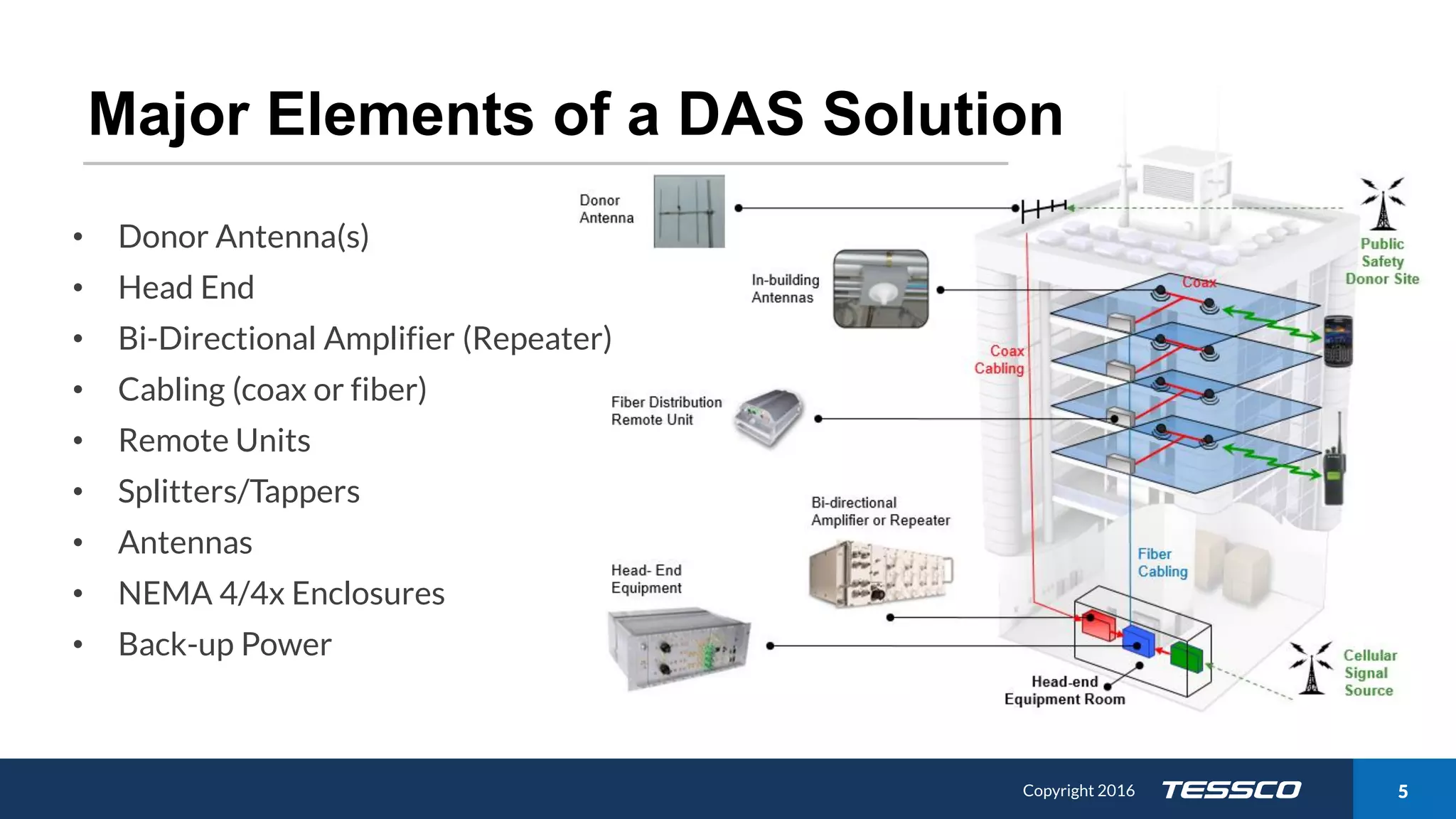
Major Elements of a DAS Solution
• Donor Antenna(s)
• Head End
• Bi-Directional Amplifier (Repeater)
• Cabling (coax or fiber)
• Remote Units
• Splitters/Tappers
• Antennas
• NEMA 4/4x Enclosures
• Back-up Power
Copyright 2015 611/21/2016 Copyright 2016 6
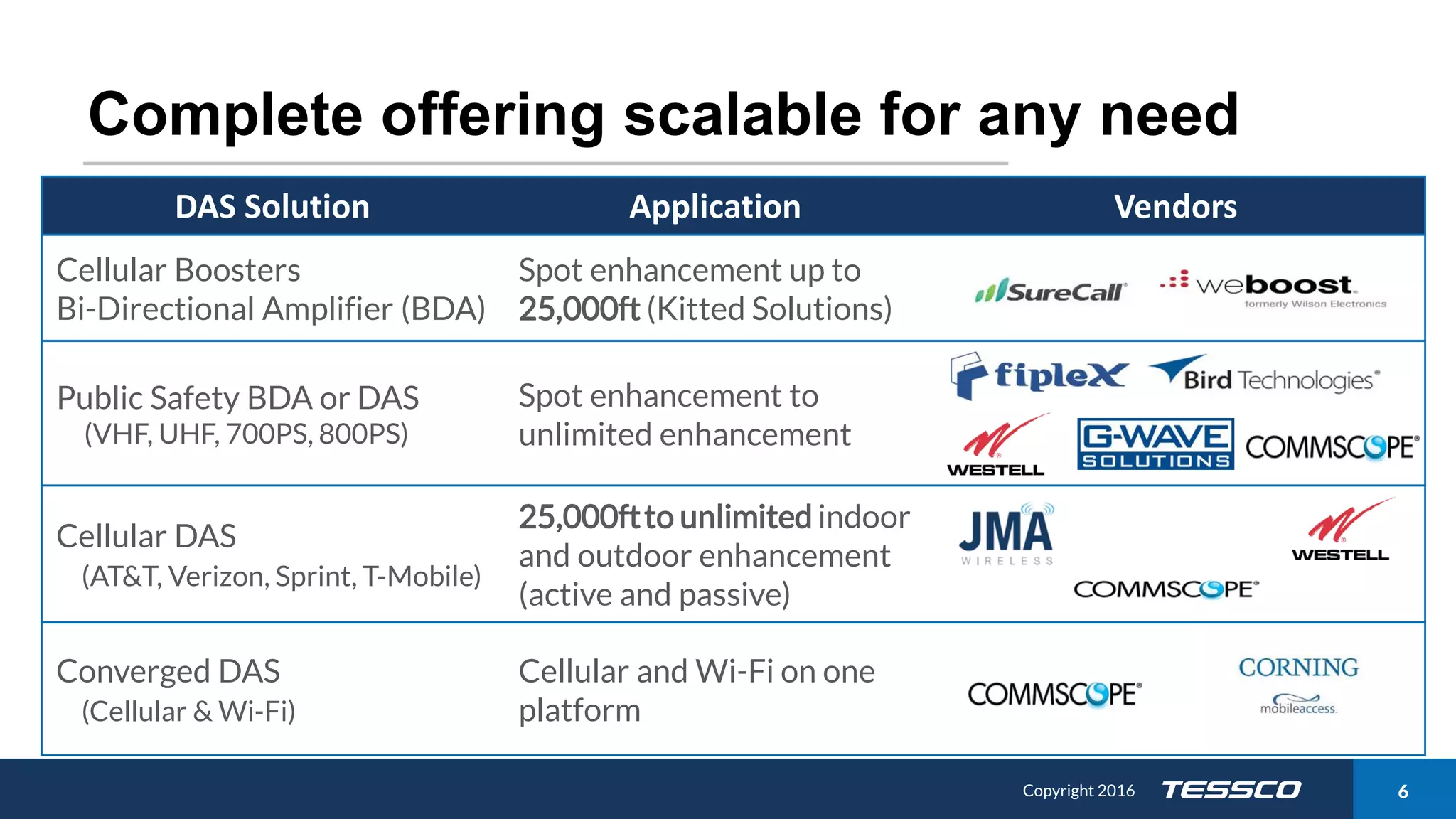
Complete offering scalable for any need
Public Safety BDA or DAS
(VHF, UHF, 700PS, 800PS)
Spot enhancement to
unlimited enhancement
Converged DAS
(Cellular & Wi-Fi)
Cellular and Wi-Fi on one
platform
DAS Solution Application Vendors
Cellular Boosters
Bi-Directional Amplifier (BDA)
Spot enhancement up to
25,000ft (Kitted Solutions)
Cellular DAS
(AT&T, Verizon, Sprint, T-Mobile)
25,000ftto unlimited indoor
and outdoor enhancement
(active and passive)
Copyright 2015 711/21/2016 Copyright 2016 7
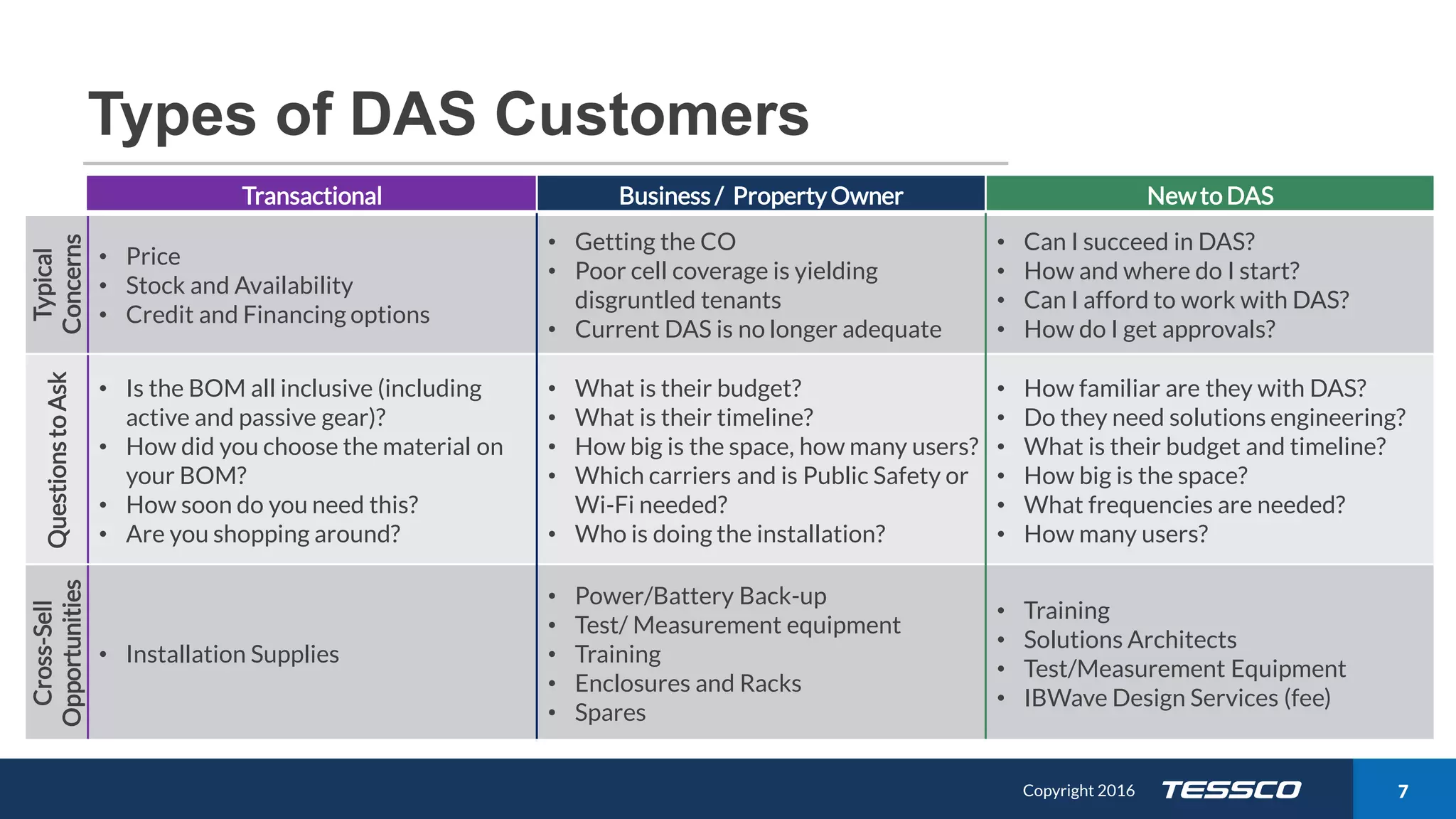
Types of DAS Customers
1. Building Owner
2. Transactional
3. New to DAS
Three types of DAS Customers
Transactional
Typical
Concerns
• Price
• Stock and Availability
• Credit and Financing options
QuestionstoAsk
• Is the BOM all inclusive (including
active and passive gear)?
• How did you choose the material on
your BOM?
• How soon do you need this?
• Are you shopping around?
Cross-Sell
Opportunities
• Installation Supplies
Business / PropertyOwner
• Getting the CO
• Poor cell coverage is yielding
disgruntled tenants
• Current DAS is no longer adequate
• What is their budget?
• What is their timeline?
• How big is the space, how many users?
• Which carriers and is Public Safety or
Wi-Fi needed?
• Who is doing the installation?
• Power/Battery Back-up
• Test/ Measurement equipment
• Training
• Enclosures and Racks
• Spares
Newto DAS
• Can I succeed in DAS?
• How and where do I start?
• Can I afford to work with DAS?
• How do I get approvals?
• How familiar are they with DAS?
• Do they need solutions engineering?
• What is their budget and timeline?
• How big is the space?
• What frequencies are needed?
• How many users?
• Training
• Solutions Architects
• Test/Measurement Equipment
• IBWave Design Services (fee)
Copyright 2015 811/21/2016 Copyright 2016 8
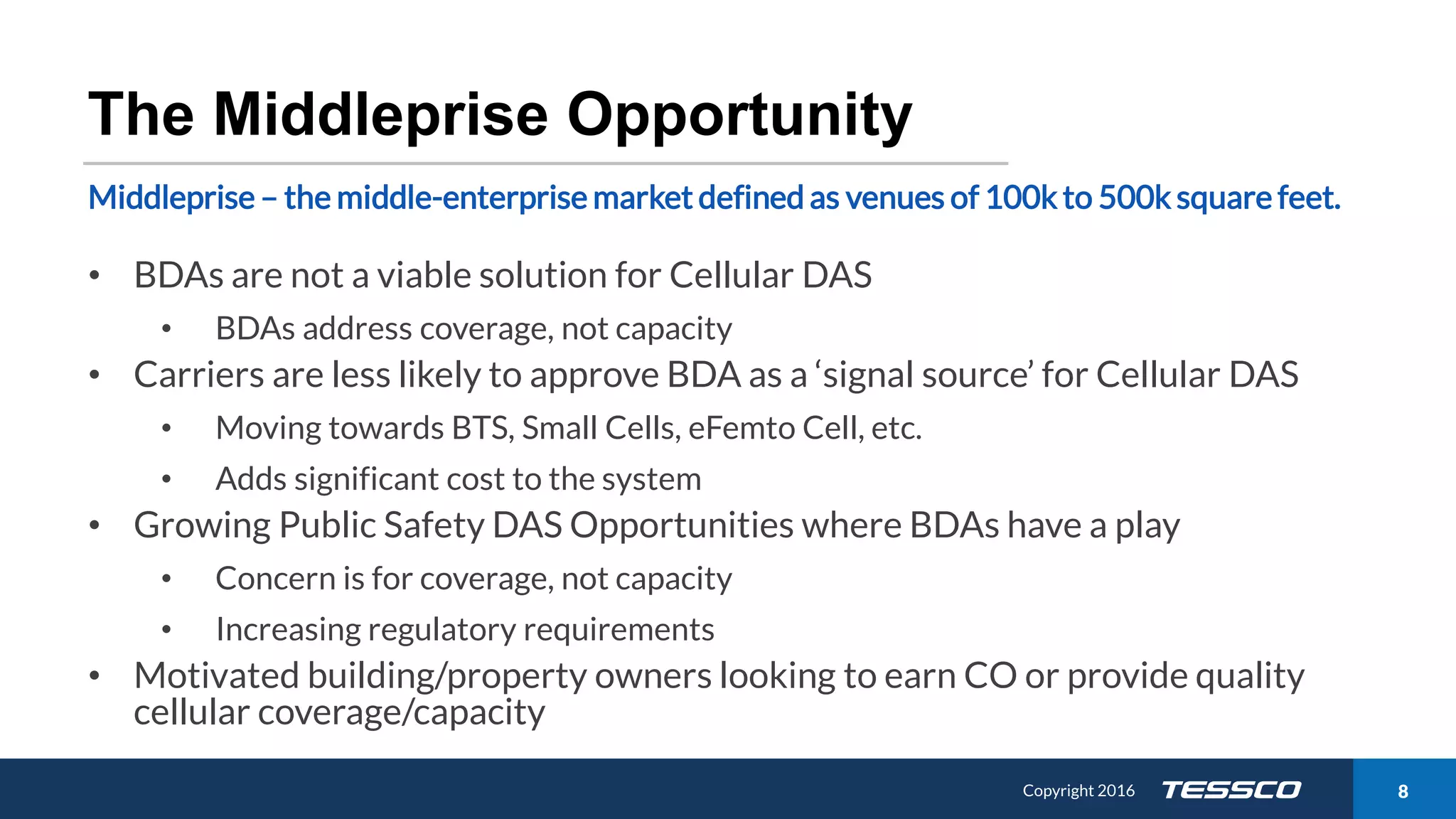
The Middleprise Opportunity
• BDAs are not a viable solution for Cellular DAS
• BDAs address coverage, not capacity
• Carriers are less likely to approve BDA as a ‘signal source’ for Cellular DAS
• Moving towards BTS, Small Cells, eFemto Cell, etc.
• Adds significant cost to the system
• Growing Public Safety DAS Opportunities where BDAs have a play
• Concern is for coverage, not capacity
• Increasing regulatory requirements
• Motivated building/property owners looking to earn CO or provide quality
cellular coverage/capacity
Middleprise – the middle-enterprise market defined as venues of 100k to 500k square feet.
Copyright 2015 911/21/2016 Copyright 2016 9
What should I listen for?
• Poor coverage (choppy or drops)
• Bring your own device (BYOD)
• LEED Glass / Green Building
• Building is being remodeled / building a new facility
• Installing or upgrading Wi-Fi or structured wiring and networks
• CO (Certificate of Occupancy) requirements
Copyright 2015 1011/21/2016 Copyright 2016 10
Transactional Customer Concerns
• Do we have access to the OEM’s being asked for?
• Is this a carrier-funded project, if so which one?
• What is the budget assigned to the project?
• Do we have competitive pricing?
• Does the customer have adequate credit?
• Will they need Financing?
• Do we have stock or how quickly can we provide product?
Copyright 2015 1111/21/2016 Copyright 2016 11
New DAS Customer Concerns
Do they…
• Need help determining end-customer requirements?
• Have all of the proper equipment?
• Know how to design, install, and commission the system?
• Need DAS Training?
• Have relationships with key Carriers/AHJs?
• Need to consult with a TESSCO Solution Architect?
Copyright 2015 1211/21/2016 Copyright 2016 12
2-Day DAS 101 Training…
Do they understand…
• RF Signal Basics?
• Bandwidths/Frequencies for CDAM, TDMA, GMS, AWS, UMTS, LTE, UL/DL Bands?
• Power levels from dBm to Watts?
• Complicated Free Space Path Loss Tables/Link Budgets?
• Basic set-up/adjustments of BDAs and POIs?
If not, this is the class for them!
• Ref SKU 574795, $815/seat
If your customer is reluctant to make this investment in their future, why should you
invest your time with them?
Copyright 2015 1311/21/2016 Copyright 2016 13
Budgetary ROM vs Full Design
• ROMs offer fast turn and are typically within 20% of actual cost
• Full designs may be subject to a Design Fee (Reference SOP 1891)
• First order approximations can be handled by the DE!
• Designed amplifier projects can range from $8,500 and up
• Multi-carrier DAS projects start at $75K+, 60% being material
• A single-carrier DAS costs approximately $1+/sq. ft.
• A multi-carrier DAS costs approximately $1.50+/sq. ft. and can be designed to be
future proofed for additional WSPs later on
• A Public Safety DAS costs approximately $0.50-0.75+/sq. ft.
• Projects may potentially funded by a third party (Carrier Funded or Leased)
Copyright 2015 1411/21/2016 Copyright 2016 14
Set Realistic Expectations Early
• Have the customer provide the following information:
• Incoming signal strength from roof of building
• Site survey / walk → complete design → provide official quote
• Initiate the Carrier Coordination process (based on location)
• For PS DAS, initiate Coordination with AHJ (Authority Having Jurisdiction)
• Design cycle time are generally 10-15 business days
• Advise of possible design/redesign fees
Copyright 2015 1511/21/2016 Copyright 2016 15
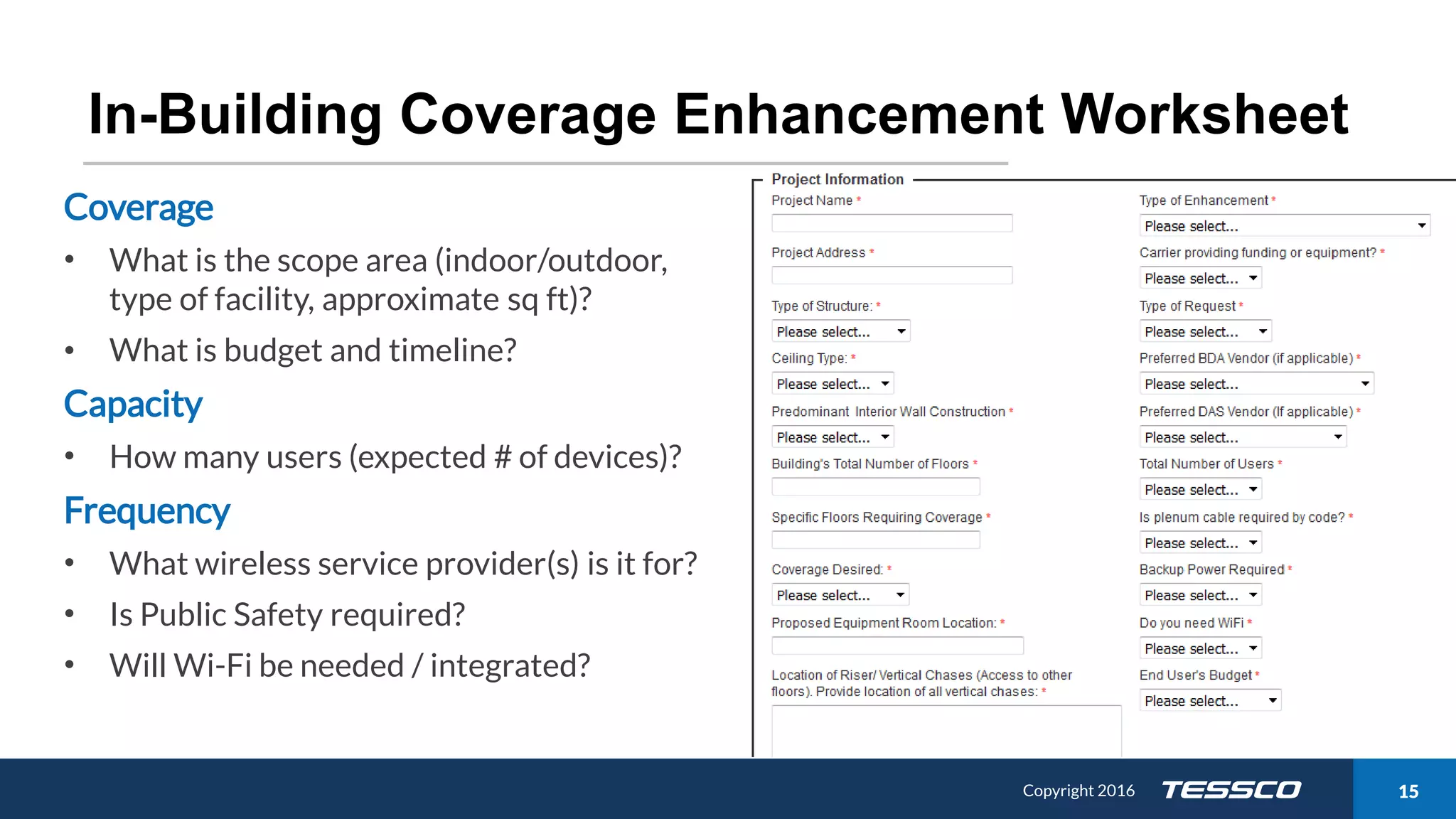
In-Building Coverage Enhancement Worksheet
Coverage
• What is the scope area (indoor/outdoor,
type of facility, approximate sq ft)?
• What is budget and timeline?
Capacity
• How many users (expected # of devices)?
Frequency
• What wireless service provider(s) is it for?
• Is Public Safety required?
• Will Wi-Fi be needed / integrated?
Copyright 2015 1611/21/2016 Copyright 2016 16
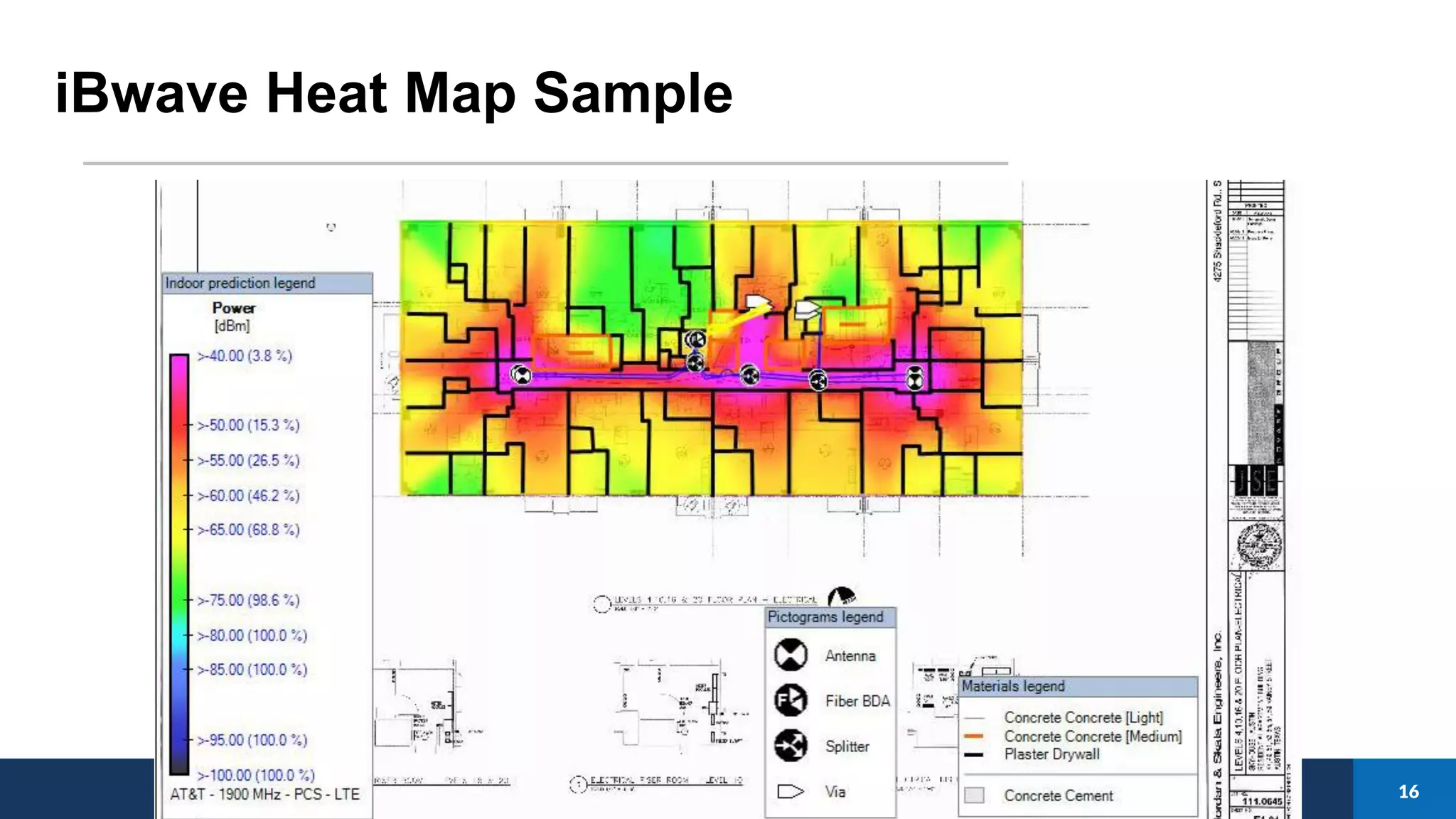
iBwave Heat Map Sample
Copyright 2015 1711/21/2016 Copyright 2016 17
Leasing & Finance Options
Leasing
• Up to 5 year leases through TESSCO’s
partner Lease Corp of America (LCA)
• Leasing helps customers with budget
constraints and can provide accounting
benefits
• Customers can lease the product and
service
• LCA buys product from TESSCO and
pays TESSCO on delivery to customer
Financing
• TESSCO provides NET 30/45/60
financing terms
• TESSCO also works with partners to
provide terms of NET 60/90/120
• Partners include GE capital, Wells Fargo
and others
• TESSCO and/or Manufacturer can buy
down or subsidize the cost of extended
terms
Copyright 2015 1811/21/2016 Copyright 2016 18
Where do I go for help?
• CTS for Kitted Solutions
25,000 ft and less (single kit)
$10,000 or less budget
• Solutions Architect for Custom Solutions
Lanka Karunaratne
Seth Sweetser
Tom Ulrich
• Product Managers for Vendor Support
Ramiz Taqi
Mark Rice

das-level-2-training-resource-pdf1

  • 1.
    Copyright 2015 111/21/2016Copyright 2016 1 Why DAS? Why do our customers need a DAS? • Better coverage and/or capacity • Improved user experience (connectivity & battery life) • Cellular as a means of primary and safety communications • BYOD necessitates coverage for all carriers • Liability, Certificate of Occupancy (CO), or Public Safety regulations • Lack of Wi-Fi capacity and/or security concerns
  • 2.
    Copyright 2015 211/21/2016Copyright 2016 2 Key Terms • Cellular  commercial frequencies 700 to 2500 MHz for 2G, 3G and 4G • Public Safety  UHF, VHF, and 700/800 MHz • Bi-Directional Amplifier (BDA)  Repeater • Active System  Fiber based DAS • Passive System  Coax based DAS • Vertical Chase  Locations inside a building for vertical cable runs • Authority Having Jurisdiction (AHJ)  local governing body • Certificate of Occupancy (CO)  legal ability to occupy a building/facility
  • 3.
    Copyright 2015 311/21/2016Copyright 2016 3 Cellular DAS vs Public Safety DAS Criteria Cellular DAS Public Safety DAS Coverage Area Main public use / populated areas Where people ARE Total coverage including stairwells, basements, equipment / storage rooms Where people ARE NOT Benefactors Building occupants First responders Signals Cellular voice and data (700 to 2500 MHz) Voice / Radio Communications (700MHz, 800MHz, UHF, VHF) Compliance & Approval Comply with carrier guidelines and approvals Comply with NFPA & IFC standards and meet AHJ standards & approvals
  • 4.
    Copyright 2015 411/21/2016Copyright 2016 4 PS-DAS Requirements 1. More extensive coverage than cellular networks • 95% coverage in all areas • 99% coverage in ‘Critical Areas’ as defined by the AHJ 2. -95 db Minimum Signal Strength regardless of frequency • Portable radios work in ALL critical areas 3. System Survivability • Waterproof installation using NEMA 4/4X enclosures • Generator and/or battery backup for ‘x’ hours • System monitoring and alarm notifications • Cabling requirements National Fire Protection Association (NFPA-72) and International Fire Code (IFC) standards :
  • 5.
    Copyright 2015 511/21/2016Copyright 2016 5 Major Elements of a DAS Solution • Donor Antenna(s) • Head End • Bi-Directional Amplifier (Repeater) • Cabling (coax or fiber) • Remote Units • Splitters/Tappers • Antennas • NEMA 4/4x Enclosures • Back-up Power
  • 6.
    Copyright 2015 611/21/2016Copyright 2016 6 Complete offering scalable for any need Public Safety BDA or DAS (VHF, UHF, 700PS, 800PS) Spot enhancement to unlimited enhancement Converged DAS (Cellular & Wi-Fi) Cellular and Wi-Fi on one platform DAS Solution Application Vendors Cellular Boosters Bi-Directional Amplifier (BDA) Spot enhancement up to 25,000ft (Kitted Solutions) Cellular DAS (AT&T, Verizon, Sprint, T-Mobile) 25,000ftto unlimited indoor and outdoor enhancement (active and passive)
  • 7.
    Copyright 2015 711/21/2016Copyright 2016 7 Types of DAS Customers 1. Building Owner 2. Transactional 3. New to DAS Three types of DAS Customers Transactional Typical Concerns • Price • Stock and Availability • Credit and Financing options QuestionstoAsk • Is the BOM all inclusive (including active and passive gear)? • How did you choose the material on your BOM? • How soon do you need this? • Are you shopping around? Cross-Sell Opportunities • Installation Supplies Business / PropertyOwner • Getting the CO • Poor cell coverage is yielding disgruntled tenants • Current DAS is no longer adequate • What is their budget? • What is their timeline? • How big is the space, how many users? • Which carriers and is Public Safety or Wi-Fi needed? • Who is doing the installation? • Power/Battery Back-up • Test/ Measurement equipment • Training • Enclosures and Racks • Spares Newto DAS • Can I succeed in DAS? • How and where do I start? • Can I afford to work with DAS? • How do I get approvals? • How familiar are they with DAS? • Do they need solutions engineering? • What is their budget and timeline? • How big is the space? • What frequencies are needed? • How many users? • Training • Solutions Architects • Test/Measurement Equipment • IBWave Design Services (fee)
  • 8.
    Copyright 2015 811/21/2016Copyright 2016 8 The Middleprise Opportunity • BDAs are not a viable solution for Cellular DAS • BDAs address coverage, not capacity • Carriers are less likely to approve BDA as a ‘signal source’ for Cellular DAS • Moving towards BTS, Small Cells, eFemto Cell, etc. • Adds significant cost to the system • Growing Public Safety DAS Opportunities where BDAs have a play • Concern is for coverage, not capacity • Increasing regulatory requirements • Motivated building/property owners looking to earn CO or provide quality cellular coverage/capacity Middleprise – the middle-enterprise market defined as venues of 100k to 500k square feet.
  • 9.
    Copyright 2015 911/21/2016Copyright 2016 9 What should I listen for? • Poor coverage (choppy or drops) • Bring your own device (BYOD) • LEED Glass / Green Building • Building is being remodeled / building a new facility • Installing or upgrading Wi-Fi or structured wiring and networks • CO (Certificate of Occupancy) requirements
  • 10.
    Copyright 2015 1011/21/2016Copyright 2016 10 Transactional Customer Concerns • Do we have access to the OEM’s being asked for? • Is this a carrier-funded project, if so which one? • What is the budget assigned to the project? • Do we have competitive pricing? • Does the customer have adequate credit? • Will they need Financing? • Do we have stock or how quickly can we provide product?
  • 11.
    Copyright 2015 1111/21/2016Copyright 2016 11 New DAS Customer Concerns Do they… • Need help determining end-customer requirements? • Have all of the proper equipment? • Know how to design, install, and commission the system? • Need DAS Training? • Have relationships with key Carriers/AHJs? • Need to consult with a TESSCO Solution Architect?
  • 12.
    Copyright 2015 1211/21/2016Copyright 2016 12 2-Day DAS 101 Training… Do they understand… • RF Signal Basics? • Bandwidths/Frequencies for CDAM, TDMA, GMS, AWS, UMTS, LTE, UL/DL Bands? • Power levels from dBm to Watts? • Complicated Free Space Path Loss Tables/Link Budgets? • Basic set-up/adjustments of BDAs and POIs? If not, this is the class for them! • Ref SKU 574795, $815/seat If your customer is reluctant to make this investment in their future, why should you invest your time with them?
  • 13.
    Copyright 2015 1311/21/2016Copyright 2016 13 Budgetary ROM vs Full Design • ROMs offer fast turn and are typically within 20% of actual cost • Full designs may be subject to a Design Fee (Reference SOP 1891) • First order approximations can be handled by the DE! • Designed amplifier projects can range from $8,500 and up • Multi-carrier DAS projects start at $75K+, 60% being material • A single-carrier DAS costs approximately $1+/sq. ft. • A multi-carrier DAS costs approximately $1.50+/sq. ft. and can be designed to be future proofed for additional WSPs later on • A Public Safety DAS costs approximately $0.50-0.75+/sq. ft. • Projects may potentially funded by a third party (Carrier Funded or Leased)
  • 14.
    Copyright 2015 1411/21/2016Copyright 2016 14 Set Realistic Expectations Early • Have the customer provide the following information: • Incoming signal strength from roof of building • Site survey / walk → complete design → provide official quote • Initiate the Carrier Coordination process (based on location) • For PS DAS, initiate Coordination with AHJ (Authority Having Jurisdiction) • Design cycle time are generally 10-15 business days • Advise of possible design/redesign fees
  • 15.
    Copyright 2015 1511/21/2016Copyright 2016 15 In-Building Coverage Enhancement Worksheet Coverage • What is the scope area (indoor/outdoor, type of facility, approximate sq ft)? • What is budget and timeline? Capacity • How many users (expected # of devices)? Frequency • What wireless service provider(s) is it for? • Is Public Safety required? • Will Wi-Fi be needed / integrated?
  • 16.
    Copyright 2015 1611/21/2016Copyright 2016 16 iBwave Heat Map Sample
  • 17.
    Copyright 2015 1711/21/2016Copyright 2016 17 Leasing & Finance Options Leasing • Up to 5 year leases through TESSCO’s partner Lease Corp of America (LCA) • Leasing helps customers with budget constraints and can provide accounting benefits • Customers can lease the product and service • LCA buys product from TESSCO and pays TESSCO on delivery to customer Financing • TESSCO provides NET 30/45/60 financing terms • TESSCO also works with partners to provide terms of NET 60/90/120 • Partners include GE capital, Wells Fargo and others • TESSCO and/or Manufacturer can buy down or subsidize the cost of extended terms
  • 18.
    Copyright 2015 1811/21/2016Copyright 2016 18 Where do I go for help? • CTS for Kitted Solutions 25,000 ft and less (single kit) $10,000 or less budget • Solutions Architect for Custom Solutions Lanka Karunaratne Seth Sweetser Tom Ulrich • Product Managers for Vendor Support Ramiz Taqi Mark Rice