New Ethical Dilemmas:
Developing Professional Competency in the
Digital Age
Christina Boyd, LSCSW, LCAC
Gary Wareham, MA, LPC, LAC
An Exploration of Digital Novices, Digital
Pros, & Digital Culture
Week 2
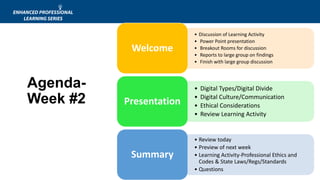
Agenda-
Week #2
• Discussion of Learning Activity
Welcome
• Power Point presentation
• Breakout Rooms for discussion
• Reports to large group on findings
• Finish with large group discussion
• Digital Types/Digital Divide
Presentation
• Digital Culture/Communication
• Ethical Considerations
• Review Learning Activity
• Review today
Summary
• Preview of next week
• Learning Activity-Professional Ethics and
Codes & State Laws/Regs/Standards
• Questions
Digital Types
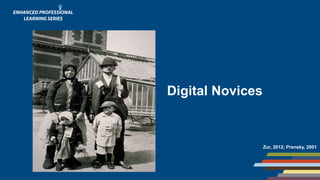
Zur, 2012; Prensky, 2001
Digital Novices
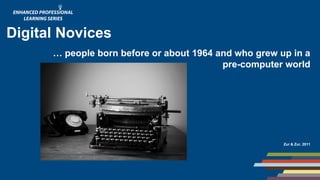
Digital Novices
… people born before or about 1964 and who grew up in a
pre-computer world
Zur & Zur, 2011
Like all immigrants… as Digital Novices
learn to adapt to their environment, they
retain, to some degree, their ‘accent’ …
What is your digital
accent?
(Prensky, 2001)
… ‘native speakers’ of the digital language of computers,
cell phones, video games, and the Internet
Zur, 2012; Prensky, 2001
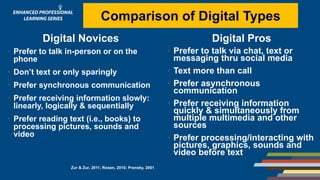
Comparison of Digital Types
Digital Novices
• Prefer to talk in-person or on the
phone
• Don’t text or only sparingly
• Prefer synchronous communication
• Prefer receiving information slowly:
linearly, logically & sequentially
• Prefer reading text (i.e., books) to
processing pictures, sounds and
video
Zur & Zur, 2011; Rosen, 2010; Prensky, 2001
Digital Pros
• Prefer to talk via chat, text or
messaging thru social media
• Text more than call
• Prefer asynchronous
communication
• Prefer receiving information
quickly & simultaneously from
multiple multimedia and other
sources
• Prefer processing/interacting with
pictures, graphics, sounds and
video before text
Other Digital Types
Ways to sort people other than age:
• Attitudes
• Comprehension
• Relationships
• Practices
• Comfort with Technology
Feeney, 2010; Toledo, 2007
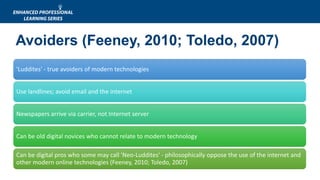
Avoiders (Feeney, 2010; Toledo, 2007)
'Luddites' - true avoiders of modern technologies
Use landlines; avoid email and the internet
Newspapers arrive via carrier, not Internet server
Can be old digital novices who cannot relate to modern technology
Can be digital pros who some may call 'Neo-Luddites' - philosophically oppose the use of the internet and
other modern online technologies (Feeney, 2010; Toledo, 2007)
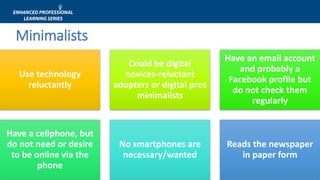
Minimalists
Use technology
reluctantly
Could be digital
novices-reluctant
adopters or digital pros
minimalists
Have an email account
and probably a
Facebook profile but
do not check them
regularly
Have a cellphone, but
do not need or desire
to be online via the
phone
No smartphones are
necessary/wanted
Reads the newspaper
in paper form
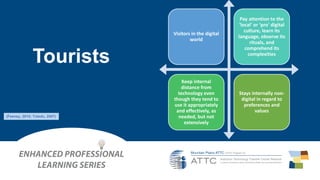
Tourists
Visitors in the digital
world
Pay attention to the
'local' or ‘pro' digital
culture, learn its
language, observe its
rituals, and
comprehend its
complexities
Keep internal
distance from
technology even
though they tend to
use it appropriately
and effectively, as
needed, but not
extensively
Stays internally non-
digital in regard to
preferences and
values
(Feeney, 2010; Toledo, 2007)
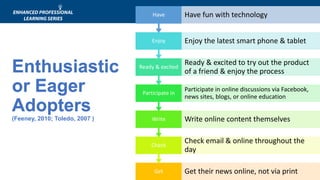
Enthusiastic
or Eager
Adopters
Enthusiastic
or Eager
Adopters
(Feeney, 2010; Toledo, 2007 )
Have Have fun with technology
Enjoy Enjoy the latest smart phone & tablet
Ready & excited to try out the productReady & excited
of a friend & enjoy the process
Participate in online discussions via Facebook,
Participate in
news sites, blogs, or online education
Write Write online content themselves
Check email & online throughout theCheck
day
Get Get their news online, not via print
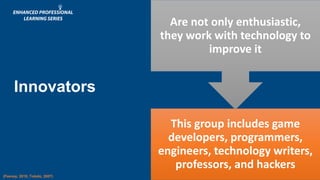
Innovators
Are not only enthusiastic,
they work with technology to
improve it
This group includes game
developers, programmers,
engineers, technology writers,
professors, and hackers
(Feeney, 2010; Toledo, 2007)
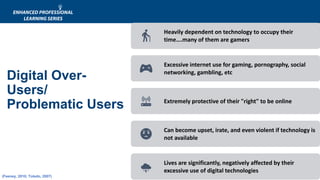
Digital Over-
Users/
Problematic Users
Heavily dependent on technology to occupy their
time….many of them are gamers
Excessive internet use for gaming, pornography, social
networking, gambling, etc
Extremely protective of their "right" to be online
Can become upset, irate, and even violent if technology is
not available
Lives are significantly, negatively affected by their
excessive use of digital technologies
(Feeney, 2010; Toledo, 2007)
Do you identify more as a Digital
Novice or Digital Pro?
Polling Question
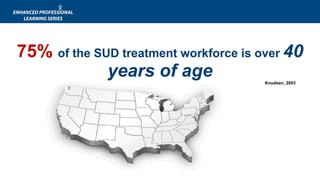
75% of the SUD treatment workforce is over 40
years of age Knudsen, 2003
Average age of Clinical Directors is 52 years…
… 60% are over the age of 50 years
Ryan, Murphy, & Krom 2012
Almost 70% of individuals who received SUD
services were under the age of 40 years old.
TEDS Data; SAMHSA, 2011
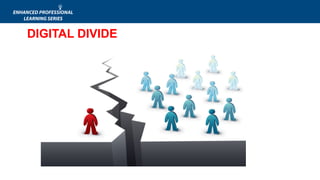
DIGITAL DIVIDE
Steps for Breakout Rooms Today
1) You will be given your assigned room number and group number.
2) When instructor tells you that rooms are open, wait for your
prompt to appear and use that to enter your room.
3) Discuss the questions on the next slide for about 30 minutes.
4) You will receive a prompt called a “broadcast” to return to the
large group to report out your group’s process and findings.
In your Breakout group, talk about…
• Do you see yourself as a Digital Novice or Digital Pro? Why?
• Do you retain a Digital accent of some sort?
• From your self-identified Digital Type, discuss how this affects your
communication with clients: pros/cons, and what you have to be
aware of when working with clients in today’s digital culture.
• What are some biases you may have regarding clients who have a
different Digital Type than yours?
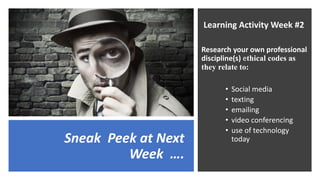
Sneak Peek at Next
Week ….
Learning Activity Week #2
Research your own professional
discipline(s) ethical codes as
they relate to:
• Social media
• texting
• emailing
• video conferencing
• use of technology
today
Questions
Thank you
Acknowledgments
• Feeney, L. (2010). Digital denizens. In Instructional technology resources: In the spotlight. The Richard
Stockton College of New Jersey website, Retrieved from http://loki.stockton.edu/~intech/spotlight-digital-
denizens.htm
• Knudsen, H. K., Johnson, J. A., & Roman, P. M. (2003). Retaining counseling staff at substance abuse
treatment centers: Effects of management practices. Journal of Substance Abuse and Treatment, 24(2),
129-135.
• Prensky, M. (2001). Digital natives, digital immigrants. On the Horizon, 9(5).
• Rosen, L. (2010). Rewired: Understanding the iGeneration and the Way They Learn. New York: Palgrave
Macmillan.
• Ryan, O., Murphy, D., & Krom, L. (2012). Vital Signs: Taking the Pulse of the Addiction Treatment
Workforce, A National Report - Executive Summary. Kansas City, MO: Addiction Technology Transfer
Center National Office in residence at the University of Missouri-Kansas City.
• Toledo, C. A. (2007). Digital culture: Immigrants and tourists responding to the natives'
drumbeat. International Journal of Teaching and Learning in Higher Education, 19(1), 84-92.
• Zur, O. (2012). Therapeutic ethics in the digital age: What to do when the world is watching.
Psychotherapy Networker, 36(4).
• Zur, O. & Zur, A. (2011a). On Digital Immigrants and Digital Natives: How the Digital Divide Affects
Families, Educational Institutions, and the Workplace. Retrieved
from http://www.zurinstitute.com/digital_divide.html

Ned workwise-week 2 508v2

  • 1.
    New Ethical Dilemmas: DevelopingProfessional Competency in the Digital Age Christina Boyd, LSCSW, LCAC Gary Wareham, MA, LPC, LAC
  • 2.
    An Exploration ofDigital Novices, Digital Pros, & Digital Culture Week 2
  • 3.
    Agenda- Week #2 • Discussionof Learning Activity Welcome • Power Point presentation • Breakout Rooms for discussion • Reports to large group on findings • Finish with large group discussion • Digital Types/Digital Divide Presentation • Digital Culture/Communication • Ethical Considerations • Review Learning Activity • Review today Summary • Preview of next week • Learning Activity-Professional Ethics and Codes & State Laws/Regs/Standards • Questions
  • 4.
  • 5.
    Zur, 2012; Prensky,2001 Digital Novices
  • 6.
    Digital Novices … peopleborn before or about 1964 and who grew up in a pre-computer world Zur & Zur, 2011
  • 7.
    Like all immigrants…as Digital Novices learn to adapt to their environment, they retain, to some degree, their ‘accent’ … What is your digital accent? (Prensky, 2001)
  • 8.
    … ‘native speakers’of the digital language of computers, cell phones, video games, and the Internet Zur, 2012; Prensky, 2001
  • 9.
    Comparison of DigitalTypes Digital Novices • Prefer to talk in-person or on the phone • Don’t text or only sparingly • Prefer synchronous communication • Prefer receiving information slowly: linearly, logically & sequentially • Prefer reading text (i.e., books) to processing pictures, sounds and video Zur & Zur, 2011; Rosen, 2010; Prensky, 2001 Digital Pros • Prefer to talk via chat, text or messaging thru social media • Text more than call • Prefer asynchronous communication • Prefer receiving information quickly & simultaneously from multiple multimedia and other sources • Prefer processing/interacting with pictures, graphics, sounds and video before text
  • 10.
    Other Digital Types Waysto sort people other than age: • Attitudes • Comprehension • Relationships • Practices • Comfort with Technology Feeney, 2010; Toledo, 2007
  • 11.
    Avoiders (Feeney, 2010;Toledo, 2007) 'Luddites' - true avoiders of modern technologies Use landlines; avoid email and the internet Newspapers arrive via carrier, not Internet server Can be old digital novices who cannot relate to modern technology Can be digital pros who some may call 'Neo-Luddites' - philosophically oppose the use of the internet and other modern online technologies (Feeney, 2010; Toledo, 2007)
  • 12.
    Minimalists Use technology reluctantly Could bedigital novices-reluctant adopters or digital pros minimalists Have an email account and probably a Facebook profile but do not check them regularly Have a cellphone, but do not need or desire to be online via the phone No smartphones are necessary/wanted Reads the newspaper in paper form
  • 13.
    Tourists Visitors in thedigital world Pay attention to the 'local' or ‘pro' digital culture, learn its language, observe its rituals, and comprehend its complexities Keep internal distance from technology even though they tend to use it appropriately and effectively, as needed, but not extensively Stays internally non- digital in regard to preferences and values (Feeney, 2010; Toledo, 2007)
  • 14.
    Enthusiastic or Eager Adopters Enthusiastic or Eager Adopters (Feeney,2010; Toledo, 2007 ) Have Have fun with technology Enjoy Enjoy the latest smart phone & tablet Ready & excited to try out the productReady & excited of a friend & enjoy the process Participate in online discussions via Facebook, Participate in news sites, blogs, or online education Write Write online content themselves Check email & online throughout theCheck day Get Get their news online, not via print
  • 15.
    Innovators Are not onlyenthusiastic, they work with technology to improve it This group includes game developers, programmers, engineers, technology writers, professors, and hackers (Feeney, 2010; Toledo, 2007)
  • 16.
    Digital Over- Users/ Problematic Users Heavilydependent on technology to occupy their time….many of them are gamers Excessive internet use for gaming, pornography, social networking, gambling, etc Extremely protective of their "right" to be online Can become upset, irate, and even violent if technology is not available Lives are significantly, negatively affected by their excessive use of digital technologies (Feeney, 2010; Toledo, 2007)
  • 17.
    Do you identifymore as a Digital Novice or Digital Pro? Polling Question
  • 18.
    75% of theSUD treatment workforce is over 40 years of age Knudsen, 2003
  • 19.
    Average age ofClinical Directors is 52 years… … 60% are over the age of 50 years Ryan, Murphy, & Krom 2012
  • 20.
    Almost 70% ofindividuals who received SUD services were under the age of 40 years old. TEDS Data; SAMHSA, 2011
  • 21.
  • 22.
    Steps for BreakoutRooms Today 1) You will be given your assigned room number and group number. 2) When instructor tells you that rooms are open, wait for your prompt to appear and use that to enter your room. 3) Discuss the questions on the next slide for about 30 minutes. 4) You will receive a prompt called a “broadcast” to return to the large group to report out your group’s process and findings.
  • 23.
    In your Breakoutgroup, talk about… • Do you see yourself as a Digital Novice or Digital Pro? Why? • Do you retain a Digital accent of some sort? • From your self-identified Digital Type, discuss how this affects your communication with clients: pros/cons, and what you have to be aware of when working with clients in today’s digital culture. • What are some biases you may have regarding clients who have a different Digital Type than yours?
  • 24.
    Sneak Peek atNext Week …. Learning Activity Week #2 Research your own professional discipline(s) ethical codes as they relate to: • Social media • texting • emailing • video conferencing • use of technology today
  • 25.
  • 26.
  • 27.
    Acknowledgments • Feeney, L.(2010). Digital denizens. In Instructional technology resources: In the spotlight. The Richard Stockton College of New Jersey website, Retrieved from http://loki.stockton.edu/~intech/spotlight-digital- denizens.htm • Knudsen, H. K., Johnson, J. A., & Roman, P. M. (2003). Retaining counseling staff at substance abuse treatment centers: Effects of management practices. Journal of Substance Abuse and Treatment, 24(2), 129-135. • Prensky, M. (2001). Digital natives, digital immigrants. On the Horizon, 9(5). • Rosen, L. (2010). Rewired: Understanding the iGeneration and the Way They Learn. New York: Palgrave Macmillan. • Ryan, O., Murphy, D., & Krom, L. (2012). Vital Signs: Taking the Pulse of the Addiction Treatment Workforce, A National Report - Executive Summary. Kansas City, MO: Addiction Technology Transfer Center National Office in residence at the University of Missouri-Kansas City. • Toledo, C. A. (2007). Digital culture: Immigrants and tourists responding to the natives' drumbeat. International Journal of Teaching and Learning in Higher Education, 19(1), 84-92. • Zur, O. (2012). Therapeutic ethics in the digital age: What to do when the world is watching. Psychotherapy Networker, 36(4). • Zur, O. & Zur, A. (2011a). On Digital Immigrants and Digital Natives: How the Digital Divide Affects Families, Educational Institutions, and the Workplace. Retrieved from http://www.zurinstitute.com/digital_divide.html