S
Behavioral
Addictions
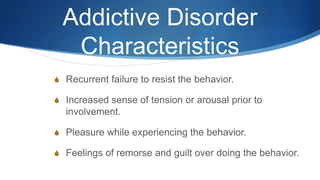
Addictive Disorder
Characteristics
S Recurrent failure to resist the behavior.
S Increased sense of tension or arousal prior to
involvement.
S Pleasure while experiencing the behavior.
S Feelings of remorse and guilt over doing the behavior.
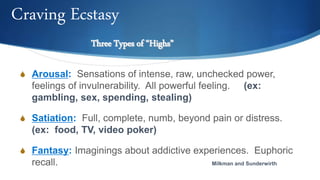
S Arousal: Sensations of intense, raw, unchecked power,
feelings of invulnerability. All powerful feeling. (ex:
gambling, sex, spending, stealing)
S Satiation: Full, complete, numb, beyond pain or distress.
(ex: food, TV, video poker)
S Fantasy: Imaginings about addictive experiences. Euphoric
recall. Milkman and Sunderwirth
Three Types of “Highs”
Craving Ecstasy
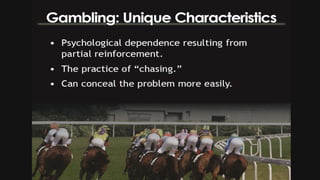
Gambling:Unique
characteristics
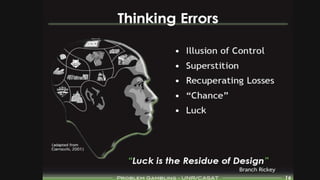
Thinking errors
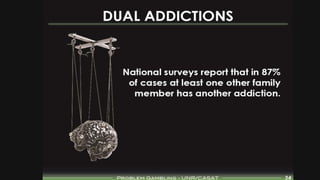
Dual addictions
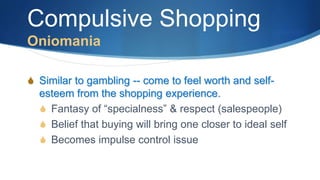
Compulsive Shopping
Oniomania
S Similar to gambling -- come to feel worth and self-
esteem from the shopping experience.
S Fantasy of “specialness” & respect (salespeople)
S Belief that buying will bring one closer to ideal self
S Becomes impulse control issue
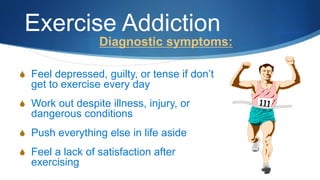
Exercise Addiction
S Feel depressed, guilty, or tense if don’t
get to exercise every day
S Work out despite illness, injury, or
dangerous conditions
S Push everything else in life aside
S Feel a lack of satisfaction after
exercising
Diagnostic symptoms:
Addicted to Love
S Obsessed -- hyper-involvement to
notion of connectedness
S Romantic --“in love with fantasy”
overwhelming need to care for, no
matter the price.
S Narcissistic -- possessive,
controlling, or demanding of
partner
An unhealthy
attachment
to a person,
relationship
or “romance”
(Susan Peabody)
Brain Changes & Sexual Behavior
S Prolonged acting out alters a
person’s brain chemistry until they
“require excitement to feel normal.”
S MAO -- enzyme that regulated the
neurotransmission of arousal in the
brain.
S Severe mood changes related to
sexual activity.
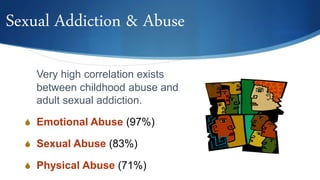
Sexual Addiction & Abuse
Very high correlation exists
between childhood abuse and
adult sexual addiction.
S Emotional Abuse (97%)
S Sexual Abuse (83%)
S Physical Abuse (71%)
Cybersex Activity
S Has had historical approval
S Debate regarding harm
S Gender differences
S Visual vs relational stimulus
S Internet impact
S moved to a “virtual source of cocaine”
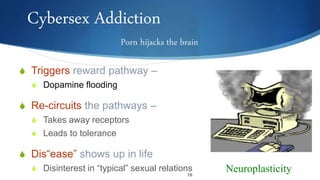
Cybersex Addiction
S Triggers reward pathway –
S Dopamine flooding
S Re-circuits the pathways –
S Takes away receptors
S Leads to tolerance
S Dis“ease” shows up in life
S Disinterest in “typical” sexual relations Neuroplasticity10
Porn hijacks the brain

Behavioral addictions.2020

  • 1.
  • 2.
    Addictive Disorder Characteristics S Recurrentfailure to resist the behavior. S Increased sense of tension or arousal prior to involvement. S Pleasure while experiencing the behavior. S Feelings of remorse and guilt over doing the behavior.
  • 3.
    S Arousal: Sensationsof intense, raw, unchecked power, feelings of invulnerability. All powerful feeling. (ex: gambling, sex, spending, stealing) S Satiation: Full, complete, numb, beyond pain or distress. (ex: food, TV, video poker) S Fantasy: Imaginings about addictive experiences. Euphoric recall. Milkman and Sunderwirth Three Types of “Highs” Craving Ecstasy
  • 4.
  • 5.
  • 6.
  • 7.
    Compulsive Shopping Oniomania S Similarto gambling -- come to feel worth and self- esteem from the shopping experience. S Fantasy of “specialness” & respect (salespeople) S Belief that buying will bring one closer to ideal self S Becomes impulse control issue
  • 8.
    Exercise Addiction S Feeldepressed, guilty, or tense if don’t get to exercise every day S Work out despite illness, injury, or dangerous conditions S Push everything else in life aside S Feel a lack of satisfaction after exercising Diagnostic symptoms:
  • 9.
    Addicted to Love SObsessed -- hyper-involvement to notion of connectedness S Romantic --“in love with fantasy” overwhelming need to care for, no matter the price. S Narcissistic -- possessive, controlling, or demanding of partner An unhealthy attachment to a person, relationship or “romance” (Susan Peabody)
  • 10.
    Brain Changes &Sexual Behavior S Prolonged acting out alters a person’s brain chemistry until they “require excitement to feel normal.” S MAO -- enzyme that regulated the neurotransmission of arousal in the brain. S Severe mood changes related to sexual activity.
  • 11.
    Sexual Addiction &Abuse Very high correlation exists between childhood abuse and adult sexual addiction. S Emotional Abuse (97%) S Sexual Abuse (83%) S Physical Abuse (71%)
  • 12.
    Cybersex Activity S Hashad historical approval S Debate regarding harm S Gender differences S Visual vs relational stimulus S Internet impact S moved to a “virtual source of cocaine”
  • 13.
    Cybersex Addiction S Triggersreward pathway – S Dopamine flooding S Re-circuits the pathways – S Takes away receptors S Leads to tolerance S Dis“ease” shows up in life S Disinterest in “typical” sexual relations Neuroplasticity10 Porn hijacks the brain

Editor's Notes

  • #2 As all of you know, substances are not the only thing that a person can become addicted to and/or have difficulty with along the path of recovery. We wanted to make sure and briefly talk about a variety of these other issues that can complicate recovery and/or be the primary concern for some people as they work to have a healthy life. Some of the issues that are on the list of “Behavioral Addictions” include Gambling, Gaming, Sex, Cybersex, Internet, Shopping, Exercising, and eating. While we will have some special folks talking about the Gambling and Disordered Eating sections, this section is to talk briefly about a few of these these to make sure you are conscious of these issues as causing some folks extra concern.
  • #3 So, as you know, the general characteristics of identifying an addictive disorders are oftentimes similar, no matter the substance or behavior that one is having struggles with. We will just reiterate those characteristics so you can think of them in terms of these behaviors. Recurrent failure to resist a behavior that has become harmful to self & others. Increased sense of tension or arousal prior to involvement with behavior. Pleasure while experiencing the behavior. Feelings of remorse and guilt over the consequences of doing the behavior.
  • #4 The bottom line is that typically when we are developing and struggling with an addiction we are craving Ecstasy. That ecstasy might serve different purposes and some of the behaviors are more effective for meeting that desired “high”. For example – The desired outcomes from the use of the behavior include – ACTION ESCAPE POWER / CONTROL INCLUSION
  • #5 There are many parallels between problem gambling and other substance abuse. There are environmental reinforcements, there is a denial of vulnerability, and generally we believe we have a right to “take the edge off” by pleasing ourselves with these outlets. One of the reasons that gambling, in particular, has become such an issue on the past few years is that it has characteristics that feed directly into our ways of thinking and our decision making. We are pre-wired for these problems, and gambling processes exploit our natural inclinations. Gambling provides partial reinforcement which we know from psychology is the most behaviorally reinforcing. Also, since gambling does not show up like alcoholism, it can be hidden and the discovery of this problem might take more examination. - Chasing is the phenomena unique to gamblers where they return another day to “recoup their losses.” You rarely find another addict returning to try and seek “a new low” or to replicate “an overdose,” however gamblers are going after the action and the irrational belief they have special powers to retrieve money “owed” to them.
  • #6 We see here that modern gambling takes advantage of our natural tendencies. These thinking errors really challenge us and, if believed, often create humans to make bad decisions. Just look at the way people play slots and you will see all of these errors--such as the illusion of control, when players believe that slots pay off in a pattern, and if they respond to the pattern properly, the machine will pay off or when the numbers almost line up, players may think that the next pull will pay off because the last one was so close. Luck is another issue. For example, the idea that we have to wear our “lucky shirt” or believe that WE have a special machine can certainly be enticing. Sometimes people begin to believe their luck is running and they are on a winning streak, when the odds are the only thing that really predicts or controls payoffs.
  • #7 Along with the physical and mental problems mentioned on the last two slides, we are aware that addictive behaviors tend to cluster together, and gambling, like other addictions, tends to be part of a larger constellation of problems—for the pathological gambler and their families. Look at the statistics on the following slides and imagine the struggles a person might have attempting to face two or more of these problems?
  • #8 Studies suggest that compulsive shoppers give in to their buying urges 74% of the time.
  • #10  http://www.youtube.com/watch?v=IPtk9FQuC88
  • #12 Carnes reports that while 2/3 of those sexually addicted today generally have this background (along with problems with attachment, rigid and disengaged family history, and other addictive behaviors) – however, the advent of cybersex is increasing the numbers who do not have this background.
  • #13 As sex came out of the closet, we see: Originally utilized more by men, therefore, often more appealing to men (i.e., more visually stimulating vs relational story) Sometimes viewed as method to satisfy partner so spouse could “get on with other needs in life” One sexologist says that it is far less damaging to marriages than “depression” However, the internet has created problem due to “quick” response time – available, accessible, affordable, abundant “like virtual cocaine” in terms of the fix. When diagnosing for “problem”– check for compulsive use preferred over real life partner whether decreases sexual drive or desire need to act out fantasy coercion
  • #14 Just like other addictive substances, Porn triggers reward pathway– Re-circuits -- What fires together, wires together Brain gets overwhelmed by the constant overload of chemicals that comes with consistent porn use, so It fights back by taking away some of its dopamine receptors. As a result, porn isn’t as arousing or exciting, so many go hunting for more or harder core porn As a frequent porn user’s brain acclimates, harder for person to get a normal burst of dopamine so Person feels down or uneasy whenever going without looking at Like food, sex is wired for survival—recognized by brain 20% times faster (Anokhin,et al, 2006) Fear also creates brain response –releases hormones that also stimulate the brain center Neuroplasticity works both ways, though. The damage to the brain can be undone when someone gets away from unhealthy behaviors.