NECK
TRAUMA
CASE
• 35-year-old male presents after being stabbed in the neck.
• A 5-cm wound is present and an expanding hematoma is noted
• Vitals – BP 86/46 HR 140 SpO2 95% RR 22
• What would you do next?
PENETRATING NECK
TRAUMA
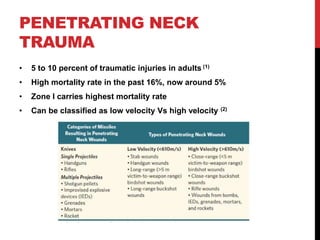
• 5 to 10 percent of traumatic injuries in adults (1)
• High mortality rate in the past 16%, now around 5%
• Zone I carries highest mortality rate
• Can be classified as low velocity Vs high velocity (2)
ANATOMY
INITIAL
MANAGEMENT
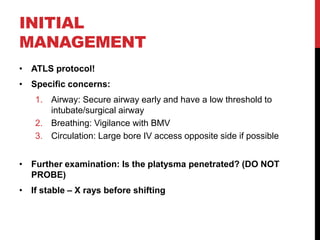
• ATLS protocol!
• Specific concerns:
1. Airway: Secure airway early and have a low threshold to
intubate/surgical airway
2. Breathing: Vigilance with BMV
3. Circulation: Large bore IV access opposite side if possible
• Further examination: Is the platysma penetrated? (DO NOT
PROBE)
• If stable – X rays before shifting
CLINICAL FEATURES
OF INJURIES:
• Vascular injuries:
1. Shock, decreased or absent peripheral pulses, global or focal
neurologic deficits (eg, stroke), expanding hematoma.
2. Subtle signs include nonexpansile hematomas, mild bleeding, and
transient hypotension
3. If missed, can lead to delayed complications
• Aerodigestive tract injuries:
1. Missed in approximately 25% (3) of cases as most are indolent.
2. ysphagia, blood in the saliva, hematemesis, and subcutaneous air
highly suggestive
• Nervous system injuries:
1. Central nervous system (spinal cord) or the peripheral nervous
system.
2. Detailed cranial nerve examination.
3. Horner syndrome may also occure and seen most commonly with
zone I injuries.
DO I NEED TO SHIFT THE
PATIENT TO OT?
EVOLUTION OF NECK
EXPLORATION
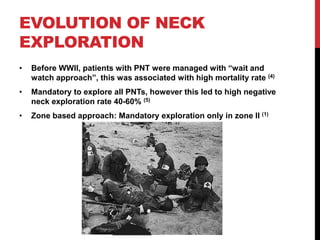
• Before WWII, patients with PNT were managed with “wait and
watch approach”, this was associated with high mortality rate (4)
• Mandatory to explore all PNTs, however this led to high negative
neck exploration rate 40-60% (5)
• Zone based approach: Mandatory exploration only in zone II (1)
EVOLUTION OF NECK
EXPLORATION
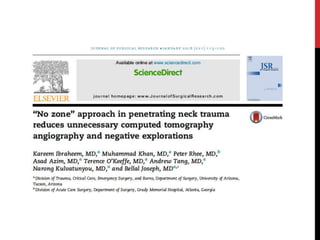
• Further studies and guidelines favored even more
selective approach
WTA ALGORITHM
FURTHER
MANAGEMENT
• Only patients with hard signs of vascular or aerodigestive injuries
proceed directly to OT
1. Airway compromise
2. Massive subcutaneous emphysema/air bubbling through wound
3. Expanding or pulsatile hematoma
4. Active bleeding
5. Shock
6. Neurologic deficit
7. Hematemesis
• Otherwise patients who are at low risk of any injuries (superficial
injury) can be observed
• Further investigations is indicated if patient is symptomatic or zone
II is involved
FURTHER
INVESTIGATIONS
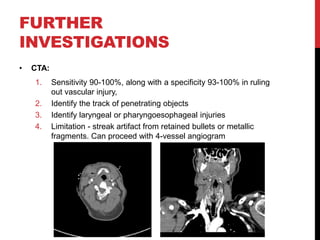
• CTA:
1. Sensitivity 90-100%, along with a specificity 93-100% in ruling
out vascular injury,
2. Identify the track of penetrating objects
3. Identify laryngeal or pharyngoesophageal injuries
4. Limitation - streak artifact from retained bullets or metallic
fragments. Can proceed with 4-vessel angiogram
FURTHER
INVESTIGATIONS
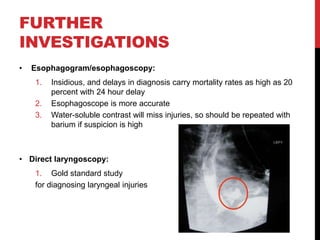
• Esophagogram/esophagoscopy:
1. Insidious, and delays in diagnosis carry mortality rates as high as 20
percent with 24 hour delay
2. Esophagoscope is more accurate
3. Water-soluble contrast will miss injuries, so should be repeated with
barium if suspicion is high
• Direct laryngoscopy:
1. Gold standard study
for diagnosing laryngeal injuries
OPERATIVE
EXPOSURE
1. Supine with a shoulder roll and the neck extended if there is no
concern for cervical spine injury
2. Prepped from the earlobe to the umbilicus +/- a groin and thigh
3. 3 types of incisions: Anterior border of the SCM, collar incision
and median sternotomy. Special considerations: B/L exploration,
zone I and zone III
4. Divide platysma and dissect along the anterior border of the SCM
5. Identify IJV and dissect along its anterior border, facial vein is
identified and ligated encounter the facial vein.
6. Retract IJV laterally and carotid sheath is identified and opened,
dissection is continued into the periadventitial plane. Care is taken
to not injure vagus and hypoglossal nerves
7. Retract carotid artery laterally and continue dissection medially to
identify oesophagus and trachea (can place NGT to aid in
identification)
OPERATIVE
MANAGEMENT OF
SPECIFIC INJURIES
• Esophagus:
1. Fully débrided to expose the entirety of the perforation.
2. Primary repair in one or two layers, need to repair can be buttressed especially with
concomitant tracheal injury.
3. If significant injury: diversion with esophagostomy followed by delayed reconstruction
• Trachea:
1. Primary repair with knots placed outside
2. Large tracheal defects often require resection and anastomosis
3. Some anterior injuries can be managed by creating a tracheostomy through the injury.
• Veins:
1. Direct pressure, ligation
2. IJV – transverse venorrhaphy (PIC)
• Arteries:
1. Initially proximal and distal control
2. Primary repair or graft repair with a synthetic graft or autologous vein
3. If extensive injury – ligate (Risk of ipsilateral stroke)
NON-OPERATIVE
MANAGEMENT
1. Vascular: Consult vascular. Some cases may only require
antiplatelet or anticoagulation, some may benefit from
endovascular treatment alone
2. Hypopharyngeal injury (above arytenoids) can be
managed conservatively
BLUNT NECK TRAUMA
• Uncommon 0.8-1.5% (2)
• Causes: MVCs, blunt object from assaults, crush injuries,
and hanging
• Presents similarly to penetrating neck trauma and initially
managed the same
• Need to rule out blunt
cerebrovascular injury (BCVI)
by CTA
• Managed conservatively
+/- endovascular
REFERENCES
1. Demetriades D, Theodorou D, Cornwell E, Berne TV, Asensio J,
Belzberg H, Velmahos G, Weaver F, Yellin A . Evaluation of
penetrating injuries of the neck: prospective study of 223
patients.. World J Surg 1997; 21(1): .
2. Brennan J, Holt GR, Conner M, Donald P, Esterman V, Hayes
D. Resident Manual of Trauma to the Face, Head, and Neck, 1
ed. Virginia: American Academy of Otolaryngology—Head and
Neck Surgery Foundation; 2010.
3. Bryant AS, Cerfolio RJ. Esophageal trauma. Thorac Surg
Clin 2007; 17(1): .
4. Thal ER, Meyer DM. Esophageal trauma. Curr Prob Surg 1992;
29(1): .
5. Maier RV, Marquardt DL. Penetrating neck trauma. In: Cameron
JL, Cameron AM, eds. Current Surgical Therapy. 13th ed.
Philadelphia: Elsevier; 2014.
QUESTIONS?
THANK YOU!

Neck trauma final.pptx

  • 1.
  • 2.
    CASE • 35-year-old malepresents after being stabbed in the neck. • A 5-cm wound is present and an expanding hematoma is noted • Vitals – BP 86/46 HR 140 SpO2 95% RR 22 • What would you do next?
  • 3.
    PENETRATING NECK TRAUMA • 5to 10 percent of traumatic injuries in adults (1) • High mortality rate in the past 16%, now around 5% • Zone I carries highest mortality rate • Can be classified as low velocity Vs high velocity (2)
  • 4.
  • 5.
    INITIAL MANAGEMENT • ATLS protocol! •Specific concerns: 1. Airway: Secure airway early and have a low threshold to intubate/surgical airway 2. Breathing: Vigilance with BMV 3. Circulation: Large bore IV access opposite side if possible • Further examination: Is the platysma penetrated? (DO NOT PROBE) • If stable – X rays before shifting
  • 6.
    CLINICAL FEATURES OF INJURIES: •Vascular injuries: 1. Shock, decreased or absent peripheral pulses, global or focal neurologic deficits (eg, stroke), expanding hematoma. 2. Subtle signs include nonexpansile hematomas, mild bleeding, and transient hypotension 3. If missed, can lead to delayed complications • Aerodigestive tract injuries: 1. Missed in approximately 25% (3) of cases as most are indolent. 2. ysphagia, blood in the saliva, hematemesis, and subcutaneous air highly suggestive • Nervous system injuries: 1. Central nervous system (spinal cord) or the peripheral nervous system. 2. Detailed cranial nerve examination. 3. Horner syndrome may also occure and seen most commonly with zone I injuries.
  • 7.
    DO I NEEDTO SHIFT THE PATIENT TO OT?
  • 8.
    EVOLUTION OF NECK EXPLORATION •Before WWII, patients with PNT were managed with “wait and watch approach”, this was associated with high mortality rate (4) • Mandatory to explore all PNTs, however this led to high negative neck exploration rate 40-60% (5) • Zone based approach: Mandatory exploration only in zone II (1)
  • 9.
    EVOLUTION OF NECK EXPLORATION •Further studies and guidelines favored even more selective approach
  • 10.
  • 13.
    FURTHER MANAGEMENT • Only patientswith hard signs of vascular or aerodigestive injuries proceed directly to OT 1. Airway compromise 2. Massive subcutaneous emphysema/air bubbling through wound 3. Expanding or pulsatile hematoma 4. Active bleeding 5. Shock 6. Neurologic deficit 7. Hematemesis • Otherwise patients who are at low risk of any injuries (superficial injury) can be observed • Further investigations is indicated if patient is symptomatic or zone II is involved
  • 14.
    FURTHER INVESTIGATIONS • CTA: 1. Sensitivity90-100%, along with a specificity 93-100% in ruling out vascular injury, 2. Identify the track of penetrating objects 3. Identify laryngeal or pharyngoesophageal injuries 4. Limitation - streak artifact from retained bullets or metallic fragments. Can proceed with 4-vessel angiogram
  • 15.
    FURTHER INVESTIGATIONS • Esophagogram/esophagoscopy: 1. Insidious,and delays in diagnosis carry mortality rates as high as 20 percent with 24 hour delay 2. Esophagoscope is more accurate 3. Water-soluble contrast will miss injuries, so should be repeated with barium if suspicion is high • Direct laryngoscopy: 1. Gold standard study for diagnosing laryngeal injuries
  • 16.
    OPERATIVE EXPOSURE 1. Supine witha shoulder roll and the neck extended if there is no concern for cervical spine injury 2. Prepped from the earlobe to the umbilicus +/- a groin and thigh 3. 3 types of incisions: Anterior border of the SCM, collar incision and median sternotomy. Special considerations: B/L exploration, zone I and zone III 4. Divide platysma and dissect along the anterior border of the SCM 5. Identify IJV and dissect along its anterior border, facial vein is identified and ligated encounter the facial vein. 6. Retract IJV laterally and carotid sheath is identified and opened, dissection is continued into the periadventitial plane. Care is taken to not injure vagus and hypoglossal nerves 7. Retract carotid artery laterally and continue dissection medially to identify oesophagus and trachea (can place NGT to aid in identification)
  • 17.
    OPERATIVE MANAGEMENT OF SPECIFIC INJURIES •Esophagus: 1. Fully débrided to expose the entirety of the perforation. 2. Primary repair in one or two layers, need to repair can be buttressed especially with concomitant tracheal injury. 3. If significant injury: diversion with esophagostomy followed by delayed reconstruction • Trachea: 1. Primary repair with knots placed outside 2. Large tracheal defects often require resection and anastomosis 3. Some anterior injuries can be managed by creating a tracheostomy through the injury. • Veins: 1. Direct pressure, ligation 2. IJV – transverse venorrhaphy (PIC) • Arteries: 1. Initially proximal and distal control 2. Primary repair or graft repair with a synthetic graft or autologous vein 3. If extensive injury – ligate (Risk of ipsilateral stroke)
  • 18.
    NON-OPERATIVE MANAGEMENT 1. Vascular: Consultvascular. Some cases may only require antiplatelet or anticoagulation, some may benefit from endovascular treatment alone 2. Hypopharyngeal injury (above arytenoids) can be managed conservatively
  • 19.
    BLUNT NECK TRAUMA •Uncommon 0.8-1.5% (2) • Causes: MVCs, blunt object from assaults, crush injuries, and hanging • Presents similarly to penetrating neck trauma and initially managed the same • Need to rule out blunt cerebrovascular injury (BCVI) by CTA • Managed conservatively +/- endovascular
  • 20.
    REFERENCES 1. Demetriades D,Theodorou D, Cornwell E, Berne TV, Asensio J, Belzberg H, Velmahos G, Weaver F, Yellin A . Evaluation of penetrating injuries of the neck: prospective study of 223 patients.. World J Surg 1997; 21(1): . 2. Brennan J, Holt GR, Conner M, Donald P, Esterman V, Hayes D. Resident Manual of Trauma to the Face, Head, and Neck, 1 ed. Virginia: American Academy of Otolaryngology—Head and Neck Surgery Foundation; 2010. 3. Bryant AS, Cerfolio RJ. Esophageal trauma. Thorac Surg Clin 2007; 17(1): . 4. Thal ER, Meyer DM. Esophageal trauma. Curr Prob Surg 1992; 29(1): . 5. Maier RV, Marquardt DL. Penetrating neck trauma. In: Cameron JL, Cameron AM, eds. Current Surgical Therapy. 13th ed. Philadelphia: Elsevier; 2014.
  • 21.
  • 22.