Building Regional Entrepreneurship &
     Innovation Support Systems


             Rural Entrepreneurship Convening
                       Nebraska City, Nebraska
                            November 9, 2010
A Question to my Facebook Friends
What is the most helpful thing the public sector can to
to help you start and grown your business?

“No idea, never had any help from the government except paperwork and
                                                        huge tax bills.”

“Reduce the red tape. Period. Their intervention does absolutely nothing to
                                                         help. Stay away.”

                 “Tax abatements and incentives”

        “Access to resources that are usually only
 available to larger companies – market research,
       mentoring from successful executives, etc.”
Points to Cover

•   Our Analogy
•   Our Model
•   Our Process
•   North Central Indiana
•   Ideas for the Future
•   Tools & Technical Assistance
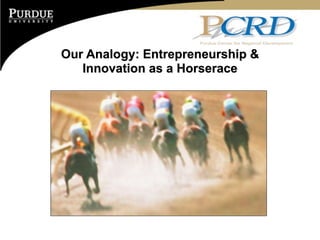
Our Analogy: Entrepreneurship &
   Innovation as a Horserace
A Horse Race

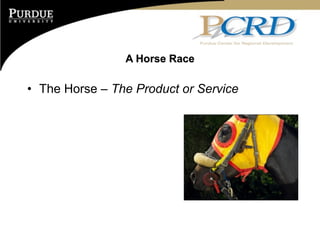
• The Horse – The Product or Service
A Horse Race

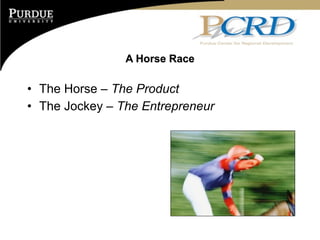
• The Horse – The Product
• The Jockey – The Entrepreneur
A Horse Race

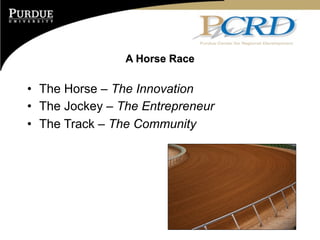
• The Horse – The Innovation
• The Jockey – The Entrepreneur
• The Track – The Community
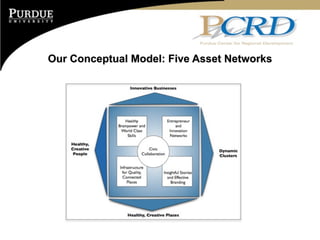
Our Conceptual Model: Five Asset Networks
Five Asset Networks

– Build world-class brainpower
– Translate brainpower into wealth through
  innovation and entrepreneurship
– Create quality, connected places where “hot spots”
  can develop
– Create a buzz with a brand & new stories
– Continuously strengthen habits of civic leadership
  and collaboration
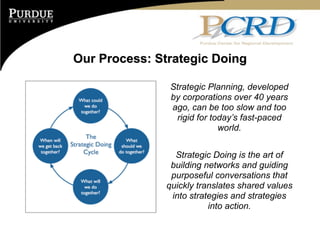
Our Process: Strategic Doing

               Strategic Planning, developed
               by corporations over 40 years
               ago, can be too slow and too
                rigid for today’s fast-paced
                            world.


                 Strategic Doing is the art of
                building networks and guiding
                purposeful conversations that
               quickly translates shared values
                into strategies and strategies
                          into action.
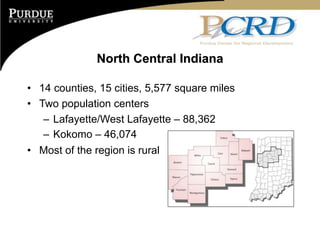
North Central Indiana

• 14 counties, 15 cities, 5,577 square miles
• Two population centers
   – Lafayette/West Lafayette – 88,362
   – Kokomo – 46,074
• Most of the region is rural
Background
•   Purdue University (Indiana’s land grant university)
    – A mission that includes learning, discovery, and delivery
    – 69,000 students
    – “Research 1” Institution
    – Top rankings in engineering, business, agriculture
•   $15 million investment from DOLETA in 2006 (Gen1)
    – Only WIRED initiative led by a university
• An additional $18 million leveraged
•   Four Key Strategies
    – Developing 21st Century talent
    – Creating globally competitive industry clusters
    – Building a regional support system for entrepreneurship
    – Weaving a supportive regional civic infrastructure
70+ Shareholders


•   Federal: DOL, EDA, SBA, NIST
•   Philanthropy: Kauffman, Edward Lowe, Purdue Research
    Foundation, Community Foundations
•   State: Economic Development, Workforce Development, SBDC
•   Higher Ed: Purdue, IU Kokomo, Ivy Tech Community College
•   Local & Regional: Extension, LEDOs, SBDCs, K-12,
    Incubators/Tech Parks, Workforce Boards
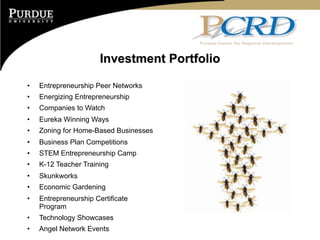
Investment Portfolio

•   Entrepreneurship Peer Networks
•   Energizing Entrepreneurship
•   Companies to Watch
•   Eureka Winning Ways
•   Zoning for Home-Based Businesses
•   Business Plan Competitions
•   STEM Entrepreneurship Camp
•   K-12 Teacher Training
•   Skunkworks
•   Economic Gardening
•   Entrepreneurship Certificate
    Program
•   Technology Showcases
•   Angel Network Events
Investment Strategy

Phased Investment Approach
•Exploratory
•Demonstration
•Implementation
Flexible Contracting Tools
•Master Agreements
•Project Task Agreements
Return on our Investment (Metrics)
  •   227 K-12 teachers trained to teach entrepreneurship
  •   1,536 students (future entrepreneurs) enrolled in entrepreneurship
      programs
  •   1,851 existing and emerging adult entrepreneurs trained
  •   654 new products, services, and top-line growth ideas created
  •   102 business plans developed
  •   10 new start-up business launched
  •   353 jobs created or retained
  •   $3.5 million in industry cost savings realized
  •   $1.6 million in industry sales growth
  •   $4 million in industry sales retained

80% of these initiatives have been sustained beyond the initial investment
Ideas for the Future

• Economic Development Certificate
  program
• Statewide roll out of Economic
  Gardening
• Export strategy based on connecting
  Indiana products with Purdue
  international students
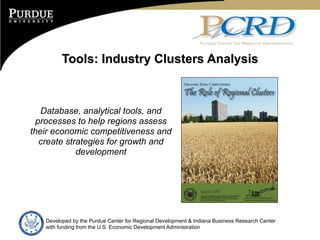
Tools: Industry Clusters Analysis


   Database, analytical tools, and
 processes to help regions assess
their economic competitiveness and
  create strategies for growth and
            development


   Developed by the Purdue Center for Regional Development & Indiana Business Research Center
   with funding from the U.S. Economic Development Administration
Tools: Occupational Cluster Analysis


  Analytic tools to explore employment size, growth, location quotient, and
 shift share for 15 knowledge-based occupation clusters. These tools help
  regional leaders understand their workforce and educational situation in
order to bridge the gap between workforce and economic development. It is
   also useful to diagnose how well-positioned the region is to participate
            effectively in a knowledge-based innovation economy.


      Developed by the Purdue Center for Regional Development & Indiana Business Research Center
      with funding from the U.S. Economic Development Administration
Tools: Innovation Index


                                                  The Innovation Index provides
                                                leaders and practitioners with the
                                                first tool for comparing a region's
                                              innovation performance with that of
                                               the United States, a state, or other
                                                               regions.


Developed by the Purdue Center for Regional Development & Indiana Business Research Center
with funding from the U.S. Economic Development Administration
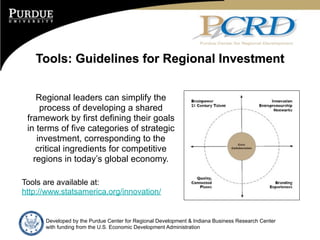
Tools: Guidelines for Regional Investment


    Regional leaders can simplify the
     process of developing a shared
 framework by first defining their goals
 in terms of five categories of strategic
    investment, corresponding to the
    critical ingredients for competitive
   regions in today’s global economy.

Tools are available at:
http://www.statsamerica.org/innovation/


      Developed by the Purdue Center for Regional Development & Indiana Business Research Center
      with funding from the U.S. Economic Development Administration
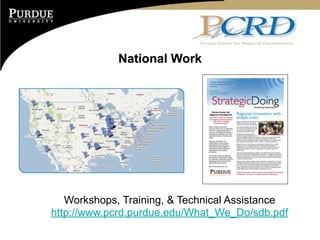
National Work


   Workshops, Training, & Technical Assistance
http://www.pcrd.purdue.edu/What_We_Do/sdb.pdf
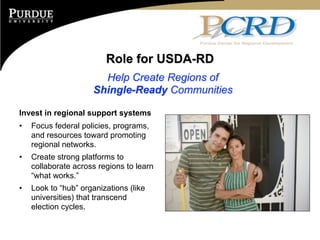
Role for USDA-RD
                       Help Create Regions of
                     Shingle-Ready Communities

Invest in regional support systems
•   Focus federal policies, programs,
    and resources toward promoting
    regional networks.
•   Create strong platforms to
    collaborate across regions to learn
    “what works.”
•   Look to “hub” organizations (like
    universities) that transcend
    election cycles.
Scott Hutcheson
Assistant Program Leader, Economic & Community Development


                      Purdue University
 Purdue Extension & Purdue Center for Regional Development
        Burton D. Morgan Center for Entrepreneurship
              1207 W. State Street, Room 227
                    765-494-7273 (office)
                     765-494-3200 (fax)
                   765-479-7704 (mobile)

Nebraska city presentation

  • 1.
    Building Regional Entrepreneurship& Innovation Support Systems Rural Entrepreneurship Convening Nebraska City, Nebraska November 9, 2010
  • 2.
    A Question tomy Facebook Friends What is the most helpful thing the public sector can to to help you start and grown your business? “No idea, never had any help from the government except paperwork and huge tax bills.” “Reduce the red tape. Period. Their intervention does absolutely nothing to help. Stay away.” “Tax abatements and incentives” “Access to resources that are usually only available to larger companies – market research, mentoring from successful executives, etc.”
  • 3.
    Points to Cover • Our Analogy • Our Model • Our Process • North Central Indiana • Ideas for the Future • Tools & Technical Assistance
  • 4.
    Our Analogy: Entrepreneurship& Innovation as a Horserace
  • 5.
    A Horse Race •The Horse – The Product or Service
  • 6.
    A Horse Race •The Horse – The Product • The Jockey – The Entrepreneur
  • 7.
    A Horse Race •The Horse – The Innovation • The Jockey – The Entrepreneur • The Track – The Community
  • 8.
    Our Conceptual Model:Five Asset Networks
  • 9.
    Five Asset Networks –Build world-class brainpower – Translate brainpower into wealth through innovation and entrepreneurship – Create quality, connected places where “hot spots” can develop – Create a buzz with a brand & new stories – Continuously strengthen habits of civic leadership and collaboration
  • 10.
    Our Process: StrategicDoing Strategic Planning, developed by corporations over 40 years ago, can be too slow and too rigid for today’s fast-paced world. Strategic Doing is the art of building networks and guiding purposeful conversations that quickly translates shared values into strategies and strategies into action.
  • 11.
    North Central Indiana •14 counties, 15 cities, 5,577 square miles • Two population centers – Lafayette/West Lafayette – 88,362 – Kokomo – 46,074 • Most of the region is rural
  • 12.
    Background • Purdue University (Indiana’s land grant university) – A mission that includes learning, discovery, and delivery – 69,000 students – “Research 1” Institution – Top rankings in engineering, business, agriculture • $15 million investment from DOLETA in 2006 (Gen1) – Only WIRED initiative led by a university • An additional $18 million leveraged • Four Key Strategies – Developing 21st Century talent – Creating globally competitive industry clusters – Building a regional support system for entrepreneurship – Weaving a supportive regional civic infrastructure
  • 13.
    70+ Shareholders • Federal: DOL, EDA, SBA, NIST • Philanthropy: Kauffman, Edward Lowe, Purdue Research Foundation, Community Foundations • State: Economic Development, Workforce Development, SBDC • Higher Ed: Purdue, IU Kokomo, Ivy Tech Community College • Local & Regional: Extension, LEDOs, SBDCs, K-12, Incubators/Tech Parks, Workforce Boards
  • 14.
    Investment Portfolio • Entrepreneurship Peer Networks • Energizing Entrepreneurship • Companies to Watch • Eureka Winning Ways • Zoning for Home-Based Businesses • Business Plan Competitions • STEM Entrepreneurship Camp • K-12 Teacher Training • Skunkworks • Economic Gardening • Entrepreneurship Certificate Program • Technology Showcases • Angel Network Events
  • 15.
    Investment Strategy Phased InvestmentApproach •Exploratory •Demonstration •Implementation Flexible Contracting Tools •Master Agreements •Project Task Agreements
  • 16.
    Return on ourInvestment (Metrics) • 227 K-12 teachers trained to teach entrepreneurship • 1,536 students (future entrepreneurs) enrolled in entrepreneurship programs • 1,851 existing and emerging adult entrepreneurs trained • 654 new products, services, and top-line growth ideas created • 102 business plans developed • 10 new start-up business launched • 353 jobs created or retained • $3.5 million in industry cost savings realized • $1.6 million in industry sales growth • $4 million in industry sales retained 80% of these initiatives have been sustained beyond the initial investment
  • 17.
    Ideas for theFuture • Economic Development Certificate program • Statewide roll out of Economic Gardening • Export strategy based on connecting Indiana products with Purdue international students
  • 18.
    Tools: Industry ClustersAnalysis Database, analytical tools, and processes to help regions assess their economic competitiveness and create strategies for growth and development Developed by the Purdue Center for Regional Development & Indiana Business Research Center with funding from the U.S. Economic Development Administration
  • 19.
    Tools: Occupational ClusterAnalysis Analytic tools to explore employment size, growth, location quotient, and shift share for 15 knowledge-based occupation clusters. These tools help regional leaders understand their workforce and educational situation in order to bridge the gap between workforce and economic development. It is also useful to diagnose how well-positioned the region is to participate effectively in a knowledge-based innovation economy. Developed by the Purdue Center for Regional Development & Indiana Business Research Center with funding from the U.S. Economic Development Administration
  • 20.
    Tools: Innovation Index The Innovation Index provides leaders and practitioners with the first tool for comparing a region's innovation performance with that of the United States, a state, or other regions. Developed by the Purdue Center for Regional Development & Indiana Business Research Center with funding from the U.S. Economic Development Administration
  • 21.
    Tools: Guidelines forRegional Investment Regional leaders can simplify the process of developing a shared framework by first defining their goals in terms of five categories of strategic investment, corresponding to the critical ingredients for competitive regions in today’s global economy. Tools are available at: http://www.statsamerica.org/innovation/ Developed by the Purdue Center for Regional Development & Indiana Business Research Center with funding from the U.S. Economic Development Administration
  • 22.
    National Work Workshops, Training, & Technical Assistance http://www.pcrd.purdue.edu/What_We_Do/sdb.pdf
  • 23.
    Role for USDA-RD Help Create Regions of Shingle-Ready Communities Invest in regional support systems • Focus federal policies, programs, and resources toward promoting regional networks. • Create strong platforms to collaborate across regions to learn “what works.” • Look to “hub” organizations (like universities) that transcend election cycles.
  • 24.
    Scott Hutcheson Assistant ProgramLeader, Economic & Community Development Purdue University Purdue Extension & Purdue Center for Regional Development Burton D. Morgan Center for Entrepreneurship 1207 W. State Street, Room 227 765-494-7273 (office) 765-494-3200 (fax) 765-479-7704 (mobile)