MEGS-KT Research Project

    Interim Reporting
      October 2012
Contents
• Context
• Aims
• Methods
• Results (achievements to note and initial
  technical development)
• Barriers, limitations and the next stage
  (WP3, WP4)
• Transferability, sustainability, social impact
  and other benefits
MEGS-KT - Aims

• Skills shortage in the renewable energy sector.
• Business development needs in the energy sector
  to support the growth of low carbon communities
• An opportunity for innovative collaboration SMEs
  with the HEI sector
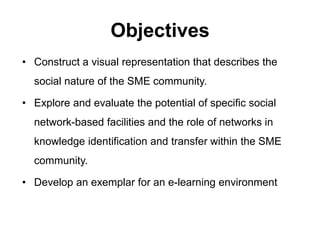
Objectives
• Construct a visual representation that describes the
  social nature of the SME community.

• Explore and evaluate the potential of specific social
  network-based facilities and the role of networks in
  knowledge identification and transfer within the SME
  community.

• Develop an exemplar for an e-learning environment
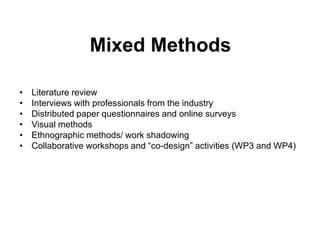
Mixed Methods

•   Literature review
•   Interviews with professionals from the industry
•   Distributed paper questionnaires and online surveys
•   Visual methods
•   Ethnographic methods/ work shadowing
•   Collaborative workshops and “co-design” activities (WP3 and WP4)
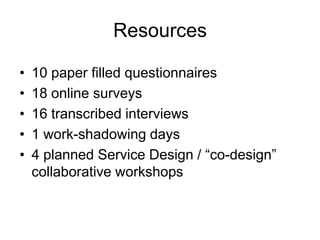
Resources

•   10 paper filled questionnaires
•   18 online surveys
•   16 transcribed interviews
•   1 work-shadowing days
•   4 planned Service Design / “co-design”
    collaborative workshops
Question 1
What would you say are the main difficulties to
 overcome in your role at the present time?
Question 2
What are the most important work related
  questions in your mind right now?
Question 3
What information are you lacking to support
          your business growth?
Question 4
Are you networked/ networking?
Insights
SMEs do not have defined roles like larger companies.
SMEs have little time to research and improve their businesses
No-one understands the Green Deal (May 2012)?
SMEs cannot communicate well their needs, when asked.
In the current climate there is a lack of work/ of projects (architects lack
projects, construction companies lack projects).
Bureaucratic methods for getting accredited discourages
peoples/companies from accreditation (subsequent lack of jobs, loss of
tenders).
Many people are interested in the DIY section of the sector.
The construction industry is poor in terms of QA.
With the Green Deal approaching there is a need for up-skilling the retro-fit
industry.
Low carbon and renewable energy technologies need to be marketed to
the average client.
Summary Barriers and Limitations

• Little previous research to explore the
  needs of SMEs in the sector (no literature)
• Hard to engage SMEs
• Professional bodies/networks limiting
  access to SMEs by “outsiders”.
• Concerns about sharing commercial
  information from SMEs – “I prefer not to
  say”
Positives
• Positive support from academics,
  professionals, Government bodies
• Interest from many different sectors –
  academics.
• Engagement with key figures working in
  the field.
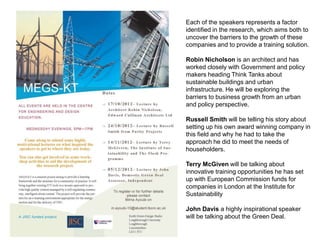
Each of the speakers represents a factor
identified in the research, which aims both to
uncover the barriers to the growth of these
companies and to provide a training solution.

Robin Nicholson is an architect and has
worked closely with Government and policy
makers heading Think Tanks about
sustainable buildings and urban
infrastructure. He will be exploring the
barriers to business growth from an urban
and policy perspective.

Russell Smith will be telling his story about
setting up his own award winning company in
this field and why he had to take the
approach he did to meet the needs of
householders.

Terry McGiven will be talking about
innovative training opportunities he has set
up with European Commission funds for
companies in London at the Institute for
Sustainability

John Davis a highly inspirational speaker
will be talking about the Green Deal.
Technical developments
  Mandy Kings’ Presentation
Transferability

• Links to the Institute for Sustainability
  FLASH programme and other new
  initiatives.
Sustainability

• Link with the Midlands Energy Graduate
  School.
Megs-KT Interim report presentation October 2012

Megs-KT Interim report presentation October 2012

  • 1.
    MEGS-KT Research Project Interim Reporting October 2012
  • 2.
    Contents • Context • Aims •Methods • Results (achievements to note and initial technical development) • Barriers, limitations and the next stage (WP3, WP4) • Transferability, sustainability, social impact and other benefits
  • 3.
    MEGS-KT - Aims •Skills shortage in the renewable energy sector. • Business development needs in the energy sector to support the growth of low carbon communities • An opportunity for innovative collaboration SMEs with the HEI sector
  • 4.
    Objectives • Construct avisual representation that describes the social nature of the SME community. • Explore and evaluate the potential of specific social network-based facilities and the role of networks in knowledge identification and transfer within the SME community. • Develop an exemplar for an e-learning environment
  • 5.
    Mixed Methods • Literature review • Interviews with professionals from the industry • Distributed paper questionnaires and online surveys • Visual methods • Ethnographic methods/ work shadowing • Collaborative workshops and “co-design” activities (WP3 and WP4)
  • 6.
    Resources • 10 paper filled questionnaires • 18 online surveys • 16 transcribed interviews • 1 work-shadowing days • 4 planned Service Design / “co-design” collaborative workshops
  • 8.
    Question 1 What wouldyou say are the main difficulties to overcome in your role at the present time?
  • 9.
    Question 2 What arethe most important work related questions in your mind right now?
  • 10.
    Question 3 What informationare you lacking to support your business growth?
  • 11.
    Question 4 Are younetworked/ networking?
  • 12.
    Insights SMEs do nothave defined roles like larger companies. SMEs have little time to research and improve their businesses No-one understands the Green Deal (May 2012)? SMEs cannot communicate well their needs, when asked. In the current climate there is a lack of work/ of projects (architects lack projects, construction companies lack projects). Bureaucratic methods for getting accredited discourages peoples/companies from accreditation (subsequent lack of jobs, loss of tenders). Many people are interested in the DIY section of the sector. The construction industry is poor in terms of QA. With the Green Deal approaching there is a need for up-skilling the retro-fit industry. Low carbon and renewable energy technologies need to be marketed to the average client.
  • 13.
    Summary Barriers andLimitations • Little previous research to explore the needs of SMEs in the sector (no literature) • Hard to engage SMEs • Professional bodies/networks limiting access to SMEs by “outsiders”. • Concerns about sharing commercial information from SMEs – “I prefer not to say”
  • 14.
    Positives • Positive supportfrom academics, professionals, Government bodies • Interest from many different sectors – academics. • Engagement with key figures working in the field.
  • 15.
    Each of thespeakers represents a factor identified in the research, which aims both to uncover the barriers to the growth of these companies and to provide a training solution. Robin Nicholson is an architect and has worked closely with Government and policy makers heading Think Tanks about sustainable buildings and urban infrastructure. He will be exploring the barriers to business growth from an urban and policy perspective. Russell Smith will be telling his story about setting up his own award winning company in this field and why he had to take the approach he did to meet the needs of householders. Terry McGiven will be talking about innovative training opportunities he has set up with European Commission funds for companies in London at the Institute for Sustainability John Davis a highly inspirational speaker will be talking about the Green Deal.
  • 16.
    Technical developments Mandy Kings’ Presentation
  • 17.
    Transferability • Links tothe Institute for Sustainability FLASH programme and other new initiatives.
  • 18.
    Sustainability • Link withthe Midlands Energy Graduate School.