The Russia Innovation Collaborative

Building the Perm Innovation Ecosystem
The Russia Innovation Collaborative
         has designed programs
 to nurture and support innovation and
accelerate the migration of ideas from the
  lab to practical commercial application.
Russia Innovation Collaborative:
            Mission

    Russia is currently undertaking a program of modernization of its
 economy, with a particular focus on fostering technological innovation.
   Despite the strength of intellectual resources and very strong basic
   science, Russia has not been successful at developing clusters of
                                 innovation.

 Massachusetts is one of the world-leading clusters of innovation. It has
  a well-developed public-private relationships that contributes to the
                success of the innovation ecosystem.

     The focus of the Russia Innovation Collaborative is to connect key
  institutions and stakeholders in Russia with those in Massachusetts
  and throughout the US with the goal of increasing economic wealth
Introduction


• The Russia Innovation Collaborative (RIC) is a limited liability
  company registered in the Commonwealth (state) of
  Massachusetts with its office in Boston, Massachusetts in the
  Cambridge Innovation Center, across the street from MIT.
• RIC has three inter-related lines of business:
   – Consulting to Russian regional governments on policies to promote
     innovation and action plans to implement those policies.
   – Building cooperative programs between U.S. and Russian universities
     (primarily national research universities) to facilite innovation.
   – Tech transfer and market entry for private companies.
Introduction


• Daniel Satinsky – Background:
   – Business lawyer for 15 years
   – Graduate of Fletcher School of Law & Diplomacy
   – Former President, U.S.-Russia Chamber of Commerce of New England,
     Inc.
   – Participant in 4 start-up companies
   – Consultant to Russian software companies in U.S. market entry
   – Co-author Yaroslavl Roadmap 10-15-20, innovation policy study done
     by New York Academy of Science
   – Contributor to Modern Russia (www.modernrussia.com)
Introduction

• Cynthia Bouthot – Background:
   – Head of Innovation and R&D Programs for the British Government for the
     past 2 years
   – Consul, Head of UK Trade & Investment for 6 years
   – 15 years industry experience in global operations:
       • Global Lead of Business Readiness for EMC’s $200 million ERP implementation
         and
       • Director of Industry Practice for Benchmarking Partners
       • International Finance and Auditing at Honeywell Bull
   – BS from Boston College’s Carroll School of Management with a major in
     Finance and a Masters degree in International Economics and Finance
     from Brandeis University
   – Mentor for Boston University’s Kindle Management program
   – Founder of 3 start-up companies
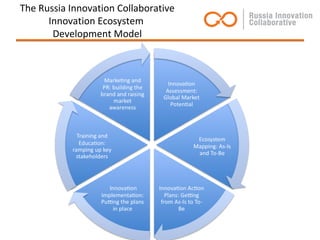
The Russia Innovation Collaborative
      Innovation Ecosystem
       Development Model
Perm’s Phase 1 Project
Innovation Ecosystem Development:
      Innovation Assessment


                               • Review key strengths of the region
                               • Define priority sectors vis-à-vis key
                                 counterparts and global market
                                 potential
                               • Evaluate competitive position
                                 nationally and internationally
                               • Identify key innovation ecosystem
                                 stakeholders
                               • Determine if innovation project is a
                                 go or no-go
Innovation Ecosystem Development:
        Ecosystem Mapping


                               • Map region’s capabilities against
                                 innovation ecosystem
                               • Interview key stakeholders in each
                                 ecosystem area, including
                                 entrepreneurs, VC’s, academics,
                                 large business, SME’s and
                                 government policy makers
                               • Determine ‘AS-IS’ reality,
                                 highlighting existing gaps
                               • Determine ‘TO-BE’ aspirations
                                 through interviews and analysis of
                                 what is possible
Innovation Ecosystem Development:
      Innovation Action Plans


                               • The difference between the AS-
                                 IS reality and the TO-BE
                                 Aspirations is the innovation gap
                               • Compile and prioritize key gaps
                                 between as-is and to-be
                               • Build teams of stakeholders to
                                 construct action plans (teams will
                                 be called I-team ‘innovation
                                 teams’)
Innovation Ecosystem Development:
    Innovation Implementation


   • Assign cross-functional innovation
     teams to each action item
   • Manage and implement action items
Innovation Ecosystem Development:
      Training and Education


  • Build educational campaigns for key
    stakeholders including academics,
    scientists, entrepreneurs and
    government officials
  • Convene networking groups and
    other forum for consistent sharing of
    information between stakeholders
Innovation Ecosystem Development:
         Marketing and PR


  • Build marketing and PR
    campaigns based on
    innovation strengths
  • Promote region to possible
    collaborators and inward
    investors
  • Continue to link region’s
    innovation cluster to
    innovation clusters throughout
    the world
Best Practice Innovation
             Ecosystems

                       Tech transfer and commercialization           Serial
     Academic                                                     Entrepreneurs
     Excellence


Government
  / Policy                     Innovation Ecosystem
                                                                       Thriving
                                                                       knowledge
                                                                       based
                                                                       sectors
        Industry
    Associations and                             Public and Seed
   Networking Groups                            Funding, grants and
                                Venture                loans
                                Capital
Perm’s Innovation Ecosystem


  Academic                  Tech transfer and commercialization
  Excellence                                                                  Serial
                                                                           Entrepreneurs
    University
   Innovation

                                         Perm’s AS-IS                                     Thriving
                                     Innovation Ecosystem                                 knowledge
                                                                                          based
Government
                                                                                          sectors
  / Policy

                                                                                        Big Business
      Industry                                                                           and Small
  Associations and                    Venture
                                                        Public and Seed                   Business
 Networking Groups                                     Funding, grants and              relationship
                                      Capital
                                                              loans


  Best Practice Exhibited         Gaps to Best Practice Exist     Significant Gaps and Failures Exist
AS-IS and GAP Analysis
University Gaps
•   Small number of students exposed to knowledge about entrepreneurship
•   Narrow focus on teaching students, rather than including Post-Grads and Professors in business or
    entrepreneurship education
•   Inability to structure scientific research on business basis (weak understanding of markets or commercial
    applications)
•   Missing conceptual understanding of basis of business and university cooperation in innovation process
    (traditional contract research does exist where university plays following role)
•   Insufficiently developed connections and understanding of international research directions
•   Lack of knowledge of foreign business curriculum and consistent contact with innovative Russian businesses
•   Lack of clarity on purpose and expectations from incubators
•   Perm’s universities appear to be focused on the Incubator as the one answer to bringing entrepreneurship into
    universities rather than creating multiple programs and schemes to educate and stimulate activity
•   Competition for scarce federal and regional funds among competing universities and RAS institutes
•   Problem of ‘me-first’ pursuit of funding that inhibits cost and function-sharing cross-institutional cooperation
•   Lack of physical facilities for student gathering to exchange ideas
•   Lack of consistent and long-term curriculum development that includes integration with business in the
    innovative, knowledge-based sectors
•   No course work on innovation in large enterprises
•   Lack of consistent interaction with businesses engaged in innovation
•   Lack of differentiated strategy for academic/research collaboration and commercial innovation development
Large and Small Business
                  Gaps
•   Lack of global competition in Perm prevents incentive to innovate
•   Market mechanisms are not working freely and a a result there are limited incentives for large companies
    to innovate internally or look outside to smaller companies for innovation
•   Large companies are not using open innovation and therefore blocking the fundamental supply/demand
    relationship with small companies; Market failure in the relationship between big business as demand and
    small business as supply
•   No clear route to market for Perm’s new projects; Funding seems to be small and early stage and no clear
    path for future funding
•   New Russian companies do not benchmark against global competitors (which is needed even if addressing
    only the Russian market first)
•   No mechanisms for small business to liaise with universities; No apparent funding to encourage a business
    to work with the universities via funding or “innovation vouchers”
•   Appropriate government support structures do not appear to support big/existing business modernization
    and/or innovation. Current schemes appear focused on new business
•   Lack of government programs to encourage or spur collaboration between big business and small business
•   Lack of good news stories and examples of how careers in small / entrepreneurial companies are attractive;
    and current success stories appear to be exceptions rather than the rule.
•   Lack of systemic processes; successes are opportunistic rather than systematic
•   Perm’s investment agency does support business by bringing international companies and R&D shops into
    Perm and helping Perm companies make links internationally (R&D collaborations, licensing deals, and new
    routes to market)
•   Lack of consistent missions of Perm companies and key stakeholders traveling to international markets to
    develop new relationships and understand routes to market
Government Gaps

•   Perm’s sector focus priorities (Biotech, ICT, Energy, etc) are not clearly based on existing strengths and
    capabilities as expressed during university and industry interviews
•   Sector focus areas are not defined in a way to show detailed capability based on existing industrial
    capability, university strengths and differentiation from competitors such as: Remediation technologies
    (water, soil, etc), Utilization of Waste materials and super toxics, Biotesting and Diagnostics, Plant biology
    and organic chemistry, Nano materials and polymers
•   No clearly stated set of incentives and grants to support entrepreneurs, start-ups, existing companies and
    FDI target companies
•   Mechanisms are not in place to enable meaningful data to be collected on the value of grants/funding, as
    well as dissemination of key propositional differentiators
•   High taxes and costs of credit for big and small companies are sited as barriers for growth
•   Perception is that Perm lags similar regions of Tomsk and Ekaterinberg. Need to determine if this is
    perception or truth and make appropriate changes (real programs or PR)
•   Perm’s investment agency does not appear focused on key international targets nor focused on the three
    key goals of an agency: to create a new wave of high value investment into Perm, to promote the
    integration of Perm technology into world markets through professional representation and to develop a
    positive brand image for Perm and for its scientific and business resources
Serial Entrepreneurs

•   No existence of or culture supporting serial entrepreneurs
•   No mechanism/network in place that enables the coalescing of an entrepreneurial community, including
    tech transfer and commercialization support systems
•   Lack of awareness of existing entrepreneurs in the community
•   Lack of on-going engagement in entrepreneurship teaching and curriculum; Lack of consistent
    entrepreneurship training at each university
•   Lack of supporting tax, grants and inward investment incentives and support for serial entrepreneurs
•   Limited public/Seed Funding, grants and loans for serial entrepreneurs
•   No early stage educational programs for young children to learn entrepreneurship
•   No apparent incentives to encourage entrepreneurs to work with the universities via funding or
    “innovation vouchers 
Tech Transfer and
                Commercialization
•   Patent filing and in particular international patent filing is a missing skill set in the Perm Innovation
    ecosystem
•   Local, rather than global, expertise in commercialization and intellectual property
•   Lack of understanding of how to create IP products or services from academic’s work
•   Lack of local resources to evaluate technology for market and assist with business expertise
•   ‘Old school’ scientist do not understand a personal benefit of commercialization nor do they understand
    the benefit for their students and as a result, they cannot teach or mentor their students in these areas.
•   No technology transfer or commercialization education or training programs geared towards faculty
•   Some Perm prize competitions appear to be narrowly focused and difficult to penetrate making it difficult
    for innovative companies or technologies to participate
•   Academic publishing of scientific work does not appear to be taking place internationally and therefore the
    peer review process and understanding of international findings and competitors is limited.
 
VC and other
                    Funding Sources
•   Lack of a ‘menu’ of tax incentives focused on each phase of a start-up’s life cycle.
•   Funding seems to be small and early stage and no clear path for future funding
•   Venture Capital industry is underdeveloped
•   Limited public/Seed Funding, grants and loans
•   Lack of private funded IT investment in the region. As a result, highly innovative and fast growing ICT
    companies are more likely to encounter difficulties in raising finance
•   Lack of sophisticated Business Angels network
•   There is no clear support to identify and promote a range of other sources of finance for growth, including
    dept as well as equity funding
Innovation Gaps, Innovation Teams
         and Action Plans


                Short Term Issues


                                       Cross
                                    Functional   Action
  Identified   Medium Term Issues                plans
                                    Innovation
    Gaps
                                      teams


                 Long Term Issues
DRAFT Gap Summary

Short    • Lack of clarity on Incubators and over- reliance as the one answer to brining entrepreneurship into universities
           rather than creating multiple programs and schemes to educate and stimulate activity
Term     • Each university is creating its own incubator / tech transfer center without having the scale to support
         • No clearly stated set of incentives and grants to support entrepreneurs, start-ups, existing companies and FDI
           target companies
         • Patent filing, especially international patents are a missing skill-set in the innovation process
         • Business plan and prize competitions are not easy to access and not leading to a clear path of
           commercialization
         • Lack of consistent missions of Perm companies and key stakeholders traveling to international markets to
           develop new relationships and understand routes to market


Medium   • No consistent course work or curriculum on entrepreneurship, technology transfer and other business training
           to a broad range of students and focus only on students rather than post-docs and professors
Term     • Lack of systematic international relationships at the government, university and business levels
         • Lack of government programs to spur collaboration between big business and small business, and university
           and business
         • Perception that Perm lags Tomsk and Ekanterinburg
         • Perm’s investment agency is not focused on international targets, promoting FDI into Perm and helping Perm
           companies understand international routes to market

Long     • Lack of global competition prevents incentive to innovate
         • Market failure in relationship between big business as demand and small business as supply and for large
Term       companies to innovate internally – complete lack of open innovation mentality
         • Lack of serial entrepreneurs and culture of entrepreneurship
The Implementation Process –
Taking Action and Getting Results!


                                                                         ACTION PLAN:
                                                                    Create one overarching
                                                                  technology transfer center
                                                                 to support all university and
                  Each university is creating                    institute commercialization
                  its own incubator / tech                         and have each university
                  transfer center without                            focus on educational
                  having the scale to support                      programs and curriculum
                                                      Cross
                                                    functional
                 Lack of consistent missions of
                 Perm companies and key               teams
                 stakeholders traveling to                            ACTION PLAN:
                 international markets to develop                Conduct a mission of Perm
                 new relationships and understand                   companies and key
                 routes to market                                stakeholders to Boston to
                                                                   develop international
                                                                      relationships

RIC

  • 1.
    The Russia InnovationCollaborative Building the Perm Innovation Ecosystem
  • 2.
    The Russia InnovationCollaborative has designed programs to nurture and support innovation and accelerate the migration of ideas from the lab to practical commercial application.
  • 3.
    Russia Innovation Collaborative: Mission Russia is currently undertaking a program of modernization of its economy, with a particular focus on fostering technological innovation. Despite the strength of intellectual resources and very strong basic science, Russia has not been successful at developing clusters of innovation. Massachusetts is one of the world-leading clusters of innovation. It has a well-developed public-private relationships that contributes to the success of the innovation ecosystem. The focus of the Russia Innovation Collaborative is to connect key institutions and stakeholders in Russia with those in Massachusetts and throughout the US with the goal of increasing economic wealth
  • 4.
    Introduction • The RussiaInnovation Collaborative (RIC) is a limited liability company registered in the Commonwealth (state) of Massachusetts with its office in Boston, Massachusetts in the Cambridge Innovation Center, across the street from MIT. • RIC has three inter-related lines of business: – Consulting to Russian regional governments on policies to promote innovation and action plans to implement those policies. – Building cooperative programs between U.S. and Russian universities (primarily national research universities) to facilite innovation. – Tech transfer and market entry for private companies.
  • 5.
    Introduction • Daniel Satinsky– Background: – Business lawyer for 15 years – Graduate of Fletcher School of Law & Diplomacy – Former President, U.S.-Russia Chamber of Commerce of New England, Inc. – Participant in 4 start-up companies – Consultant to Russian software companies in U.S. market entry – Co-author Yaroslavl Roadmap 10-15-20, innovation policy study done by New York Academy of Science – Contributor to Modern Russia (www.modernrussia.com)
  • 6.
    Introduction • Cynthia Bouthot– Background: – Head of Innovation and R&D Programs for the British Government for the past 2 years – Consul, Head of UK Trade & Investment for 6 years – 15 years industry experience in global operations: • Global Lead of Business Readiness for EMC’s $200 million ERP implementation and • Director of Industry Practice for Benchmarking Partners • International Finance and Auditing at Honeywell Bull – BS from Boston College’s Carroll School of Management with a major in Finance and a Masters degree in International Economics and Finance from Brandeis University – Mentor for Boston University’s Kindle Management program – Founder of 3 start-up companies
  • 7.
    The Russia InnovationCollaborative Innovation Ecosystem Development Model
  • 8.
  • 9.
    Innovation Ecosystem Development: Innovation Assessment • Review key strengths of the region • Define priority sectors vis-à-vis key counterparts and global market potential • Evaluate competitive position nationally and internationally • Identify key innovation ecosystem stakeholders • Determine if innovation project is a go or no-go
  • 10.
    Innovation Ecosystem Development: Ecosystem Mapping • Map region’s capabilities against innovation ecosystem • Interview key stakeholders in each ecosystem area, including entrepreneurs, VC’s, academics, large business, SME’s and government policy makers • Determine ‘AS-IS’ reality, highlighting existing gaps • Determine ‘TO-BE’ aspirations through interviews and analysis of what is possible
  • 11.
    Innovation Ecosystem Development: Innovation Action Plans • The difference between the AS- IS reality and the TO-BE Aspirations is the innovation gap • Compile and prioritize key gaps between as-is and to-be • Build teams of stakeholders to construct action plans (teams will be called I-team ‘innovation teams’)
  • 12.
    Innovation Ecosystem Development: Innovation Implementation • Assign cross-functional innovation teams to each action item • Manage and implement action items
  • 13.
    Innovation Ecosystem Development: Training and Education • Build educational campaigns for key stakeholders including academics, scientists, entrepreneurs and government officials • Convene networking groups and other forum for consistent sharing of information between stakeholders
  • 14.
    Innovation Ecosystem Development: Marketing and PR • Build marketing and PR campaigns based on innovation strengths • Promote region to possible collaborators and inward investors • Continue to link region’s innovation cluster to innovation clusters throughout the world
  • 15.
    Best Practice Innovation Ecosystems Tech transfer and commercialization Serial Academic Entrepreneurs Excellence Government / Policy Innovation Ecosystem Thriving knowledge based sectors Industry Associations and Public and Seed Networking Groups Funding, grants and Venture loans Capital
  • 16.
    Perm’s Innovation Ecosystem Academic Tech transfer and commercialization Excellence Serial Entrepreneurs University Innovation Perm’s AS-IS Thriving Innovation Ecosystem knowledge based Government sectors / Policy Big Business Industry and Small Associations and Venture Public and Seed Business Networking Groups Funding, grants and relationship Capital loans Best Practice Exhibited Gaps to Best Practice Exist Significant Gaps and Failures Exist
  • 17.
    AS-IS and GAPAnalysis
  • 18.
    University Gaps • Small number of students exposed to knowledge about entrepreneurship • Narrow focus on teaching students, rather than including Post-Grads and Professors in business or entrepreneurship education • Inability to structure scientific research on business basis (weak understanding of markets or commercial applications) • Missing conceptual understanding of basis of business and university cooperation in innovation process (traditional contract research does exist where university plays following role) • Insufficiently developed connections and understanding of international research directions • Lack of knowledge of foreign business curriculum and consistent contact with innovative Russian businesses • Lack of clarity on purpose and expectations from incubators • Perm’s universities appear to be focused on the Incubator as the one answer to bringing entrepreneurship into universities rather than creating multiple programs and schemes to educate and stimulate activity • Competition for scarce federal and regional funds among competing universities and RAS institutes • Problem of ‘me-first’ pursuit of funding that inhibits cost and function-sharing cross-institutional cooperation • Lack of physical facilities for student gathering to exchange ideas • Lack of consistent and long-term curriculum development that includes integration with business in the innovative, knowledge-based sectors • No course work on innovation in large enterprises • Lack of consistent interaction with businesses engaged in innovation • Lack of differentiated strategy for academic/research collaboration and commercial innovation development
  • 19.
    Large and SmallBusiness Gaps • Lack of global competition in Perm prevents incentive to innovate • Market mechanisms are not working freely and a a result there are limited incentives for large companies to innovate internally or look outside to smaller companies for innovation • Large companies are not using open innovation and therefore blocking the fundamental supply/demand relationship with small companies; Market failure in the relationship between big business as demand and small business as supply • No clear route to market for Perm’s new projects; Funding seems to be small and early stage and no clear path for future funding • New Russian companies do not benchmark against global competitors (which is needed even if addressing only the Russian market first) • No mechanisms for small business to liaise with universities; No apparent funding to encourage a business to work with the universities via funding or “innovation vouchers” • Appropriate government support structures do not appear to support big/existing business modernization and/or innovation. Current schemes appear focused on new business • Lack of government programs to encourage or spur collaboration between big business and small business • Lack of good news stories and examples of how careers in small / entrepreneurial companies are attractive; and current success stories appear to be exceptions rather than the rule. • Lack of systemic processes; successes are opportunistic rather than systematic • Perm’s investment agency does support business by bringing international companies and R&D shops into Perm and helping Perm companies make links internationally (R&D collaborations, licensing deals, and new routes to market) • Lack of consistent missions of Perm companies and key stakeholders traveling to international markets to develop new relationships and understand routes to market
  • 20.
    Government Gaps • Perm’s sector focus priorities (Biotech, ICT, Energy, etc) are not clearly based on existing strengths and capabilities as expressed during university and industry interviews • Sector focus areas are not defined in a way to show detailed capability based on existing industrial capability, university strengths and differentiation from competitors such as: Remediation technologies (water, soil, etc), Utilization of Waste materials and super toxics, Biotesting and Diagnostics, Plant biology and organic chemistry, Nano materials and polymers • No clearly stated set of incentives and grants to support entrepreneurs, start-ups, existing companies and FDI target companies • Mechanisms are not in place to enable meaningful data to be collected on the value of grants/funding, as well as dissemination of key propositional differentiators • High taxes and costs of credit for big and small companies are sited as barriers for growth • Perception is that Perm lags similar regions of Tomsk and Ekaterinberg. Need to determine if this is perception or truth and make appropriate changes (real programs or PR) • Perm’s investment agency does not appear focused on key international targets nor focused on the three key goals of an agency: to create a new wave of high value investment into Perm, to promote the integration of Perm technology into world markets through professional representation and to develop a positive brand image for Perm and for its scientific and business resources
  • 21.
    Serial Entrepreneurs • No existence of or culture supporting serial entrepreneurs • No mechanism/network in place that enables the coalescing of an entrepreneurial community, including tech transfer and commercialization support systems • Lack of awareness of existing entrepreneurs in the community • Lack of on-going engagement in entrepreneurship teaching and curriculum; Lack of consistent entrepreneurship training at each university • Lack of supporting tax, grants and inward investment incentives and support for serial entrepreneurs • Limited public/Seed Funding, grants and loans for serial entrepreneurs • No early stage educational programs for young children to learn entrepreneurship • No apparent incentives to encourage entrepreneurs to work with the universities via funding or “innovation vouchers 
  • 22.
    Tech Transfer and Commercialization • Patent filing and in particular international patent filing is a missing skill set in the Perm Innovation ecosystem • Local, rather than global, expertise in commercialization and intellectual property • Lack of understanding of how to create IP products or services from academic’s work • Lack of local resources to evaluate technology for market and assist with business expertise • ‘Old school’ scientist do not understand a personal benefit of commercialization nor do they understand the benefit for their students and as a result, they cannot teach or mentor their students in these areas. • No technology transfer or commercialization education or training programs geared towards faculty • Some Perm prize competitions appear to be narrowly focused and difficult to penetrate making it difficult for innovative companies or technologies to participate • Academic publishing of scientific work does not appear to be taking place internationally and therefore the peer review process and understanding of international findings and competitors is limited.  
  • 23.
    VC and other Funding Sources • Lack of a ‘menu’ of tax incentives focused on each phase of a start-up’s life cycle. • Funding seems to be small and early stage and no clear path for future funding • Venture Capital industry is underdeveloped • Limited public/Seed Funding, grants and loans • Lack of private funded IT investment in the region. As a result, highly innovative and fast growing ICT companies are more likely to encounter difficulties in raising finance • Lack of sophisticated Business Angels network • There is no clear support to identify and promote a range of other sources of finance for growth, including dept as well as equity funding
  • 24.
    Innovation Gaps, InnovationTeams and Action Plans Short Term Issues Cross Functional Action Identified Medium Term Issues plans Innovation Gaps teams Long Term Issues
  • 25.
    DRAFT Gap Summary Short • Lack of clarity on Incubators and over- reliance as the one answer to brining entrepreneurship into universities rather than creating multiple programs and schemes to educate and stimulate activity Term • Each university is creating its own incubator / tech transfer center without having the scale to support • No clearly stated set of incentives and grants to support entrepreneurs, start-ups, existing companies and FDI target companies • Patent filing, especially international patents are a missing skill-set in the innovation process • Business plan and prize competitions are not easy to access and not leading to a clear path of commercialization • Lack of consistent missions of Perm companies and key stakeholders traveling to international markets to develop new relationships and understand routes to market Medium • No consistent course work or curriculum on entrepreneurship, technology transfer and other business training to a broad range of students and focus only on students rather than post-docs and professors Term • Lack of systematic international relationships at the government, university and business levels • Lack of government programs to spur collaboration between big business and small business, and university and business • Perception that Perm lags Tomsk and Ekanterinburg • Perm’s investment agency is not focused on international targets, promoting FDI into Perm and helping Perm companies understand international routes to market Long • Lack of global competition prevents incentive to innovate • Market failure in relationship between big business as demand and small business as supply and for large Term companies to innovate internally – complete lack of open innovation mentality • Lack of serial entrepreneurs and culture of entrepreneurship
  • 26.
    The Implementation Process– Taking Action and Getting Results! ACTION PLAN: Create one overarching technology transfer center to support all university and Each university is creating institute commercialization its own incubator / tech and have each university transfer center without focus on educational having the scale to support programs and curriculum Cross functional Lack of consistent missions of Perm companies and key teams stakeholders traveling to ACTION PLAN: international markets to develop Conduct a mission of Perm new relationships and understand companies and key routes to market stakeholders to Boston to develop international relationships