Leadership for
Local Foods
North Dakota Local Foods
Leadership Training
NC SARE Grant
Glenn Muske, PhD
Abby Gold, PhD
Megan Myrdahl
North Dakota State University Extension Service
BISMAN
Community
Food Coop
Tyler & Heidi Demars
BISMAN Coop Timeline
• October 2011 - First Meeting
• January 2012 – Visioning Session
• June 2012 - APUC grant awarded to complete
feasibility study
• May 2013 - Feasibility Study Complete
• June 2013 – Member Drive Started
• August 2013 – 2nd APUC grant awarded for legal
services, technical support, and to hire an outreach
coordinator.
• July 1, 2015 – 820 member-owners invested!
• Will open at their physical location (711 E Sweet Ave)
when they reach 1,200 member-owners.
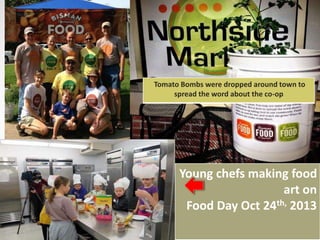
Tomato Bombs were dropped around town to
spread the word about the co-op
Young chefs making food
art on
Food Day Oct 24th, 2013
SNAP & Town
Square Farmers
Market
Molly Soeby
Promote Local
Foods through
Harvest Festival
Vaughn Hammond
FAARMS/EconomicDevelopmentSummit
(SOLE)
Sue Balcom
• Objective: We need to support farmers meeting economic
developers and encourage scaling up through economic
development
• Summit: April 14 and 15, 2015 in Medora
• Outcomes: To showcase CSAs, farmers markets, food hubs,
aggregation, cooperative models and support the ND local
food system as a tool for economic development in small
communities — and large.
• Goal: We hope putting a face on the farmer will encourage
more JDA and Economic Development offices to support
projects such as light processing and food hubs to assist with
the distribution of locally grown and value added agriculture
products.
• SOLE2: August 25 & 26, 2015 with support from USDA Rural
Development.
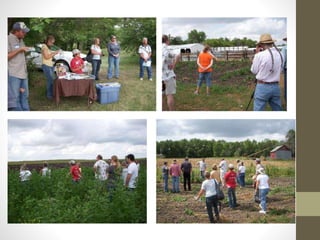
Sustainable Gluten Free Crops in
Central ND
GlenPhilbrick
• Rational: To promote locally grown gluten free foods in
central ND and prove that ND can sustainably grow gluten free
foods.
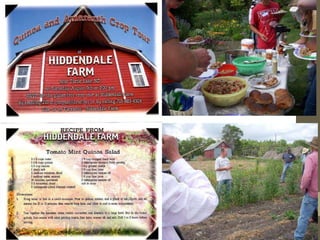
• How Did it Go? The tour had 20 participants. Had several
discussions with people about gluten free foods such as
quinoa and amaranth. Distributed recipe cards to provide
meal ideas for products.
• Main Outcomes: Most people were not aware quinoa and
amaranth could be grown in ND. Customers were excited
they will have a local option for gluten free grains.
• Future Plans:
• Will be hosting another farm tour in August.
• Planning to visit Kevin Murphy, Barley & Alternative Crop
Breeding Professor at the University of Washington, Pullman in
August 2015.
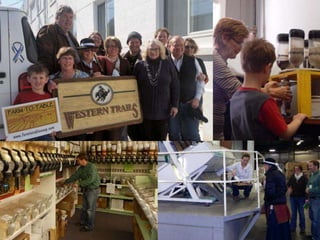
Cross-Pollination Tour to Farm to
Table Co-op
StephanieBlumhagen
• Farm to Table Co-op in Glendive is building a local food
system in Eastern Montana and Western North Dakota.
• The point of the cross-pollination trip was to take Local
Food leaders from eastern and central North Dakota to
see what Farm to Table has accomplished, learn from
their experience, and share with themwhat North
Dakota local food leaders have learned in their own
efforts to build local food systems.
• Tour Dates: March 20-21, 2015
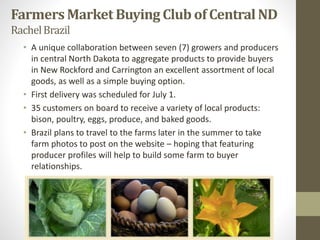
FarmersMarketBuying Club of CentralND
RachelBrazil
• A unique collaboration between seven (7) growers and producers
in central North Dakota to aggregate products to provide buyers
in New Rockford and Carrington an excellent assortment of local
goods, as well as a simple buying option.
• First delivery was scheduled for July 1.
• 35 customers on board to receive a variety of local products:
bison, poultry, eggs, produce, and baked goods.
• Brazil plans to travel to the farms later in the summer to take
farm photos to post on the website – hoping that featuring
producer profiles will help to build some farm to buyer
relationships.
Farm to School Awareness
and Marketing Campaign.
Jonathon& HannahMoser
• Main Objective: To increase awareness about Forager
Farm and Jamestown Public School District's
involvement in ND Farm to School. We will be
designing and distributing informational marketing
materials to schools. We will also be hosting on the
farm tours for students from Jamestown Schools.
Heart of Dakota Local Foods
Educational Wagon
Irene Graves
Project Name: Heart of Dakota Local Foods Educational Wagon
Rational: To educate the public about Local Foods
How Did it Go? GREAT
• 182 surveys
• 379 direct contacts
• Handed out over 1,500 publications and information sheets
• Ponies brought in diverse crowd
Main Outcomes:
• There is a great need for education
• Gardeners do not see there foods as commercial item will give it
away but not sell.
• Local Foods – interpreted as a brand name not a locally grown food.
Future Plans:
• Will repeat the process
• More invitations than available weekends – do as many as possible
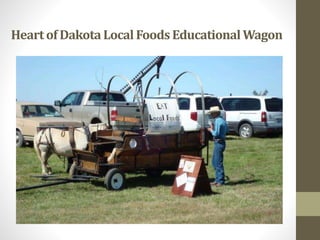
Heartof DakotaLocal FoodsEducationalWagon
United Tribes
Technical College
Winter Market
Jana Millner
MOSES- February2015–LaCrosse,WI
LoriMartin & Annie Carlson
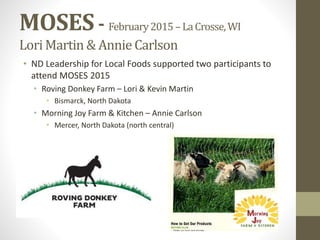
• ND Leadership for Local Foods supported two participants to
attend MOSES 2015
• Roving Donkey Farm – Lori & Kevin Martin
• Bismarck, North Dakota
• Morning Joy Farm & Kitchen – Annie Carlson
• Mercer, North Dakota (north central)
Northern Small Farmer Alliance
Ross& Amber Lockhart
• Four Pillars of NSFA & Actions:
• Local Food Awareness Building
• NSFA Facebook Page
• NSFA Media Message, Marketing Materials & Mission
Statement
• Get Local Event
• Farmer-to-Farmer Education
• On Farm Tours/Best Practice Sharing
• Support for New & Emerging Farmers
• NSFA Internship Program
• NSFA Membership Guidelines
• Aggregation of Produce
• Food Truck/Mobile Farmers Market
Dickey County Ag Day – April 23
NicholasPodoll
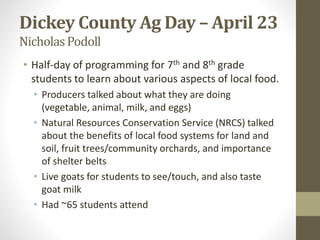
• Half-day of programming for 7th and 8th grade
students to learn about various aspects of local food.
• Producers talked about what they are doing
(vegetable, animal, milk, and eggs)
• Natural Resources Conservation Service (NRCS) talked
about the benefits of local food systems for land and
soil, fruit trees/community orchards, and importance
of shelter belts
• Live goats for students to see/touch, and also taste
goat milk
• Had ~65 students attend
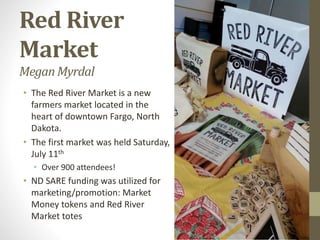
Red River
Market
MeganMyrdal
• The Red River Market is a new
farmers market located in the
heart of downtown Fargo, North
Dakota.
• The first market was held Saturday,
July 11th
• Over 900 attendees!
• ND SARE funding was utilized for
marketing/promotion: Market
Money tokens and Red River
Market totes
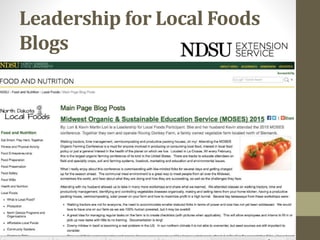
Leadership for Local Foods
Blogs
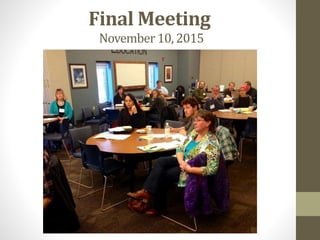
Final Meeting
November10, 2015

Local Foods and Local Leaders - July, 2015 CDS presentation

  • 1.
    Leadership for Local Foods NorthDakota Local Foods Leadership Training NC SARE Grant Glenn Muske, PhD Abby Gold, PhD Megan Myrdahl North Dakota State University Extension Service
  • 2.
  • 3.
    BISMAN Coop Timeline •October 2011 - First Meeting • January 2012 – Visioning Session • June 2012 - APUC grant awarded to complete feasibility study • May 2013 - Feasibility Study Complete • June 2013 – Member Drive Started • August 2013 – 2nd APUC grant awarded for legal services, technical support, and to hire an outreach coordinator. • July 1, 2015 – 820 member-owners invested! • Will open at their physical location (711 E Sweet Ave) when they reach 1,200 member-owners.
  • 4.
    Tomato Bombs weredropped around town to spread the word about the co-op Young chefs making food art on Food Day Oct 24th, 2013
  • 5.
    SNAP & Town SquareFarmers Market Molly Soeby
  • 7.
    Promote Local Foods through HarvestFestival Vaughn Hammond
  • 9.
    FAARMS/EconomicDevelopmentSummit (SOLE) Sue Balcom • Objective:We need to support farmers meeting economic developers and encourage scaling up through economic development • Summit: April 14 and 15, 2015 in Medora • Outcomes: To showcase CSAs, farmers markets, food hubs, aggregation, cooperative models and support the ND local food system as a tool for economic development in small communities — and large. • Goal: We hope putting a face on the farmer will encourage more JDA and Economic Development offices to support projects such as light processing and food hubs to assist with the distribution of locally grown and value added agriculture products. • SOLE2: August 25 & 26, 2015 with support from USDA Rural Development.
  • 11.
    Sustainable Gluten FreeCrops in Central ND GlenPhilbrick • Rational: To promote locally grown gluten free foods in central ND and prove that ND can sustainably grow gluten free foods. • How Did it Go? The tour had 20 participants. Had several discussions with people about gluten free foods such as quinoa and amaranth. Distributed recipe cards to provide meal ideas for products. • Main Outcomes: Most people were not aware quinoa and amaranth could be grown in ND. Customers were excited they will have a local option for gluten free grains. • Future Plans: • Will be hosting another farm tour in August. • Planning to visit Kevin Murphy, Barley & Alternative Crop Breeding Professor at the University of Washington, Pullman in August 2015.
  • 14.
    Cross-Pollination Tour toFarm to Table Co-op StephanieBlumhagen • Farm to Table Co-op in Glendive is building a local food system in Eastern Montana and Western North Dakota. • The point of the cross-pollination trip was to take Local Food leaders from eastern and central North Dakota to see what Farm to Table has accomplished, learn from their experience, and share with themwhat North Dakota local food leaders have learned in their own efforts to build local food systems. • Tour Dates: March 20-21, 2015
  • 16.
    FarmersMarketBuying Club ofCentralND RachelBrazil • A unique collaboration between seven (7) growers and producers in central North Dakota to aggregate products to provide buyers in New Rockford and Carrington an excellent assortment of local goods, as well as a simple buying option. • First delivery was scheduled for July 1. • 35 customers on board to receive a variety of local products: bison, poultry, eggs, produce, and baked goods. • Brazil plans to travel to the farms later in the summer to take farm photos to post on the website – hoping that featuring producer profiles will help to build some farm to buyer relationships.
  • 17.
    Farm to SchoolAwareness and Marketing Campaign. Jonathon& HannahMoser • Main Objective: To increase awareness about Forager Farm and Jamestown Public School District's involvement in ND Farm to School. We will be designing and distributing informational marketing materials to schools. We will also be hosting on the farm tours for students from Jamestown Schools.
  • 18.
    Heart of DakotaLocal Foods Educational Wagon Irene Graves Project Name: Heart of Dakota Local Foods Educational Wagon Rational: To educate the public about Local Foods How Did it Go? GREAT • 182 surveys • 379 direct contacts • Handed out over 1,500 publications and information sheets • Ponies brought in diverse crowd Main Outcomes: • There is a great need for education • Gardeners do not see there foods as commercial item will give it away but not sell. • Local Foods – interpreted as a brand name not a locally grown food. Future Plans: • Will repeat the process • More invitations than available weekends – do as many as possible
  • 19.
  • 20.
  • 23.
    MOSES- February2015–LaCrosse,WI LoriMartin &Annie Carlson • ND Leadership for Local Foods supported two participants to attend MOSES 2015 • Roving Donkey Farm – Lori & Kevin Martin • Bismarck, North Dakota • Morning Joy Farm & Kitchen – Annie Carlson • Mercer, North Dakota (north central)
  • 24.
    Northern Small FarmerAlliance Ross& Amber Lockhart • Four Pillars of NSFA & Actions: • Local Food Awareness Building • NSFA Facebook Page • NSFA Media Message, Marketing Materials & Mission Statement • Get Local Event • Farmer-to-Farmer Education • On Farm Tours/Best Practice Sharing • Support for New & Emerging Farmers • NSFA Internship Program • NSFA Membership Guidelines • Aggregation of Produce • Food Truck/Mobile Farmers Market
  • 25.
    Dickey County AgDay – April 23 NicholasPodoll • Half-day of programming for 7th and 8th grade students to learn about various aspects of local food. • Producers talked about what they are doing (vegetable, animal, milk, and eggs) • Natural Resources Conservation Service (NRCS) talked about the benefits of local food systems for land and soil, fruit trees/community orchards, and importance of shelter belts • Live goats for students to see/touch, and also taste goat milk • Had ~65 students attend
  • 26.
    Red River Market MeganMyrdal • TheRed River Market is a new farmers market located in the heart of downtown Fargo, North Dakota. • The first market was held Saturday, July 11th • Over 900 attendees! • ND SARE funding was utilized for marketing/promotion: Market Money tokens and Red River Market totes
  • 28.
  • 29.

Editor's Notes

  • #2 This slide show is an overview of the North Dakota Local Foods Leadership Training projects as of July 2015. The goal of this project was to provide training, guidance and support to local food leaders, as well as small mini grant to fund projects. Nearly 20 teams participated in the training and received mini grant to build capacity, education and marketing for local and regional foods. These slides were presented as part of the Leadership for Local Foods training held on December 2, 2014 in Jamestown at the North Dakota Farmer’s Union. The slides were updated in July to reflect project progress.
  • #3 Participants: Tyler & Heidi Demars   Project: BisMan Community Food Coop   Overview: The Bisman Community Food Coop currently has 820 members owners/investors. They hit the 600 member milestone in the summer of 2014 (the number necessary to move forward with a physical site).   Three coop members attended the Consumer Cooperative Management Association (CCMA) conference in June 2014 with funding support from the Leadership for Local Foods program. In addition to presentations/sessions, CCMA included various tours in Madison, Wisconsin that the coop members found very valuable including a community garden with various education components and an organic farmer owned cooperative. The conference had difference tracks and Heidi attended the marketing/outreach track, which was very helpful. SARE grant funding was used to offset the costs of the coop members to attend this training.
  • #4 BISMAN Community Food Coop The coop plans to open with 1,200 members-owners invested. They are gaining an average of 40 members/month, consistently making it one of the fastest growing start-ups in the nation! They have a retail location at 711 E Sweet Ave and have hired a general manager. The Coop is heaving into fund raising right now. The goal is $900,000 by the end of July, and they are $445,000 raised.
  • #5 BISMAN Community Food Coop
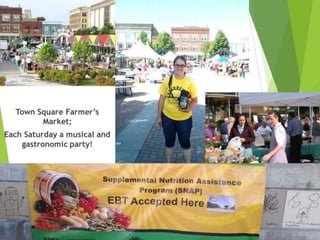
  • #6 Molly Soeby, Family & Consumer Science Agent for Grand Forks County Extension, and Community Health Action Response Team “Take Action” Chair joined the Leadership for Local Foods program in 2013 with the goal of getting Supplemental Nutrition Assistant Program (SNAP) dollars accepted at the Town Square Farmer’s Market in Grand Forks.   SNAP offers nutrition assistance to eligible, low-income individuals, and is the largest hunger safety net in the country. There are numerous benefits to allowing SNAP participants to spend their dollars at farmers markets, including increased access to healthy, locally grown foods, and keeping more dollars in the local community.   The Town Square/SNAP initiative began through a diverse community partnership under the “Take Action” umbrella. This group’s been working to allow SNAP use at the farmers market for a number of years, but without the buy-in and participation of the market vendors, they had little success.   There are many steps to implement SNAP acceptance at a farmers market including obtaining an FNS number (USDA certification), identifying a non-profit to sponsor, covering the cost of the point-of-sale machine (SNAP dollars operate like a credit card and many farmers markets operate on cash only), staffing needs to operate the EBT machine, and the costs associated with bookkeeping, start-up, transaction fees, and recruiting vendors to accept the SNAP dollars.   The “Take Action” group was able to complete nearly all of these important logistical pieces, but they were missing one crucial element – buy in from the market vendors. Shortly after the first Local Foods Leadership Training, Molly connected with Caryl Lester, manager of the Town Square Farmer’s Market, who was in full support of the market accepting SNAP and was able to bring all the vendors on board.   Through grant dollars received in the Local Foods Leadership Training, Town Square was able to cover the cost of hiring a summer employee to run the EBT machine. The market operated SNAP with a token system, allowing SNAP participants to purchase tokens to be exchanged for fresh produce, and vendors to be immediately reimbursed for their products. Also, through connections made in the Local Foods Leadership Training, Molly connected with members of the BisMarket Farmers Market, as they successfully began accepting SNAP the previous year. This connection provided guidance and mentorship to Molly and the TownSquare/SNAP team throughout the process.   The Town Square Farmers Market is gearing up for the 2015 market and its second season accepting SNAP benefits. They have many inspiring ideas for the coming year, and one of the key goals, according to Molly, is marketing the EBT capabilities to those in the SNAP program and to see an increase in the use of EBT SNAP at the market.   The Take Action coalition hopes to continue strong, collaborative effort to promote better health, support the local farmers, and ease poverty in the community.
  • #7 Town Square Farmers Market - Photo of the person hired (Jill Swingen) to operate and manage the EBT machine for the summer.
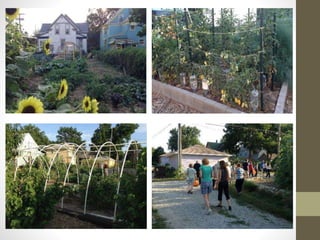
  • #8 Participant: Vaughn Hammond Project: Promote Local Foods through Harvest Festival Overview: Hawley is a neighborhood in Lincoln, NE. Eighteen yards in this neighborhood that shared a common alley chose to dedicate their yards to growing food and hosted the Hawley Gathering” – a one day event that sold food from the yards and the excess went to farmers markets. The event attracted over 400 people. From this event came the Local Foods Dinner. This was a high-end meal limited to 50 people. Based on the success and press from the Hawley Gathering, a Nebraska state senator asked to come and speak about local foods, and a candidate for lieutenant governor attended the event.
  • #9 Promote Local Foods through Harvest Festival
  • #10 Participant: Sue Balcom Project: Farmers Showcase at Local Foods Economic Development Summit
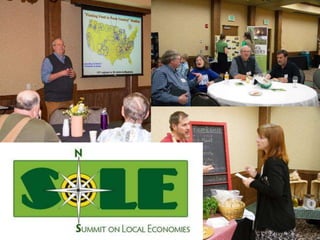
  • #11 Photos: Ken Meters discussing economic impact of local foods. Logo of SOLE. Attendees connecting with Ken Meters.
  • #12 Participant: Glen Philbrick Project: Sustainable Gluten Free Crops in Central ND
  • #13 Sustainable Gluten Free Crops in Central ND
  • #14 Sustainable Gluten Free Crops in Central ND
  • #15 Participant: Stephanie Blumhagen Project: Cross-Pollination Tour to Farm to Table Co-op Overview: Farm to Table Co-op in Glendive, Montana is building a local food system in Eastern Montana and Western North Dakota. The point of the cross-pollination trip was to take a van-load of Local Food leaders from eastern and central North Dakota to see what Farm to Table has accomplished, learn from their experience and share with them what we’ve learned in our own efforts to build local food systems. Like the bees that help our fields and gardens flourish by moving pollen from plant to plant, we will help local food systems across the region flourish through the exchange of knowledge and ideas. Farm to Table Co-op’s projects: A Local Buyer’s Guide An ag marketing co-op to market member’s produce and products to local stores, restaurants and food services Western Trails Food, a value added business featuring locally grown hull-less barley and beans in pancake, bread, and soup mixes. Partnership with Dawson Community College’s Culinary Arts program to train chefs to work with local growers and producers. A Food Development Center with a commercial kitchen which is can be rented by food entrepreneurs. They documented and photographed their experience, and had great reflections/discussions on the van rides to and from each location, as well as home. Transportation and lodging for participants was be covered by the SARE grant.
  • #16 Photos of the tours.
  • #17 Participants: Rachel Brazil Project: Farmers Market Buying Club of Central ND Note: Originally, the project was in combination with Jill Louters, Superintendent at New Rockford Public School, trying to increase farm to school participation in the district. After about a year into the grant project, it was identified that in order to build farm to school, they first needed to increase the aggregating capabilities and networking of local producers. Through conversations with various community members interested in local foods, Brazil determined (and with the support of Louters) that it would be a better use of time and grant funding to support aggregation and distribution of local goods through the buying club. They hope this will support further growth of local foods capacity and interest in the area, and lead to more farm to school activities in the near future.
  • #18 Participant: Jonathon Moser   Project: Increase Farm to School Awareness in Jamestown   How are things going? In the 2014/2015 school year, they provided zucchini, tomatoes and cucumbers to the school and want to get the kids to see where and who this food is coming from. They have been talking to Shelley Mack, the School Nutrition Director at Jamestown Public Schools. They will develop some coloring sheets with farm to school and Forager Farm logos for the students. In the fall of 2015, they will go into the classrooms and talk to students about their farm and will also be hosting some farm tours.
  • #19 Participant: Irene Graves Project: Heart of Dakota Local Foods Educational Wagon Irene Graves, NDSU Extension Agent, created the Heart of Dakota Local Foods Education Wagon. Irene, along with her ponies Robby and Joshua, traveled across North Dakota in the summer of 2014 (and have been doing it this summer as well) sharing the good news about local food. They attend festivals and county fairs providing information about why eating locally is good and how it supports the local economy. They also asked those they met to complete surveys to further understand the local food scene in the areas they visited, and to help make connections for individuals to purchase local foods.
  • #20 Heart of Dakota Local Foods Educational Wagon Irene is taking the wagon around in 2015 and also created a Facebook page to document she and Joshua’s experiences. Visit www.facebook.com/HeartOfDakotaLocalFoodsWagon
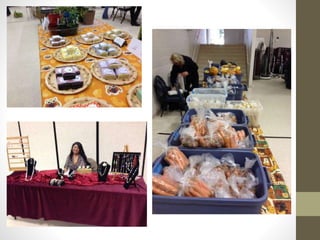
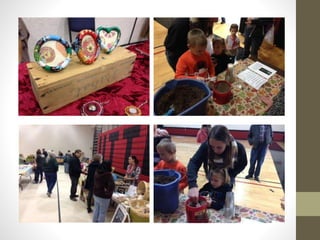
  • #21 Participant: Jana Millner   Project: UTTC Winter Market Overview: The Winter Market completed its second season, running once a month from November 2014 – April 2015. The first season served as a pilot season and was March, April and May of 2014. The market was dedicated to only selling locally grown, or crafted items. The market ranged from local produce, canned foods, baked goods, jewelry, clothing, artwork, pottery, hula hoops, dog treats, plants, soaps, natural products, and more! They wanted to create a warm atmosphere and also included children’s activities at most markets.   ND SARE mini grant dollars were used for three things: advertising, logo development/production and market signage. They hired a graphic design artist to make the Winter Market logo: incorporating shopping locally, food, and a tribal aspect, as UTTC is where the event was hosted.
  • #22 The market had a fairly consistent stream of customers.
  • #23 The NC-SARE dollars were also used to create market signage to direct customers once on campus, as well as advertising.
  • #24 The MOSES Conference is the largest event in the US about organic and sustainable farming. Every February, about 3,000 farmers, advocates, educators, students, and others attend educational workshops and keynote speakers in La Crosse, Wisconsin. Lori Martin and Annie Carlson, both Leadership for Local Foods participants, attended MOSES 2015 with support from ND Leadership for Local Foods. Lori & her husband, Kevin, attended the 2015 MOSES conference. Lori is a Leadership for Local Foods Participant. Together they own and operate Roving Donkey Farm, a family owned vegetable farm located north of Bismarck. Annie Carlson own and operates Morning Joy Farm, a third generation, family owned, pasture-based, local-market farm located in central North Dakota. They have an on-farm commercial kitchen and produce pastured eggs, chicken, turkeys, pork and grass-fed lamb. Here are the key takeaways Martin and Carlson shared from their experience at MOSES: Walking tractors are not for everyone, and the need to accommodate smaller statured folks in terms of power and size has not yet been addressed. We would love to have one on our farm, as we are 100% human powered, but it may be overkill. A great idea for managing regular tasks on the farm is to create checklists (with pictures when applicable). This will allow employees and interns to fill in or pick up new tasks with little to no training. Documentation is king! Downy mildew in basil is becoming a real problem in the US. In our northern climate it is not able to overwinter, but seed sources are still important to consider. One would think vermicomposting and organic disease management would be boring workshops to attend, but it’s all in the presentation folks. I have heard both presenters at previous conferences and they are amazing! If you ever see Erin Silva or John Biernbaum on an agenda, go see them! Navigating your state’s cottage food law (or local health district regulations in the case of ND) is vital when planning to produce items for sale from your home kitchen. Presentation is just as important as quality of the product. There were so many gleanings from the productive packing shed workshop, an entire post could be written on that. Even for the small producer, there are some great DIY options for having a great packing shed. These include: Color coding tools and containers Mini pallet jack using a hand truck Rain gear for cleaning root vegetables Posted schedules for cleaning tasks – daily, weekly, monthly, seasonally During design phase, plan for all utilities to be installed outside the walls so any changes are easy to make and have all water drain outside Vermicomposting on a large scale is being studied in several locations across the country and some successes are being reported. It is a labor-intensive process in that the best results come from raw materials being pre-composted before adding worms. While there is still a lot of room to grow in the field of solar energy, it can be a viable option for powering all, or at least a portion, of your operation. Additionally, several grant and/or tax credit options exist to help get you started. A proper evaluation of your usage is key, and finding local installers can be difficult in some areas, but who wouldn’t want to use free, continuous energy? Adam Montri is a ‘numbers’ guy. When laying out his planting plan for the year, especially in the high tunnel, he breaks his earning potential down to $ / square foot / day, even if that number is $0.002. By letting his dollar per square foot goal be a main driving force behind his year-round planting plan, he has laid out a sound financial plan that will increase the chance of success year after year.
  • #25 Northern Small Farmer Alliance is a network of small-scale producers in the Red River Valley regions of North Dakota and Minnesota. They have held four meetings since January 2015. They have created a logo and are working to do some farm tours/sharing of best practices this summer. They are also hoping to host a Get Local event in Fargo. They They have developed four action pillars for the NSFA and under each pillar listed on the slide, you can see some of the activities they have begun (or hope to begin) in order to meet their goals.
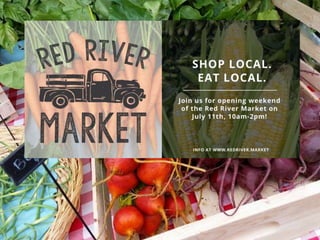
  • #27 The market will run every Saturday from July 11th through the October or the food producing season.
  • #28 Red River Market
  • #29 To capture some of the success and progress to date on the projects, we created bi-monthly blogs that are posted to the North Dakota State University Extension Food & Nutrition website. This website houses a local foods section that shares the benefits of growing and consuming locally grown food. Blogs have been published since February 2015, and have been shared with various local food networks around the state. They have been a great way to share success and progress with the participants and the larger local food community in the state, as well as capture our participants stories.
  • #30 To date three trainings have been held and participants have learned about many areas of local foods including:   How to Build Food Capacity at the Local and Regional Level Food Safety & GAP Training Local Food Distribution Farm to Grocer, School & Restaurant Telling Your Story - Marketing, Storytelling, & Social Media Making it a Sustainable Business Food Coops & Food Hubs Finding the Resources & Funding The final meeting will take place in November 2015. This meeting will be an opportunity to share all the outcomes that have been achieved throughout the project. Each participant will be given ~10 minutes to share their successes and be recognized for their achievements by fellow local food leaders in the state. We will also utilize the Ripple Effect Mapping method to engage the program participants to reflect upon and visually map the changes produced in their business, community, region & state as a result of this program.