Finances


Future Managers   Mathematical Literacy 2   1
Income, Expenses and
                     Financial Planning


Mathematical Literacy pg 48
 Future Managers              Mathematical Literacy 2   2
Finance
• Income, expenses and financial planning
• Read financial information and make decisions


Future Managers   Mathematical Literacy 2   3
Identify, record and manage
                  your income
• Income is the money that you have earned
  during a specific period, either by selling your
  own goods and services or working for a wage
  or salary
• Salaries are paid on a monthly basis
• Wages are paid per hour


Future Managers   Mathematical Literacy 2   4
Gross and Net Income
• Gross Income is that amount of money that you
  will cost the company
• Net Income is the amount of money that you will
  receive
• The difference is made up of taxes, medical aid,
  pensions, unemployment taxes (for wage
  workers) etc


Future Managers        Mathematical Literacy 2   5
Fixed Income
• Salaries and Wages
• Income from property


Future Managers    Mathematical Literacy 2   6
Variable Income
• Commission earned
• Interest received on investments
• Tips in the case of waiters or waitresses


Future Managers     Mathematical Literacy 2   7
Expenses
• Expenses is the collective name for all the things
  that you spend money on


Future Managers   Mathematical Literacy 2   8
Fixed Expenses
• Occur every month. Don’t generally change
  much from month to month
• Examples
       – Rent
       – Loan repayments
       – Hire purchase agreements


Future Managers      Mathematical Literacy 2   9
Variable expenses
 • Change from month to month
 • You generally have more control over variable
   expenses
 • Examples:
        –    Electricity
        –    Haircuts
        –    Entertainment
        –    Food


Mathematical Literacy pg 51
 Future Managers              Mathematical Literacy 2   10
Recording your income and
                  expenses
• Record where your income and expenses are going
• Tips for keeping record
       – Keep a notebook handy and write down immediately what
         you bought
       – Collect a till slip for each payment
       – Record the amount that you take with you when you go out,
         and what you have left at the end
       – Use bank statements


Future Managers         Mathematical Literacy 2   11
Saving
• Reasons for saving
       –    Avoid financial worries
       –    Keep out of debt
       –    Retirement
       –    Have interest working in your favour, rather than
            against you


Future Managers          Mathematical Literacy 2   12
How can I save?
• Buy necessities first and luxuries last
• Take advantages of benefits available
• Budget carefully and plan in advance
• Get the best quality for the lowest price
• Try to get what is needed without spending your money
  on it
• Negotiate prices and ask for discounts
• Don’t buy on debt. Save until you have enough money


Future Managers     Mathematical Literacy 2   13
How interest rates are
                       calculated
• Interest is the amount that the bank pays into
  your account
• They are calculated as a percentage of the
  amount in you account
• A 10% interest rate means that if you keep R100
  in your bank account, you will get R10 back per
  year


Future Managers        Mathematical Literacy 2   14
Ways of Saving
• Joining your employer’s pension of provident
  fund
• Putting your money in a savings account
• Joining a savings club or stokvel
• Taking out insurance to cover losses to yourself
  and your possessions
• Put away amounts into a less accessible interest
  earning account


Future Managers     Mathematical Literacy 2   15
Frequently Asked Questions
• Isn’t it better to buy now and save on increased
  costs later?
• Can buying on credit help me?
• Cana I on paying off my load or making down
  payments?
• What is inflation?
• What are stokvels?
• What are Pyramid Schemes?


Future Managers   Mathematical Literacy 2   16
Income Statement
 • An income statement provides a history of your
   financial matters. It reports on how much you have
   earned and what you did with it
 • A basic income statement should:
        – Group together all income items and total them
        – Group together all expense items and total them
        – Deduct the total expenses from the total income to indicate
          the net income for the period


Mathematical Literacy pg 58
 Future Managers              Mathematical Literacy 2   17
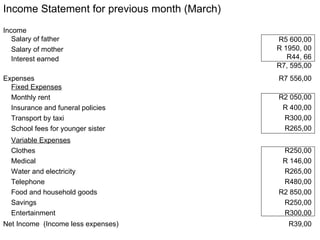
Income Statement for previous month (March)
Income
   Salary of father                                               R5 600,00
   Salary of mother                                               R 1950, 00
   Interest earned                                                   R44, 66
                                                                  R7, 595,00
Expenses                                                          R7 556,00
  Fixed Expenses
  Monthly rent                                                    R2 050,00
  Insurance and funeral policies                                   R 400,00
  Transport by taxi                                                R300,00
  School fees for younger sister                                   R265,00
  Variable Expenses
  Clothes                                                          R250,00
  Medical                                                          R 146,00
  Water and electricity                                            R265,00
  Telephone                                                        R480,00
  Food and household goods                                        R2 850,00
  Savings                                                          R250,00
  Entertainment                                                    R300,00
Net Income (Income less expenses)                                    R39,00
     Future Managers               Mathematical Literacy 2   18
Budgeting

   • A budget is an estimate of expected income and
     expenditure done on a monthly basis for an
     individual or household
   • Actual income and expenses are recorded
     accurately and then used to plan for future income
     and expenses
   • A budget is a summary of all your projected
     earnings and expenses in the immediate future
   • A budget helps you avoid debt
   • A budget provides motivation and control
   • All business and even the country uses budgets
Mathematical Literacy pg 58
 Future Managers              Mathematical Literacy 2   19
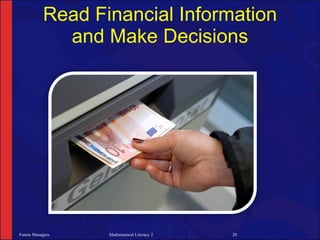
Read Financial Information
             and Make Decisions


Future Managers   Mathematical Literacy 2   20
Finance
• Income, expenses and financial planning
• Read financial information and make decisions


Future Managers   Mathematical Literacy 2   21
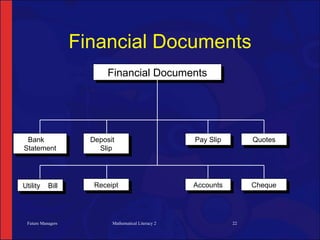
Financial Documents
                          Financial Documents


 Bank                Deposit                         Pay Slip        Quotes
Statement              Slip


Utility    Bill       Receipt                        Accounts        Cheque


 Future Managers           Mathematical Literacy 2              22
Bank Account

   • A bank account is a safe storage to deposit a salary
     as it is earned
   • Any cheque payments received have to pass
     through a bank account
   • Your salary will be deposited into your bank
     account
   • You earn interest on money in your account
   • Banks charge you for every transaction on your
     account
   • Before opening an account compare the costs
     between banks

Future Managers     Mathematical Literacy 2   23
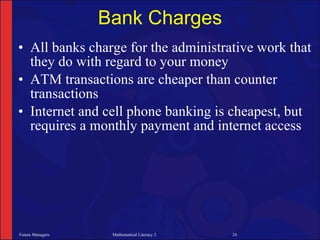
Bank Charges
• All banks charge for the administrative work that
  they do with regard to your money
• ATM transactions are cheaper than counter
  transactions
• Internet and cell phone banking is cheapest, but
  requires a monthly payment and internet access


Future Managers    Mathematical Literacy 2   24
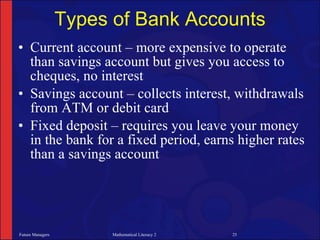
Types of Bank Accounts
• Current account – more expensive to operate
  than savings account but gives you access to
  cheques, no interest
• Savings account – collects interest, withdrawals
  from ATM or debit card
• Fixed deposit – requires you leave your money
  in the bank for a fixed period, earns higher rates
  than a savings account


Future Managers         Mathematical Literacy 2   25
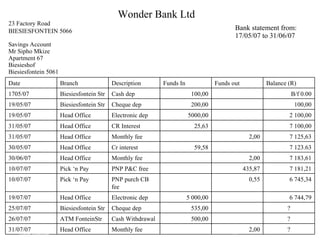
Reading your bank statement
• Banks issue statements, usually on a monthly
  basis
• They include debits (expenses) and credits
  (income)
• They should be self-explanatory


Future Managers   Mathematical Literacy 2   26
Wonder Bank Ltd
  23 Factory Road
  BIESIESFONTEIN 5066                                                                         Bank statement from:
                                                                                              17/05/07 to 31/06/07
  Savings Account
  Mr Sipho Mkize
  Apartment 67
  Biesieshof
  Biesiesfontein 5061
  Date                    Branch               Description       Funds In              Funds out            Balance (R)
  1705/07                 Biesiesfontein Str   Cash dep                      100,00                                    B/f 0.00
  19/05/07                Biesiesfontein Str   Cheque dep                    200,00                                     100,00
  19/05/07                Head Office          Electronic dep               5000,00                                 2 100,00
  31/05/07                Head Office          CR Interest                    25,63                                 7 100,00
  31/05/07                Head Office          Monthly fee                                           2,00           7 125,63
  30/05/07                Head Office          Cr interest                    59,58                                 7 123.63
  30/06/07                Head Office          Monthly fee                                           2,00           7 183,61
  10/07/07                Pick ‘n Pay          PNP P&C free                                        435,87           7 181,21
  10/07/07                Pick ‘n Pay          PNP purch CB                                          0,55           6 745,34
                                               fee
  19/07/07                Head Office          Electronic dep               5 000,00                                6 744,79
  25/07/07                Biesiesfontein Str   Cheque dep                    535,00                                ?
  26/07/07                ATM FonteinStr       Cash Withdrawal               500,00                                ?
Mathematical Literacy 2
  31/07/07                Head Office          Monthly fee                                           2,00          ?
        Future Managers                                                                      27
Cheques
• A cheque is a safe way of paying a large amount
  of money
• It costs a lot of money to write a cheque


Future Managers   Mathematical Literacy 2   28
Writing Cheques
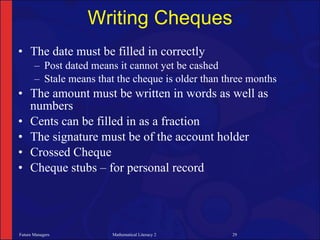
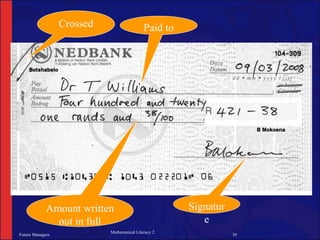
• The date must be filled in correctly
       – Post dated means it cannot yet be cashed
       – Stale means that the cheque is older than three months
• The amount must be written in words as well as
  numbers
• Cents can be filled in as a fraction
• The signature must be of the account holder
• Crossed Cheque
• Cheque stubs – for personal record


Future Managers          Mathematical Literacy 2    29
Crossed                    Paid to


             Amount written                            Signatur
               out in full                                e
                            Mathematical Literacy 2
Future Managers                                                   30
Deposit Slip


Future Managers   Mathematical Literacy 2   31
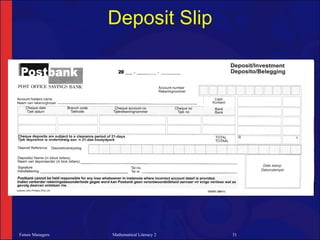
Deposit Slip
• The following information is required:
       –    Date
       –    Person who receives the deposit
       –    Your account number
       –    The depositors name
       –    Contact number of the depositor
       –    Signature
       –    Cash details – total amount in notes and coins
       –    Cheque details


Future Managers             Mathematical Literacy 2     32
Pay Slip

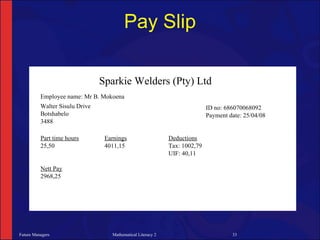
                                Sparkie Welders (Pty) Ltd
          Employee name: Mr B. Mokoena
          Walter Sisulu Drive                                               ID no: 686070068092
          Botshabelo                                                        Payment date: 25/04/08
          3488

          Part time hours        Earnings                    Deductions
          25,50                  4011,15                     Tax: 1002,79
                                                             UIF: 40,11

          Nett Pay
          2968,25


Future Managers                    Mathematical Literacy 2                           33
Pay Slip
• Information that must appear:
       –    Employer and employee details
       –    Salary amount
       –    Taxable amount
       –    UIF contribution
       –    Company contributions
       –    Leave due


Future Managers         Mathematical Literacy 2   34
Receipts


Future Managers   Mathematical Literacy 2   35
Receipts
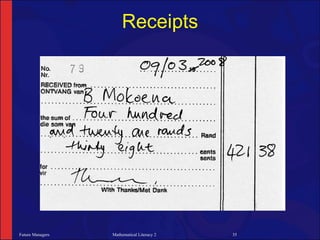
• A receipt is evidence of payment
• These should be kept for personal records and
  for tax purposes


Future Managers   Mathematical Literacy 2   36
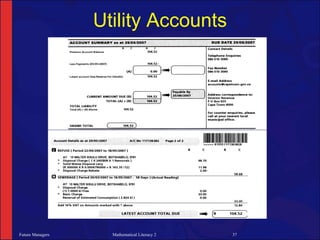
Utility Accounts


Future Managers     Mathematical Literacy 2   37
Utility Accounts
• Utility accounts are for services that the local
  municipality provides
• They must be paid monthly
• The more you use, the higher the rate per unit


Future Managers     Mathematical Literacy 2   38
Utility Accounts

   • The following information will appear on a utility
     account:
           –      Your details
           –      Type of service
           –      Rate
           –      Usage
           –      Free amount
           –      Date of the reading
           –      Outstanding amount
           –      Amount payable


Future Managers               Mathematical Literacy 2   39
Retail Accounts


Future Managers     Mathematical Literacy 2   40
Retail Accounts
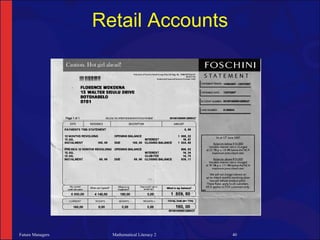
•    Allows you to buy from the shop on credit
•    Designed to encourage loyalty to the shop
•    Charge interest
•    Payments are made monthly


Future Managers     Mathematical Literacy 2   41
Travel Costs
• Travel costs generally make up a significant part
  of our daily expenses
• It is generally cheaper to buy a monthly ticket
  for public transport
• However, there is a risk of losing the ticket


Future Managers   Mathematical Literacy 2   42
National Credit Act
• Aims to protect the customer against unfair and
  unlawful credit provision
• Aims to educate customers about their rights
• Applies to all credit agreements


Future Managers      Mathematical Literacy 2   43
Benefits of the NCA
   •     Ban negative marketing
   •     Will hear complaints about credit providers
   •     Hand out penalties to credit providers
   •     Issue an order to declare the details of the agreement on
         your behalf
   •     Provides you information before entering into a credit
         agreement
   •     Requires a credit provider to give you a quotation
   •     Credit providers must show all the costs
   •     Credit providers must inform you that they are going to
         give negative information to the credit bureau
   •     Credit bureaus must give you a copy of your credit record
         on request


Future Managers          Mathematical Literacy 2     44
NCA
• Credit providers must ask you for the following
  information:
       –    Pay slip
       –    ID Document
       –    List of existing debt with other credit providers
       –    A personal budget
       –    A utility bill
       –    A declaration of financial ability


Future Managers           Mathematical Literacy 2   45

NCV 2 Mathematical Literacy Hands-On Training Module 2

  • 1.
    Finances Future Managers Mathematical Literacy 2 1
  • 2.
    Income, Expenses and Financial Planning Mathematical Literacy pg 48 Future Managers Mathematical Literacy 2 2
  • 3.
    Finance • Income, expensesand financial planning • Read financial information and make decisions Future Managers Mathematical Literacy 2 3
  • 4.
    Identify, record andmanage your income • Income is the money that you have earned during a specific period, either by selling your own goods and services or working for a wage or salary • Salaries are paid on a monthly basis • Wages are paid per hour Future Managers Mathematical Literacy 2 4
  • 5.
    Gross and NetIncome • Gross Income is that amount of money that you will cost the company • Net Income is the amount of money that you will receive • The difference is made up of taxes, medical aid, pensions, unemployment taxes (for wage workers) etc Future Managers Mathematical Literacy 2 5
  • 6.
    Fixed Income • Salariesand Wages • Income from property Future Managers Mathematical Literacy 2 6
  • 7.
    Variable Income • Commissionearned • Interest received on investments • Tips in the case of waiters or waitresses Future Managers Mathematical Literacy 2 7
  • 8.
    Expenses • Expenses isthe collective name for all the things that you spend money on Future Managers Mathematical Literacy 2 8
  • 9.
    Fixed Expenses • Occurevery month. Don’t generally change much from month to month • Examples – Rent – Loan repayments – Hire purchase agreements Future Managers Mathematical Literacy 2 9
  • 10.
    Variable expenses •Change from month to month • You generally have more control over variable expenses • Examples: – Electricity – Haircuts – Entertainment – Food Mathematical Literacy pg 51 Future Managers Mathematical Literacy 2 10
  • 11.
    Recording your incomeand expenses • Record where your income and expenses are going • Tips for keeping record – Keep a notebook handy and write down immediately what you bought – Collect a till slip for each payment – Record the amount that you take with you when you go out, and what you have left at the end – Use bank statements Future Managers Mathematical Literacy 2 11
  • 12.
    Saving • Reasons forsaving – Avoid financial worries – Keep out of debt – Retirement – Have interest working in your favour, rather than against you Future Managers Mathematical Literacy 2 12
  • 13.
    How can Isave? • Buy necessities first and luxuries last • Take advantages of benefits available • Budget carefully and plan in advance • Get the best quality for the lowest price • Try to get what is needed without spending your money on it • Negotiate prices and ask for discounts • Don’t buy on debt. Save until you have enough money Future Managers Mathematical Literacy 2 13
  • 14.
    How interest ratesare calculated • Interest is the amount that the bank pays into your account • They are calculated as a percentage of the amount in you account • A 10% interest rate means that if you keep R100 in your bank account, you will get R10 back per year Future Managers Mathematical Literacy 2 14
  • 15.
    Ways of Saving •Joining your employer’s pension of provident fund • Putting your money in a savings account • Joining a savings club or stokvel • Taking out insurance to cover losses to yourself and your possessions • Put away amounts into a less accessible interest earning account Future Managers Mathematical Literacy 2 15
  • 16.
    Frequently Asked Questions •Isn’t it better to buy now and save on increased costs later? • Can buying on credit help me? • Cana I on paying off my load or making down payments? • What is inflation? • What are stokvels? • What are Pyramid Schemes? Future Managers Mathematical Literacy 2 16
  • 17.
    Income Statement •An income statement provides a history of your financial matters. It reports on how much you have earned and what you did with it • A basic income statement should: – Group together all income items and total them – Group together all expense items and total them – Deduct the total expenses from the total income to indicate the net income for the period Mathematical Literacy pg 58 Future Managers Mathematical Literacy 2 17
  • 18.
    Income Statement forprevious month (March) Income Salary of father R5 600,00 Salary of mother R 1950, 00 Interest earned R44, 66 R7, 595,00 Expenses R7 556,00 Fixed Expenses Monthly rent R2 050,00 Insurance and funeral policies R 400,00 Transport by taxi R300,00 School fees for younger sister R265,00 Variable Expenses Clothes R250,00 Medical R 146,00 Water and electricity R265,00 Telephone R480,00 Food and household goods R2 850,00 Savings R250,00 Entertainment R300,00 Net Income (Income less expenses) R39,00 Future Managers Mathematical Literacy 2 18
  • 19.
    Budgeting • A budget is an estimate of expected income and expenditure done on a monthly basis for an individual or household • Actual income and expenses are recorded accurately and then used to plan for future income and expenses • A budget is a summary of all your projected earnings and expenses in the immediate future • A budget helps you avoid debt • A budget provides motivation and control • All business and even the country uses budgets Mathematical Literacy pg 58 Future Managers Mathematical Literacy 2 19
  • 20.
    Read Financial Information and Make Decisions Future Managers Mathematical Literacy 2 20
  • 21.
    Finance • Income, expensesand financial planning • Read financial information and make decisions Future Managers Mathematical Literacy 2 21
  • 22.
    Financial Documents Financial Documents Bank Deposit Pay Slip Quotes Statement Slip Utility Bill Receipt Accounts Cheque Future Managers Mathematical Literacy 2 22
  • 23.
    Bank Account • A bank account is a safe storage to deposit a salary as it is earned • Any cheque payments received have to pass through a bank account • Your salary will be deposited into your bank account • You earn interest on money in your account • Banks charge you for every transaction on your account • Before opening an account compare the costs between banks Future Managers Mathematical Literacy 2 23
  • 24.
    Bank Charges • Allbanks charge for the administrative work that they do with regard to your money • ATM transactions are cheaper than counter transactions • Internet and cell phone banking is cheapest, but requires a monthly payment and internet access Future Managers Mathematical Literacy 2 24
  • 25.
    Types of BankAccounts • Current account – more expensive to operate than savings account but gives you access to cheques, no interest • Savings account – collects interest, withdrawals from ATM or debit card • Fixed deposit – requires you leave your money in the bank for a fixed period, earns higher rates than a savings account Future Managers Mathematical Literacy 2 25
  • 26.
    Reading your bankstatement • Banks issue statements, usually on a monthly basis • They include debits (expenses) and credits (income) • They should be self-explanatory Future Managers Mathematical Literacy 2 26
  • 27.
    Wonder Bank Ltd 23 Factory Road BIESIESFONTEIN 5066 Bank statement from: 17/05/07 to 31/06/07 Savings Account Mr Sipho Mkize Apartment 67 Biesieshof Biesiesfontein 5061 Date Branch Description Funds In Funds out Balance (R) 1705/07 Biesiesfontein Str Cash dep 100,00 B/f 0.00 19/05/07 Biesiesfontein Str Cheque dep 200,00 100,00 19/05/07 Head Office Electronic dep 5000,00 2 100,00 31/05/07 Head Office CR Interest 25,63 7 100,00 31/05/07 Head Office Monthly fee 2,00 7 125,63 30/05/07 Head Office Cr interest 59,58 7 123.63 30/06/07 Head Office Monthly fee 2,00 7 183,61 10/07/07 Pick ‘n Pay PNP P&C free 435,87 7 181,21 10/07/07 Pick ‘n Pay PNP purch CB 0,55 6 745,34 fee 19/07/07 Head Office Electronic dep 5 000,00 6 744,79 25/07/07 Biesiesfontein Str Cheque dep 535,00 ? 26/07/07 ATM FonteinStr Cash Withdrawal 500,00 ? Mathematical Literacy 2 31/07/07 Head Office Monthly fee 2,00 ? Future Managers 27
  • 28.
    Cheques • A chequeis a safe way of paying a large amount of money • It costs a lot of money to write a cheque Future Managers Mathematical Literacy 2 28
  • 29.
    Writing Cheques • Thedate must be filled in correctly – Post dated means it cannot yet be cashed – Stale means that the cheque is older than three months • The amount must be written in words as well as numbers • Cents can be filled in as a fraction • The signature must be of the account holder • Crossed Cheque • Cheque stubs – for personal record Future Managers Mathematical Literacy 2 29
  • 30.
    Crossed Paid to Amount written Signatur out in full e Mathematical Literacy 2 Future Managers 30
  • 31.
    Deposit Slip Future Managers Mathematical Literacy 2 31
  • 32.
    Deposit Slip • Thefollowing information is required: – Date – Person who receives the deposit – Your account number – The depositors name – Contact number of the depositor – Signature – Cash details – total amount in notes and coins – Cheque details Future Managers Mathematical Literacy 2 32
  • 33.
    Pay Slip Sparkie Welders (Pty) Ltd Employee name: Mr B. Mokoena Walter Sisulu Drive ID no: 686070068092 Botshabelo Payment date: 25/04/08 3488 Part time hours Earnings Deductions 25,50 4011,15 Tax: 1002,79 UIF: 40,11 Nett Pay 2968,25 Future Managers Mathematical Literacy 2 33
  • 34.
    Pay Slip • Informationthat must appear: – Employer and employee details – Salary amount – Taxable amount – UIF contribution – Company contributions – Leave due Future Managers Mathematical Literacy 2 34
  • 35.
    Receipts Future Managers Mathematical Literacy 2 35
  • 36.
    Receipts • A receiptis evidence of payment • These should be kept for personal records and for tax purposes Future Managers Mathematical Literacy 2 36
  • 37.
    Utility Accounts Future Managers Mathematical Literacy 2 37
  • 38.
    Utility Accounts • Utilityaccounts are for services that the local municipality provides • They must be paid monthly • The more you use, the higher the rate per unit Future Managers Mathematical Literacy 2 38
  • 39.
    Utility Accounts • The following information will appear on a utility account: – Your details – Type of service – Rate – Usage – Free amount – Date of the reading – Outstanding amount – Amount payable Future Managers Mathematical Literacy 2 39
  • 40.
    Retail Accounts Future Managers Mathematical Literacy 2 40
  • 41.
    Retail Accounts • Allows you to buy from the shop on credit • Designed to encourage loyalty to the shop • Charge interest • Payments are made monthly Future Managers Mathematical Literacy 2 41
  • 42.
    Travel Costs • Travelcosts generally make up a significant part of our daily expenses • It is generally cheaper to buy a monthly ticket for public transport • However, there is a risk of losing the ticket Future Managers Mathematical Literacy 2 42
  • 43.
    National Credit Act •Aims to protect the customer against unfair and unlawful credit provision • Aims to educate customers about their rights • Applies to all credit agreements Future Managers Mathematical Literacy 2 43
  • 44.
    Benefits of theNCA • Ban negative marketing • Will hear complaints about credit providers • Hand out penalties to credit providers • Issue an order to declare the details of the agreement on your behalf • Provides you information before entering into a credit agreement • Requires a credit provider to give you a quotation • Credit providers must show all the costs • Credit providers must inform you that they are going to give negative information to the credit bureau • Credit bureaus must give you a copy of your credit record on request Future Managers Mathematical Literacy 2 44
  • 45.
    NCA • Credit providersmust ask you for the following information: – Pay slip – ID Document – List of existing debt with other credit providers – A personal budget – A utility bill – A declaration of financial ability Future Managers Mathematical Literacy 2 45