2004


Noncommunicable diseases in
      the Americas
post UN commitments & advances

                Branka Legetic, MD, MPH, PhD
                  PAHO-WHO Regional Adviser on
                  Prevention and control of NCDs


 Pan American
 Health
 Organization
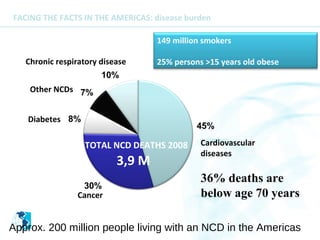
FACING THE FACTS IN THE AMERICAS: disease burden

                                   149 million smokers

   Chronic respiratory disease     25% persons >15 years old obese


    Other NCDs


   Diabetes

                  TOTAL NCD DEATHS 2008       Cardiovascular
                                              diseases
                           3,9 M
                                              36% deaths are
                 Cancer                       below age 70 years

Approx. 200 million people living with an NCD in the Americas
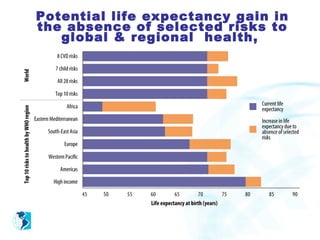
Potential life expectancy gain in
the absence of selected risks to
   global & regional health,
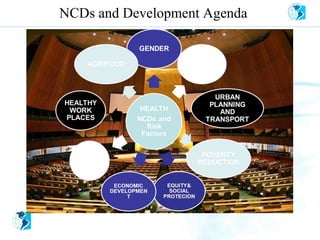
NCDs and Development Agenda
2004

                  POST UN HLM and PAHO

NCD Regional Strategy 2012
Plan of Action with regional targets and
indicators
2. Technical cooperation with Member States
3. Continue advocacy in global forums: Social
Determinants, G8/G20, Summit of the Americas, etc.
4. Promote multi-sector partnerships
   • Pan American Forum for Action on NCDs
5. Broader engagement in NCDs with other regional UN
agencies
   Pan American
   Health
   Organization
2004


2012


Pan American
Health
Organization
Regional Action Plan 2013 :                            2004


OBJECTIVE 1: Multi sector policies and partnerships
1.1: To establish multi-sector partnerships and integration of
NCD prevention policies into sectors outside of health

OBJECTIVE 2: NCD risk factor reduction & protection
2.1: To reduce tobacco use and exposure to second-hand smoke[1].
2.2: To reduce the harmful use of alcohol[2].
2.3: To promote healthy eating and active living (salt, Trans fat)

OBJECTIVE 3: Health System Response to NCDs
3.1 To strengthening the capacity of primary health care providers
3.2 To implement a model of integrated management of NCDs
3.3. To secure supplies for NCD drugs.
3.4. To secure coverage of multi-drug therapy

OBJECTIVE 4: NCD surveillance and research
4.1.quality of NCD and risk factor surveillance systems, including
cancer registries
       Pan American
4.2. improve utilization of NCD and risk factor surveillance systems to
       Health
       Organization
plan and monitor NCD program
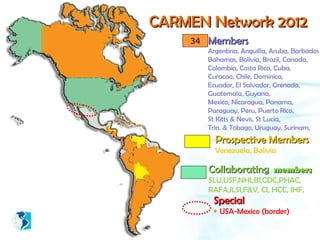
CARMEN Network 2012
    34   Members
         Argentina, Anguilla, Aruba, Barbados
         Bahamas, Bolivia, Brazil, Canada,
         Colombia, Costa Rica, Cuba,
         Curacao, Chile, Dominica,
         Ecuador, El Salvador, Grenada,
         Guatemala, Guyana,
         Mexico, Nicaragua, Panama,
         Paraguay, Peru, Puerto Rico,
         St Kitts & Nevis, St Lucia,
         Trin. & Tobago, Uruguay, Surinam,
           Prospective Members
           Venezuela, Bolivia

         Collaborating members
         SLU,USF,NHLBI,CDC,PHAC,
         RAFA,ILSI,F&V, CI, HCC, IHF,
          Special
          • USA-Mexico (border)
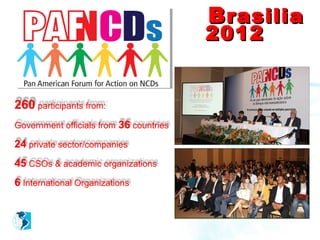
B rasilia
                                         2012


260 participants from:
Government officials from 36 countries

24 private sector/companies
45 CSOs & academic organizations
6 International Organizations
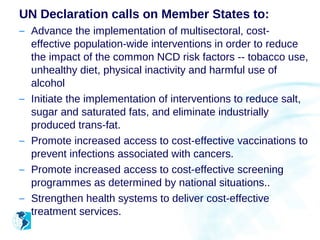
UN Declaration calls on Member States to:
– Advance the implementation of multisectoral, cost-
  effective population-wide interventions in order to reduce
  the impact of the common NCD risk factors -- tobacco use,
  unhealthy diet, physical inactivity and harmful use of
  alcohol
– Initiate the implementation of interventions to reduce salt,
  sugar and saturated fats, and eliminate industrially
  produced trans-fat.
– Promote increased access to cost-effective vaccinations to
  prevent infections associated with cancers.
– Promote increased access to cost-effective screening
  programmes as determined by national situations..
– Strengthen health systems to deliver cost-effective
  treatment services.
2004


                Advances: policy
• NCD Policy Observatory: with Public Health
  Agency, Canada
   – Policy Monitoring (national capacity survey &
     registry of laws for diabetes, obesity & CVD)
   – Research: case studies: C Rica, Brazil; T&T,
     Barbados
   – Development/revision of National Action plans:
   Belize, Ecuador,. Rica, Paragvay
   – Policy dialogues/advocacy: e.g.,
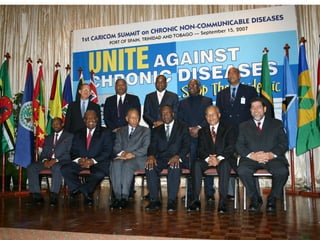
        • CARICOM Summit of Heads on chronic diseases
        • CARMEN MERCOSUR, SICA, CAN
 Pan American
 Health
 Organization
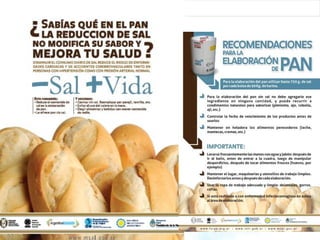
Advances: Promotion and Prevention

• Ratification and full implementation of FCTC

• Trans Fat Free Americas Initiative : Argentina,
  Chile, Brazil, Ecuador, Mexico, Canada, Colombia,
  Central America,
• Regional Salt reduction initiative : Argentina,
  Barbados, Brazil, Canada, Chile, Colombia, C
  Rica, Mexico, Paraguay, Uruguay, US.
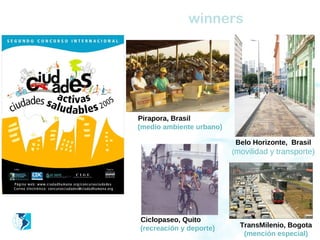
• Urban Planning and development of public
  transport to improve physical activity: 38 cities in
  Americas; Ciclovia network, Active cities reward
winners


Pirapora, Brasil
(medio ambiente urbano)

                           Belo Horizonte, Brasil
                          (movilidad y transporte)


Ciclopaseo, Quito
(recreación y deporte)      TransMilenio, Bogota
                             (mención especial)
Advances : Integrated Management
• Integrated Chronic Care model
• CAMDI – Central American Diabetes Intervention
• VIDA Project Mexico on integrated chronic care
• TATI project – Peru on cervical cancer screening
• TATI 2 Honduras, Bolivia, El Salvador
• CVD control through community workers Chile,
  Guatemala, Argentina
• CVD risk assessment approach Argentina, Ecuador,
  Jamaica,

• NCD drugs and basic technology in PAHO Strategic
  fund to reduce cost of drugs ;
• HPV Vaccine in PAHO Revolving fund
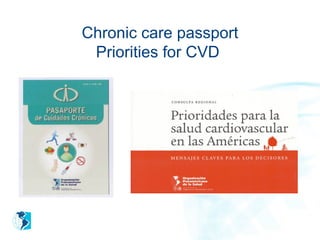
Chronic care passport
 Priorities for CVD
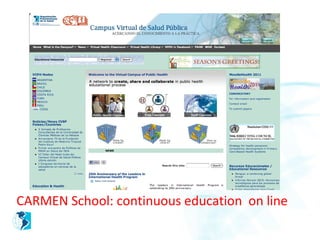
CARMEN School: continuous education on line
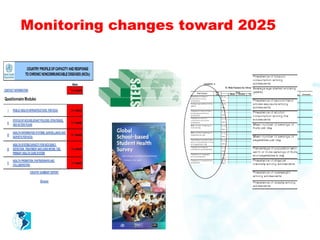
Monitoring changes toward 2025
www.paho.org/chronicdisease
Thank you!

Noncommunicable Diseases in the Americas_Branka Legetic_4.23.13

  • 1.
    2004 Noncommunicable diseases in the Americas post UN commitments & advances Branka Legetic, MD, MPH, PhD PAHO-WHO Regional Adviser on Prevention and control of NCDs Pan American Health Organization
  • 2.
    FACING THE FACTSIN THE AMERICAS: disease burden 149 million smokers Chronic respiratory disease 25% persons >15 years old obese Other NCDs Diabetes TOTAL NCD DEATHS 2008 Cardiovascular diseases 3,9 M 36% deaths are Cancer below age 70 years Approx. 200 million people living with an NCD in the Americas
  • 3.
    Potential life expectancygain in the absence of selected risks to global & regional health,
  • 4.
  • 5.
    2004 POST UN HLM and PAHO NCD Regional Strategy 2012 Plan of Action with regional targets and indicators 2. Technical cooperation with Member States 3. Continue advocacy in global forums: Social Determinants, G8/G20, Summit of the Americas, etc. 4. Promote multi-sector partnerships • Pan American Forum for Action on NCDs 5. Broader engagement in NCDs with other regional UN agencies Pan American Health Organization
  • 6.
  • 7.
    Regional Action Plan2013 : 2004 OBJECTIVE 1: Multi sector policies and partnerships 1.1: To establish multi-sector partnerships and integration of NCD prevention policies into sectors outside of health OBJECTIVE 2: NCD risk factor reduction & protection 2.1: To reduce tobacco use and exposure to second-hand smoke[1]. 2.2: To reduce the harmful use of alcohol[2]. 2.3: To promote healthy eating and active living (salt, Trans fat) OBJECTIVE 3: Health System Response to NCDs 3.1 To strengthening the capacity of primary health care providers 3.2 To implement a model of integrated management of NCDs 3.3. To secure supplies for NCD drugs. 3.4. To secure coverage of multi-drug therapy OBJECTIVE 4: NCD surveillance and research 4.1.quality of NCD and risk factor surveillance systems, including cancer registries Pan American 4.2. improve utilization of NCD and risk factor surveillance systems to Health Organization plan and monitor NCD program
  • 8.
    CARMEN Network 2012 34 Members Argentina, Anguilla, Aruba, Barbados Bahamas, Bolivia, Brazil, Canada, Colombia, Costa Rica, Cuba, Curacao, Chile, Dominica, Ecuador, El Salvador, Grenada, Guatemala, Guyana, Mexico, Nicaragua, Panama, Paraguay, Peru, Puerto Rico, St Kitts & Nevis, St Lucia, Trin. & Tobago, Uruguay, Surinam, Prospective Members Venezuela, Bolivia Collaborating members SLU,USF,NHLBI,CDC,PHAC, RAFA,ILSI,F&V, CI, HCC, IHF, Special • USA-Mexico (border)
  • 9.
    B rasilia 2012 260 participants from: Government officials from 36 countries 24 private sector/companies 45 CSOs & academic organizations 6 International Organizations
  • 10.
    UN Declaration callson Member States to: – Advance the implementation of multisectoral, cost- effective population-wide interventions in order to reduce the impact of the common NCD risk factors -- tobacco use, unhealthy diet, physical inactivity and harmful use of alcohol – Initiate the implementation of interventions to reduce salt, sugar and saturated fats, and eliminate industrially produced trans-fat. – Promote increased access to cost-effective vaccinations to prevent infections associated with cancers. – Promote increased access to cost-effective screening programmes as determined by national situations.. – Strengthen health systems to deliver cost-effective treatment services.
  • 11.
    2004 Advances: policy • NCD Policy Observatory: with Public Health Agency, Canada – Policy Monitoring (national capacity survey & registry of laws for diabetes, obesity & CVD) – Research: case studies: C Rica, Brazil; T&T, Barbados – Development/revision of National Action plans: Belize, Ecuador,. Rica, Paragvay – Policy dialogues/advocacy: e.g., • CARICOM Summit of Heads on chronic diseases • CARMEN MERCOSUR, SICA, CAN Pan American Health Organization
  • 13.
    Advances: Promotion andPrevention • Ratification and full implementation of FCTC • Trans Fat Free Americas Initiative : Argentina, Chile, Brazil, Ecuador, Mexico, Canada, Colombia, Central America, • Regional Salt reduction initiative : Argentina, Barbados, Brazil, Canada, Chile, Colombia, C Rica, Mexico, Paraguay, Uruguay, US. • Urban Planning and development of public transport to improve physical activity: 38 cities in Americas; Ciclovia network, Active cities reward
  • 15.
    winners Pirapora, Brasil (medio ambienteurbano) Belo Horizonte, Brasil (movilidad y transporte) Ciclopaseo, Quito (recreación y deporte) TransMilenio, Bogota (mención especial)
  • 16.
    Advances : IntegratedManagement • Integrated Chronic Care model • CAMDI – Central American Diabetes Intervention • VIDA Project Mexico on integrated chronic care • TATI project – Peru on cervical cancer screening • TATI 2 Honduras, Bolivia, El Salvador • CVD control through community workers Chile, Guatemala, Argentina • CVD risk assessment approach Argentina, Ecuador, Jamaica, • NCD drugs and basic technology in PAHO Strategic fund to reduce cost of drugs ; • HPV Vaccine in PAHO Revolving fund
  • 17.
    Chronic care passport Priorities for CVD
  • 18.
    CARMEN School: continuouseducation on line
  • 19.
  • 20.
  • 21.

Editor's Notes

  • #2 Welcome to Module 2 of the course dedicated to the topic of Non Communicable disease surveillance. My name is ….. And I am a regional adviser for non communicable disease prevention and control in PAHO office in WDC, with the area of responsibility: surveillance of NCDs Knowledge and evidence should be a base of decision making what well conveyed to you by professor Ross Brownson in Module 1. The importance of timely, relevant and quality information on health is crucial. Each country should look what strategic information it needs for good decision making… .In the last decade in our Continent there has been good advances regarding quality and access to information that can serve surveillance purposes..
  • #5 Individual responsibility can only have its full effect where individuals have equitable access to a healthy life, and are supported to make healthy choices. All sectors and all levels within governments, international partners, civil society, non-governmental organization's and the private sector have vital roles to play in shaping healthy environments and making healthier diet options affordable, and easily accessible.
  • #7 At recent Pan American Sanitary Conference, all Ministers of health of the Americas have adopted a resolution on CSP28R13 on Strategy for Prevention and control of NCDs where Surveillance systems have a separate paragraph with he following text: