Ethical Issues
Developing Responsible Internet
           Citizens


                     Sarah Elliott
                    Technology for
                      Educators
                    June 12, 2012
Example 1: Inappropriate Use
A Boston school tracked usage for one day and found that
  85,000 clicks were to eBay, craigslist, and other retail
  shopping sites from school computers.
Example 2:Commercial Entities
Corporations that offer "free" computers, printers, internet
connections and educational web access for a promise that
schools/students will use ZapMe! for a minimum of 4 hours each
day.


   Example 3: Criminal Activity
      because of Pop Culture
8 Florida teenagers were arrested for a brutal attack on a 16-
year-old girl. They lured her to one of their homes for the sole
purpose of videotaping the brutal attack and posting it on
youtube and myspace.
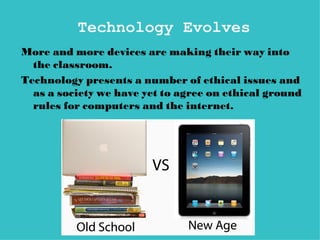
Technology Evolves
More and more devices are making their way into
  the classroom.
Technology presents a number of ethical issues and
  as a society we have yet to agree on ethical ground
  rules for computers and the internet.
"Character is what you are in the dark"
           Dwight Lyman Moody

 The internet is problematic because users believe
   they are anonymous.
 What that quote means is that a person's true
   character comes out when others don't see what
   the person is doing...they are "in the dark"
 Some people make good decisions, while others
   do not.
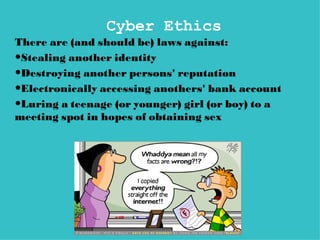
Cyber Ethics
There are (and should be) laws against:
•Stealing another identity
•Destroying another persons' reputation
•Electronically accessing anothers' bank account
•Luring a teenage (or younger) girl (or boy) to a
meeting spot in hopes of obtaining sex
Looking back at the
               examples...

Something as insignificant as misuse of resources is
  not a big deal.
However, is it ethical to allow commercial entities
  into schools because we 'need' their products?
With the third example, these teens are clearly guilty
  of criminal acts, but they clearly lack good ethical
  decision making.
Ethics Training
It is important to let students build an awareness of
   their actions and help them to understand that
   things done in cyberspace can hurt people too.
Relating real world behavior (entering a neighbors
   house without permission) to bad internet behavior
   (accessing another person's computer without permission)
   can be helpful and helps students make the
   transition.
Cybercitizen Awareness Program- has online
   resources at http://www.cybercitizen.org
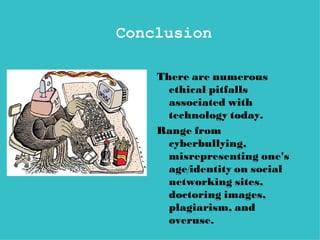
Conclusion

    There are numerous
      ethical pitfalls
      associated with
      technology today.
    Range from
      cyberbullying,
      misrepresenting one's
      age/identity on social
      networking sites,
      doctoring images,
      plagiarism, and
      overuse.
References
Bissonette, Aimée M.. "Ethical Issues." Cyber law:
maximizing safety and minimizing risk in classrooms.
Thousand Oaks, Calif.: Corwin Press, 2009. 80-86.
Print.


Pictures:
http://www.theeap.com/wp-
content/uploads/2012/05/CyberSafetyResourceCenter.jpg
http://gamezblog.com/wp-content/uploads/2011/02/Plagiarism.gif
http://mpsit.edublogs.org/files/2011/08/iPad-OldSchool-vs-
NewAge-13n34y9.jpg
http://www.cagle.com/artists/Simanca/Smallsimanca/sim-
internet_addict420.jpg

Ethical issues

  • 1.
    Ethical Issues Developing ResponsibleInternet Citizens Sarah Elliott Technology for Educators June 12, 2012
  • 2.
    Example 1: InappropriateUse A Boston school tracked usage for one day and found that 85,000 clicks were to eBay, craigslist, and other retail shopping sites from school computers. Example 2:Commercial Entities Corporations that offer "free" computers, printers, internet connections and educational web access for a promise that schools/students will use ZapMe! for a minimum of 4 hours each day. Example 3: Criminal Activity because of Pop Culture 8 Florida teenagers were arrested for a brutal attack on a 16- year-old girl. They lured her to one of their homes for the sole purpose of videotaping the brutal attack and posting it on youtube and myspace.
  • 3.
    Technology Evolves More andmore devices are making their way into the classroom. Technology presents a number of ethical issues and as a society we have yet to agree on ethical ground rules for computers and the internet.
  • 4.
    "Character is whatyou are in the dark" Dwight Lyman Moody The internet is problematic because users believe they are anonymous. What that quote means is that a person's true character comes out when others don't see what the person is doing...they are "in the dark" Some people make good decisions, while others do not.
  • 5.
    Cyber Ethics There are(and should be) laws against: •Stealing another identity •Destroying another persons' reputation •Electronically accessing anothers' bank account •Luring a teenage (or younger) girl (or boy) to a meeting spot in hopes of obtaining sex
  • 6.
    Looking back atthe examples... Something as insignificant as misuse of resources is not a big deal. However, is it ethical to allow commercial entities into schools because we 'need' their products? With the third example, these teens are clearly guilty of criminal acts, but they clearly lack good ethical decision making.
  • 7.
    Ethics Training It isimportant to let students build an awareness of their actions and help them to understand that things done in cyberspace can hurt people too. Relating real world behavior (entering a neighbors house without permission) to bad internet behavior (accessing another person's computer without permission) can be helpful and helps students make the transition. Cybercitizen Awareness Program- has online resources at http://www.cybercitizen.org
  • 8.
    Conclusion There are numerous ethical pitfalls associated with technology today. Range from cyberbullying, misrepresenting one's age/identity on social networking sites, doctoring images, plagiarism, and overuse.
  • 9.
    References Bissonette, Aimée M.."Ethical Issues." Cyber law: maximizing safety and minimizing risk in classrooms. Thousand Oaks, Calif.: Corwin Press, 2009. 80-86. Print. Pictures: http://www.theeap.com/wp- content/uploads/2012/05/CyberSafetyResourceCenter.jpg http://gamezblog.com/wp-content/uploads/2011/02/Plagiarism.gif http://mpsit.edublogs.org/files/2011/08/iPad-OldSchool-vs- NewAge-13n34y9.jpg http://www.cagle.com/artists/Simanca/Smallsimanca/sim- internet_addict420.jpg