● Learning Objectives
●Students will be able to differentiate between
renewable and non-renewable resources.
● Students will be able understand conservation of
natural resources.
● Will understand importance of new technologies
● Analyze personal consumption of resources
3.
2.1 What isa resource?
A resource is anything we get from the
environment to meet our needs and desires.
Which has dependability through time.
All forms of life need resources such as food
water and shelter for survival.
4.
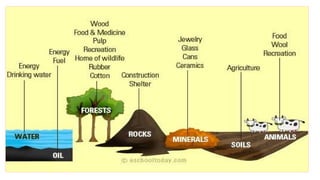
Natural resource
Resources thatoccur in our nature are called
natural resource.
Ex: Land , water, air , minerals, forests,
sunlight and wildlife
6.
● A resourcecan be defined as a form of energy
and /or matter which is essential for the
functioning of organisms, populations and
ecosystems.
● With respect to humans, it is any form of energy or
matter essential for fulfillment of physiological,
socioeconomic and cultural needs.
7.
● Five basicecological variables Energy,
matter, space, time and diversity are
sometimes called natural resources.
● Resources are dynamic
● They not only improve new knowledge,
but expand science and technology and
change culture of society.
8.
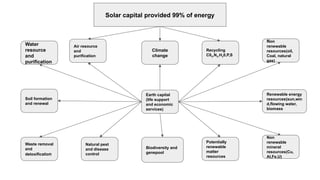
Solar capital provided99% of energy
Water
resource
and
purification
Air resource
and
purification
Climate
change
Earth capital
(life support
and economic
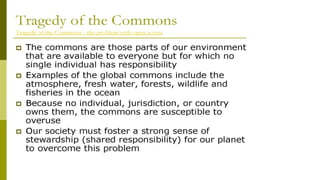
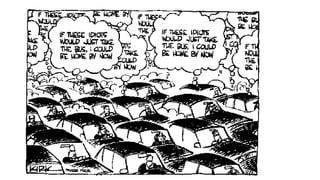
services)
Recycling
C02,N2,H20,P,S
Non
renewable
resources(oil,
Coal, natural
gas)
Waste removal
and
detoxification
Natural pest
and disease
control
Biodiversity and
genepool
Potentially
renewable
matter
resources
Non
renewable
mineral
resources(Cu,
Al,Fe,U)
Soil formation
and renewal
Renewable energy
resources(sun,win
d,flowing water,
biomass
9.
● Resources availabledirectly to man and
other organisms are:
● Solar energy, Fresh air, surface water and
plants
● Resources available only to man:
● Petroleum, Ground water, Minerals
● These resources are available only with
effort.
● Resource Appraisal:
●Resource is material needed or used to sustain
life
● Air, Water, Food
● Forest: Timber, paper, wood products
● Ores: Iron, Aluminum, copper
● Oil, Natural gas, Coal
● Assessment of the availability of resources
in a given area is called resource appraisal.
12.
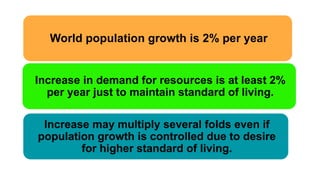
World population growthis 2% per year
Increase in demand for resources is at least 2%
per year just to maintain standard of living.
Increase may multiply several folds even if
population growth is controlled due to desire
for higher standard of living.
13.
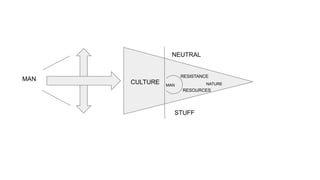
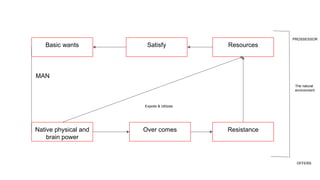
Basic wants SatisfyResources
Resistance
Native physical and
brain power
Over comes
MAN
PROSSESSOR
OFFERS
The natural
environment
Expoits & Utilizes
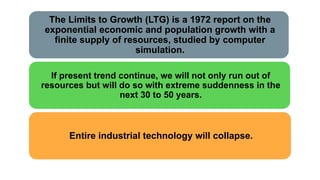
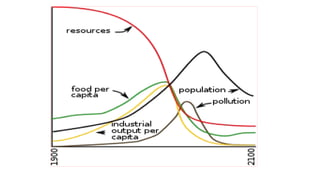
The Limits toGrowth (LTG) is a 1972 report on the
exponential economic and population growth with a
finite supply of resources, studied by computer
simulation.
If present trend continue, we will not only run out of
resources but will do so with extreme suddenness in the
next 30 to 50 years.
Entire industrial technology will collapse.
17.
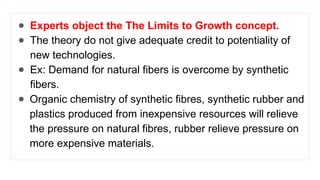
● Experts objectthe The Limits to Growth concept.
● The theory do not give adequate credit to potentiality of
new technologies.
● Ex: Demand for natural fibers is overcome by synthetic
fibers.
● Organic chemistry of synthetic fibres, synthetic rubber and
plastics produced from inexpensive resources will relieve
the pressure on natural fibres, rubber relieve pressure on
more expensive materials.
18.
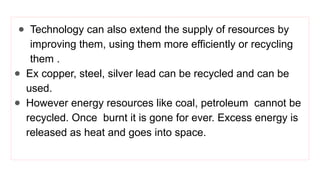
● Technology canalso extend the supply of resources by
improving them, using them more efficiently or recycling
them .
● Ex copper, steel, silver lead can be recycled and can be
used.
● However energy resources like coal, petroleum cannot be
recycled. Once burnt it is gone for ever. Excess energy is
released as heat and goes into space.
19.
● A materialcan be used as a resource, only if it is available
at reasonable cost.
● Once the easily available resource is depleted, the cost of
finding scarce resource becomes high and eventully
resource becomes expensive.
● This stimulates a new search for new supplies of mining
and processing lower grade deposits economically feasible.
● We can never find a resource if it is out of earth.
20.
● There isan economic limit to recycling.
● Recycling is done only,
(i) if recycling is cheaper than mining metal.
(ii) If the material is not too widely dispersed.
21.
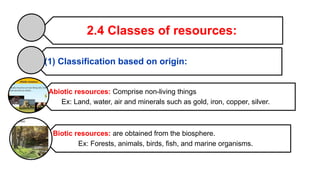
2.4 Classes ofresources:
(1) Classification based on origin:
Abiotic resources: Comprise non-living things
Ex: Land, water, air and minerals such as gold, iron, copper, silver.
Biotic resources: are obtained from the biosphere.
Ex: Forests, animals, birds, fish, and marine organisms.
22.
Classification based onstocks
in nature
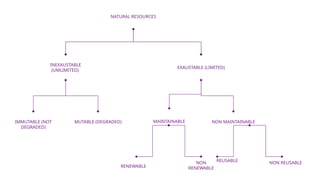
(1)In-exhaustible:
Resource that never runs out or
gets depleted.
Ex: Wind, sun, solar energy,
tides, and geothermal energy.
These resources are 2 types
(a) Immutable:
Much adverse change not observed through
man’s activities
Ex:(i) Wind power
(ii) Precipitation
(iii) Tidal power
(iv) Atomic energy
(b)Mutable:
Little danger of complete exhaustion, but when
improperly used their resource quality may be
impaired, such as:
(i) Atmosphere
(ii) Ocean
(iii) Water power of flowing streams
23.
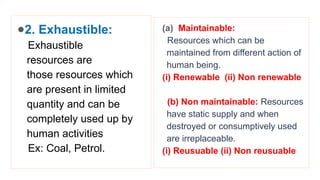
●2. Exhaustible:
Exhaustible
resources are
thoseresources which
are present in limited
quantity and can be
completely used up by
human activities
Ex: Coal, Petrol.
(a) Maintainable:
Resources which can be
maintained from different action of
human being.
(i) Renewable (ii) Non renewable
(b) Non maintainable: Resources
have static supply and when
destroyed or consumptively used
are irreplaceable.
(i) Reusuable (ii) Non reusuable
24.
● Classification basedon reusability:
Immutable [Quality not degraded]
●Inexhaustible: Wind power, ocean
Mutable[Quality may be
degraded]
solar, hydro power
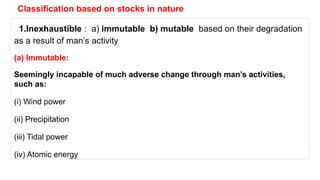
Classification based onstocks in nature
1.Inexhaustible : a) immutable b) mutable based on their degradation
as a result of man’s activity
(a) Immutable:
Seemingly incapable of much adverse change through man’s activities,
such as:
(i) Wind power
(ii) Precipitation
(iii) Tidal power
(iv) Atomic energy
28.
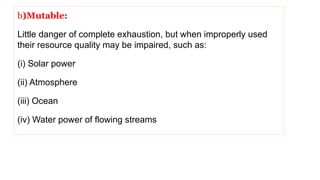
b)Mutable:
Little danger ofcomplete exhaustion, but when improperly used
their resource quality may be impaired, such as:
(i) Solar power
(ii) Atmosphere
(iii) Ocean
(iv) Water power of flowing streams
29.
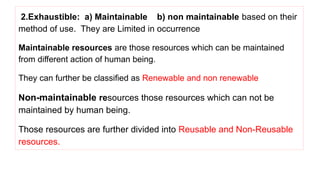
2.Exhaustible: a) Maintainableb) non maintainable based on their
method of use. They are Limited in occurrence
Maintainable resources are those resources which can be maintained
from different action of human being.
They can further be classified as Renewable and non renewable
Non-maintainable resources those resources which can not be
maintained by human being.
Those resources are further divided into Reusable and Non-Reusable
resources.
30.
Another classification basedon general categories :
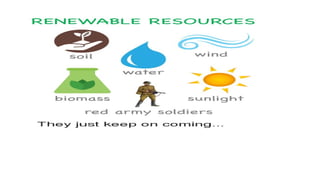
1. Renewable resources
2. Nonrenewable resources that can be recycled
3. Nonrenewable resources that cannot be recycled
31.
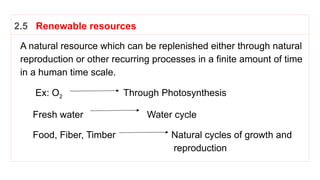
2.5 Renewable resources
Anatural resource which can be replenished either through natural
reproduction or other recurring processes in a finite amount of time
in a human time scale.
Ex: O2 Through Photosynthesis
Fresh water Water cycle
Food, Fiber, Timber Natural cycles of growth and
reproduction
32.
● Other examplesinclude:
● Solar Energy
● Forest, Grass land, Wild animals
35.
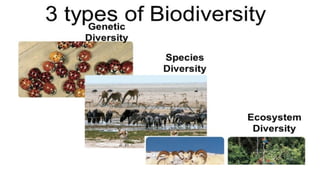
Another important renewableis biodiversity which consists of
life forms which can best survive the variety of conditions
found on earth. They are
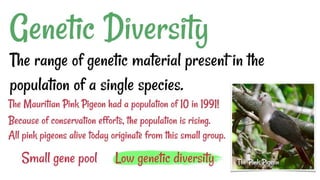
1. Genetic diversity
2. Species diversity
3. Ecological diversity
36.
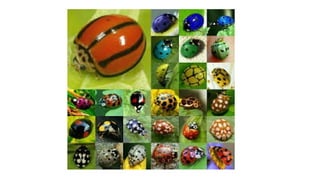
Genetic diversity :
Varietyin the genetic makeup among individuals with in a
single species
Genetic diversity serves as a way for populations to adapt
to changing environments.
Woody plants, such as trees, tend to have more genetic
diversity, on the whole, than vascular plants, such as grasses.
40.
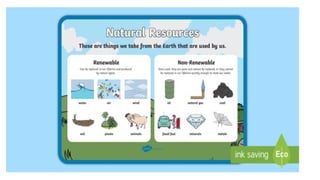
Natural resources canbe categorized on the basis of renewability:
● Non-renewable resources are formed over very long geological
periods.
● Minerals and fossils are included in this category.
● Since their rate of formation is extremely slow, they cannot be
replenished, once they are depleted.
● Out of these, the metallic minerals can be re-used by recycling
them, but coal and petroleum cannot be recycled.
41.
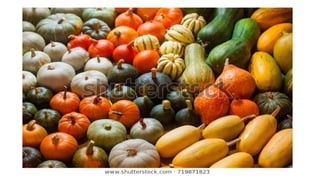
Species diversity:
Species diversityis defined as the number of different
species present in an ecosystem and relative abundance of
each of those species.
Diversity is greatest when all the species present are equally
abundant in the area.
44.
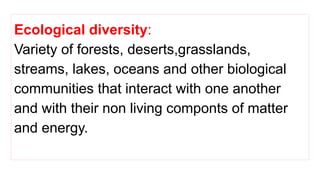
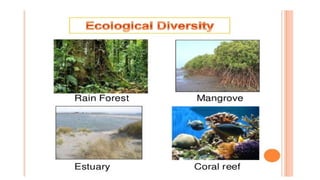
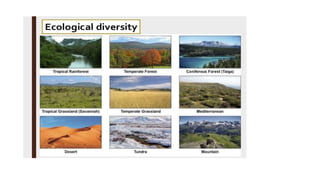
Ecological diversity:
Variety offorests, deserts,grasslands,
streams, lakes, oceans and other biological
communities that interact with one another
and with their non living componts of matter
and energy.
48.
● This diversitygives food, energy and raw materials.
● Potential renewable resources can be depleted.
● Sustainable yield:
● The highest rate at which a potentially renewable resource
can be used indefinitely without reducing its available
supply.
49.
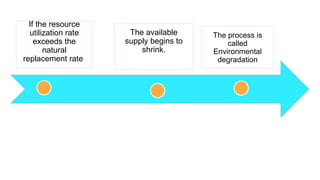
If the resource
utilizationrate
exceeds the
natural
replacement rate
The available
supply begins to
shrink.
The process is
called
Environmental
degradation
50.
Overuse of commons:
Oneof the causes of environmental degradation is overuse of common property
resources which are owned by none and used by all for free.
Most of such resources are potentially renewable.
51.
Global common:
The portionof earth and its surrounding space that
lie beyond the territorial claims of any nation.
Ex: clean air, the open ocean, seas, fish in the open
ocean, migratory birds, Antarctica, gases of lower
atmosphere, ozone content of stratosphere and 70%
of the earth’s surface are common
56.
2.6 Non renewableresources that can be recycled
● Few resources are non-renewable.
● Some of them may be recycled.
● Ex: All non energy mineral sources.
They can be recovered from their prior use to be used again.
● A good example of this would be aluminum from aluminum cans,
old cars or other products , Mercury and copper.
Many types of plastic (made from petroleum oil) are also recyclable.
57.
● Deposits offertilizer nutrients such as phosphate rock,
and potassium and minerals like asbestos clay and mica
are Non renewable resources that can be recycled.
● Recycling involves collecting and reprocessing a resource
into new products.
● Ex: Glass bottles or other glass items.
58.
Reuse involves useof a resource in the same form.
A nonrenewable mineral resource is never completely
exhausted, but it can be economically depleted when the cost
of finding, extracting transporting and processing what is left
exceeds the amount earned from them. At that time we have
five choices
59.
● Recycle orreuse existing supplies
● Waste less
● Use less amounts
● Try to develop a substitute
Or
● Wait for millions of years for more to be produced.
60.
2.7 Non renewableresources that cannot be recycled
These resources exist in a fixed quantity in Earth’s crust and
thus theoretically can be completely used up.
On a time scaleof millions to billions of years, such resources
can be renewed by geological processes.
However, on the much shorter human time scale of hundreds
to thousands of years, these resources can be depleted
much faster than they are formed.
61.
Fossil fuels arederived from organic matter that accumulated
during hundreds of millions of years of early bio-geological
history.
There is no way of recycling the energy in fossil fuels.
Resources that cannot be recycled are those “mineral”
energy resources, namely, fossil fuels (coal, oil, and natural
gas), that presently supply better than 90 percent of our
energy, and uranium that is used for nuclear (atomic) power.
62.
Non-renewable energy resources,such as coal, oil, and
natural gas, can’t be recycled or reused. Once burned, the
useful energy in these fossil fuels is gone, leaving behind
waste “heat and polluting exhaust gases.
Most of the per capita economic growth has been fueled by
relatively cheap non-renewable oil, which is expected to be
economically depleted within 40 to 80 years.
63.
2.8 Limits ofrenewable resources -Destruction vs Conservation
In theory, a renewable resource can last forever.
The term renewable resource is often taken to mean inexhaustible.
All renewable resources are named by the capacity of natural systems to
renew them .
ex:
(1) Groundwater is renewable only at the rate of which water continues to
percolate into the soil . in many areas water is being exhausted by
withdrawing it faster than it is being replaced
64.
2. Wetlands areeither drained or polluted.coral reefs are destroyed.
3 in many developed countries, diverse old forests are being destroyed
and are replaced with single species new tree plantations. These can
reduce wild life.
4 overgrazing of livestock degrades large areas of land.
5 wildlife species become extinct due to human activities.
Thus there is a danger of degradation and depletion of for potentially
renewable resources. There are no environmentally acceptable
sustitutes.
66.
Biological species alsorepresent a renewable resource as long as
depending population is maintained. Many species are going extinct.
Renewable resources are renewable and will last so long as the use of
them remains within the capacity of the system to renew itself and protect
it from pollution and habitat destruction.
Learning to manage and use renewable resources in accordance
with these considerations is the essence of study and practice of
environmental conservation.

![● Classification based on reusability:
Immutable [Quality not degraded]
●Inexhaustible: Wind power, ocean
Mutable[Quality may be
degraded]
solar, hydro power](https://image.slidesharecdn.com/renewableandnonrenewableresourceschapter21-250227152745-5df8f871/85/RENEWABLE-AND-NONRENEWABLE-RESOURCEs-CHAPTER-2-1-pptx-24-320.jpg)
![Maintainable [Availability depends on method of use]
● Exhaustible:
Non maintainable[ total quantity static]](https://image.slidesharecdn.com/renewableandnonrenewableresourceschapter21-250227152745-5df8f871/85/RENEWABLE-AND-NONRENEWABLE-RESOURCEs-CHAPTER-2-1-pptx-25-320.jpg)