Natural resource exploitation:
       basic concepts
         NRE - Lecture 1


          Aaron Hatcher

       Department of Economics
       University of Portsmouth
Introduction

    I   Natural resources are natural assets from which we derive
        value (utility)
Introduction

    I   Natural resources are natural assets from which we derive
        value (utility)
    I   Broad de…nition includes amenity value, provision of
        “ecosystem services”, etc.
Introduction

    I   Natural resources are natural assets from which we derive
        value (utility)
    I   Broad de…nition includes amenity value, provision of
        “ecosystem services”, etc.
    I   We focus here on natural resources that must be extracted or
        harvested
Introduction

    I   Natural resources are natural assets from which we derive
        value (utility)
    I   Broad de…nition includes amenity value, provision of
        “ecosystem services”, etc.
    I   We focus here on natural resources that must be extracted or
        harvested
    I   Distinguish between renewable and non-renewable resources
Introduction

    I   Natural resources are natural assets from which we derive
        value (utility)
    I   Broad de…nition includes amenity value, provision of
        “ecosystem services”, etc.
    I   We focus here on natural resources that must be extracted or
        harvested
    I   Distinguish between renewable and non-renewable resources
    I   Renewable resources are capable of growth (on some
        meaningful timescale), e.g., …sh, (young growth) forests
Introduction

    I   Natural resources are natural assets from which we derive
        value (utility)
    I   Broad de…nition includes amenity value, provision of
        “ecosystem services”, etc.
    I   We focus here on natural resources that must be extracted or
        harvested
    I   Distinguish between renewable and non-renewable resources
    I   Renewable resources are capable of growth (on some
        meaningful timescale), e.g., …sh, (young growth) forests
    I   Non-renewable resources are incapable of signi…cant growth,
        e.g., fossil fuels, ores, diamonds
Introduction

    I   Natural resources are natural assets from which we derive
        value (utility)
    I   Broad de…nition includes amenity value, provision of
        “ecosystem services”, etc.
    I   We focus here on natural resources that must be extracted or
        harvested
    I   Distinguish between renewable and non-renewable resources
    I   Renewable resources are capable of growth (on some
        meaningful timescale), e.g., …sh, (young growth) forests
    I   Non-renewable resources are incapable of signi…cant growth,
        e.g., fossil fuels, ores, diamonds
    I   In general, e¢ cient and optimal use of natural resources
        involves intertemporal allocation
A capital-theoretic approach


     I   Think of natural resources as natural capital
A capital-theoretic approach


     I   Think of natural resources as natural capital
     I   We expect a capital asset to generate a return at least as
         great as that from an alternative (numeraire) investment
A capital-theoretic approach


     I   Think of natural resources as natural capital
     I   We expect a capital asset to generate a return at least as
         great as that from an alternative (numeraire) investment
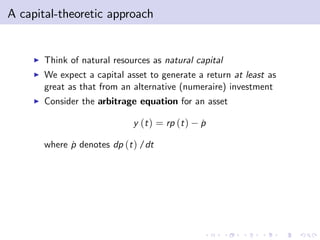
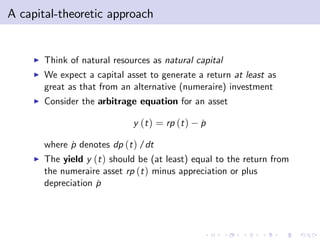
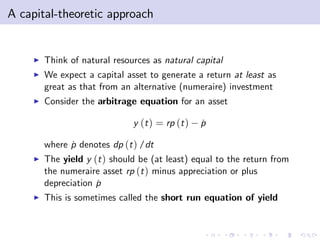
     I   Consider the arbitrage equation for an asset

                               y (t ) = rp (t )   p
                                                  ˙

         where p denotes dp (t ) /dt
               ˙
A capital-theoretic approach


     I   Think of natural resources as natural capital
     I   We expect a capital asset to generate a return at least as
         great as that from an alternative (numeraire) investment
     I   Consider the arbitrage equation for an asset

                               y (t ) = rp (t )   p
                                                  ˙

         where p denotes dp (t ) /dt
               ˙
     I   The yield y (t ) should be (at least) equal to the return from
         the numeraire asset rp (t ) minus appreciation or plus
         depreciation p
                      ˙
A capital-theoretic approach


     I   Think of natural resources as natural capital
     I   We expect a capital asset to generate a return at least as
         great as that from an alternative (numeraire) investment
     I   Consider the arbitrage equation for an asset

                               y (t ) = rp (t )   p
                                                  ˙

         where p denotes dp (t ) /dt
               ˙
     I   The yield y (t ) should be (at least) equal to the return from
         the numeraire asset rp (t ) minus appreciation or plus
         depreciation p
                      ˙
     I   This is sometimes called the short run equation of yield
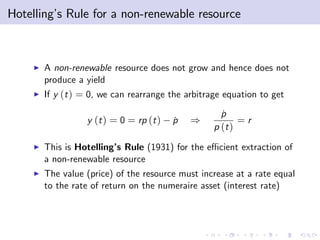
Hotelling’ Rule for a non-renewable resource
         s


    I   A non-renewable resource does not grow and hence does not
        produce a yield
Hotelling’ Rule for a non-renewable resource
         s


    I   A non-renewable resource does not grow and hence does not
        produce a yield
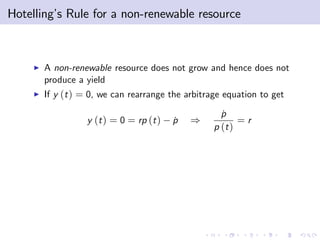
    I   If y (t ) = 0, we can rearrange the arbitrage equation to get

                                                     p
                                                     ˙
                  y (t ) = 0 = rp (t )   p
                                         ˙   )            =r
                                                   p (t )
Hotelling’ Rule for a non-renewable resource
         s


    I   A non-renewable resource does not grow and hence does not
        produce a yield
    I   If y (t ) = 0, we can rearrange the arbitrage equation to get

                                                     p
                                                     ˙
                  y (t ) = 0 = rp (t )   p
                                         ˙   )            =r
                                                   p (t )
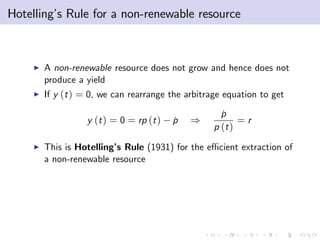
    I   This is Hotelling’ Rule (1931) for the e¢ cient extraction of
                         s
        a non-renewable resource
Hotelling’ Rule for a non-renewable resource
         s


    I   A non-renewable resource does not grow and hence does not
        produce a yield
    I   If y (t ) = 0, we can rearrange the arbitrage equation to get

                                                     p
                                                     ˙
                  y (t ) = 0 = rp (t )   p
                                         ˙   )            =r
                                                   p (t )
    I   This is Hotelling’ Rule (1931) for the e¢ cient extraction of
                         s
        a non-renewable resource
    I   The value (price) of the resource must increase at a rate equal
        to the rate of return on the numeraire asset (interest rate)
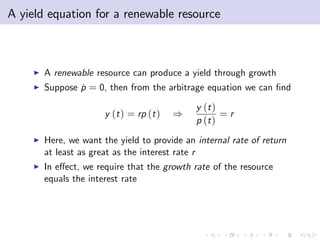
A yield equation for a renewable resource


     I   A renewable resource can produce a yield through growth
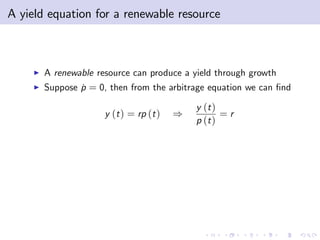
A yield equation for a renewable resource


     I   A renewable resource can produce a yield through growth
     I   Suppose p = 0, then from the arbitrage equation we can …nd
                 ˙

                                              y (t )
                       y (t ) = rp (t )   )          =r
                                              p (t )
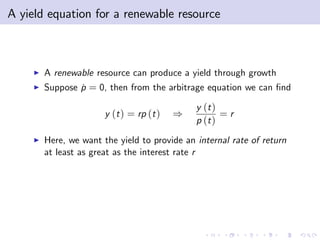
A yield equation for a renewable resource


     I   A renewable resource can produce a yield through growth
     I   Suppose p = 0, then from the arbitrage equation we can …nd
                 ˙

                                               y (t )
                        y (t ) = rp (t )   )          =r
                                               p (t )
     I   Here, we want the yield to provide an internal rate of return
         at least as great as the interest rate r
A yield equation for a renewable resource


     I   A renewable resource can produce a yield through growth
     I   Suppose p = 0, then from the arbitrage equation we can …nd
                 ˙

                                               y (t )
                        y (t ) = rp (t )   )          =r
                                               p (t )
     I   Here, we want the yield to provide an internal rate of return
         at least as great as the interest rate r
     I   In e¤ect, we require that the growth rate of the resource
         equals the interest rate
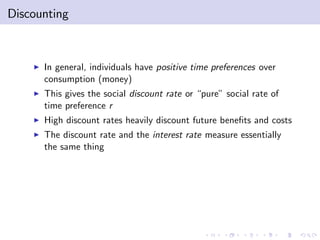
Discounting


    I   In general, individuals have positive time preferences over
        consumption (money)
Discounting


    I   In general, individuals have positive time preferences over
        consumption (money)
    I   This gives the social discount rate or “pure” social rate of
        time preference r
Discounting


    I   In general, individuals have positive time preferences over
        consumption (money)
    I   This gives the social discount rate or “pure” social rate of
        time preference r
    I   High discount rates heavily discount future bene…ts and costs
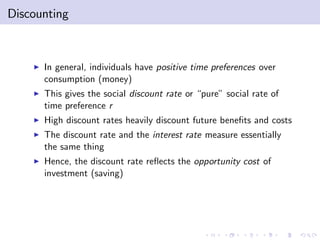
Discounting


    I   In general, individuals have positive time preferences over
        consumption (money)
    I   This gives the social discount rate or “pure” social rate of
        time preference r
    I   High discount rates heavily discount future bene…ts and costs
    I   The discount rate and the interest rate measure essentially
        the same thing
Discounting


    I   In general, individuals have positive time preferences over
        consumption (money)
    I   This gives the social discount rate or “pure” social rate of
        time preference r
    I   High discount rates heavily discount future bene…ts and costs
    I   The discount rate and the interest rate measure essentially
        the same thing
    I   Hence, the discount rate re‡ects the opportunity cost of
        investment (saving)
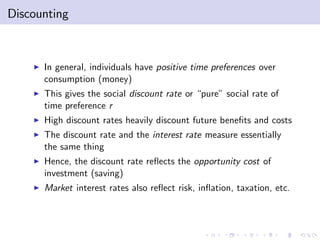
Discounting


    I   In general, individuals have positive time preferences over
        consumption (money)
    I   This gives the social discount rate or “pure” social rate of
        time preference r
    I   High discount rates heavily discount future bene…ts and costs
    I   The discount rate and the interest rate measure essentially
        the same thing
    I   Hence, the discount rate re‡ects the opportunity cost of
        investment (saving)
    I   Market interest rates also re‡ect risk, in‡ation, taxation, etc.
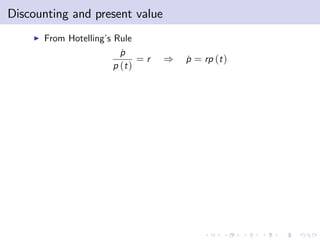
Discounting and present value
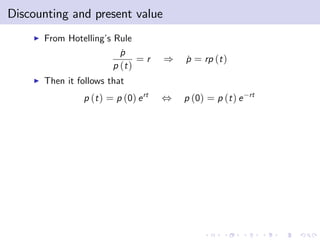
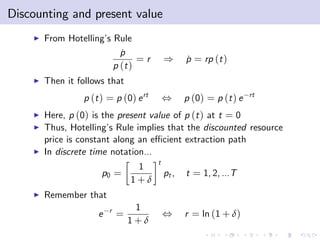
    I   From Hotelling’ Rule
                       s
                           p
                           ˙
                                =r   )   p = rp (t )
                                         ˙
                         p (t )
Discounting and present value
    I   From Hotelling’ Rule
                       s
                           p
                           ˙
                                =r     )   p = rp (t )
                                           ˙
                         p (t )
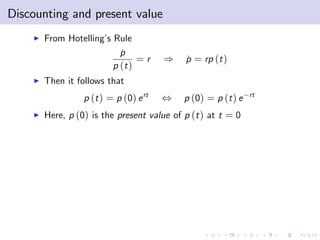
    I   Then it follows that
                 p (t ) = p (0) e rt   ,   p (0) = p (t ) e   rt
Discounting and present value
    I   From Hotelling’ Rule
                       s
                           p
                           ˙
                                =r      )   p = rp (t )
                                            ˙
                         p (t )
    I   Then it follows that
                  p (t ) = p (0) e rt   ,   p (0) = p (t ) e   rt

    I   Here, p (0) is the present value of p (t ) at t = 0
Discounting and present value
    I   From Hotelling’ Rule
                       s
                           p
                           ˙
                                =r     )   p = rp (t )
                                           ˙
                         p (t )
    I   Then it follows that
                 p (t ) = p (0) e rt   ,   p (0) = p (t ) e   rt

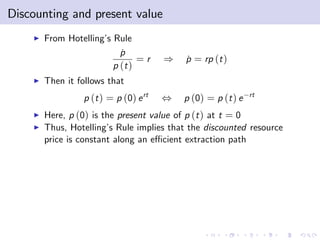
    I   Here, p (0) is the present value of p (t ) at t = 0
    I   Thus, Hotelling’ Rule implies that the discounted resource
                         s
        price is constant along an e¢ cient extraction path
Discounting and present value
    I   From Hotelling’ Rule
                       s
                           p
                           ˙
                                =r         )      p = rp (t )
                                                  ˙
                         p (t )
    I   Then it follows that
                 p (t ) = p (0) e rt       ,      p (0) = p (t ) e   rt

    I   Here, p (0) is the present value of p (t ) at t = 0
    I   Thus, Hotelling’ Rule implies that the discounted resource
                         s
        price is constant along an e¢ cient extraction path
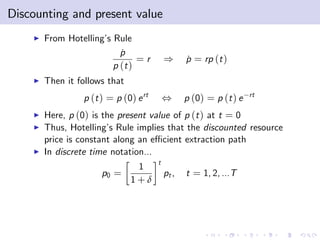
    I   In discrete time notation...
                                       t
                                1
                      p0 =                 pt ,   t = 1, 2, ...T
                               1+δ
Discounting and present value
    I   From Hotelling’ Rule
                       s
                           p
                           ˙
                                =r         )      p = rp (t )
                                                  ˙
                         p (t )
    I   Then it follows that
                 p (t ) = p (0) e rt       ,      p (0) = p (t ) e   rt

    I   Here, p (0) is the present value of p (t ) at t = 0
    I   Thus, Hotelling’ Rule implies that the discounted resource
                         s
        price is constant along an e¢ cient extraction path
    I   In discrete time notation...
                                       t
                                  1
                      p0 =                 pt ,   t = 1, 2, ...T
                                 1+δ
    I   Remember that
                         r        1
                     e       =             ,      r = ln (1 + δ)
                                 1+δ
Discounting and present value contd.


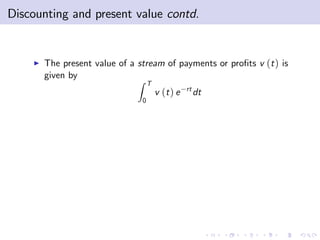
    I   The present value of a stream of payments or pro…ts v (t ) is
        given by
                               Z T
                                                rt
                                     v (t ) e        dt
                                0
Discounting and present value contd.


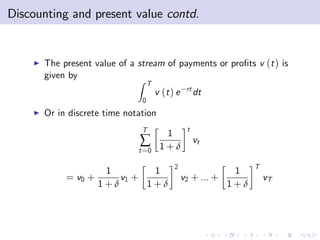
    I   The present value of a stream of payments or pro…ts v (t ) is
        given by
                               Z T
                                                  rt
                                      v (t ) e         dt
                                0
    I   Or in discrete time notation
                                T                 t
                                        1
                               ∑       1+δ
                                                       vt
                               t =0

                                            2                     T
                     1        1                              1
             = v0 +     v1 +                     v2 + ... +           vT
                    1+δ      1+δ                            1+δ
A simple two-period resource allocation problem
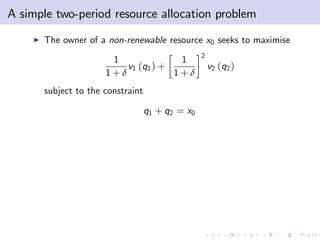
    I   The owner of a non-renewable resource x0 seeks to maximise
                                                   2
                        1              1
                           v1 (q1 ) +                  v2 (q2 )
                       1+δ            1+δ
        subject to the constraint

                                    q1 + q2 = x0
A simple two-period resource allocation problem
    I   The owner of a non-renewable resource x0 seeks to maximise
                                                    2
                        1              1
                           v1 (q1 ) +                   v2 (q2 )
                       1+δ            1+δ
        subject to the constraint

                                    q1 + q2 = x0
    I   The Lagrangian function for this problem is
                                          2
                 1              1
           L        v1 (q1 ) +                v2 (q2 ) + λ [x0     q1   q2 ]
                1+δ            1+δ
A simple two-period resource allocation problem
    I   The owner of a non-renewable resource x0 seeks to maximise
                                                    2
                        1              1
                           v1 (q1 ) +                   v2 (q2 )
                       1+δ            1+δ
        subject to the constraint

                                    q1 + q2 = x0
    I   The Lagrangian function for this problem is
                                          2
                  1              1
           L         v1 (q1 ) +               v2 (q2 ) + λ [x0     q1   q2 ]
                 1+δ            1+δ
    I   The two …rst order (necessary) conditions are
                                                    2
                1                           1
                  v 0 (q )   λ = 0,                      0
                                                        v2 (q2 )   λ=0
               1+δ 1 1                     1+δ
A simple two-period resource allocation problem contd.

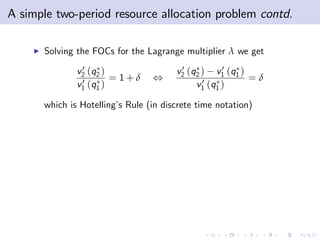
    I   Solving the FOCs for the Lagrange multiplier λ we get
                 0
                v2 (q2 )                  0          0
                                         v2 (q2 ) v1 (q1 )
                 0       = 1+δ     ,            0 (q )     =δ
                v1 (q1 )                      v1 1

        which is Hotelling’ Rule (in discrete time notation)
                           s
A simple two-period resource allocation problem contd.

    I   Solving the FOCs for the Lagrange multiplier λ we get
                   0
                  v2 (q2 )                   0          0
                                            v2 (q2 ) v1 (q1 )
                   0       = 1+δ     ,             0 (q )     =δ
                  v1 (q1 )                       v1 1

        which is Hotelling’ Rule (in discrete time notation)
                           s
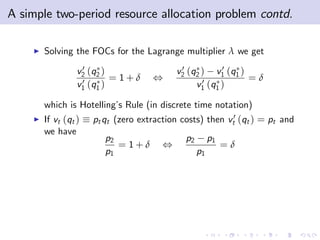
    I   If vt (qt )   pt qt (zero extraction costs) then vt0 (qt ) = pt and
        we have
                         p2                   p2        p1
                            = 1+δ       ,                    =δ
                         p1                        p1
A simple two-period resource allocation problem contd.

    I   Solving the FOCs for the Lagrange multiplier λ we get
                   0
                  v2 (q2 )                   0          0
                                            v2 (q2 ) v1 (q1 )
                   0       = 1+δ     ,             0 (q )     =δ
                  v1 (q1 )                       v1 1

        which is Hotelling’ Rule (in discrete time notation)
                           s
    I   If vt (qt )   pt qt (zero extraction costs) then vt0 (qt ) = pt and
        we have
                         p2                   p2        p1
                            = 1+δ       ,                    =δ
                         p1                        p1
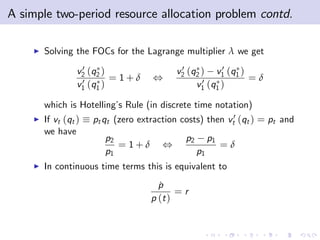
    I   In continuous time terms this is equivalent to
                                       p
                                       ˙
                                            =r
                                     p (t )
A simple two-period resource allocation problem contd.

    I   Instead, we could attach a multiplier to a stock constraint at
        each point in time
                                               2
                 1              1                                1
        L           v1 (q1 ) +                     v2 (q2 ) +       λ1 [x0       x1 ]
                1+δ            1+δ                              1+δ
                           2                                        3
                     1                                       1
                +              λ 2 [ x1   q1       x2 ] +               λ3 [x2    q2 ]
                    1+δ                                     1+δ
A simple two-period resource allocation problem contd.

    I   Instead, we could attach a multiplier to a stock constraint at
        each point in time
                                                 2
                 1              1                                   1
        L           v1 (q1 ) +                       v2 (q2 ) +        λ1 [x0        x1 ]
                1+δ            1+δ                                 1+δ
                           2                                            3
                     1                                             1
                +              λ 2 [ x1     q1       x2 ] +                 λ3 [x2    q2 ]
                    1+δ                                           1+δ
    I   The FOCs for q1 and q2 are now
                                                          2
                        1                         1
                          v 0 (q )                            λ2 = 0
                       1+δ 1 1                   1+δ
                               2                              3
                       1            0                 1
                                   v2   (q2 )                     λ3 = 0
                      1+δ                            1+δ
A simple two-period resource allocation problem contd.
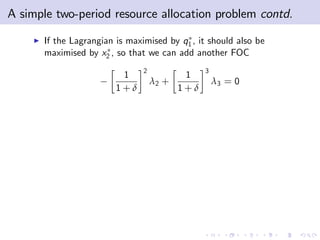
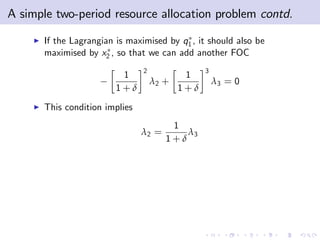
    I   If the Lagrangian is maximised by q1 , it should also be
        maximised by x2 , so that we can add another FOC
                                 2                3
                           1                 1
                                     λ2 +             λ3 = 0
                          1+δ               1+δ
A simple two-period resource allocation problem contd.
    I   If the Lagrangian is maximised by q1 , it should also be
        maximised by x2 , so that we can add another FOC
                                 2                3
                           1                 1
                                     λ2 +             λ3 = 0
                          1+δ               1+δ
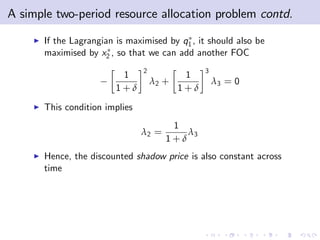
    I   This condition implies
                                         1
                                 λ2 =       λ3
                                        1+δ
A simple two-period resource allocation problem contd.
    I   If the Lagrangian is maximised by q1 , it should also be
        maximised by x2 , so that we can add another FOC
                                 2                3
                           1                 1
                                     λ2 +             λ3 = 0
                          1+δ               1+δ
    I   This condition implies
                                         1
                                 λ2 =       λ3
                                        1+δ
    I   Hence, the discounted shadow price is also constant across
        time
A simple two-period resource allocation problem contd.
    I   If the Lagrangian is maximised by q1 , it should also be
        maximised by x2 , so that we can add another FOC
                                 2                3
                           1                 1
                                     λ2 +             λ3 = 0
                          1+δ               1+δ
    I   This condition implies
                                          1
                                 λ2 =        λ3
                                         1+δ
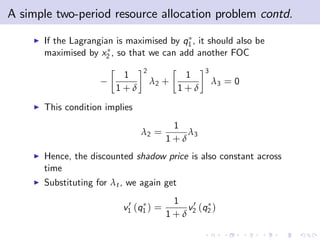
    I   Hence, the discounted shadow price is also constant across
        time
    I   Substituting for λt , we again get

                             0            1
                            v1 (q1 ) =      v 0 (q )
                                         1+δ 2 2
A simple renewable resource problem

    I   We can set the problem in terms of a renewable resource by
        incorporating a growth function gt (xt ) into each of the stock
        constraints
                         t
                   1
                             λt [xt   1   + gt   1   (xt   1)   qt   1   xt ]
                  1+δ
A simple renewable resource problem

    I   We can set the problem in terms of a renewable resource by
        incorporating a growth function gt (xt ) into each of the stock
        constraints
                          t
                   1
                              λt [xt   1   + gt   1   (xt   1)     qt   1   xt ]
                  1+δ
    I   Solving the Lagrangian as before, we get
                                       2                      2                          3
         1   0          1                              1           0                1
            v1 (q1 ) =                     λ2 ,                   v2 (q2 ) =                 λ3
        1+δ            1+δ                            1+δ                          1+δ

        and
                              2                       3
                     1                       1                    0
                                  λ2 =                    λ3 1 + g2 (x2 )
                    1+δ                     1+δ
A simple renewable resource problem contd.
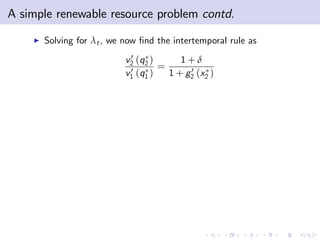
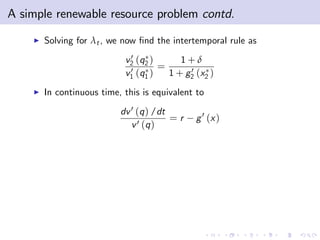
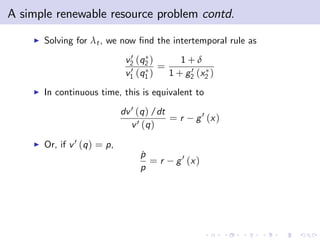
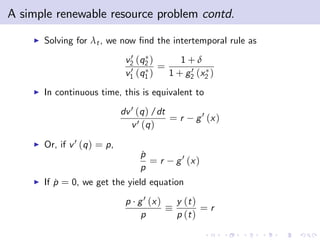
    I   Solving for λt , we now …nd the intertemporal rule as
                             0
                            v2 (q2 )     1+δ
                             0 (q ) = 1 + g 0 (x )
                            v1 1           2    2
A simple renewable resource problem contd.
    I   Solving for λt , we now …nd the intertemporal rule as
                             0
                            v2 (q2 )     1+δ
                             0 (q ) = 1 + g 0 (x )
                            v1 1           2    2

    I   In continuous time, this is equivalent to
                           dv 0 (q ) /dt
                                         =r   g 0 (x )
                              v 0 (q )
A simple renewable resource problem contd.
    I   Solving for λt , we now …nd the intertemporal rule as
                                 0
                                v2 (q2 )     1+δ
                                 0 (q ) = 1 + g 0 (x )
                                v1 1           2    2

    I   In continuous time, this is equivalent to
                               dv 0 (q ) /dt
                                             =r    g 0 (x )
                                  v 0 (q )
    I   Or, if v 0 (q ) = p,
                                    p
                                    ˙
                                      =r     g 0 (x )
                                    p
A simple renewable resource problem contd.
    I   Solving for λt , we now …nd the intertemporal rule as
                                 0
                                v2 (q2 )     1+δ
                                 0 (q ) = 1 + g 0 (x )
                                v1 1           2    2

    I   In continuous time, this is equivalent to
                               dv 0 (q ) /dt
                                             =r    g 0 (x )
                                  v 0 (q )
    I   Or, if v 0 (q ) = p,
                                    p
                                    ˙
                                      =r     g 0 (x )
                                    p
    I   If p = 0, we get the yield equation
           ˙
                                p g 0 (x )   y (t )
                                                    =r
                                   p         p (t )

Natural resource exploitation: basic concepts

  • 1.
    Natural resource exploitation: basic concepts NRE - Lecture 1 Aaron Hatcher Department of Economics University of Portsmouth
  • 2.
    Introduction I Natural resources are natural assets from which we derive value (utility)
  • 3.
    Introduction I Natural resources are natural assets from which we derive value (utility) I Broad de…nition includes amenity value, provision of “ecosystem services”, etc.
  • 4.
    Introduction I Natural resources are natural assets from which we derive value (utility) I Broad de…nition includes amenity value, provision of “ecosystem services”, etc. I We focus here on natural resources that must be extracted or harvested
  • 5.
    Introduction I Natural resources are natural assets from which we derive value (utility) I Broad de…nition includes amenity value, provision of “ecosystem services”, etc. I We focus here on natural resources that must be extracted or harvested I Distinguish between renewable and non-renewable resources
  • 6.
    Introduction I Natural resources are natural assets from which we derive value (utility) I Broad de…nition includes amenity value, provision of “ecosystem services”, etc. I We focus here on natural resources that must be extracted or harvested I Distinguish between renewable and non-renewable resources I Renewable resources are capable of growth (on some meaningful timescale), e.g., …sh, (young growth) forests
  • 7.
    Introduction I Natural resources are natural assets from which we derive value (utility) I Broad de…nition includes amenity value, provision of “ecosystem services”, etc. I We focus here on natural resources that must be extracted or harvested I Distinguish between renewable and non-renewable resources I Renewable resources are capable of growth (on some meaningful timescale), e.g., …sh, (young growth) forests I Non-renewable resources are incapable of signi…cant growth, e.g., fossil fuels, ores, diamonds
  • 8.
    Introduction I Natural resources are natural assets from which we derive value (utility) I Broad de…nition includes amenity value, provision of “ecosystem services”, etc. I We focus here on natural resources that must be extracted or harvested I Distinguish between renewable and non-renewable resources I Renewable resources are capable of growth (on some meaningful timescale), e.g., …sh, (young growth) forests I Non-renewable resources are incapable of signi…cant growth, e.g., fossil fuels, ores, diamonds I In general, e¢ cient and optimal use of natural resources involves intertemporal allocation
  • 9.
    A capital-theoretic approach I Think of natural resources as natural capital
  • 10.
    A capital-theoretic approach I Think of natural resources as natural capital I We expect a capital asset to generate a return at least as great as that from an alternative (numeraire) investment
  • 11.
    A capital-theoretic approach I Think of natural resources as natural capital I We expect a capital asset to generate a return at least as great as that from an alternative (numeraire) investment I Consider the arbitrage equation for an asset y (t ) = rp (t ) p ˙ where p denotes dp (t ) /dt ˙
  • 12.
    A capital-theoretic approach I Think of natural resources as natural capital I We expect a capital asset to generate a return at least as great as that from an alternative (numeraire) investment I Consider the arbitrage equation for an asset y (t ) = rp (t ) p ˙ where p denotes dp (t ) /dt ˙ I The yield y (t ) should be (at least) equal to the return from the numeraire asset rp (t ) minus appreciation or plus depreciation p ˙
  • 13.
    A capital-theoretic approach I Think of natural resources as natural capital I We expect a capital asset to generate a return at least as great as that from an alternative (numeraire) investment I Consider the arbitrage equation for an asset y (t ) = rp (t ) p ˙ where p denotes dp (t ) /dt ˙ I The yield y (t ) should be (at least) equal to the return from the numeraire asset rp (t ) minus appreciation or plus depreciation p ˙ I This is sometimes called the short run equation of yield
  • 14.
    Hotelling’ Rule fora non-renewable resource s I A non-renewable resource does not grow and hence does not produce a yield
  • 15.
    Hotelling’ Rule fora non-renewable resource s I A non-renewable resource does not grow and hence does not produce a yield I If y (t ) = 0, we can rearrange the arbitrage equation to get p ˙ y (t ) = 0 = rp (t ) p ˙ ) =r p (t )
  • 16.
    Hotelling’ Rule fora non-renewable resource s I A non-renewable resource does not grow and hence does not produce a yield I If y (t ) = 0, we can rearrange the arbitrage equation to get p ˙ y (t ) = 0 = rp (t ) p ˙ ) =r p (t ) I This is Hotelling’ Rule (1931) for the e¢ cient extraction of s a non-renewable resource
  • 17.
    Hotelling’ Rule fora non-renewable resource s I A non-renewable resource does not grow and hence does not produce a yield I If y (t ) = 0, we can rearrange the arbitrage equation to get p ˙ y (t ) = 0 = rp (t ) p ˙ ) =r p (t ) I This is Hotelling’ Rule (1931) for the e¢ cient extraction of s a non-renewable resource I The value (price) of the resource must increase at a rate equal to the rate of return on the numeraire asset (interest rate)
  • 18.
    A yield equationfor a renewable resource I A renewable resource can produce a yield through growth
  • 19.
    A yield equationfor a renewable resource I A renewable resource can produce a yield through growth I Suppose p = 0, then from the arbitrage equation we can …nd ˙ y (t ) y (t ) = rp (t ) ) =r p (t )
  • 20.
    A yield equationfor a renewable resource I A renewable resource can produce a yield through growth I Suppose p = 0, then from the arbitrage equation we can …nd ˙ y (t ) y (t ) = rp (t ) ) =r p (t ) I Here, we want the yield to provide an internal rate of return at least as great as the interest rate r
  • 21.
    A yield equationfor a renewable resource I A renewable resource can produce a yield through growth I Suppose p = 0, then from the arbitrage equation we can …nd ˙ y (t ) y (t ) = rp (t ) ) =r p (t ) I Here, we want the yield to provide an internal rate of return at least as great as the interest rate r I In e¤ect, we require that the growth rate of the resource equals the interest rate
  • 22.
    Discounting I In general, individuals have positive time preferences over consumption (money)
  • 23.
    Discounting I In general, individuals have positive time preferences over consumption (money) I This gives the social discount rate or “pure” social rate of time preference r
  • 24.
    Discounting I In general, individuals have positive time preferences over consumption (money) I This gives the social discount rate or “pure” social rate of time preference r I High discount rates heavily discount future bene…ts and costs
  • 25.
    Discounting I In general, individuals have positive time preferences over consumption (money) I This gives the social discount rate or “pure” social rate of time preference r I High discount rates heavily discount future bene…ts and costs I The discount rate and the interest rate measure essentially the same thing
  • 26.
    Discounting I In general, individuals have positive time preferences over consumption (money) I This gives the social discount rate or “pure” social rate of time preference r I High discount rates heavily discount future bene…ts and costs I The discount rate and the interest rate measure essentially the same thing I Hence, the discount rate re‡ects the opportunity cost of investment (saving)
  • 27.
    Discounting I In general, individuals have positive time preferences over consumption (money) I This gives the social discount rate or “pure” social rate of time preference r I High discount rates heavily discount future bene…ts and costs I The discount rate and the interest rate measure essentially the same thing I Hence, the discount rate re‡ects the opportunity cost of investment (saving) I Market interest rates also re‡ect risk, in‡ation, taxation, etc.
  • 28.
    Discounting and presentvalue I From Hotelling’ Rule s p ˙ =r ) p = rp (t ) ˙ p (t )
  • 29.
    Discounting and presentvalue I From Hotelling’ Rule s p ˙ =r ) p = rp (t ) ˙ p (t ) I Then it follows that p (t ) = p (0) e rt , p (0) = p (t ) e rt
  • 30.
    Discounting and presentvalue I From Hotelling’ Rule s p ˙ =r ) p = rp (t ) ˙ p (t ) I Then it follows that p (t ) = p (0) e rt , p (0) = p (t ) e rt I Here, p (0) is the present value of p (t ) at t = 0
  • 31.
    Discounting and presentvalue I From Hotelling’ Rule s p ˙ =r ) p = rp (t ) ˙ p (t ) I Then it follows that p (t ) = p (0) e rt , p (0) = p (t ) e rt I Here, p (0) is the present value of p (t ) at t = 0 I Thus, Hotelling’ Rule implies that the discounted resource s price is constant along an e¢ cient extraction path
  • 32.
    Discounting and presentvalue I From Hotelling’ Rule s p ˙ =r ) p = rp (t ) ˙ p (t ) I Then it follows that p (t ) = p (0) e rt , p (0) = p (t ) e rt I Here, p (0) is the present value of p (t ) at t = 0 I Thus, Hotelling’ Rule implies that the discounted resource s price is constant along an e¢ cient extraction path I In discrete time notation... t 1 p0 = pt , t = 1, 2, ...T 1+δ
  • 33.
    Discounting and presentvalue I From Hotelling’ Rule s p ˙ =r ) p = rp (t ) ˙ p (t ) I Then it follows that p (t ) = p (0) e rt , p (0) = p (t ) e rt I Here, p (0) is the present value of p (t ) at t = 0 I Thus, Hotelling’ Rule implies that the discounted resource s price is constant along an e¢ cient extraction path I In discrete time notation... t 1 p0 = pt , t = 1, 2, ...T 1+δ I Remember that r 1 e = , r = ln (1 + δ) 1+δ
  • 34.
    Discounting and presentvalue contd. I The present value of a stream of payments or pro…ts v (t ) is given by Z T rt v (t ) e dt 0
  • 35.
    Discounting and presentvalue contd. I The present value of a stream of payments or pro…ts v (t ) is given by Z T rt v (t ) e dt 0 I Or in discrete time notation T t 1 ∑ 1+δ vt t =0 2 T 1 1 1 = v0 + v1 + v2 + ... + vT 1+δ 1+δ 1+δ
  • 36.
    A simple two-periodresource allocation problem I The owner of a non-renewable resource x0 seeks to maximise 2 1 1 v1 (q1 ) + v2 (q2 ) 1+δ 1+δ subject to the constraint q1 + q2 = x0
  • 37.
    A simple two-periodresource allocation problem I The owner of a non-renewable resource x0 seeks to maximise 2 1 1 v1 (q1 ) + v2 (q2 ) 1+δ 1+δ subject to the constraint q1 + q2 = x0 I The Lagrangian function for this problem is 2 1 1 L v1 (q1 ) + v2 (q2 ) + λ [x0 q1 q2 ] 1+δ 1+δ
  • 38.
    A simple two-periodresource allocation problem I The owner of a non-renewable resource x0 seeks to maximise 2 1 1 v1 (q1 ) + v2 (q2 ) 1+δ 1+δ subject to the constraint q1 + q2 = x0 I The Lagrangian function for this problem is 2 1 1 L v1 (q1 ) + v2 (q2 ) + λ [x0 q1 q2 ] 1+δ 1+δ I The two …rst order (necessary) conditions are 2 1 1 v 0 (q ) λ = 0, 0 v2 (q2 ) λ=0 1+δ 1 1 1+δ
  • 39.
    A simple two-periodresource allocation problem contd. I Solving the FOCs for the Lagrange multiplier λ we get 0 v2 (q2 ) 0 0 v2 (q2 ) v1 (q1 ) 0 = 1+δ , 0 (q ) =δ v1 (q1 ) v1 1 which is Hotelling’ Rule (in discrete time notation) s
  • 40.
    A simple two-periodresource allocation problem contd. I Solving the FOCs for the Lagrange multiplier λ we get 0 v2 (q2 ) 0 0 v2 (q2 ) v1 (q1 ) 0 = 1+δ , 0 (q ) =δ v1 (q1 ) v1 1 which is Hotelling’ Rule (in discrete time notation) s I If vt (qt ) pt qt (zero extraction costs) then vt0 (qt ) = pt and we have p2 p2 p1 = 1+δ , =δ p1 p1
  • 41.
    A simple two-periodresource allocation problem contd. I Solving the FOCs for the Lagrange multiplier λ we get 0 v2 (q2 ) 0 0 v2 (q2 ) v1 (q1 ) 0 = 1+δ , 0 (q ) =δ v1 (q1 ) v1 1 which is Hotelling’ Rule (in discrete time notation) s I If vt (qt ) pt qt (zero extraction costs) then vt0 (qt ) = pt and we have p2 p2 p1 = 1+δ , =δ p1 p1 I In continuous time terms this is equivalent to p ˙ =r p (t )
  • 42.
    A simple two-periodresource allocation problem contd. I Instead, we could attach a multiplier to a stock constraint at each point in time 2 1 1 1 L v1 (q1 ) + v2 (q2 ) + λ1 [x0 x1 ] 1+δ 1+δ 1+δ 2 3 1 1 + λ 2 [ x1 q1 x2 ] + λ3 [x2 q2 ] 1+δ 1+δ
  • 43.
    A simple two-periodresource allocation problem contd. I Instead, we could attach a multiplier to a stock constraint at each point in time 2 1 1 1 L v1 (q1 ) + v2 (q2 ) + λ1 [x0 x1 ] 1+δ 1+δ 1+δ 2 3 1 1 + λ 2 [ x1 q1 x2 ] + λ3 [x2 q2 ] 1+δ 1+δ I The FOCs for q1 and q2 are now 2 1 1 v 0 (q ) λ2 = 0 1+δ 1 1 1+δ 2 3 1 0 1 v2 (q2 ) λ3 = 0 1+δ 1+δ
  • 44.
    A simple two-periodresource allocation problem contd. I If the Lagrangian is maximised by q1 , it should also be maximised by x2 , so that we can add another FOC 2 3 1 1 λ2 + λ3 = 0 1+δ 1+δ
  • 45.
    A simple two-periodresource allocation problem contd. I If the Lagrangian is maximised by q1 , it should also be maximised by x2 , so that we can add another FOC 2 3 1 1 λ2 + λ3 = 0 1+δ 1+δ I This condition implies 1 λ2 = λ3 1+δ
  • 46.
    A simple two-periodresource allocation problem contd. I If the Lagrangian is maximised by q1 , it should also be maximised by x2 , so that we can add another FOC 2 3 1 1 λ2 + λ3 = 0 1+δ 1+δ I This condition implies 1 λ2 = λ3 1+δ I Hence, the discounted shadow price is also constant across time
  • 47.
    A simple two-periodresource allocation problem contd. I If the Lagrangian is maximised by q1 , it should also be maximised by x2 , so that we can add another FOC 2 3 1 1 λ2 + λ3 = 0 1+δ 1+δ I This condition implies 1 λ2 = λ3 1+δ I Hence, the discounted shadow price is also constant across time I Substituting for λt , we again get 0 1 v1 (q1 ) = v 0 (q ) 1+δ 2 2
  • 48.
    A simple renewableresource problem I We can set the problem in terms of a renewable resource by incorporating a growth function gt (xt ) into each of the stock constraints t 1 λt [xt 1 + gt 1 (xt 1) qt 1 xt ] 1+δ
  • 49.
    A simple renewableresource problem I We can set the problem in terms of a renewable resource by incorporating a growth function gt (xt ) into each of the stock constraints t 1 λt [xt 1 + gt 1 (xt 1) qt 1 xt ] 1+δ I Solving the Lagrangian as before, we get 2 2 3 1 0 1 1 0 1 v1 (q1 ) = λ2 , v2 (q2 ) = λ3 1+δ 1+δ 1+δ 1+δ and 2 3 1 1 0 λ2 = λ3 1 + g2 (x2 ) 1+δ 1+δ
  • 50.
    A simple renewableresource problem contd. I Solving for λt , we now …nd the intertemporal rule as 0 v2 (q2 ) 1+δ 0 (q ) = 1 + g 0 (x ) v1 1 2 2
  • 51.
    A simple renewableresource problem contd. I Solving for λt , we now …nd the intertemporal rule as 0 v2 (q2 ) 1+δ 0 (q ) = 1 + g 0 (x ) v1 1 2 2 I In continuous time, this is equivalent to dv 0 (q ) /dt =r g 0 (x ) v 0 (q )
  • 52.
    A simple renewableresource problem contd. I Solving for λt , we now …nd the intertemporal rule as 0 v2 (q2 ) 1+δ 0 (q ) = 1 + g 0 (x ) v1 1 2 2 I In continuous time, this is equivalent to dv 0 (q ) /dt =r g 0 (x ) v 0 (q ) I Or, if v 0 (q ) = p, p ˙ =r g 0 (x ) p
  • 53.
    A simple renewableresource problem contd. I Solving for λt , we now …nd the intertemporal rule as 0 v2 (q2 ) 1+δ 0 (q ) = 1 + g 0 (x ) v1 1 2 2 I In continuous time, this is equivalent to dv 0 (q ) /dt =r g 0 (x ) v 0 (q ) I Or, if v 0 (q ) = p, p ˙ =r g 0 (x ) p I If p = 0, we get the yield equation ˙ p g 0 (x ) y (t ) =r p p (t )