



Gone are the days when business dealings were
primarily handled in-person or over the phone;
email is the preferred method of communicating
in today's business environments.



Email communication gives businesses a quick
way to send messages to clients and colleagues.



When conducting business via email, it's
important for users to exercise etiquette
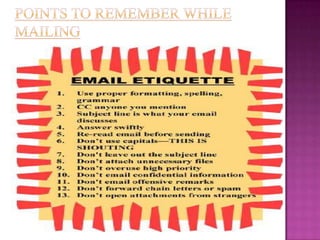
Use Descriptive And Meaningful Subject Line
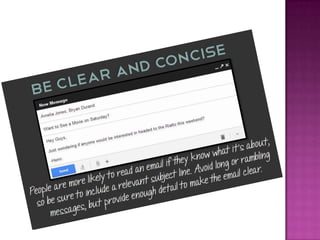
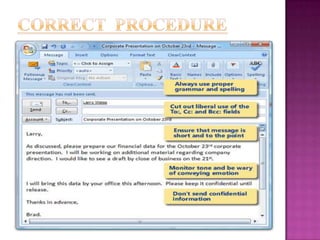
 Write Clear And Concise Message
 Scan Attachments
 Avoid Using Emoticons
 Avoid Sending Forwards And Inappropriate Jokes
 Use Email Signature
 Respond to Emails in Timely Fashion
 Know When to Email and When to Call
 Be clear and precise
 Don’t use CAPITAL words

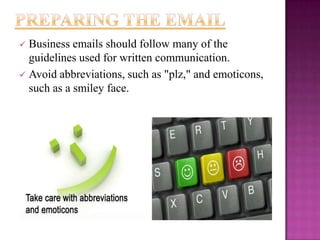
Business emails should follow many of the
guidelines used for written communication.
 Avoid abbreviations, such as "plz," and emoticons,
such as a smiley face.



Capital letters are reserved for emphasis, since
their use is considering yelling in the Internet
culture.



Make emails concise and easy-to-read by writing a
descriptive subject line, utilizing bullet points and
summarizing key points.



Always use proper grammar and spelling.


Think twice before hitting the "send" button. Emails are
a form of communication that can be seen by anybody
down the road.



Only copy people on a need-to-know basis to avoid
overwhelming a user with unnecessary information.



Also remember that sensitive topics are often better
addressed via the phone or in-person.


Email correspondents often expect immediate
responses.



To manage this expectation, create an out-of-office
message with alternate contact information when
you will be unavailable.



Otherwise, answer emails within a reasonable
time-frame. It is helpful to include a phone number
as part of your salutation to enable recipients to
easily connect with you in this manner.


An email sender expects that his address won't be
shared for unapproved purposes, even if it is not
formalized in a privacy policy.



The sender also has a responsibility to not include
sensitive information, such as credit card
information, that might be inappropriately used by
an unintended party.


Emails transmitted at work are subject to the
company's policies.



It is usually unacceptable to send jokes and chain
emails.



Limit personal email correspondence and use a
professional email address if you get to choose
one.
http://www.moocsengine.com
http://www.facebook.com/moocsengineonline
Presentation on e mail ettiquetes

Presentation on e mail ettiquetes

  • 2.
     Gone are thedays when business dealings were primarily handled in-person or over the phone; email is the preferred method of communicating in today's business environments.  Email communication gives businesses a quick way to send messages to clients and colleagues.  When conducting business via email, it's important for users to exercise etiquette
  • 3.
    Use Descriptive AndMeaningful Subject Line  Write Clear And Concise Message  Scan Attachments  Avoid Using Emoticons  Avoid Sending Forwards And Inappropriate Jokes  Use Email Signature  Respond to Emails in Timely Fashion  Know When to Email and When to Call  Be clear and precise  Don’t use CAPITAL words 
  • 8.
    Business emails shouldfollow many of the guidelines used for written communication.  Avoid abbreviations, such as "plz," and emoticons, such as a smiley face. 
  • 9.
     Capital letters arereserved for emphasis, since their use is considering yelling in the Internet culture.  Make emails concise and easy-to-read by writing a descriptive subject line, utilizing bullet points and summarizing key points.  Always use proper grammar and spelling.
  • 10.
     Think twice beforehitting the "send" button. Emails are a form of communication that can be seen by anybody down the road.  Only copy people on a need-to-know basis to avoid overwhelming a user with unnecessary information.  Also remember that sensitive topics are often better addressed via the phone or in-person.
  • 11.
     Email correspondents oftenexpect immediate responses.  To manage this expectation, create an out-of-office message with alternate contact information when you will be unavailable.  Otherwise, answer emails within a reasonable time-frame. It is helpful to include a phone number as part of your salutation to enable recipients to easily connect with you in this manner.
  • 12.
     An email senderexpects that his address won't be shared for unapproved purposes, even if it is not formalized in a privacy policy.  The sender also has a responsibility to not include sensitive information, such as credit card information, that might be inappropriately used by an unintended party.
  • 13.
     Emails transmitted atwork are subject to the company's policies.  It is usually unacceptable to send jokes and chain emails.  Limit personal email correspondence and use a professional email address if you get to choose one.
  • 15.