Na#ve	
  OSGi
Modular	
  So1ware	
  Development	
  in	
  a	
  Na#ve	
  World
Alexander	
  Broekhuis	
  
alexander.broekhuis@luminis.eu
Sascha	
  Zelzer
s.zelzer@dkfz-­‐heidelberg.de
Agenda
• Introduc#on
• Mo#va#on
• History
• Current	
  State
• Na#ve	
  OSGi
• Outlook
Alexander	
  Broekhuis
• So1ware	
  Developer
• Started	
  as	
  a	
  Java	
  Engineer
• Programming	
  C	
  since	
  2010
• At	
  Luminis	
  since	
  2008
• So1ware	
  House
• Research	
  and	
  innova#on	
  oriented
• Involved	
  in	
  Open	
  Source	
  (Apache)
• Apache	
  commiXer	
  since	
  2010
Sascha	
  Zelzer
• So1ware	
  Developer
• 15	
  years	
  of	
  experience	
  with	
  Java,	
  Eclipse,	
  C++
• Current	
  focus	
  on	
  modular	
  C++	
  systems
• For	
  research	
  environments
• Since	
  2005	
  at	
  the	
  German	
  Cancer	
  Research	
  
Center	
  (DKFZ)
• Large	
  mul#-­‐disciplinary	
  research	
  environment
• Mainly	
  cancer	
  research	
  and	
  medical	
  imaging
• Long	
  open-­‐source	
  history	
  within	
  the	
  department
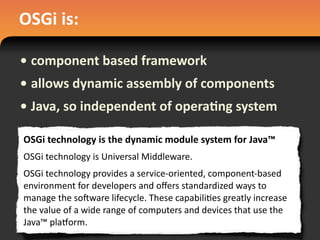
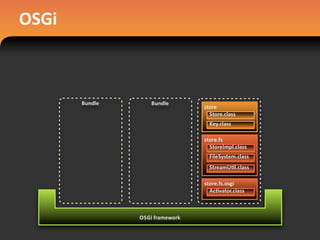
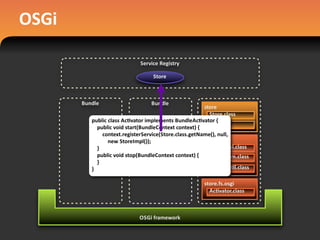
OSGi	
  is:
• component	
  based	
  framework
• allows	
  dynamic	
  assembly	
  of	
  components
• Java,	
  so	
  independent	
  of	
  opera#ng	
  system
OSGi	
  technology	
  is	
  the	
  dynamic	
  module	
  system	
  for	
  Java™
OSGi	
  technology	
  is	
  Universal	
  Middleware.
OSGi	
  technology	
  provides	
  a	
  service-­‐oriented,	
  component-­‐based	
  
environment	
  for	
  developers	
  and	
  offers	
  standardized	
  ways	
  to	
  
manage	
  the	
  so@ware	
  lifecycle.	
  These	
  capabiliBes	
  greatly	
  increase	
  
the	
  value	
  of	
  a	
  wide	
  range	
  of	
  computers	
  and	
  devices	
  that	
  use	
  the	
  
Java™	
  plaForm.
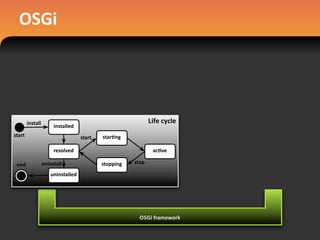
OSGi
!"#$%&'()*+,'-
!"#$%&'&($
)*+,*
$-.
)*+,/-0)*+,*
)*122"-0 )*12
+&/3$,$)1(3$.
4-"-)*+(($.
4-"-)*+((
"-)*+(($.
"-)*+((
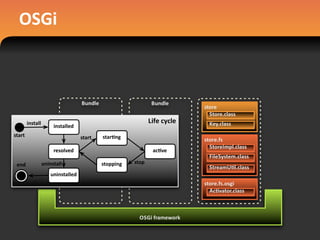
OSGi
!"#$%
&"#$%'()*!!
+%,'()*!!
!"#$%&'!
("#$%)*+,&-,.!!
/0,%(1!"%*&-,.!!
("$%.*23,&-,.!!
!"#$%&'!&#!()
*+,-."#$&+/.!!
!"#$%&!"#$%&
!"#$%&'()*+,'-
!"#$%&'&($
)*+,*
$-.
)*+,/-0)*+,*
)*122"-0 )*12
+&/3$,$)1(3$.
4-"-)*+(($.
4-"-)*+((
"-)*+(($.
"-)*+((
OSGi
!"#$%
&"#$%'()*!!
+%,'()*!!
!"#$%&'!
("#$%)*+,&-,.!!
/0,%(1!"%*&-,.!!
("$%.*23,&-,.!!
!"#$%&'!&#!()
*+,-."#$&+/.!!
!"#$%&!"#$%&
!"#$%&'()*+,'-
OSGi
!"#$%
&"#$%'()*!!
+%,'()*!!
!"#$%&'!
("#$%)*+,&-,.!!
/0,%(1!"%*&-,.!!
("$%.*23,&-,.!!
!"#$%&'!&#!()
*+,-."#$&+/.!!
!"#$%&!"#$%&
!"#$%&'()*+,'-
!"#$%&'&$())'*&+,(-./'%0!$1012-)'3"24$1*&+,(-./'5
''''!"#$%&',.%4')-(/-63"24$17.2-18-'&.2-18-9'5
''''''''&.2-18-:/1;%)-1/<1/,%&16<-./1:&$()):;1-=(0169>'2"$$>'
''''''''''''21?'<-./1@0!$699A
''''B
''''!"#$%&',.%4')-.!63"24$17.2-18-'&.2-18-9'5
''''B
B
!"#$%&"'(")%*+#,
!+-#"
Benefits
• Making	
  products	
  with	
  many	
  varia#ons
• Improving	
  quality	
  through	
  re-­‐use
• Speed:	
  #me	
  to	
  market
Na#ve	
  OSGi
"The	
  Na#ve	
  OSGi	
  project	
  is	
  a	
  collabora#ve	
  
effort	
  to	
  write,	
  test,	
  and	
  implement	
  the	
  Java	
  
OSGi	
  specifica#ons	
  in	
  C	
  and	
  C++	
  with	
  a	
  focus	
  
on	
  interoperability	
  between	
  C,	
  C++	
  and	
  Java"
Mo#va#on	
  -­‐	
  Why?
• C	
  and	
  C++	
  are	
  NOT	
  obsolete
• C++11	
  is	
  a	
  big	
  step	
  forward
• Tradi#onal	
  Applica#on	
  Domains
• Embedded	
  Devices
• Medical	
  Imaging
• Sensor	
  Networks
• Lightweight	
  Na#ve	
  Module	
  System
• Benefits	
  na#ve	
  developers
C/C++	
  Modulariza#on
• Examples
• CORBA	
  and	
  CCM:	
  Portable,	
  heavy-­‐weight
• Service	
  Component	
  Architecture	
  (SCA)
• Problems
• Find	
  a	
  C/C++	
  implementa#on	
  with	
  an	
  appropriate	
  
license
• Scope	
  can	
  be	
  too	
  broad/overwhelming
Benefits
• Mature	
  API
• OSGi	
  is	
  around	
  since	
  1999
• Core	
  Specifica#ons	
  are	
  small
• Enables	
  hybrid	
  Java/C/C++	
  solu#ons
• as	
  an	
  alterna#ve	
  to	
  JNI
• Eases	
  migra#on
• From	
  Na#ve	
  to	
  Java
• Embedded	
  Performance
Challenges
• Dynamic	
  Module	
  Layer
• Code	
  Sharing
• Linking	
  and	
  Versioning
• Different	
  Plajorms
• Posix/Win32/...
History	
  -­‐	
  Universal	
  OSGi
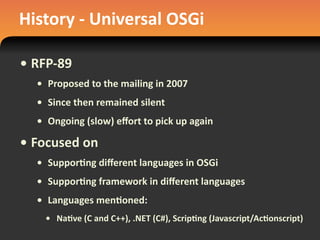
• RFP-­‐89
• Proposed	
  to	
  the	
  mailing	
  in	
  2007
• Since	
  then	
  remained	
  silent
• Ongoing	
  (slow)	
  effort	
  to	
  pick	
  up	
  again
• Focused	
  on
• Suppor#ng	
  different	
  languages	
  in	
  OSGi
• Suppor#ng	
  framework	
  in	
  different	
  languages
• Languages	
  men#oned:	
  
• Na#ve	
  (C	
  and	
  C++),	
  .NET	
  (C#),	
  Scrip#ng	
  (Javascript/Ac#onscript)
History	
  -­‐	
  Universal	
  OSGi
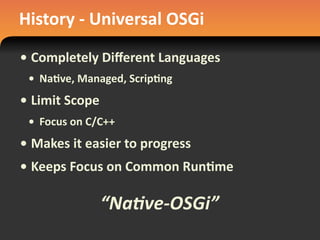
• Completely	
  Different	
  Languages
• Na#ve,	
  Managed,	
  Scrip#ng
• Limit	
  Scope
• Focus	
  on	
  C/C++
• Makes	
  it	
  easier	
  to	
  progress
• Keeps	
  Focus	
  on	
  Common	
  Run#me
“Na$ve-­‐OSGi”
Current	
  State
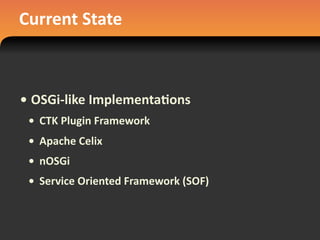
• OSGi-­‐like	
  Implementa#ons
• CTK	
  Plugin	
  Framework
• Apache	
  Celix
• nOSGi
• Service	
  Oriented	
  Framework	
  (SOF)
Current	
  State
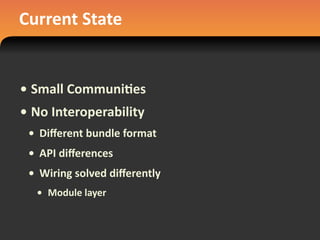
• Small	
  Communi#es
• No	
  Interoperability
• Different	
  bundle	
  format
• API	
  differences
• Wiring	
  solved	
  differently
• Module	
  layer
CTK	
  Plugin	
  Framework
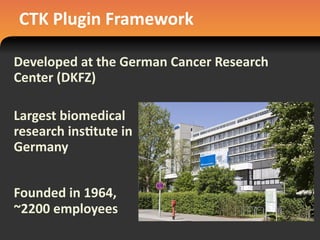
Largest	
  biomedical	
  
research	
  ins#tute	
  in	
  
Germany
Founded	
  in	
  1964,	
  
~2200	
  employees
Developed	
  at	
  the	
  German	
  Cancer	
  Research	
  
Center	
  (DKFZ)
CTK	
  Plugin	
  Framework
• Part	
  of	
  “Common	
  Toolkit”
• Large	
  interna#onal	
  ini#a#ve	
  (medical	
  imaging)
• C++	
  API	
  is	
  very	
  close	
  to	
  the	
  OSGi	
  Specifica#on
• Provides	
  Implementa#ons
• Log
• Configura#on	
  Admin
• Metatype
• Event	
  Admin
• Runs	
  on:	
  Windows,	
  Linux,	
  MacOS
CTK	
  Plugin	
  Framework
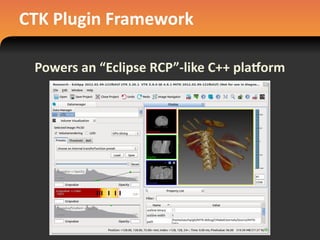
Powers	
  an	
  “Eclipse	
  RCP”-­‐like	
  C++	
  plajorm
Apache	
  Celix
• Development	
  started	
  at	
  Thales	
  Netherlands
• Open	
  Sourced	
  /	
  Donated	
  by	
  Luminis	
  to	
  Apache
• Embedded	
  distributed	
  systems
• Dynamic	
  (Re)Configura#on
• Used	
  as	
  middleware	
  in	
  large	
  research	
  project
Apache	
  Celix
• Implemented	
  in	
  C
• API	
  close	
  to	
  the	
  specifica#on
• Adapted	
  to	
  Non-­‐Object	
  Oriented	
  use
• Donated	
  to	
  the	
  Apache	
  Incubator
• Provides
• Log	
  Service	


  Remote	
  Service	
  Admin
• Devices	
  Access	


  Deployment	
  Admin
• Shell
nOSGi
• Research	
  project	
  at	
  University	
  of	
  Ulm
• Steffen	
  Kächele
• Very	
  lightweight	
  and	
  fast	
  implementa#on	
  
(only	
  requires	
  c++	
  run#me	
  and	
  unzip)
• Runs	
  on	
  POSIX	
  systems
• Features
• Wiring	
  of	
  shared	
  objects	
  for	
  code-­‐sharing
• Service	
  registry	
  with	
  filters
• Supports	
  source	
  bundles	
  (compiled	
  at	
  run#me)
• Comes	
  with	
  a	
  Shell	
  implementa#on
Service	
  Oriented	
  Framework	
  (SOF)
• Mature	
  open-­‐source	
  project	
  (BSD)
• MaXhias	
  Grosam
• Shared	
  libraries	
  model	
  bundles
• Runs	
  on	
  Windows	
  and	
  Linux
• Features
• Service	
  registry,	
  trackers	
  and	
  listeners
• Provides	
  a	
  command	
  shell
• Remo#ng	
  capabili#es	
  (using	
  CORBA)
• Remote	
  services	
  and	
  service	
  listeners
• Command	
  shell	
  for	
  each	
  process
Specifica#on
• Members
• Goal
• Bundle	
  Format
• Module	
  Layer
• Life	
  Cycle	
  Layer
• Service	
  Layer
• C	
  and	
  C++	
  Interoperability
Members
• CTK	
  Plugin	
  Framework
• Apache	
  Celix
• nOSGi
Ini#al/startup	
  mee#ng	
  took	
  place	
  in	
  Hengelo	
  in	
  
May	
  this	
  year
Goal
• Follow	
  OSGi	
  Specifica#on
• Allow	
  Interoperability
• Bundles
• Remote	
  Services
• Seamless	
  C	
  and	
  C++	
  Interoperability
• E.g.	
  provide	
  a	
  C	
  service,	
  consume	
  via	
  C++	
  interface
Goal
• Grow	
  Communi#es
• Combine	
  where	
  possible
• Channel	
  efforts
• Write	
  Open	
  Source	
  reference
• All	
  feedback	
  is	
  welcome!
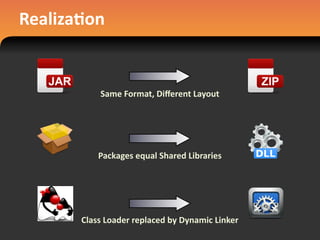
Realiza#on
Same	
  Format,	
  Different	
  Layout
Packages	
  equal	
  Shared	
  Libraries
Class	
  Loader	
  replaced	
  by	
  Dynamic	
  Linker
Bundle	
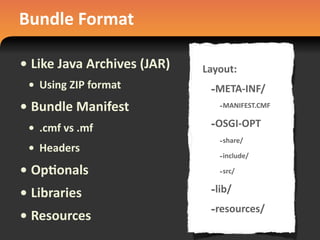
  Format
• Like	
  Java	
  Archives	
  (JAR)
• Using	
  ZIP	
  format
• Bundle	
  Manifest
• .cmf	
  vs	
  .mf
• Headers
• Op#onals
• Libraries
• Resources
Layout:
-­‐META-­‐INF/
-­‐MANIFEST.CMF
-­‐OSGI-­‐OPT
-­‐share/
-­‐include/
-­‐src/
-­‐lib/
-­‐resources/
Module	
  Layer
• Shared	
  Libraries	
  model	
  Java	
  Packages
• Allows	
  Code	
  Sharing
• Mul#ple	
  Libraries	
  per	
  Bundle
• Symbols	
  must	
  be	
  exported	
  explicitly
• Addi#onal	
  visibility	
  control
• Symbol	
  Searching	
  Handled	
  by	
  Linker
• Meta-­‐data
• Import/Export	
  Headers
• Execu#on	
  Environment	
  for	
  Addi#onal	
  Requirements
“Package”	
  Wiring
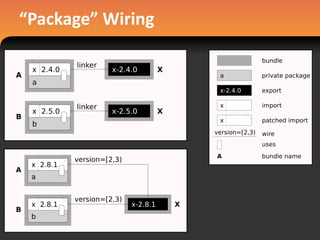
• Mechanism	
  from	
  nOSGi
• Library	
  Dependencies	
  Patched	
  at	
  Run#me
• To	
  match	
  with	
  available	
  exports
• Allows	
  Mul#ple	
  Versions
• Of	
  the	
  same	
  package
• Allows	
  Bundle	
  Updates
“Package”	
  Wiring
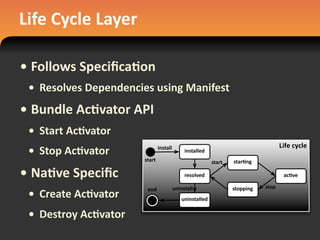
Life	
  Cycle	
  Layer
• Follows	
  Specifica#on
• Resolves	
  Dependencies	
  using	
  Manifest
• Bundle	
  Ac#vator	
  API
• Start	
  Ac#vator
• Stop	
  Ac#vator
• Na#ve	
  Specific
• Create	
  Ac#vator
• Destroy	
  Ac#vator
!"#$%&'&($
)*+,*
$-.
)*+,/-0)*+,*
)*122"-0 )*12
+&/3$,$)1(3$.
4-"-)*+(($.
4-"-)*+((
"-)*+(($.
"-)*+((
Service	
  Layer
• Na#ve	
  API	
  Close	
  to	
  the	
  Specifica#on
• Especially	
  C++
• C	
  API	
  is	
  adapted	
  to	
  Non-­‐Object	
  Oriented	
  use
• Requirements	
  for	
  C++
• Be	
  Type-­‐Safe
• Avoid	
  exposing	
  void*	
  where	
  possible
• Do	
  not	
  require	
  a	
  Service	
  base	
  class
• Allow	
  mul#ple	
  inheritance	
  of	
  Service	
  interfaces
Service	
  Layer
• Requirements	
  for	
  C
• Use	
  Struct	
  with	
  Func#on	
  pointers	
  for	
  Services
• Components	
  are	
  represented	
  as	
  void*
• Return	
  value	
  only	
  used	
  for	
  error	
  codes
• Return	
  values	
  via	
  arguments
C	
  /	
  C++	
  Interoperability
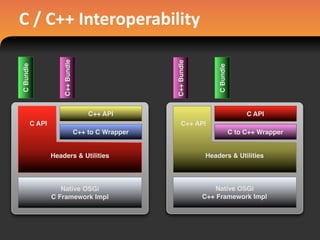
• Na#ve-­‐OSGi
• Provides	
  both	
  C	
  and	
  C++	
  headers
• Provide	
  thin	
  bi-­‐direc#onal	
  wrapping
• Service	
  Interfaces
• Should	
  provide	
  C	
  and	
  C++
• C++	
  Services	
  implemented	
  using	
  Interfaces
• C	
  Services	
  implemented	
  using	
  Structs	
  and	
  Func#on	
  
Pointers
C	
  /	
  C++	
  Interoperability
• Service	
  Interfaces
• Provide	
  bindings	
  for	
  C	
  -­‐>	
  C++	
  and	
  C++	
  -­‐>	
  C
• IDL	
  for	
  Service	
  descrip#on	
  and	
  code	
  genera#on
• Service	
  Provider
• Implement	
  either	
  the	
  C	
  or	
  C++	
  header
• Service	
  Consumer
• Use	
  either	
  the	
  C	
  or	
  C++	
  API
C	
  /	
  C++	
  Interoperability
Native OSGi
C Framework Impl
C API
Headers & Utilities
C++ to C Wrapper
C++ API
CBundle
C++Bundle
C++Bundle
Native OSGi
C++ Framework Impl
C++ API
Headers & Utilities
C to C++ Wrapper
C API
CBundle
Code	
  Examples	
  -­‐	
  Interface	
  Declara#on
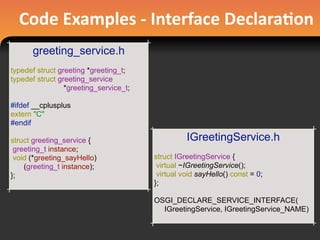
greeting_service.h
typedef struct greeting *greeting_t;
typedef struct greeting_service
*greeting_service_t;
#ifdef __cplusplus
extern "C"
#endif
struct greeting_service {
greeting_t instance;
void (*greeting_sayHello)
(greeting_t instance);
};
IGreetingService.h
struct IGreetingService {
virtual ~IGreetingService();
virtual void sayHello() const = 0;
};
OSGI_DECLARE_SERVICE_INTERFACE(
IGreetingService, IGreetingService_NAME)
Code	
  Examples	
  -­‐	
  Service	
  Registra#on
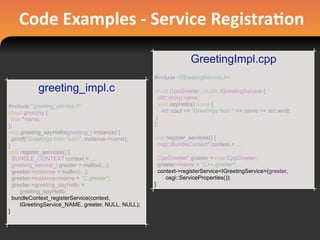
greeting_impl.c
#include "greeting_service.h"
struct greeting {
char *name;
};
void greeting_sayHello(greeting_t instance) {
printf("Greetings from %sn", instance->name);
}
void register_services() {
BUNDLE_CONTEXT context = ...
greeting_service_t greeter = malloc(...);
greeter->instance = malloc(...);
greeter->instance->name = "C greeter";
greeter->greeting_sayHello =
greeting_sayHello;
bundleContext_registerService(context,
IGreetingService_NAME, greeter, NULL, NULL);
}
GreetingImpl.cpp
#include <IGreetingService.h>
struct CppGreeter : public IGreetingService {
std::string name;
void sayHello() const {
std::cout << "Greetings from " << name << std::endl;
}
};
void register_services() {
osgi::BundleContext* context = ...
CppGreeter* greeter = new CppGreeter;
greeter->name = "C++ greeter";
context->registerService<IGreetingService>(greeter,
osgi::ServiceProperties());
}
Code	
  Examples	
  -­‐	
  Service	
  Consump#on
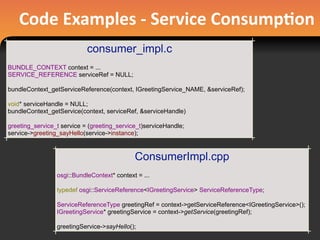
consumer_impl.c
BUNDLE_CONTEXT context = ...
SERVICE_REFERENCE serviceRef = NULL;
bundleContext_getServiceReference(context, IGreetingService_NAME, &serviceRef);
void* serviceHandle = NULL;
bundleContext_getService(context, serviceRef, &serviceHandle)
greeting_service_t service = (greeting_service_t)serviceHandle;
service->greeting_sayHello(service->instance);
ConsumerImpl.cpp
osgi::BundleContext* context = ...
typedef osgi::ServiceReference<IGreetingService> ServiceReferenceType;
ServiceReferenceType greetingRef = context->getServiceReference<IGreetingService>();
IGreetingService* greetingService = context->getService(greetingRef);
greetingService->sayHello();
Outlook
• Write	
  Specifica#on
• Test	
  ideas/solu#ons
• As	
  part	
  of	
  the	
  OSGi	
  Alliance
• Define	
  Reference	
  Implementa#on
• Look	
  into	
  Compendium	
  Services
• Remote	
  Service	
  as	
  alterna#ve	
  to	
  JNI
• Adapt	
  other	
  Services	
  to	
  Na#ve-­‐OSGi
• Community!
Resources
• Na#ve-­‐OSGi:	
  www.na#veosgi.org
• Apache	
  Celix:	
  
• incubator.apache.org/celix
• CTK	
  Plugin	
  Framework:	
  
• www.commontk.org/index.php/Documenta#on/Plugin_Framework
• nOSGi:
• www.uni-­‐ulm.de/in/vs/proj/nosgi/
• SOF:
• sof.#ddlyspot.com/

Native OSGi, Modular Software Development in a Native World - Alexander Broekhuis, Sascha Zelzer

  • 1.
    Na#ve  OSGi Modular  So1ware  Development  in  a  Na#ve  World Alexander  Broekhuis   alexander.broekhuis@luminis.eu Sascha  Zelzer s.zelzer@dkfz-­‐heidelberg.de
  • 2.
    Agenda • Introduc#on • Mo#va#on •History • Current  State • Na#ve  OSGi • Outlook
  • 3.
    Alexander  Broekhuis • So1ware  Developer • Started  as  a  Java  Engineer • Programming  C  since  2010 • At  Luminis  since  2008 • So1ware  House • Research  and  innova#on  oriented • Involved  in  Open  Source  (Apache) • Apache  commiXer  since  2010
  • 4.
    Sascha  Zelzer • So1ware  Developer • 15  years  of  experience  with  Java,  Eclipse,  C++ • Current  focus  on  modular  C++  systems • For  research  environments • Since  2005  at  the  German  Cancer  Research   Center  (DKFZ) • Large  mul#-­‐disciplinary  research  environment • Mainly  cancer  research  and  medical  imaging • Long  open-­‐source  history  within  the  department
  • 5.
    OSGi  is: • component  based  framework • allows  dynamic  assembly  of  components • Java,  so  independent  of  opera#ng  system OSGi  technology  is  the  dynamic  module  system  for  Java™ OSGi  technology  is  Universal  Middleware. OSGi  technology  provides  a  service-­‐oriented,  component-­‐based   environment  for  developers  and  offers  standardized  ways  to   manage  the  so@ware  lifecycle.  These  capabiliBes  greatly  increase   the  value  of  a  wide  range  of  computers  and  devices  that  use  the   Java™  plaForm.
  • 6.
  • 7.
  • 8.
  • 9.
  • 10.
    Benefits • Making  products  with  many  varia#ons • Improving  quality  through  re-­‐use • Speed:  #me  to  market
  • 11.
    Na#ve  OSGi "The  Na#ve  OSGi  project  is  a  collabora#ve   effort  to  write,  test,  and  implement  the  Java   OSGi  specifica#ons  in  C  and  C++  with  a  focus   on  interoperability  between  C,  C++  and  Java"
  • 12.
    Mo#va#on  -­‐  Why? •C  and  C++  are  NOT  obsolete • C++11  is  a  big  step  forward • Tradi#onal  Applica#on  Domains • Embedded  Devices • Medical  Imaging • Sensor  Networks • Lightweight  Na#ve  Module  System • Benefits  na#ve  developers
  • 13.
    C/C++  Modulariza#on • Examples •CORBA  and  CCM:  Portable,  heavy-­‐weight • Service  Component  Architecture  (SCA) • Problems • Find  a  C/C++  implementa#on  with  an  appropriate   license • Scope  can  be  too  broad/overwhelming
  • 14.
    Benefits • Mature  API •OSGi  is  around  since  1999 • Core  Specifica#ons  are  small • Enables  hybrid  Java/C/C++  solu#ons • as  an  alterna#ve  to  JNI • Eases  migra#on • From  Na#ve  to  Java • Embedded  Performance
  • 15.
    Challenges • Dynamic  Module  Layer • Code  Sharing • Linking  and  Versioning • Different  Plajorms • Posix/Win32/...
  • 16.
    History  -­‐  Universal  OSGi • RFP-­‐89 • Proposed  to  the  mailing  in  2007 • Since  then  remained  silent • Ongoing  (slow)  effort  to  pick  up  again • Focused  on • Suppor#ng  different  languages  in  OSGi • Suppor#ng  framework  in  different  languages • Languages  men#oned:   • Na#ve  (C  and  C++),  .NET  (C#),  Scrip#ng  (Javascript/Ac#onscript)
  • 17.
    History  -­‐  Universal  OSGi • Completely  Different  Languages • Na#ve,  Managed,  Scrip#ng • Limit  Scope • Focus  on  C/C++ • Makes  it  easier  to  progress • Keeps  Focus  on  Common  Run#me “Na$ve-­‐OSGi”
  • 18.
    Current  State • OSGi-­‐like  Implementa#ons • CTK  Plugin  Framework • Apache  Celix • nOSGi • Service  Oriented  Framework  (SOF)
  • 19.
    Current  State • Small  Communi#es • No  Interoperability • Different  bundle  format • API  differences • Wiring  solved  differently • Module  layer
  • 20.
    CTK  Plugin  Framework Largest  biomedical   research  ins#tute  in   Germany Founded  in  1964,   ~2200  employees Developed  at  the  German  Cancer  Research   Center  (DKFZ)
  • 21.
    CTK  Plugin  Framework •Part  of  “Common  Toolkit” • Large  interna#onal  ini#a#ve  (medical  imaging) • C++  API  is  very  close  to  the  OSGi  Specifica#on • Provides  Implementa#ons • Log • Configura#on  Admin • Metatype • Event  Admin • Runs  on:  Windows,  Linux,  MacOS
  • 22.
    CTK  Plugin  Framework Powers  an  “Eclipse  RCP”-­‐like  C++  plajorm
  • 23.
    Apache  Celix • Development  started  at  Thales  Netherlands • Open  Sourced  /  Donated  by  Luminis  to  Apache • Embedded  distributed  systems • Dynamic  (Re)Configura#on • Used  as  middleware  in  large  research  project
  • 24.
    Apache  Celix • Implemented  in  C • API  close  to  the  specifica#on • Adapted  to  Non-­‐Object  Oriented  use • Donated  to  the  Apache  Incubator • Provides • Log  Service                                Remote  Service  Admin • Devices  Access                  Deployment  Admin • Shell
  • 25.
    nOSGi • Research  project  at  University  of  Ulm • Steffen  Kächele • Very  lightweight  and  fast  implementa#on   (only  requires  c++  run#me  and  unzip) • Runs  on  POSIX  systems • Features • Wiring  of  shared  objects  for  code-­‐sharing • Service  registry  with  filters • Supports  source  bundles  (compiled  at  run#me) • Comes  with  a  Shell  implementa#on
  • 26.
    Service  Oriented  Framework  (SOF) • Mature  open-­‐source  project  (BSD) • MaXhias  Grosam • Shared  libraries  model  bundles • Runs  on  Windows  and  Linux • Features • Service  registry,  trackers  and  listeners • Provides  a  command  shell • Remo#ng  capabili#es  (using  CORBA) • Remote  services  and  service  listeners • Command  shell  for  each  process
  • 27.
    Specifica#on • Members • Goal •Bundle  Format • Module  Layer • Life  Cycle  Layer • Service  Layer • C  and  C++  Interoperability
  • 28.
    Members • CTK  Plugin  Framework • Apache  Celix • nOSGi Ini#al/startup  mee#ng  took  place  in  Hengelo  in   May  this  year
  • 29.
    Goal • Follow  OSGi  Specifica#on • Allow  Interoperability • Bundles • Remote  Services • Seamless  C  and  C++  Interoperability • E.g.  provide  a  C  service,  consume  via  C++  interface
  • 30.
    Goal • Grow  Communi#es •Combine  where  possible • Channel  efforts • Write  Open  Source  reference • All  feedback  is  welcome!
  • 31.
    Realiza#on Same  Format,  Different  Layout Packages  equal  Shared  Libraries Class  Loader  replaced  by  Dynamic  Linker
  • 32.
    Bundle  Format • Like  Java  Archives  (JAR) • Using  ZIP  format • Bundle  Manifest • .cmf  vs  .mf • Headers • Op#onals • Libraries • Resources Layout: -­‐META-­‐INF/ -­‐MANIFEST.CMF -­‐OSGI-­‐OPT -­‐share/ -­‐include/ -­‐src/ -­‐lib/ -­‐resources/
  • 33.
    Module  Layer • Shared  Libraries  model  Java  Packages • Allows  Code  Sharing • Mul#ple  Libraries  per  Bundle • Symbols  must  be  exported  explicitly • Addi#onal  visibility  control • Symbol  Searching  Handled  by  Linker • Meta-­‐data • Import/Export  Headers • Execu#on  Environment  for  Addi#onal  Requirements
  • 34.
    “Package”  Wiring • Mechanism  from  nOSGi • Library  Dependencies  Patched  at  Run#me • To  match  with  available  exports • Allows  Mul#ple  Versions • Of  the  same  package • Allows  Bundle  Updates
  • 35.
  • 36.
    Life  Cycle  Layer •Follows  Specifica#on • Resolves  Dependencies  using  Manifest • Bundle  Ac#vator  API • Start  Ac#vator • Stop  Ac#vator • Na#ve  Specific • Create  Ac#vator • Destroy  Ac#vator !"#$%&'&($ )*+,* $-. )*+,/-0)*+,* )*122"-0 )*12 +&/3$,$)1(3$. 4-"-)*+(($. 4-"-)*+(( "-)*+(($. "-)*+((
  • 37.
    Service  Layer • Na#ve  API  Close  to  the  Specifica#on • Especially  C++ • C  API  is  adapted  to  Non-­‐Object  Oriented  use • Requirements  for  C++ • Be  Type-­‐Safe • Avoid  exposing  void*  where  possible • Do  not  require  a  Service  base  class • Allow  mul#ple  inheritance  of  Service  interfaces
  • 38.
    Service  Layer • Requirements  for  C • Use  Struct  with  Func#on  pointers  for  Services • Components  are  represented  as  void* • Return  value  only  used  for  error  codes • Return  values  via  arguments
  • 39.
    C  /  C++  Interoperability • Na#ve-­‐OSGi • Provides  both  C  and  C++  headers • Provide  thin  bi-­‐direc#onal  wrapping • Service  Interfaces • Should  provide  C  and  C++ • C++  Services  implemented  using  Interfaces • C  Services  implemented  using  Structs  and  Func#on   Pointers
  • 40.
    C  /  C++  Interoperability • Service  Interfaces • Provide  bindings  for  C  -­‐>  C++  and  C++  -­‐>  C • IDL  for  Service  descrip#on  and  code  genera#on • Service  Provider • Implement  either  the  C  or  C++  header • Service  Consumer • Use  either  the  C  or  C++  API
  • 41.
    C  /  C++  Interoperability Native OSGi C Framework Impl C API Headers & Utilities C++ to C Wrapper C++ API CBundle C++Bundle C++Bundle Native OSGi C++ Framework Impl C++ API Headers & Utilities C to C++ Wrapper C API CBundle
  • 42.
    Code  Examples  -­‐  Interface  Declara#on greeting_service.h typedef struct greeting *greeting_t; typedef struct greeting_service *greeting_service_t; #ifdef __cplusplus extern "C" #endif struct greeting_service { greeting_t instance; void (*greeting_sayHello) (greeting_t instance); }; IGreetingService.h struct IGreetingService { virtual ~IGreetingService(); virtual void sayHello() const = 0; }; OSGI_DECLARE_SERVICE_INTERFACE( IGreetingService, IGreetingService_NAME)
  • 43.
    Code  Examples  -­‐  Service  Registra#on greeting_impl.c #include "greeting_service.h" struct greeting { char *name; }; void greeting_sayHello(greeting_t instance) { printf("Greetings from %sn", instance->name); } void register_services() { BUNDLE_CONTEXT context = ... greeting_service_t greeter = malloc(...); greeter->instance = malloc(...); greeter->instance->name = "C greeter"; greeter->greeting_sayHello = greeting_sayHello; bundleContext_registerService(context, IGreetingService_NAME, greeter, NULL, NULL); } GreetingImpl.cpp #include <IGreetingService.h> struct CppGreeter : public IGreetingService { std::string name; void sayHello() const { std::cout << "Greetings from " << name << std::endl; } }; void register_services() { osgi::BundleContext* context = ... CppGreeter* greeter = new CppGreeter; greeter->name = "C++ greeter"; context->registerService<IGreetingService>(greeter, osgi::ServiceProperties()); }
  • 44.
    Code  Examples  -­‐  Service  Consump#on consumer_impl.c BUNDLE_CONTEXT context = ... SERVICE_REFERENCE serviceRef = NULL; bundleContext_getServiceReference(context, IGreetingService_NAME, &serviceRef); void* serviceHandle = NULL; bundleContext_getService(context, serviceRef, &serviceHandle) greeting_service_t service = (greeting_service_t)serviceHandle; service->greeting_sayHello(service->instance); ConsumerImpl.cpp osgi::BundleContext* context = ... typedef osgi::ServiceReference<IGreetingService> ServiceReferenceType; ServiceReferenceType greetingRef = context->getServiceReference<IGreetingService>(); IGreetingService* greetingService = context->getService(greetingRef); greetingService->sayHello();
  • 45.
    Outlook • Write  Specifica#on •Test  ideas/solu#ons • As  part  of  the  OSGi  Alliance • Define  Reference  Implementa#on • Look  into  Compendium  Services • Remote  Service  as  alterna#ve  to  JNI • Adapt  other  Services  to  Na#ve-­‐OSGi • Community!
  • 46.
    Resources • Na#ve-­‐OSGi:  www.na#veosgi.org •Apache  Celix:   • incubator.apache.org/celix • CTK  Plugin  Framework:   • www.commontk.org/index.php/Documenta#on/Plugin_Framework • nOSGi: • www.uni-­‐ulm.de/in/vs/proj/nosgi/ • SOF: • sof.#ddlyspot.com/