Spring Framework 4.0 to 4.1
Sam Brannen
@sam_brannen
AJUG | Atlanta, GA, USA | April 22, 2014
Atlanta User Group
2
Sam Brannen
•  Spring and Java Consultant @ Swiftmind
•  Georgia Tech College of Computing Alumnus
•  Java Developer for over 15 years
•  Spring Framework Core Committer since 2007
•  Spring Trainer
•  Speaker on Spring, Java, OSGi, and testing
•  Swiss Spring User Group Lead
3
Swiftmind
Your experts for Enterprise Java
Areas of expertise
•  Spring *
•  Java EE
•  OSGi
•  Software Architecture
•  Software Engineering Best Practices
Where you find us
•  Zurich, Switzerland
•  @swiftmind
•  http://www.swiftmind.com
4
A Show of Hands…
5
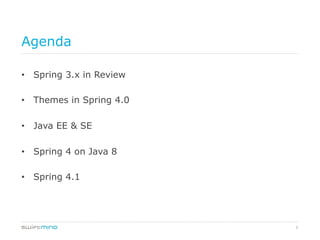
Agenda
•  Spring 3.x in Review
•  Themes in Spring 4.0
•  Java EE & SE
•  Spring 4 on Java 8
•  Spring 4.1
6
Spring 3.x in Review
7
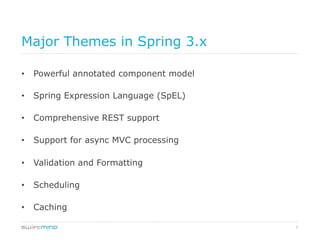
Major Themes in Spring 3.x
•  Powerful annotated component model
•  Spring Expression Language (SpEL)
•  Comprehensive REST support
•  Support for async MVC processing
•  Validation and Formatting
•  Scheduling
•  Caching
8
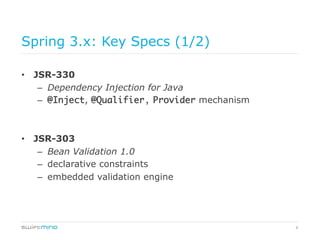
Spring 3.x: Key Specs (1/2)
•  JSR-330
–  Dependency Injection for Java
–  @Inject, @Qualifier, Provider mechanism
•  JSR-303
–  Bean Validation 1.0
–  declarative constraints
–  embedded validation engine
9
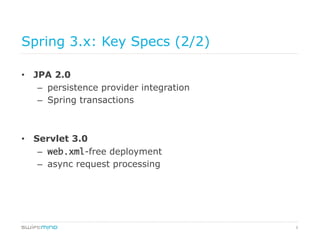
Spring 3.x: Key Specs (2/2)
•  JPA 2.0
–  persistence provider integration
–  Spring transactions
•  Servlet 3.0
–  web.xml-free deployment
–  async request processing
10
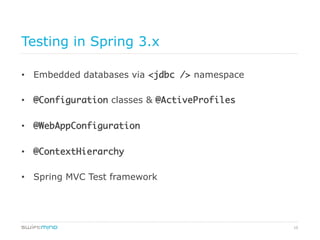
Testing in Spring 3.x
•  Embedded databases via <jdbc /> namespace
•  @Configuration classes & @ActiveProfiles	
•  @WebAppConfiguration	
•  @ContextHierarchy	
•  Spring MVC Test framework
11
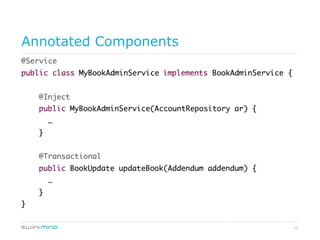
Annotated Components
12
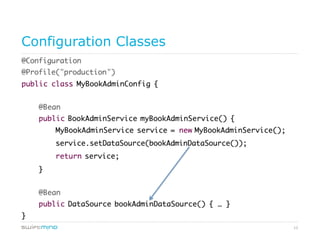
Configuration Classes
13
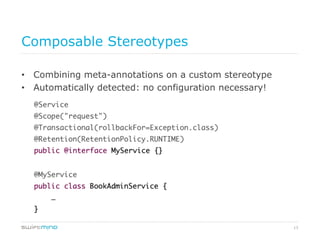
Composable Stereotypes
•  Combining meta-annotations on a custom stereotype
•  Automatically detected: no configuration necessary!
14
Spring 4.0 Themes
15
Ready for New Application Architectures
•  Embedded web servers and non-traditional data stores
•  Lightweight messaging and WebSocket-style architectures
•  Custom asynchronous processing with convenient APIs
16
New Baselines
•  Java SE 6+
•  Java EE 6+
–  Servlet 3.0/3.1 focus
–  Servlet 2.5 compatible
•  All deprecated packages removed
•  Many deprecated methods and fields removed as well
17
Third Party Libraries
•  Minimum versions ~ mid 2010 now
•  For example
–  Hibernate 3.6+
–  Quartz 1.8+
–  Ehcache 2.1+
18
Java 8 Language and API Features
•  Lambda expressions
•  Method references
•  JSR-310 Date and Time
•  Repeatable annotations
•  Parameter name discovery
19
Groovy + Spring 4.0
•  A smooth out-of-the-box experience for Groovy-based
Spring applications
•  AOP adaptations
–  special handling of GroovyObject calls
–  consider a Spring application with all components
written in the Groovy language instead of Java
•  Groovy-based bean definitions
–  formerly known as the Bean Builder in Grails
–  now lives alongside Spring's configuration class model
20
Spring Bean Def’s with Groovy DSL
import org.mypackage.domain.Person;	
beans {	
xmlns util: 'http://www.springframework.org/schema/util'	
person1(Person) {	
name = "homer"	
age = 45	
props = [overweight: true, height: "1.8m"]	
children = ["bart", "lisa"]	
}	
util.list(id: 'foo') {	
value 'one'	
value 'two'	
}	
}
21
Conditional Beans
•  A generalized model for conditional bean definitions
•  A more flexible and more dynamic variant of bean
definition profiles (as known from Spring 3.1)
•  Can be used for smart defaulting
•  See Spring Boot J
22
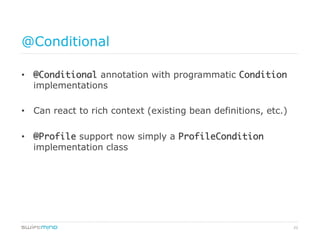
@Conditional
•  @Conditional annotation with programmatic Condition
implementations
•  Can react to rich context (existing bean definitions, etc.)
•  @Profile support now simply a ProfileCondition
implementation class
23
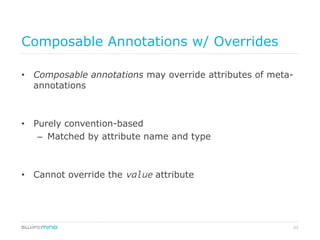
Composable Annotations w/ Overrides
•  Composable annotations may override attributes of meta-
annotations
•  Purely convention-based
–  Matched by attribute name and type
•  Cannot override the value attribute
24
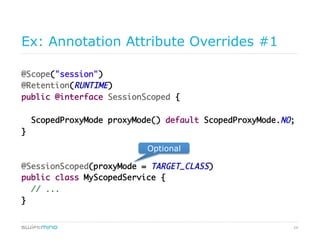
Optional Annotation Attribute Override
@Scope("session")	
@Retention(RUNTIME)	
public @interface SessionScoped {	
	
ScopedProxyMode proxyMode() default ScopedProxyMode.NO;	
}	
	
	
@SessionScoped(proxyMode = TARGET_CLASS)	
public class MyScopedService {	
// ...	
}
optional
25
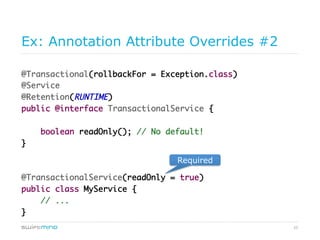
Required Annotation Attribute Override
@Transactional(rollbackFor = Exception.class)	
@Service	
@Retention(RUNTIME)	
public @interface TransactionalService {	
	
boolean readOnly(); // No default!	
}	
	
	
@TransactionalService(readOnly = true)	
public class MyService {	
// ...	
}
required
26
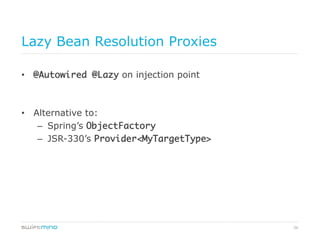
Lazy Bean Resolution Proxies
•  @Autowired @Lazy on injection point
•  Alternative to:
–  Spring’s ObjectFactory	
–  JSR-330’s Provider<MyTargetType>
27
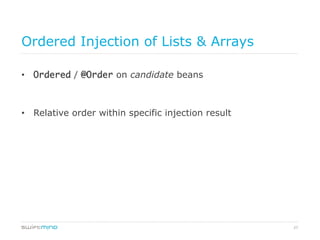
Ordered Injection of Lists & Arrays
•  Ordered / @Order on candidate beans
•  Relative order within specific injection result
28
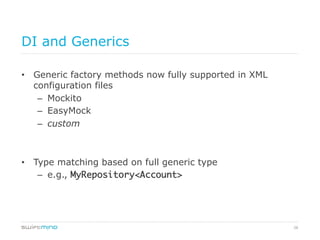
DI and Generics
•  Generic factory methods now fully supported in XML
configuration files
–  Mockito
–  EasyMock
–  custom
•  Type matching based on full generic type
–  e.g., MyRepository<Account>
29
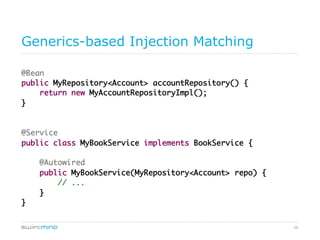
Generics-based Injection Matching
@Bean	
public MyRepository<Account> accountRepository() {	
return new MyAccountRepositoryImpl();	
}	
	
	
@Service	
public class MyBookService implements BookService {	
	
@Autowired	
public MyBookService(MyRepository<Account> repo) {	
// ...	
}	
}
30
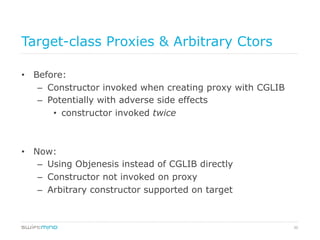
Target-class Proxies & Arbitrary Ctors
•  Before:
–  Constructor invoked when creating proxy with CGLIB
–  Potentially with adverse side effects
•  constructor invoked twice
•  Now:
–  Using Objenesis instead of CGLIB directly
–  Constructor not invoked on proxy
–  Arbitrary constructor supported on target
31
spring-messaging
•  New org.springframework.messaging module
•  Extracted from Spring Integration
•  Core message and channel abstractions
32
WebSockets
•  WebSocket endpoint model along the lines of Spring MVC
•  JSR-356 but also covering SockJS and STOMP
•  Endpoints using generic messaging patterns
33
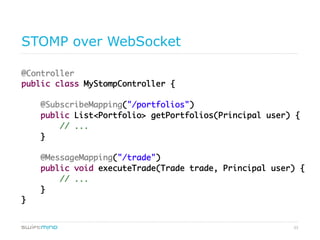
STOMP over WebSocket
@Controller	
public class MyStompController {	
	
@SubscribeMapping("/portfolios")	
public List<Portfolio> getPortfolios(Principal user) {	
// ...	
}	
	
@MessageMapping("/trade")	
public void executeTrade(Trade trade, Principal user) {	
// ...	
}	
}
34
AsyncRestTemplate
•  Analogous to existing RestTemplate	
•  Based on ListenableFuture return values
•  Custom listeners implement ListenableFutureCallback
35
Spring + Java SE & Java EE
36
Java SE Support
•  Spring 3.1 / 3.2
–  explicit Java 7 support
–  JDK 5 à JDK 7
•  Spring 4.0
–  introduces explicit Java 8 support
–  JDK 6 à JDK 8
37
Java EE Support
•  Spring 3.1 / 3.2
–  strong Servlet 3.0 focus
–  J2EE 1.4 (deprecated) à Java EE 6
•  Spring 4.0
–  introduces explicit Java EE 7 support
–  Java EE 5 (with JPA 2.0 feature pack) à Java EE 7
38
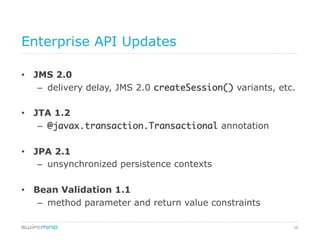
Enterprise API Updates
•  JMS 2.0
–  delivery delay, JMS 2.0 createSession() variants, etc.
•  JTA 1.2
–  @javax.transaction.Transactional annotation
•  JPA 2.1
–  unsynchronized persistence contexts
•  Bean Validation 1.1
–  method parameter and return value constraints
39
Java 8 Programming Model
40
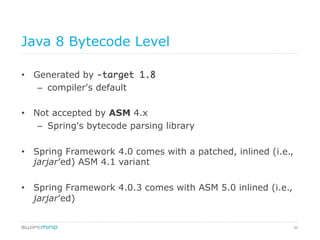
Java 8 Bytecode Level
•  Generated by -target 1.8	
–  compiler's default
•  Not accepted by ASM 4.x
–  Spring's bytecode parsing library
•  Spring Framework 4.0 comes with a patched, inlined (i.e.,
jarjar’ed) ASM 4.1 variant
•  Spring Framework 4.0.3 comes with ASM 5.0 inlined (i.e.,
jarjar’ed)
41
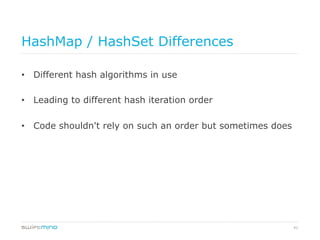
HashMap / HashSet Differences
•  Different hash algorithms in use
•  Leading to different hash iteration order
•  Code shouldn't rely on such an order but sometimes does
42
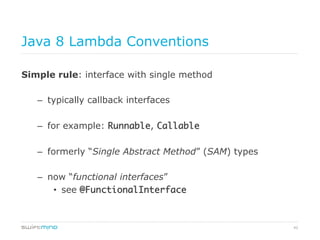
Java 8 Lambda Conventions
Simple rule: interface with single method
–  typically callback interfaces
–  for example: Runnable, Callable	
–  formerly “Single Abstract Method” (SAM) types
–  now “functional interfaces”
•  see @FunctionalInterface
43
Lambda + Spring = Natural Fit
Many Spring APIs are candidates for lambdas
–  simply by following the lambda interface conventions
44
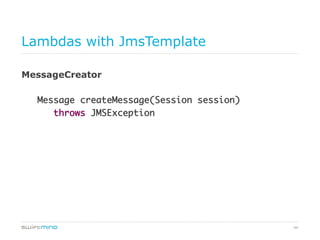
Lambdas with JmsTemplate
MessageCreator
Message createMessage(Session session)	
	throws JMSException
45
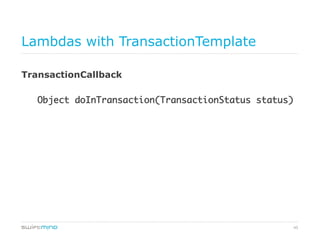
Lambdas with TransactionTemplate
TransactionCallback
Object doInTransaction(TransactionStatus status)
46
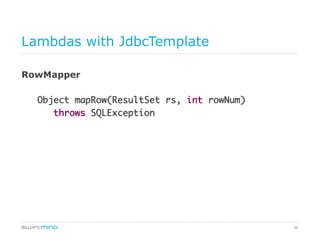
Lambdas with JdbcTemplate
RowMapper
Object mapRow(ResultSet rs, int rowNum)	
	throws SQLException
47
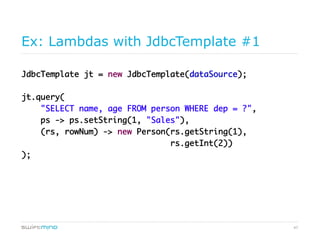
Ex: Lambdas with JdbcTemplate #1
JdbcTemplate jt = new JdbcTemplate(dataSource);	
jt.query(	
"SELECT name, age FROM person WHERE dep = ?",	
ps -> ps.setString(1, "Sales"),	
(rs, rowNum) -> new Person(rs.getString(1),	
rs.getInt(2))	
);
48
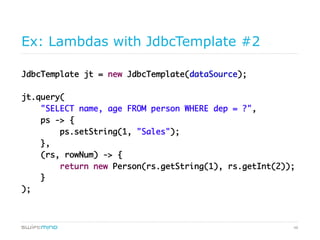
Ex: Lambdas with JdbcTemplate #2
JdbcTemplate jt = new JdbcTemplate(dataSource);	
	
jt.query(	
"SELECT name, age FROM person WHERE dep = ?",	
ps -> {	
ps.setString(1, "Sales");	
},	
(rs, rowNum) -> {	
return new Person(rs.getString(1), rs.getInt(2));	
}	
);
49
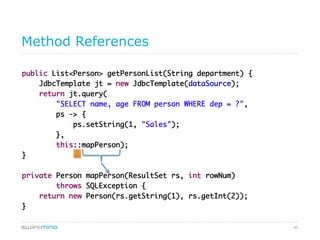
Method References
public List<Person> getPersonList(String department) {	
JdbcTemplate jt = new JdbcTemplate(dataSource);	
return jt.query(	
"SELECT name, age FROM person WHERE dep = ?",	
ps -> {	
ps.setString(1, "Sales");	
},	
this::mapPerson);	
}	
	
private Person mapPerson(ResultSet rs, int rowNum)	
throws SQLException {	
return new Person(rs.getString(1), rs.getInt(2));	
}
50
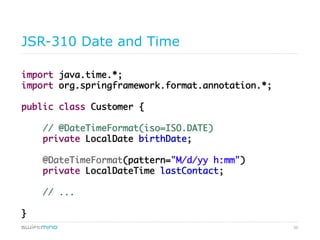
JSR-310 Date and Time
import java.time.*;	
import org.springframework.format.annotation.*;	
	
public class Customer {	
	
// @DateTimeFormat(iso=ISO.DATE)	
private LocalDate birthDate;	
	
@DateTimeFormat(pattern="M/d/yy h:mm")	
private LocalDateTime lastContact;	
	
// ...	
	
}
51
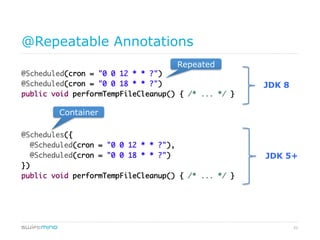
@Repeatable Annotations
@Scheduled(cron = "0 0 12 * * ?")	
@Scheduled(cron = "0 0 18 * * ?")	
public void performTempFileCleanup() { /* ... */ }	


@Schedules({	
@Scheduled(cron = "0 0 12 * * ?"),	
@Scheduled(cron = "0 0 18 * * ?")	
})	
public void performTempFileCleanup() { /* ... */ }	
JDK 8
JDK 5+
container
repeated
52
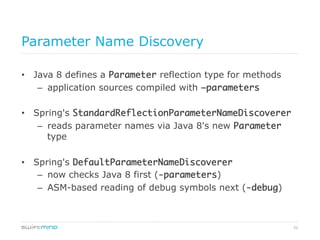
Parameter Name Discovery
•  Java 8 defines a Parameter reflection type for methods
–  application sources compiled with –parameters	
•  Spring's StandardReflectionParameterNameDiscoverer	
–  reads parameter names via Java 8's new Parameter
type
•  Spring's DefaultParameterNameDiscoverer	
–  now checks Java 8 first (-parameters)
–  ASM-based reading of debug symbols next (-debug)
53
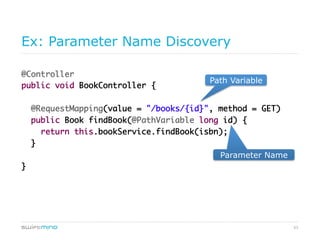
Ex: Parameter Name Discovery
@Controller	
public void BookController {	
	
@RequestMapping(value = "/books/{id}", method = GET)	
public Book findBook(@PathVariable long id) {	
return this.bookService.findBook(isbn);	
}	
	
}	
path variable
parameter name
54
Spring Framework 4.1
55
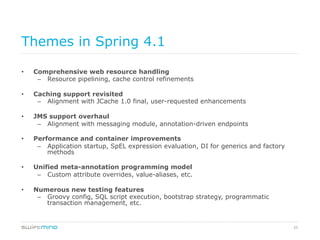
Themes in Spring 4.1
•  Comprehensive web resource handling
–  Resource pipelining, cache control refinements
•  Caching support revisited
–  Alignment with JCache 1.0 final, user-requested enhancements
•  JMS support overhaul
–  Alignment with messaging module, annotation-driven endpoints
•  Performance and container improvements
–  Application startup, SpEL expression evaluation, DI for generics and factory
methods
•  Unified meta-annotation programming model
–  Custom attribute overrides, value-aliases, etc.
•  Numerous new testing features
–  Groovy config, SQL script execution, bootstrap strategy, programmatic
transaction management, etc.
56
Spring MVC and Messaging
•  GroovyWebApplicationContext (SPR-11371)
•  Static resource handling in Spring MVC (SPR-10933)
•  WebSocket scope (SPR-11305)
57
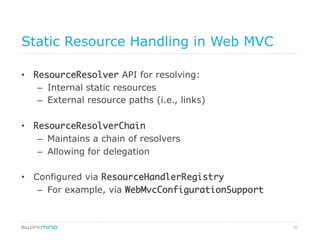
Static Resource Handling in Web MVC
•  ResourceResolver API for resolving:
–  Internal static resources
–  External resource paths (i.e., links)
•  ResourceResolverChain
–  Maintains a chain of resolvers
–  Allowing for delegation
•  Configured via ResourceHandlerRegistry	
–  For example, via WebMvcConfigurationSupport
58
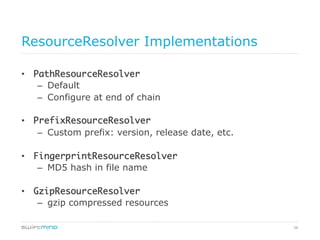
ResourceResolver Implementations
•  PathResourceResolver	
–  Default
–  Configure at end of chain
•  PrefixResourceResolver	
–  Custom prefix: version, release date, etc.
•  FingerprintResourceResolver	
–  MD5 hash in file name
•  GzipResourceResolver	
–  gzip compressed resources
59
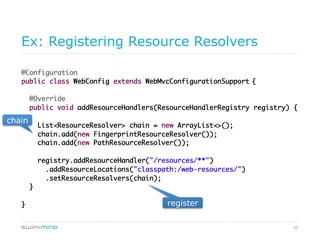
Ex: Registering Resource Resolvers
@Configuration	
public class WebConfig extends WebMvcConfigurationSupport {	
	
@Override	
public void addResourceHandlers(ResourceHandlerRegistry 	
registry) {	
	
registry.addResourceHandler("/resources/**")	
.addResourceLocations("classpath:/web-resources/")	
.setResourceResolvers(new FingerprintResourceResolver(),	
new PathResourceResolver());	
}	
	
}	
resolver chain
60
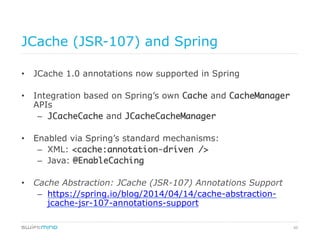
JCache (JSR-107) and Spring
•  JCache 1.0 annotations now supported in Spring
•  Integration based on Spring’s own Cache and CacheManager
APIs
–  JCacheCache and JCacheCacheManager	
•  Enabled via Spring’s standard mechanisms:
–  XML: <cache:annotation-driven />	
–  Java: @EnableCaching	
•  Cache Abstraction: JCache (JSR-107) Annotations Support
–  https://spring.io/blog/2014/04/14/cache-abstraction-
jcache-jsr-107-annotations-support
61
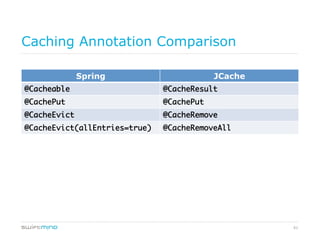
Caching Annotation Comparison
Spring JCache
@Cacheable	 @CacheResult	
@CachePut	 @CachePut	
@CacheEvict	 @CacheRemove	
@CacheEvict(allEntries=true)	 @CacheRemoveAll
62
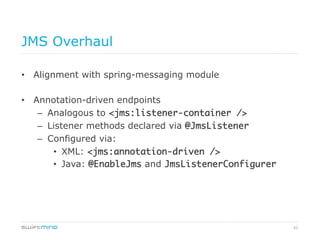
JMS Overhaul
•  Alignment with spring-messaging module
•  Annotation-driven endpoints
–  Analogous to <jms:listener-container />
–  Listener methods declared via @JmsListener	
–  Configured via:
•  XML: <jms:annotation-driven />	
•  Java: @EnableJms and JmsListenerConfigurer
63
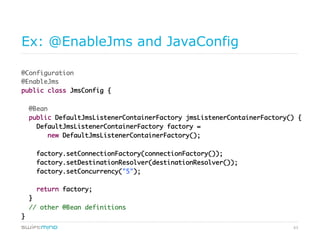
Ex: @EnableJms and JavaConfig
@Configuration	
@EnableJms	
public class JmsConfig {	
	
@Bean	
public JmsListenerContainerFactory jmsListenerContainerFactory() {	
DefaultJmsListenerContainerFactory factory =	
new DefaultJmsListenerContainerFactory();	
	
factory.setConnectionFactory(connectionFactory());	
factory.setDestinationResolver(destinationResolver());	
factory.setConcurrency("5");	
	
return factory;	
}	
// other @Bean definitions	
}
64
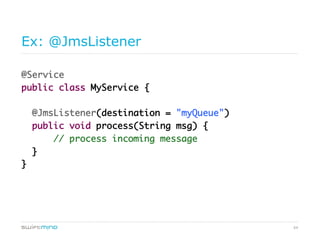
Ex: @JmsListener
@Service	
public class MyService {	
	
@JmsListener(destination = "myQueue")	
public void process(String msg) {	
// process incoming message	
}	
}
65
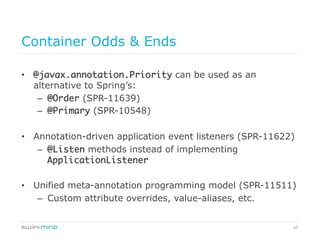
Container Odds & Ends
•  @javax.annotation.Priority can be used as an
alternative to Spring’s:
–  @Order (SPR-11639)
–  @Primary (SPR-10548)
•  Annotation-driven application event listeners (SPR-11622)
–  @Listen methods instead of implementing
ApplicationListener
•  Unified meta-annotation programming model (SPR-11511)
–  Custom attribute overrides, value-aliases, etc.
66
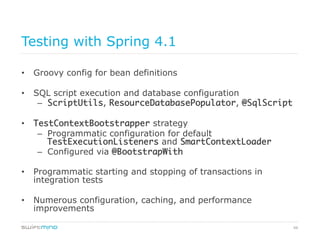
Testing with Spring 4.1
•  Groovy config for bean definitions
•  SQL script execution and database configuration
–  ScriptUtils, ResourceDatabasePopulator, @SqlScript
•  TestContextBootstrapper strategy
–  Programmatic configuration for default
TestExecutionListeners and SmartContextLoader	
–  Configured via @BootstrapWith	
•  Programmatic starting and stopping of transactions in
integration tests
•  Numerous configuration, caching, and performance
improvements
67
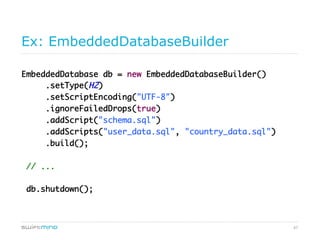
Ex: EmbeddedDatabaseBuilder
EmbeddedDatabase db = new EmbeddedDatabaseBuilder()	
.setType(H2)	
.setScriptEncoding("UTF-8")	
.ignoreFailedDrops(true)	
.addScript("schema.sql")	
.addScripts("user_data.sql", "country_data.sql")	
.build();	
	
// ...	
	
db.shutdown();
68
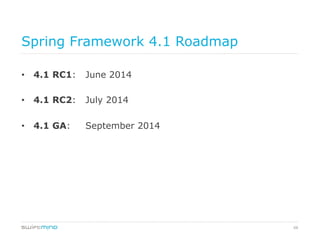
Spring Framework 4.1 Roadmap
•  4.1 RC1: June 2014
•  4.1 RC2: July 2014
•  4.1 GA: September 2014
69
In Closing…
70
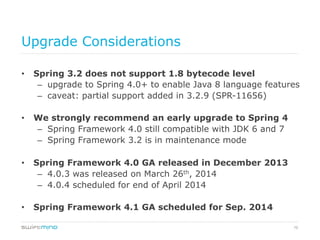
Upgrade Considerations
•  Spring 3.2 does not support 1.8 bytecode level
–  upgrade to Spring 4.0+ to enable Java 8 language features
–  caveat: partial support added in 3.2.9 (SPR-11656)
•  We strongly recommend an early upgrade to Spring 4
–  Spring Framework 4.0 still compatible with JDK 6 and 7
–  Spring Framework 3.2 is in maintenance mode
•  Spring Framework 4.0 GA released in December 2013
–  4.0.3 was released on March 26th, 2014
–  4.0.4 scheduled for end of April 2014
•  Spring Framework 4.1 GA scheduled for Sep. 2014
71
Acknowledgements
Thanks to Jürgen Höller and Stéphane Nicoll for
permitting reuse of some of their content.
72
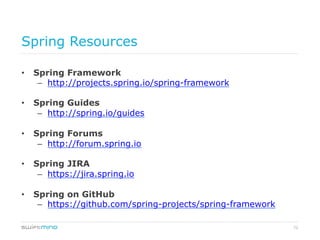
Spring Resources
•  Spring Framework
–  http://projects.spring.io/spring-framework
•  Spring Guides
–  http://spring.io/guides
•  Spring Forums
–  http://forum.spring.io
•  Spring JIRA
–  https://jira.spring.io
•  Spring on GitHub
–  https://github.com/spring-projects/spring-framework
73
Blogs
•  Swiftmind Blog
–  http://www.swiftmind.com/blog
•  Spring Blog
–  http://spring.io/blog
74
Q & A
Sam Brannen
twitter: @sam_brannen
www.slideshare.net/sbrannen
www.swiftmind.com

Spring Framework 4.0 to 4.1

  • 1.
    Spring Framework 4.0to 4.1 Sam Brannen @sam_brannen AJUG | Atlanta, GA, USA | April 22, 2014 Atlanta User Group
  • 2.
    2 Sam Brannen •  Springand Java Consultant @ Swiftmind •  Georgia Tech College of Computing Alumnus •  Java Developer for over 15 years •  Spring Framework Core Committer since 2007 •  Spring Trainer •  Speaker on Spring, Java, OSGi, and testing •  Swiss Spring User Group Lead
  • 3.
    3 Swiftmind Your experts forEnterprise Java Areas of expertise •  Spring * •  Java EE •  OSGi •  Software Architecture •  Software Engineering Best Practices Where you find us •  Zurich, Switzerland •  @swiftmind •  http://www.swiftmind.com
  • 4.
    4 A Show ofHands…
  • 5.
    5 Agenda •  Spring 3.xin Review •  Themes in Spring 4.0 •  Java EE & SE •  Spring 4 on Java 8 •  Spring 4.1
  • 6.
  • 7.
    7 Major Themes inSpring 3.x •  Powerful annotated component model •  Spring Expression Language (SpEL) •  Comprehensive REST support •  Support for async MVC processing •  Validation and Formatting •  Scheduling •  Caching
  • 8.
    8 Spring 3.x: KeySpecs (1/2) •  JSR-330 –  Dependency Injection for Java –  @Inject, @Qualifier, Provider mechanism •  JSR-303 –  Bean Validation 1.0 –  declarative constraints –  embedded validation engine
  • 9.
    9 Spring 3.x: KeySpecs (2/2) •  JPA 2.0 –  persistence provider integration –  Spring transactions •  Servlet 3.0 –  web.xml-free deployment –  async request processing
  • 10.
    10 Testing in Spring3.x •  Embedded databases via <jdbc /> namespace •  @Configuration classes & @ActiveProfiles •  @WebAppConfiguration •  @ContextHierarchy •  Spring MVC Test framework
  • 11.
  • 12.
  • 13.
    13 Composable Stereotypes •  Combiningmeta-annotations on a custom stereotype •  Automatically detected: no configuration necessary!
  • 14.
  • 15.
    15 Ready for NewApplication Architectures •  Embedded web servers and non-traditional data stores •  Lightweight messaging and WebSocket-style architectures •  Custom asynchronous processing with convenient APIs
  • 16.
    16 New Baselines •  JavaSE 6+ •  Java EE 6+ –  Servlet 3.0/3.1 focus –  Servlet 2.5 compatible •  All deprecated packages removed •  Many deprecated methods and fields removed as well
  • 17.
    17 Third Party Libraries • Minimum versions ~ mid 2010 now •  For example –  Hibernate 3.6+ –  Quartz 1.8+ –  Ehcache 2.1+
  • 18.
    18 Java 8 Languageand API Features •  Lambda expressions •  Method references •  JSR-310 Date and Time •  Repeatable annotations •  Parameter name discovery
  • 19.
    19 Groovy + Spring4.0 •  A smooth out-of-the-box experience for Groovy-based Spring applications •  AOP adaptations –  special handling of GroovyObject calls –  consider a Spring application with all components written in the Groovy language instead of Java •  Groovy-based bean definitions –  formerly known as the Bean Builder in Grails –  now lives alongside Spring's configuration class model
  • 20.
    20 Spring Bean Def’swith Groovy DSL import org.mypackage.domain.Person; beans { xmlns util: 'http://www.springframework.org/schema/util' person1(Person) { name = "homer" age = 45 props = [overweight: true, height: "1.8m"] children = ["bart", "lisa"] } util.list(id: 'foo') { value 'one' value 'two' } }
  • 21.
    21 Conditional Beans •  Ageneralized model for conditional bean definitions •  A more flexible and more dynamic variant of bean definition profiles (as known from Spring 3.1) •  Can be used for smart defaulting •  See Spring Boot J
  • 22.
    22 @Conditional •  @Conditional annotationwith programmatic Condition implementations •  Can react to rich context (existing bean definitions, etc.) •  @Profile support now simply a ProfileCondition implementation class
  • 23.
    23 Composable Annotations w/Overrides •  Composable annotations may override attributes of meta- annotations •  Purely convention-based –  Matched by attribute name and type •  Cannot override the value attribute
  • 24.
    24 Optional Annotation AttributeOverride @Scope("session") @Retention(RUNTIME) public @interface SessionScoped { ScopedProxyMode proxyMode() default ScopedProxyMode.NO; } @SessionScoped(proxyMode = TARGET_CLASS) public class MyScopedService { // ... } optional
  • 25.
    25 Required Annotation AttributeOverride @Transactional(rollbackFor = Exception.class) @Service @Retention(RUNTIME) public @interface TransactionalService { boolean readOnly(); // No default! } @TransactionalService(readOnly = true) public class MyService { // ... } required
  • 26.
    26 Lazy Bean ResolutionProxies •  @Autowired @Lazy on injection point •  Alternative to: –  Spring’s ObjectFactory –  JSR-330’s Provider<MyTargetType>
  • 27.
    27 Ordered Injection ofLists & Arrays •  Ordered / @Order on candidate beans •  Relative order within specific injection result
  • 28.
    28 DI and Generics • Generic factory methods now fully supported in XML configuration files –  Mockito –  EasyMock –  custom •  Type matching based on full generic type –  e.g., MyRepository<Account>
  • 29.
    29 Generics-based Injection Matching @Bean publicMyRepository<Account> accountRepository() { return new MyAccountRepositoryImpl(); } @Service public class MyBookService implements BookService { @Autowired public MyBookService(MyRepository<Account> repo) { // ... } }
  • 30.
    30 Target-class Proxies &Arbitrary Ctors •  Before: –  Constructor invoked when creating proxy with CGLIB –  Potentially with adverse side effects •  constructor invoked twice •  Now: –  Using Objenesis instead of CGLIB directly –  Constructor not invoked on proxy –  Arbitrary constructor supported on target
  • 31.
    31 spring-messaging •  New org.springframework.messagingmodule •  Extracted from Spring Integration •  Core message and channel abstractions
  • 32.
    32 WebSockets •  WebSocket endpointmodel along the lines of Spring MVC •  JSR-356 but also covering SockJS and STOMP •  Endpoints using generic messaging patterns
  • 33.
    33 STOMP over WebSocket @Controller publicclass MyStompController { @SubscribeMapping("/portfolios") public List<Portfolio> getPortfolios(Principal user) { // ... } @MessageMapping("/trade") public void executeTrade(Trade trade, Principal user) { // ... } }
  • 34.
    34 AsyncRestTemplate •  Analogous toexisting RestTemplate •  Based on ListenableFuture return values •  Custom listeners implement ListenableFutureCallback
  • 35.
    35 Spring + JavaSE & Java EE
  • 36.
    36 Java SE Support • Spring 3.1 / 3.2 –  explicit Java 7 support –  JDK 5 à JDK 7 •  Spring 4.0 –  introduces explicit Java 8 support –  JDK 6 à JDK 8
  • 37.
    37 Java EE Support • Spring 3.1 / 3.2 –  strong Servlet 3.0 focus –  J2EE 1.4 (deprecated) à Java EE 6 •  Spring 4.0 –  introduces explicit Java EE 7 support –  Java EE 5 (with JPA 2.0 feature pack) à Java EE 7
  • 38.
    38 Enterprise API Updates • JMS 2.0 –  delivery delay, JMS 2.0 createSession() variants, etc. •  JTA 1.2 –  @javax.transaction.Transactional annotation •  JPA 2.1 –  unsynchronized persistence contexts •  Bean Validation 1.1 –  method parameter and return value constraints
  • 39.
  • 40.
    40 Java 8 BytecodeLevel •  Generated by -target 1.8 –  compiler's default •  Not accepted by ASM 4.x –  Spring's bytecode parsing library •  Spring Framework 4.0 comes with a patched, inlined (i.e., jarjar’ed) ASM 4.1 variant •  Spring Framework 4.0.3 comes with ASM 5.0 inlined (i.e., jarjar’ed)
  • 41.
    41 HashMap / HashSetDifferences •  Different hash algorithms in use •  Leading to different hash iteration order •  Code shouldn't rely on such an order but sometimes does
  • 42.
    42 Java 8 LambdaConventions Simple rule: interface with single method –  typically callback interfaces –  for example: Runnable, Callable –  formerly “Single Abstract Method” (SAM) types –  now “functional interfaces” •  see @FunctionalInterface
  • 43.
    43 Lambda + Spring= Natural Fit Many Spring APIs are candidates for lambdas –  simply by following the lambda interface conventions
  • 44.
    44 Lambdas with JmsTemplate MessageCreator MessagecreateMessage(Session session) throws JMSException
  • 45.
    45 Lambdas with TransactionTemplate TransactionCallback ObjectdoInTransaction(TransactionStatus status)
  • 46.
    46 Lambdas with JdbcTemplate RowMapper ObjectmapRow(ResultSet rs, int rowNum) throws SQLException
  • 47.
    47 Ex: Lambdas withJdbcTemplate #1 JdbcTemplate jt = new JdbcTemplate(dataSource); jt.query( "SELECT name, age FROM person WHERE dep = ?", ps -> ps.setString(1, "Sales"), (rs, rowNum) -> new Person(rs.getString(1), rs.getInt(2)) );
  • 48.
    48 Ex: Lambdas withJdbcTemplate #2 JdbcTemplate jt = new JdbcTemplate(dataSource); jt.query( "SELECT name, age FROM person WHERE dep = ?", ps -> { ps.setString(1, "Sales"); }, (rs, rowNum) -> { return new Person(rs.getString(1), rs.getInt(2)); } );
  • 49.
    49 Method References public List<Person>getPersonList(String department) { JdbcTemplate jt = new JdbcTemplate(dataSource); return jt.query( "SELECT name, age FROM person WHERE dep = ?", ps -> { ps.setString(1, "Sales"); }, this::mapPerson); } private Person mapPerson(ResultSet rs, int rowNum) throws SQLException { return new Person(rs.getString(1), rs.getInt(2)); }
  • 50.
    50 JSR-310 Date andTime import java.time.*; import org.springframework.format.annotation.*; public class Customer { // @DateTimeFormat(iso=ISO.DATE) private LocalDate birthDate; @DateTimeFormat(pattern="M/d/yy h:mm") private LocalDateTime lastContact; // ... }
  • 51.
    51 @Repeatable Annotations @Scheduled(cron ="0 0 12 * * ?") @Scheduled(cron = "0 0 18 * * ?") public void performTempFileCleanup() { /* ... */ } @Schedules({ @Scheduled(cron = "0 0 12 * * ?"), @Scheduled(cron = "0 0 18 * * ?") }) public void performTempFileCleanup() { /* ... */ } JDK 8 JDK 5+ container repeated
  • 52.
    52 Parameter Name Discovery • Java 8 defines a Parameter reflection type for methods –  application sources compiled with –parameters •  Spring's StandardReflectionParameterNameDiscoverer –  reads parameter names via Java 8's new Parameter type •  Spring's DefaultParameterNameDiscoverer –  now checks Java 8 first (-parameters) –  ASM-based reading of debug symbols next (-debug)
  • 53.
    53 Ex: Parameter NameDiscovery @Controller public void BookController { @RequestMapping(value = "/books/{id}", method = GET) public Book findBook(@PathVariable long id) { return this.bookService.findBook(isbn); } } path variable parameter name
  • 54.
  • 55.
    55 Themes in Spring4.1 •  Comprehensive web resource handling –  Resource pipelining, cache control refinements •  Caching support revisited –  Alignment with JCache 1.0 final, user-requested enhancements •  JMS support overhaul –  Alignment with messaging module, annotation-driven endpoints •  Performance and container improvements –  Application startup, SpEL expression evaluation, DI for generics and factory methods •  Unified meta-annotation programming model –  Custom attribute overrides, value-aliases, etc. •  Numerous new testing features –  Groovy config, SQL script execution, bootstrap strategy, programmatic transaction management, etc.
  • 56.
    56 Spring MVC andMessaging •  GroovyWebApplicationContext (SPR-11371) •  Static resource handling in Spring MVC (SPR-10933) •  WebSocket scope (SPR-11305)
  • 57.
    57 Static Resource Handlingin Web MVC •  ResourceResolver API for resolving: –  Internal static resources –  External resource paths (i.e., links) •  ResourceResolverChain –  Maintains a chain of resolvers –  Allowing for delegation •  Configured via ResourceHandlerRegistry –  For example, via WebMvcConfigurationSupport
  • 58.
    58 ResourceResolver Implementations •  PathResourceResolver – Default –  Configure at end of chain •  PrefixResourceResolver –  Custom prefix: version, release date, etc. •  FingerprintResourceResolver –  MD5 hash in file name •  GzipResourceResolver –  gzip compressed resources
  • 59.
    59 Ex: Registering ResourceResolvers @Configuration public class WebConfig extends WebMvcConfigurationSupport { @Override public void addResourceHandlers(ResourceHandlerRegistry registry) { registry.addResourceHandler("/resources/**") .addResourceLocations("classpath:/web-resources/") .setResourceResolvers(new FingerprintResourceResolver(), new PathResourceResolver()); } } resolver chain
  • 60.
    60 JCache (JSR-107) andSpring •  JCache 1.0 annotations now supported in Spring •  Integration based on Spring’s own Cache and CacheManager APIs –  JCacheCache and JCacheCacheManager •  Enabled via Spring’s standard mechanisms: –  XML: <cache:annotation-driven /> –  Java: @EnableCaching •  Cache Abstraction: JCache (JSR-107) Annotations Support –  https://spring.io/blog/2014/04/14/cache-abstraction- jcache-jsr-107-annotations-support
  • 61.
    61 Caching Annotation Comparison SpringJCache @Cacheable @CacheResult @CachePut @CachePut @CacheEvict @CacheRemove @CacheEvict(allEntries=true) @CacheRemoveAll
  • 62.
    62 JMS Overhaul •  Alignmentwith spring-messaging module •  Annotation-driven endpoints –  Analogous to <jms:listener-container /> –  Listener methods declared via @JmsListener –  Configured via: •  XML: <jms:annotation-driven /> •  Java: @EnableJms and JmsListenerConfigurer
  • 63.
    63 Ex: @EnableJms andJavaConfig @Configuration @EnableJms public class JmsConfig { @Bean public JmsListenerContainerFactory jmsListenerContainerFactory() { DefaultJmsListenerContainerFactory factory = new DefaultJmsListenerContainerFactory(); factory.setConnectionFactory(connectionFactory()); factory.setDestinationResolver(destinationResolver()); factory.setConcurrency("5"); return factory; } // other @Bean definitions }
  • 64.
    64 Ex: @JmsListener @Service public classMyService { @JmsListener(destination = "myQueue") public void process(String msg) { // process incoming message } }
  • 65.
    65 Container Odds &Ends •  @javax.annotation.Priority can be used as an alternative to Spring’s: –  @Order (SPR-11639) –  @Primary (SPR-10548) •  Annotation-driven application event listeners (SPR-11622) –  @Listen methods instead of implementing ApplicationListener •  Unified meta-annotation programming model (SPR-11511) –  Custom attribute overrides, value-aliases, etc.
  • 66.
    66 Testing with Spring4.1 •  Groovy config for bean definitions •  SQL script execution and database configuration –  ScriptUtils, ResourceDatabasePopulator, @SqlScript •  TestContextBootstrapper strategy –  Programmatic configuration for default TestExecutionListeners and SmartContextLoader –  Configured via @BootstrapWith •  Programmatic starting and stopping of transactions in integration tests •  Numerous configuration, caching, and performance improvements
  • 67.
    67 Ex: EmbeddedDatabaseBuilder EmbeddedDatabase db= new EmbeddedDatabaseBuilder() .setType(H2) .setScriptEncoding("UTF-8") .ignoreFailedDrops(true) .addScript("schema.sql") .addScripts("user_data.sql", "country_data.sql") .build(); // ... db.shutdown();
  • 68.
    68 Spring Framework 4.1Roadmap •  4.1 RC1: June 2014 •  4.1 RC2: July 2014 •  4.1 GA: September 2014
  • 69.
  • 70.
    70 Upgrade Considerations •  Spring3.2 does not support 1.8 bytecode level –  upgrade to Spring 4.0+ to enable Java 8 language features –  caveat: partial support added in 3.2.9 (SPR-11656) •  We strongly recommend an early upgrade to Spring 4 –  Spring Framework 4.0 still compatible with JDK 6 and 7 –  Spring Framework 3.2 is in maintenance mode •  Spring Framework 4.0 GA released in December 2013 –  4.0.3 was released on March 26th, 2014 –  4.0.4 scheduled for end of April 2014 •  Spring Framework 4.1 GA scheduled for Sep. 2014
  • 71.
    71 Acknowledgements Thanks to JürgenHöller and Stéphane Nicoll for permitting reuse of some of their content.
  • 72.
    72 Spring Resources •  SpringFramework –  http://projects.spring.io/spring-framework •  Spring Guides –  http://spring.io/guides •  Spring Forums –  http://forum.spring.io •  Spring JIRA –  https://jira.spring.io •  Spring on GitHub –  https://github.com/spring-projects/spring-framework
  • 73.
    73 Blogs •  Swiftmind Blog – http://www.swiftmind.com/blog •  Spring Blog –  http://spring.io/blog
  • 74.
    74 Q & A SamBrannen twitter: @sam_brannen www.slideshare.net/sbrannen www.swiftmind.com